Middle Ear Disorders
Lecture 13
Outline
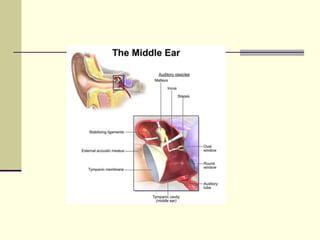
 Anatomy – ME
 Development
 Changes due to Mass/Stiffness
 Disorders
 Otitis Media
 Mastoiditis
 Cholesteatoma
 Otosclerosis
Embryonic Development of ME
 1st month: formation of ossicles starts
 6 weeks: oval window formed
 3rd month: ossicles fully developed but still
cartilaginous tissue
 5-6 months: ossification of ossicles
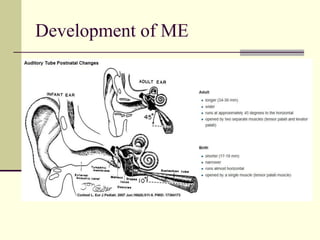
Development of ME
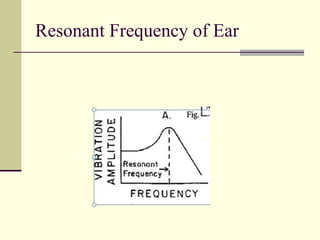
Resonant Frequency of Ear
MASS vs STIFFNESS
 Mass –
 Changes in Mass occur with ME
 Stiffness
 Changes in Stiffness occur with ME
MASS vs STIFFNESS
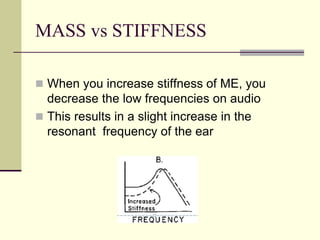
 When you increase stiffness of ME, you
decrease the low frequencies on audio
 This results in a slight increase in the
resonant frequency of the ear
MASS vs STIFFNESS
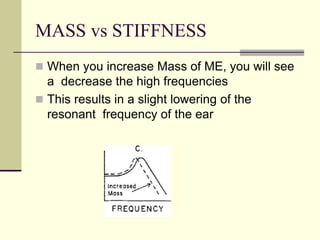
 When you increase Mass of ME, you will see
a decrease the high frequencies
 This results in a slight lowering of the
resonant frequency of the ear
Otitis Media
 70% of children under age 3 have at least 1 episode
(Winskel, 2008)
 50% of children will have 1st infection before age
1(ASHA, 2004) and 9/10 before age 5.
 35 % of these will have recurring OM (ASHA, 2004)
 Most common cause of HL in children under age 3,
which occurs while developing language
 OM and language development
 OM and academic ability
 OM and literacy
Impact of OME
 NOT a relationship between OME and cognitive
function (Roberts et al, 1995)
 Presence of fluid/infection causes ____________ HL
 Fluid may take ___________________to resolve
 Hearing loss may continue to be present after
________________
Otitis Media
 Acute Otitis Media: fluid in the middle ear
with signs of infection (bulging eardrum, ear
pain, drainage, perforation)
 Otitis Media with effusion: fluid in the middle
ear without signs of infection (sometimes
called serous effusion)
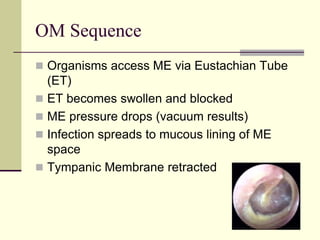
OM Sequence
 Organisms access ME via Eustachian Tube
(ET)
 ET becomes swollen and blocked
 ME pressure drops (vacuum results)
 Infection spreads to mucous lining of ME
space
 Tympanic Membrane retracted
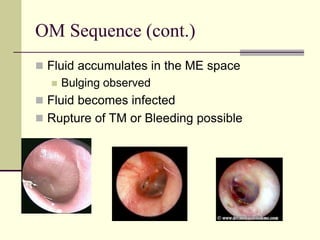
OM Sequence (cont.)
 Fluid accumulates in the ME space
 Bulging observed
 Fluid becomes infected
 Rupture of TM or Bleeding possible
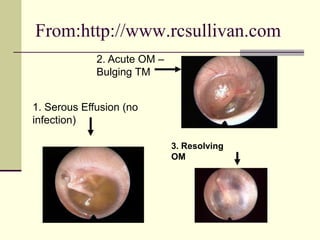
From:http://www.rcsullivan.com
1. Serous Effusion (no
infection)
2. Acute OM –
Bulging TM
3. Resolving
OM
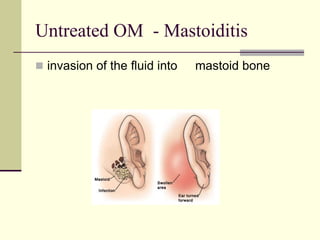
Untreated OM - Mastoiditis
 invasion of the fluid into mastoid bone
OME
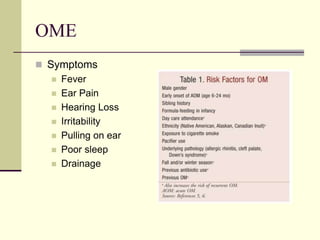
 Symptoms
 Fever
 Ear Pain
 Hearing Loss
 Irritability
 Pulling on ear
 Poor sleep
 Drainage
Audiometric Results
 Degree of HL:
 Type:
 Tympanogram:
OAEs:
ABRs:
IWI:
Absolute latency of wave V
Absolute threshold of wave V
Interventions
(Pediatrician, ENT)
 Watchful Waiting
 Antibiotics
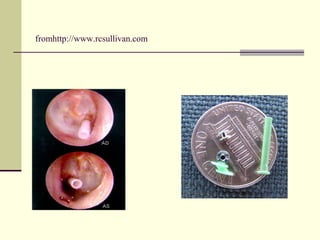
 PE Tubes
 Myringotomy
 Politzerization
 Valsalva maneuver
fromhttp://www.rcsullivan.com
Interventions
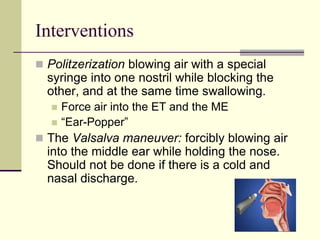
 Politzerization blowing air with a special
syringe into one nostril while blocking the
other, and at the same time swallowing.
 Force air into the ET and the ME
 “Ear-Popper”
 The Valsalva maneuver: forcibly blowing air
into the middle ear while holding the nose.
Should not be done if there is a cold and
nasal discharge.
Prevention of OM
Cholesteatoma
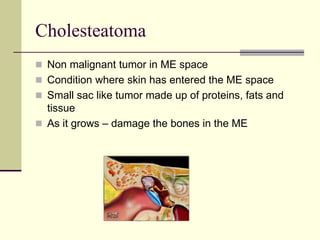
 Non malignant tumor in ME space
 Condition where skin has entered the ME space
 Small sac like tumor made up of proteins, fats and
tissue
 As it grows – damage the bones in the ME
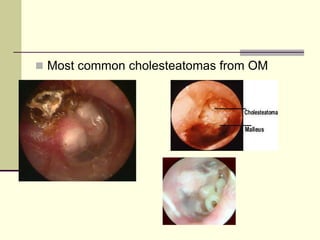
 Most common cholesteatomas from OM
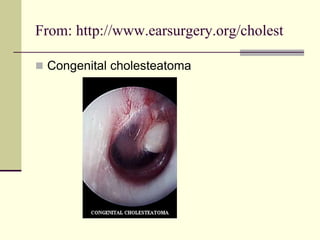
From: http://www.earsurgery.org/cholest
 Congenital cholesteatoma
Etiology/Symptoms
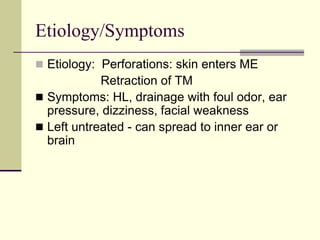
 Etiology: Perforations: skin enters ME
Retraction of TM
 Symptoms: HL, drainage with foul odor, ear
pressure, dizziness, facial weakness
 Left untreated - can spread to inner ear or
brain
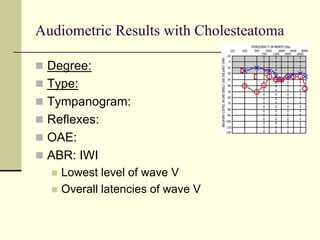
Audiometric Results with Cholesteatoma
 Degree:
 Type:
 Tympanogram:
 Reflexes:
 OAE:
 ABR: IWI
 Lowest level of wave V
 Overall latencies of wave V
Intervention
 ENT: Mastoidectomy
needs frequent follow-up
keep ear dry
antibiotics: both oral and ear drops
CT-Scan/MR imaging: determines
extent
 Audiological: post-op results
Bell’s Palsy
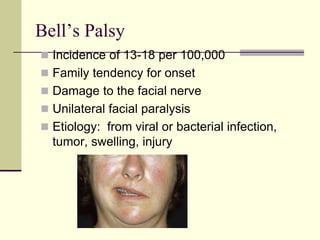
 Incidence of 13-18 per 100,000
 Family tendency for onset
 Damage to the facial nerve
 Unilateral facial paralysis
 Etiology: from viral or bacterial infection,
tumor, swelling, injury
Facial Nerve – VII Cranial Nerve
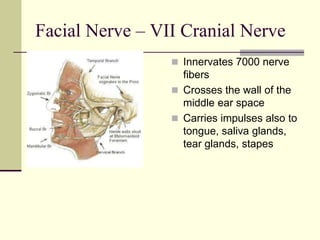
 Innervates 7000 nerve
fibers
 Crosses the wall of the
middle ear space
 Carries impulses also to
tongue, saliva glands,
tear glands, stapes
Symptoms
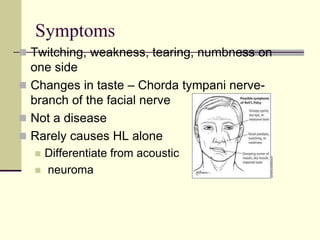
 Twitching, weakness, tearing, numbness on
one side
 Changes in taste – Chorda tympani nerve-
branch of the facial nerve
 Not a disease
 Rarely causes HL alone
 Differentiate from acoustic
 neuroma
Intervention
 ENT: Steroids esp within week after onset
 Recovery in 4-6 weeks may take up to 4
months for full recovery
 Eye patch at night
 Keep eye from drying out
 Permanent Facial Nerve paralysis:
surgical interventions
PT- facial retraining
Audiometric Results with Bell’s Palsy
 Degree:
 Type:
 Tympanogram:
 Reflexes:
 OAE:
 ABR: IWI
 Lowest level of wave V
 Overall latencies of wave V
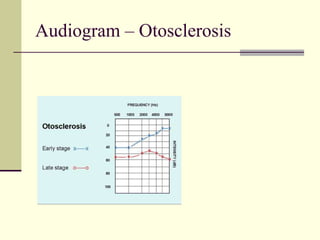
Otosclerosis
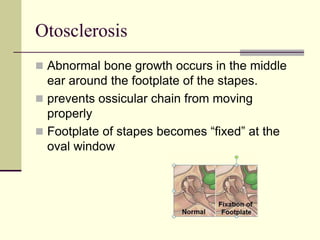
 Abnormal bone growth occurs in the middle
ear around the footplate of the stapes.
 prevents ossicular chain from moving
properly
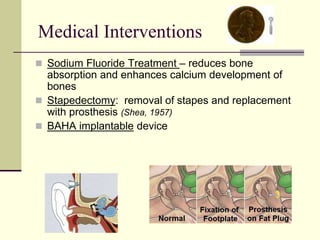
 Footplate of stapes becomes “fixed” at the
oval window
Otosclerosis
 Progressive
 More common in adults, rare in children
 Higher prevalence in females: adolescence
through middle age (2:1)
 Genetic
 Hereditary: Accounts for 70 % of cases
 Autosomal Dominant
25% chance if one parent carrier
50% chance if both parents carriers
Symptoms
 Gradual HL: initial onset after puberty
Increased HL after pregnancies
 Tinnitus
 Dizziness
 Paracusis Willisi
Audiogram – Otosclerosis
Medical Interventions
 Sodium Fluoride Treatment – reduces bone
absorption and enhances calcium development of
bones
 Stapedectomy: removal of stapes and replacement
with prosthesis (Shea, 1957)
 BAHA implantable device
Audiometric Results with Otosclerosis
 Degree:
 Type:
 Tympanogram:
 Reflexes:
 OAE:
 ABR: IWI
 Lowest level of wave V
 Overall latencies of wave V

Lecture 13 Middle Ear Disorders 2015.ppt

  • 1.
  • 2.
    Outline  Anatomy –ME  Development  Changes due to Mass/Stiffness  Disorders  Otitis Media  Mastoiditis  Cholesteatoma  Otosclerosis
  • 4.
    Embryonic Development ofME  1st month: formation of ossicles starts  6 weeks: oval window formed  3rd month: ossicles fully developed but still cartilaginous tissue  5-6 months: ossification of ossicles
  • 5.
  • 6.
  • 7.
    MASS vs STIFFNESS Mass –  Changes in Mass occur with ME  Stiffness  Changes in Stiffness occur with ME
  • 8.
    MASS vs STIFFNESS When you increase stiffness of ME, you decrease the low frequencies on audio  This results in a slight increase in the resonant frequency of the ear
  • 9.
    MASS vs STIFFNESS When you increase Mass of ME, you will see a decrease the high frequencies  This results in a slight lowering of the resonant frequency of the ear
  • 10.
    Otitis Media  70%of children under age 3 have at least 1 episode (Winskel, 2008)  50% of children will have 1st infection before age 1(ASHA, 2004) and 9/10 before age 5.  35 % of these will have recurring OM (ASHA, 2004)  Most common cause of HL in children under age 3, which occurs while developing language  OM and language development  OM and academic ability  OM and literacy
  • 11.
    Impact of OME NOT a relationship between OME and cognitive function (Roberts et al, 1995)  Presence of fluid/infection causes ____________ HL  Fluid may take ___________________to resolve  Hearing loss may continue to be present after ________________
  • 12.
    Otitis Media  AcuteOtitis Media: fluid in the middle ear with signs of infection (bulging eardrum, ear pain, drainage, perforation)  Otitis Media with effusion: fluid in the middle ear without signs of infection (sometimes called serous effusion)
  • 13.
    OM Sequence  Organismsaccess ME via Eustachian Tube (ET)  ET becomes swollen and blocked  ME pressure drops (vacuum results)  Infection spreads to mucous lining of ME space  Tympanic Membrane retracted
  • 14.
    OM Sequence (cont.) Fluid accumulates in the ME space  Bulging observed  Fluid becomes infected  Rupture of TM or Bleeding possible
  • 15.
    From:http://www.rcsullivan.com 1. Serous Effusion(no infection) 2. Acute OM – Bulging TM 3. Resolving OM
  • 16.
    Untreated OM -Mastoiditis  invasion of the fluid into mastoid bone
  • 17.
    OME  Symptoms  Fever Ear Pain  Hearing Loss  Irritability  Pulling on ear  Poor sleep  Drainage
  • 18.
    Audiometric Results  Degreeof HL:  Type:  Tympanogram: OAEs: ABRs: IWI: Absolute latency of wave V Absolute threshold of wave V
  • 19.
    Interventions (Pediatrician, ENT)  WatchfulWaiting  Antibiotics  PE Tubes  Myringotomy  Politzerization  Valsalva maneuver
  • 20.
  • 21.
    Interventions  Politzerization blowingair with a special syringe into one nostril while blocking the other, and at the same time swallowing.  Force air into the ET and the ME  “Ear-Popper”  The Valsalva maneuver: forcibly blowing air into the middle ear while holding the nose. Should not be done if there is a cold and nasal discharge.
  • 22.
  • 23.
    Cholesteatoma  Non malignanttumor in ME space  Condition where skin has entered the ME space  Small sac like tumor made up of proteins, fats and tissue  As it grows – damage the bones in the ME
  • 24.
     Most commoncholesteatomas from OM
  • 25.
  • 26.
    Etiology/Symptoms  Etiology: Perforations:skin enters ME Retraction of TM  Symptoms: HL, drainage with foul odor, ear pressure, dizziness, facial weakness  Left untreated - can spread to inner ear or brain
  • 27.
    Audiometric Results withCholesteatoma  Degree:  Type:  Tympanogram:  Reflexes:  OAE:  ABR: IWI  Lowest level of wave V  Overall latencies of wave V
  • 28.
    Intervention  ENT: Mastoidectomy needsfrequent follow-up keep ear dry antibiotics: both oral and ear drops CT-Scan/MR imaging: determines extent  Audiological: post-op results
  • 29.
    Bell’s Palsy  Incidenceof 13-18 per 100,000  Family tendency for onset  Damage to the facial nerve  Unilateral facial paralysis  Etiology: from viral or bacterial infection, tumor, swelling, injury
  • 30.
    Facial Nerve –VII Cranial Nerve  Innervates 7000 nerve fibers  Crosses the wall of the middle ear space  Carries impulses also to tongue, saliva glands, tear glands, stapes
  • 31.
    Symptoms  Twitching, weakness,tearing, numbness on one side  Changes in taste – Chorda tympani nerve- branch of the facial nerve  Not a disease  Rarely causes HL alone  Differentiate from acoustic  neuroma
  • 32.
    Intervention  ENT: Steroidsesp within week after onset  Recovery in 4-6 weeks may take up to 4 months for full recovery  Eye patch at night  Keep eye from drying out  Permanent Facial Nerve paralysis: surgical interventions PT- facial retraining
  • 33.
    Audiometric Results withBell’s Palsy  Degree:  Type:  Tympanogram:  Reflexes:  OAE:  ABR: IWI  Lowest level of wave V  Overall latencies of wave V
  • 34.
    Otosclerosis  Abnormal bonegrowth occurs in the middle ear around the footplate of the stapes.  prevents ossicular chain from moving properly  Footplate of stapes becomes “fixed” at the oval window
  • 35.
    Otosclerosis  Progressive  Morecommon in adults, rare in children  Higher prevalence in females: adolescence through middle age (2:1)  Genetic  Hereditary: Accounts for 70 % of cases  Autosomal Dominant 25% chance if one parent carrier 50% chance if both parents carriers
  • 36.
    Symptoms  Gradual HL:initial onset after puberty Increased HL after pregnancies  Tinnitus  Dizziness  Paracusis Willisi
  • 37.
  • 38.
    Medical Interventions  SodiumFluoride Treatment – reduces bone absorption and enhances calcium development of bones  Stapedectomy: removal of stapes and replacement with prosthesis (Shea, 1957)  BAHA implantable device
  • 39.
    Audiometric Results withOtosclerosis  Degree:  Type:  Tympanogram:  Reflexes:  OAE:  ABR: IWI  Lowest level of wave V  Overall latencies of wave V