Foundation Law 2013/14
Lecture 13
Contract Law (2)
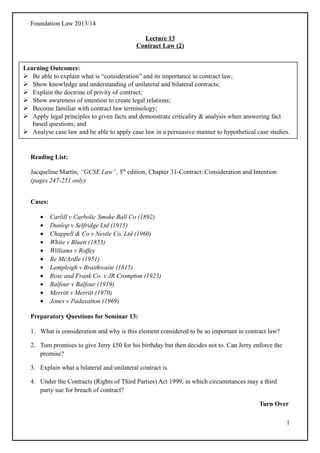
Reading List:
Jacqueline Martin, “GCSE Law”, 5th
edition, Chapter 31-Contract: Consideration and Intention
(pages 247-251 only)
Cases:
• Carlill v Carbolic Smoke Ball Co (1892)
• Dunlop v Selfridge Ltd (1915)
• Chappell & Co v Nestle Co. Ltd (1960)
• White v Bluett (1853)
• Williams v Roffey
• Re McArdle (1951)
• Lampleigh v Braithwaite (1615)
• Rose and Frank Co. v JR Crompton (1923)
• Balfour v Balfour (1919)
• Merritt v Merritt (1970)
• Jones v Padavatton (1969)
Preparatory Questions for Seminar 13:
1. What is consideration and why is this element considered to be so important in contract law?
2. Tom promises to give Jerry £50 for his birthday but then decides not to. Can Jerry enforce the
promise?
3. Explain what a bilateral and unilateral contract is.
4. Under the Contracts (Rights of Third Parties) Act 1999, in which circumstances may a third
party sue for breach of contract?
Turn Over
1
Learning Outcomes:
 Be able to explain what is “consideration” and its importance in contract law;
 Show knowledge and understanding of unilateral and bilateral contracts;
 Explain the doctrine of privity of contract;
 Show awareness of intention to create legal relations;
 Become familiar with contract law terminology;
 Apply legal principles to given facts and demonstrate criticality & analysis when answering fact
based questions; and
 Analyse case law and be able to apply case law in a persuasive manner to hypothetical case studies.
Foundation Law 2013/14
5. With respect to business agreements, what is the presumption taken by the courts with regards
to intention to create legal relations?
6. With respect to social/domestic agreements, what is the presumption taken by the courts with
regards to intention to create legal relations? Use case law to explain your answer.
2

Lecture 13 handout contract law

  • 1.
    Foundation Law 2013/14 Lecture13 Contract Law (2) Reading List: Jacqueline Martin, “GCSE Law”, 5th edition, Chapter 31-Contract: Consideration and Intention (pages 247-251 only) Cases: • Carlill v Carbolic Smoke Ball Co (1892) • Dunlop v Selfridge Ltd (1915) • Chappell & Co v Nestle Co. Ltd (1960) • White v Bluett (1853) • Williams v Roffey • Re McArdle (1951) • Lampleigh v Braithwaite (1615) • Rose and Frank Co. v JR Crompton (1923) • Balfour v Balfour (1919) • Merritt v Merritt (1970) • Jones v Padavatton (1969) Preparatory Questions for Seminar 13: 1. What is consideration and why is this element considered to be so important in contract law? 2. Tom promises to give Jerry £50 for his birthday but then decides not to. Can Jerry enforce the promise? 3. Explain what a bilateral and unilateral contract is. 4. Under the Contracts (Rights of Third Parties) Act 1999, in which circumstances may a third party sue for breach of contract? Turn Over 1 Learning Outcomes:  Be able to explain what is “consideration” and its importance in contract law;  Show knowledge and understanding of unilateral and bilateral contracts;  Explain the doctrine of privity of contract;  Show awareness of intention to create legal relations;  Become familiar with contract law terminology;  Apply legal principles to given facts and demonstrate criticality & analysis when answering fact based questions; and  Analyse case law and be able to apply case law in a persuasive manner to hypothetical case studies.
  • 2.
    Foundation Law 2013/14 5.With respect to business agreements, what is the presumption taken by the courts with regards to intention to create legal relations? 6. With respect to social/domestic agreements, what is the presumption taken by the courts with regards to intention to create legal relations? Use case law to explain your answer. 2