1
MARKETING
ACCOUNTABILITY AND
PERFORMANCE
LECTURE 12
1
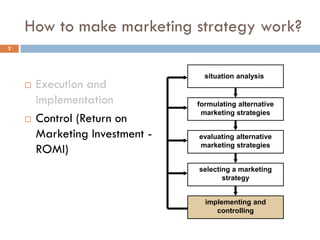
How to make marketing strategy work?
 Execution and
implementation
 Control (Return on
Marketing Investment -
ROMI)
2
situation analysis
formulating alternative
marketing strategies
evaluating alternative
marketing strategies
selecting a marketing
strategy
implementing and
controlling
Learning objectives
 Understand relevance of marketing performance
measurement ability
 Understand the concept of customer lifetime value
and customer equity
 Understand that changes in customer equity reflect
changes in value, brand, and/or relationship equity
 Understand link between customer lifetime
value/customer equity and firm performance
3
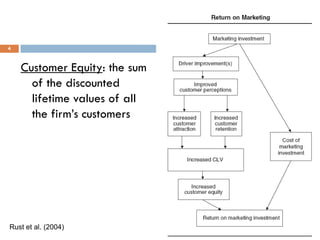
Customer Equity: the sum
of the discounted
lifetime values of all
the firm’s customers
4
Rust et al. (2004)
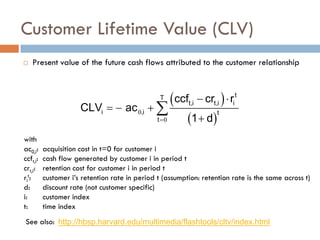
 Present value of the future cash flows attributed to the customer relationship
with
ac0,i: acquisition cost in t=0 for customer i
ccft,i: cash flow generated by customer i in period t
crt,i: retention cost for customer i in period t
ri
t: customer i’s retention rate in period t (assumption: retention rate is the same across t)
d: discount rate (not customer specific)
i: customer index
t: time index
Customer Lifetime Value (CLV)
See also:
( )
( )
0
0
=
− ⋅
=
− +
+
∑
t
T
t,i t,i i
i ,i t
t
ccf cr r
CLV ac
1 d
http://hbsp.harvard.edu/multimedia/flashtools/cltv/index.html
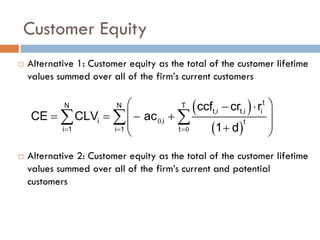
 Alternative 1: Customer equity as the total of the customer lifetime
values summed over all of the firm’s current customers
 Alternative 2: Customer equity as the total of the customer lifetime
values summed over all of the firm’s current and potential
customers
Customer Equity
( )
( )
0
0
= = =
 
− ⋅
 
= = − +
 
+
 
∑ ∑ ∑
t
N N T
t,i t,i i
i ,i t
i 1 i 1 t
ccf cr r
CE CLV ac
1 d
ROMI: foundations (Rust et al. 2004)
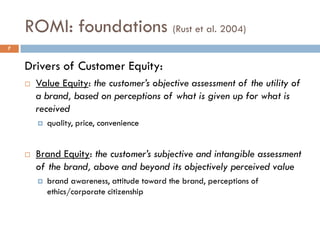
Drivers of Customer Equity:
 Value Equity: the customer’s objective assessment of the utility of
a brand, based on perceptions of what is given up for what is
received
 quality, price, convenience
 Brand Equity: the customer’s subjective and intangible assessment
of the brand, above and beyond its objectively perceived value
 brand awareness, attitude toward the brand, perceptions of
ethics/corporate citizenship
7
ROMI: foundations (Rust et al. 2004)
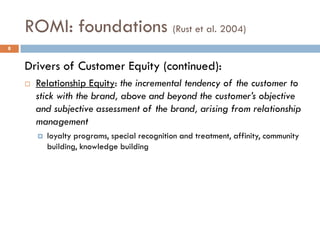
Drivers of Customer Equity (continued):
 Relationship Equity: the incremental tendency of the customer to
stick with the brand, above and beyond the customer’s objective
and subjective assessment of the brand, arising from relationship
management
 loyalty programs, special recognition and treatment, affinity, community
building, knowledge building
8
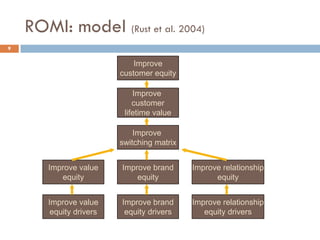
ROMI: model (Rust et al. 2004)
Improve value
equity drivers
Improve
switching matrix
Improve relationship
equity
Improve brand
equity drivers
Improve relationship
equity drivers
Improve brand
equity
Improve value
equity
Improve
customer
lifetime value
Improve
customer equity
9
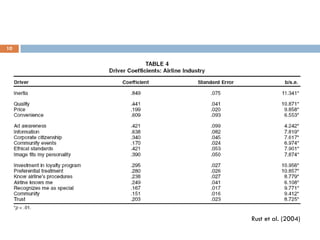
Rust et al. (2004)
10
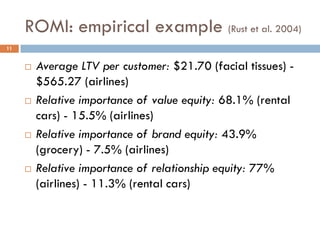
ROMI: empirical example (Rust et al. 2004)
 Average LTV per customer: $21.70 (facial tissues) -
$565.27 (airlines)
 Relative importance of value equity: 68.1% (rental
cars) - 15.5% (airlines)
 Relative importance of brand equity: 43.9%
(grocery) - 7.5% (airlines)
 Relative importance of relationship equity: 77%
(airlines) - 11.3% (rental cars)
11
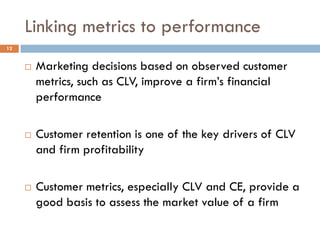
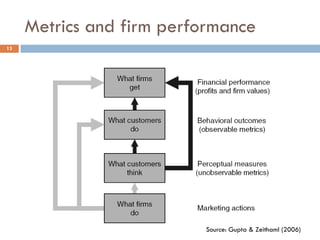
Linking metrics to performance
 Marketing decisions based on observed customer
metrics, such as CLV, improve a firm’s financial
performance
 Customer retention is one of the key drivers of CLV
and firm profitability
 Customer metrics, especially CLV and CE, provide a
good basis to assess the market value of a firm
12
Metrics and firm performance
13
Source: Gupta & Zeithaml (2006)
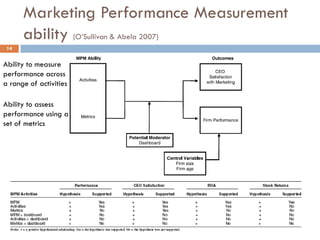
Marketing Performance Measurement
ability (O’Sullivan & Abela 2007)
O’Sullivan & Abela 2007
14
Ability to measure
performance across
a range of activities
Ability to assess
performance using a
set of metrics
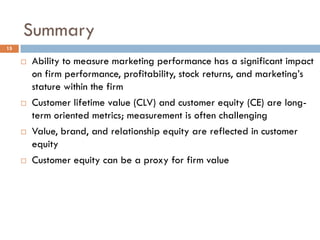
Summary
 Ability to measure marketing performance has a significant impact
on firm performance, profitability, stock returns, and marketing’s
stature within the firm
 Customer lifetime value (CLV) and customer equity (CE) are long-
term oriented metrics; measurement is often challenging
 Value, brand, and relationship equity are reflected in customer
equity
 Customer equity can be a proxy for firm value
15
15

Lecture 12 Marketing accountability and performance BB.pdf

  • 1.
  • 2.
    How to makemarketing strategy work?  Execution and implementation  Control (Return on Marketing Investment - ROMI) 2 situation analysis formulating alternative marketing strategies evaluating alternative marketing strategies selecting a marketing strategy implementing and controlling
  • 3.
    Learning objectives  Understandrelevance of marketing performance measurement ability  Understand the concept of customer lifetime value and customer equity  Understand that changes in customer equity reflect changes in value, brand, and/or relationship equity  Understand link between customer lifetime value/customer equity and firm performance 3
  • 4.
    Customer Equity: thesum of the discounted lifetime values of all the firm’s customers 4 Rust et al. (2004)
  • 5.
     Present valueof the future cash flows attributed to the customer relationship with ac0,i: acquisition cost in t=0 for customer i ccft,i: cash flow generated by customer i in period t crt,i: retention cost for customer i in period t ri t: customer i’s retention rate in period t (assumption: retention rate is the same across t) d: discount rate (not customer specific) i: customer index t: time index Customer Lifetime Value (CLV) See also: ( ) ( ) 0 0 = − ⋅ = − + + ∑ t T t,i t,i i i ,i t t ccf cr r CLV ac 1 d http://hbsp.harvard.edu/multimedia/flashtools/cltv/index.html
  • 6.
     Alternative 1:Customer equity as the total of the customer lifetime values summed over all of the firm’s current customers  Alternative 2: Customer equity as the total of the customer lifetime values summed over all of the firm’s current and potential customers Customer Equity ( ) ( ) 0 0 = = =   − ⋅   = = − +   +   ∑ ∑ ∑ t N N T t,i t,i i i ,i t i 1 i 1 t ccf cr r CE CLV ac 1 d
  • 7.
    ROMI: foundations (Rustet al. 2004) Drivers of Customer Equity:  Value Equity: the customer’s objective assessment of the utility of a brand, based on perceptions of what is given up for what is received  quality, price, convenience  Brand Equity: the customer’s subjective and intangible assessment of the brand, above and beyond its objectively perceived value  brand awareness, attitude toward the brand, perceptions of ethics/corporate citizenship 7
  • 8.
    ROMI: foundations (Rustet al. 2004) Drivers of Customer Equity (continued):  Relationship Equity: the incremental tendency of the customer to stick with the brand, above and beyond the customer’s objective and subjective assessment of the brand, arising from relationship management  loyalty programs, special recognition and treatment, affinity, community building, knowledge building 8
  • 9.
    ROMI: model (Rustet al. 2004) Improve value equity drivers Improve switching matrix Improve relationship equity Improve brand equity drivers Improve relationship equity drivers Improve brand equity Improve value equity Improve customer lifetime value Improve customer equity 9
  • 10.
    Rust et al.(2004) 10
  • 11.
    ROMI: empirical example(Rust et al. 2004)  Average LTV per customer: $21.70 (facial tissues) - $565.27 (airlines)  Relative importance of value equity: 68.1% (rental cars) - 15.5% (airlines)  Relative importance of brand equity: 43.9% (grocery) - 7.5% (airlines)  Relative importance of relationship equity: 77% (airlines) - 11.3% (rental cars) 11
  • 12.
    Linking metrics toperformance  Marketing decisions based on observed customer metrics, such as CLV, improve a firm’s financial performance  Customer retention is one of the key drivers of CLV and firm profitability  Customer metrics, especially CLV and CE, provide a good basis to assess the market value of a firm 12
  • 13.
    Metrics and firmperformance 13 Source: Gupta & Zeithaml (2006)
  • 14.
    Marketing Performance Measurement ability(O’Sullivan & Abela 2007) O’Sullivan & Abela 2007 14 Ability to measure performance across a range of activities Ability to assess performance using a set of metrics
  • 15.
    Summary  Ability tomeasure marketing performance has a significant impact on firm performance, profitability, stock returns, and marketing’s stature within the firm  Customer lifetime value (CLV) and customer equity (CE) are long- term oriented metrics; measurement is often challenging  Value, brand, and relationship equity are reflected in customer equity  Customer equity can be a proxy for firm value 15 15