The Theory of Computation
‫االحتسابية‬ ‫النظرية‬
‫رقم‬ ‫المحاضرة‬
-
10
-
Binary Trees ‫الثنائية‬ ‫االشجار‬
‫إعداد‬
‫م‬
.
‫حميد‬ ‫حبيب‬ ‫وديان‬ ‫م‬
‫االساسية‬ ‫التربية‬ ‫كلية‬
/
‫الحاسبات‬ ‫قسم‬
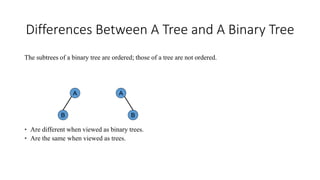
Differences Between A Tree and A Binary Tree
The subtrees of a binary tree are ordered; those of a tree are not ordered.
• Are different when viewed as binary trees.
• Are the same when viewed as trees.
A
B
A
B
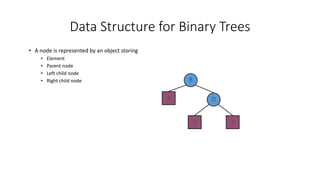
Data Structure for Binary Trees
• A node is represented by an object storing
• Element
• Parent node
• Left child node
• Right child node B
D
A
C E
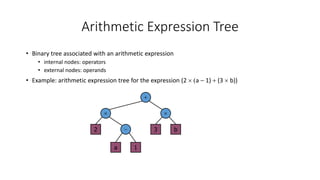
Arithmetic Expression Tree
• Binary tree associated with an arithmetic expression
• internal nodes: operators
• external nodes: operands
• Example: arithmetic expression tree for the expression (2  (a - 1) + (3  b))
+


-
2
a 1
3 b
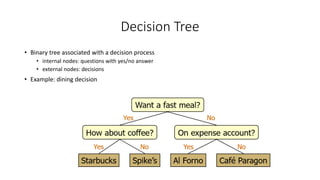
Decision Tree
• Binary tree associated with a decision process
• internal nodes: questions with yes/no answer
• external nodes: decisions
• Example: dining decision
Maximum Number of Nodes in a Binary Tree
• The maximum number of nodes on depth i of a binary
tree is 2i, i>=0.
• The maximum nubmer of nodes in a binary tree of height
k is 2k+1-1, k>=0.
Prove by induction.
1
2
2 1
0
-
 +

 k
k
i
i
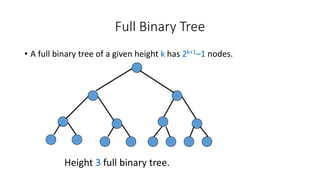
Full Binary Tree
• A full binary tree of a given height k has 2k+1–1 nodes.
Height 3 full binary tree.
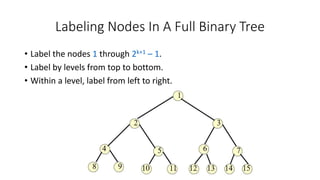
Labeling Nodes In A Full Binary Tree
• Label the nodes 1 through 2k+1 – 1.
• Label by levels from top to bottom.
• Within a level, label from left to right.
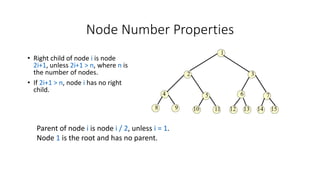
Node Number Properties
Parent of node i is node i / 2, unless i = 1.
Node 1 is the root and has no parent.
• Right child of node i is node
2i+1, unless 2i+1 > n, where n is
the number of nodes.
• If 2i+1 > n, node i has no right
child.
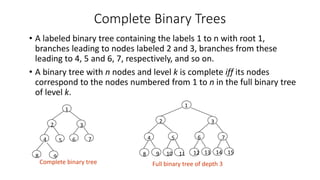
Complete Binary Trees
• A labeled binary tree containing the labels 1 to n with root 1,
branches leading to nodes labeled 2 and 3, branches from these
leading to 4, 5 and 6, 7, respectively, and so on.
• A binary tree with n nodes and level k is complete iff its nodes
correspond to the nodes numbered from 1 to n in the full binary tree
of level k.
1
2 3
7
5
9
4
8
6
Complete binary tree
1
2 3
7
5
11
4
10
6
9
8 15
14
13
12
Full binary tree of depth 3

Lecture 10.pptx

  • 1.
    The Theory ofComputation ‫االحتسابية‬ ‫النظرية‬ ‫رقم‬ ‫المحاضرة‬ - 10 - Binary Trees ‫الثنائية‬ ‫االشجار‬ ‫إعداد‬ ‫م‬ . ‫حميد‬ ‫حبيب‬ ‫وديان‬ ‫م‬ ‫االساسية‬ ‫التربية‬ ‫كلية‬ / ‫الحاسبات‬ ‫قسم‬
  • 2.
    Differences Between ATree and A Binary Tree The subtrees of a binary tree are ordered; those of a tree are not ordered. • Are different when viewed as binary trees. • Are the same when viewed as trees. A B A B
  • 3.
    Data Structure forBinary Trees • A node is represented by an object storing • Element • Parent node • Left child node • Right child node B D A C E
  • 4.
    Arithmetic Expression Tree •Binary tree associated with an arithmetic expression • internal nodes: operators • external nodes: operands • Example: arithmetic expression tree for the expression (2  (a - 1) + (3  b)) +   - 2 a 1 3 b
  • 5.
    Decision Tree • Binarytree associated with a decision process • internal nodes: questions with yes/no answer • external nodes: decisions • Example: dining decision
  • 6.
    Maximum Number ofNodes in a Binary Tree • The maximum number of nodes on depth i of a binary tree is 2i, i>=0. • The maximum nubmer of nodes in a binary tree of height k is 2k+1-1, k>=0. Prove by induction. 1 2 2 1 0 -  +   k k i i
  • 7.
    Full Binary Tree •A full binary tree of a given height k has 2k+1–1 nodes. Height 3 full binary tree.
  • 8.
    Labeling Nodes InA Full Binary Tree • Label the nodes 1 through 2k+1 – 1. • Label by levels from top to bottom. • Within a level, label from left to right.
  • 9.
    Node Number Properties Parentof node i is node i / 2, unless i = 1. Node 1 is the root and has no parent. • Right child of node i is node 2i+1, unless 2i+1 > n, where n is the number of nodes. • If 2i+1 > n, node i has no right child.
  • 10.
    Complete Binary Trees •A labeled binary tree containing the labels 1 to n with root 1, branches leading to nodes labeled 2 and 3, branches from these leading to 4, 5 and 6, 7, respectively, and so on. • A binary tree with n nodes and level k is complete iff its nodes correspond to the nodes numbered from 1 to n in the full binary tree of level k. 1 2 3 7 5 9 4 8 6 Complete binary tree 1 2 3 7 5 11 4 10 6 9 8 15 14 13 12 Full binary tree of depth 3