What is Behavior?
1
Meaning of Behavior
• The actions displayed by an organism in response to its environment.
Source: American Heritage Dictionary
• The way in which an animal or person responds to a situation or stimulus
Source: Concise Oxford English Dictionary
• the potential and expressed capacity for physical, mental, and social activity during the phases of
human life
Source: Encyclopedia Britannica
2
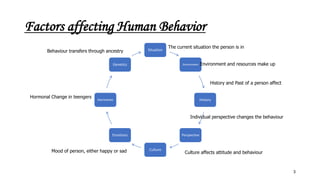
Factors affecting Human Behavior
3
Situation
Environment
History
Perspective
Culture
Emotions
Hormones
Genetics
The current situation the person is in
Environment and resources make up
History and Past of a person affect
Individual perspective changes the behaviour
Culture affects attitude and behaviour
Mood of person, either happy or sad
Hormonal Change in teengers
Behaviour transfers through ancestry
Behavioral Testing
4
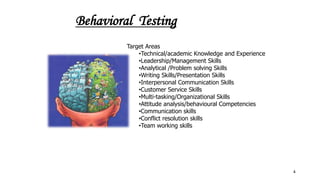
Target Areas
•Technical/academic Knowledge and Experience
•Leadership/Management Skills
•Analytical /Problem solving Skills
•Writing Skills/Presentation Skills
•Interpersonal Communication Skills
•Customer Service Skills
•Multi-tasking/Organizational Skills
•Attitude analysis/behavioural Competencies
•Communication skills
•Conflict resolution skills
•Team working skills
Types of Interviews
• Selection interview
• A selection procedure designed to predict future job performance on
the basis of applicants’ oral responses to oral inquiries.
• Appraisal interview
• A discussion, following a performance appraisal, in which supervisor
and employee discuss the employee’s rating and possible remedial
actions.
• Exit interview
• An interview to elicit information about the job or related matters to
the employer some insight into what’s right or wrong about the firm.
Formats of Interviews
• Unstructured or nondirective interview
• An unstructured conversational-style interview in which the interviewer
pursues points of interest as they come up in response to questions.
• Structured or directive interview
• An interview following a set sequence of questions.
Interview Content: Types of Questions
• Situational interview
• A series of job-related questions that focus on how the candidate would
behave in a given situation.
• Behavioral interview
• A series of job-related questions that focus on how they reacted to actual
situations in the past.
• Job-related interview
• A series of job-related questions that focus on relevant past job-related
behaviors.
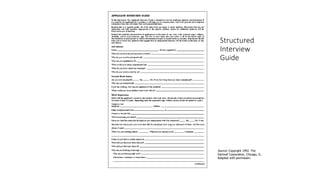
Structured
Interview
Guide
Source: Copyright 1992. The
Dartnell Corporation, Chicago, IL.
Adapted with permission.
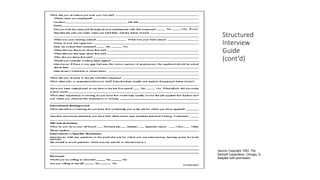
Structured
Interview
Guide
(cont’d)
Source: Copyright 1992. The
Dartnell Corporation, Chicago, IL.
Adapted with permission.
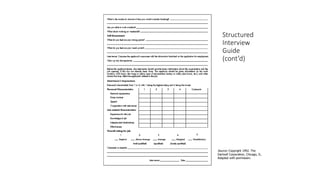
Structured
Interview
Guide
(cont’d)
Source: Copyright 1992. The
Dartnell Corporation, Chicago, IL.
Adapted with permission.
11
Attitude
• Internal
• Feeling that a person can’t see
• Something that only you know
• Something that you think
• Something in your mind
• Your opinion
Behaviour
 External
 Other People can see
 Others Know
 Something that you act
 Something shown in outer world
 Other’s opinion
Attitude Vs Behaviour
12
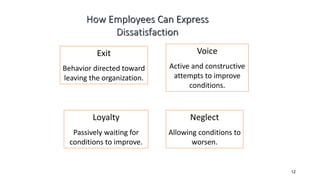
How Employees Can Express
Dissatisfaction
Exit
Behavior directed toward
leaving the organization.
Voice
Active and constructive
attempts to improve
conditions.
Neglect
Allowing conditions to
worsen.
Loyalty
Passively waiting for
conditions to improve.
13
Responses to Job Dissatisfaction

Lecture 06 Behavior.pptx

  • 1.
  • 2.
    Meaning of Behavior •The actions displayed by an organism in response to its environment. Source: American Heritage Dictionary • The way in which an animal or person responds to a situation or stimulus Source: Concise Oxford English Dictionary • the potential and expressed capacity for physical, mental, and social activity during the phases of human life Source: Encyclopedia Britannica 2
  • 3.
    Factors affecting HumanBehavior 3 Situation Environment History Perspective Culture Emotions Hormones Genetics The current situation the person is in Environment and resources make up History and Past of a person affect Individual perspective changes the behaviour Culture affects attitude and behaviour Mood of person, either happy or sad Hormonal Change in teengers Behaviour transfers through ancestry
  • 4.
    Behavioral Testing 4 Target Areas •Technical/academicKnowledge and Experience •Leadership/Management Skills •Analytical /Problem solving Skills •Writing Skills/Presentation Skills •Interpersonal Communication Skills •Customer Service Skills •Multi-tasking/Organizational Skills •Attitude analysis/behavioural Competencies •Communication skills •Conflict resolution skills •Team working skills
  • 5.
    Types of Interviews •Selection interview • A selection procedure designed to predict future job performance on the basis of applicants’ oral responses to oral inquiries. • Appraisal interview • A discussion, following a performance appraisal, in which supervisor and employee discuss the employee’s rating and possible remedial actions. • Exit interview • An interview to elicit information about the job or related matters to the employer some insight into what’s right or wrong about the firm.
  • 6.
    Formats of Interviews •Unstructured or nondirective interview • An unstructured conversational-style interview in which the interviewer pursues points of interest as they come up in response to questions. • Structured or directive interview • An interview following a set sequence of questions.
  • 7.
    Interview Content: Typesof Questions • Situational interview • A series of job-related questions that focus on how the candidate would behave in a given situation. • Behavioral interview • A series of job-related questions that focus on how they reacted to actual situations in the past. • Job-related interview • A series of job-related questions that focus on relevant past job-related behaviors.
  • 8.
    Structured Interview Guide Source: Copyright 1992.The Dartnell Corporation, Chicago, IL. Adapted with permission.
  • 9.
    Structured Interview Guide (cont’d) Source: Copyright 1992.The Dartnell Corporation, Chicago, IL. Adapted with permission.
  • 10.
    Structured Interview Guide (cont’d) Source: Copyright 1992.The Dartnell Corporation, Chicago, IL. Adapted with permission.
  • 11.
    11 Attitude • Internal • Feelingthat a person can’t see • Something that only you know • Something that you think • Something in your mind • Your opinion Behaviour  External  Other People can see  Others Know  Something that you act  Something shown in outer world  Other’s opinion Attitude Vs Behaviour
  • 12.
    12 How Employees CanExpress Dissatisfaction Exit Behavior directed toward leaving the organization. Voice Active and constructive attempts to improve conditions. Neglect Allowing conditions to worsen. Loyalty Passively waiting for conditions to improve.
  • 13.
    13 Responses to JobDissatisfaction