Gastritis
Prepared by
Muhammad Umar
CCC ,GBSN,CCE,PHICIP
Medicose Nursing Academy
Learning Objectives
By the end of the session learners will be able to:
• Discuss the causes, pathophysiology and
manifestation of the diagnostic, medical and
surgical management of the Gastritis.
• Apply nursing process including assessment,
planning, implementation and evaluation of
care provided to the clients with Gastritis.
Gastritis
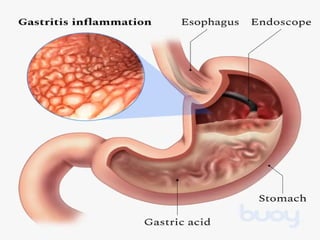
 Inflammation of stomach lining from
irritation of gastric mucosa (normally
protected from gastric acid and enzymes by
mucosal barrier).
The incidence of gastritis is highest in the fifth
and sixth decades of life; men are more
frequently affected than women. The incidence
is greater in clients who are heavy drinkers
and smokers.
Acute Gastritis
1.Disruption of mucosal barrier allowing
hydrochloric acid and pepsin to have contact
with gastric tissue: leads to irritation,
inflammation, superficial erosions
2.Gastric mucosa rapidly regenerates; self-
limiting disorder
Causes of acute gastritis
• a. Irritants include aspirin and other NSAIDS,
corticosteroids, alcohol, caffeine
• b.Ingestion of corrosive substances: alkali or acid
• c. Effects from radiation therapy, certain
chemotherapeutic agents
Erosive Gastritis: form of acute which is stress-
induced, complication of life-threatening
condition (Curling’s ulcer with burns); gastric
mucosa becomes ischemic and tissue is then
injured by acid of stomach
Cont.…
Acute alcoholism and food poisoning (typically
caused by Staphylococcus organisms) are
common causes.
 Food substances including excessive amounts of
tea, paprika, clove and pepper can precipitate
acute gastritis.
 Foods with a rough texture or those eaten at an
extremely high temperature can also damage the
stomach mucosa.
 Acute gastritis is usually of short duration unless
the gastric mucosa has suffered extensive damage.
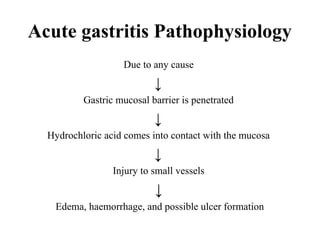
Acute gastritis Pathophysiology
Due to any cause
↓
Gastric mucosal barrier is penetrated
↓
Hydrochloric acid comes into contact with the mucosa
↓
Injury to small vessels
↓
Edema, haemorrhage, and possible ulcer formation
Manifestations
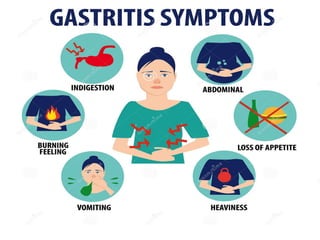
• a. Mild: anorexia, mild epigastric
discomfort, belching
• b. More severe: abdominal pain, nausea,
vomiting, hematemesis, melena
• c. Erosive: not associated with pain;
bleeding occurs 2 or more days post stress event
• d. If perforation occurs, signs of peritonitis
• Sometime GI bleeding is the only manifestation
• When contaminated food is the cause of
gastritis, diarrhea usually develops within 5
hours of ingestion
Diagnostic Findings
Diagnosis is based on a detailed history of
food intake, medications taken, and any
disorder related to gastritis.
 The physician may also perform a
gastroscopic examination with endoscopy.
 Histological examination by biopsy of a
sample.
Treatment
a.NPO status to rest GI tract for 6 – 12 hours,
reintroduce clear liquids gradually and
progress; intravenous fluid and electrolytes if
indicated
b. Medications: proton-pump inhibitor or H2-
receptor blocker; Sucralfate (Carafate) acts
locally; coats and protects gastric mucosa
c. If gastritis from corrosive substance:
immediate dilution and removal of substance by
gastric lavage (washing out stomach contents via
nasogastric tube), no vomiting.
Cont.…
Anti – emetic drugs like Inj. Perinorm or Tab.
Domperidone are frequently effective in
vomiting
Chronic Gastritis
• 1. Progressive disorder beginning with
superficial inflammation and leads to atrophy of
gastric tissues
• 2. Type A: autoimmune component and
affecting persons of northern European descent;
loss of hydrochloric acid and pepsin secretion;
develops pernicious anemia
–Parietal cells normally secrete intrinsic factor
needed for absorption of B12, when they are
destroyed by gastritis patients develop
pernicious anemia.
Cont.…
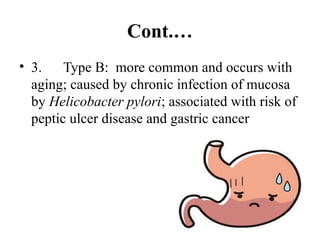
• 3. Type B: more common and occurs with
aging; caused by chronic infection of mucosa
by Helicobacter pylori; associated with risk of
peptic ulcer disease and gastric cancer
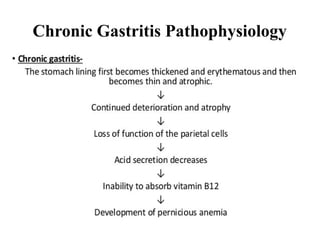
Chronic Gastritis Pathophysiology
Etiological Factors
Peptic Ulcer Disease (PUD), infection with
Helicobacter pylori bacteria or gastric surgery may
lead to chronic gastritis.
After gastric resection with a gastro- jejunostomy,
bile and bile acids may reflux into the remaining
stomach, causing gastritis.
H.Pylori infection can lead to chronic atrophic
gastritis.
Age is also a risk factor; chronic gastritis is more
common in older adults.
Manifestations
Vague gastric distress, epigastric heaviness not
relieved by antacids
Fatigue associated with anemia; symptoms
associated with pernicious anemia:
paresthesias
Lack of B12 affects nerve transmission
Intolerance of spicy and fatty foods
Diagnostic Tests
• a. Gastric analysis: assess hydrochloric acid
secretion (less with chronic gastritis)
• b. Hemoglobin, hematocrit, red blood cell
indices: anemia including pernicious or iron
deficiency
Cont.…
• Serum vitamin B12 levels: determine
pernicious anemia
• d. Upper endoscopy: visualize mucosa,
identify areas of bleeding, obtain biopsies;
may treat areas of bleeding with electro or
laser coagulation or sclerosing agent
Treatment
Discomfort may lessen with a bland diet, small
frequent meals, antacids, H2 receptor antagonists,
proton pump inhibitors, and avoidance of food that
cause manifestations.
Type B: eradicate H. pylori infection with
combination therapy of two antibiotics (metronidazole
(Flagyl) and clarithomycin or tetracycline) and proton–
pump inhibitor (Prevacid or Prilosec) for 1 week
 If 1 week of this regimen does not succeed in
eliminating the bacteria, the regimen may be repeated
for an additional week.
 If pernicious anemia develops, intramuscular
injections of vitamin B12 may be administered
monthly for the remainder of the client’s life.
Collaborative Care
• a. Usually managed in community
• b. Teach food safety measures to prevent
acute gastritis from food contaminated with
bacteria
• c. Management of acute gastritis with NPO
state and then gradual reintroduction of fluids
with electrolytes and glucose and advance to
solid foods
• d. Teaching regarding use of prescribed
medications, smoking cessation, treatment of
alcohol abuse
NURSING PROCESS:
Assessment
• Does the patient have heartburn, indigestion, nausea,
or vomiting?
• Do the symptoms occur at any specific time of the
day, before or after meals, after ingesting spicy or
irritating foods, or after the ingestion of certain drugs
or alcohol?
• Has there been recent weight gain or loss?
• Are the symptoms related to anxiety, stress, allergies,
eating or drinking too much, or eating too quickly?
• How are the symptoms relieved?
Nursing Diagnoses
Based on the assessment data, the patient’s major
nursing diagnoses may include the following:
• Anxiety related to treatment
• Imbalanced nutrition, less than body requirements,
related to inadequate intake of nutrients
• Risk for imbalanced fluid volume related to
insufficient fluid intake and excessive fluid loss
subsequent to vomiting
• Deficient knowledge about dietary management and
disease process
• Acute pain related to irritated stomach mucosa
Planning and Goals
Major goals for the patient may include:
• reduced anxiety,
• avoidance of irritating foods, adequate intake of
nutrients,
• Maintenance of fluid balance, increased
awareness of dietary management,
• relief of pain.
Nursing Interventions
 Reducing anxiety
 Promoting optimal nutrition
 Promoting fluid balance
 Relieving pain
 Promoting home and community-based care
Evaluation
1. Exhibits less anxiety
2. Avoids eating irritating foods or drinking caffeinated
beverages or alcohol
3. Maintains fluid balance
a. Has intake of at least 1.5 L daily
b. Drinks six to eight glasses of water daily
c. Has a urinary output of about 1 L daily
d. Displays adequate skin turgor
Cont...
4. Adheres to medical regimen
a. Selects nonirritating foods and beverages
b. Takes medications as prescribed
5. Maintains appropriate weight
6. Reports less pain
REFERENCE
Smeltzer, S. C., Bare, B. G., Hinkle, J. L., &
Cheever, K. H. (2010). Brunner and Suddarth’s
textbook of medical-surgical nursing (12th ed.).
Philadelphia:Lippincott Williams & Wilkins.
Lect 7. gastritis.pptxgggffcvvdfgfbfdvgvbggvbcvbv

Lect 7. gastritis.pptxgggffcvvdfgfbfdvgvbggvbcvbv

  • 1.
    Gastritis Prepared by Muhammad Umar CCC,GBSN,CCE,PHICIP Medicose Nursing Academy
  • 3.
    Learning Objectives By theend of the session learners will be able to: • Discuss the causes, pathophysiology and manifestation of the diagnostic, medical and surgical management of the Gastritis. • Apply nursing process including assessment, planning, implementation and evaluation of care provided to the clients with Gastritis.
  • 4.
    Gastritis  Inflammation ofstomach lining from irritation of gastric mucosa (normally protected from gastric acid and enzymes by mucosal barrier). The incidence of gastritis is highest in the fifth and sixth decades of life; men are more frequently affected than women. The incidence is greater in clients who are heavy drinkers and smokers.
  • 5.
    Acute Gastritis 1.Disruption ofmucosal barrier allowing hydrochloric acid and pepsin to have contact with gastric tissue: leads to irritation, inflammation, superficial erosions 2.Gastric mucosa rapidly regenerates; self- limiting disorder
  • 6.
    Causes of acutegastritis • a. Irritants include aspirin and other NSAIDS, corticosteroids, alcohol, caffeine • b.Ingestion of corrosive substances: alkali or acid • c. Effects from radiation therapy, certain chemotherapeutic agents Erosive Gastritis: form of acute which is stress- induced, complication of life-threatening condition (Curling’s ulcer with burns); gastric mucosa becomes ischemic and tissue is then injured by acid of stomach
  • 7.
    Cont.… Acute alcoholism andfood poisoning (typically caused by Staphylococcus organisms) are common causes.  Food substances including excessive amounts of tea, paprika, clove and pepper can precipitate acute gastritis.  Foods with a rough texture or those eaten at an extremely high temperature can also damage the stomach mucosa.  Acute gastritis is usually of short duration unless the gastric mucosa has suffered extensive damage.
  • 8.
    Acute gastritis Pathophysiology Dueto any cause ↓ Gastric mucosal barrier is penetrated ↓ Hydrochloric acid comes into contact with the mucosa ↓ Injury to small vessels ↓ Edema, haemorrhage, and possible ulcer formation
  • 9.
    Manifestations • a. Mild:anorexia, mild epigastric discomfort, belching • b. More severe: abdominal pain, nausea, vomiting, hematemesis, melena • c. Erosive: not associated with pain; bleeding occurs 2 or more days post stress event • d. If perforation occurs, signs of peritonitis • Sometime GI bleeding is the only manifestation • When contaminated food is the cause of gastritis, diarrhea usually develops within 5 hours of ingestion
  • 11.
    Diagnostic Findings Diagnosis isbased on a detailed history of food intake, medications taken, and any disorder related to gastritis.  The physician may also perform a gastroscopic examination with endoscopy.  Histological examination by biopsy of a sample.
  • 12.
    Treatment a.NPO status torest GI tract for 6 – 12 hours, reintroduce clear liquids gradually and progress; intravenous fluid and electrolytes if indicated b. Medications: proton-pump inhibitor or H2- receptor blocker; Sucralfate (Carafate) acts locally; coats and protects gastric mucosa c. If gastritis from corrosive substance: immediate dilution and removal of substance by gastric lavage (washing out stomach contents via nasogastric tube), no vomiting.
  • 13.
    Cont.… Anti – emeticdrugs like Inj. Perinorm or Tab. Domperidone are frequently effective in vomiting
  • 14.
    Chronic Gastritis • 1.Progressive disorder beginning with superficial inflammation and leads to atrophy of gastric tissues • 2. Type A: autoimmune component and affecting persons of northern European descent; loss of hydrochloric acid and pepsin secretion; develops pernicious anemia –Parietal cells normally secrete intrinsic factor needed for absorption of B12, when they are destroyed by gastritis patients develop pernicious anemia.
  • 15.
    Cont.… • 3. TypeB: more common and occurs with aging; caused by chronic infection of mucosa by Helicobacter pylori; associated with risk of peptic ulcer disease and gastric cancer
  • 16.
  • 17.
    Etiological Factors Peptic UlcerDisease (PUD), infection with Helicobacter pylori bacteria or gastric surgery may lead to chronic gastritis. After gastric resection with a gastro- jejunostomy, bile and bile acids may reflux into the remaining stomach, causing gastritis. H.Pylori infection can lead to chronic atrophic gastritis. Age is also a risk factor; chronic gastritis is more common in older adults.
  • 19.
    Manifestations Vague gastric distress,epigastric heaviness not relieved by antacids Fatigue associated with anemia; symptoms associated with pernicious anemia: paresthesias Lack of B12 affects nerve transmission Intolerance of spicy and fatty foods
  • 20.
    Diagnostic Tests • a.Gastric analysis: assess hydrochloric acid secretion (less with chronic gastritis) • b. Hemoglobin, hematocrit, red blood cell indices: anemia including pernicious or iron deficiency
  • 21.
    Cont.… • Serum vitaminB12 levels: determine pernicious anemia • d. Upper endoscopy: visualize mucosa, identify areas of bleeding, obtain biopsies; may treat areas of bleeding with electro or laser coagulation or sclerosing agent
  • 22.
    Treatment Discomfort may lessenwith a bland diet, small frequent meals, antacids, H2 receptor antagonists, proton pump inhibitors, and avoidance of food that cause manifestations. Type B: eradicate H. pylori infection with combination therapy of two antibiotics (metronidazole (Flagyl) and clarithomycin or tetracycline) and proton– pump inhibitor (Prevacid or Prilosec) for 1 week  If 1 week of this regimen does not succeed in eliminating the bacteria, the regimen may be repeated for an additional week.  If pernicious anemia develops, intramuscular injections of vitamin B12 may be administered monthly for the remainder of the client’s life.
  • 23.
    Collaborative Care • a.Usually managed in community • b. Teach food safety measures to prevent acute gastritis from food contaminated with bacteria • c. Management of acute gastritis with NPO state and then gradual reintroduction of fluids with electrolytes and glucose and advance to solid foods • d. Teaching regarding use of prescribed medications, smoking cessation, treatment of alcohol abuse
  • 24.
    NURSING PROCESS: Assessment • Doesthe patient have heartburn, indigestion, nausea, or vomiting? • Do the symptoms occur at any specific time of the day, before or after meals, after ingesting spicy or irritating foods, or after the ingestion of certain drugs or alcohol? • Has there been recent weight gain or loss? • Are the symptoms related to anxiety, stress, allergies, eating or drinking too much, or eating too quickly? • How are the symptoms relieved?
  • 25.
    Nursing Diagnoses Based onthe assessment data, the patient’s major nursing diagnoses may include the following: • Anxiety related to treatment • Imbalanced nutrition, less than body requirements, related to inadequate intake of nutrients • Risk for imbalanced fluid volume related to insufficient fluid intake and excessive fluid loss subsequent to vomiting • Deficient knowledge about dietary management and disease process • Acute pain related to irritated stomach mucosa
  • 26.
    Planning and Goals Majorgoals for the patient may include: • reduced anxiety, • avoidance of irritating foods, adequate intake of nutrients, • Maintenance of fluid balance, increased awareness of dietary management, • relief of pain.
  • 27.
    Nursing Interventions  Reducinganxiety  Promoting optimal nutrition  Promoting fluid balance  Relieving pain  Promoting home and community-based care
  • 28.
    Evaluation 1. Exhibits lessanxiety 2. Avoids eating irritating foods or drinking caffeinated beverages or alcohol 3. Maintains fluid balance a. Has intake of at least 1.5 L daily b. Drinks six to eight glasses of water daily c. Has a urinary output of about 1 L daily d. Displays adequate skin turgor
  • 29.
    Cont... 4. Adheres tomedical regimen a. Selects nonirritating foods and beverages b. Takes medications as prescribed 5. Maintains appropriate weight 6. Reports less pain
  • 30.
    REFERENCE Smeltzer, S. C.,Bare, B. G., Hinkle, J. L., & Cheever, K. H. (2010). Brunner and Suddarth’s textbook of medical-surgical nursing (12th ed.). Philadelphia:Lippincott Williams & Wilkins.