Nand
computational intractability
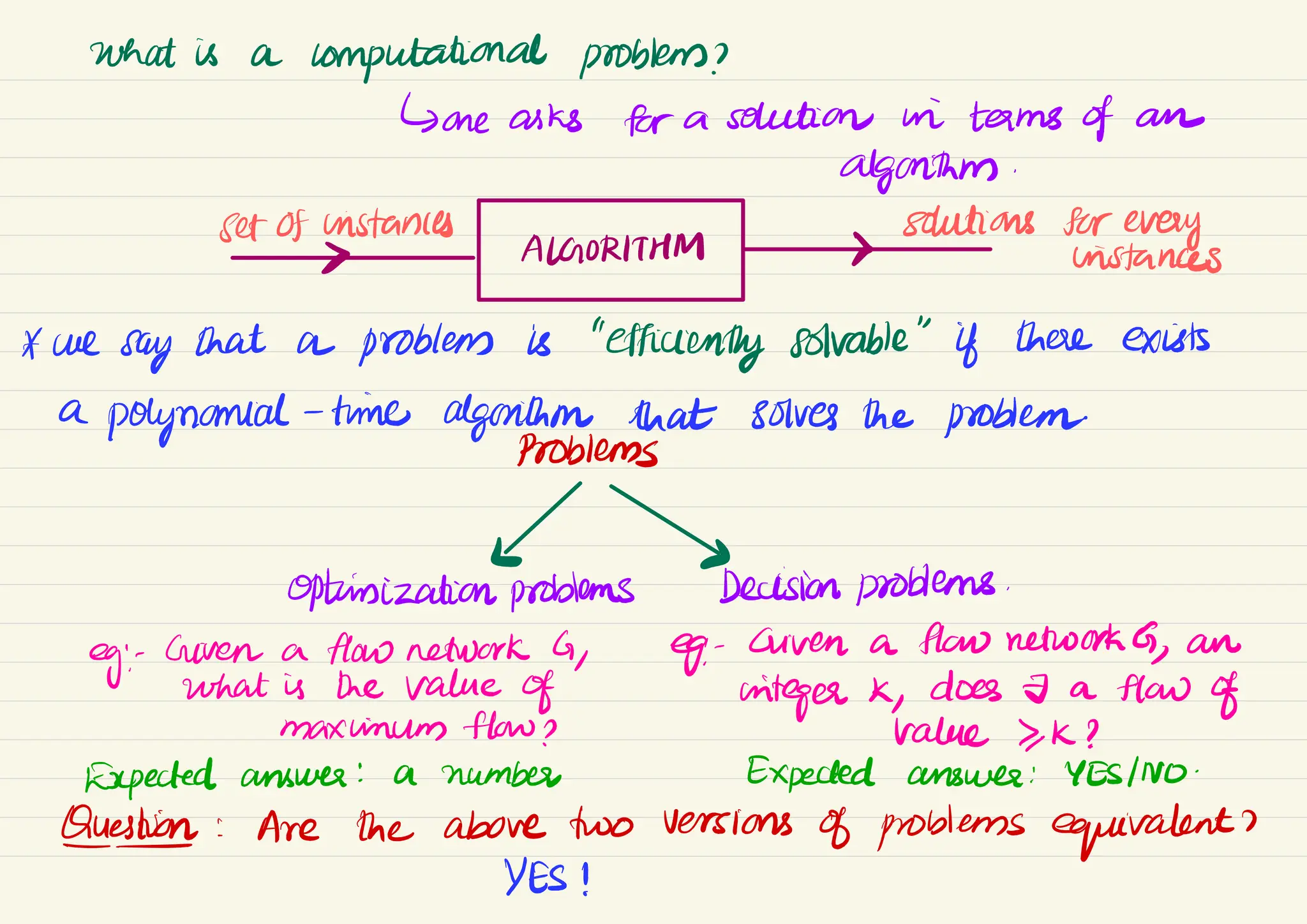
what is a
computational problem?
↳one asks for a solution in terms of an
algorithme .
set of instances solutions for every
> ALGORITHM > instances
A we
say that a problem is "efficiently solvable" if there exists
a
polynomial-time algorithm that solves the problem
Problems
L S
optimization problems Decision problems.
egi
- Given a flow network G, eg: -Given a flow network
,
an
what is the value of integer K
,
does - a flow of
maximum flow ? value 2
,
K ?
Expected answer : a number Expected answer : YESINO-
Question : Are the above two versions of problems equivalents
YES !
Prooffortheequivalence
-
clearly,
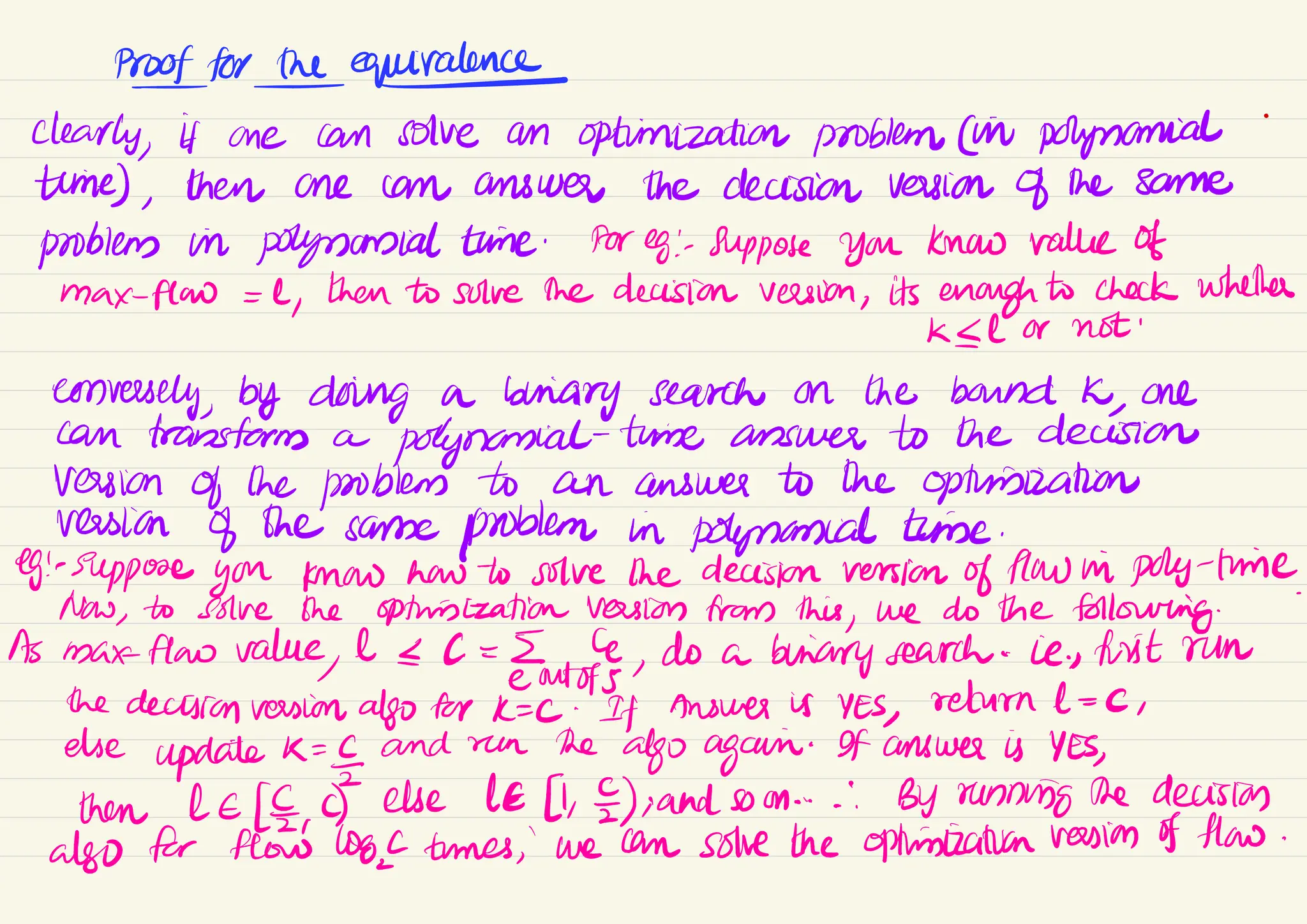
if one can solve an optimization problem (in polynomial
time) ,
then one can answer the decision version of the same
problems in polynomial time ·
Her eg : suppose you know value of
max-flow =1
,
then to solve the decision version ,
its enough to check whether
KIl or not
conversely, by doing a briary search on the bound K
,
one
can transform a
polynomial-time answer to the decision
version of the problem to an answer to the optimization
version of the same
problem in polynomial time.
eg!-
Suppose you know how to solve the decision version of flaw in poly-time.
Now,
to solve the optimization version from this
,
we do the following
.
As max flaw value 11 = C
,
do a binary search -
ie, first run
(
eoutofs
the decision version also for K= C
. If Answer is YES, return 1 = c
,
else
update K
=
and run the
algo again
.
If answer is YES
,
then leCE,
C) ele le11, 2),and som .... By running the decision
also for flow log times , ' we can solve the optimistication version of flow.
thus,
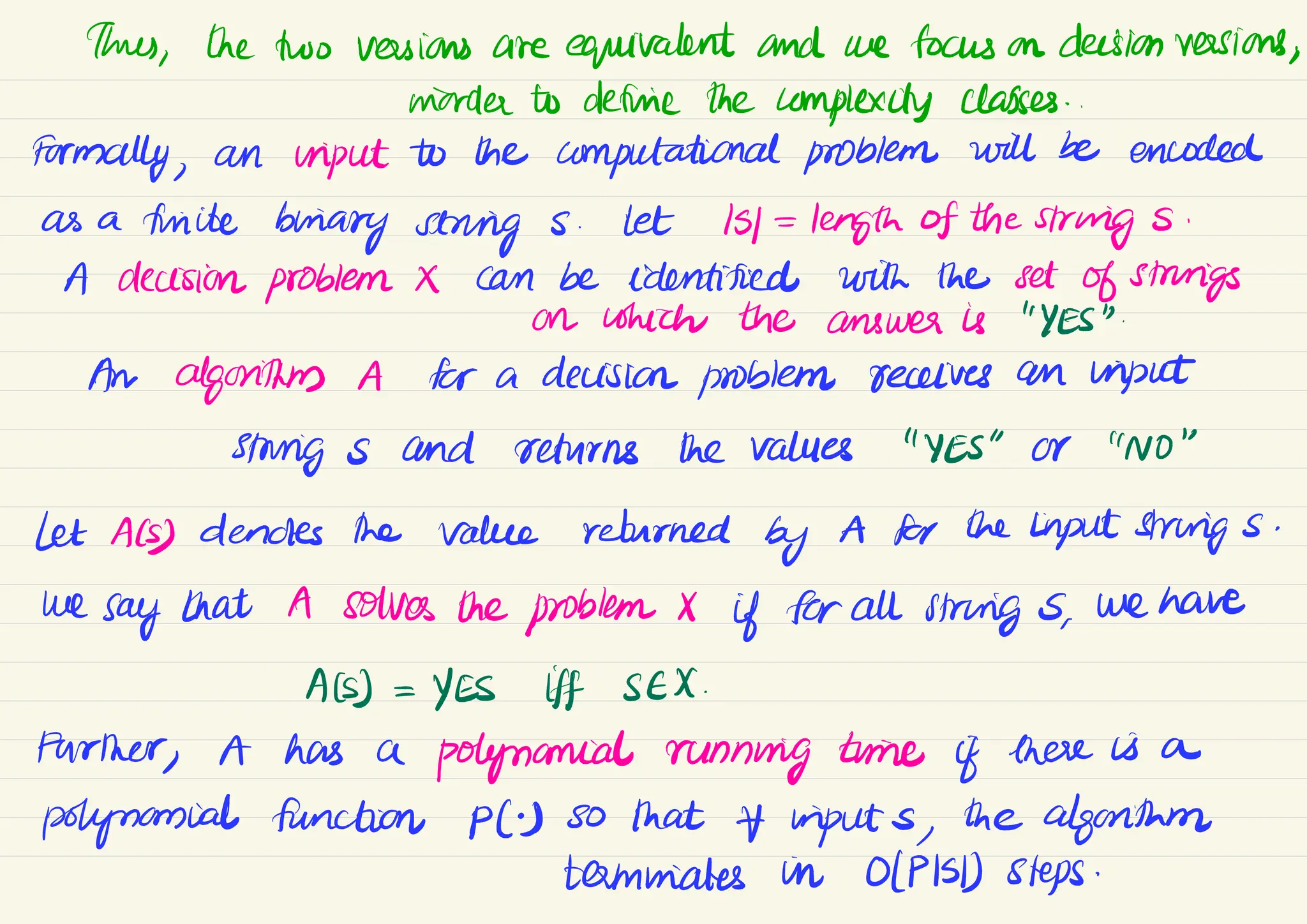
the two versions are equivalent and we focus on decision versions,
morder to define thecomplexity classes
.
Formally,
an input to the computational problem will be encoded
as a finite
binary string s .
Let
Isl =
length of the strings .
A decision problem X can be identified with the set of strings
on which the answer is "YES".
An algorithms A for a decision problem receives an input
stungs and returns the values "YES" Or "NO"
Let Als) dendes the value returned by
A for the Input strings .
we
say that A solves the problem X
if for all string s
,
we have
Als) =
YES If SEX
.
Further
, A has a
polynomial running time if there is a
polynomial function PC) so
that inputs , the algorithm
taminates in OIPISD) steps.
the class
,
O = set
of all problems X for which I an
algorithms A with a
poliponial running time that solves X
.
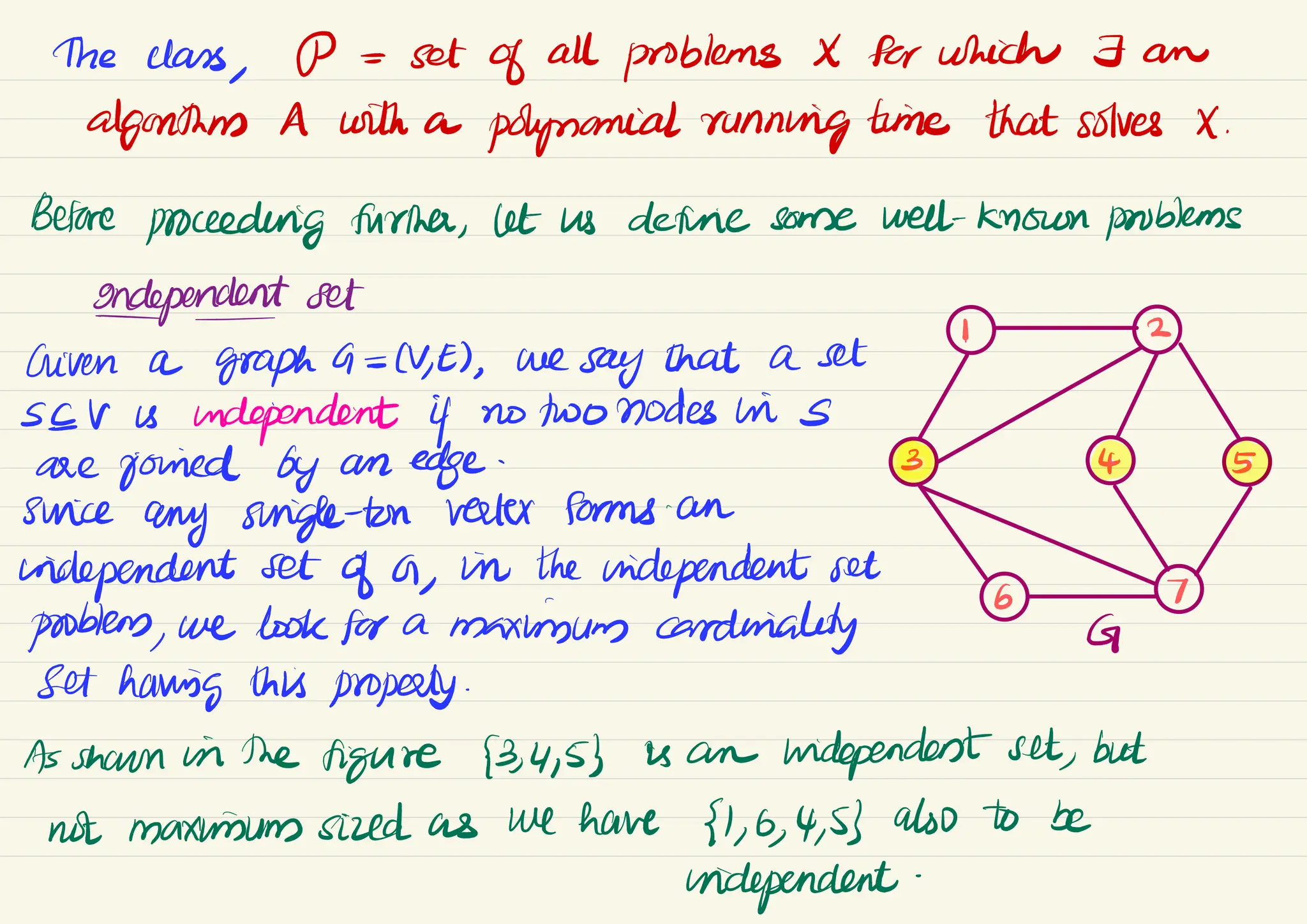
Before proceeding further, let us define same well-known problems
dependent set
Il 2
Given a graph G = (V
,
E),
we
say that a set
SCV is
independent if no two nodes his
are joined by an edge. 3 4 5
swice
any single-ton vertex farmsan
independent set
of G,
in the independent set
6 7
problem,
we look for a maximum cardinality G
set having this property
.
As shar in the figure[3
, 4, 5) is an widependent set,
but
not maximum sized as we have $1,
6
,
4,53 also to be
independent
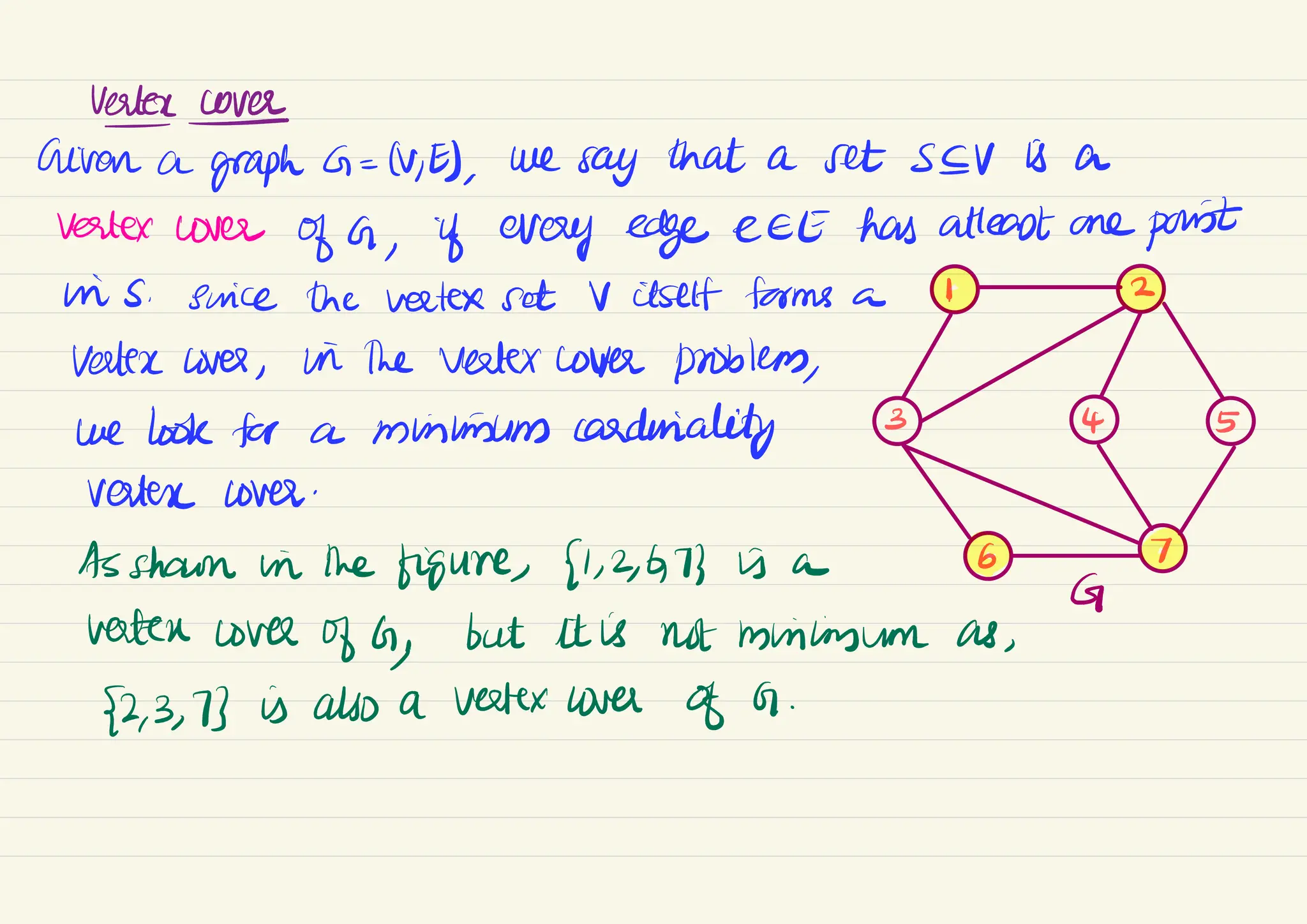
esteveLG = N, E),
we say that a set SEV is a
Vertex cover
of G
, if every edge eEE has atleast are point
his.
swice the vertex set V itself forms a I 2
Velez cover ,
in the Vertex cover problem,
we look for a minimums radicality 3 4 5
Vester cover
.
As shar in the figure, [1,
2
,
6
, 73 is a 6 7
G
raten cover of G
,
but it is not minimum as
,
52,
3, 73 is also a retex cover of G
.
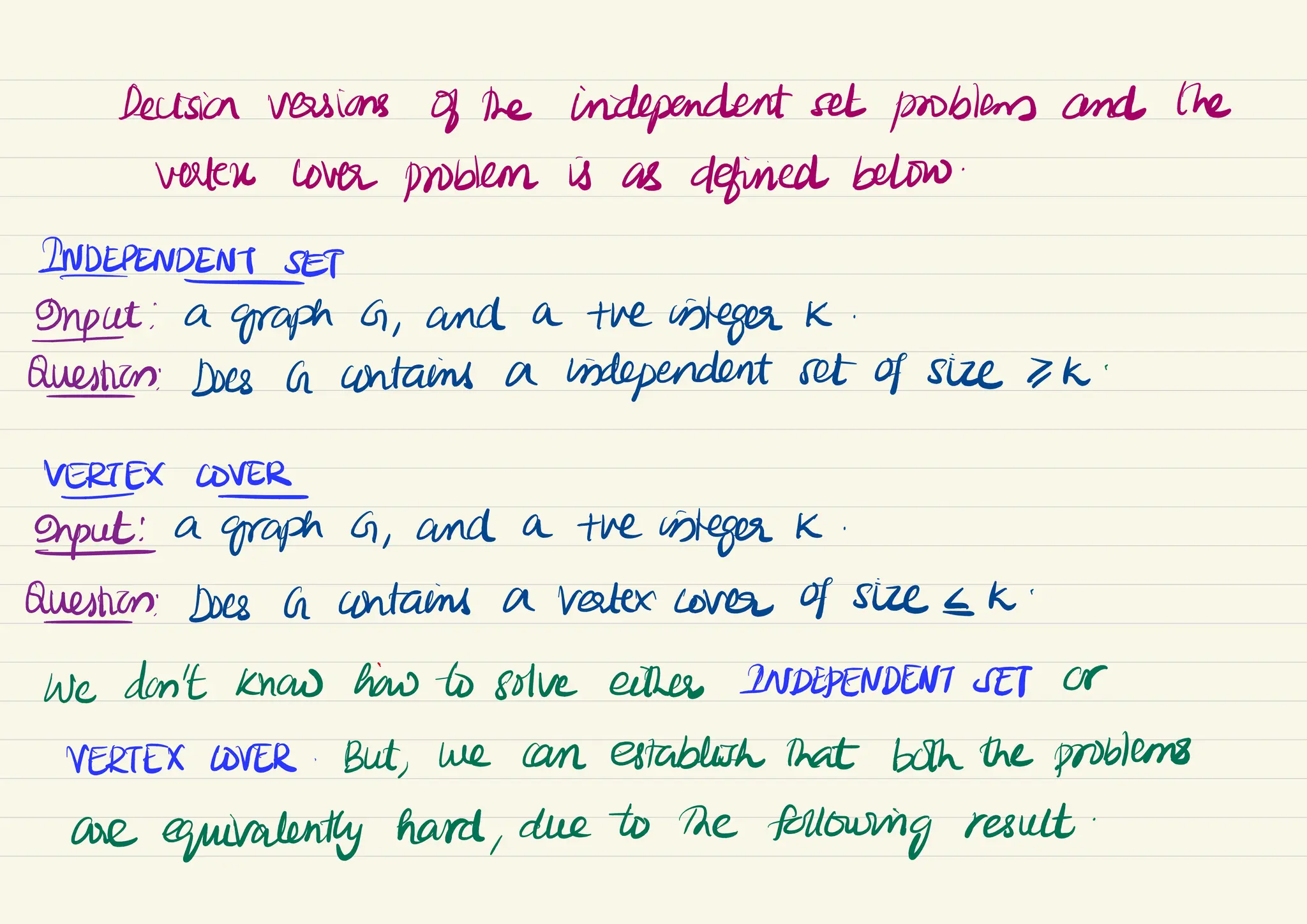
Decision versions of the independent set problems and the
verter cover problem is as defined below
.
INDEPENDENT
SET
Input : a
graph G ,
and a the integer K
.
Question: Does a contains a independent set of size >K.
HERTEXCOVEh G ,
and a the integer K.
Question: Does a contains a Vertex cover of size <K.
We don't know how to solve either INDEPENDENT SET Or
VERTEX LOVER .
But
, we can establish that both the problems
are equivalently hard,
due to the
following result
.
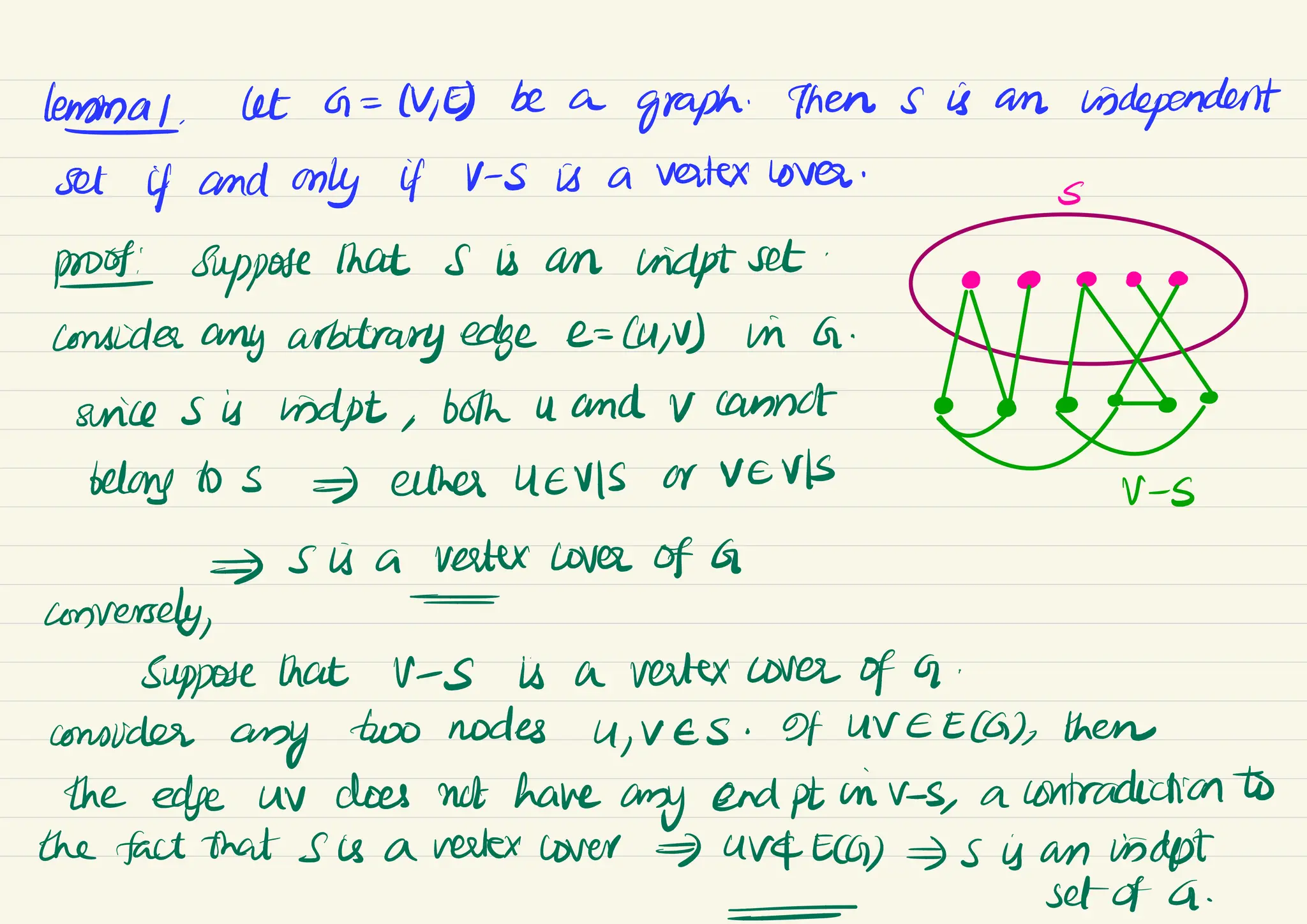
lensal.
Let G = N
, E) be a
graph.
Then s is an
independent
set
if and only if V-S is a vetex cover.
S
prof
:
suppose that s is an kidpt set
.
& 0 o
consider any arbitrary edge e=
(u,v) in G
.
swices is midpt ,
both u and v cannot ① · 00
belong to s > either LEVIS or verls
V-
S
=> S is a vertex
cover of G
conversely,
-
Suppose that V-S is a vertex cover of G
.
consider
any
two modes u,
Ves .
Of UVEE(a), then
the ede ur does not have
any end etinv-s,
a contradiction to
the fact that s is a netex cover -
> uVKECG) =S is an indpt
-
setof G
-
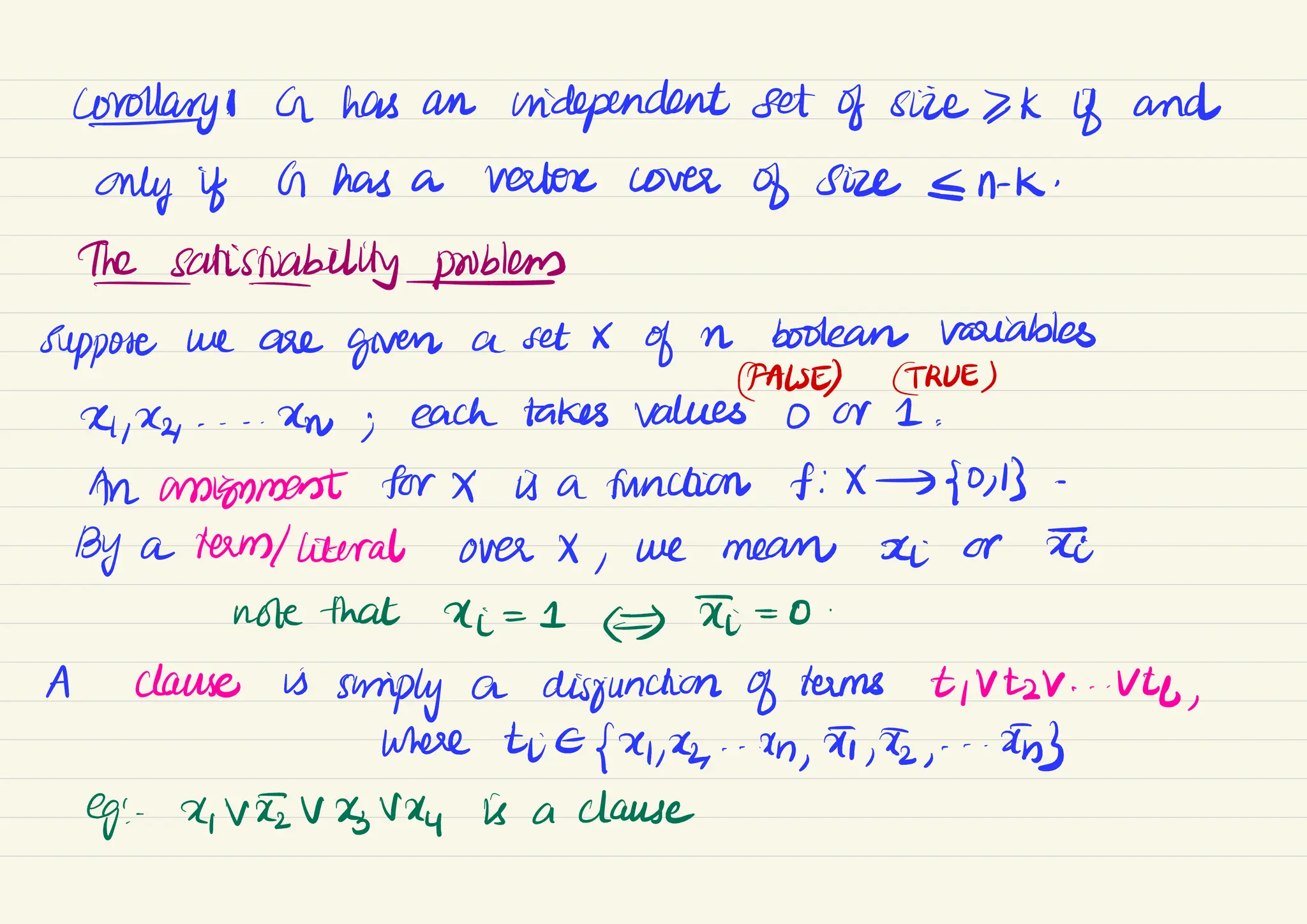
Coronary : G has an independent set of size >K if and
only if G has a verter cover
of size N-K.
the
satisfability/
problems
suppose we are
given a set X
of
a boolean variables
CFALSE) GRUES
14
, -- -
ew ;
each takes values 0 or 1 :
An anignment for X is a function f:X - 50, 13-
By a term/literal over X ,
we mean
ei or ste
note that di = 1
(f I = 0
.
A clause is
smiply a disjunction of terms tivtzV . . . Uty
,
where tre [x,-Un, , ,
- -
an
eg: 1, Vevevey is a clause
A conjuctive normal form (CNF) is a
conjuction of clauses.
GNEM . . .
ACm where each C is a cause.
eg: -
(, ve2) & [Vv) N y)
A CNF formula E is said to be satisfiable If the z an
asignment v :
X-20, 13 st .
F evaluates to
be
eg: -let F= (, VM2) &VRV) & Luy) True.
Then 2 = 0
,
x= 2
, x3 = 0
My= 1 is a
satisfying assignment
of F-
let F =
(x, ve) avct) (, vi) a (T Vez)
has no
satisfying assignment
.
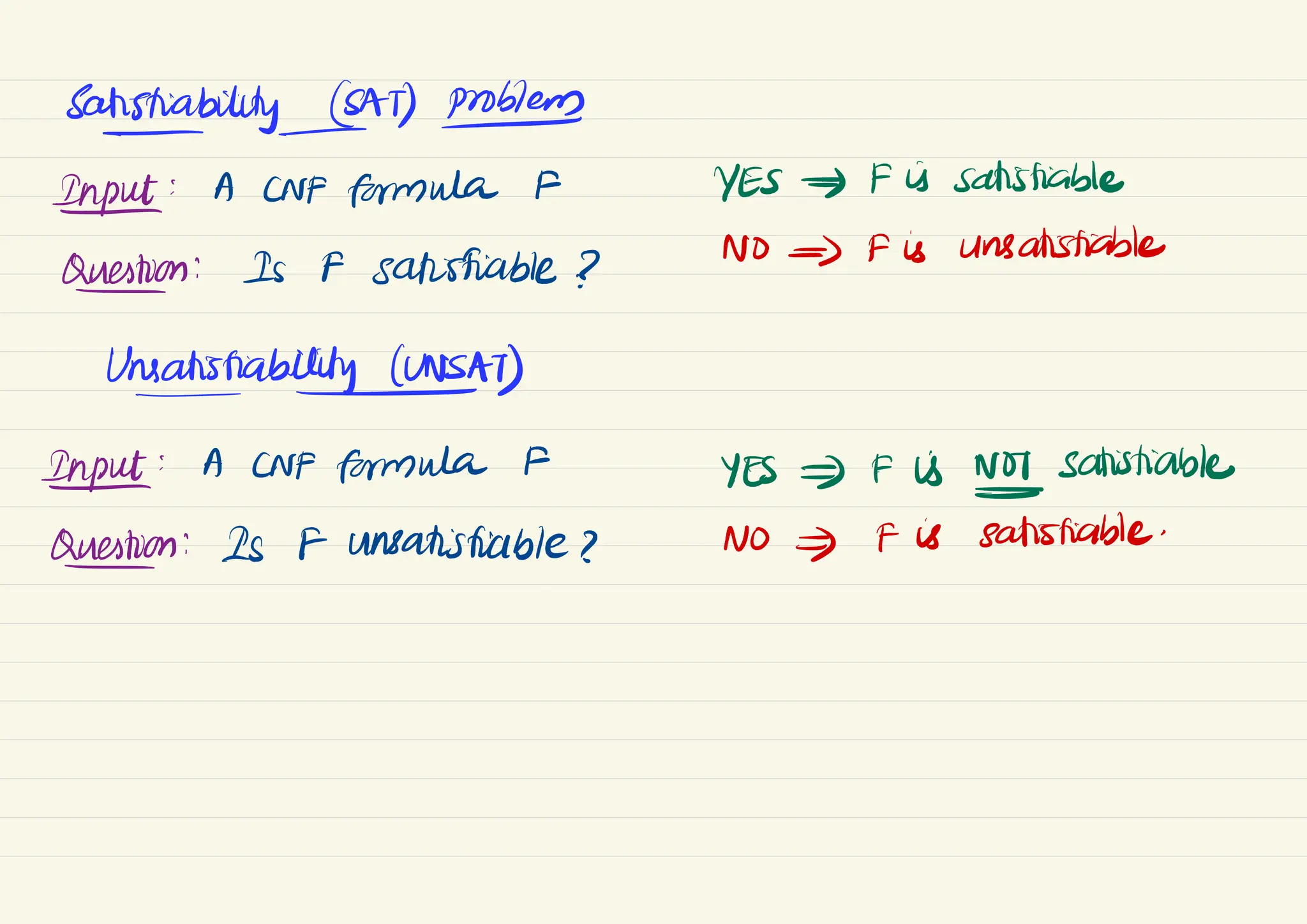
satisfiability-SAT) problem
-
Input : A CNF formula F YES F is satisfiable
No =
> F is unsatisfiable
Question : Is F satisfiable ?
Umatisfiability
(UNSAT)
Input : A CNF formula F YES
= F is satisfiable
Question : Is F unsatisfiable ? No > F is satisfiable.
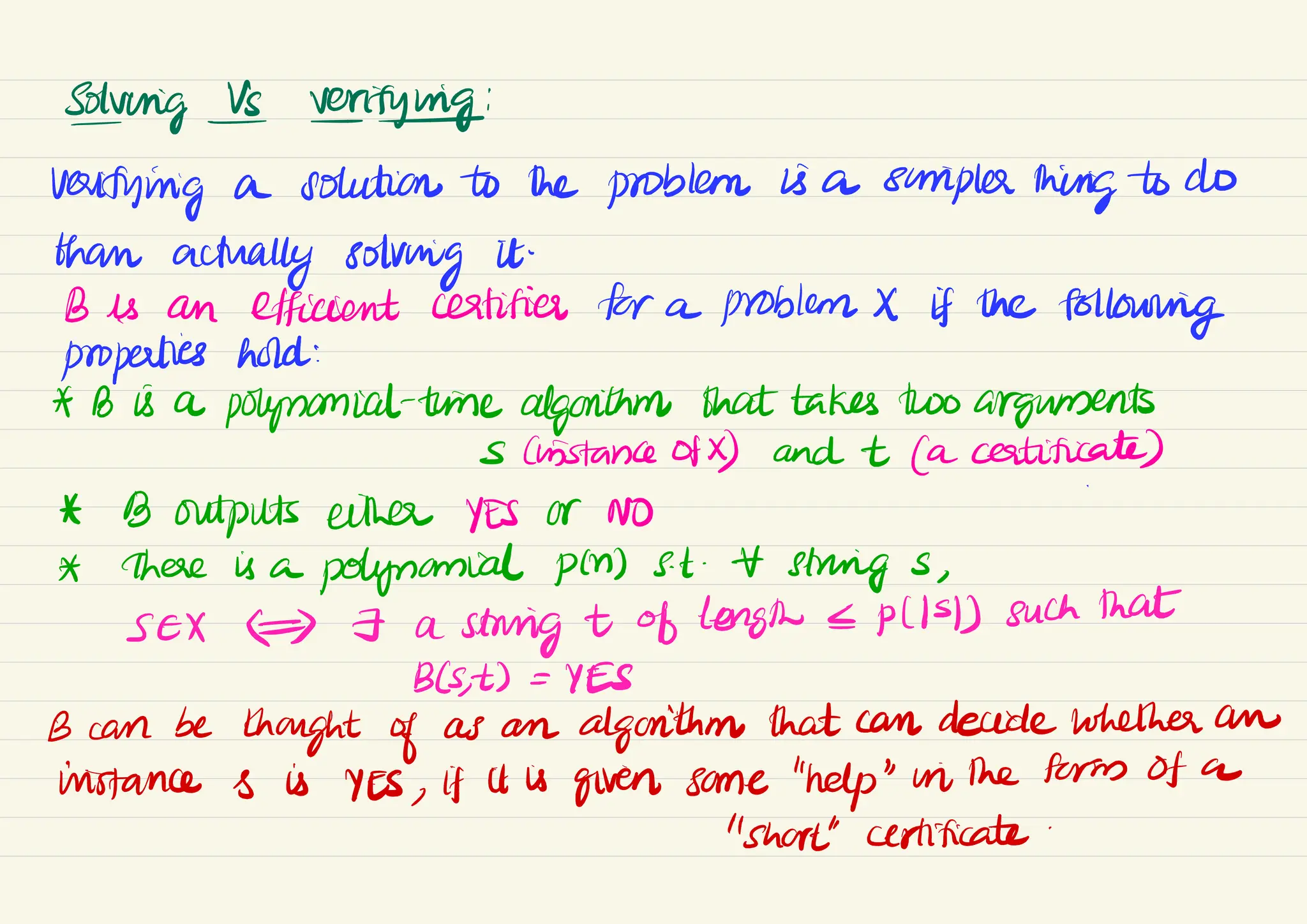
Solving Is verifying:
verifying a solution to the problem is a simpler thing to do
than
actually solving it
.
B is an efficient certifies for a problem X If the
following
properties hold:
* B is a
polynomial-time algorithm that takes two arguments
sChistance of X) and + (a certificate)
&
* B outputs either YES or NO
A there is a
polynomial pin) st . strings ,
seX #) - a
string t of length <P(ISI) such that
B(s
,
t) =
YES
B can be
thought of as an algorithm that can decide whether an
instance s is YES , if it is
given some "help" in the form of a
"short" certificate
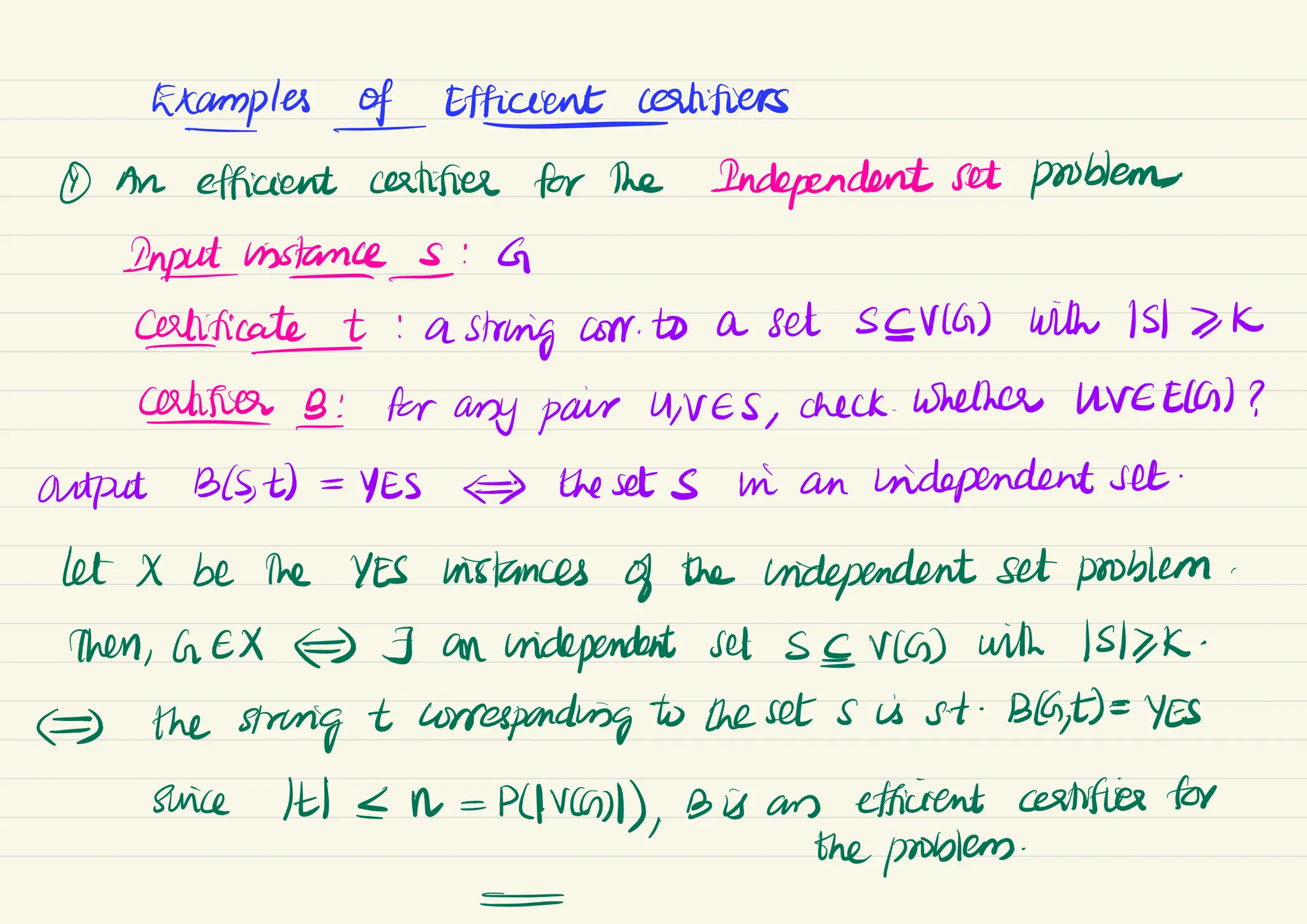
Examples & Efficient
certifiers
① An efficient certifies for the Independent set problem
,
In instances : G
certificate + : a
string corr to a set SEVIG) with 1517K
-
Califier B: for any pair UNES,
check .
Whether UVEECG) ?
output B(S
, t) =
YES
) the sets in an independent set
.
let X be the YES histances of the independent set problem.
then, GEX#) J an independent set SEV(G) with 1SK
/K
-
E) the string t corresponding to the set s is st .
Bla,
t)=
YES
swice It <N =
P(IVC)),
Bis are efficient certifies for
the problem.
-
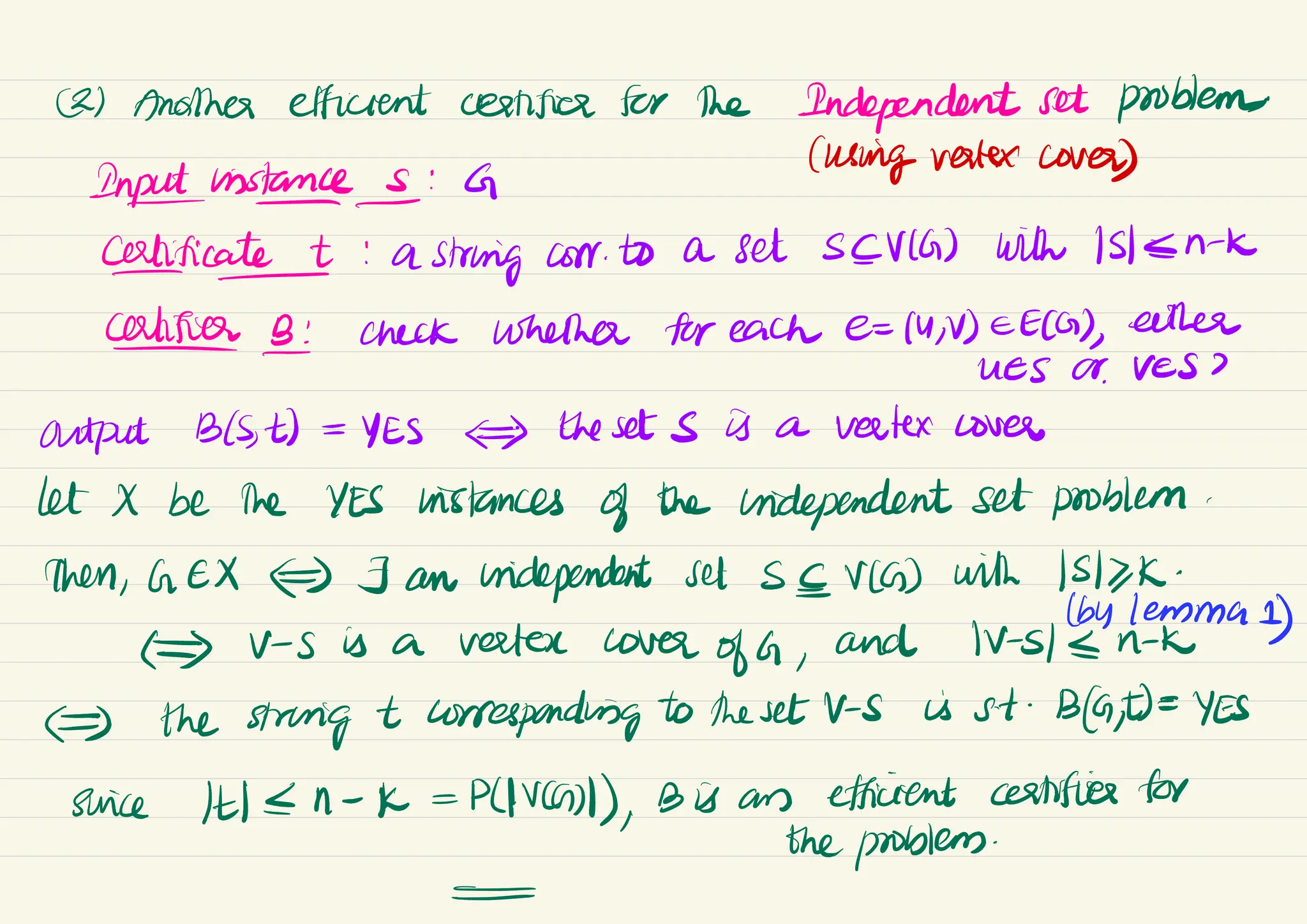
(2) Another efficient certifice for the Independent set problem
,
In instances : G
cusing vertex cover
certificate + : a
string corr to a set S[VIG) with Islen-k
-
Califier B: check whether for each e=
/,
V) EE(G),
either
uts or Vess
output B(S
, t) =
YES
) the sets is a veetex cover
let X be the YES histances of the independent set problem-
then, GEX#) J an independent set SEV(G) with 1SK
/K
-
(by lemma
#) V-S is a verter cover
of h ,
and IV-s/n-k
E) the string + corresponding to theset V-S is st ·
B(a,
t)=
YES
swice It < n- 1 =
P(IVC)),
Bis are efficient certifies for
the problem.
-
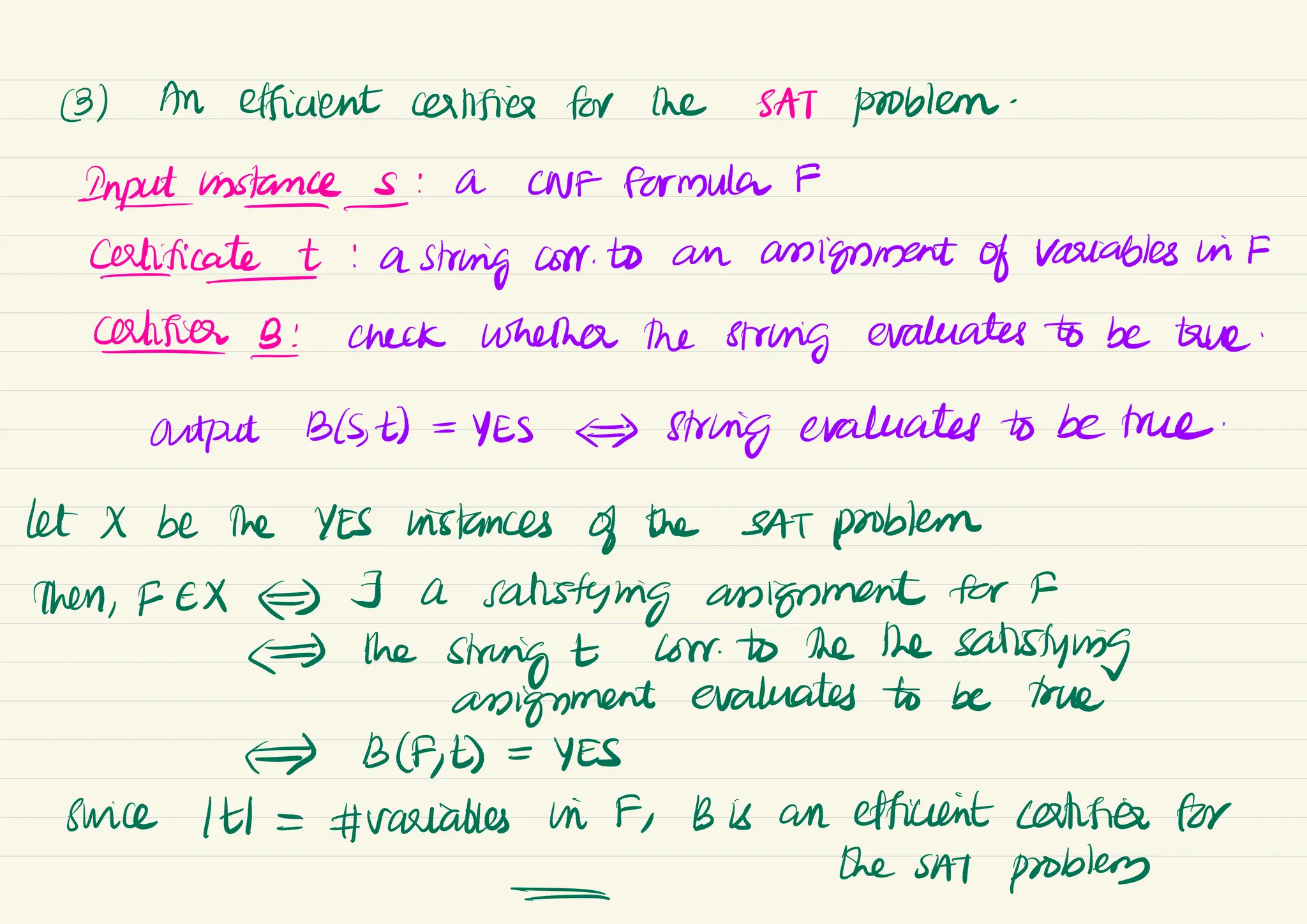
(3) An efficient certifies for the SAT problem-
Instances : a CNF Formula #
certificate : a
string corr to an assignment of variables in F
-
Califier B: check whether the string evaluates to be true
-
output B(St) =
YES
) String evaluates to be true
.
let X be the YES histances of the SAT problem
then, FEX) J a
satisfying angement for F
# the
string t low to the the
satisfying
anignment evaluates to be true
=> B(AE) =
YES
Swice (t =
#variables in F, B is an efficient certifies for
-
the
sA
T problem
-
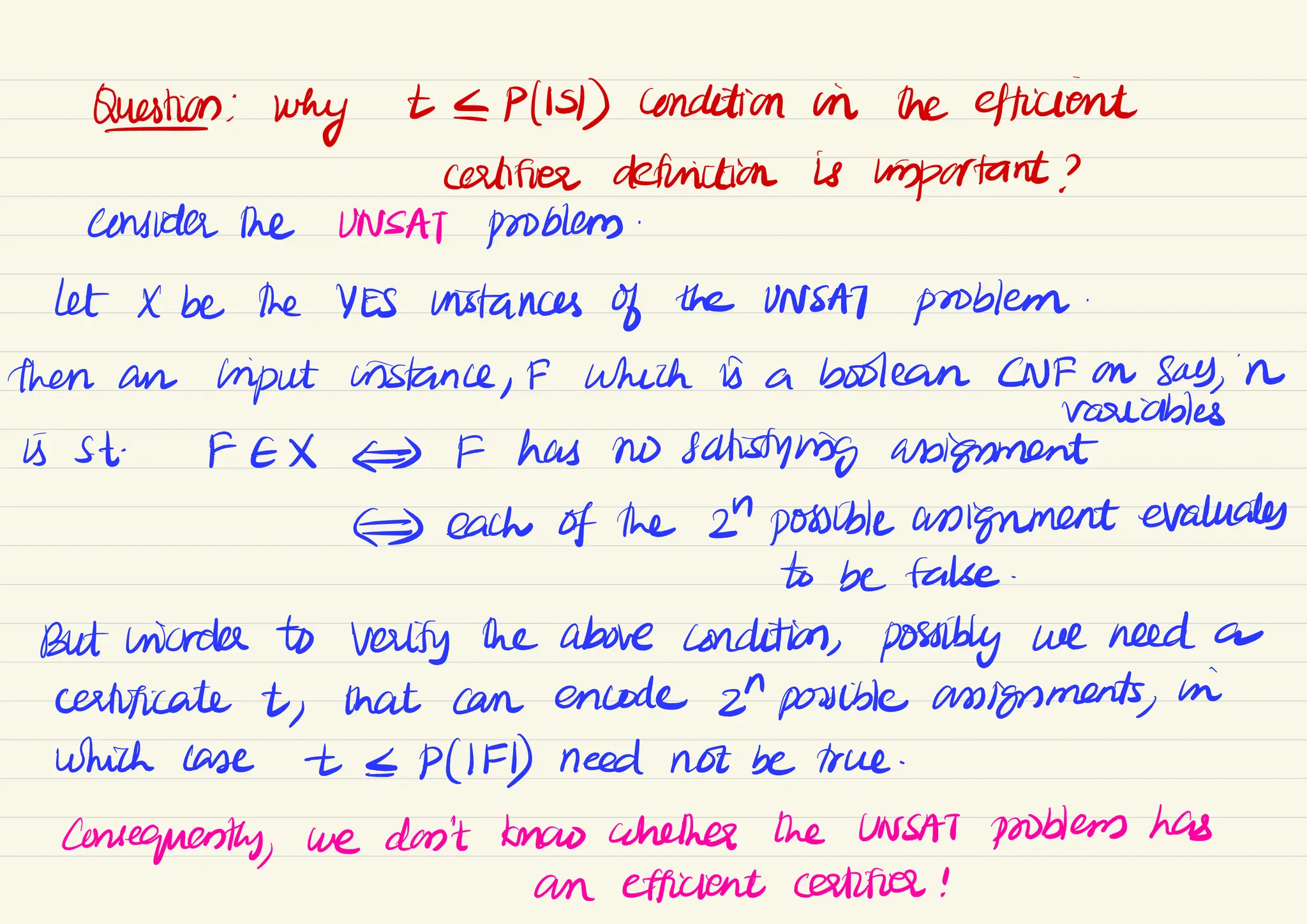
Quan:
why t[P(IS) condition in the efficient
certifies definition is important ?
consider the UNSAT problem.
let X be the YES instances of the UNSAT problem.
then an Input instance,
# which is a boolean CNF on say
,
in
variables
i St.
FEX #S # has no satisfying abigument
= each of the 2" possible assignment evaluates
to be false.
But wades to verify the above condition, possibly we need a
certificate t,
that can encode 2"possible assignments
,
in
which case t & P(IF) need not be true.
consequently,
we don't know whether the UNSAT problems has
an efficient certifies !
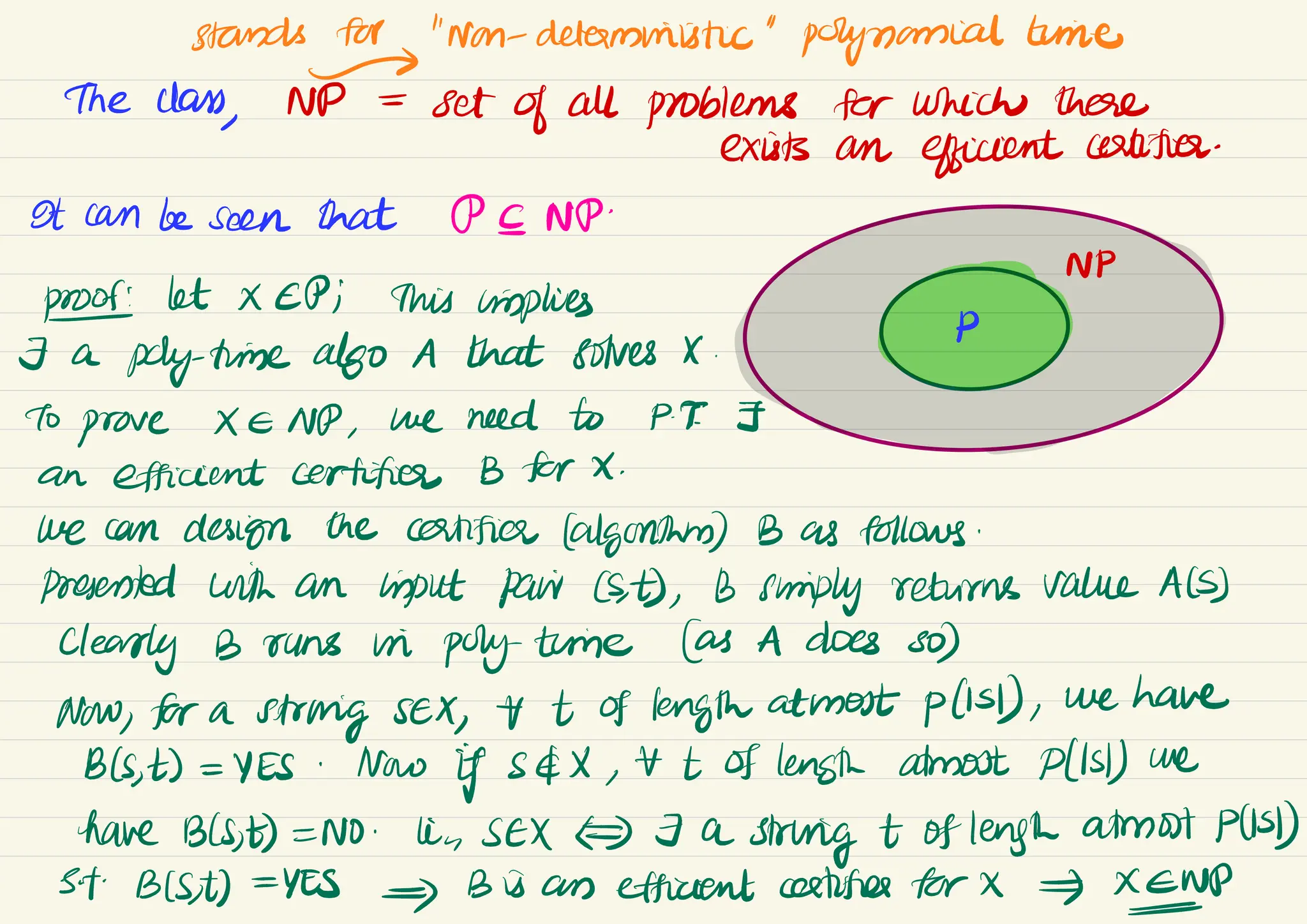
stands for "Non-determistic" polynomial time
-
the clas
,
NP =
set of all problems for which there
exists an
efficient certifies
.
It can be seen that PCNP-
NP
Prof: Let XEP; This implies
P
7 a
poly-time also A that solves X
to
prove XtNP ,
we need to p.
TJ
an efficient certifies B for X
.
we can design the certifies (algorithm) B as follows.
presented with an input Pari (S
,t),
B simply returns value A(S)
clearly B runs in
poly-time (as A does so)
Now, for a
string seX, At of length atmost plis),
we have
B(s
,
t) = YES ·
Now
if SeX ,
At of length almost PlsI) we
have B(SE) = No ·
(in SEX F a
string t of length atmost P(Is)
St.
BISt) =
YES =
) Bis an efficient certifie for X = XENO
-
Question
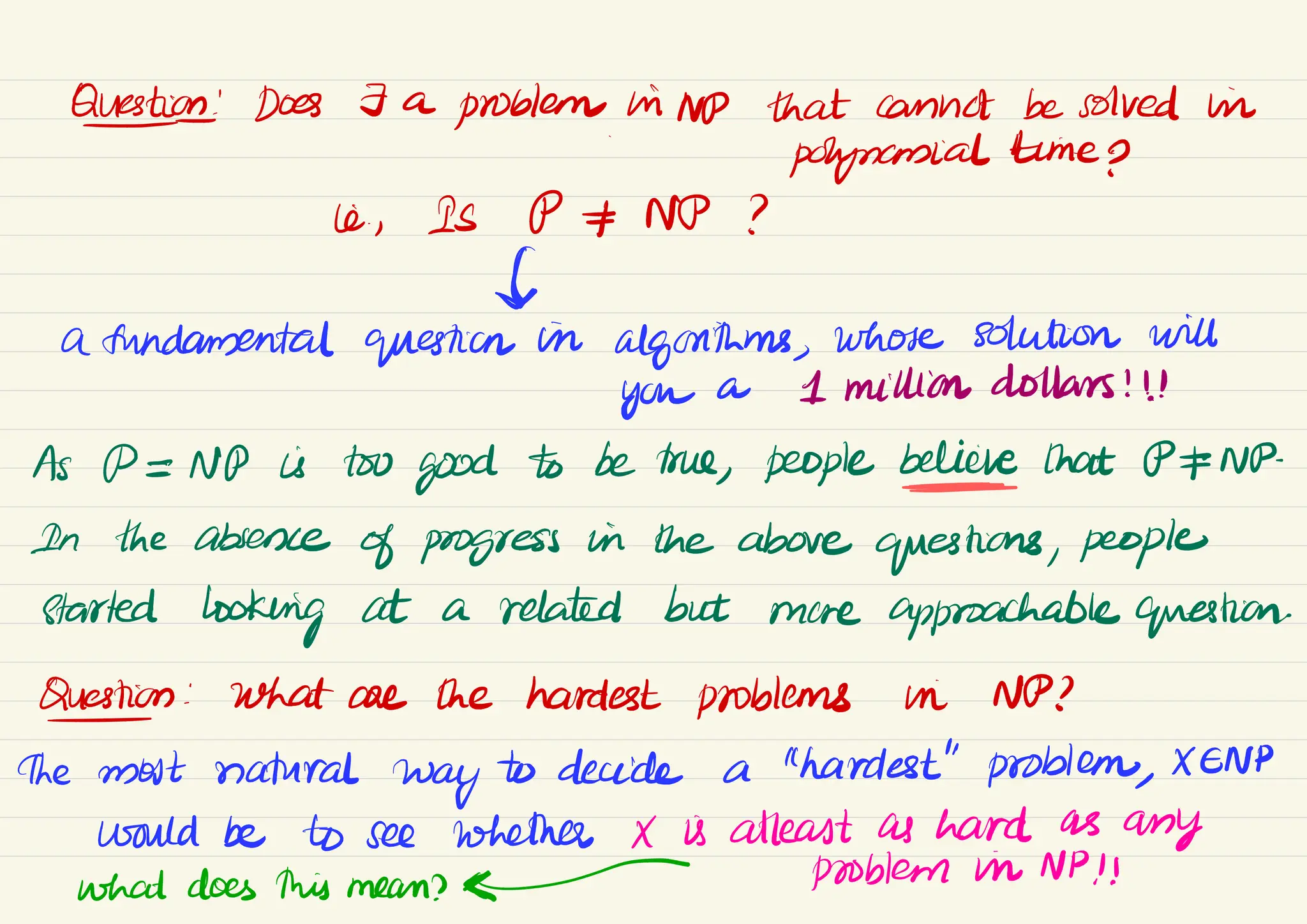
! Does 7 a
problem hiND that cannot be solved in
&
polynomial time p
ic, Is P*NP ?
#
a fundamental question in
algorithms,
whose solution will
you a 1 million dollars !!!
As PENP is two
good to be true, people believe that OENP-
In the absence
of progress in the above
questions, people
started
looking at a related but more approachable question
Question : What are the hardest problems in NP?
-
the most natural
way
to decide a "hardest" problem,
XENP
would be to see whether X is atleast as hard as
any
what does this mean? problem in NP!!

Lect 31_32 NP and Intractability_Part 1.pdf

  • 1.
  • 2.
    what is a computationalproblem? ↳one asks for a solution in terms of an algorithme . set of instances solutions for every > ALGORITHM > instances A we say that a problem is "efficiently solvable" if there exists a polynomial-time algorithm that solves the problem Problems L S optimization problems Decision problems. egi - Given a flow network G, eg: -Given a flow network , an what is the value of integer K , does - a flow of maximum flow ? value 2 , K ? Expected answer : a number Expected answer : YESINO- Question : Are the above two versions of problems equivalents YES !
  • 3.
    Prooffortheequivalence - clearly, if one cansolve an optimization problem (in polynomial time) , then one can answer the decision version of the same problems in polynomial time · Her eg : suppose you know value of max-flow =1 , then to solve the decision version , its enough to check whether KIl or not conversely, by doing a briary search on the bound K , one can transform a polynomial-time answer to the decision version of the problem to an answer to the optimization version of the same problem in polynomial time. eg!- Suppose you know how to solve the decision version of flaw in poly-time. Now, to solve the optimization version from this , we do the following . As max flaw value 11 = C , do a binary search - ie, first run ( eoutofs the decision version also for K= C . If Answer is YES, return 1 = c , else update K = and run the algo again . If answer is YES , then leCE, C) ele le11, 2),and som .... By running the decision also for flow log times , ' we can solve the optimistication version of flow.
  • 4.
    thus, the two versionsare equivalent and we focus on decision versions, morder to define thecomplexity classes . Formally, an input to the computational problem will be encoded as a finite binary string s . Let Isl = length of the strings . A decision problem X can be identified with the set of strings on which the answer is "YES". An algorithms A for a decision problem receives an input stungs and returns the values "YES" Or "NO" Let Als) dendes the value returned by A for the Input strings . we say that A solves the problem X if for all string s , we have Als) = YES If SEX . Further , A has a polynomial running time if there is a polynomial function PC) so that inputs , the algorithm taminates in OIPISD) steps.
  • 5.
    the class , O =set of all problems X for which I an algorithms A with a poliponial running time that solves X . Before proceeding further, let us define same well-known problems dependent set Il 2 Given a graph G = (V , E), we say that a set SCV is independent if no two nodes his are joined by an edge. 3 4 5 swice any single-ton vertex farmsan independent set of G, in the independent set 6 7 problem, we look for a maximum cardinality G set having this property . As shar in the figure[3 , 4, 5) is an widependent set, but not maximum sized as we have $1, 6 , 4,53 also to be independent
  • 6.
    esteveLG = N,E), we say that a set SEV is a Vertex cover of G , if every edge eEE has atleast are point his. swice the vertex set V itself forms a I 2 Velez cover , in the Vertex cover problem, we look for a minimums radicality 3 4 5 Vester cover . As shar in the figure, [1, 2 , 6 , 73 is a 6 7 G raten cover of G , but it is not minimum as , 52, 3, 73 is also a retex cover of G .
  • 7.
    Decision versions ofthe independent set problems and the verter cover problem is as defined below . INDEPENDENT SET Input : a graph G , and a the integer K . Question: Does a contains a independent set of size >K. HERTEXCOVEh G , and a the integer K. Question: Does a contains a Vertex cover of size <K. We don't know how to solve either INDEPENDENT SET Or VERTEX LOVER . But , we can establish that both the problems are equivalently hard, due to the following result .
  • 8.
    lensal. Let G =N , E) be a graph. Then s is an independent set if and only if V-S is a vetex cover. S prof : suppose that s is an kidpt set . & 0 o consider any arbitrary edge e= (u,v) in G . swices is midpt , both u and v cannot ① · 00 belong to s > either LEVIS or verls V- S => S is a vertex cover of G conversely, - Suppose that V-S is a vertex cover of G . consider any two modes u, Ves . Of UVEE(a), then the ede ur does not have any end etinv-s, a contradiction to the fact that s is a netex cover - > uVKECG) =S is an indpt - setof G -
  • 9.
    Coronary : Ghas an independent set of size >K if and only if G has a verter cover of size N-K. the satisfability/ problems suppose we are given a set X of a boolean variables CFALSE) GRUES 14 , -- - ew ; each takes values 0 or 1 : An anignment for X is a function f:X - 50, 13- By a term/literal over X , we mean ei or ste note that di = 1 (f I = 0 . A clause is smiply a disjunction of terms tivtzV . . . Uty , where tre [x,-Un, , , - - an eg: 1, Vevevey is a clause
  • 10.
    A conjuctive normalform (CNF) is a conjuction of clauses. GNEM . . . ACm where each C is a cause. eg: - (, ve2) & [Vv) N y) A CNF formula E is said to be satisfiable If the z an asignment v : X-20, 13 st . F evaluates to be eg: -let F= (, VM2) &VRV) & Luy) True. Then 2 = 0 , x= 2 , x3 = 0 My= 1 is a satisfying assignment of F- let F = (x, ve) avct) (, vi) a (T Vez) has no satisfying assignment .
  • 11.
    satisfiability-SAT) problem - Input :A CNF formula F YES F is satisfiable No = > F is unsatisfiable Question : Is F satisfiable ? Umatisfiability (UNSAT) Input : A CNF formula F YES = F is satisfiable Question : Is F unsatisfiable ? No > F is satisfiable.
  • 12.
    Solving Is verifying: verifyinga solution to the problem is a simpler thing to do than actually solving it . B is an efficient certifies for a problem X If the following properties hold: * B is a polynomial-time algorithm that takes two arguments sChistance of X) and + (a certificate) & * B outputs either YES or NO A there is a polynomial pin) st . strings , seX #) - a string t of length <P(ISI) such that B(s , t) = YES B can be thought of as an algorithm that can decide whether an instance s is YES , if it is given some "help" in the form of a "short" certificate
  • 13.
    Examples & Efficient certifiers ①An efficient certifies for the Independent set problem , In instances : G certificate + : a string corr to a set SEVIG) with 1517K - Califier B: for any pair UNES, check . Whether UVEECG) ? output B(S , t) = YES ) the sets in an independent set . let X be the YES histances of the independent set problem. then, GEX#) J an independent set SEV(G) with 1SK /K - E) the string t corresponding to the set s is st . Bla, t)= YES swice It <N = P(IVC)), Bis are efficient certifies for the problem. -
  • 14.
    (2) Another efficientcertifice for the Independent set problem , In instances : G cusing vertex cover certificate + : a string corr to a set S[VIG) with Islen-k - Califier B: check whether for each e= /, V) EE(G), either uts or Vess output B(S , t) = YES ) the sets is a veetex cover let X be the YES histances of the independent set problem- then, GEX#) J an independent set SEV(G) with 1SK /K - (by lemma #) V-S is a verter cover of h , and IV-s/n-k E) the string + corresponding to theset V-S is st · B(a, t)= YES swice It < n- 1 = P(IVC)), Bis are efficient certifies for the problem. -
  • 15.
    (3) An efficientcertifies for the SAT problem- Instances : a CNF Formula # certificate : a string corr to an assignment of variables in F - Califier B: check whether the string evaluates to be true - output B(St) = YES ) String evaluates to be true . let X be the YES histances of the SAT problem then, FEX) J a satisfying angement for F # the string t low to the the satisfying anignment evaluates to be true => B(AE) = YES Swice (t = #variables in F, B is an efficient certifies for - the sA T problem -
  • 16.
    Quan: why t[P(IS) conditionin the efficient certifies definition is important ? consider the UNSAT problem. let X be the YES instances of the UNSAT problem. then an Input instance, # which is a boolean CNF on say , in variables i St. FEX #S # has no satisfying abigument = each of the 2" possible assignment evaluates to be false. But wades to verify the above condition, possibly we need a certificate t, that can encode 2"possible assignments , in which case t & P(IF) need not be true. consequently, we don't know whether the UNSAT problems has an efficient certifies !
  • 17.
    stands for "Non-determistic"polynomial time - the clas , NP = set of all problems for which there exists an efficient certifies . It can be seen that PCNP- NP Prof: Let XEP; This implies P 7 a poly-time also A that solves X to prove XtNP , we need to p. TJ an efficient certifies B for X . we can design the certifies (algorithm) B as follows. presented with an input Pari (S ,t), B simply returns value A(S) clearly B runs in poly-time (as A does so) Now, for a string seX, At of length atmost plis), we have B(s , t) = YES · Now if SeX , At of length almost PlsI) we have B(SE) = No · (in SEX F a string t of length atmost P(Is) St. BISt) = YES = ) Bis an efficient certifie for X = XENO -
  • 18.
    Question ! Does 7a problem hiND that cannot be solved in & polynomial time p ic, Is P*NP ? # a fundamental question in algorithms, whose solution will you a 1 million dollars !!! As PENP is two good to be true, people believe that OENP- In the absence of progress in the above questions, people started looking at a related but more approachable question Question : What are the hardest problems in NP? - the most natural way to decide a "hardest" problem, XENP would be to see whether X is atleast as hard as any what does this mean? problem in NP!!