Dr. Farid Ghrayeb
3-2
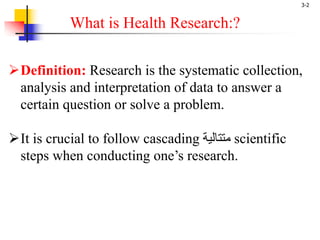
What is Health Research:?
ØDefinition: Research is the systematic collection,
analysis and interpretation of data to answer a
certain question or solve a problem.
ØIt is crucial to follow cascading ‫ةللاتتم‬ scientific
steps when conducting one’s research.
3-3
Purpose of Research
It is a scientific process that:
•validate and refine existing knowledge and/or
•generate new knowledge about issues of importance to the
nursing profession including:
- nursing practice,
- education,
- administration, and
- informatics to improve clinical practice.
‫تل‬ ‫قق‬ ‫نم‬ ‫ةحق‬ ‫صو‬ ‫قق‬ ‫نم‬ ‫ةفر‬ ‫ئاقق‬ ‫ل‬ ‫تو‬ ‫توايديل‬ ‫را‬ ‫توا‬ ‫وحي‬ ‫وئ‬ ‫تاي‬ ‫توث‬ ‫قتي‬ ‫توا‬ ‫وأثر‬ ‫أيي‬ ‫نم‬ ‫يثش‬ ‫وي‬
‫ا‬ ‫لح‬ ‫تويي‬
3-4
Objectives of Research
The three objectives of research are:
§ to conduct a general exploration of the issue,
§ to describe a population, and
§ to attribute cause and affect relationships
among two or more variables
3-5
categories of Research
categories of research design are:
1. exploratory,
2. descriptive and
3. causal.
3-6
Importance of Research
§ Reason 1: Research Adds Knowledge About Educational
Issues
n Addresses gaps in knowledge
n Expands knowledge
n Adds voices of individuals to knowledge
§ Reason 2: Research Helps Improve Practice
n Educators gain new ideas
n Educators gain new insight into methods
n Educators gain new insight into students
§ Reason 3: Research Informs Policy Debates
n Research helps people weigh different perspectives on issues
n Research helps people make informed decisions regarding policy
§ Reason 4: Research Builds Student Research Skills
n Organizational skills, analytical skills, writing skills, presentation skills
3-7
Research Spiral or Process:
Selection of Research Area
3-8
Research Spiral or Process:
Selection of Research Area
n Selection of this broad entity of research is
based on the following:
n researcher’s:
n Specialty
n Interest
n Scientific background
n Experience
n Actual need for research in this area
n Available resources (interest of funding body)
3-9
Research Spiral or Process:
Selection of Research Area
The priority of a topic for research depends on:
n The characteristics of the problem (topic):
n Impact on health:
n Magnitude
n Seriousness
n Preventability
n Curability
n Available interventions
n Proposed solutions
n The characteristics of the proposed study:
n Feasibility
n Cost-effectiveness
n Applicability of the results
3-10
Research Spiral:
Reviewing the Literature
Development of the literature review requires four stages:
n Problem formulation—which topic or field is being
examined and what are its component issues?
n Literature search—finding materials relevant to the subject
being explored
n Data evaluation—determining which literature makes a
significant contribution to the understanding of the topic
n Analysis and interpretation—discussing the findings and
conclusions of pertinent literature
3-11
Research Spiral:
Sources of Literature
Journal articles:
n these are good sources, especially for up-to-date
information. They are frequently used in literature
reviews because they offer a relatively concise, up-to-
date format for research.
n Depending on the publication, these materials may be
refereed materials.
3-12
Research Spiral:
Sources of Literature
Books:
§ Remember that books tend to be less up-to-date, as it
takes longer for a book to be published than for a
journal article.
§ They are still likely to be useful for including in your
literature review as they offer a good starting point
from which to find more detailed and up-to-date
sources of information.
3-13
Research Spiral:
Sources of Literature
Conference proceedings:
§ These can be useful in providing the latest research,
or research that has not been published.
§ They are also helpful in providing information about
people in different research areas, and so can be
helpful in tracking down other work by the same
researchers.
3-14
Research Spiral:
Sources of Literature
Government/corporate reports:
n Many government departments and corporations
commission carry out research.
n Their published findings can provide a useful source
of information, depending on your field of study.
3-15
Research Spiral:
Sources of Literature
Theses and dissertations: these can be useful sources of
information. However there are disadvantages:
n they can be difficult to obtain since they are not
published, but are generally only available from the
library or interlibrary systems
n the student who carried out the research may not be
an experienced researcher and therefore you might
have to treat their findings with more caution than
published research.
3-16
Research Spiral:
Sources of Literature
Internet: the fastest-growing source of information is on
the Internet.
n bear in mind that anyone can post information on the
Internet so the quality may not be reliable
n the information you find may be intended for a
general audience and so not be suitable for inclusion
in your literature review (information for a general
audience is usually less detailed)
3-17
Research Spiral:
Reviewing the Literature
Relevant literature refers to those sources that are pertinent or highly
important in providing the in-depth knowledge needed to study a selected
problem. This background enables the researcher to build on the work of
others and to avoid unnecessary and redundant work.
• It prevents you from duplicating work that has been done before.
• It helps you to find out what others have learned and reported on the
problem you want to study. This may assist you in refining your statement
of the problem.
• Bring clarity and focus to your research problem
• Improve your methodology
• Broaden your knowledge
• interpretation your findings
• i.e., To generate a picture of what is known about a particular situation and
the knowledge gaps that exist in it, researchers conduct a review of relevant
literature.
3-18
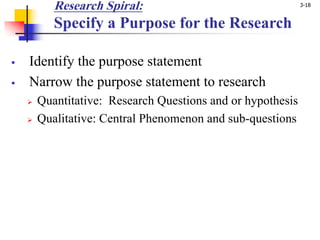
Research Spiral:
Specify a Purpose for the Research
§ Identify the purpose statement
§ Narrow the purpose statement to research
Ø Quantitative: Research Questions and or hypothesis
Ø Qualitative: Central Phenomenon and sub-questions
3-19
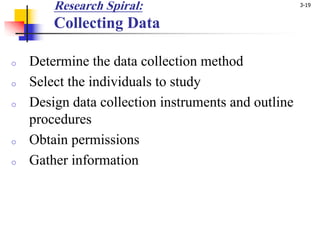
Research Spiral:
Collecting Data
o Determine the data collection method
o Select the individuals to study
o Design data collection instruments and outline
procedures
o Obtain permissions
o Gather information
3-20
Research Spiral:
Analyzing and Interpreting Data
§ Breaking down the data
§ Representing the data
§ Explaining the data
3-21
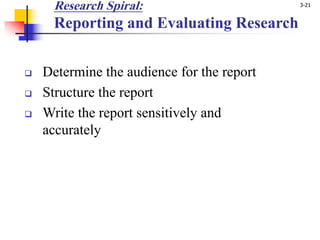
Research Spiral:
Reporting and Evaluating Research
q Determine the audience for the report
q Structure the report
q Write the report sensitively and
accurately
3-22
Major Types of Research
§ Descriptive research
§ Analytical research
§ Applied research
§ Basic research
§ Correlational research
§ Ethnographic research
§ Experimental research
§ Exploratory research
§ Grounded theory research
§ Historical research
§ Phenomenological research
3-23
Descriptive Research
§ Descriptive research refers to research that provides an accurate
portrayal of characteristics ‫راوتم‬ ‫ت‬ ‫تي‬ ‫ل‬ ‫ةيصاخ‬ of a particular
individual, situation, or group. Descriptive research, also known
as statistical research.
§ Purpose is the description of the state of affairs as it exists in
present
§ These studies are a means of discovering new meaning,
§ describing what exists, determining the frequency with which
something occurs, and categorizing information.
For example,
• finding the most frequent disease that affects the children of a town.
The reader of the research will know what to do to prevent that
disease thus, more people will live a healthy life.
3-24
Descriptive Research
Advantages:
§ The people individual studied are unaware so they act naturally or
as they usually do in everyday situation;
§ It is less expensive and time consuming than quantitative
experiments;
§ Collects a large amount of notes for detailed studying;
§ As it is used to describe and not make any conclusions it is to start
the research with it;
Disadvantages
• Descriptive research requires more skills.
• Does not identify cause behind a phenomenon
• Response rate is low in this research.
• Results of this research can change over the period of time.
3-25
Analytical Research
§ Involves in-depth study and evaluation of available
information in an attempt to explain complex
phenomenon
§ The researcher has to use facts or information already
available and analyze these to make a critical evaluation
of the material
Subdivisions of Analytical Research
ü Historical Research
ü Philosophical Research
ü Research synthesis (meta analysis i.e. analysis of the
review already published)
3-26
Applied / Action Research
1. To solve a current problem faced by the manager in
the work setting. Such research is called applied
research.
§ For example, Apple’s iPod sales increased by 200%
from 2001 to 2008. but the sales decreased by 6% in
2009. What is the reason for this decrease?
§ The question is: what will apple do about this problem?
3-27
Pure/Basic/Fundamental research
§ To generate a body of knowledge about how to solve problems
that could be occurred in organizations. This is called basic
research or fundamental research. It is also known as pure
research.
§ For example, University professors engage in basic research
in an effort to understand and generate more knowledge about
various aspects of businesses, such as:
- How to improve the effectiveness of information
systems.
- How to integrate technology into the overall
strategic objectives of an organization.
- How to increase the productivity of the employees.
- How to increase the effectiveness of small businesses.
§ These findings later become useful for application in business
situations.
3-28
Distinction Between Applied and Basic Research
q The main distinction between applied and basic
business research is:
ü Applied research is specifically aimed at solving a
currently experienced problem.
ü Basic research has a broader objective of generating
knowledge and understanding of phenomena and
problems that occur in various organizational settings.
Ø Both types of research follow the same steps of
systematic inquiry to arrive at solutions to problems.
3-29
CORRELATIONAL RESEARCH
Correlational research refers to the systematic
investigation or statistical study of relationships among two
or more variables, without necessarily determining cause and
effect.
It Seeks to establish a relation/association/correlation between two or
more variables that do not readily lend themselves to experimental
manipulation.
For example, to test the hypothesis “ Listening to music lowers
blood pressure levels” there are 2 ways of conducting research
• Experimental – group samples and make one group listen to music
and then compare the blood pressure levels
• Survey – ask people how they feel ? How often they listen? And
3-30
CORRELATIONAL RESEARCH
Advantages:
1. Can collect much information from many subjects at one time.
2. Can study a wide range of variables and their interrelations.
3. Study variables that are not easily produced in the laboratory.
Disadvantages:
§ Correlation does not indicate causation( cause and effect).
§ Problems with self-report method .
3-31
ETHNOGRAPHIC RESEARCH
Ethnographic research refer to the investigation of a culture
through an in-depth study of the members of the culture; it involves
the systematic collection, description, and analysis of data for
development of theories of cultural behavior.
§ It studies people, ethnic groups and other ethnic formations, their
ethno genesis, composition, resettlement, social welfare
characteristics, as well as their material and spiritual culture.
§ Data collection is often done through participant observation,
interviews, questionnaires, etc.
§ The purpose of ethnographic research is to attempt to understand
what is happening naturally in the setting and to interpret the data
gathered to see what implications could be formed from the data.
3-32
EXPLORATORY RESEARCH
Exploratory research is a type of research conducted for a
problem that has not been clearly defined. Exploratory
research helps determine the best research design, data
collection method and selection of subjects.
ü The results of exploratory research are not usually useful for
decision-making by themselves, but they can provide significant
insight into a given situation.
ü Exploratory research is not typically generalizable to the
population at large.
3-33
GROUNDED THEORY RESEARCH
Grounded theory research is a research approach designed to
discover what problems exist in a given social environment and how
the persons involved handle them; it involves formulation, testing,
and reformulation of propositions until a theory is developed.
Ø Grounded theory is a research method that operates almost in a reverse fashion
from traditional research and at first may appear to be in contradiction to the
scientific method.
3-34
HISTORICAL RESEARCH
Historical research is research involving analysis of events that
occurred in the remote or recent past.
Application
ü Historical research can show patterns that occurred in the past and over time
which can help us to see where we came from and what kinds of solutions we
have used in the past.
ü Understanding this can add perspective on how we examine current events and
educational practices.
The steps involved in the conduct of historical research
Here are the five steps:
1. Identification of the research topic and formulation of the research problem or
question.
2. Data collection or literature review
3. Evaluation of materials
4. Data synthesis
5. Report preparation or preparation of the narrative exposition
3-35
PHENOMENLOGICAL RESEARCH
Phenomenological research an inductive, descriptive research
approach developed from phenomenological philosophy; its aim is to
describe an experience as it is actually lived by the person.
• Phenomenology is concerned with the study of experience from
the perspective of the individual, ‘bracketing’ taken-forgranted
assumptions and usual ways of perceiving.
• They are based in a paradigm of personal knowledge and
subjectivity, and emphasize the importance of personal perspective
and interpretation.
• As such they are powerful for understanding subjective
experience, gaining insights into people’s motivations and actions,
and cutting through the clutter of taken-for-granted assumptions
and conventional wisdom.
3-36
On a broader perspective, all researches
can be classified into two groups:
ü Quantitative Research
ü Qualitative Research
3-37
Quantitative Research
Quantitative research refers to the systematic empirical
investigation of any phenomena via statistical, mathematical or
computational techniques. The objective of quantitative research is to
develop and employ mathematical models, theories and/or
hypotheses pertaining ‫لم‬ ‫ةتللت‬ to phenomena
3-38
Quantitative Research
Advantages
§ Quantitative research allows the researcher to measure and analyze data.
§ The researcher is more objective about the findings of the research.
§ Quantitative research can be used to test hypotheses in experiments because of
its ability to measure data using statistics.
Disadvantages
ü The main disadvantage of quantitative research is the context of the study or
experiment is ignored.
ü Quantitative research does not study things in a natural setting or discuss the
meaning things have for different people.
ü A large sample of the population must be studied for more accurate results
3-39
Qualitative Research
§ Qualitative research is research dealing with phenomena
that are difficult or impossible to quantify mathematically,
such as beliefs, meanings, attributes, and symbols.
§ Qualitative researchers aim to gather an in-depth
understanding of human behavior and the reasons that
govern such behavior. The qualitative method investigates
the why and how of decision making, not just what,
where, when.
3-40
Advantages
• It enables more complex aspects of a persons experience to be studied
• Fewer restriction or assumptions are placed on the data to be collected.
• Not everything can be quantified, or quantified easily, Individuals can be studied in
more depth
• Good for exploratory research and hypothesis generation
• The participants are able to provide data in their own words and in their own way
Disadvantages
ü It is more difficult to determine the validity and reliability of
linguistic data
ü there is more subjectivity involved in analyzing the data.
ü “Data overload” – open-ended questions can sometimes create lots
of data, which can take along time to analyze!
ü Time consuming
3-41
How do you get a topic?
n Reading
n Academic Experience
n Daily Experience/Patients
n Exposure to Field Situations/Clinical experience
n Consultations
n Brainstorming
n Research
n Intuition ‫ةدم‬، ‫اد‬،‫ة‬
Build your area of expertise from multiple sources.
3-42
n
‫تما‬ ‫تو‬
:
‫ا‬،‫ات‬ ، ‫لا‬ ‫د‬ ‫ةتلي‬
n Prediction: A forecast about what may happen.
n
:‫تويقرحي‬
‫ةتللبتخةا‬ ‫تع‬ ‫ةا‬ ‫م‬ ‫اتتب‬ ‫د‬ ‫ةتلي‬
n Hypothesis: Prediction about the relationship
between variables.
n
:‫ي‬ ‫اق‬ ‫تو‬
.‫ةترخبتم‬ ‫ن‬ ،‫اتلل‬ ‫ةليع‬ ‫اف‬ ‫ةل‬.
n Experiment: A fair test driven by a hypothesis.
n
:‫تواالمي‬
‫ةا‬،‫ةتلهاد‬
n Observation: What is seen
‫ا‬ ‫ناحيي‬
Terms to Know
3-43
n
:‫ل‬ ‫ت‬ ‫تات‬
‫ةل‬ ‫ةتلت‬ ‫ةا‬،‫ةعة‬ ‫ةبد‬ ‫ةع‬ ‫ةعلتم‬ ‫ن‬ ،‫ةتلتلل‬ ‫ةتلليلاد‬
.‫دا‬،‫فو‬
n Inference: A conclusion based on evidence about
events that have already occurred.
n Manipulated Variable: The factor in the experiment
that is changed by the scientist (independent variables).
n
‫غحقتا‬ ‫توا‬
:
‫اةو‬ ‫ةت‬ ‫ت‬ ‫ةع‬ ‫ةبتخدا‬ ‫ةل‬ ‫ةتلت‬ ‫م‬ ‫ةتلبخ‬ ‫صةةت‬
.(‫ةتلمللت‬ ‫)ةتتاةت‬
n Responding Variable: The factor in the experiment that
changes as a result of the manipulated variable.
n
:‫احمي‬ ‫تواي‬ ‫غحقتا‬ ‫توا‬
‫للتبم‬ ‫م‬ ‫ةتلبخ‬ ‫ت‬ ‫ةبتخا‬ ‫ةتلت‬ ‫ةتتصةةت‬ ‫دت‬
.‫اةو‬ ‫ةت‬ ‫ت‬ ‫ةع‬ ‫ةبتخدا‬ ‫ةل‬ ‫ةتلت‬ ‫تصةةت‬ ‫ت‬
‫ا‬ ‫ناحيي‬
Terms to Know
3-44
Control:
n Using “rules” to decrease error and increase probability
that study findings are an accurate reflection of reality
n Ensure results that reflect true relationship among
variables
n Reduction of the influence of unwanted “extraneous”
variables
n These occur in all research studies (and in everyday life!).
n They may interfere with the hypothesized relationships between
variables.
n The influence of extraneous variables can be decreased through
sample selection and the use of defined research settings.
‫ا‬ ‫ناحيي‬
Terms to Know
3-45
Control in Quantitative Research
Type of
Quantitative Research
Researcher
Control
Research
Setting
Descriptive Uncontrolled Natural or partially
controlled
Correlational Uncontrolled or partially
controlled
Natural or partially controlled
Quasi-experimental Partially controlled Partially controlled
Experimental Highly controlled Laboratory
3-46
Causation vs. Correlation
n Correlation – association between
independent and dependent variables
n Causation – relationship between
independent and dependent variables such that
a change in an independent variable
(predictor) will change the dependent variable
(outcome) in a known way
3-47
n SAMPLING
n Who/what do you want to study?
n Choosing subjects who are “representative”
of the study population
Cont….
3-48
Cont….
Variables in research:
n Measurable characteristic that varies among subjects
n Research is conducted because this variance occurs.
Independent Variable:
§ (presumed cause)– has
a presumed effect on
the dependent variable,
§ May or may not be
manipulated.
Independent Variable:
- Cause
- Action
- Intervention
Dependent Variable:
§ (presumed effect)–
Something that varies with
a change in the independent
variable.
§ (Outcome variable).
Dependent Variable:
- Effect, outcome
- Reaction
- Response
3-49
Practice
Identify variables for
the following experiments.
You can do it!
3-50
Testable Question #1
n Does changing the temperature of a ball
affect the height the ball will bounce?
Hot
Cold
3-51
Manipulated
Variable
Responding
Variable
Identify Variables #1
Cold Hot
n Does changing the temperature
of a ball affect the height the ball
will bounce?
3-52
n Does changing the color of light
affect the growth rate of plants?
Testable Question #2
3-53
Manipulated
Variable
Responding
Variable
Identify Variables #2
n Does changing the color of light
affect the growth rate of plants?
3-54
n How does the size of a parachute
affect the time it takes a
hippo to fall 10 feet?
Testable Question #3
3-55
Manipulated
Variable
Responding
Variable
Identify Variables #3
n How does the size of a parachute
affect the time it takes a hippo to
fall 10 feet?
3-56
Cont..
Dependent vs. Independent
Ø What is the effect of number of cigarette
smoked and the incident of lung cancer
among third and 4th year nursing school
students
Ø Dependent: incident of lung cancer
Ø Independent: number of cigarette
3-57
Cont..
n Is there a relationship between the level of
education and the Number of hours of
exercise per week
Ø Dependent: level of education
Ø Independent: Number of hours of exercise
per week
3-58
Cont..
n Which is more affected by the number of
working hours per shift in the ICU, turn over
rate or number of incident reports.
Ø Independent: number of working hours
Ø Dependent/s: numbers of incident reports and
turn over rate
3-59
Cont..
Data:
n Pieces of information obtained in a study. Data
are the actual “values” of the study variables
n Quantitative - numeric value
n Qualitative - narrative descriptions
3-60
Cont….
SETTING
n Location of the study - can affect results
n Natural Setting: Uncontrolled, real life situation
n Partially Controlled: Manipulated or modified in
some way
n Highly Controlled: Artificial environment for sole
purpose of doing research. Decreases effects of
outside influences
3-61
Cont….
RIGOR: ‫تويلي‬
Why is Rigor Important?
n Striving for excellence in research involves:
n adherence to detail
n Precise measurement tools, a representative
sample, and a tightly controlled study design
n Logical reasoning is essential.
n Precision, accuracy, detail, and order required
3-62
Types of research approach:
3-63
Quantitative (Deductive) Research
§ Formal, objective, systematic process using:
§ measurement
§ hypothesis testing
§ data analysis
§ It is traditional approaches such as experiments and surveys.
§ From the general to the specific. This approach involves starting
with a theoretical framework, formulating hypotheses, gathering
data and analyzing it to test the hypotheses.
§ Example: assume that separation anxiety occurs in hospitalized child,
then we might predict that the child in hospital who his parents not
room in would manifest symptoms of stress.
3-64
Qualitative (Inductive) Research
n Is the “collection of in-depth, non-numeric data
(data derived from words), traditionally collected
face-to-face in an unstructured manner.”
n Evaluate subjective life experiences and give
meaning to them.
n Focuses on understanding phenomena from an
individual’s perspective without trying to
manipulate them.
n Approaches: observation, in-depth interviews,
case studies, narrative analysis.
3-65
Deductive vs. Inductive
Deduction
Induction
3-66
Comparison between Quantitative &
Qualitative Research
To gain a qualitative
understanding of the
underlying reasons and
motivations
Small number of non-
representative cases
Unstructured
Non-statistical
Develop an initial
understanding
Objective
Sample
Data Collection
Data Analysis
Outcome
Quantitative Research
To quantify the data and
generalize the results from the
sample to the population of
interest
Large number of representative
cases
Structured
Statistical
Recommend a final course of
action
3-67
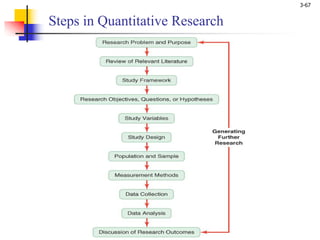
Steps in Quantitative Research
3-68
1
6
5
4
3
2
8 7
3-69
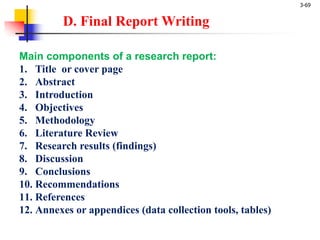
D. Final Report Writing
Main components of a research report:
1. Title or cover page
2. Abstract
3. Introduction
4. Objectives
5. Methodology
6. Literature Review
7. Research results (findings)
8. Discussion
9. Conclusions
10. Recommendations
11. References
12. Annexes or appendices (data collection tools, tables)
3-70

Lect 1 Research Introduction.pdf

  • 1.
  • 2.
    3-2 What is HealthResearch:? ØDefinition: Research is the systematic collection, analysis and interpretation of data to answer a certain question or solve a problem. ØIt is crucial to follow cascading ‫ةللاتتم‬ scientific steps when conducting one’s research.
  • 3.
    3-3 Purpose of Research Itis a scientific process that: •validate and refine existing knowledge and/or •generate new knowledge about issues of importance to the nursing profession including: - nursing practice, - education, - administration, and - informatics to improve clinical practice. ‫تل‬ ‫قق‬ ‫نم‬ ‫ةحق‬ ‫صو‬ ‫قق‬ ‫نم‬ ‫ةفر‬ ‫ئاقق‬ ‫ل‬ ‫تو‬ ‫توايديل‬ ‫را‬ ‫توا‬ ‫وحي‬ ‫وئ‬ ‫تاي‬ ‫توث‬ ‫قتي‬ ‫توا‬ ‫وأثر‬ ‫أيي‬ ‫نم‬ ‫يثش‬ ‫وي‬ ‫ا‬ ‫لح‬ ‫تويي‬
  • 4.
    3-4 Objectives of Research Thethree objectives of research are: § to conduct a general exploration of the issue, § to describe a population, and § to attribute cause and affect relationships among two or more variables
  • 5.
    3-5 categories of Research categoriesof research design are: 1. exploratory, 2. descriptive and 3. causal.
  • 6.
    3-6 Importance of Research §Reason 1: Research Adds Knowledge About Educational Issues n Addresses gaps in knowledge n Expands knowledge n Adds voices of individuals to knowledge § Reason 2: Research Helps Improve Practice n Educators gain new ideas n Educators gain new insight into methods n Educators gain new insight into students § Reason 3: Research Informs Policy Debates n Research helps people weigh different perspectives on issues n Research helps people make informed decisions regarding policy § Reason 4: Research Builds Student Research Skills n Organizational skills, analytical skills, writing skills, presentation skills
  • 7.
    3-7 Research Spiral orProcess: Selection of Research Area
  • 8.
    3-8 Research Spiral orProcess: Selection of Research Area n Selection of this broad entity of research is based on the following: n researcher’s: n Specialty n Interest n Scientific background n Experience n Actual need for research in this area n Available resources (interest of funding body)
  • 9.
    3-9 Research Spiral orProcess: Selection of Research Area The priority of a topic for research depends on: n The characteristics of the problem (topic): n Impact on health: n Magnitude n Seriousness n Preventability n Curability n Available interventions n Proposed solutions n The characteristics of the proposed study: n Feasibility n Cost-effectiveness n Applicability of the results
  • 10.
    3-10 Research Spiral: Reviewing theLiterature Development of the literature review requires four stages: n Problem formulation—which topic or field is being examined and what are its component issues? n Literature search—finding materials relevant to the subject being explored n Data evaluation—determining which literature makes a significant contribution to the understanding of the topic n Analysis and interpretation—discussing the findings and conclusions of pertinent literature
  • 11.
    3-11 Research Spiral: Sources ofLiterature Journal articles: n these are good sources, especially for up-to-date information. They are frequently used in literature reviews because they offer a relatively concise, up-to- date format for research. n Depending on the publication, these materials may be refereed materials.
  • 12.
    3-12 Research Spiral: Sources ofLiterature Books: § Remember that books tend to be less up-to-date, as it takes longer for a book to be published than for a journal article. § They are still likely to be useful for including in your literature review as they offer a good starting point from which to find more detailed and up-to-date sources of information.
  • 13.
    3-13 Research Spiral: Sources ofLiterature Conference proceedings: § These can be useful in providing the latest research, or research that has not been published. § They are also helpful in providing information about people in different research areas, and so can be helpful in tracking down other work by the same researchers.
  • 14.
    3-14 Research Spiral: Sources ofLiterature Government/corporate reports: n Many government departments and corporations commission carry out research. n Their published findings can provide a useful source of information, depending on your field of study.
  • 15.
    3-15 Research Spiral: Sources ofLiterature Theses and dissertations: these can be useful sources of information. However there are disadvantages: n they can be difficult to obtain since they are not published, but are generally only available from the library or interlibrary systems n the student who carried out the research may not be an experienced researcher and therefore you might have to treat their findings with more caution than published research.
  • 16.
    3-16 Research Spiral: Sources ofLiterature Internet: the fastest-growing source of information is on the Internet. n bear in mind that anyone can post information on the Internet so the quality may not be reliable n the information you find may be intended for a general audience and so not be suitable for inclusion in your literature review (information for a general audience is usually less detailed)
  • 17.
    3-17 Research Spiral: Reviewing theLiterature Relevant literature refers to those sources that are pertinent or highly important in providing the in-depth knowledge needed to study a selected problem. This background enables the researcher to build on the work of others and to avoid unnecessary and redundant work. • It prevents you from duplicating work that has been done before. • It helps you to find out what others have learned and reported on the problem you want to study. This may assist you in refining your statement of the problem. • Bring clarity and focus to your research problem • Improve your methodology • Broaden your knowledge • interpretation your findings • i.e., To generate a picture of what is known about a particular situation and the knowledge gaps that exist in it, researchers conduct a review of relevant literature.
  • 18.
    3-18 Research Spiral: Specify aPurpose for the Research § Identify the purpose statement § Narrow the purpose statement to research Ø Quantitative: Research Questions and or hypothesis Ø Qualitative: Central Phenomenon and sub-questions
  • 19.
    3-19 Research Spiral: Collecting Data oDetermine the data collection method o Select the individuals to study o Design data collection instruments and outline procedures o Obtain permissions o Gather information
  • 20.
    3-20 Research Spiral: Analyzing andInterpreting Data § Breaking down the data § Representing the data § Explaining the data
  • 21.
    3-21 Research Spiral: Reporting andEvaluating Research q Determine the audience for the report q Structure the report q Write the report sensitively and accurately
  • 22.
    3-22 Major Types ofResearch § Descriptive research § Analytical research § Applied research § Basic research § Correlational research § Ethnographic research § Experimental research § Exploratory research § Grounded theory research § Historical research § Phenomenological research
  • 23.
    3-23 Descriptive Research § Descriptiveresearch refers to research that provides an accurate portrayal of characteristics ‫راوتم‬ ‫ت‬ ‫تي‬ ‫ل‬ ‫ةيصاخ‬ of a particular individual, situation, or group. Descriptive research, also known as statistical research. § Purpose is the description of the state of affairs as it exists in present § These studies are a means of discovering new meaning, § describing what exists, determining the frequency with which something occurs, and categorizing information. For example, • finding the most frequent disease that affects the children of a town. The reader of the research will know what to do to prevent that disease thus, more people will live a healthy life.
  • 24.
    3-24 Descriptive Research Advantages: § Thepeople individual studied are unaware so they act naturally or as they usually do in everyday situation; § It is less expensive and time consuming than quantitative experiments; § Collects a large amount of notes for detailed studying; § As it is used to describe and not make any conclusions it is to start the research with it; Disadvantages • Descriptive research requires more skills. • Does not identify cause behind a phenomenon • Response rate is low in this research. • Results of this research can change over the period of time.
  • 25.
    3-25 Analytical Research § Involvesin-depth study and evaluation of available information in an attempt to explain complex phenomenon § The researcher has to use facts or information already available and analyze these to make a critical evaluation of the material Subdivisions of Analytical Research ü Historical Research ü Philosophical Research ü Research synthesis (meta analysis i.e. analysis of the review already published)
  • 26.
    3-26 Applied / ActionResearch 1. To solve a current problem faced by the manager in the work setting. Such research is called applied research. § For example, Apple’s iPod sales increased by 200% from 2001 to 2008. but the sales decreased by 6% in 2009. What is the reason for this decrease? § The question is: what will apple do about this problem?
  • 27.
    3-27 Pure/Basic/Fundamental research § Togenerate a body of knowledge about how to solve problems that could be occurred in organizations. This is called basic research or fundamental research. It is also known as pure research. § For example, University professors engage in basic research in an effort to understand and generate more knowledge about various aspects of businesses, such as: - How to improve the effectiveness of information systems. - How to integrate technology into the overall strategic objectives of an organization. - How to increase the productivity of the employees. - How to increase the effectiveness of small businesses. § These findings later become useful for application in business situations.
  • 28.
    3-28 Distinction Between Appliedand Basic Research q The main distinction between applied and basic business research is: ü Applied research is specifically aimed at solving a currently experienced problem. ü Basic research has a broader objective of generating knowledge and understanding of phenomena and problems that occur in various organizational settings. Ø Both types of research follow the same steps of systematic inquiry to arrive at solutions to problems.
  • 29.
    3-29 CORRELATIONAL RESEARCH Correlational researchrefers to the systematic investigation or statistical study of relationships among two or more variables, without necessarily determining cause and effect. It Seeks to establish a relation/association/correlation between two or more variables that do not readily lend themselves to experimental manipulation. For example, to test the hypothesis “ Listening to music lowers blood pressure levels” there are 2 ways of conducting research • Experimental – group samples and make one group listen to music and then compare the blood pressure levels • Survey – ask people how they feel ? How often they listen? And
  • 30.
    3-30 CORRELATIONAL RESEARCH Advantages: 1. Cancollect much information from many subjects at one time. 2. Can study a wide range of variables and their interrelations. 3. Study variables that are not easily produced in the laboratory. Disadvantages: § Correlation does not indicate causation( cause and effect). § Problems with self-report method .
  • 31.
    3-31 ETHNOGRAPHIC RESEARCH Ethnographic researchrefer to the investigation of a culture through an in-depth study of the members of the culture; it involves the systematic collection, description, and analysis of data for development of theories of cultural behavior. § It studies people, ethnic groups and other ethnic formations, their ethno genesis, composition, resettlement, social welfare characteristics, as well as their material and spiritual culture. § Data collection is often done through participant observation, interviews, questionnaires, etc. § The purpose of ethnographic research is to attempt to understand what is happening naturally in the setting and to interpret the data gathered to see what implications could be formed from the data.
  • 32.
    3-32 EXPLORATORY RESEARCH Exploratory researchis a type of research conducted for a problem that has not been clearly defined. Exploratory research helps determine the best research design, data collection method and selection of subjects. ü The results of exploratory research are not usually useful for decision-making by themselves, but they can provide significant insight into a given situation. ü Exploratory research is not typically generalizable to the population at large.
  • 33.
    3-33 GROUNDED THEORY RESEARCH Groundedtheory research is a research approach designed to discover what problems exist in a given social environment and how the persons involved handle them; it involves formulation, testing, and reformulation of propositions until a theory is developed. Ø Grounded theory is a research method that operates almost in a reverse fashion from traditional research and at first may appear to be in contradiction to the scientific method.
  • 34.
    3-34 HISTORICAL RESEARCH Historical researchis research involving analysis of events that occurred in the remote or recent past. Application ü Historical research can show patterns that occurred in the past and over time which can help us to see where we came from and what kinds of solutions we have used in the past. ü Understanding this can add perspective on how we examine current events and educational practices. The steps involved in the conduct of historical research Here are the five steps: 1. Identification of the research topic and formulation of the research problem or question. 2. Data collection or literature review 3. Evaluation of materials 4. Data synthesis 5. Report preparation or preparation of the narrative exposition
  • 35.
    3-35 PHENOMENLOGICAL RESEARCH Phenomenological researchan inductive, descriptive research approach developed from phenomenological philosophy; its aim is to describe an experience as it is actually lived by the person. • Phenomenology is concerned with the study of experience from the perspective of the individual, ‘bracketing’ taken-forgranted assumptions and usual ways of perceiving. • They are based in a paradigm of personal knowledge and subjectivity, and emphasize the importance of personal perspective and interpretation. • As such they are powerful for understanding subjective experience, gaining insights into people’s motivations and actions, and cutting through the clutter of taken-for-granted assumptions and conventional wisdom.
  • 36.
    3-36 On a broaderperspective, all researches can be classified into two groups: ü Quantitative Research ü Qualitative Research
  • 37.
    3-37 Quantitative Research Quantitative researchrefers to the systematic empirical investigation of any phenomena via statistical, mathematical or computational techniques. The objective of quantitative research is to develop and employ mathematical models, theories and/or hypotheses pertaining ‫لم‬ ‫ةتللت‬ to phenomena
  • 38.
    3-38 Quantitative Research Advantages § Quantitativeresearch allows the researcher to measure and analyze data. § The researcher is more objective about the findings of the research. § Quantitative research can be used to test hypotheses in experiments because of its ability to measure data using statistics. Disadvantages ü The main disadvantage of quantitative research is the context of the study or experiment is ignored. ü Quantitative research does not study things in a natural setting or discuss the meaning things have for different people. ü A large sample of the population must be studied for more accurate results
  • 39.
    3-39 Qualitative Research § Qualitativeresearch is research dealing with phenomena that are difficult or impossible to quantify mathematically, such as beliefs, meanings, attributes, and symbols. § Qualitative researchers aim to gather an in-depth understanding of human behavior and the reasons that govern such behavior. The qualitative method investigates the why and how of decision making, not just what, where, when.
  • 40.
    3-40 Advantages • It enablesmore complex aspects of a persons experience to be studied • Fewer restriction or assumptions are placed on the data to be collected. • Not everything can be quantified, or quantified easily, Individuals can be studied in more depth • Good for exploratory research and hypothesis generation • The participants are able to provide data in their own words and in their own way Disadvantages ü It is more difficult to determine the validity and reliability of linguistic data ü there is more subjectivity involved in analyzing the data. ü “Data overload” – open-ended questions can sometimes create lots of data, which can take along time to analyze! ü Time consuming
  • 41.
    3-41 How do youget a topic? n Reading n Academic Experience n Daily Experience/Patients n Exposure to Field Situations/Clinical experience n Consultations n Brainstorming n Research n Intuition ‫ةدم‬، ‫اد‬،‫ة‬ Build your area of expertise from multiple sources.
  • 42.
    3-42 n ‫تما‬ ‫تو‬ : ‫ا‬،‫ات‬ ،‫لا‬ ‫د‬ ‫ةتلي‬ n Prediction: A forecast about what may happen. n :‫تويقرحي‬ ‫ةتللبتخةا‬ ‫تع‬ ‫ةا‬ ‫م‬ ‫اتتب‬ ‫د‬ ‫ةتلي‬ n Hypothesis: Prediction about the relationship between variables. n :‫ي‬ ‫اق‬ ‫تو‬ .‫ةترخبتم‬ ‫ن‬ ،‫اتلل‬ ‫ةليع‬ ‫اف‬ ‫ةل‬. n Experiment: A fair test driven by a hypothesis. n :‫تواالمي‬ ‫ةا‬،‫ةتلهاد‬ n Observation: What is seen ‫ا‬ ‫ناحيي‬ Terms to Know
  • 43.
    3-43 n :‫ل‬ ‫ت‬ ‫تات‬ ‫ةل‬‫ةتلت‬ ‫ةا‬،‫ةعة‬ ‫ةبد‬ ‫ةع‬ ‫ةعلتم‬ ‫ن‬ ،‫ةتلتلل‬ ‫ةتلليلاد‬ .‫دا‬،‫فو‬ n Inference: A conclusion based on evidence about events that have already occurred. n Manipulated Variable: The factor in the experiment that is changed by the scientist (independent variables). n ‫غحقتا‬ ‫توا‬ : ‫اةو‬ ‫ةت‬ ‫ت‬ ‫ةع‬ ‫ةبتخدا‬ ‫ةل‬ ‫ةتلت‬ ‫م‬ ‫ةتلبخ‬ ‫صةةت‬ .(‫ةتلمللت‬ ‫)ةتتاةت‬ n Responding Variable: The factor in the experiment that changes as a result of the manipulated variable. n :‫احمي‬ ‫تواي‬ ‫غحقتا‬ ‫توا‬ ‫للتبم‬ ‫م‬ ‫ةتلبخ‬ ‫ت‬ ‫ةبتخا‬ ‫ةتلت‬ ‫ةتتصةةت‬ ‫دت‬ .‫اةو‬ ‫ةت‬ ‫ت‬ ‫ةع‬ ‫ةبتخدا‬ ‫ةل‬ ‫ةتلت‬ ‫تصةةت‬ ‫ت‬ ‫ا‬ ‫ناحيي‬ Terms to Know
  • 44.
    3-44 Control: n Using “rules”to decrease error and increase probability that study findings are an accurate reflection of reality n Ensure results that reflect true relationship among variables n Reduction of the influence of unwanted “extraneous” variables n These occur in all research studies (and in everyday life!). n They may interfere with the hypothesized relationships between variables. n The influence of extraneous variables can be decreased through sample selection and the use of defined research settings. ‫ا‬ ‫ناحيي‬ Terms to Know
  • 45.
    3-45 Control in QuantitativeResearch Type of Quantitative Research Researcher Control Research Setting Descriptive Uncontrolled Natural or partially controlled Correlational Uncontrolled or partially controlled Natural or partially controlled Quasi-experimental Partially controlled Partially controlled Experimental Highly controlled Laboratory
  • 46.
    3-46 Causation vs. Correlation nCorrelation – association between independent and dependent variables n Causation – relationship between independent and dependent variables such that a change in an independent variable (predictor) will change the dependent variable (outcome) in a known way
  • 47.
    3-47 n SAMPLING n Who/whatdo you want to study? n Choosing subjects who are “representative” of the study population Cont….
  • 48.
    3-48 Cont…. Variables in research: nMeasurable characteristic that varies among subjects n Research is conducted because this variance occurs. Independent Variable: § (presumed cause)– has a presumed effect on the dependent variable, § May or may not be manipulated. Independent Variable: - Cause - Action - Intervention Dependent Variable: § (presumed effect)– Something that varies with a change in the independent variable. § (Outcome variable). Dependent Variable: - Effect, outcome - Reaction - Response
  • 49.
    3-49 Practice Identify variables for thefollowing experiments. You can do it!
  • 50.
    3-50 Testable Question #1 nDoes changing the temperature of a ball affect the height the ball will bounce? Hot Cold
  • 51.
    3-51 Manipulated Variable Responding Variable Identify Variables #1 ColdHot n Does changing the temperature of a ball affect the height the ball will bounce?
  • 52.
    3-52 n Does changingthe color of light affect the growth rate of plants? Testable Question #2
  • 53.
    3-53 Manipulated Variable Responding Variable Identify Variables #2 nDoes changing the color of light affect the growth rate of plants?
  • 54.
    3-54 n How doesthe size of a parachute affect the time it takes a hippo to fall 10 feet? Testable Question #3
  • 55.
    3-55 Manipulated Variable Responding Variable Identify Variables #3 nHow does the size of a parachute affect the time it takes a hippo to fall 10 feet?
  • 56.
    3-56 Cont.. Dependent vs. Independent ØWhat is the effect of number of cigarette smoked and the incident of lung cancer among third and 4th year nursing school students Ø Dependent: incident of lung cancer Ø Independent: number of cigarette
  • 57.
    3-57 Cont.. n Is therea relationship between the level of education and the Number of hours of exercise per week Ø Dependent: level of education Ø Independent: Number of hours of exercise per week
  • 58.
    3-58 Cont.. n Which ismore affected by the number of working hours per shift in the ICU, turn over rate or number of incident reports. Ø Independent: number of working hours Ø Dependent/s: numbers of incident reports and turn over rate
  • 59.
    3-59 Cont.. Data: n Pieces ofinformation obtained in a study. Data are the actual “values” of the study variables n Quantitative - numeric value n Qualitative - narrative descriptions
  • 60.
    3-60 Cont…. SETTING n Location ofthe study - can affect results n Natural Setting: Uncontrolled, real life situation n Partially Controlled: Manipulated or modified in some way n Highly Controlled: Artificial environment for sole purpose of doing research. Decreases effects of outside influences
  • 61.
    3-61 Cont…. RIGOR: ‫تويلي‬ Why isRigor Important? n Striving for excellence in research involves: n adherence to detail n Precise measurement tools, a representative sample, and a tightly controlled study design n Logical reasoning is essential. n Precision, accuracy, detail, and order required
  • 62.
  • 63.
    3-63 Quantitative (Deductive) Research §Formal, objective, systematic process using: § measurement § hypothesis testing § data analysis § It is traditional approaches such as experiments and surveys. § From the general to the specific. This approach involves starting with a theoretical framework, formulating hypotheses, gathering data and analyzing it to test the hypotheses. § Example: assume that separation anxiety occurs in hospitalized child, then we might predict that the child in hospital who his parents not room in would manifest symptoms of stress.
  • 64.
    3-64 Qualitative (Inductive) Research nIs the “collection of in-depth, non-numeric data (data derived from words), traditionally collected face-to-face in an unstructured manner.” n Evaluate subjective life experiences and give meaning to them. n Focuses on understanding phenomena from an individual’s perspective without trying to manipulate them. n Approaches: observation, in-depth interviews, case studies, narrative analysis.
  • 65.
  • 66.
    3-66 Comparison between Quantitative& Qualitative Research Qualitative Research To gain a qualitative understanding of the underlying reasons and motivations Small number of non- representative cases Unstructured Non-statistical Develop an initial understanding Objective Sample Data Collection Data Analysis Outcome Quantitative Research To quantify the data and generalize the results from the sample to the population of interest Large number of representative cases Structured Statistical Recommend a final course of action
  • 67.
  • 68.
  • 69.
    3-69 D. Final ReportWriting Main components of a research report: 1. Title or cover page 2. Abstract 3. Introduction 4. Objectives 5. Methodology 6. Literature Review 7. Research results (findings) 8. Discussion 9. Conclusions 10. Recommendations 11. References 12. Annexes or appendices (data collection tools, tables)
  • 70.