HISTORY OF PROGRAMMING
LANGUAGES
TRACING THE EVOLUTION OF PROGRAMMING FROM ITS ORIGINS TO MODERN TIMES
INTRODUCTION TO PROGRAMMING LANGUAGES
•Programming languages are tools that allow
humans to communicate instructions to
computers. They have evolved over decades,
from machine-level code to high-level
languages.
1940S - THE BEGINNING
1. Machine Language: The first programming language;
consisted of binary instructions.
2. Assembly Language: Introduced mnemonics for easier
coding.
Example: Instructions like ADD, SUB replaced binary codes.
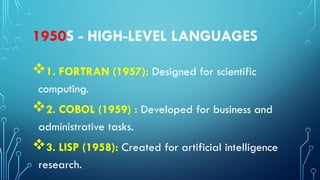
1950S - HIGH-LEVEL LANGUAGES
1. FORTRAN (1957): Designed for scientific
computing.
2. COBOL (1959) : Developed for business and
administrative tasks.
3. LISP (1958): Created for artificial intelligence
research.
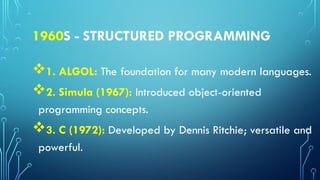
1960S - STRUCTURED PROGRAMMING
1. ALGOL: The foundation for many modern languages.
2. Simula (1967): Introduced object-oriented
programming concepts.
3. C (1972): Developed by Dennis Ritchie; versatile and
powerful.
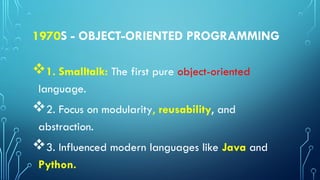
1970S - OBJECT-ORIENTED PROGRAMMING
1. Smalltalk: The first pure object-oriented
language.
2. Focus on modularity, reusability, and
abstraction.
3. Influenced modern languages like Java and
Python.
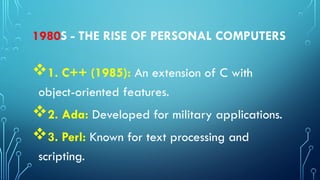
1980S - THE RISE OF PERSONAL COMPUTERS
1. C++ (1985): An extension of C with
object-oriented features.
2. Ada: Developed for military applications.
3. Perl: Known for text processing and
scripting.
1990S - THE INTERNET ERA
1. Java (1995): Platform-independent, widely
used for web development.
2. Python (1991): Simple and versatile, used in
various domains.
3. JavaScript (1995): Revolutionized web
interactivity.
2000S - MODERN PROGRAMMING LANGUAGES
1. C#: Introduced by Microsoft for enterprise
applications.
2. PHP: Popular for dynamic web pages.
3. Ruby: Known for simplicity and used in
frameworks like Ruby on Rails.
2010S - DATA AND AI
1. R: Popular for statistical computing and data
visualization.
2. Go: Designed for scalability and performance.
3. Swift: Apple's language for iOS development.
SUMMARY AND FUTURE TRENDS
1. Evolution from machine code to AI-focused
languages.
2. Focus on simplicity, security, and performance.
3. Future: Quantum programming, low-code
platforms, and more.
THE Star Gate

Lec_04 History_of_Programming_Languages.pptx

  • 1.
    HISTORY OF PROGRAMMING LANGUAGES TRACINGTHE EVOLUTION OF PROGRAMMING FROM ITS ORIGINS TO MODERN TIMES
  • 2.
    INTRODUCTION TO PROGRAMMINGLANGUAGES •Programming languages are tools that allow humans to communicate instructions to computers. They have evolved over decades, from machine-level code to high-level languages.
  • 3.
    1940S - THEBEGINNING 1. Machine Language: The first programming language; consisted of binary instructions. 2. Assembly Language: Introduced mnemonics for easier coding. Example: Instructions like ADD, SUB replaced binary codes.
  • 4.
    1950S - HIGH-LEVELLANGUAGES 1. FORTRAN (1957): Designed for scientific computing. 2. COBOL (1959) : Developed for business and administrative tasks. 3. LISP (1958): Created for artificial intelligence research.
  • 5.
    1960S - STRUCTUREDPROGRAMMING 1. ALGOL: The foundation for many modern languages. 2. Simula (1967): Introduced object-oriented programming concepts. 3. C (1972): Developed by Dennis Ritchie; versatile and powerful.
  • 6.
    1970S - OBJECT-ORIENTEDPROGRAMMING 1. Smalltalk: The first pure object-oriented language. 2. Focus on modularity, reusability, and abstraction. 3. Influenced modern languages like Java and Python.
  • 7.
    1980S - THERISE OF PERSONAL COMPUTERS 1. C++ (1985): An extension of C with object-oriented features. 2. Ada: Developed for military applications. 3. Perl: Known for text processing and scripting.
  • 8.
    1990S - THEINTERNET ERA 1. Java (1995): Platform-independent, widely used for web development. 2. Python (1991): Simple and versatile, used in various domains. 3. JavaScript (1995): Revolutionized web interactivity.
  • 9.
    2000S - MODERNPROGRAMMING LANGUAGES 1. C#: Introduced by Microsoft for enterprise applications. 2. PHP: Popular for dynamic web pages. 3. Ruby: Known for simplicity and used in frameworks like Ruby on Rails.
  • 10.
    2010S - DATAAND AI 1. R: Popular for statistical computing and data visualization. 2. Go: Designed for scalability and performance. 3. Swift: Apple's language for iOS development.
  • 11.
    SUMMARY AND FUTURETRENDS 1. Evolution from machine code to AI-focused languages. 2. Focus on simplicity, security, and performance. 3. Future: Quantum programming, low-code platforms, and more.
  • 12.