Neural Networks II
Chen Gao
Virginia Tech Spring 2019
ECE-5424G / CS-5824
Neural Networks
• Origins: Algorithms that try to mimic the brain.
What is this?
A single neuron in the brain
Input
Output Slide credit: Andrew Ng
An artificial neuron: Logistic unit
𝑥 =
𝑥0
𝑥1
𝑥2
𝑥3
𝜃 =
𝜃0
𝜃1
𝜃2
𝜃3
• Sigmoid (logistic) activation function
𝑥1
𝑥2
𝑥3
𝑥0
ℎ𝜃 𝑥 =
1
1 + 𝑒−𝜃⊤𝑥
“Bias unit”
“Input”
“Output”
“Weights”
“Parameters”
Slide credit: Andrew Ng
Visualization of weights, bias, activation function
bias b only change the
position of the hyperplane
Slide credit: Hugo Larochelle
range
determined
by g(.)
Activation - sigmoid
• Squashes the neuron’s pre-
activation between 0 and 1
• Always positive
• Bounded
• Strictly increasing
𝑔 𝑥 =
1
1 + 𝑒−𝑥
Slide credit: Hugo Larochelle
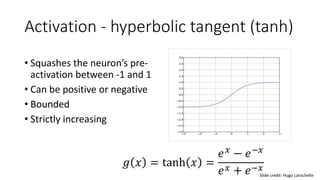
Activation - hyperbolic tangent (tanh)
• Squashes the neuron’s pre-
activation between -1 and 1
• Can be positive or negative
• Bounded
• Strictly increasing
𝑔 𝑥 = tanh 𝑥 =
𝑒𝑥
− 𝑒−𝑥
𝑒𝑥 + 𝑒−𝑥
Slide credit: Hugo Larochelle
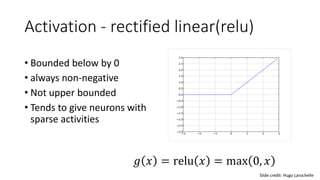
Activation - rectified linear(relu)
• Bounded below by 0
• always non-negative
• Not upper bounded
• Tends to give neurons with
sparse activities
Slide credit: Hugo Larochelle
𝑔 𝑥 = relu 𝑥 = max 0, 𝑥
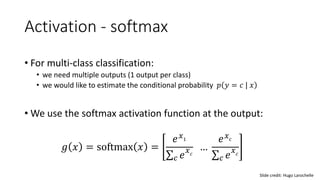
Activation - softmax
• For multi-class classification:
• we need multiple outputs (1 output per class)
• we would like to estimate the conditional probability 𝑝 𝑦 = 𝑐 | 𝑥
• We use the softmax activation function at the output:
𝑔 𝑥 = softmax 𝑥 =
𝑒𝑥1
𝑐 𝑒
𝑥𝑐
…
𝑒𝑥𝑐
𝑐 𝑒
𝑥𝑐
Slide credit: Hugo Larochelle
Universal approximation theorem
‘‘a single hidden layer neural network with a linear output unit
can approximate any continuous function arbitrarily well,
given enough hidden units’’
Hornik, 1991
Slide credit: Hugo Larochelle
Neural network – Multilayer
𝑎1
(2)
𝑎2
(2)
𝑎3
(2)
𝑎0
(2)
ℎΘ 𝑥
Layer 1
“Output”
𝑥1
𝑥2
𝑥3
𝑥0
Layer 2 (hidden) Layer 3 Slide credit: Andrew Ng
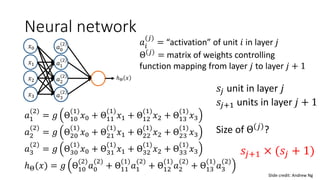
Neural network
𝑎1
(2)
𝑎2
(2)
𝑎3
(2)
𝑎0
(2)
ℎΘ 𝑥
𝑥1
𝑥2
𝑥3
𝑥0
𝑎𝑖
(𝑗)
= “activation” of unit 𝑖 in layer 𝑗
Θ 𝑗 = matrix of weights controlling
function mapping from layer 𝑗 to layer 𝑗 + 1
𝑎1
(2)
= 𝑔 Θ10
(1)
𝑥0 + Θ11
(1)
𝑥1 + Θ12
(1)
𝑥2 + Θ13
(1)
𝑥3
𝑎2
(2)
= 𝑔 Θ20
(1)
𝑥0 + Θ21
(1)
𝑥1 + Θ22
(1)
𝑥2 + Θ23
(1)
𝑥3
𝑎3
(2)
= 𝑔 Θ30
(1)
𝑥0 + Θ31
(1)
𝑥1 + Θ32
(1)
𝑥2 + Θ33
(1)
𝑥3
ℎΘ(𝑥) = 𝑔 Θ10
(2)
𝑎0
(2)
+ Θ11
(1)
𝑎1
(2)
+ Θ12
(1)
𝑎2
(2)
+ Θ13
(1)
𝑎3
(2)
𝑠𝑗 unit in layer 𝑗
𝑠𝑗+1 units in layer 𝑗 + 1
Size of Θ 𝑗
?
𝑠𝑗+1 × (𝑠𝑗 + 1)
Slide credit: Andrew Ng
Neural network
𝑎1
(2)
𝑎2
(2)
𝑎3
(2)
𝑎0
(2)
ℎΘ 𝑥
𝑥1
𝑥2
𝑥3
𝑥0
𝑥 =
𝑥0
𝑥1
𝑥2
𝑥3
z(2) =
z1
(2)
z2
(2)
z3
(2)
𝑎1
(2)
= 𝑔 Θ10
(1)
𝑥0 + Θ11
(1)
𝑥1 + Θ12
(1)
𝑥2 + Θ13
(1)
𝑥3 = 𝑔(z1
(2)
)
𝑎2
(2)
= 𝑔 Θ20
(1)
𝑥0 + Θ21
(1)
𝑥1 + Θ22
(1)
𝑥2 + Θ23
(1)
𝑥3 = 𝑔(z2
(2)
)
𝑎3
(2)
= 𝑔 Θ30
(1)
𝑥0 + Θ31
(1)
𝑥1 + Θ32
(1)
𝑥2 + Θ33
(1)
𝑥3 = 𝑔(z3
(2)
)
ℎΘ 𝑥 = 𝑔 Θ10
2
𝑎0
2
+ Θ11
1
𝑎1
2
+ Θ12
1
𝑎2
2
+ Θ13
1
𝑎3
2
= 𝑔(𝑧(3))
“Pre-activation”
Slide credit: Andrew Ng
Why do we need g(.)?
Neural network
𝑎1
(2)
𝑎2
(2)
𝑎3
(2)
𝑎0
(2)
ℎΘ 𝑥
𝑥1
𝑥2
𝑥3
𝑥0
𝑥 =
𝑥0
𝑥1
𝑥2
𝑥3
z(2) =
z1
(2)
z2
(2)
z3
(2)
𝑎1
(2)
= 𝑔(z1
(2)
)
𝑎2
(2)
= 𝑔(z2
(2)
)
𝑎3
(2)
= 𝑔(z3
(2)
)
ℎΘ 𝑥 = 𝑔(𝑧(3)
)
“Pre-activation”
𝑧(2)
= Θ(1)
𝑥 = Θ(1)
𝑎(1)
𝑎(2)
= 𝑔(𝑧(2)
)
Add 𝑎0
(2)
= 1
𝑧(3)
= Θ(2)
𝑎(2)
ℎΘ 𝑥 = 𝑎(3)
= 𝑔(𝑧(3)
)
Slide credit: Andrew Ng
Flow graph - Forward propagation
𝑎
(2)
𝑧
(2)
𝑎
(3)
ℎΘ 𝑥
X
𝑊
(1)
𝑏
(1)
𝑧
(3)
𝑊
(2)
𝑏
(2)
𝑧(2)
= Θ(1)
𝑥 = Θ(1)
𝑎(1)
𝑎(2)
= 𝑔(𝑧(2)
)
Add 𝑎0
(2)
= 1
𝑧(3)
= Θ(2)
𝑎(2)
ℎΘ 𝑥 = 𝑎(3)
= 𝑔(𝑧(3)
)
How do we evaluate
our prediction?
Cost function
Logistic regression:
Neural network:
Slide credit: Andrew Ng
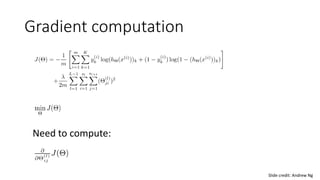
Gradient computation
Need to compute:
Slide credit: Andrew Ng
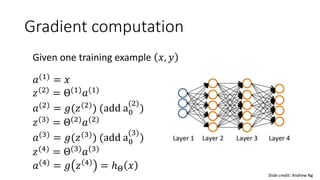
Gradient computation
Given one training example 𝑥, 𝑦
𝑎(1)
= 𝑥
𝑧(2)
= Θ(1)
𝑎(1)
𝑎(2)
= 𝑔(𝑧(2)
) (add a0
(2)
)
𝑧(3)
= Θ(2)
𝑎(2)
𝑎(3)
= 𝑔(𝑧(3)
) (add a0
(3)
)
𝑧(4)
= Θ(3)
𝑎(3)
𝑎(4)
= 𝑔 𝑧 4
= ℎΘ 𝑥
Slide credit: Andrew Ng
Gradient computation: Backpropagation
Intuition: ߜ𝑗
(𝑙)
= “error” of node 𝑗 in layer 𝑙
For each output unit (layer L = 4)
Slide credit: Andrew Ng
ߜ(4) = 𝑎(4) − 𝑦
ߜ(3) = ߜ(4) 𝜕ߜ(4)
𝜕𝑧(3) = ߜ(4) 𝜕ߜ(4)
𝜕𝑎(4)
𝜕𝑎(4)
𝜕𝑧(4)
𝜕𝑧(4)
𝜕𝑎(3)
𝜕𝑎(3)
𝜕𝑧(3)
= 1 *Θ 3 𝑇
ߜ(4)
.∗ 𝑔′ 𝑧 4
.∗ 𝑔′(𝑧(3)
)
𝑧(3)
= Θ(2)
𝑎(2)
𝑎(3)
= 𝑔(𝑧(3)
)
𝑧(4)
= Θ(3)
𝑎(3)
𝑎(4)
= 𝑔 𝑧 4
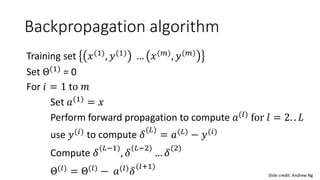
Backpropagation algorithm
Training set 𝑥(1)
, 𝑦(1)
… 𝑥(𝑚)
, 𝑦(𝑚)
Set Θ(1)
= 0
For 𝑖 = 1 to 𝑚
Set 𝑎(1)
= 𝑥
Perform forward propagation to compute 𝑎(𝑙)
for 𝑙 = 2. . 𝐿
use 𝑦(𝑖)
to compute ߜ
(𝐿)
= 𝑎(𝐿)
− 𝑦(𝑖)
Compute ߜ
(𝐿−1)
, ߜ
(𝐿−2)
… ߜ
(2)
Θ(𝑙)
= Θ(𝑙)
− 𝑎(𝑙)
ߜ
(𝑙+1)
Slide credit: Andrew Ng
Activation - sigmoid
• Partial derivative
𝑔 𝑥 =
1
1 + 𝑒−𝑥
Slide credit: Hugo Larochelle
𝑔′ 𝑥 = 𝑔 𝑥 1 − 𝑔 𝑥
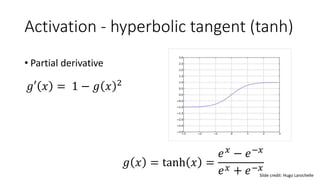
Activation - hyperbolic tangent (tanh)
𝑔 𝑥 = tanh 𝑥 =
𝑒𝑥
− 𝑒−𝑥
𝑒𝑥 + 𝑒−𝑥
Slide credit: Hugo Larochelle
• Partial derivative
𝑔′ 𝑥 = 1 − 𝑔 𝑥 2
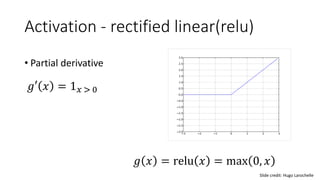
Activation - rectified linear(relu)
Slide credit: Hugo Larochelle
𝑔 𝑥 = relu 𝑥 = max 0, 𝑥
• Partial derivative
𝑔′ 𝑥 = 1𝑥 > 0
Initialization
• For bias
• Initialize all to 0
• For weights
• Can’t initialize all weights to the same value
• we can show that all hidden units in a layer will always behave the same
• need to break symmetry
• Recipe: U[-b, b]
• the idea is to sample around 0 but break symmetry
Slide credit: Hugo Larochelle
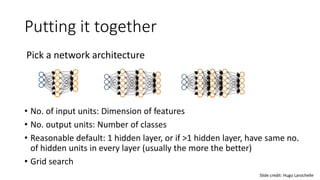
Putting it together
Pick a network architecture
Slide credit: Hugo Larochelle
• No. of input units: Dimension of features
• No. output units: Number of classes
• Reasonable default: 1 hidden layer, or if >1 hidden layer, have same no.
of hidden units in every layer (usually the more the better)
• Grid search
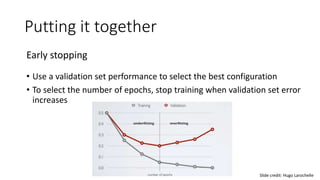
Putting it together
Early stopping
Slide credit: Hugo Larochelle
• Use a validation set performance to select the best configuration
• To select the number of epochs, stop training when validation set error
increases
Other tricks of the trade
Slide credit: Hugo Larochelle
• Normalizing your (real-valued) data
• Decaying the learning rate
• as we get closer to the optimum, makes sense to take smaller update steps
• mini-batch
• can give a more accurate estimate of the risk gradient
• Momentum
• can use an exponential average of previous gradients
Dropout
Slide credit: Hugo Larochelle
• Idea: «cripple» neural network by removing hidden units
• each hidden unit is set to 0 with probability 0.5
• hidden units cannot co-adapt to other units
• hidden units must be more generally useful

Lec10.pptx

  • 1.
    Neural Networks II ChenGao Virginia Tech Spring 2019 ECE-5424G / CS-5824
  • 2.
    Neural Networks • Origins:Algorithms that try to mimic the brain. What is this?
  • 3.
    A single neuronin the brain Input Output Slide credit: Andrew Ng
  • 4.
    An artificial neuron:Logistic unit 𝑥 = 𝑥0 𝑥1 𝑥2 𝑥3 𝜃 = 𝜃0 𝜃1 𝜃2 𝜃3 • Sigmoid (logistic) activation function 𝑥1 𝑥2 𝑥3 𝑥0 ℎ𝜃 𝑥 = 1 1 + 𝑒−𝜃⊤𝑥 “Bias unit” “Input” “Output” “Weights” “Parameters” Slide credit: Andrew Ng
  • 5.
    Visualization of weights,bias, activation function bias b only change the position of the hyperplane Slide credit: Hugo Larochelle range determined by g(.)
  • 6.
    Activation - sigmoid •Squashes the neuron’s pre- activation between 0 and 1 • Always positive • Bounded • Strictly increasing 𝑔 𝑥 = 1 1 + 𝑒−𝑥 Slide credit: Hugo Larochelle
  • 7.
    Activation - hyperbolictangent (tanh) • Squashes the neuron’s pre- activation between -1 and 1 • Can be positive or negative • Bounded • Strictly increasing 𝑔 𝑥 = tanh 𝑥 = 𝑒𝑥 − 𝑒−𝑥 𝑒𝑥 + 𝑒−𝑥 Slide credit: Hugo Larochelle
  • 8.
    Activation - rectifiedlinear(relu) • Bounded below by 0 • always non-negative • Not upper bounded • Tends to give neurons with sparse activities Slide credit: Hugo Larochelle 𝑔 𝑥 = relu 𝑥 = max 0, 𝑥
  • 9.
    Activation - softmax •For multi-class classification: • we need multiple outputs (1 output per class) • we would like to estimate the conditional probability 𝑝 𝑦 = 𝑐 | 𝑥 • We use the softmax activation function at the output: 𝑔 𝑥 = softmax 𝑥 = 𝑒𝑥1 𝑐 𝑒 𝑥𝑐 … 𝑒𝑥𝑐 𝑐 𝑒 𝑥𝑐 Slide credit: Hugo Larochelle
  • 10.
    Universal approximation theorem ‘‘asingle hidden layer neural network with a linear output unit can approximate any continuous function arbitrarily well, given enough hidden units’’ Hornik, 1991 Slide credit: Hugo Larochelle
  • 11.
    Neural network –Multilayer 𝑎1 (2) 𝑎2 (2) 𝑎3 (2) 𝑎0 (2) ℎΘ 𝑥 Layer 1 “Output” 𝑥1 𝑥2 𝑥3 𝑥0 Layer 2 (hidden) Layer 3 Slide credit: Andrew Ng
  • 12.
    Neural network 𝑎1 (2) 𝑎2 (2) 𝑎3 (2) 𝑎0 (2) ℎΘ 𝑥 𝑥1 𝑥2 𝑥3 𝑥0 𝑎𝑖 (𝑗) =“activation” of unit 𝑖 in layer 𝑗 Θ 𝑗 = matrix of weights controlling function mapping from layer 𝑗 to layer 𝑗 + 1 𝑎1 (2) = 𝑔 Θ10 (1) 𝑥0 + Θ11 (1) 𝑥1 + Θ12 (1) 𝑥2 + Θ13 (1) 𝑥3 𝑎2 (2) = 𝑔 Θ20 (1) 𝑥0 + Θ21 (1) 𝑥1 + Θ22 (1) 𝑥2 + Θ23 (1) 𝑥3 𝑎3 (2) = 𝑔 Θ30 (1) 𝑥0 + Θ31 (1) 𝑥1 + Θ32 (1) 𝑥2 + Θ33 (1) 𝑥3 ℎΘ(𝑥) = 𝑔 Θ10 (2) 𝑎0 (2) + Θ11 (1) 𝑎1 (2) + Θ12 (1) 𝑎2 (2) + Θ13 (1) 𝑎3 (2) 𝑠𝑗 unit in layer 𝑗 𝑠𝑗+1 units in layer 𝑗 + 1 Size of Θ 𝑗 ? 𝑠𝑗+1 × (𝑠𝑗 + 1) Slide credit: Andrew Ng
  • 13.
    Neural network 𝑎1 (2) 𝑎2 (2) 𝑎3 (2) 𝑎0 (2) ℎΘ 𝑥 𝑥1 𝑥2 𝑥3 𝑥0 𝑥= 𝑥0 𝑥1 𝑥2 𝑥3 z(2) = z1 (2) z2 (2) z3 (2) 𝑎1 (2) = 𝑔 Θ10 (1) 𝑥0 + Θ11 (1) 𝑥1 + Θ12 (1) 𝑥2 + Θ13 (1) 𝑥3 = 𝑔(z1 (2) ) 𝑎2 (2) = 𝑔 Θ20 (1) 𝑥0 + Θ21 (1) 𝑥1 + Θ22 (1) 𝑥2 + Θ23 (1) 𝑥3 = 𝑔(z2 (2) ) 𝑎3 (2) = 𝑔 Θ30 (1) 𝑥0 + Θ31 (1) 𝑥1 + Θ32 (1) 𝑥2 + Θ33 (1) 𝑥3 = 𝑔(z3 (2) ) ℎΘ 𝑥 = 𝑔 Θ10 2 𝑎0 2 + Θ11 1 𝑎1 2 + Θ12 1 𝑎2 2 + Θ13 1 𝑎3 2 = 𝑔(𝑧(3)) “Pre-activation” Slide credit: Andrew Ng Why do we need g(.)?
  • 14.
    Neural network 𝑎1 (2) 𝑎2 (2) 𝑎3 (2) 𝑎0 (2) ℎΘ 𝑥 𝑥1 𝑥2 𝑥3 𝑥0 𝑥= 𝑥0 𝑥1 𝑥2 𝑥3 z(2) = z1 (2) z2 (2) z3 (2) 𝑎1 (2) = 𝑔(z1 (2) ) 𝑎2 (2) = 𝑔(z2 (2) ) 𝑎3 (2) = 𝑔(z3 (2) ) ℎΘ 𝑥 = 𝑔(𝑧(3) ) “Pre-activation” 𝑧(2) = Θ(1) 𝑥 = Θ(1) 𝑎(1) 𝑎(2) = 𝑔(𝑧(2) ) Add 𝑎0 (2) = 1 𝑧(3) = Θ(2) 𝑎(2) ℎΘ 𝑥 = 𝑎(3) = 𝑔(𝑧(3) ) Slide credit: Andrew Ng
  • 15.
    Flow graph -Forward propagation 𝑎 (2) 𝑧 (2) 𝑎 (3) ℎΘ 𝑥 X 𝑊 (1) 𝑏 (1) 𝑧 (3) 𝑊 (2) 𝑏 (2) 𝑧(2) = Θ(1) 𝑥 = Θ(1) 𝑎(1) 𝑎(2) = 𝑔(𝑧(2) ) Add 𝑎0 (2) = 1 𝑧(3) = Θ(2) 𝑎(2) ℎΘ 𝑥 = 𝑎(3) = 𝑔(𝑧(3) ) How do we evaluate our prediction?
  • 16.
    Cost function Logistic regression: Neuralnetwork: Slide credit: Andrew Ng
  • 17.
    Gradient computation Need tocompute: Slide credit: Andrew Ng
  • 18.
    Gradient computation Given onetraining example 𝑥, 𝑦 𝑎(1) = 𝑥 𝑧(2) = Θ(1) 𝑎(1) 𝑎(2) = 𝑔(𝑧(2) ) (add a0 (2) ) 𝑧(3) = Θ(2) 𝑎(2) 𝑎(3) = 𝑔(𝑧(3) ) (add a0 (3) ) 𝑧(4) = Θ(3) 𝑎(3) 𝑎(4) = 𝑔 𝑧 4 = ℎΘ 𝑥 Slide credit: Andrew Ng
  • 19.
    Gradient computation: Backpropagation Intuition:ߜ𝑗 (𝑙) = “error” of node 𝑗 in layer 𝑙 For each output unit (layer L = 4) Slide credit: Andrew Ng ߜ(4) = 𝑎(4) − 𝑦 ߜ(3) = ߜ(4) 𝜕ߜ(4) 𝜕𝑧(3) = ߜ(4) 𝜕ߜ(4) 𝜕𝑎(4) 𝜕𝑎(4) 𝜕𝑧(4) 𝜕𝑧(4) 𝜕𝑎(3) 𝜕𝑎(3) 𝜕𝑧(3) = 1 *Θ 3 𝑇 ߜ(4) .∗ 𝑔′ 𝑧 4 .∗ 𝑔′(𝑧(3) ) 𝑧(3) = Θ(2) 𝑎(2) 𝑎(3) = 𝑔(𝑧(3) ) 𝑧(4) = Θ(3) 𝑎(3) 𝑎(4) = 𝑔 𝑧 4
  • 20.
    Backpropagation algorithm Training set𝑥(1) , 𝑦(1) … 𝑥(𝑚) , 𝑦(𝑚) Set Θ(1) = 0 For 𝑖 = 1 to 𝑚 Set 𝑎(1) = 𝑥 Perform forward propagation to compute 𝑎(𝑙) for 𝑙 = 2. . 𝐿 use 𝑦(𝑖) to compute ߜ (𝐿) = 𝑎(𝐿) − 𝑦(𝑖) Compute ߜ (𝐿−1) , ߜ (𝐿−2) … ߜ (2) Θ(𝑙) = Θ(𝑙) − 𝑎(𝑙) ߜ (𝑙+1) Slide credit: Andrew Ng
  • 21.
    Activation - sigmoid •Partial derivative 𝑔 𝑥 = 1 1 + 𝑒−𝑥 Slide credit: Hugo Larochelle 𝑔′ 𝑥 = 𝑔 𝑥 1 − 𝑔 𝑥
  • 22.
    Activation - hyperbolictangent (tanh) 𝑔 𝑥 = tanh 𝑥 = 𝑒𝑥 − 𝑒−𝑥 𝑒𝑥 + 𝑒−𝑥 Slide credit: Hugo Larochelle • Partial derivative 𝑔′ 𝑥 = 1 − 𝑔 𝑥 2
  • 23.
    Activation - rectifiedlinear(relu) Slide credit: Hugo Larochelle 𝑔 𝑥 = relu 𝑥 = max 0, 𝑥 • Partial derivative 𝑔′ 𝑥 = 1𝑥 > 0
  • 24.
    Initialization • For bias •Initialize all to 0 • For weights • Can’t initialize all weights to the same value • we can show that all hidden units in a layer will always behave the same • need to break symmetry • Recipe: U[-b, b] • the idea is to sample around 0 but break symmetry Slide credit: Hugo Larochelle
  • 25.
    Putting it together Picka network architecture Slide credit: Hugo Larochelle • No. of input units: Dimension of features • No. output units: Number of classes • Reasonable default: 1 hidden layer, or if >1 hidden layer, have same no. of hidden units in every layer (usually the more the better) • Grid search
  • 26.
    Putting it together Earlystopping Slide credit: Hugo Larochelle • Use a validation set performance to select the best configuration • To select the number of epochs, stop training when validation set error increases
  • 27.
    Other tricks ofthe trade Slide credit: Hugo Larochelle • Normalizing your (real-valued) data • Decaying the learning rate • as we get closer to the optimum, makes sense to take smaller update steps • mini-batch • can give a more accurate estimate of the risk gradient • Momentum • can use an exponential average of previous gradients
  • 28.
    Dropout Slide credit: HugoLarochelle • Idea: «cripple» neural network by removing hidden units • each hidden unit is set to 0 with probability 0.5 • hidden units cannot co-adapt to other units • hidden units must be more generally useful

Editor's Notes

  • #3 Two ears, two eye, color, coat of hair  puppy Edges, simple pattern  ear/eye Low level feature  high level feature
  • #4 If activated  activation
  • #14 Non-linear