CSE513: Parallel Runtimes for Modern Processors © Vivek Kumar
Lecture 03: Concurrency
Decomposition
Vivek Kumar
Computer Science and Engineering
IIIT Delhi
vivekk@iiitd.ac.in
CSE513: Parallel Runtimes for Modern Processors © Vivek Kumar
Lecture 03: Concurrency Decomposition
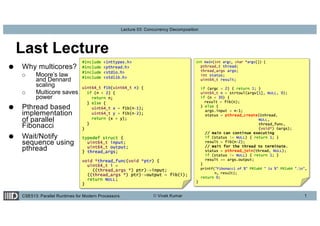
Last Lecture
● Why multicores?
o Moore’s law
and Dennard
scaling
o Multicore saves
power
● Pthread based
implementation
of parallel
Fibonacci
● Wait/Notify
sequence using
pthread
1
CSE513: Parallel Runtimes for Modern Processors © Vivek Kumar
Lecture 03: Concurrency Decomposition
Today’s Class
● Decomposition of sequential program into parallel program
o Tasks and decomposition
o Amdahl’s law
o Tasks and mapping
o Decomposition techniques
§ Recursive
§ Data
§ Exploratory
§ Speculative
2
CSE513: Parallel Runtimes for Modern Processors © Vivek Kumar
Lecture 03: Concurrency Decomposition
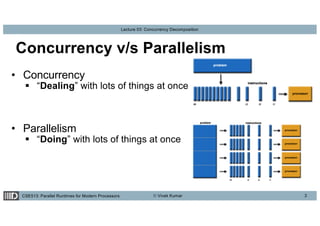
Concurrency v/s Parallelism
• Concurrency
§ “Dealing” with lots of things at once
3
• Parallelism
§ “Doing” with lots of things at once
CSE513: Parallel Runtimes for Modern Processors © Vivek Kumar
Lecture 03: Concurrency Decomposition
Concurrency v/s Parallelism
● Concurrency
o Refers to tasks that appear to be running simultaneously, but
which may, in fact, actually be running serially
● Parallelism
o Refers to concurrent tasks that actually run at the same time
o Always implies multiple processors
o Parallel tasks always run concurrently, but not all concurrent tasks
are parallel
4
CSE513: Parallel Runtimes for Modern Processors © Vivek Kumar
Lecture 03: Concurrency Decomposition
Recipe to Solve a Problem using Parallel
Programming
● Typical steps for constructing a parallel algorithm
o identify what pieces of work can be performed concurrently
o partition concurrent work onto independent processors
o distribute a program’s input, output, and intermediate data
o coordinate accesses to shared data: avoid conflicts
o ensure proper order of work using synchronization
● Why “typical”? Some of the steps may be omitted.
o if data is in shared memory, distributing it may be unnecessary
o the mapping of work to processors can be done statically by the
programmer or dynamically by the runtime
5
CSE513: Parallel Runtimes for Modern Processors © Vivek Kumar
Lecture 03: Concurrency Decomposition
Decomposing Work for Parallel Execution
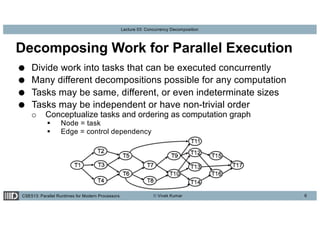
● Divide work into tasks that can be executed concurrently
● Many different decompositions possible for any computation
● Tasks may be same, different, or even indeterminate sizes
● Tasks may be independent or have non-trivial order
o Conceptualize tasks and ordering as computation graph
§ Node = task
§ Edge = control dependency
6
CSE513: Parallel Runtimes for Modern Processors © Vivek Kumar
Lecture 03: Concurrency Decomposition
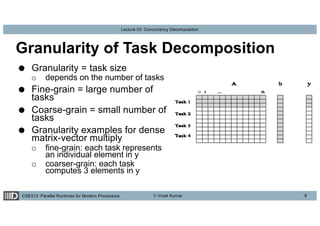
Example: Dense Matrix Vector Product
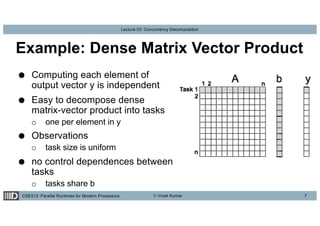
● Computing each element of
output vector y is independent
● Easy to decompose dense
matrix-vector product into tasks
o one per element in y
● Observations
o task size is uniform
● no control dependences between
tasks
o tasks share b
7
CSE513: Parallel Runtimes for Modern Processors © Vivek Kumar
Lecture 03: Concurrency Decomposition
Granularity of Task Decomposition
● Granularity = task size
o depends on the number of tasks
● Fine-grain = large number of
tasks
● Coarse-grain = small number of
tasks
● Granularity examples for dense
matrix-vector multiply
o fine-grain: each task represents
an individual element in y
o coarser-grain: each task
computes 3 elements in y
8
CSE513: Parallel Runtimes for Modern Processors © Vivek Kumar
Lecture 03: Concurrency Decomposition
Critical Path
● Edge in computation graph represents task serialization
● Critical path = longest weighted path though graph
● Critical path length = lower bound on parallel execution
time
9
CSE513: Parallel Runtimes for Modern Processors © Vivek Kumar
Lecture 03: Concurrency Decomposition
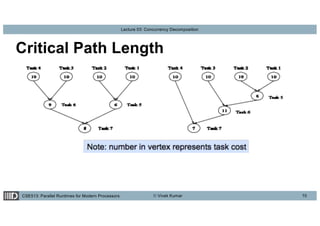
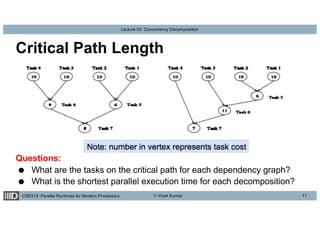
Critical Path Length
10
CSE513: Parallel Runtimes for Modern Processors © Vivek Kumar
Lecture 03: Concurrency Decomposition
Critical Path Length
11
Questions:
● What are the tasks on the critical path for each dependency graph?
● What is the shortest parallel execution time for each decomposition?
CSE513: Parallel Runtimes for Modern Processors © Vivek Kumar
Lecture 03: Concurrency Decomposition
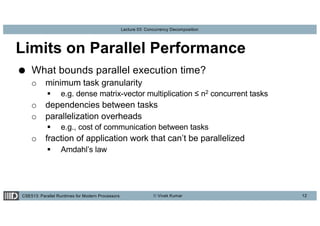
Limits on Parallel Performance
● What bounds parallel execution time?
o minimum task granularity
§ e.g. dense matrix-vector multiplication ≤ n2 concurrent tasks
o dependencies between tasks
o parallelization overheads
§ e.g., cost of communication between tasks
o fraction of application work that can’t be parallelized
§ Amdahl’s law
12
CSE513: Parallel Runtimes for Modern Processors © Vivek Kumar
Lecture 03: Concurrency Decomposition
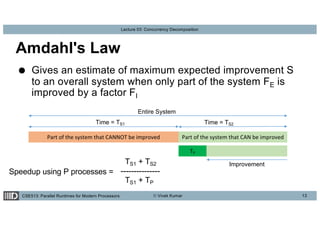
Amdahl's Law
● Gives an estimate of maximum expected improvement S
to an overall system when only part of the system FE is
improved by a factor FI
13
Part of the system that CANNOT be improved Part of the system that CAN be improved
Entire System
TP
Improvement
Time = TS1 Time = TS2
TS1 + TS2
---------------
TS1 + TP
Speedup using P processes =
CSE513: Parallel Runtimes for Modern Processors © Vivek Kumar
Lecture 03: Concurrency Decomposition
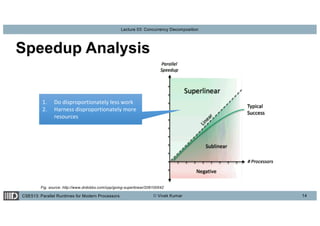
Speedup Analysis
14
1. Do disproportionately less work
2. Harness disproportionately more
resources
Fig. source: http://www.drdobbs.com/cpp/going-superlinear/206100542
CSE513: Parallel Runtimes for Modern Processors © Vivek Kumar
Lecture 03: Concurrency Decomposition
Today’s Class
● Decomposition of sequential program into parallel program
o Tasks and decomposition
o Amdahl’s law
o Tasks and mapping
o Decomposition techniques
§ Recursive
§ Data
§ Exploratory
§ Speculative
15
CSE513: Parallel Runtimes for Modern Processors © Vivek Kumar
Lecture 03: Concurrency Decomposition
Mapping Tasks to Cores
● Generally
o # of tasks > # threads available
o parallel algorithm must map tasks to threads
o schedule independent tasks on separate threads (consider
computation graph)
o threads should have minimum interaction with one another
16
CSE513: Parallel Runtimes for Modern Processors © Vivek Kumar
Lecture 03: Concurrency Decomposition
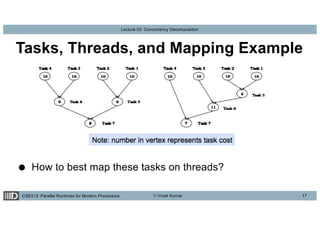
Tasks, Threads, and Mapping Example
● How to best map these tasks on threads?
17
CSE513: Parallel Runtimes for Modern Processors © Vivek Kumar
Lecture 03: Concurrency Decomposition
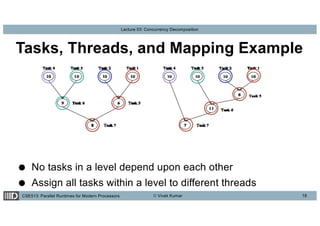
Tasks, Threads, and Mapping Example
● No tasks in a level depend upon each other
● Assign all tasks within a level to different threads
18
CSE513: Parallel Runtimes for Modern Processors © Vivek Kumar
Lecture 03: Concurrency Decomposition
Mapping Techniques
Static vs. dynamic mappings
● Static mapping
o a-priori mapping of tasks to threads or processes
§ requirements
• a good estimate of task size
• even so, computing an optimal mapping may be hard
● Dynamic mapping
§ map tasks to threads or processes at runtime
§ why?
• tasks are generated at runtime, or
• their sizes are unknown
19
CSE513: Parallel Runtimes for Modern Processors © Vivek Kumar
Lecture 03: Concurrency Decomposition
Static Mapping
● Data partitioning
● Computation graph partitioning
20
CSE513: Parallel Runtimes for Modern Processors © Vivek Kumar
Lecture 03: Concurrency Decomposition
Dynamic Mapping
● Dynamic mapping AKA dynamic load balancing
o load balancing is the primary motivation for dynamic mapping
● Styles
o centralized
o distributed
21
CSE513: Parallel Runtimes for Modern Processors © Vivek Kumar
Lecture 03: Concurrency Decomposition
Today’s Class
● Decomposition of sequential program into parallel program
o Tasks and decomposition
o Amdahl’s law
o Tasks and mapping
o Decomposition techniques
§ Recursive
§ Data
§ Exploratory
§ Speculative
22
CSE513: Parallel Runtimes for Modern Processors © Vivek Kumar
Lecture 03: Concurrency Decomposition
Decomposition Techniques
How should one decompose a task into various
subtasks?
● No single universal recipe
● In practice, a variety of techniques are used including
o Data decomposition
o Recursive decomposition
o Exploratory decomposition
o Speculative decomposition
23
CSE513: Parallel Runtimes for Modern Processors © Vivek Kumar
Lecture 03: Concurrency Decomposition
Data Decomposition
● Steps
1. identify the data on which computations are performed
2. partition the data across various tasks
§ partitioning induces a decomposition of the problem
24
CSE513: Parallel Runtimes for Modern Processors © Vivek Kumar
Lecture 03: Concurrency Decomposition
Data Decomposition Example
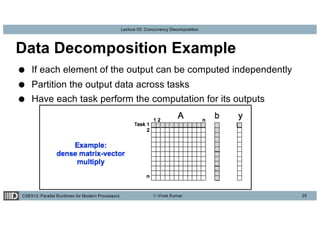
● If each element of the output can be computed independently
● Partition the output data across tasks
● Have each task perform the computation for its outputs
25
CSE513: Parallel Runtimes for Modern Processors © Vivek Kumar
Lecture 03: Concurrency Decomposition
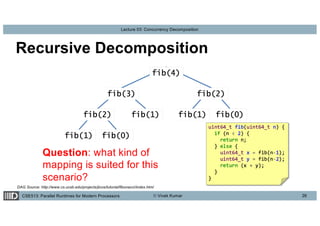
Recursive Decomposition
26
DAG Source: http://www.cs.ucsb.edu/projects/jicos/tutorial/fibonacci/index.html
Question: what kind of
mapping is suited for this
scenario?
CSE513: Parallel Runtimes for Modern Processors © Vivek Kumar
Lecture 03: Concurrency Decomposition
Exploratory Decomposition
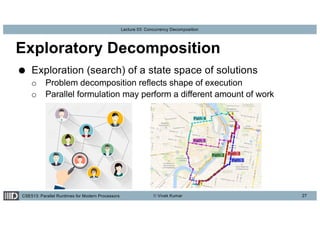
● Exploration (search) of a state space of solutions
o Problem decomposition reflects shape of execution
o Parallel formulation may perform a different amount of work
27
CSE513: Parallel Runtimes for Modern Processors © Vivek Kumar
Lecture 03: Concurrency Decomposition
Exploratory Decomposition Speedup
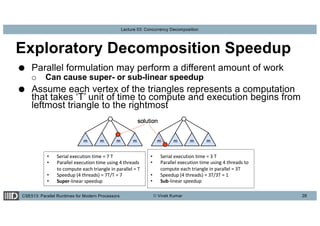
● Parallel formulation may perform a different amount of work
o Can cause super- or sub-linear speedup
● Assume each vertex of the triangles represents a computation
that takes ‘T’ unit of time to compute and execution begins from
leftmost triangle to the rightmost
28
• Serial execution time = 7 T
• Parallel execution time using 4 threads
to compute each triangle in parallel = T
• Speedup (4 threads) = 7T/T = 7
• Super-linear speedup
• Serial execution time = 3 T
• Parallel execution time using 4 threads to
compute each triangle in parallel = 3T
• Speedup (4 threads) = 3T/3T = 1
• Sub-linear speedup
CSE513: Parallel Runtimes for Modern Processors © Vivek Kumar
Lecture 03: Concurrency Decomposition
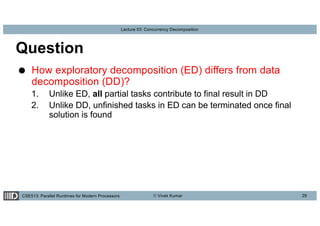
Question
● How exploratory decomposition (ED) differs from data
decomposition (DD)?
1. Unlike ED, all partial tasks contribute to final result in DD
2. Unlike DD, unfinished tasks in ED can be terminated once final
solution is found
29
CSE513: Parallel Runtimes for Modern Processors © Vivek Kumar
Lecture 03: Concurrency Decomposition
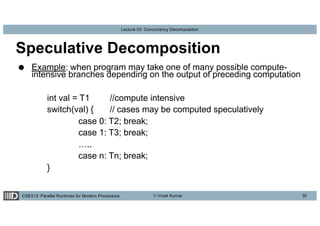
Speculative Decomposition
● Example: when program may take one of many possible compute-
intensive branches depending on the output of preceding computation
int val = T1 //compute intensive
switch(val) { // cases may be computed speculatively
case 0: T2; break;
case 1: T3; break;
…..
case n: Tn; break;
}
30
CSE513: Parallel Runtimes for Modern Processors © Vivek Kumar
Lecture 03: Concurrency Decomposition
Next Lecture (#04)
● Productivity in parallel programming (tasks based parallel
programming model)
● Quiz-1
o Syllabus: Lectures 02 and 03
31

lec03_concurrency_decomposition.pdfghhbk

  • 1.
    CSE513: Parallel Runtimesfor Modern Processors © Vivek Kumar Lecture 03: Concurrency Decomposition Vivek Kumar Computer Science and Engineering IIIT Delhi vivekk@iiitd.ac.in
  • 2.
    CSE513: Parallel Runtimesfor Modern Processors © Vivek Kumar Lecture 03: Concurrency Decomposition Last Lecture ● Why multicores? o Moore’s law and Dennard scaling o Multicore saves power ● Pthread based implementation of parallel Fibonacci ● Wait/Notify sequence using pthread 1
  • 3.
    CSE513: Parallel Runtimesfor Modern Processors © Vivek Kumar Lecture 03: Concurrency Decomposition Today’s Class ● Decomposition of sequential program into parallel program o Tasks and decomposition o Amdahl’s law o Tasks and mapping o Decomposition techniques § Recursive § Data § Exploratory § Speculative 2
  • 4.
    CSE513: Parallel Runtimesfor Modern Processors © Vivek Kumar Lecture 03: Concurrency Decomposition Concurrency v/s Parallelism • Concurrency § “Dealing” with lots of things at once 3 • Parallelism § “Doing” with lots of things at once
  • 5.
    CSE513: Parallel Runtimesfor Modern Processors © Vivek Kumar Lecture 03: Concurrency Decomposition Concurrency v/s Parallelism ● Concurrency o Refers to tasks that appear to be running simultaneously, but which may, in fact, actually be running serially ● Parallelism o Refers to concurrent tasks that actually run at the same time o Always implies multiple processors o Parallel tasks always run concurrently, but not all concurrent tasks are parallel 4
  • 6.
    CSE513: Parallel Runtimesfor Modern Processors © Vivek Kumar Lecture 03: Concurrency Decomposition Recipe to Solve a Problem using Parallel Programming ● Typical steps for constructing a parallel algorithm o identify what pieces of work can be performed concurrently o partition concurrent work onto independent processors o distribute a program’s input, output, and intermediate data o coordinate accesses to shared data: avoid conflicts o ensure proper order of work using synchronization ● Why “typical”? Some of the steps may be omitted. o if data is in shared memory, distributing it may be unnecessary o the mapping of work to processors can be done statically by the programmer or dynamically by the runtime 5
  • 7.
    CSE513: Parallel Runtimesfor Modern Processors © Vivek Kumar Lecture 03: Concurrency Decomposition Decomposing Work for Parallel Execution ● Divide work into tasks that can be executed concurrently ● Many different decompositions possible for any computation ● Tasks may be same, different, or even indeterminate sizes ● Tasks may be independent or have non-trivial order o Conceptualize tasks and ordering as computation graph § Node = task § Edge = control dependency 6
  • 8.
    CSE513: Parallel Runtimesfor Modern Processors © Vivek Kumar Lecture 03: Concurrency Decomposition Example: Dense Matrix Vector Product ● Computing each element of output vector y is independent ● Easy to decompose dense matrix-vector product into tasks o one per element in y ● Observations o task size is uniform ● no control dependences between tasks o tasks share b 7
  • 9.
    CSE513: Parallel Runtimesfor Modern Processors © Vivek Kumar Lecture 03: Concurrency Decomposition Granularity of Task Decomposition ● Granularity = task size o depends on the number of tasks ● Fine-grain = large number of tasks ● Coarse-grain = small number of tasks ● Granularity examples for dense matrix-vector multiply o fine-grain: each task represents an individual element in y o coarser-grain: each task computes 3 elements in y 8
  • 10.
    CSE513: Parallel Runtimesfor Modern Processors © Vivek Kumar Lecture 03: Concurrency Decomposition Critical Path ● Edge in computation graph represents task serialization ● Critical path = longest weighted path though graph ● Critical path length = lower bound on parallel execution time 9
  • 11.
    CSE513: Parallel Runtimesfor Modern Processors © Vivek Kumar Lecture 03: Concurrency Decomposition Critical Path Length 10
  • 12.
    CSE513: Parallel Runtimesfor Modern Processors © Vivek Kumar Lecture 03: Concurrency Decomposition Critical Path Length 11 Questions: ● What are the tasks on the critical path for each dependency graph? ● What is the shortest parallel execution time for each decomposition?
  • 13.
    CSE513: Parallel Runtimesfor Modern Processors © Vivek Kumar Lecture 03: Concurrency Decomposition Limits on Parallel Performance ● What bounds parallel execution time? o minimum task granularity § e.g. dense matrix-vector multiplication ≤ n2 concurrent tasks o dependencies between tasks o parallelization overheads § e.g., cost of communication between tasks o fraction of application work that can’t be parallelized § Amdahl’s law 12
  • 14.
    CSE513: Parallel Runtimesfor Modern Processors © Vivek Kumar Lecture 03: Concurrency Decomposition Amdahl's Law ● Gives an estimate of maximum expected improvement S to an overall system when only part of the system FE is improved by a factor FI 13 Part of the system that CANNOT be improved Part of the system that CAN be improved Entire System TP Improvement Time = TS1 Time = TS2 TS1 + TS2 --------------- TS1 + TP Speedup using P processes =
  • 15.
    CSE513: Parallel Runtimesfor Modern Processors © Vivek Kumar Lecture 03: Concurrency Decomposition Speedup Analysis 14 1. Do disproportionately less work 2. Harness disproportionately more resources Fig. source: http://www.drdobbs.com/cpp/going-superlinear/206100542
  • 16.
    CSE513: Parallel Runtimesfor Modern Processors © Vivek Kumar Lecture 03: Concurrency Decomposition Today’s Class ● Decomposition of sequential program into parallel program o Tasks and decomposition o Amdahl’s law o Tasks and mapping o Decomposition techniques § Recursive § Data § Exploratory § Speculative 15
  • 17.
    CSE513: Parallel Runtimesfor Modern Processors © Vivek Kumar Lecture 03: Concurrency Decomposition Mapping Tasks to Cores ● Generally o # of tasks > # threads available o parallel algorithm must map tasks to threads o schedule independent tasks on separate threads (consider computation graph) o threads should have minimum interaction with one another 16
  • 18.
    CSE513: Parallel Runtimesfor Modern Processors © Vivek Kumar Lecture 03: Concurrency Decomposition Tasks, Threads, and Mapping Example ● How to best map these tasks on threads? 17
  • 19.
    CSE513: Parallel Runtimesfor Modern Processors © Vivek Kumar Lecture 03: Concurrency Decomposition Tasks, Threads, and Mapping Example ● No tasks in a level depend upon each other ● Assign all tasks within a level to different threads 18
  • 20.
    CSE513: Parallel Runtimesfor Modern Processors © Vivek Kumar Lecture 03: Concurrency Decomposition Mapping Techniques Static vs. dynamic mappings ● Static mapping o a-priori mapping of tasks to threads or processes § requirements • a good estimate of task size • even so, computing an optimal mapping may be hard ● Dynamic mapping § map tasks to threads or processes at runtime § why? • tasks are generated at runtime, or • their sizes are unknown 19
  • 21.
    CSE513: Parallel Runtimesfor Modern Processors © Vivek Kumar Lecture 03: Concurrency Decomposition Static Mapping ● Data partitioning ● Computation graph partitioning 20
  • 22.
    CSE513: Parallel Runtimesfor Modern Processors © Vivek Kumar Lecture 03: Concurrency Decomposition Dynamic Mapping ● Dynamic mapping AKA dynamic load balancing o load balancing is the primary motivation for dynamic mapping ● Styles o centralized o distributed 21
  • 23.
    CSE513: Parallel Runtimesfor Modern Processors © Vivek Kumar Lecture 03: Concurrency Decomposition Today’s Class ● Decomposition of sequential program into parallel program o Tasks and decomposition o Amdahl’s law o Tasks and mapping o Decomposition techniques § Recursive § Data § Exploratory § Speculative 22
  • 24.
    CSE513: Parallel Runtimesfor Modern Processors © Vivek Kumar Lecture 03: Concurrency Decomposition Decomposition Techniques How should one decompose a task into various subtasks? ● No single universal recipe ● In practice, a variety of techniques are used including o Data decomposition o Recursive decomposition o Exploratory decomposition o Speculative decomposition 23
  • 25.
    CSE513: Parallel Runtimesfor Modern Processors © Vivek Kumar Lecture 03: Concurrency Decomposition Data Decomposition ● Steps 1. identify the data on which computations are performed 2. partition the data across various tasks § partitioning induces a decomposition of the problem 24
  • 26.
    CSE513: Parallel Runtimesfor Modern Processors © Vivek Kumar Lecture 03: Concurrency Decomposition Data Decomposition Example ● If each element of the output can be computed independently ● Partition the output data across tasks ● Have each task perform the computation for its outputs 25
  • 27.
    CSE513: Parallel Runtimesfor Modern Processors © Vivek Kumar Lecture 03: Concurrency Decomposition Recursive Decomposition 26 DAG Source: http://www.cs.ucsb.edu/projects/jicos/tutorial/fibonacci/index.html Question: what kind of mapping is suited for this scenario?
  • 28.
    CSE513: Parallel Runtimesfor Modern Processors © Vivek Kumar Lecture 03: Concurrency Decomposition Exploratory Decomposition ● Exploration (search) of a state space of solutions o Problem decomposition reflects shape of execution o Parallel formulation may perform a different amount of work 27
  • 29.
    CSE513: Parallel Runtimesfor Modern Processors © Vivek Kumar Lecture 03: Concurrency Decomposition Exploratory Decomposition Speedup ● Parallel formulation may perform a different amount of work o Can cause super- or sub-linear speedup ● Assume each vertex of the triangles represents a computation that takes ‘T’ unit of time to compute and execution begins from leftmost triangle to the rightmost 28 • Serial execution time = 7 T • Parallel execution time using 4 threads to compute each triangle in parallel = T • Speedup (4 threads) = 7T/T = 7 • Super-linear speedup • Serial execution time = 3 T • Parallel execution time using 4 threads to compute each triangle in parallel = 3T • Speedup (4 threads) = 3T/3T = 1 • Sub-linear speedup
  • 30.
    CSE513: Parallel Runtimesfor Modern Processors © Vivek Kumar Lecture 03: Concurrency Decomposition Question ● How exploratory decomposition (ED) differs from data decomposition (DD)? 1. Unlike ED, all partial tasks contribute to final result in DD 2. Unlike DD, unfinished tasks in ED can be terminated once final solution is found 29
  • 31.
    CSE513: Parallel Runtimesfor Modern Processors © Vivek Kumar Lecture 03: Concurrency Decomposition Speculative Decomposition ● Example: when program may take one of many possible compute- intensive branches depending on the output of preceding computation int val = T1 //compute intensive switch(val) { // cases may be computed speculatively case 0: T2; break; case 1: T3; break; ….. case n: Tn; break; } 30
  • 32.
    CSE513: Parallel Runtimesfor Modern Processors © Vivek Kumar Lecture 03: Concurrency Decomposition Next Lecture (#04) ● Productivity in parallel programming (tasks based parallel programming model) ● Quiz-1 o Syllabus: Lectures 02 and 03 31