METHODS OF STORAGE
ASHO3205 - 2 (1+1)
POST HARVEST MANAGEMENT
AND
VALUE ADDITION
OF
FRUITS AND VEGETABLES
COURSE IN CHARGE: Dr. M CHANDRA SURYA RAO
M. Sc. (Hort.), Ph. D
• Mainly there are two methods of storage i.e.tradirtional methods and
advanced methods.
• I. Traditional methods (Low cost storage structures) not requiring
refrigeration
• Include: in situ, sand, coir, pits
• In situ
• This method of storing fruits and vegetables involves delaying the
harvest until the crop is required.
• It can be used in some cases with root crops, such as cassava, but
means that the land on which the crop was grown will remain
occupied and a new crop cannot be planted.
• In colder climates, the crop may be exposed to freezing and chilling
injury.
• There are chances of occurring damage due to insect pests and
diseases.
• Sand or coir:
• This storage technique is used in countries like India to store potatoes for
longer periods of time, which involves covering the commodity under
ground with sand.
• Pits or trenches:
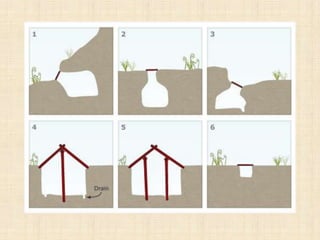
• These are dug 1.0-1.5m deep at the edges of the field where the crop has
been grown.
• Usually pits are placed at the highest point in the field, especially in regions
of high rainfall.
• The pit or trench is lined with straw or other organic material and filled
with the crop being stored, then covered with a layer of organic material
followed by a layer of soil.
• Holes are created with straw at the top to allow for air ventilation, as lack
of ventilation may cause problems with rotting of the crop.
• This method is suitable for storing ginger.
• This method is not suitable for fruits and leafy vegetables demanding high
humidity because it cannot maintain high humidity.
• The stored commodity can not be examined frequently for rotting etc.
• Clamps
• This has been a traditional method for storing potatoes,
cassava etc. in some parts of the world, such as Great
Britain.
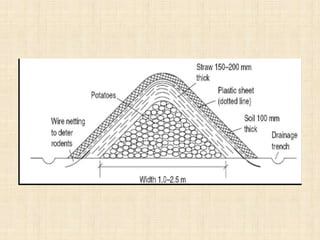
• A common design uses an area of land at the side of the
field.
• The width of the clamp is about 1 to 2.5 m.
• The dimensions are marked out and the potatoes piled
on the ground in an elongated conical heap. .
• At the top, straw is bent over the ridge so that rain will
tend to run off the structure.
• Straw thickness should be from 15-25 cm when
compressed.
• Produce may desiccate because of low relative
humidity.
• Large heaps may result in more incidence of rotting.
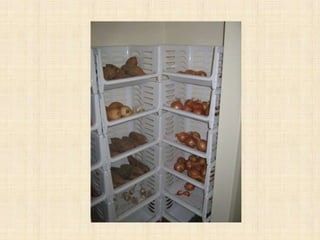
• Cellars
• These underground or partly underground rooms are often beneath a house.
• This location has good insulation, providing cooling in warm ambient
conditions and protection from excessively low temperatures in cold
climates.
• Cellars have traditionally been used at domestic scale in Britain to store
apples, cabbages, onions, and potatoes during winter.
• Produce may desiccate due to low relative humidity.
• Barns.
• A barn is a farm building for sheltering, processing, and storing agricultural
products
• Although, there is no precise scale or measure for the type or size of the
building, the term barn is usually reserved for the largest or most important
structure on any particular farm.
• Smaller or minor agricultural buildings are often labeled as sheds or
outbuildings and are normally used to house smaller implements or
activities.
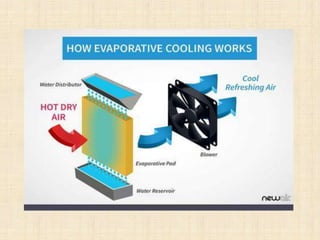
• Evaporative cooling.
• When water evaporates from the liquid phase into the vapour
phase energy is required.
• This principle can be used to cool stores by first passing the air
introduced into the storage room through a pad of water.
• The degree of cooling depends on the original humidity of the
air and the efficiency of the evaporating surface.
• If the ambient air has low humidity and is humidified to
around 100% RH, then a large reduction in temperature will be
achieved.
• This can provide cool moist conditions during storage.
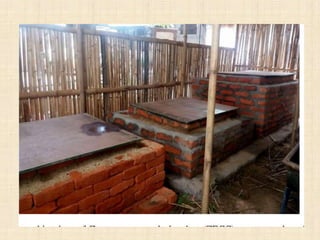
• Zero energy cool chamber (ZECC):
• It is a low cost storage structure suitable for short duration storage fruits
and vegetables
• There is no need of any power source i.e. electicity, diesel, petrol etc. for
cooling,thus,the name zero energy cool chamber.
• The zero energy cool chamber based on evaporative cooling system.
• Evaporation occurs when air that is not already saturated with water is
blown across any wet surface.
• Thus an evaporative cooler consists of a wet porous bed through which air
is drawn, cooled and humidified by evaporation of water.
• In summer, when outside temperature is 44OC, the maximum temperature
inside the chamber never goes beyond more than 28OC, the relative
humidity being 90%.
• Night ventilation
• In hot climates, the variation between day and night temperatures can be
used to keep stores cool.
• The storage room should be well insulated when the crop is placed inside.
• A fan is built into the store room, which is switched on when the outside
temperature at night becomes lower than the temperature within.
• The fan switches off when the temperatures equalize.
• The fan is controlled by a differential thermostat, which constantly
compares the outside air temperature with the internal storage temperature.
• This method is used to store bulk onions.
• Controlled atmospheres are made of gastight chambers with insulated
walls, ceiling, and floor.
• They are increasingly common for fruit storage at larger scale. Depending
on the species and variety, various blends of O2, CO2, and N2 are required.
• Low content O2 atmospheres (0.8 to 1.5%), called ULO (Ultra -Low
Oxygen) atmospheres, are used for fruits with long storage lives (e.g.,
apples).
• II. Advanced (high cost) methods of storage:
• 1. Low temperature storage (Refrigerated or cold storage):
Microbial growth and enzyme reactions are retarded in food
storage at low temperatures.
• The lower the temperature, the greater the retardation.
• Low temperatures employed can be
• a) Cellar storage temperature (about 15OC)
• b) Refrigeration or chilling temperature (OO C to 5OC)
• c) Freezing temperature(Cold storage) (-18OC to -40OC)
• 1(a) Cellar storage temperature (about15OC):
• Temperature in cellar (under ground rooms) where food is stored in many
villages are usually not much below that of the out side air and is seldom
lower than 15OC.
• The temperature is not low enough to prevent the action of many spoilage
organisms and of the plant enzymes.
• Decomposition is however slowed down considerably.
• Root crops, potatoes, onions, apples and similar foods can be stored for
limited during the winter months.
• 1(b) Refrigeration or chilling temperatures (OOC to 5OC):
• Refrigerated storage or low temperature storage is the most
common method of storage through out the world both for
fruits and vegetables.
• Refrigeration is the process of removing heat from an enclosed
space or room or a substance or commodity.
• The primary purpose of refrigeration is lowering the
temperature of th enclosed space or substance or commodity
and then maintaining that lower temperature.
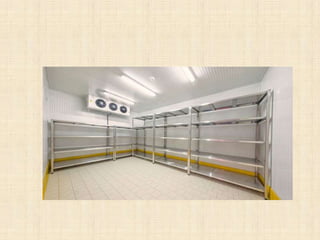
• 1(c) Cold storage:
• At temperatures below the freezing point of water (-18OC to -40OC)
growth of micro organisms and enzymes activity are reduced to the
minimum.
• Most perishable foods can be preserved for several months if the
temperature is brought down quickly(called quick freezing) and
food held at these temperatures.
• Foods can be quick frozen in about 90 minutes or less by
• (1) placing them in contact with the coil through which the
refrigerant flows
• (2) blast freezing in which cold air is blown across the food,
• (3) by dipping in liquid nitrogen.
• Quick frozen foods maintain their identity and freshness when they are
thawed (brought to room temperature) because of very small crystals are
formed when foods are frozen by these methods.
• Many micro-organisms can survive this treatment and may become active
and spoil the food if the foods are held at higher temperatures.
• Frozen foods should always ,therefore be held at temperatures below -5OC.
• Enzymes in certain vegetables can continue to act even after being quick
frozen and so vegetables have to be given heat treatment called
blanching(above 80OC) before they are frozen to prevent development of
off flavours.
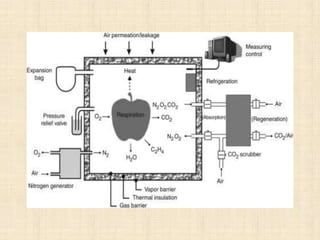
• (2) Controlled / Modified atmosphere storage:
• In this system the produce is held under atmosphere conditions
modified by package, over wrap, box liner or pellet cover.
• The first requirement of CAS is sufficiently gas tight envelops
around the produce and the second requirement is some means of
maintaining the concentration of CO2 and O2 at the desired level.
• This method in combination with refrigeration markedly enhanced
the storage life of fruits.
• The fruit that has derived the most benefit is apple. Among the
tropical fruits, the best atmosphere for storage of mangoes is 5%
CO2 and 5% O2 at 13OC.
• CAS improved the appearance of pine apple fruit by reducing the
superficial mould growth.
• The optimum O2 level was 2%. Levels of oxygen below that were
ineffective in extending storage life.
• Benefits could be obtained with papaya when the fruits are stored in
5% CO2 and 1 % O2 for 3 weeks at 13OC.
• Initiation of ripening in banana can be delayed for weeks or months
by holding the green banana fruits in an atmosphere of 1-10% O2, 5-
10% CO2 or low O2 and high CO2 combination, In general, the
response of citrus fruits to CAS has been disappointing.
• In MAS the composition of the storage atmosphere is not closely
controlled.
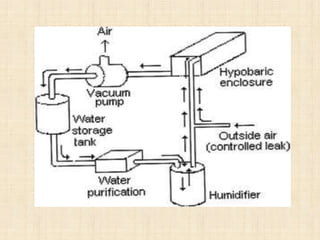
• (3) Hypobaric (Sub atmosphere) storage:
• The commodity is placed in a vacuum tight and refrigerated
container and evacuated by a vacuum pump to the desired low
pressure.
• The process of ripening and senescence are greatly retarded by
decreasing respiration and evacuation of ethylene given out by
the poduce.
• This is an expensive method.
• (4) Irradiation:
• Application of irradiation for suppressing sprouting and hence extension of
shelf life has been allowed in India.
• Sprouting onion can be checked by gamma irradiation at a dose of 0.06 -
0.1 kGY.
• In potato gamma irradiation at -0.1 kGY can inhibit sprouting completely.
• The irradiated potatoes could be stored successfully for 6 months at 15OC
with 10% loss.
• Irradiation in banana, guava, mango and papaya improves shelf life due to
delay in rate of ripening an senescence.
Thank You………

LEC 2 METHODS OF STORAGE.pptx storage ppt

  • 1.
    METHODS OF STORAGE ASHO3205- 2 (1+1) POST HARVEST MANAGEMENT AND VALUE ADDITION OF FRUITS AND VEGETABLES COURSE IN CHARGE: Dr. M CHANDRA SURYA RAO M. Sc. (Hort.), Ph. D
  • 2.
    • Mainly thereare two methods of storage i.e.tradirtional methods and advanced methods. • I. Traditional methods (Low cost storage structures) not requiring refrigeration • Include: in situ, sand, coir, pits
  • 3.
    • In situ •This method of storing fruits and vegetables involves delaying the harvest until the crop is required. • It can be used in some cases with root crops, such as cassava, but means that the land on which the crop was grown will remain occupied and a new crop cannot be planted. • In colder climates, the crop may be exposed to freezing and chilling injury. • There are chances of occurring damage due to insect pests and diseases.
  • 4.
    • Sand orcoir: • This storage technique is used in countries like India to store potatoes for longer periods of time, which involves covering the commodity under ground with sand. • Pits or trenches: • These are dug 1.0-1.5m deep at the edges of the field where the crop has been grown. • Usually pits are placed at the highest point in the field, especially in regions of high rainfall. • The pit or trench is lined with straw or other organic material and filled with the crop being stored, then covered with a layer of organic material followed by a layer of soil. • Holes are created with straw at the top to allow for air ventilation, as lack of ventilation may cause problems with rotting of the crop. • This method is suitable for storing ginger. • This method is not suitable for fruits and leafy vegetables demanding high humidity because it cannot maintain high humidity. • The stored commodity can not be examined frequently for rotting etc.
  • 6.
    • Clamps • Thishas been a traditional method for storing potatoes, cassava etc. in some parts of the world, such as Great Britain. • A common design uses an area of land at the side of the field. • The width of the clamp is about 1 to 2.5 m. • The dimensions are marked out and the potatoes piled on the ground in an elongated conical heap. . • At the top, straw is bent over the ridge so that rain will tend to run off the structure. • Straw thickness should be from 15-25 cm when compressed. • Produce may desiccate because of low relative humidity. • Large heaps may result in more incidence of rotting.
  • 8.
    • Cellars • Theseunderground or partly underground rooms are often beneath a house. • This location has good insulation, providing cooling in warm ambient conditions and protection from excessively low temperatures in cold climates. • Cellars have traditionally been used at domestic scale in Britain to store apples, cabbages, onions, and potatoes during winter. • Produce may desiccate due to low relative humidity. • Barns. • A barn is a farm building for sheltering, processing, and storing agricultural products • Although, there is no precise scale or measure for the type or size of the building, the term barn is usually reserved for the largest or most important structure on any particular farm. • Smaller or minor agricultural buildings are often labeled as sheds or outbuildings and are normally used to house smaller implements or activities.
  • 10.
    • Evaporative cooling. •When water evaporates from the liquid phase into the vapour phase energy is required. • This principle can be used to cool stores by first passing the air introduced into the storage room through a pad of water. • The degree of cooling depends on the original humidity of the air and the efficiency of the evaporating surface. • If the ambient air has low humidity and is humidified to around 100% RH, then a large reduction in temperature will be achieved. • This can provide cool moist conditions during storage.
  • 12.
    • Zero energycool chamber (ZECC): • It is a low cost storage structure suitable for short duration storage fruits and vegetables • There is no need of any power source i.e. electicity, diesel, petrol etc. for cooling,thus,the name zero energy cool chamber. • The zero energy cool chamber based on evaporative cooling system. • Evaporation occurs when air that is not already saturated with water is blown across any wet surface. • Thus an evaporative cooler consists of a wet porous bed through which air is drawn, cooled and humidified by evaporation of water. • In summer, when outside temperature is 44OC, the maximum temperature inside the chamber never goes beyond more than 28OC, the relative humidity being 90%.
  • 14.
    • Night ventilation •In hot climates, the variation between day and night temperatures can be used to keep stores cool. • The storage room should be well insulated when the crop is placed inside. • A fan is built into the store room, which is switched on when the outside temperature at night becomes lower than the temperature within. • The fan switches off when the temperatures equalize. • The fan is controlled by a differential thermostat, which constantly compares the outside air temperature with the internal storage temperature. • This method is used to store bulk onions. • Controlled atmospheres are made of gastight chambers with insulated walls, ceiling, and floor. • They are increasingly common for fruit storage at larger scale. Depending on the species and variety, various blends of O2, CO2, and N2 are required. • Low content O2 atmospheres (0.8 to 1.5%), called ULO (Ultra -Low Oxygen) atmospheres, are used for fruits with long storage lives (e.g., apples).
  • 16.
    • II. Advanced(high cost) methods of storage: • 1. Low temperature storage (Refrigerated or cold storage): Microbial growth and enzyme reactions are retarded in food storage at low temperatures. • The lower the temperature, the greater the retardation. • Low temperatures employed can be • a) Cellar storage temperature (about 15OC) • b) Refrigeration or chilling temperature (OO C to 5OC) • c) Freezing temperature(Cold storage) (-18OC to -40OC)
  • 17.
    • 1(a) Cellarstorage temperature (about15OC): • Temperature in cellar (under ground rooms) where food is stored in many villages are usually not much below that of the out side air and is seldom lower than 15OC. • The temperature is not low enough to prevent the action of many spoilage organisms and of the plant enzymes. • Decomposition is however slowed down considerably. • Root crops, potatoes, onions, apples and similar foods can be stored for limited during the winter months.
  • 18.
    • 1(b) Refrigerationor chilling temperatures (OOC to 5OC): • Refrigerated storage or low temperature storage is the most common method of storage through out the world both for fruits and vegetables. • Refrigeration is the process of removing heat from an enclosed space or room or a substance or commodity. • The primary purpose of refrigeration is lowering the temperature of th enclosed space or substance or commodity and then maintaining that lower temperature.
  • 19.
    • 1(c) Coldstorage: • At temperatures below the freezing point of water (-18OC to -40OC) growth of micro organisms and enzymes activity are reduced to the minimum. • Most perishable foods can be preserved for several months if the temperature is brought down quickly(called quick freezing) and food held at these temperatures. • Foods can be quick frozen in about 90 minutes or less by • (1) placing them in contact with the coil through which the refrigerant flows • (2) blast freezing in which cold air is blown across the food, • (3) by dipping in liquid nitrogen.
  • 21.
    • Quick frozenfoods maintain their identity and freshness when they are thawed (brought to room temperature) because of very small crystals are formed when foods are frozen by these methods. • Many micro-organisms can survive this treatment and may become active and spoil the food if the foods are held at higher temperatures. • Frozen foods should always ,therefore be held at temperatures below -5OC. • Enzymes in certain vegetables can continue to act even after being quick frozen and so vegetables have to be given heat treatment called blanching(above 80OC) before they are frozen to prevent development of off flavours.
  • 22.
    • (2) Controlled/ Modified atmosphere storage: • In this system the produce is held under atmosphere conditions modified by package, over wrap, box liner or pellet cover. • The first requirement of CAS is sufficiently gas tight envelops around the produce and the second requirement is some means of maintaining the concentration of CO2 and O2 at the desired level. • This method in combination with refrigeration markedly enhanced the storage life of fruits. • The fruit that has derived the most benefit is apple. Among the tropical fruits, the best atmosphere for storage of mangoes is 5% CO2 and 5% O2 at 13OC.
  • 23.
    • CAS improvedthe appearance of pine apple fruit by reducing the superficial mould growth. • The optimum O2 level was 2%. Levels of oxygen below that were ineffective in extending storage life. • Benefits could be obtained with papaya when the fruits are stored in 5% CO2 and 1 % O2 for 3 weeks at 13OC. • Initiation of ripening in banana can be delayed for weeks or months by holding the green banana fruits in an atmosphere of 1-10% O2, 5- 10% CO2 or low O2 and high CO2 combination, In general, the response of citrus fruits to CAS has been disappointing. • In MAS the composition of the storage atmosphere is not closely controlled.
  • 25.
    • (3) Hypobaric(Sub atmosphere) storage: • The commodity is placed in a vacuum tight and refrigerated container and evacuated by a vacuum pump to the desired low pressure. • The process of ripening and senescence are greatly retarded by decreasing respiration and evacuation of ethylene given out by the poduce. • This is an expensive method.
  • 27.
    • (4) Irradiation: •Application of irradiation for suppressing sprouting and hence extension of shelf life has been allowed in India. • Sprouting onion can be checked by gamma irradiation at a dose of 0.06 - 0.1 kGY. • In potato gamma irradiation at -0.1 kGY can inhibit sprouting completely. • The irradiated potatoes could be stored successfully for 6 months at 15OC with 10% loss. • Irradiation in banana, guava, mango and papaya improves shelf life due to delay in rate of ripening an senescence.
  • 28.