Lecture (1)
:
Introductio
 ‘‘a temporary endeavor undertaken to create a
unique product, service, or result’’
 A project has the following characteristic features:
 Every project is unique in that it requires
doing something different than was done
previously,
 A project must have a specified objective to
be completed within certain specifications,
 Should have defined start and end dates,
 Should consume resources (manpower,
materials, machinery).
Projects can range from:
 Simple repair woks, medium type of works
taken up most often by private parties &
complex infrastructure construction,
 Urgent or Secret mission projects,
 Sequential project, concurrent projects or Fast-
Track projects,
 Project with great uncertainty and complexity.
 Subprojects: These are segments of the original project
that are divided according to specialty, responsibility,
phase, area, or other criteria. To the person in charge of a
subproject, the subproject is a project, except that he/she
has to consider not only the internal relationships among
its activities but the external relationships as well (with
activities in other subprojects in the same project).
 For example, in a residential or commercial development
project, building the infrastructure may be regarded as a
subproject. In fact, building the sewer system in the
development can be a subproject (to the entire
development project) or even a sub-subproject (to the
infrastructure subproject).
 In project management, a program—usually—is a
group of related projects and/or services intended to
meet a common objective and usually managed by one
entity. (control not available from managing them
individually)
 A program could also indicate a large and complex
project that is divided into several projects for more
effective management.
 Programs may be:
 Temporary/one-time programs
 Ongoing (usually periodic/annual) programs: These include
projects such as road maintenance and storm water programs for a
public works department in many municipalities..
 This is a group of projects, not necessarily related or
dependent, usually under one project manager or
department.
 The PMI defines it as ‘‘A collection of projects or
programs and other work that are grouped together to
facilitate effective management of that work to meet
strategic business objectives.
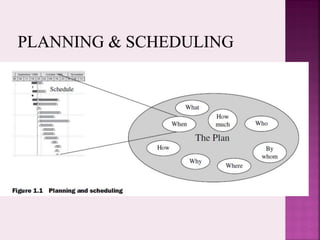
 Project planning has been defined as ‘‘the process of
choosing the one method and order of work to be
adopted for a project’’.
 Those processes performed to establish the total
scope of the effort, define and refine the objectives,
and develop the course of action required to attain
those objectives’’.
 Project planning serves as a foundation for several
related functions, such as cost estimating, scheduling,
project control, quality control, safety management,
and others.
a plan for an office building project may include the
following:
 A scope definition, (objectives).
 A schematic or conceptual design.
 A budget number (e.g., $6 million).
 A time frame (i.e., when the project is expected to
start and end).
 Project manager.
 Once a project starts, certain aspects can easily deviate or
go astray. This deviation can be overspending, a schedule
slippage, a departure from the objective/scope, or
something else. It is of utmost importance to know—at
all times—where you stand in relation to where you
planned to be (the baseline ‫)حدود‬. If you find yourself
behind schedule or over budget, you must know why and
then take corrective action to get back on track or, at
least, minimize the deviation. This process exemplifies
project control (measure work progress).
 Although the concept of project control covers all aspects
of the plan (budget, schedule, quality, safety, etc.), our
main focus in this book is on schedule and budget
control, which are related.
PMI defines project management plan as a ‘‘formal,
approved document that defines how the project is
executed, monitored and controlled. It may be summary
or detailed and may be composed of one or more
subsidiary management plans and other planning
documents’’.
 The objective of a project management plan is to
define the approach to be used by the project team to
deliver the intended project management scope of the
project.
 Scheduling is the determination of the timing and
sequence of operations in the project and their
assembly to give the overall completion time.
 schedule or a timetable, as a basic time-management
tool, consists of a list of times at which possible tasks,
events, or actions are intended to take place.
 The process of creating a schedule — deciding how to
order these tasks and how to commit resources
between the variety of possible tasks — is
called scheduling.
 Scheduling is an output of the planning process.
- Project schedule may mean different to the
stakeholders.
- Following is a group of reasons for why project
scheduling is needed, from two different perspectives:
contractors and owners.
1. Calculate the project completion date:
2. Calculate the start or end of a specific activity:
Specific activities may require special attention, such as
ordering and delivering materials or equipment.
3. Coordinate among trades and subcontractors, and
expose and adjust conflicts:
4. Determine resource utilization:
5. Predict and calculate the cash flow:
6. Improve work efficiency: (save time and money)
7. Evaluate the impact of changes:
8. Prove delay claims: Construction delay claims
are common. Contractors must be able to
accurately prove their claims against owners (or
other parties) using project schedules. In most
cases, only a critical path method (CPM)
schedule can prove or disprove a delay claim,
which can be a multimillion dollar one.
 Scheduling is done by people, and not computers!
 The person responsible for making a particular
schedule may be called a scheduler. Making and
 The Scheduler: A civil engineer, an architect, a
computer whiz, a mathematician, a project
manager, an artist, or a communicator? An
increasing trend—in all industries— is to use
computer software and other high-tech tools.
Three types of knowledge that a scheduler must
have:
1. Knowledge of computer software (and perhaps
hardware as well)
2. Knowledge of the principles of scheduling and
project control (as part of project management)
3. Knowledge of the specific technical field, such as
commercial building, industrial, transportation, and so
forth
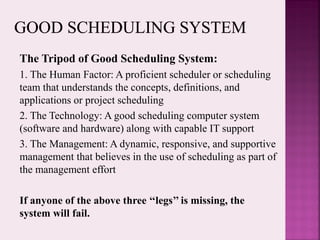
The Tripod of Good Scheduling System:
1. The Human Factor: A proficient scheduler or scheduling
team that understands the concepts, definitions, and
applications or project scheduling
2. The Technology: A good scheduling computer system
(software and hardware) along with capable IT support
3. The Management: A dynamic, responsive, and supportive
management that believes in the use of scheduling as part of
the management effort
If anyone of the above three ‘‘legs’’ is missing, the
system will fail.
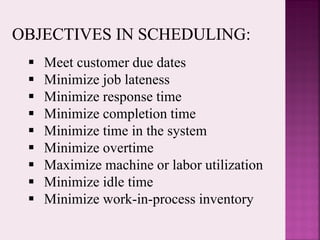
 Meet customer due dates
 Minimize job lateness
 Minimize response time
 Minimize completion time
 Minimize time in the system
 Minimize overtime
 Maximize machine or labor utilization
 Minimize idle time
 Minimize work-in-process inventory
.

Lec 1 (2).pdf

  • 1.
  • 2.
     ‘‘a temporaryendeavor undertaken to create a unique product, service, or result’’  A project has the following characteristic features:  Every project is unique in that it requires doing something different than was done previously,  A project must have a specified objective to be completed within certain specifications,  Should have defined start and end dates,  Should consume resources (manpower, materials, machinery).
  • 3.
    Projects can rangefrom:  Simple repair woks, medium type of works taken up most often by private parties & complex infrastructure construction,  Urgent or Secret mission projects,  Sequential project, concurrent projects or Fast- Track projects,  Project with great uncertainty and complexity.
  • 4.
     Subprojects: Theseare segments of the original project that are divided according to specialty, responsibility, phase, area, or other criteria. To the person in charge of a subproject, the subproject is a project, except that he/she has to consider not only the internal relationships among its activities but the external relationships as well (with activities in other subprojects in the same project).  For example, in a residential or commercial development project, building the infrastructure may be regarded as a subproject. In fact, building the sewer system in the development can be a subproject (to the entire development project) or even a sub-subproject (to the infrastructure subproject).
  • 5.
     In projectmanagement, a program—usually—is a group of related projects and/or services intended to meet a common objective and usually managed by one entity. (control not available from managing them individually)  A program could also indicate a large and complex project that is divided into several projects for more effective management.  Programs may be:  Temporary/one-time programs  Ongoing (usually periodic/annual) programs: These include projects such as road maintenance and storm water programs for a public works department in many municipalities..
  • 6.
     This isa group of projects, not necessarily related or dependent, usually under one project manager or department.  The PMI defines it as ‘‘A collection of projects or programs and other work that are grouped together to facilitate effective management of that work to meet strategic business objectives.
  • 8.
     Project planninghas been defined as ‘‘the process of choosing the one method and order of work to be adopted for a project’’.  Those processes performed to establish the total scope of the effort, define and refine the objectives, and develop the course of action required to attain those objectives’’.  Project planning serves as a foundation for several related functions, such as cost estimating, scheduling, project control, quality control, safety management, and others.
  • 9.
    a plan foran office building project may include the following:  A scope definition, (objectives).  A schematic or conceptual design.  A budget number (e.g., $6 million).  A time frame (i.e., when the project is expected to start and end).  Project manager.
  • 10.
     Once aproject starts, certain aspects can easily deviate or go astray. This deviation can be overspending, a schedule slippage, a departure from the objective/scope, or something else. It is of utmost importance to know—at all times—where you stand in relation to where you planned to be (the baseline ‫)حدود‬. If you find yourself behind schedule or over budget, you must know why and then take corrective action to get back on track or, at least, minimize the deviation. This process exemplifies project control (measure work progress).  Although the concept of project control covers all aspects of the plan (budget, schedule, quality, safety, etc.), our main focus in this book is on schedule and budget control, which are related.
  • 11.
    PMI defines projectmanagement plan as a ‘‘formal, approved document that defines how the project is executed, monitored and controlled. It may be summary or detailed and may be composed of one or more subsidiary management plans and other planning documents’’.  The objective of a project management plan is to define the approach to be used by the project team to deliver the intended project management scope of the project.
  • 12.
     Scheduling isthe determination of the timing and sequence of operations in the project and their assembly to give the overall completion time.  schedule or a timetable, as a basic time-management tool, consists of a list of times at which possible tasks, events, or actions are intended to take place.  The process of creating a schedule — deciding how to order these tasks and how to commit resources between the variety of possible tasks — is called scheduling.  Scheduling is an output of the planning process.
  • 14.
    - Project schedulemay mean different to the stakeholders. - Following is a group of reasons for why project scheduling is needed, from two different perspectives: contractors and owners. 1. Calculate the project completion date: 2. Calculate the start or end of a specific activity: Specific activities may require special attention, such as ordering and delivering materials or equipment. 3. Coordinate among trades and subcontractors, and expose and adjust conflicts: 4. Determine resource utilization: 5. Predict and calculate the cash flow:
  • 15.
    6. Improve workefficiency: (save time and money) 7. Evaluate the impact of changes: 8. Prove delay claims: Construction delay claims are common. Contractors must be able to accurately prove their claims against owners (or other parties) using project schedules. In most cases, only a critical path method (CPM) schedule can prove or disprove a delay claim, which can be a multimillion dollar one.
  • 16.
     Scheduling isdone by people, and not computers!  The person responsible for making a particular schedule may be called a scheduler. Making and  The Scheduler: A civil engineer, an architect, a computer whiz, a mathematician, a project manager, an artist, or a communicator? An increasing trend—in all industries— is to use computer software and other high-tech tools.
  • 17.
    Three types ofknowledge that a scheduler must have: 1. Knowledge of computer software (and perhaps hardware as well) 2. Knowledge of the principles of scheduling and project control (as part of project management) 3. Knowledge of the specific technical field, such as commercial building, industrial, transportation, and so forth
  • 18.
    The Tripod ofGood Scheduling System: 1. The Human Factor: A proficient scheduler or scheduling team that understands the concepts, definitions, and applications or project scheduling 2. The Technology: A good scheduling computer system (software and hardware) along with capable IT support 3. The Management: A dynamic, responsive, and supportive management that believes in the use of scheduling as part of the management effort If anyone of the above three ‘‘legs’’ is missing, the system will fail.
  • 19.
     Meet customerdue dates  Minimize job lateness  Minimize response time  Minimize completion time  Minimize time in the system  Minimize overtime  Maximize machine or labor utilization  Minimize idle time  Minimize work-in-process inventory
  • 22.