Instructor: Lilian de Greef
Quarter: Summer 2017
CSE 373: Data Structures and Algorithms
Lecture 10: AVL Trees
Today
• Announcements
• BSTs continued (this time, bringing
• buildTree
• Balance Conditions
• AVL Trees
• Tree rotations
Announcements
• Reminder: homework 3 due Friday
• Homework 2 grades should come out today
• Section
• Will especially go over material from today (it’s especially tricky)
• TAs can go over some of the tougher hw2 questions in section if you want/ask
Back to Binary Search Trees
buildTree for BST
Let’s consider buildTree (insert values starting from an empty tree)
Insert values 1, 2, 3, 4, 5, 6, 7, 8, 9 into an empty BST
• If inserted in given order,
what is the tree?
• What big-O runtime for
buildTree on this sorted input?
• Is inserting in the reverse order any better?
buildTree for BST
Insert values 1, 2, 3, 4, 5, 6, 7, 8, 9 into an empty BST
What we if could somehow re-arrange them
• median first, then left median, right median, etc.
5, 3, 7, 2, 1, 4, 8, 6, 9
• What tree does that give us?
• What big-O runtime?
Balancing Binary Search Trees
BST: Efficiency of Operations?
Problem:
Worst-case running time:
• find, insert, delete
• buildTree
How can we make a BST efficient?
Observation
Solution: Require a Balance Condition that
• When we build the tree, make sure it’s balanced.
• BUT…Balancing a tree only at build time is insufficient.
• We also need to also keep the tree balanced as we perform operations.
Potential Balance Conditions
• Left and right subtrees
Potential Balance Conditions
• Left and right subtrees
Potential Balance Conditions
Left and right subtrees
AVL Tree (Bonus material: etymology)
Invented by Georgy Adelson-Velsky and Evgenii Landis in 1962
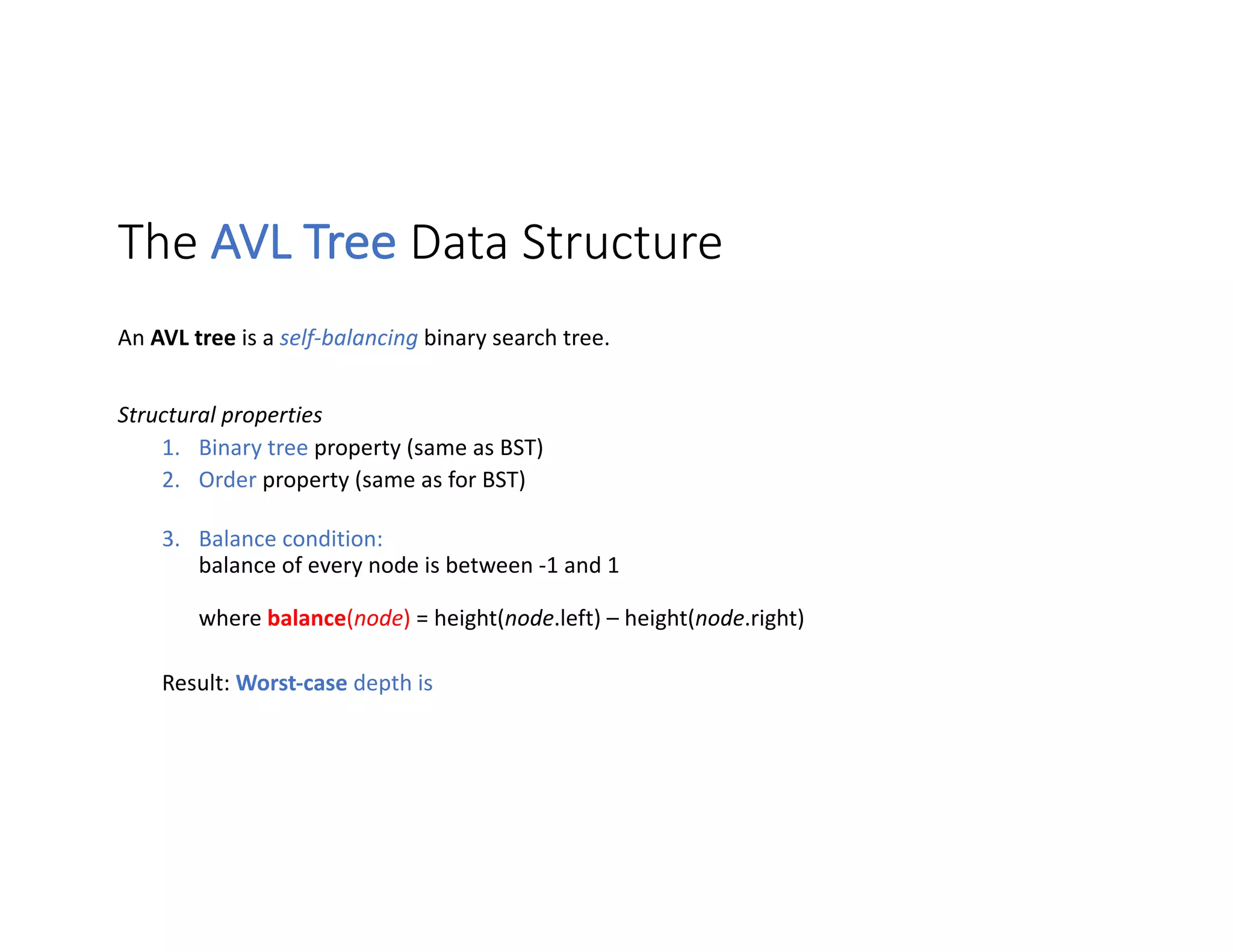
The AVL Tree Data Structure
An AVL tree is a self-balancing binary search tree.
Structural properties
1. Binary tree property (same as BST)
2. Order property (same as for BST)
3. Balance condition:
balance of every node is between -1 and 1
where balance(node) = height(node.left) – height(node.right)
Result: Worst-case depth is
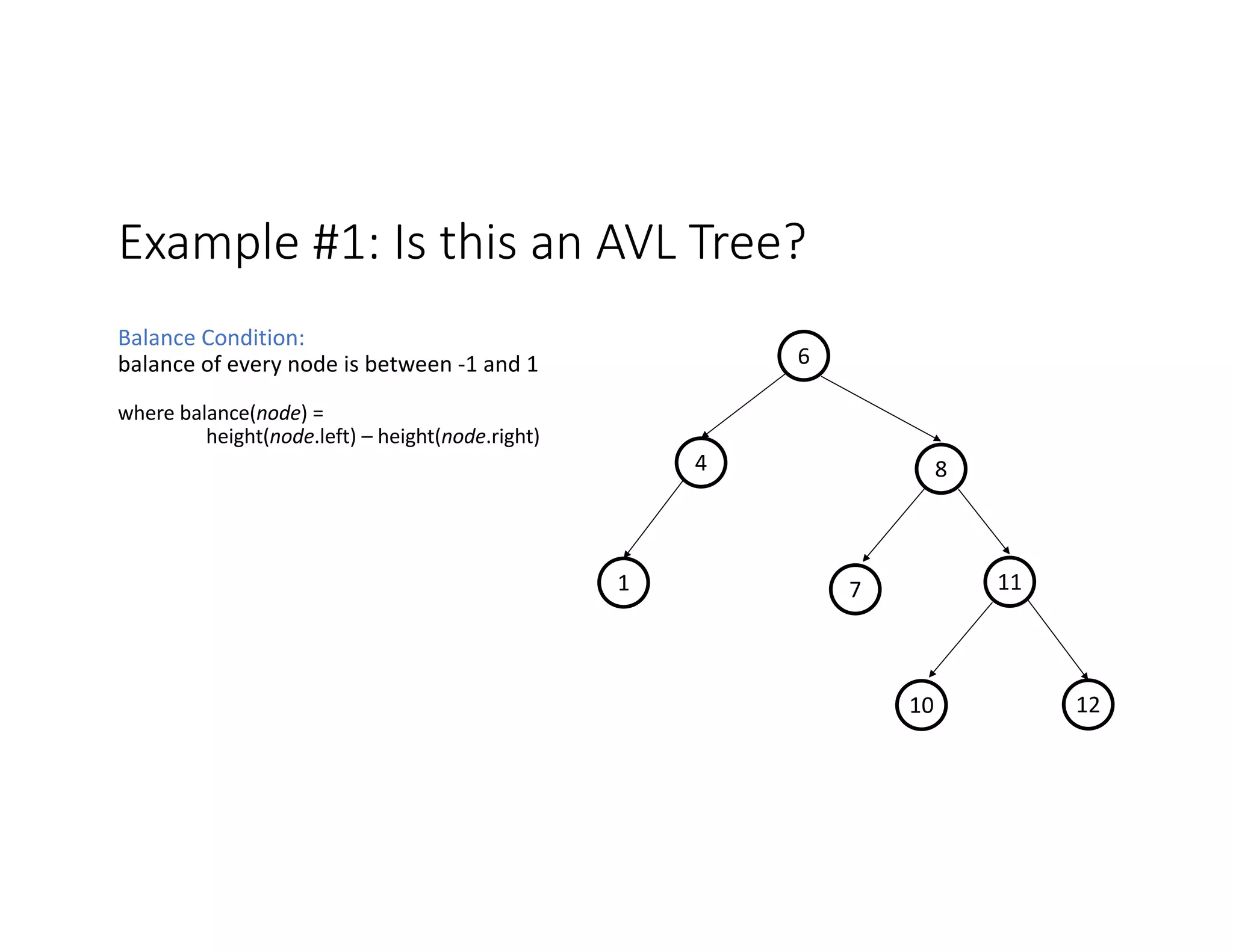
Example #1: Is this an AVL Tree?
Balance Condition:
balance of every node is between -1 and 1
where balance(node) =
height(node.left) – height(node.right)
11
1
8
4
6
10 12
7
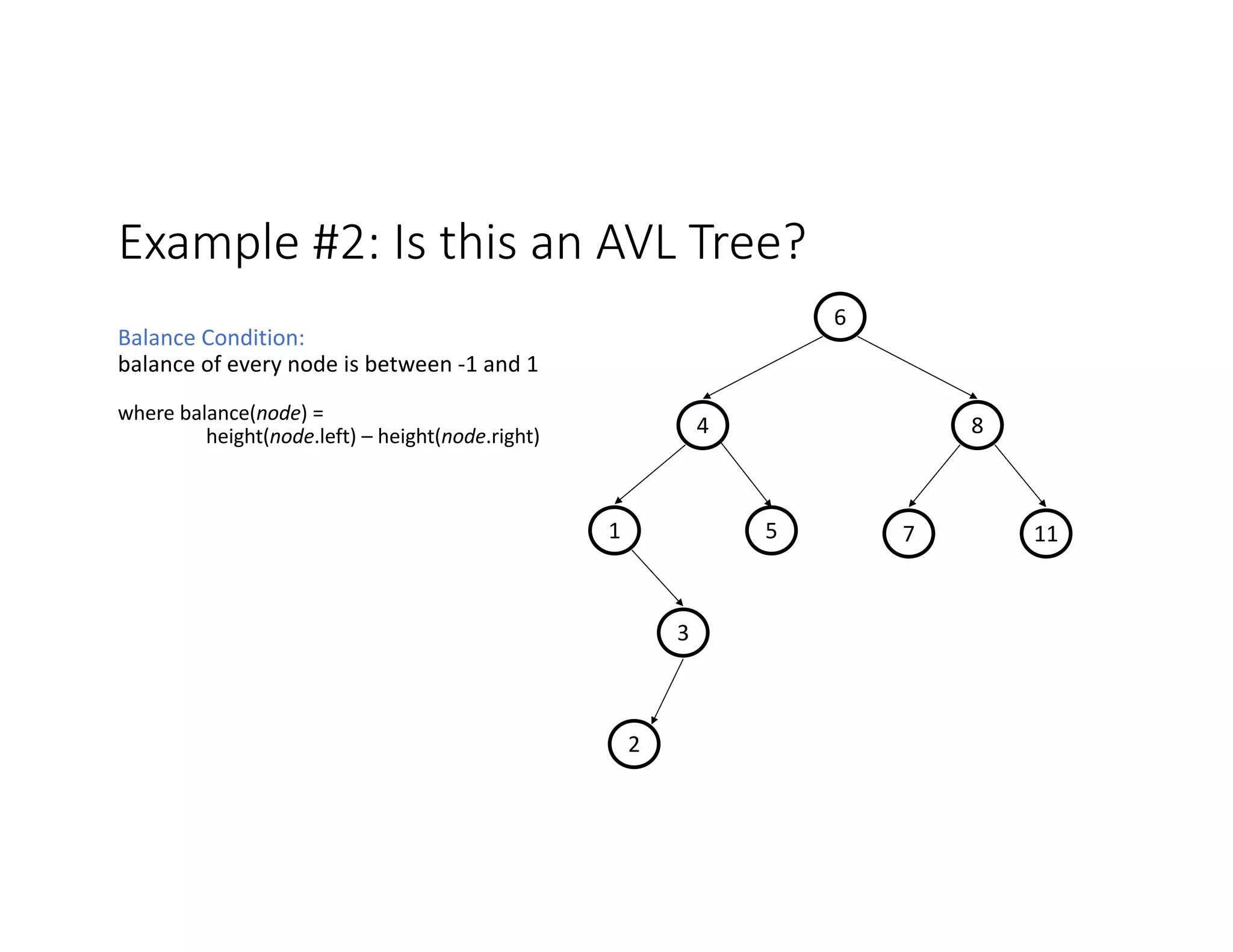
Example #2: Is this an AVL Tree?
3
11
7
1
8
4
6
2
5
Balance Condition:
balance of every node is between -1 and 1
where balance(node) =
height(node.left) – height(node.right)
AVL Trees
Good News:
Because height of AVL tree is O(log(n)), then find
But as we insert and delete elements, we need to:
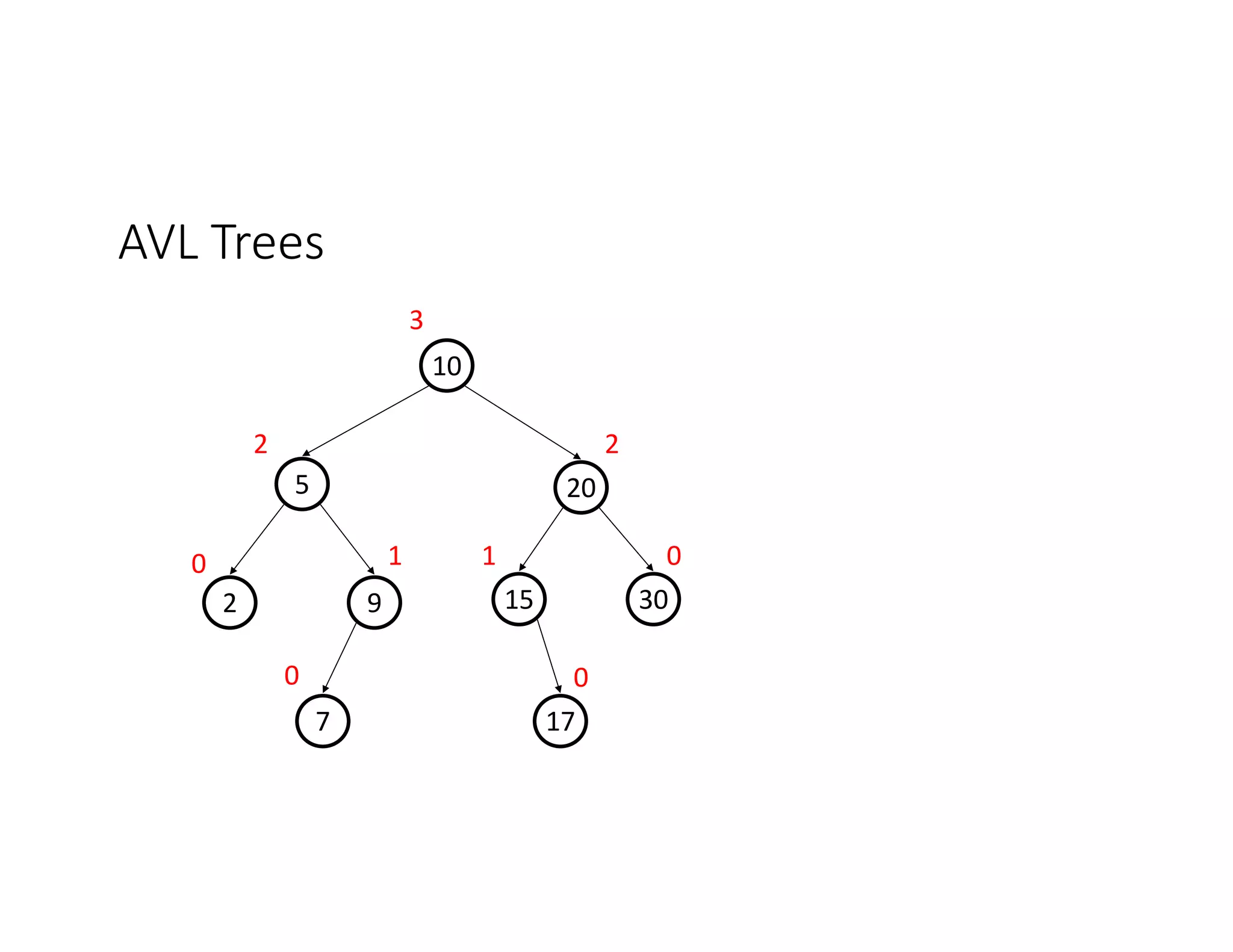
AVL Trees
20
9
2 15
5
10
30
17
7
0
0 0
0
1
1
2 2
3
AVL tree operations
• AVL find:
• Same as usual BST find
• AVL insert:
• AVL delete:
• The “easy way” is lazy deletion
• Otherwise, do the deletion and then check for several imbalance cases (we will skip
this)
First insert example
Insert(6)
Insert(3)
Insert(1)
Third insertion
What’s the only way to fix it?
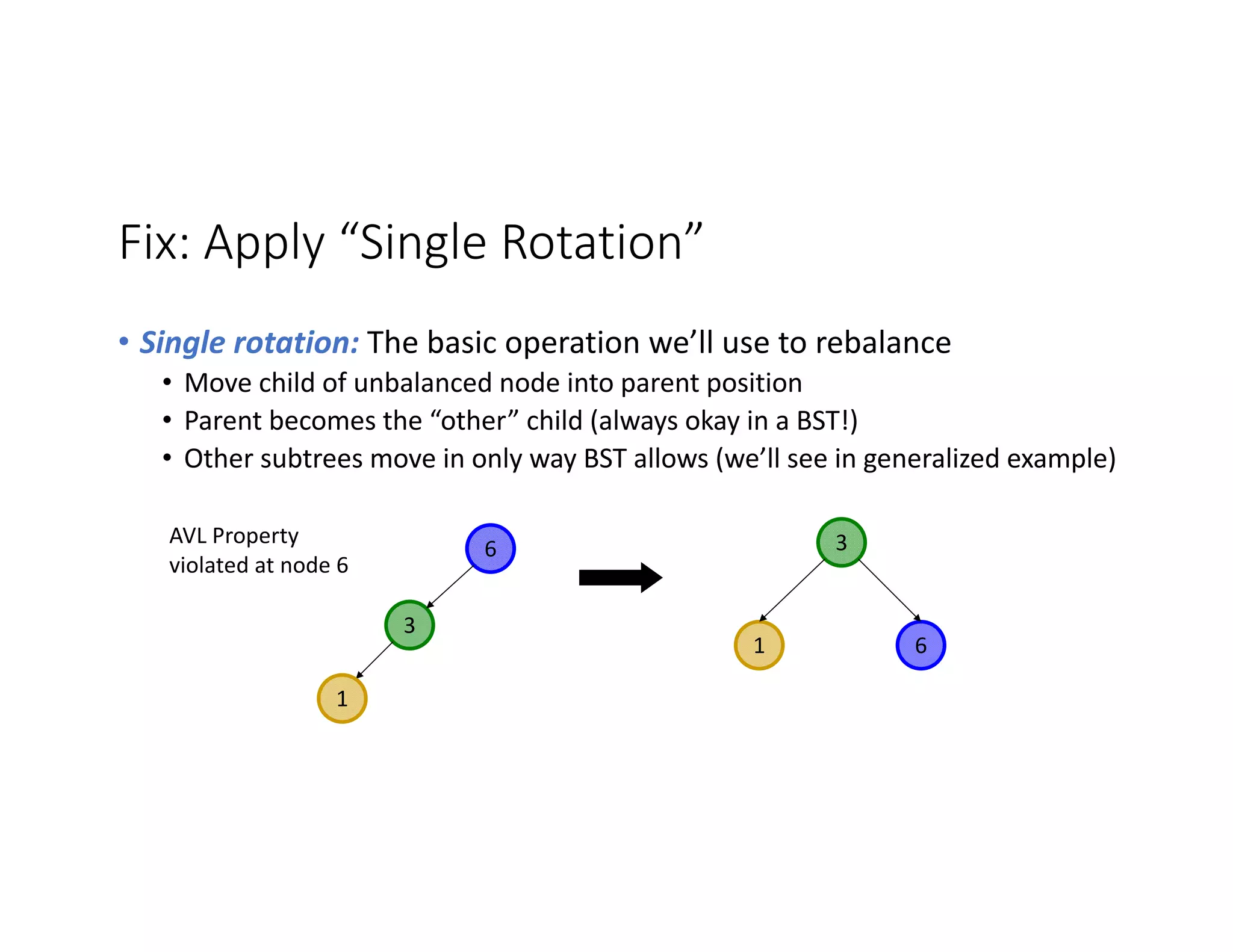
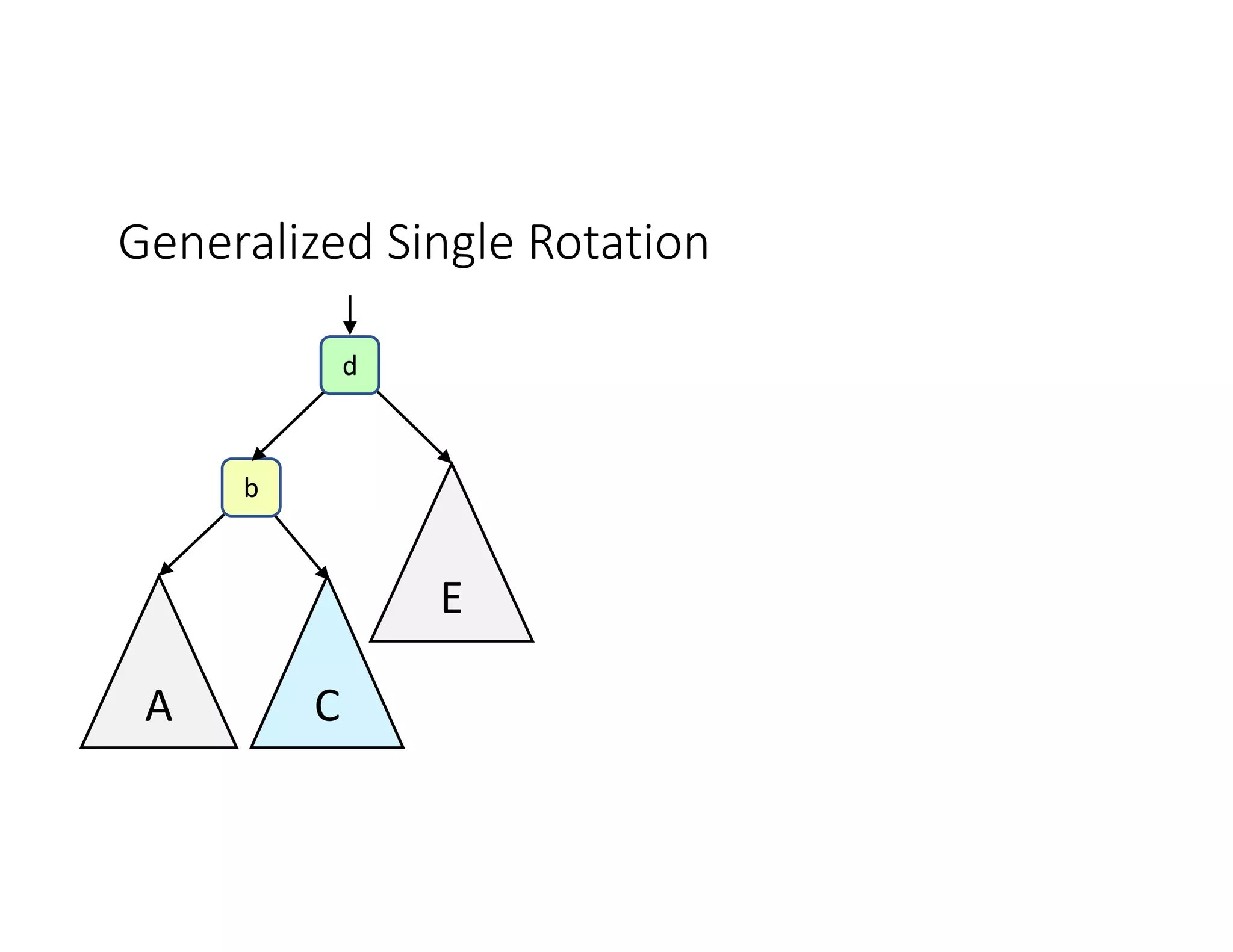
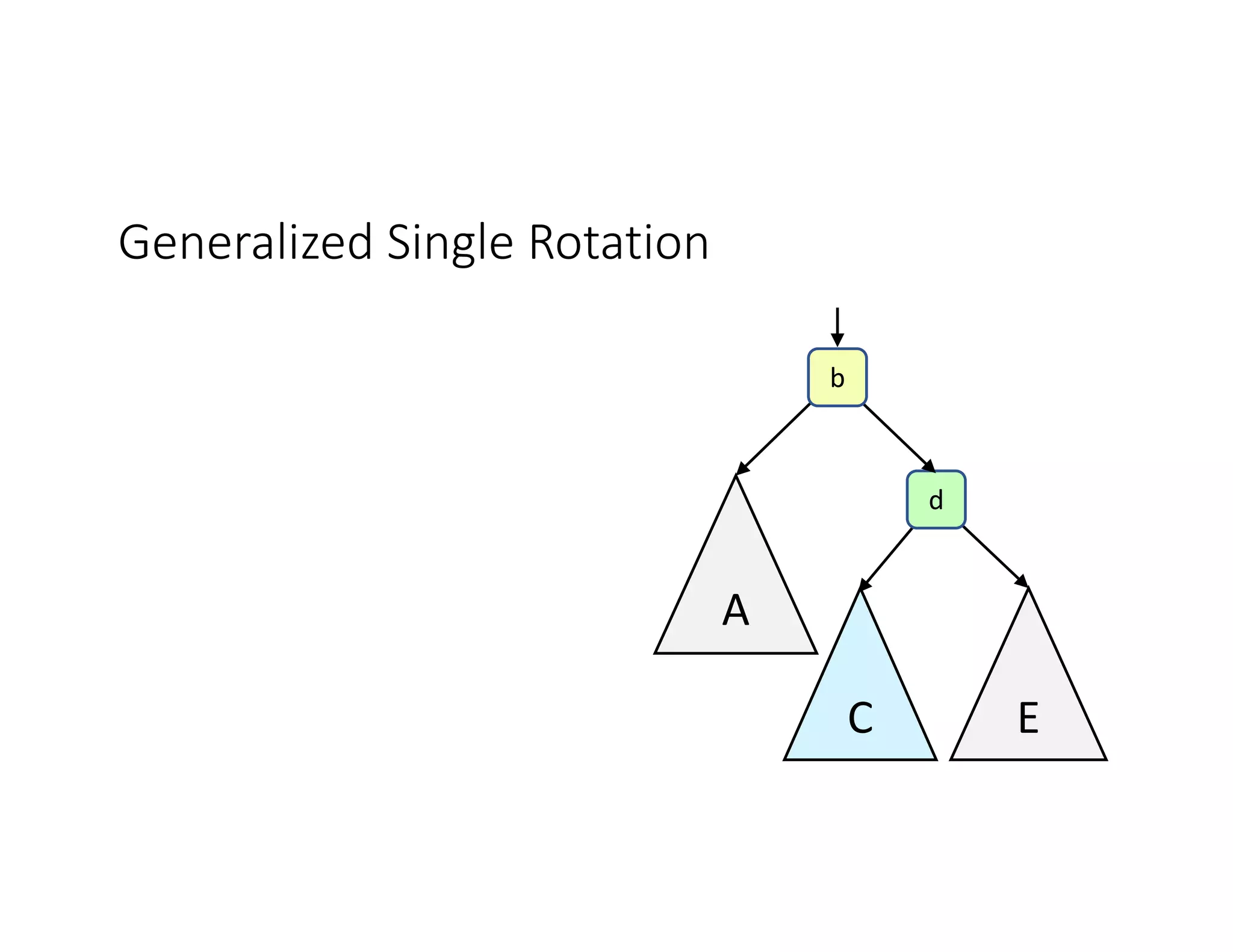
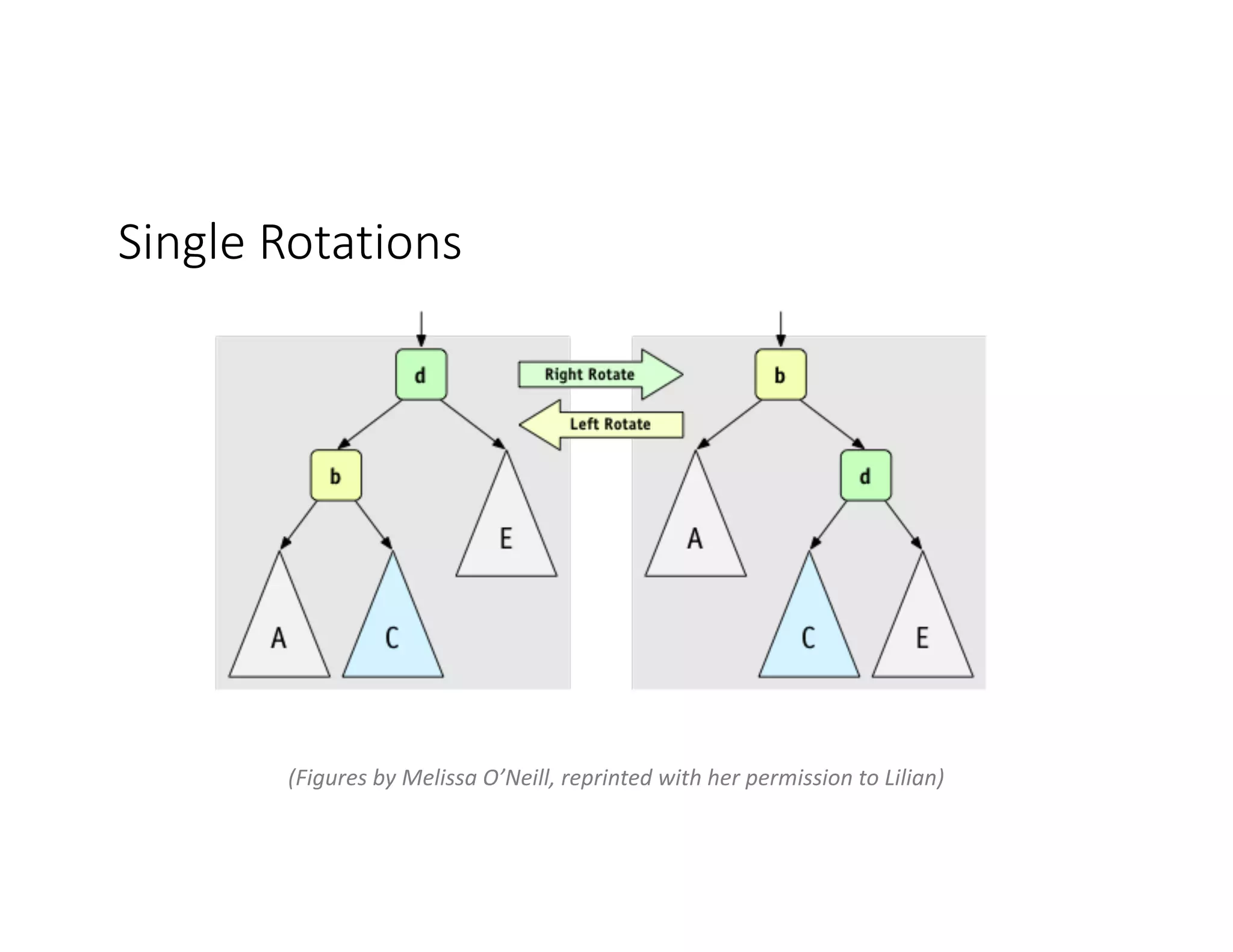
Fix: Apply “Single Rotation”
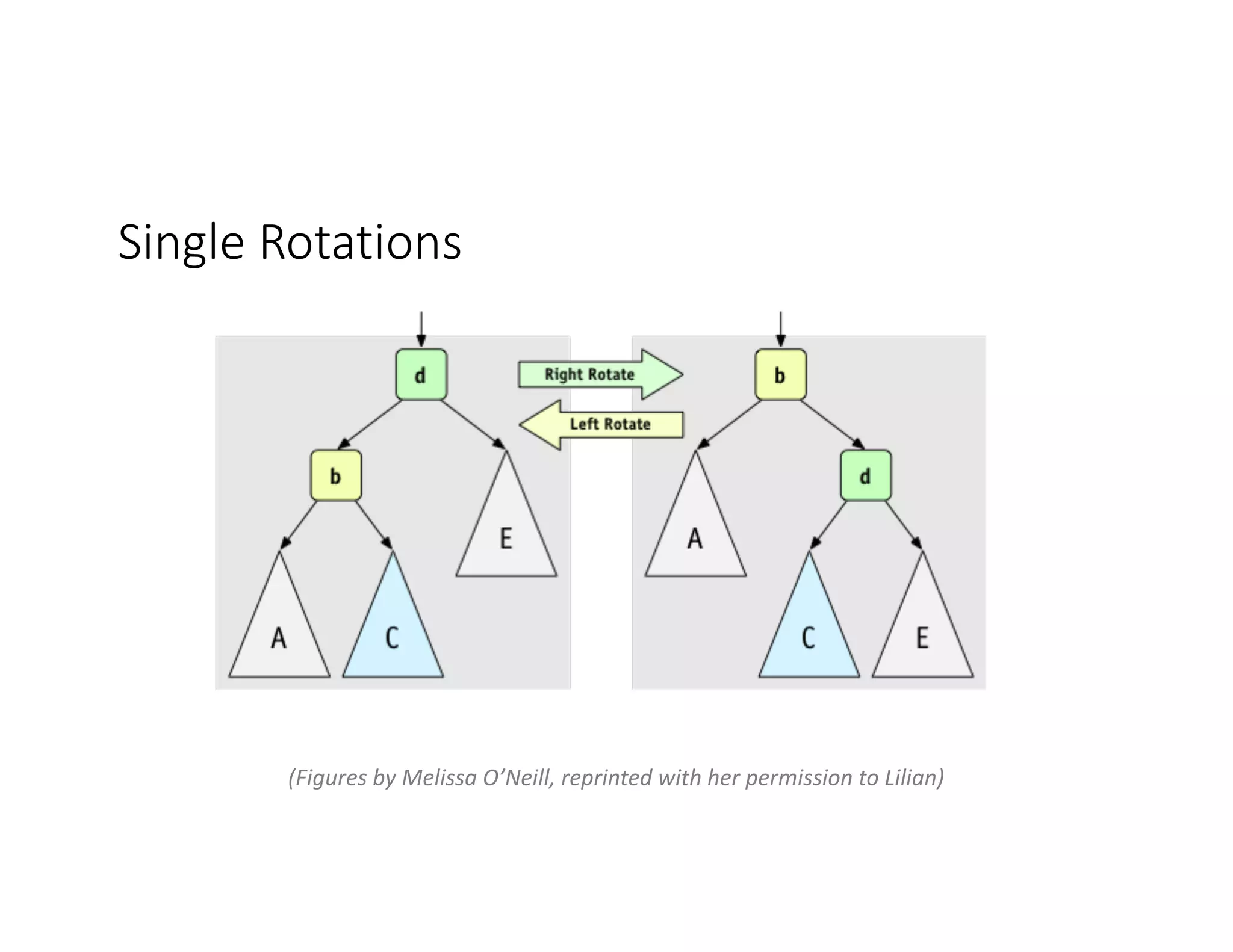
• Single rotation: The basic operation we’ll use to rebalance
• Move child of unbalanced node into parent position
• Parent becomes the “other” child (always okay in a BST!)
• Other subtrees move in only way BST allows (we’ll see in generalized example)
3
1 6
6
3
AVL Property
violated at node 6
1
Tree Rotations: Generalized
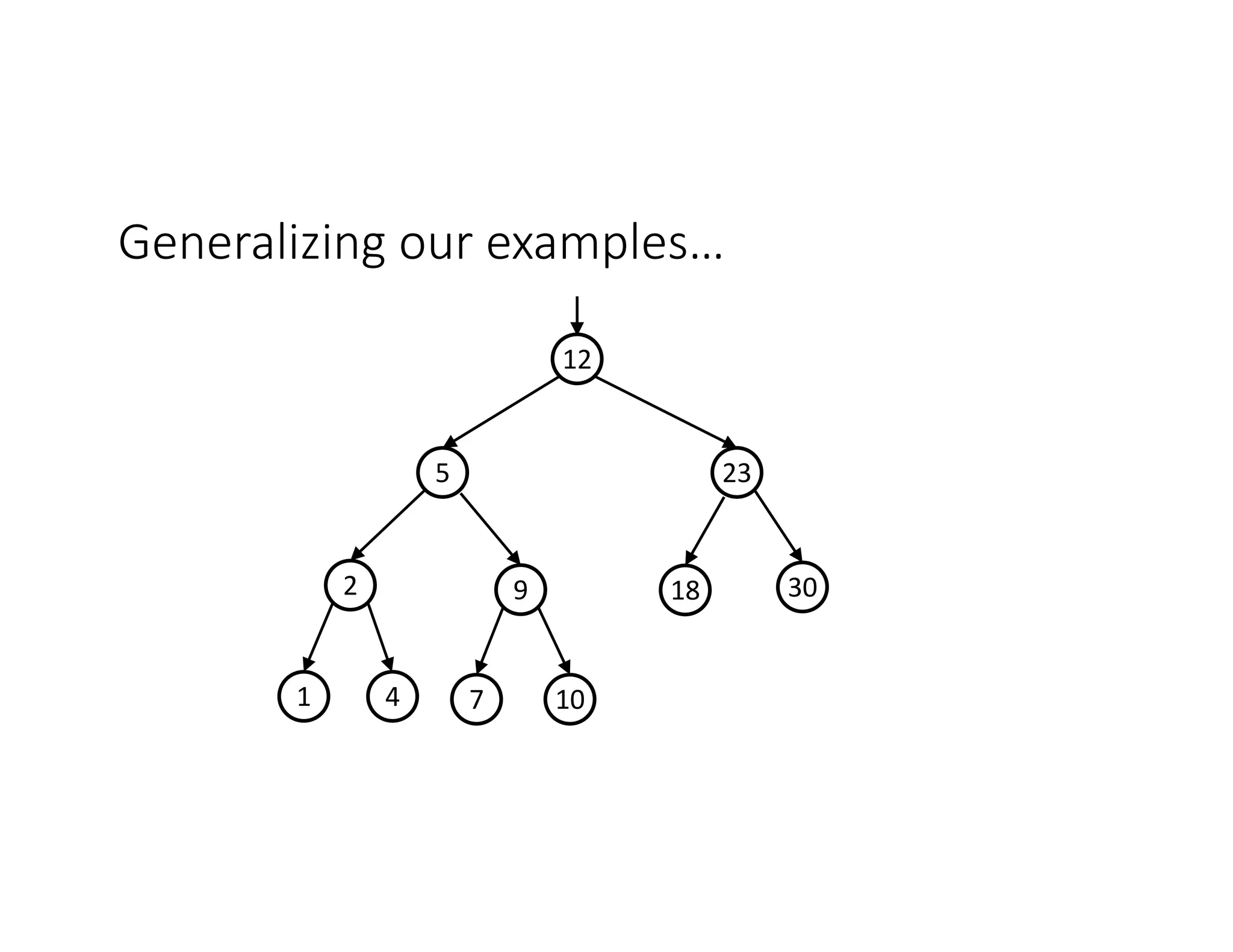
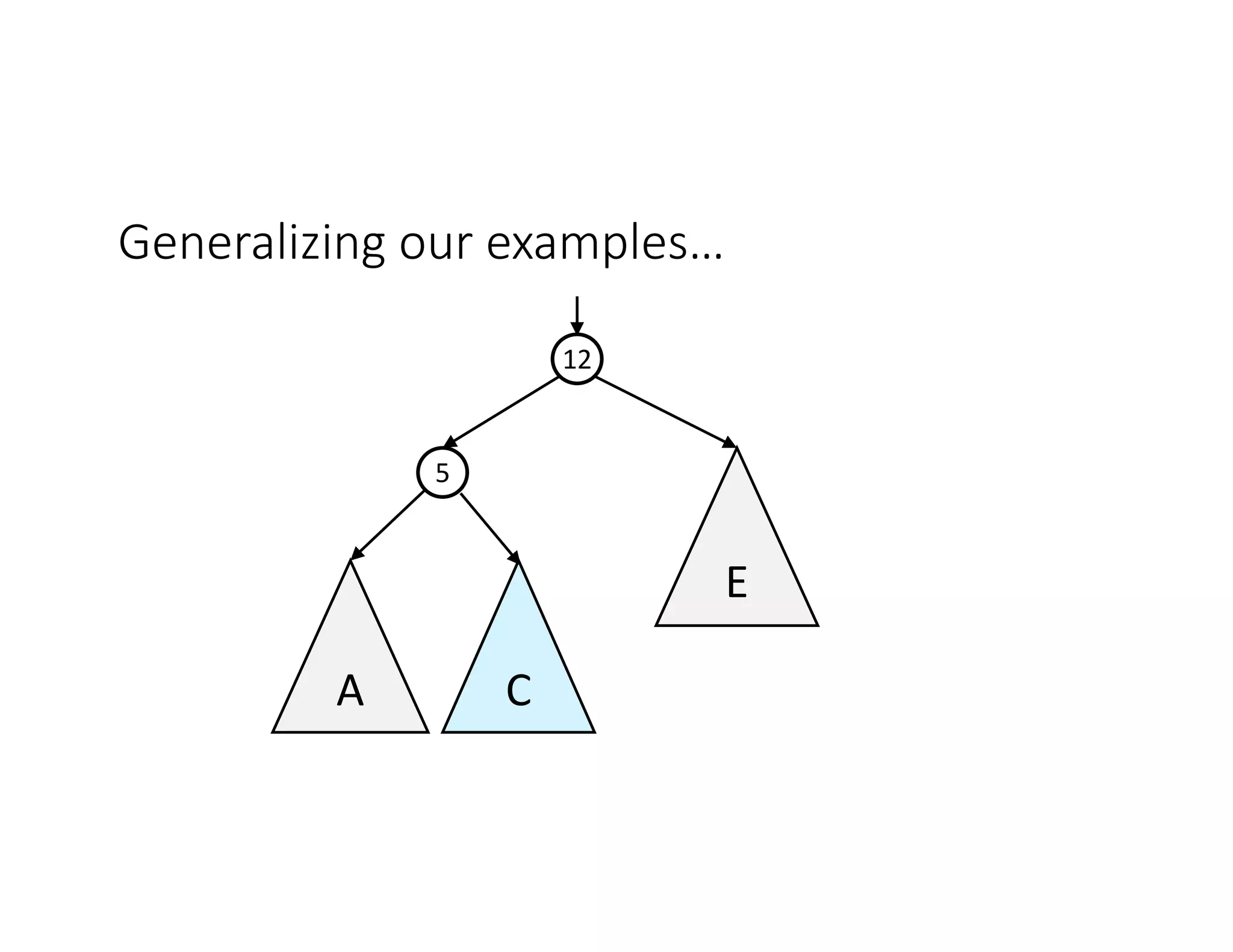
Generalizing our examples…
30
9
2
23
5
12
7 10
18
4
1
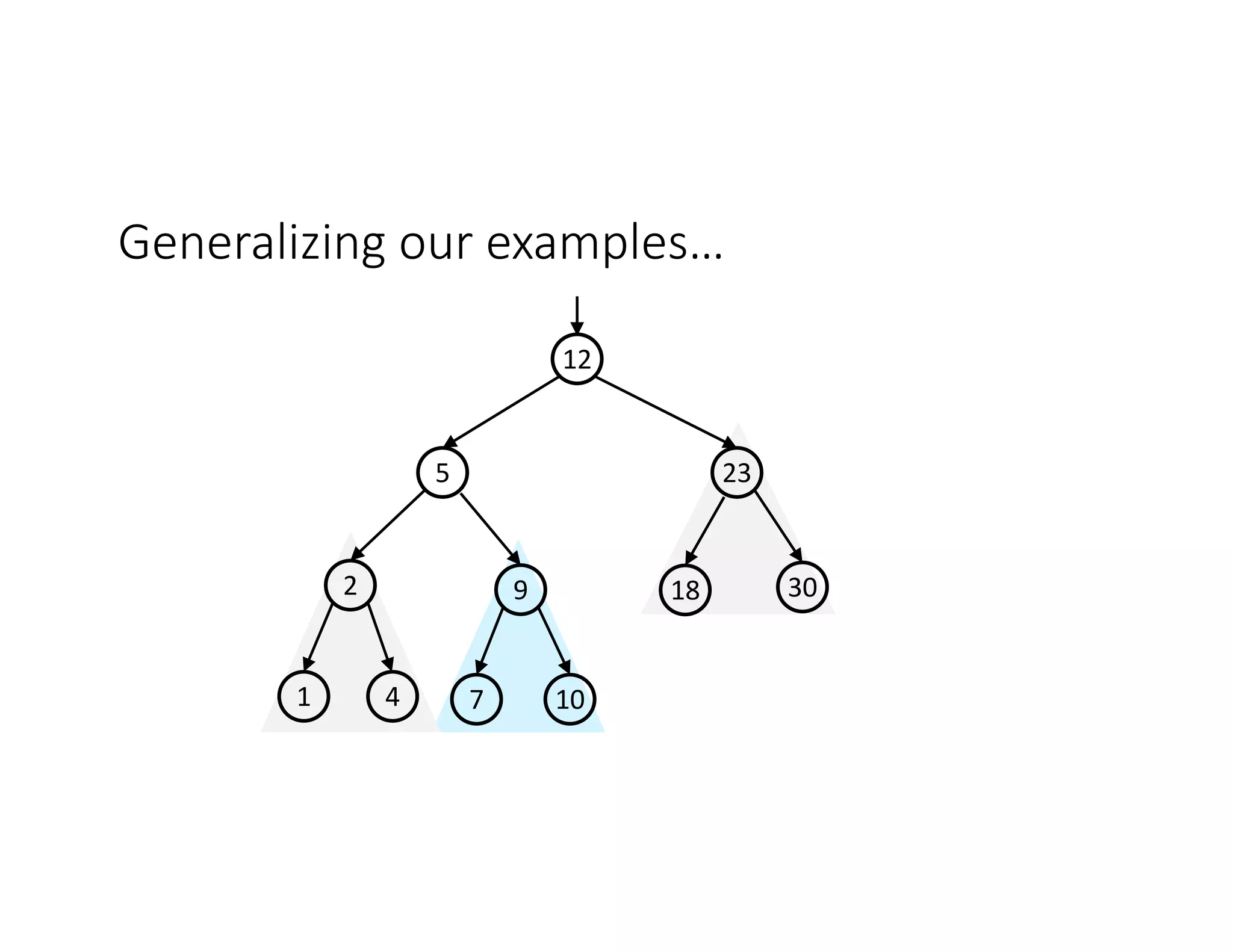
Generalizing our examples…
30
9
2
23
5
12
7 10
18
4
1
E
C
A
Generalizing our examples…
5
12
12
E
C
A
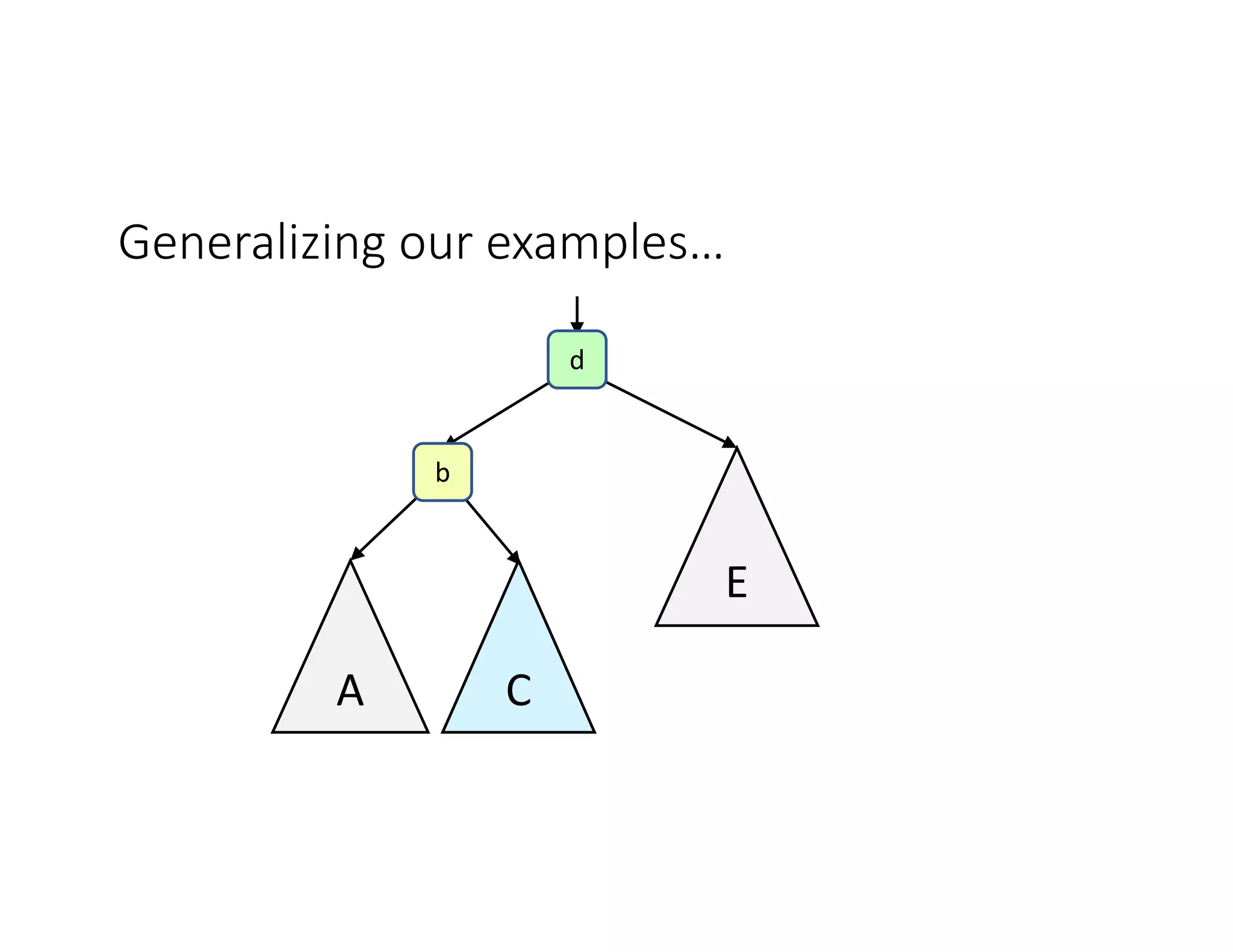
Generalizing our examples…
b
d
Generalized Single Rotation
E
C
A
b
d
Generalized Single Rotation
A
C E
d
b
Single Rotations
(Figures by Melissa O’Neill, reprinted with her permission to Lilian)
AVL Tree insert (more specific):
1. Insert the new node as in our generic BST (a new leaf)
2. For each node on the path from the root to the new leaf, the
insertion may (or may not) have changed the node’s height
3. So after insertion in a subtree,
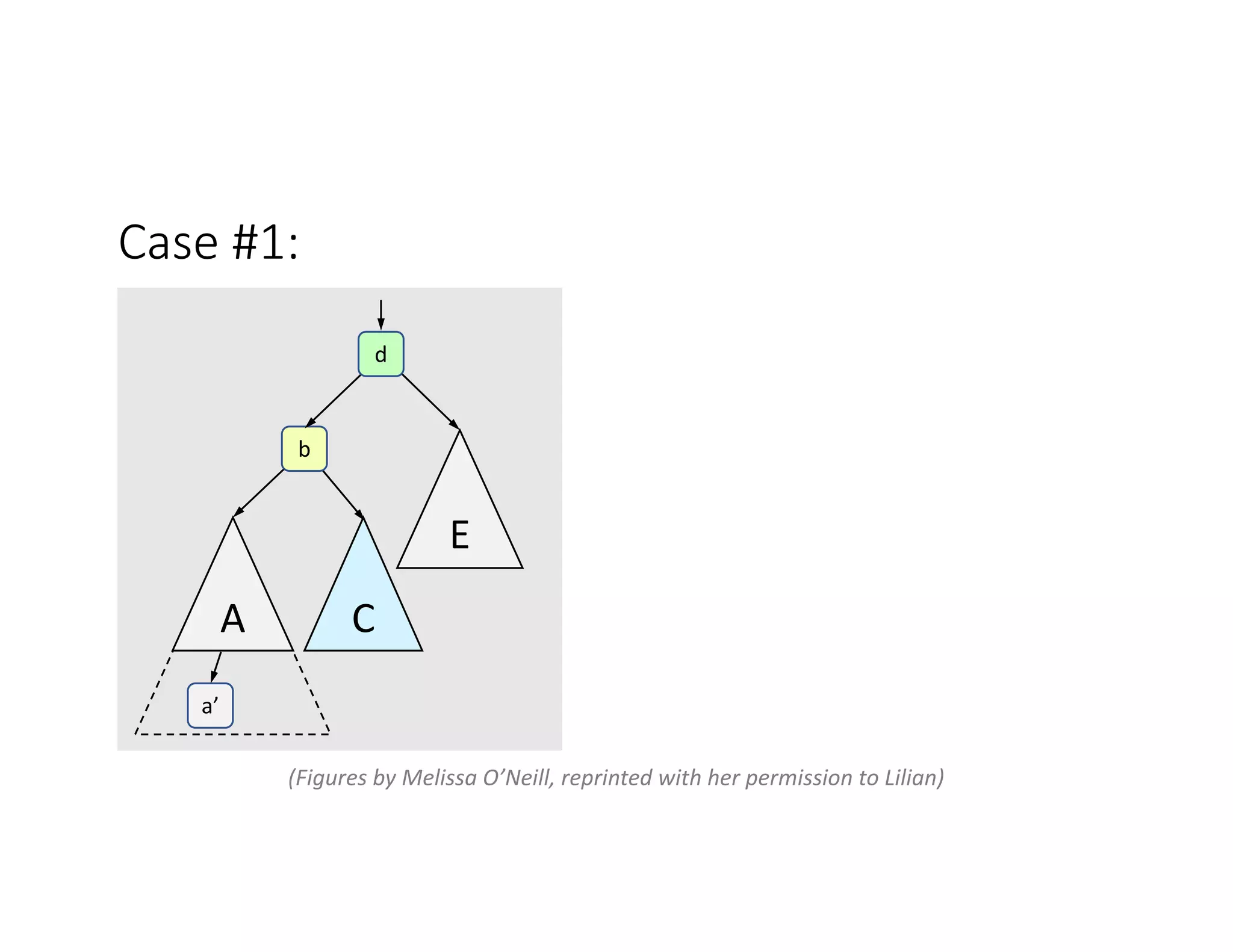
Case #1:
E
C
A
b
d
a’
(Figures by Melissa O’Neill, reprinted with her permission to Lilian)
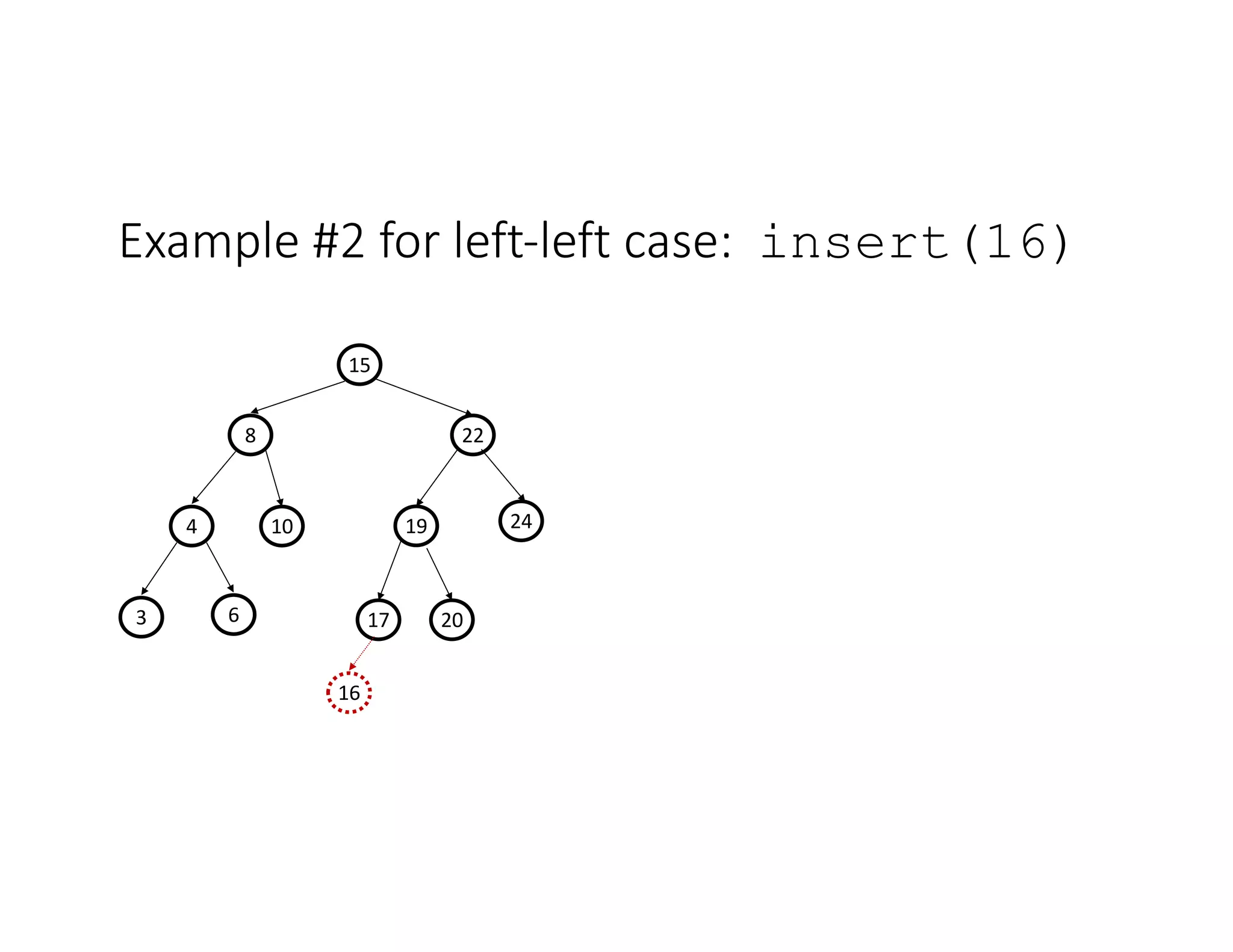
Example #2 for left-left case: insert(16)
10
4
22
8
15
3 6
19
17 20
24
16
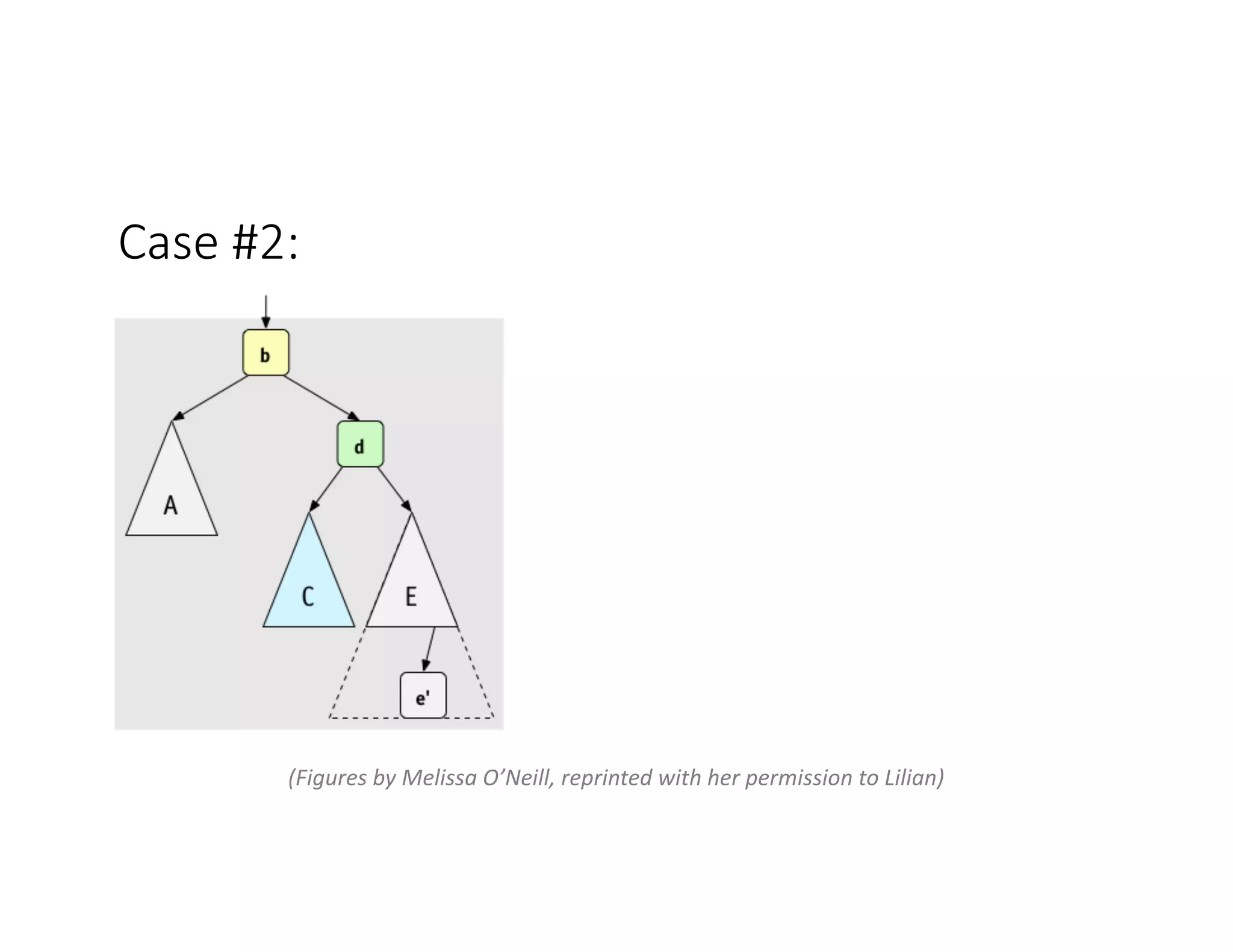
Case #2:
(Figures by Melissa O’Neill, reprinted with her permission to Lilian)
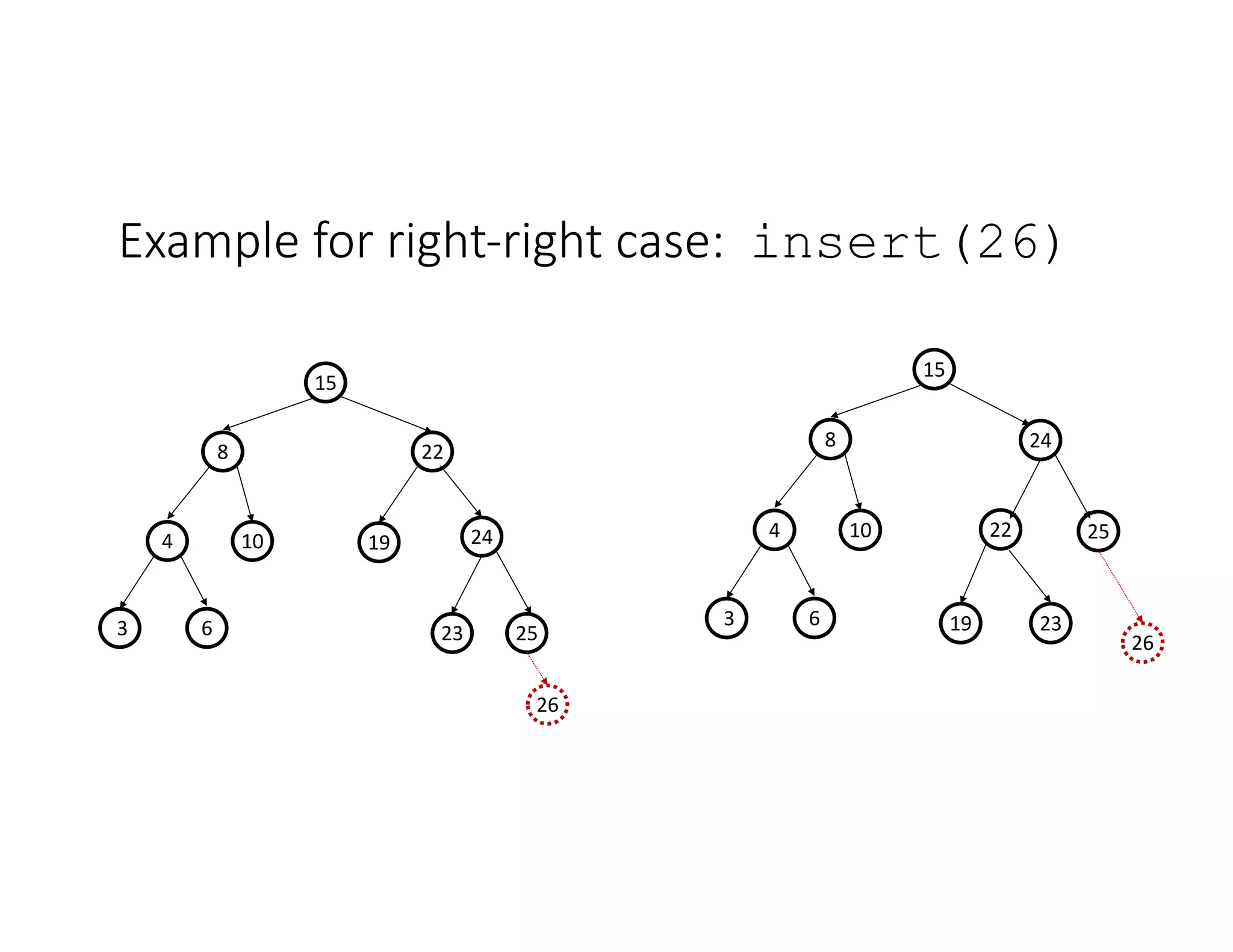
Example for right-right case: insert(26)
10
4
22
8
15
6
19
23 25
26
3
24 10
4 22
8
15
6 19 23
25
26
3
24
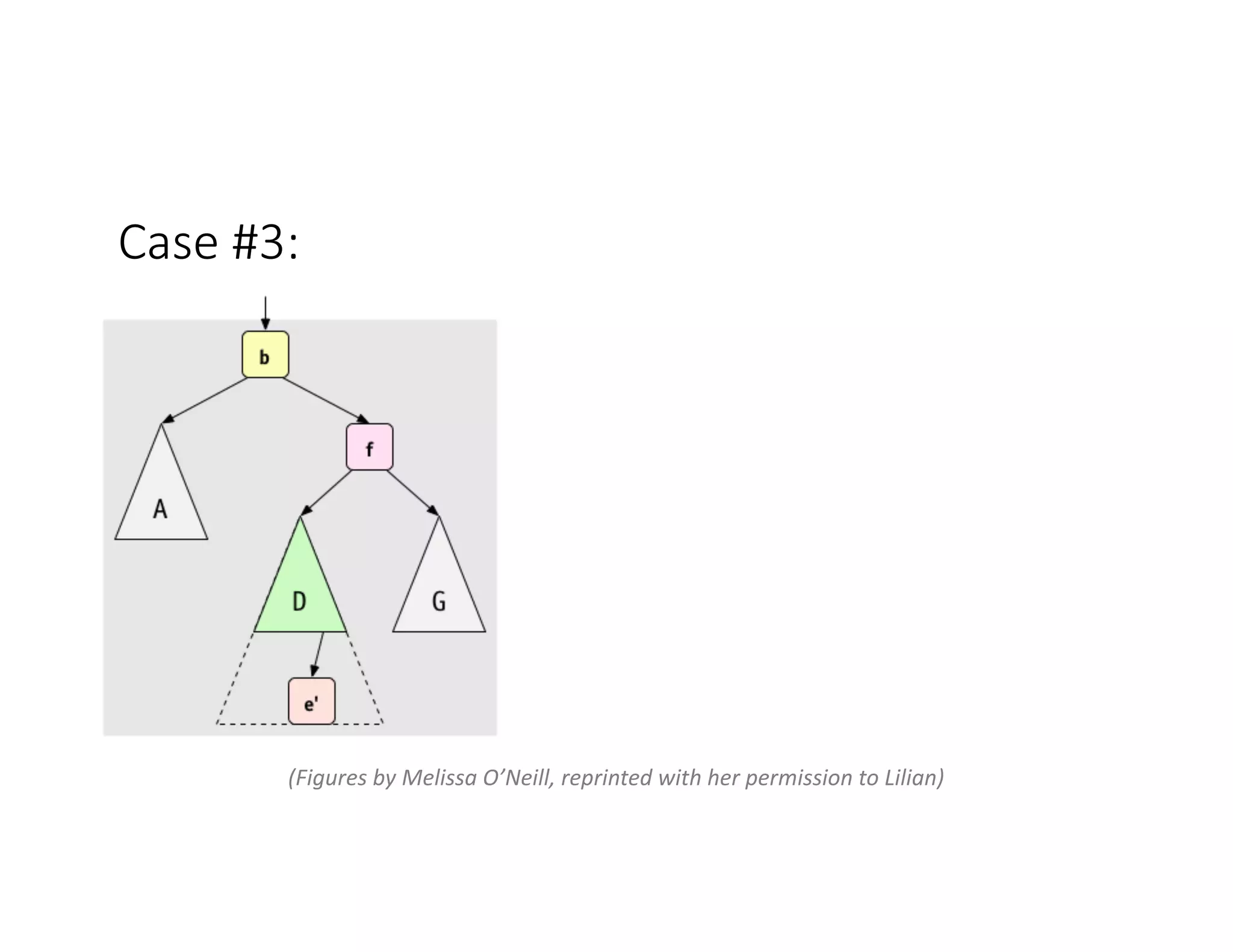
Case #3:
(Figures by Melissa O’Neill, reprinted with her permission to Lilian)
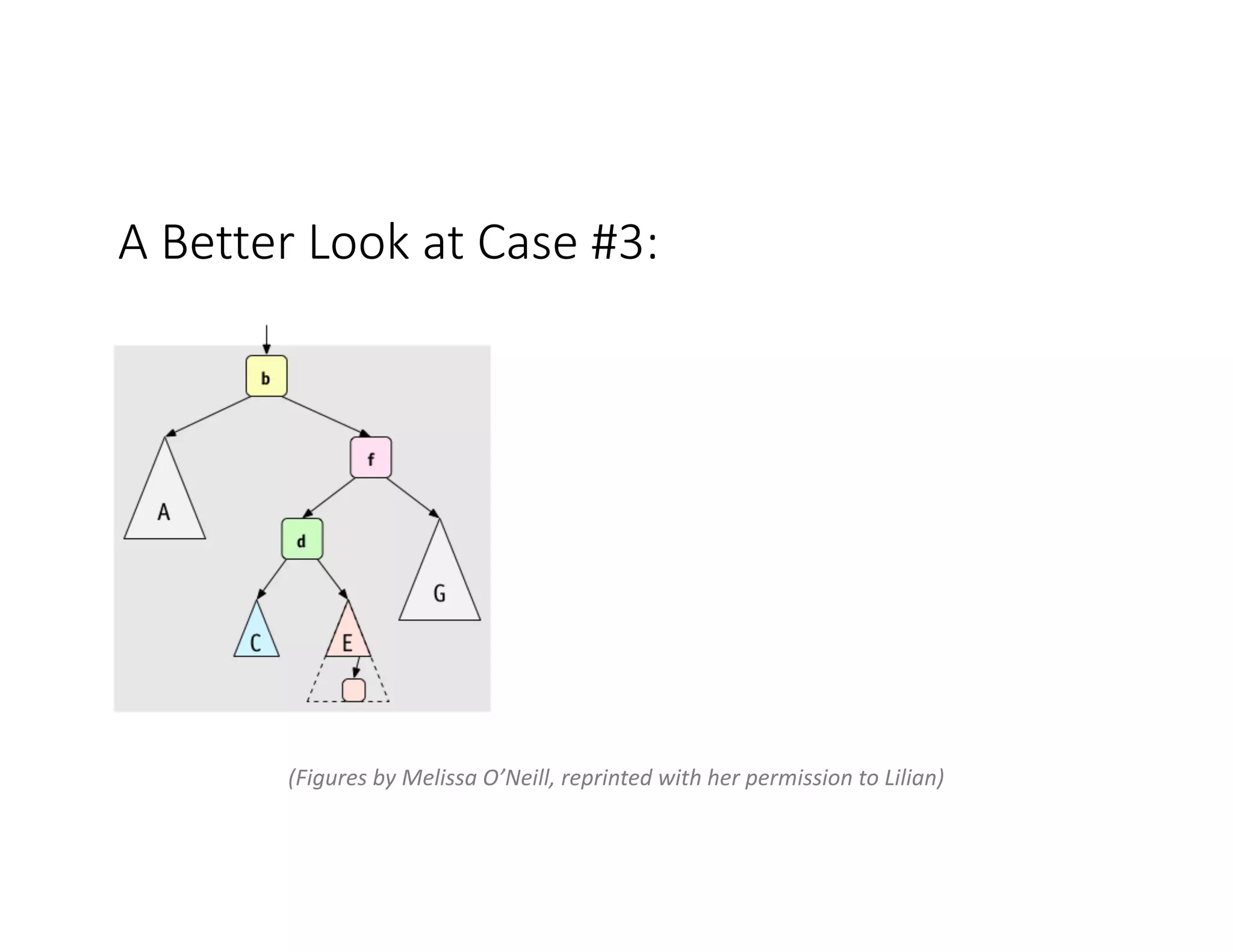
A Better Look at Case #3:
(Figures by Melissa O’Neill, reprinted with her permission to Lilian)
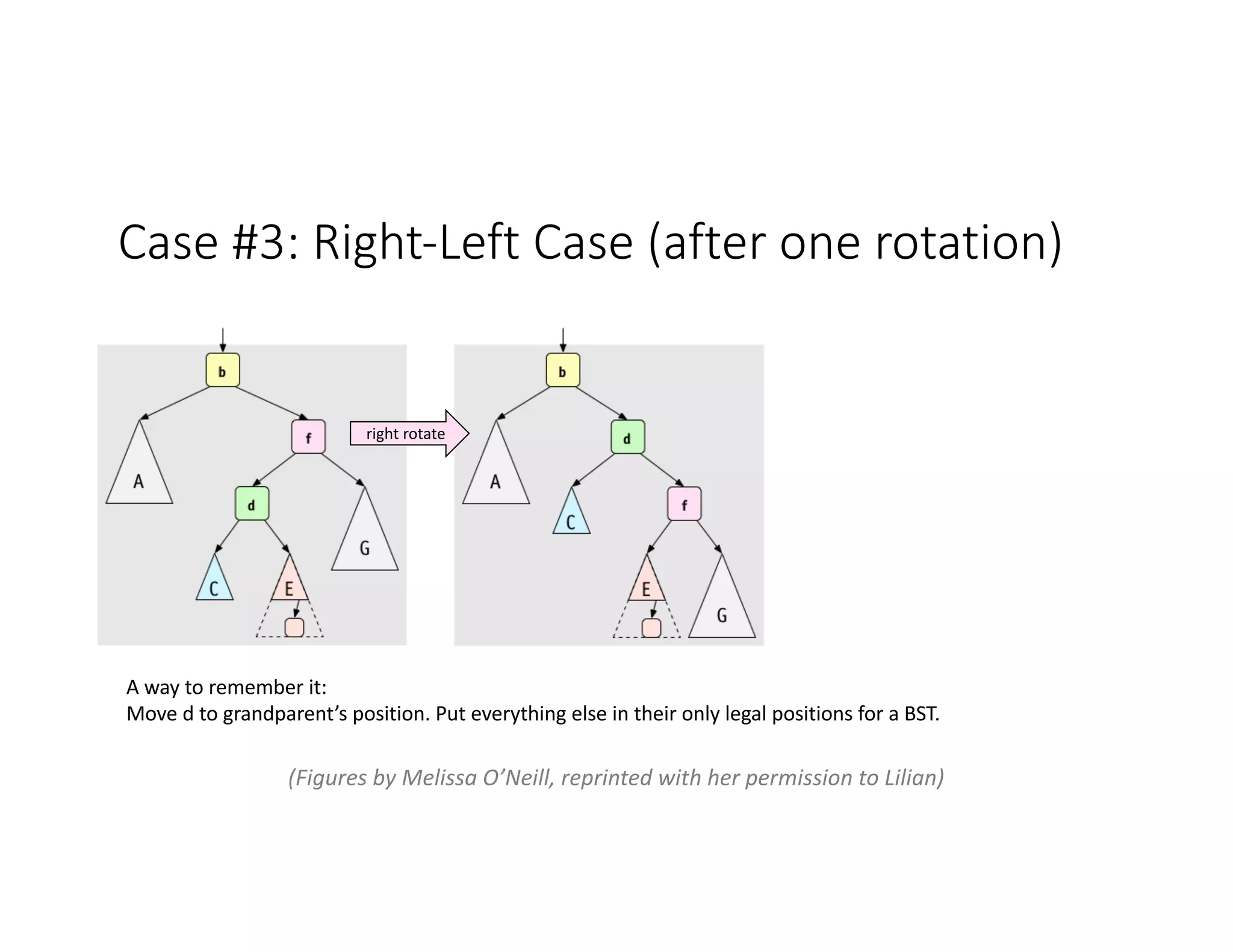
Case #3: Right-Left Case (after one rotation)
(Figures by Melissa O’Neill, reprinted with her permission to Lilian)
right rotate
A way to remember it:
Move d to grandparent’s position. Put everything else in their only legal positions for a BST.
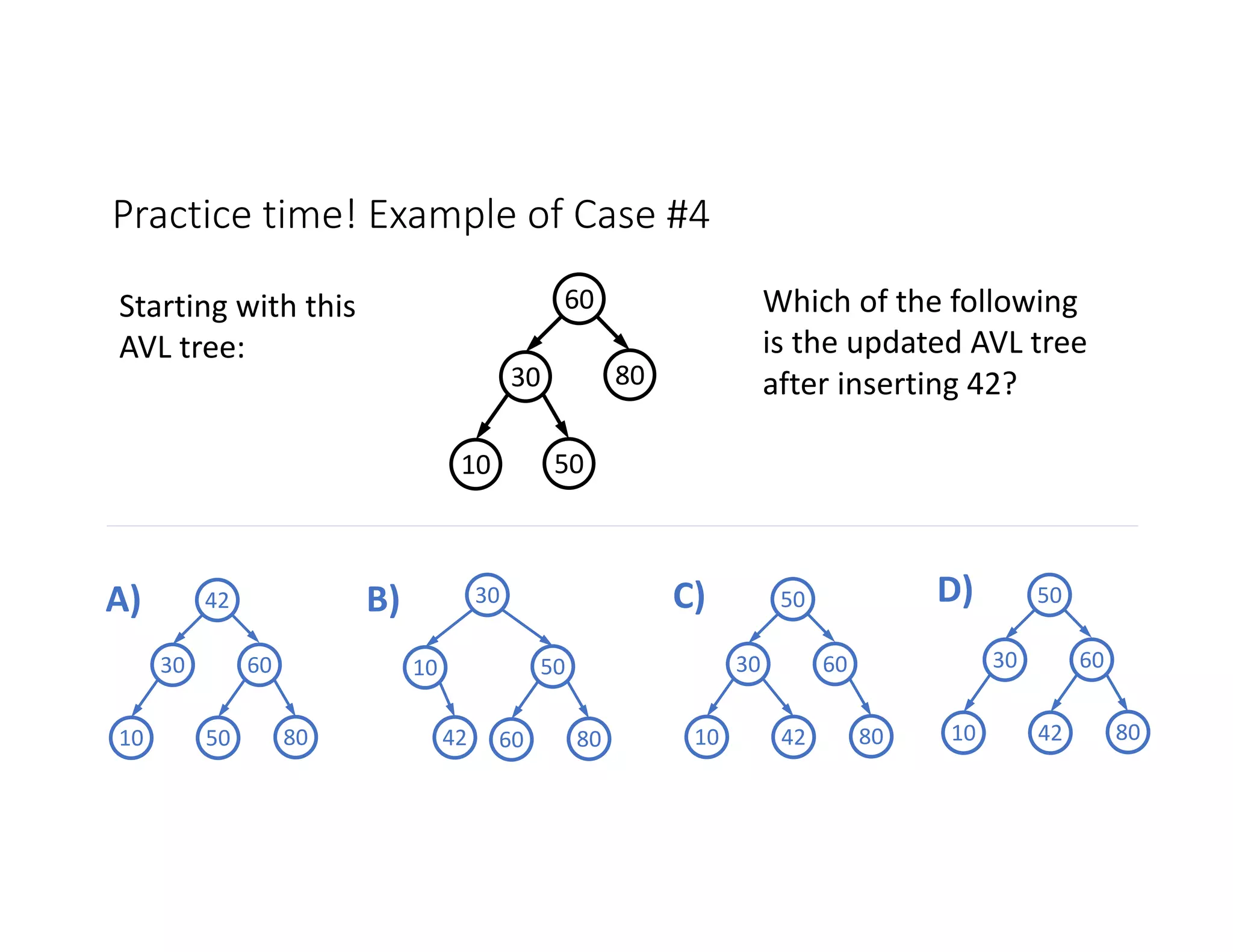
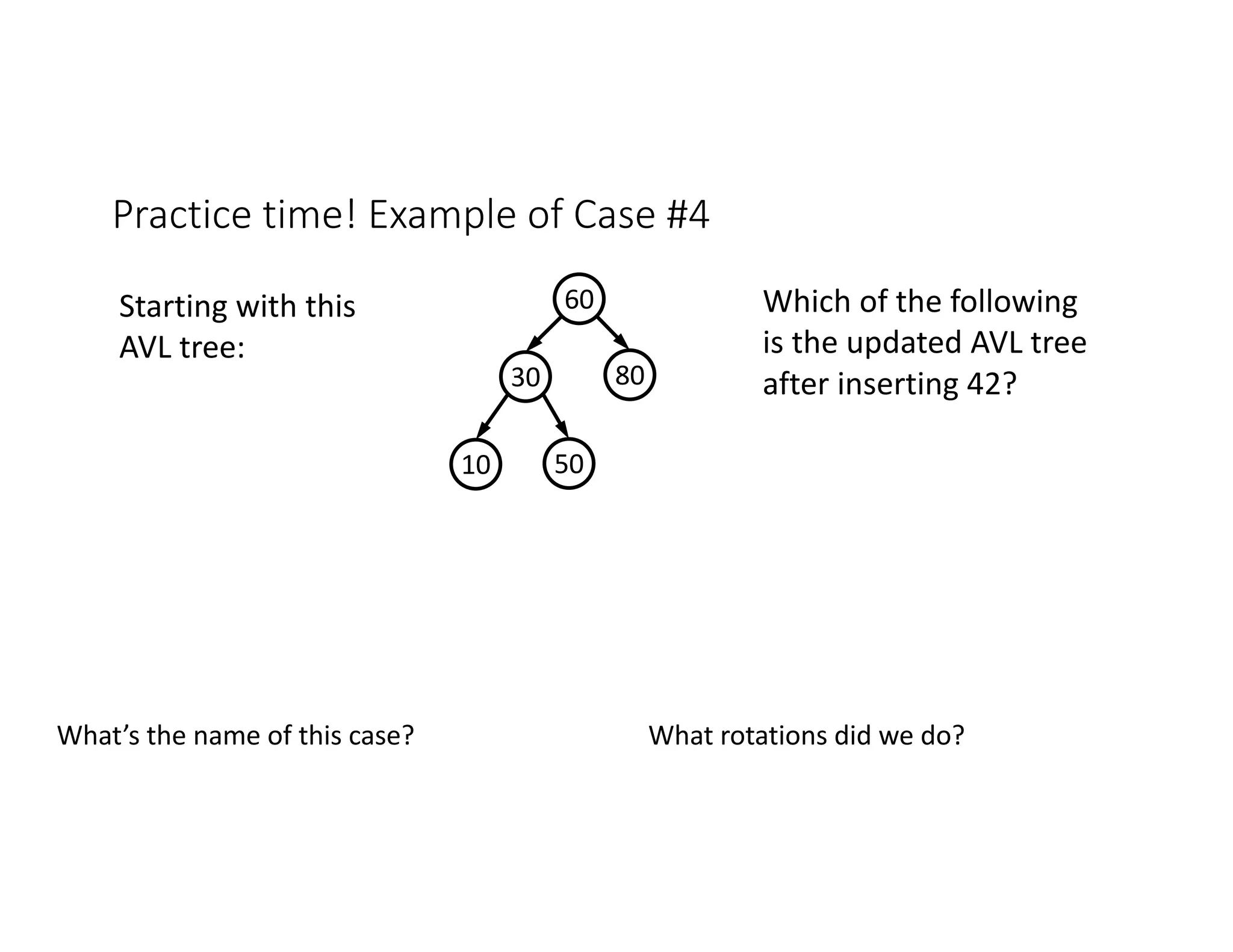
Practice time! Example of Case #4
A)
50
10
80
30
60
10
30
42
80
50
60
10
30
50
80
42
60
10
30
50
80
42
60
42
10
30
80
60
50
B) C) D)
Which of the following
is the updated AVL tree
after inserting 42?
Starting with this
AVL tree:
(Extra space for your scratch-work)
Practice time! Example of Case #4
50
10
80
30
60 Which of the following
is the updated AVL tree
after inserting 42?
Starting with this
AVL tree:
What rotations did we do?
What’s the name of this case?
Insert, summarized
• Insert as in our generic BST
• Check back up path for imbalance, which will be 1 of 4 cases:
• Node’s left-left grandchild is too tall
• Node’s left-right grandchild is too tall
• Node’s right-left grandchild is too tall
• Node’s right-right grandchild is too tall
• Only occurs because
• After the appropriate single or double rotation, the smallest-unbalanced subtree
has the same height as before the insertion
• So all ancestors are now balanced
41
AVL Tree Efficiency
• Worst-case complexity of find:
• Worst-case complexity of insert:
• Worst-case complexity of buildTree:
Takes some more rotation action to handle delete…
Pros and Cons of AVL Trees
Arguments for AVL trees:
1. All operations logarithmic worst-case because trees are always balanced
2. Height balancing adds no more than a constant factor to the speed of
insert and delete
Arguments against AVL trees:
1. Difficult to program & debug [but done once in a library!]
2. More space for height field
3. Asymptotically faster but rebalancing takes a little time
4. If amortized logarithmic time is enough, use splay trees (also in the text,
not covered in this class)
AVL Tree Rotation Cheat-Sheet
(Just two of the four cases)
Single Rotations
(Figures by Melissa O’Neill, reprinted with her permission to Lilian)
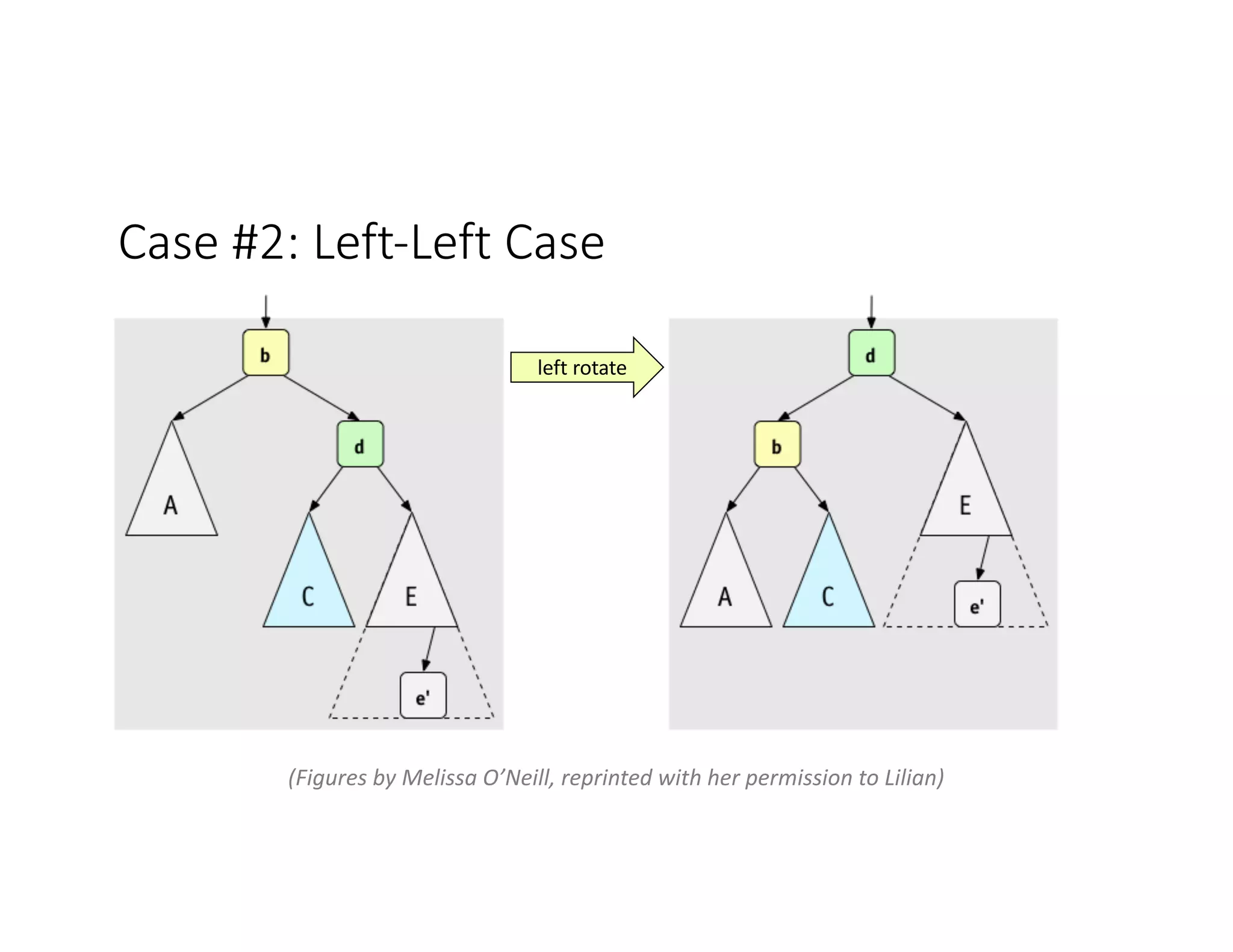
Case #2: Left-Left Case
(Figures by Melissa O’Neill, reprinted with her permission to Lilian)
left rotate
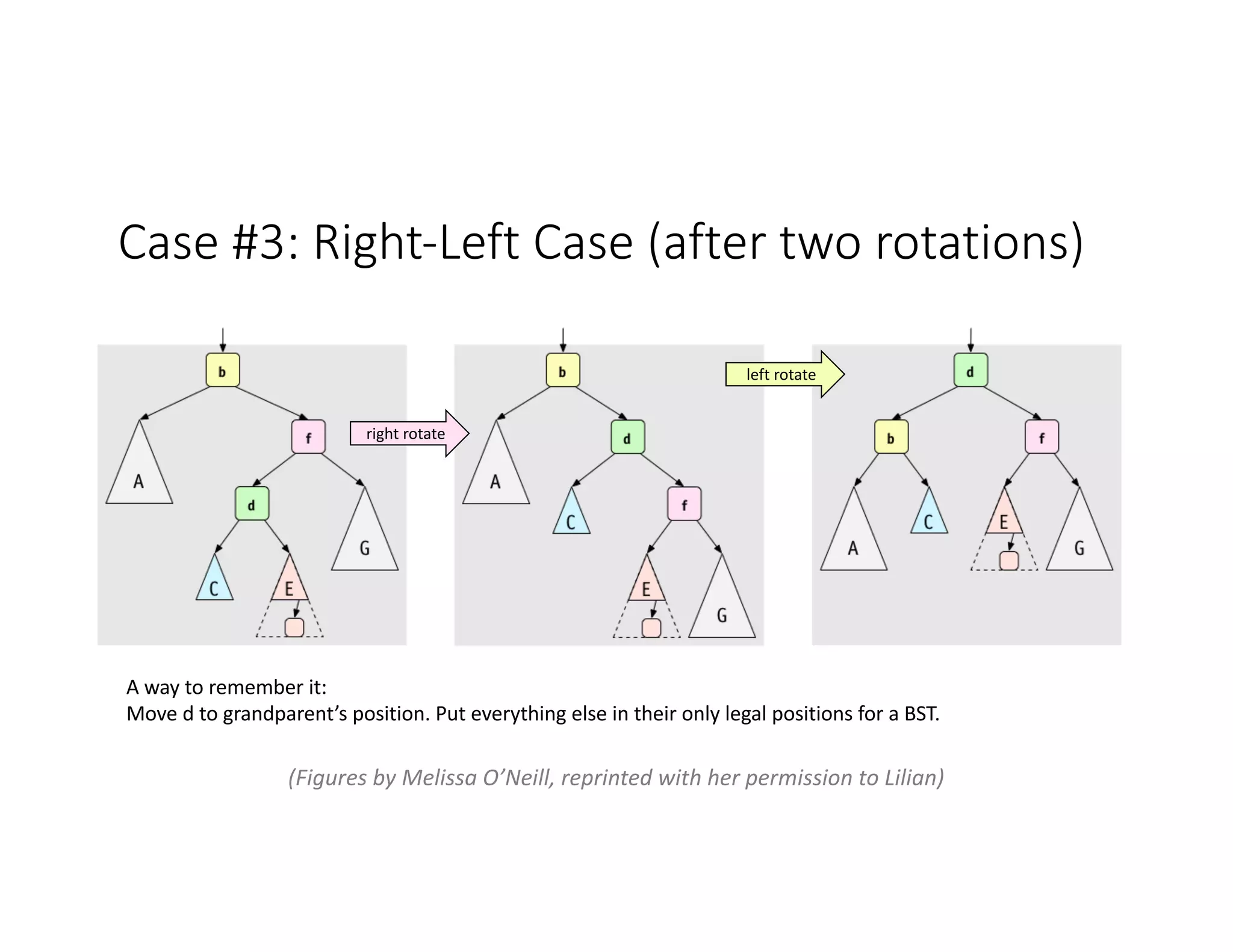
Case #3: Right-Left Case (after two rotations)
(Figures by Melissa O’Neill, reprinted with her permission to Lilian)
right rotate
left rotate
A way to remember it:
Move d to grandparent’s position. Put everything else in their only legal positions for a BST.

Lecture 10 - AVL Trees.pdf

  • 1.
    Instructor: Lilian deGreef Quarter: Summer 2017 CSE 373: Data Structures and Algorithms Lecture 10: AVL Trees
  • 2.
    Today • Announcements • BSTscontinued (this time, bringing • buildTree • Balance Conditions • AVL Trees • Tree rotations
  • 3.
    Announcements • Reminder: homework3 due Friday • Homework 2 grades should come out today • Section • Will especially go over material from today (it’s especially tricky) • TAs can go over some of the tougher hw2 questions in section if you want/ask
  • 4.
    Back to BinarySearch Trees
  • 5.
    buildTree for BST Let’sconsider buildTree (insert values starting from an empty tree) Insert values 1, 2, 3, 4, 5, 6, 7, 8, 9 into an empty BST • If inserted in given order, what is the tree? • What big-O runtime for buildTree on this sorted input? • Is inserting in the reverse order any better?
  • 6.
    buildTree for BST Insertvalues 1, 2, 3, 4, 5, 6, 7, 8, 9 into an empty BST What we if could somehow re-arrange them • median first, then left median, right median, etc. 5, 3, 7, 2, 1, 4, 8, 6, 9 • What tree does that give us? • What big-O runtime?
  • 7.
  • 8.
    BST: Efficiency ofOperations? Problem: Worst-case running time: • find, insert, delete • buildTree
  • 9.
    How can wemake a BST efficient? Observation Solution: Require a Balance Condition that • When we build the tree, make sure it’s balanced. • BUT…Balancing a tree only at build time is insufficient. • We also need to also keep the tree balanced as we perform operations.
  • 10.

    Potential Balance Conditions •Left and right subtrees • Left and right subtrees
  • 11.
    Potential Balance Conditions •Left and right subtrees • Left and right subtrees
  • 12.
  • 13.
    AVL Tree (Bonusmaterial: etymology) Invented by Georgy Adelson-Velsky and Evgenii Landis in 1962
  • 14.
    The AVL TreeData Structure An AVL tree is a self-balancing binary search tree. Structural properties 1. Binary tree property (same as BST) 2. Order property (same as for BST) 3. Balance condition: balance of every node is between -1 and 1 where balance(node) = height(node.left) – height(node.right) Result: Worst-case depth is
  • 15.
    Example #1: Isthis an AVL Tree? Balance Condition: balance of every node is between -1 and 1 where balance(node) = height(node.left) – height(node.right) 11 1 8 4 6 10 12 7
  • 16.
    Example #2: Isthis an AVL Tree? 3 11 7 1 8 4 6 2 5 Balance Condition: balance of every node is between -1 and 1 where balance(node) = height(node.left) – height(node.right)
  • 17.
    AVL Trees Good News: Becauseheight of AVL tree is O(log(n)), then find But as we insert and delete elements, we need to:
  • 18.
  • 19.
    AVL tree operations •AVL find: • Same as usual BST find • AVL insert: • AVL delete: • The “easy way” is lazy deletion • Otherwise, do the deletion and then check for several imbalance cases (we will skip this)
  • 20.
    First insert example Insert(6) Insert(3) Insert(1) Thirdinsertion What’s the only way to fix it?
  • 21.
    Fix: Apply “SingleRotation” • Single rotation: The basic operation we’ll use to rebalance • Move child of unbalanced node into parent position • Parent becomes the “other” child (always okay in a BST!) • Other subtrees move in only way BST allows (we’ll see in generalized example) 3 1 6 6 3 AVL Property violated at node 6 1
  • 22.
  • 23.
  • 24.
  • 25.
  • 26.
  • 27.
  • 28.
  • 29.
    Single Rotations (Figures byMelissa O’Neill, reprinted with her permission to Lilian)
  • 30.
    AVL Tree insert(more specific): 1. Insert the new node as in our generic BST (a new leaf) 2. For each node on the path from the root to the new leaf, the insertion may (or may not) have changed the node’s height 3. So after insertion in a subtree,
  • 31.
    Case #1: E C A b d a’ (Figures byMelissa O’Neill, reprinted with her permission to Lilian)
  • 32.
    Example #2 forleft-left case: insert(16) 10 4 22 8 15 3 6 19 17 20 24 16
  • 33.
    Case #2: (Figures byMelissa O’Neill, reprinted with her permission to Lilian)
  • 34.
    Example for right-rightcase: insert(26) 10 4 22 8 15 6 19 23 25 26 3 24 10 4 22 8 15 6 19 23 25 26 3 24
  • 35.
    Case #3: (Figures byMelissa O’Neill, reprinted with her permission to Lilian)
  • 36.
    A Better Lookat Case #3: (Figures by Melissa O’Neill, reprinted with her permission to Lilian)
  • 37.
    Case #3: Right-LeftCase (after one rotation) (Figures by Melissa O’Neill, reprinted with her permission to Lilian) right rotate A way to remember it: Move d to grandparent’s position. Put everything else in their only legal positions for a BST.
  • 38.
    Practice time! Exampleof Case #4 A) 50 10 80 30 60 10 30 42 80 50 60 10 30 50 80 42 60 10 30 50 80 42 60 42 10 30 80 60 50 B) C) D) Which of the following is the updated AVL tree after inserting 42? Starting with this AVL tree:
  • 39.
    (Extra space foryour scratch-work)
  • 40.
    Practice time! Exampleof Case #4 50 10 80 30 60 Which of the following is the updated AVL tree after inserting 42? Starting with this AVL tree: What rotations did we do? What’s the name of this case?
  • 41.
    Insert, summarized • Insertas in our generic BST • Check back up path for imbalance, which will be 1 of 4 cases: • Node’s left-left grandchild is too tall • Node’s left-right grandchild is too tall • Node’s right-left grandchild is too tall • Node’s right-right grandchild is too tall • Only occurs because • After the appropriate single or double rotation, the smallest-unbalanced subtree has the same height as before the insertion • So all ancestors are now balanced 41
  • 42.
    AVL Tree Efficiency •Worst-case complexity of find: • Worst-case complexity of insert: • Worst-case complexity of buildTree: Takes some more rotation action to handle delete…
  • 43.
    Pros and Consof AVL Trees Arguments for AVL trees: 1. All operations logarithmic worst-case because trees are always balanced 2. Height balancing adds no more than a constant factor to the speed of insert and delete Arguments against AVL trees: 1. Difficult to program & debug [but done once in a library!] 2. More space for height field 3. Asymptotically faster but rebalancing takes a little time 4. If amortized logarithmic time is enough, use splay trees (also in the text, not covered in this class)
  • 45.
    AVL Tree RotationCheat-Sheet (Just two of the four cases)
  • 46.
    Single Rotations (Figures byMelissa O’Neill, reprinted with her permission to Lilian)
  • 47.
    Case #2: Left-LeftCase (Figures by Melissa O’Neill, reprinted with her permission to Lilian) left rotate
  • 48.
    Case #3: Right-LeftCase (after two rotations) (Figures by Melissa O’Neill, reprinted with her permission to Lilian) right rotate left rotate A way to remember it: Move d to grandparent’s position. Put everything else in their only legal positions for a BST.