
Learning StylesHeather BryantEDU 352Jamie SullivanSeptember 12, 2011
In 1987 Rita Dunn and Ken Dun developed the Learning-styles Model, explaining that every individual learns using different senses (Gregory & Chapman, 2007).
Visual LearningVisual learners learn best from seen or read materials. They benefit best by using illustrations, pictures, and diagrams. Graphic organizers and colors are useful tools that help to construct meaning visually (Gregory& Chapman, 2007). Here are some other traits that attach to visual learners:Forgetful of names, but comes by spelling naturally.
Usually need a quiet study space.
Think awhile before fully understanding lectures.
Likes colors & design.
Dream in colors.
Understands/likes charts.
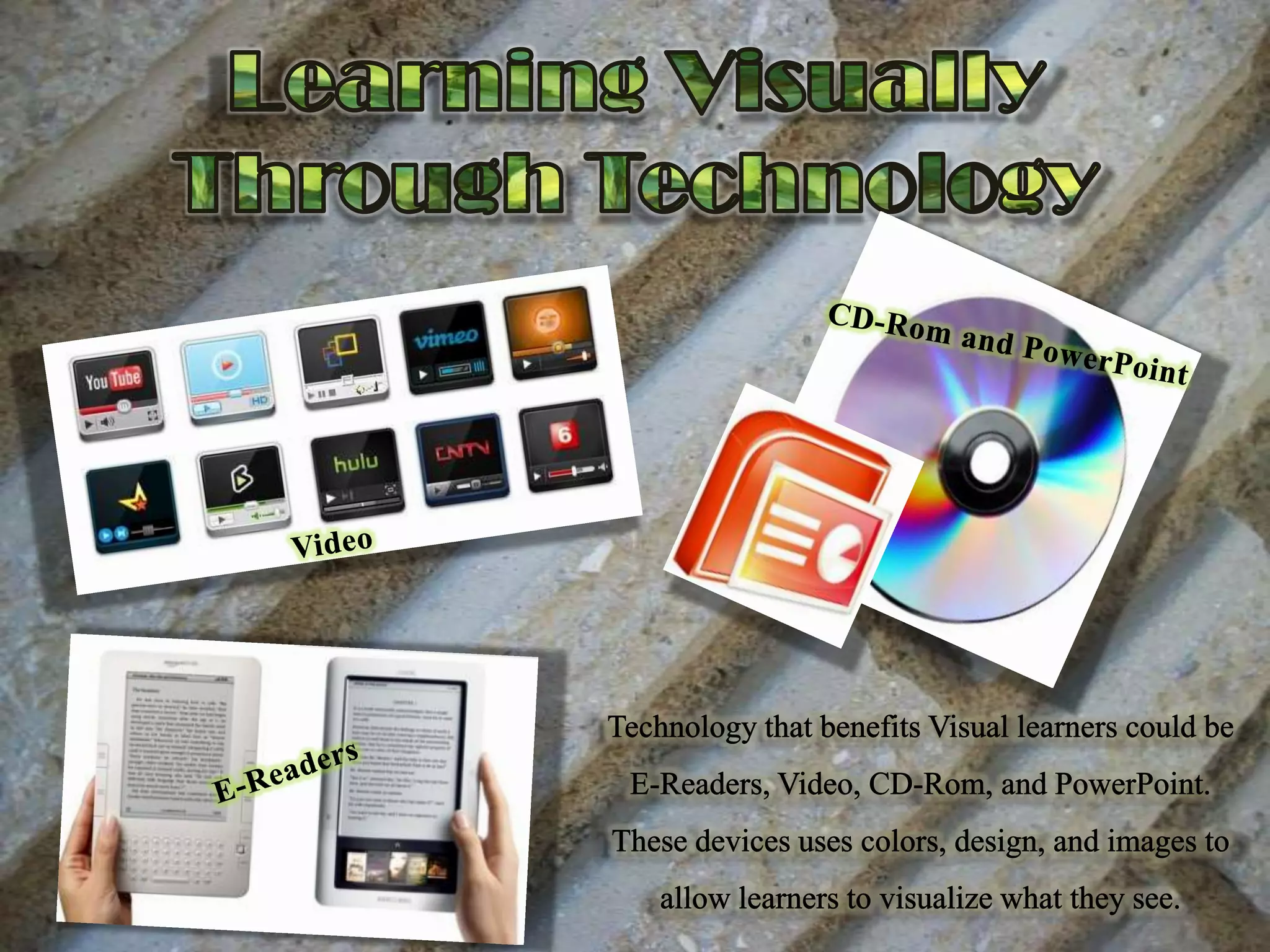
Would be good with sign language (Clark, 2000).Learning Visually Through TechnologyCD-Rom and PowerPoint Video Technology that benefits Visual learners could be E-Readers, Video, CD-Rom, and PowerPoint. These devices uses colors, design, and images to allow learners to visualize what they see.E-Readers
Auditory LearningAuditory learners can absorb spoken and heard materials easily, and prefer discussions over reading. They enjoy lectures, stories, and songs. Voice inflection and pitch greatly benefit this type of learner (Gregory & Chapman, 2007).Traits describing auditory learners are:Reads to self out loud.

Learning Styles

  • 2.
    Learning StylesHeather BryantEDU352Jamie SullivanSeptember 12, 2011
  • 3.
    In 1987 RitaDunn and Ken Dun developed the Learning-styles Model, explaining that every individual learns using different senses (Gregory & Chapman, 2007).
  • 4.
    Visual LearningVisual learnerslearn best from seen or read materials. They benefit best by using illustrations, pictures, and diagrams. Graphic organizers and colors are useful tools that help to construct meaning visually (Gregory& Chapman, 2007). Here are some other traits that attach to visual learners:Forgetful of names, but comes by spelling naturally.
  • 5.
    Usually need aquiet study space.
  • 6.
    Think awhile beforefully understanding lectures.
  • 7.
  • 8.
  • 9.
  • 10.
    Would be goodwith sign language (Clark, 2000).Learning Visually Through TechnologyCD-Rom and PowerPoint Video Technology that benefits Visual learners could be E-Readers, Video, CD-Rom, and PowerPoint. These devices uses colors, design, and images to allow learners to visualize what they see.E-Readers
  • 11.
    Auditory LearningAuditory learnerscan absorb spoken and heard materials easily, and prefer discussions over reading. They enjoy lectures, stories, and songs. Voice inflection and pitch greatly benefit this type of learner (Gregory & Chapman, 2007).Traits describing auditory learners are:Reads to self out loud.
  • 12.
    Not afraid tospeak in class.
  • 13.
    Is good atexplaining.
  • 14.
  • 15.
    Will notice soundeffects in movies.
  • 16.
  • 17.
    Talented with grammarand foreign language.
  • 18.
  • 19.
    Can follow spokendirections well.
  • 20.
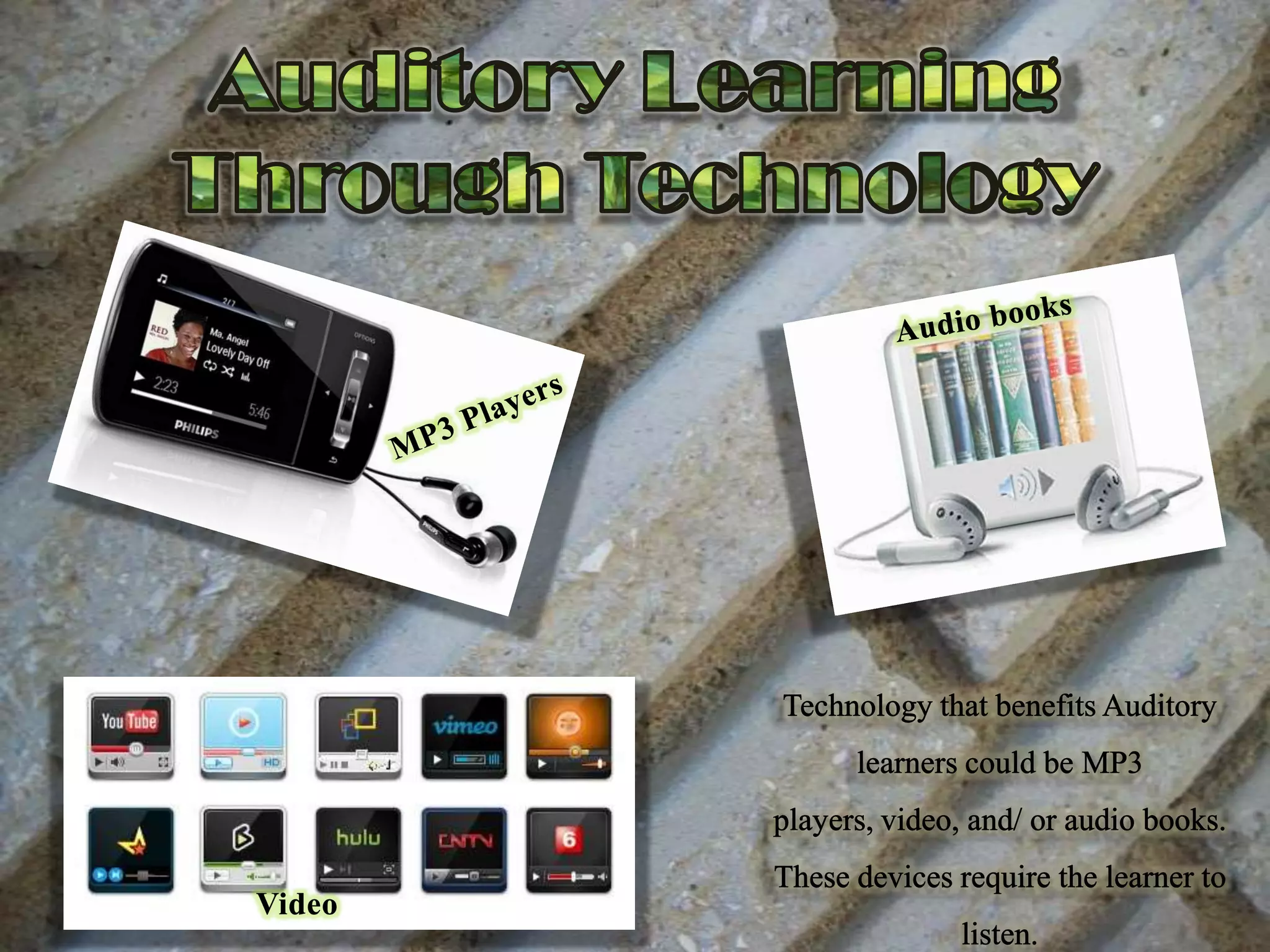
    Excel in studygroups (Clark, 2000).Auditory Learning Through TechnologyAudio booksMP3 PlayersTechnology that benefits Auditory learners could be MP3 players, video, and/ or audio books. These devices require the learner to listen.Video
  • 21.
    Tactile/Kinesthetic LearningTactile/Kinesthetic learnerslearn best by handling materials, writing, drawing, being involved with concrete materials, moving, and doing. These type of learners need to be involved in activities that are meaningful and relevant (Gregory & Chapman, 2007). Some traits that describe tactile/ kinesthetic learners are:Good at sports.
  • 22.
    Does not sitstill for long.
  • 23.
  • 24.
  • 25.
  • 26.
    Is involved inmovement activities.
  • 27.
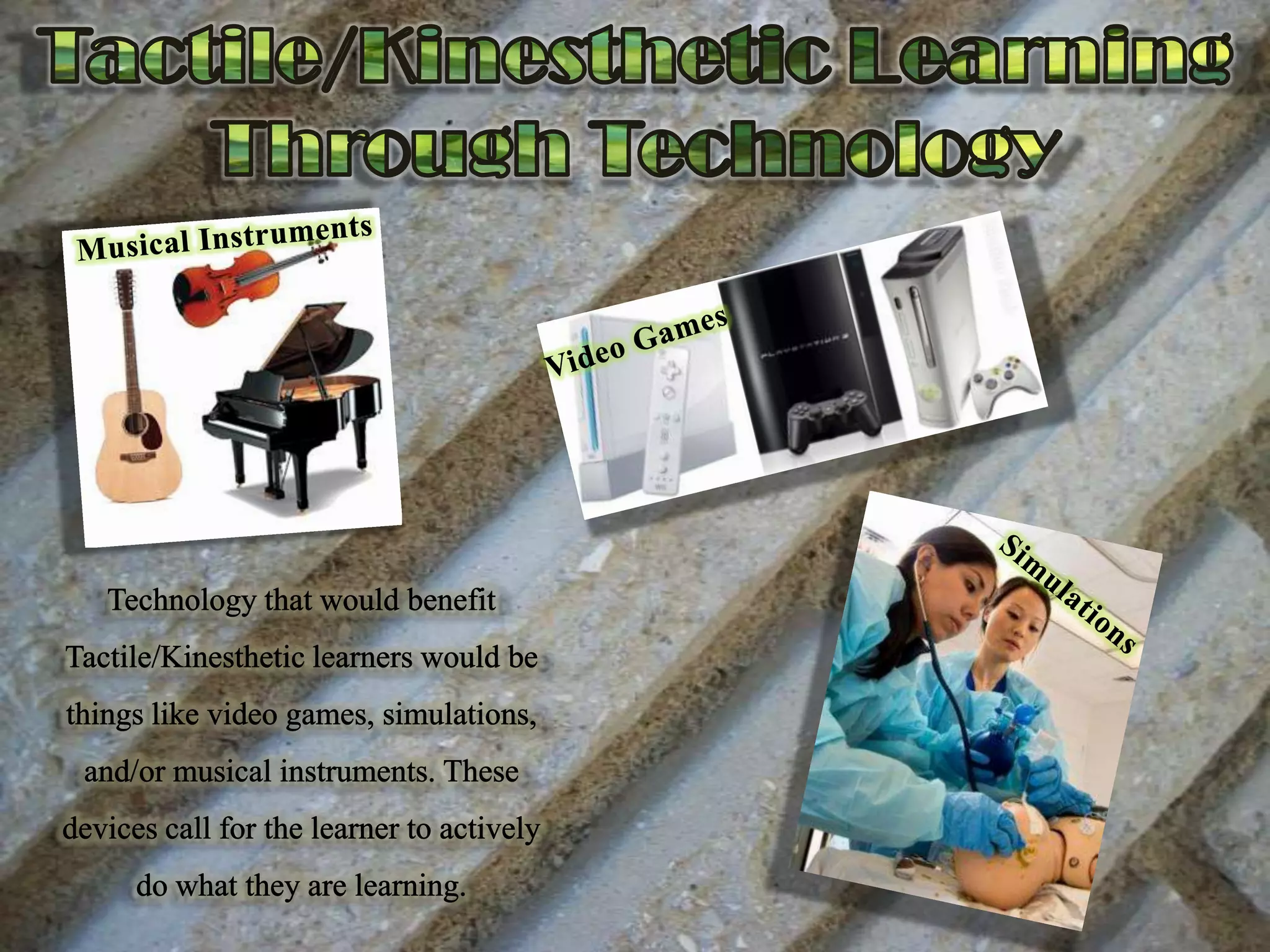
    Gets fidgety duringlectures(Clark, 2000).Tactile/Kinesthetic Learning Through TechnologySimulationsVideo GamesTechnology that would benefit Tactile/Kinesthetic learners would be things like video games, simulations, and/or musical instruments. These devices call for the learner to actively do what they are learning.Musical Instruments
  • 28.
    Every learning stylecan be accommodated to enhance learning. Once an individual establishes their style of learning, they can take the next step towards their personal techniques to learn by.
  • 29.
    ReferencesClark, D. (2000).Visual, auditory, and kinesthetic learning styles (VAK). Retrieved September 11, 2011 from http://www.nwlink.com/~donclark/hrd/styles/vakt.htmlGregory, G.H., Chapman, C. (2007). Differentiated instructional strategies: one size does not fit all (2nd Ed.). Thousand Oaks, California: Corwin Press.Henson Company, (1960). Visual thinking [Web]. Retrieved from http://www.youtube.com/watch?v=hFbyujLT8HQ

Editor's Notes

  • #2 Citation: Henson Company, 1960.
  • #4 Citation : Gregory & Chapman, 2007.
  • #5 Citation: Gregory & Chapman, 2007 Clark, 2000.
  • #9 Citation: Gregory & Chapman, 2007 Clark, 2000.