ScalaMeter 
Performance regression testing framework 
Aleksandar Prokopec, Josh Suereth, Vlad Ureche, Roman Zoller, Ngoc Duy Pham, Alexey Romanov, Roger Vion, Eugene Platonov, Lukas Rytz, Paolo Giarusso, Dan Burkert, Christian Krause, and others
Background
Background 
Georges A., Buytaert D., Eeckhout L. 
Statistically rigorous Java performance evaluation. OOPSLA '07
Motivation 
List(1 to 100000: _*).map(x => x * x) 
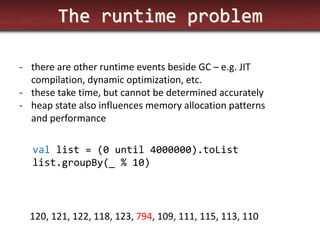
26 ms
Motivation 
List(1 to 100000: _*).map(x => x * x) 
class List[+T] 
extends Seq[T] { 
// implementation 1 
} 
26 ms
Motivation 
List(1 to 100000: _*).map(x => x * x) 
class List[+T] 
extends Seq[T] { 
// implementation 1 
} 
26 ms
Motivation 
List(1 to 100000: _*).map(x => x * x) 
class List[+T] 
extends Seq[T] { 
// implementation 2 
} 
49 ms
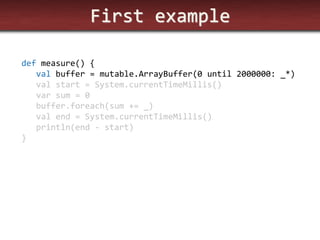
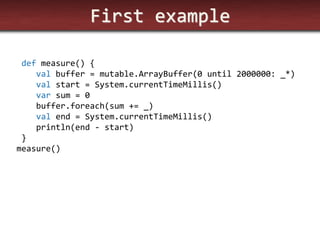
First example 
def measure() { 
val buffer = mutable.ArrayBuffer(0 until 2000000: _*) 
val start = System.currentTimeMillis() 
var sum = 0 
buffer.foreach(sum += _) 
val end = System.currentTimeMillis() 
println(end - start) 
}
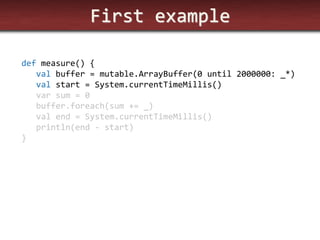
First example 
def measure() { 
val buffer = mutable.ArrayBuffer(0 until 2000000: _*) 
val start = System.currentTimeMillis() 
var sum = 0 
buffer.foreach(sum += _) 
val end = System.currentTimeMillis() 
println(end - start) 
}
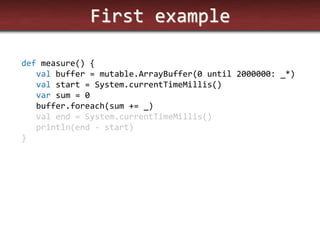
First example 
def measure() { 
val buffer = mutable.ArrayBuffer(0 until 2000000: _*) 
val start = System.currentTimeMillis() 
var sum = 0 
buffer.foreach(sum += _) 
val end = System.currentTimeMillis() 
println(end - start) 
}
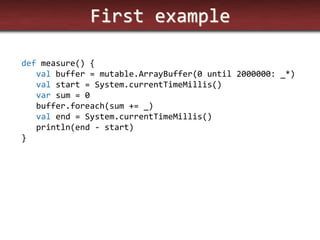
First example 
def measure() { 
val buffer = mutable.ArrayBuffer(0 until 2000000: _*) 
val start = System.currentTimeMillis() 
var sum = 0 
buffer.foreach(sum += _) 
val end = System.currentTimeMillis() 
println(end - start) 
}
First example 
def measure() { 
val buffer = mutable.ArrayBuffer(0 until 2000000: _*) 
val start = System.currentTimeMillis() 
var sum = 0 
buffer.foreach(sum += _) 
val end = System.currentTimeMillis() 
println(end - start) 
} 
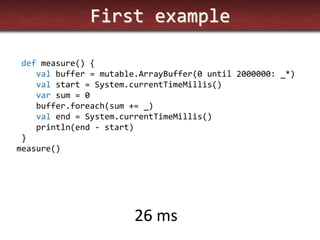
measure()
First example 
def measure() { 
val buffer = mutable.ArrayBuffer(0 until 2000000: _*) 
val start = System.currentTimeMillis() 
var sum = 0 
buffer.foreach(sum += _) 
val end = System.currentTimeMillis() 
println(end - start) 
} 
measure() 
26 ms
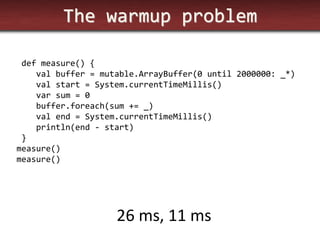
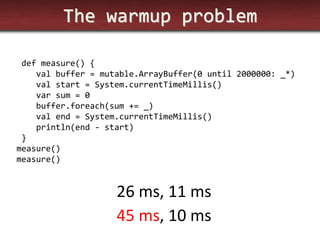
The warmup problem 
def measure() { 
val buffer = mutable.ArrayBuffer(0 until 2000000: _*) 
val start = System.currentTimeMillis() 
var sum = 0 
buffer.foreach(sum += _) 
val end = System.currentTimeMillis() 
println(end - start) 
} 
measure() 
measure() 
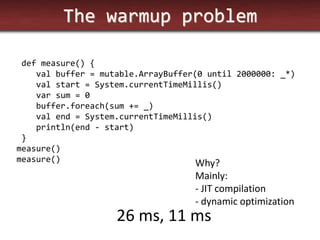
26 ms, 11 ms
The warmup problem 
def measure() { 
val buffer = mutable.ArrayBuffer(0 until 2000000: _*) 
val start = System.currentTimeMillis() 
var sum = 0 
buffer.foreach(sum += _) 
val end = System.currentTimeMillis() 
println(end - start) 
} 
measure() 
measure() 
26 ms, 11 ms 
Why? 
Mainly: 
- JIT compilation 
- dynamic optimization
The warmup problem 
def measure() { 
val buffer = mutable.ArrayBuffer(0 until 2000000: _*) 
val start = System.currentTimeMillis() 
var sum = 0 
buffer.foreach(sum += _) 
val end = System.currentTimeMillis() 
println(end - start) 
} 
measure() 
measure() 
45 ms, 10 ms 
26 ms, 11 ms
The warmup problem 
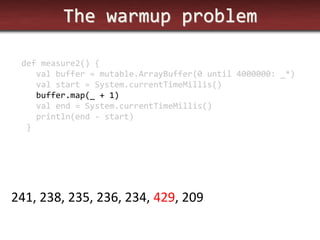
def measure2() { 
val buffer = mutable.ArrayBuffer(0 until 4000000: _*) 
val start = System.currentTimeMillis() 
buffer.map(_ + 1) 
val end = System.currentTimeMillis() 
println(end - start) 
}
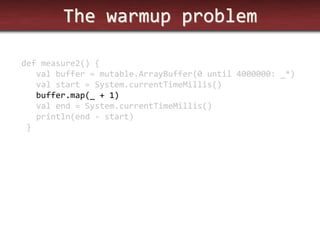
The warmup problem 
def measure2() { 
val buffer = mutable.ArrayBuffer(0 until 4000000: _*) 
val start = System.currentTimeMillis() 
buffer.map(_ + 1) 
val end = System.currentTimeMillis() 
println(end - start) 
} 
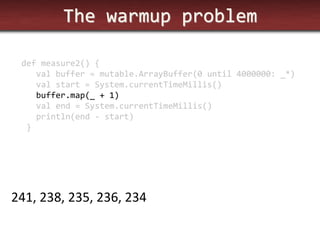
241, 238, 235, 236, 234
The warmup problem 
def measure2() { 
val buffer = mutable.ArrayBuffer(0 until 4000000: _*) 
val start = System.currentTimeMillis() 
buffer.map(_ + 1) 
val end = System.currentTimeMillis() 
println(end - start) 
} 
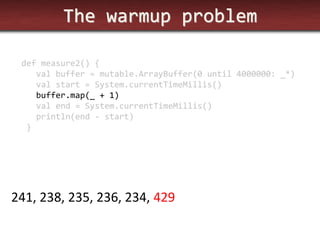
241, 238, 235, 236, 234, 429
The warmup problem 
def measure2() { 
val buffer = mutable.ArrayBuffer(0 until 4000000: _*) 
val start = System.currentTimeMillis() 
buffer.map(_ + 1) 
val end = System.currentTimeMillis() 
println(end - start) 
} 
241, 238, 235, 236, 234, 429, 209
The warmup problem 
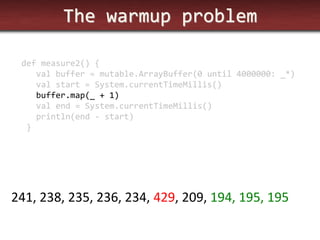
def measure2() { 
val buffer = mutable.ArrayBuffer(0 until 4000000: _*) 
val start = System.currentTimeMillis() 
buffer.map(_ + 1) 
val end = System.currentTimeMillis() 
println(end - start) 
} 
241, 238, 235, 236, 234, 429, 209, 194, 195, 195
The warmup problem 
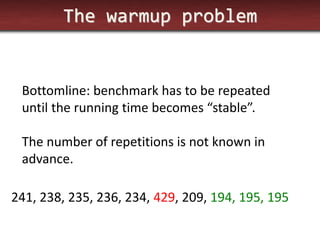
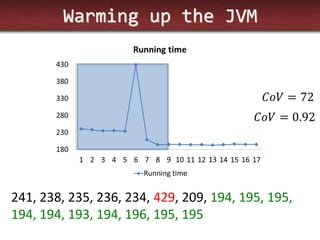
Bottomline: benchmark has to be repeated until the running time becomes “stable”. 
The number of repetitions is not known in advance. 
241, 238, 235, 236, 234, 429, 209, 194, 195, 195
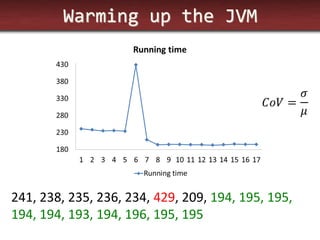
Warming up the JVM 
241, 238, 235, 236, 234, 429, 209, 194, 195, 195, 
194, 194, 193, 194, 196, 195, 195
Warming up the JVM 
241, 238, 235, 236, 234, 429, 209, 194, 195, 195, 
194, 194, 193, 194, 196, 195, 195
The interference problem 
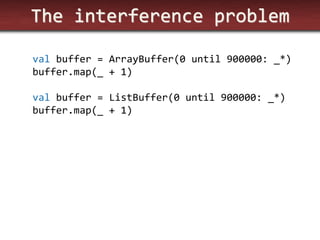
val buffer = ArrayBuffer(0 until 900000: _*) 
buffer.map(_ + 1) 
val buffer = ListBuffer(0 until 900000: _*) 
buffer.map(_ + 1)
The interference problem 
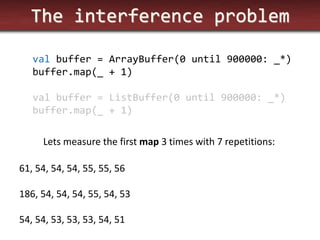
Lets measure the first map 3 times with 7 repetitions: 
val buffer = ArrayBuffer(0 until 900000: _*) 
buffer.map(_ + 1) 
val buffer = ListBuffer(0 until 900000: _*) 
buffer.map(_ + 1) 
61, 54, 54, 54, 55, 55, 56 
186, 54, 54, 54, 55, 54, 53 
54, 54, 53, 53, 53, 54, 51
The interference problem 
val buffer = ArrayBuffer(0 until 900000: _*) 
buffer.map(_ + 1) 
val buffer = ListBuffer(0 until 900000: _*) 
buffer.map(_ + 1) 
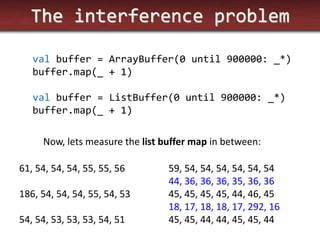
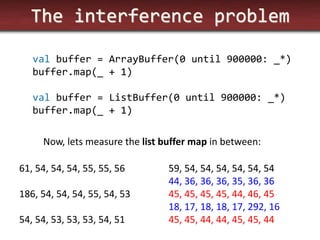
Now, lets measure the list buffer map in between: 
61, 54, 54, 54, 55, 55, 56 
186, 54, 54, 54, 55, 54, 53 
54, 54, 53, 53, 53, 54, 51 
59, 54, 54, 54, 54, 54, 54 
44, 36, 36, 36, 35, 36, 36 
45, 45, 45, 45, 44, 46, 45 
18, 17, 18, 18, 17, 292, 16 
45, 45, 44, 44, 45, 45, 44
The interference problem 
val buffer = ArrayBuffer(0 until 900000: _*) 
buffer.map(_ + 1) 
val buffer = ListBuffer(0 until 900000: _*) 
buffer.map(_ + 1) 
Now, lets measure the list buffer map in between: 
61, 54, 54, 54, 55, 55, 56 
186, 54, 54, 54, 55, 54, 53 
54, 54, 53, 53, 53, 54, 51 
59, 54, 54, 54, 54, 54, 54 
44, 36, 36, 36, 35, 36, 36 
45, 45, 45, 45, 44, 46, 45 
18, 17, 18, 18, 17, 292, 16 
45, 45, 44, 44, 45, 45, 44
Using separate JVM 
Bottomline: always run the tests in a new JVM.
Using separate JVM 
Bottomline: always run the tests in a new JVM. 
This may not reflect a real-world scenario, but it gives a good idea of how different several alternatives are.
Using separate JVM 
Bottomline: always run the tests in a new JVM. 
It results in a reproducible, more stable measurement.
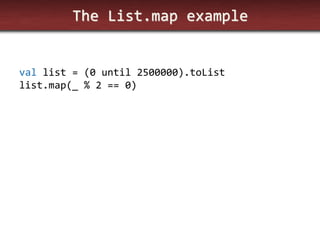
The List.map example 
val list = (0 until 2500000).toList 
list.map(_ % 2 == 0)
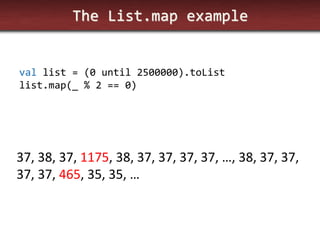
The List.map example 
val list = (0 until 2500000).toList 
list.map(_ % 2 == 0) 
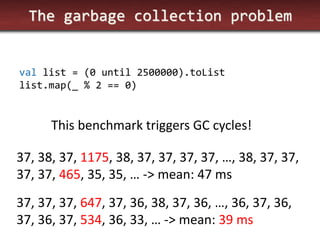
37, 38, 37, 1175, 38, 37, 37, 37, 37, …, 38, 37, 37, 37, 37, 465, 35, 35, …
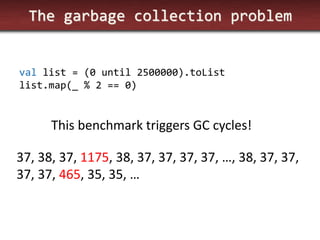
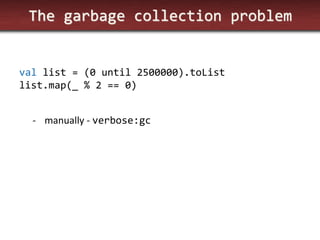
The garbage collection problem 
val list = (0 until 2500000).toList 
list.map(_ % 2 == 0) 
37, 38, 37, 1175, 38, 37, 37, 37, 37, …, 38, 37, 37, 37, 37, 465, 35, 35, … 
This benchmark triggers GC cycles!
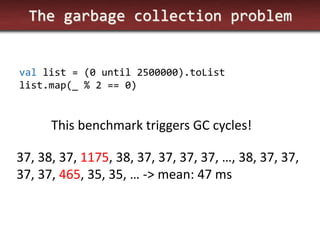
The garbage collection problem 
val list = (0 until 2500000).toList 
list.map(_ % 2 == 0) 
37, 38, 37, 1175, 38, 37, 37, 37, 37, …, 38, 37, 37, 37, 37, 465, 35, 35, … -> mean: 47 ms 
This benchmark triggers GC cycles!
The garbage collection problem 
val list = (0 until 2500000).toList 
list.map(_ % 2 == 0) 
37, 38, 37, 1175, 38, 37, 37, 37, 37, …, 38, 37, 37, 37, 37, 465, 35, 35, … -> mean: 47 ms 
This benchmark triggers GC cycles! 
37, 37, 37, 647, 37, 36, 38, 37, 36, …, 36, 37, 36, 37, 36, 37, 534, 36, 33, … -> mean: 39 ms
The garbage collection problem 
val list = (0 until 2500000).toList 
list.map(_ % 2 == 0) 
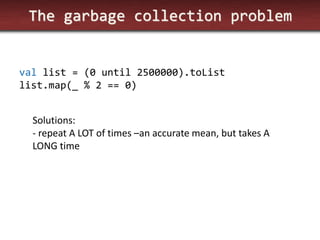
Solutions: 
- repeat A LOT of times –an accurate mean, but takes A LONG time
The garbage collection problem 
val list = (0 until 2500000).toList 
list.map(_ % 2 == 0) 
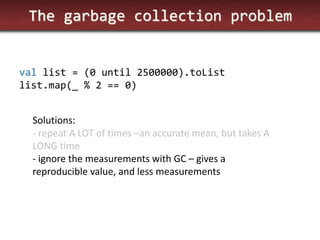
Solutions: 
- repeat A LOT of times –an accurate mean, but takes A LONG time 
- ignore the measurements with GC – gives a reproducible value, and less measurements
The garbage collection problem 
val list = (0 until 2500000).toList 
list.map(_ % 2 == 0) 
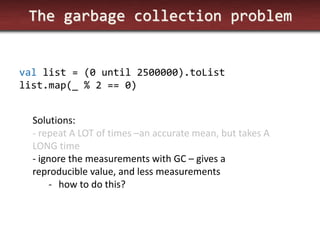
Solutions: 
- repeat A LOT of times –an accurate mean, but takes A LONG time 
- ignore the measurements with GC – gives a reproducible value, and less measurements 
-how to do this?
The garbage collection problem 
val list = (0 until 2500000).toList list.map(_ % 2 == 0) 
-manually - verbose:gc
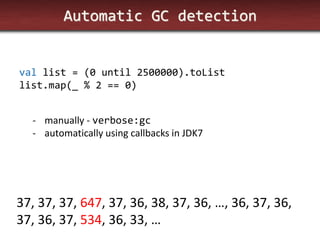
Automatic GC detection 
val list = (0 until 2500000).toList list.map(_ % 2 == 0) 
-manually - verbose:gc 
-automatically using callbacks in JDK7 
37, 37, 37, 647, 37, 36, 38, 37, 36, …, 36, 37, 36, 37, 36, 37, 534, 36, 33, …
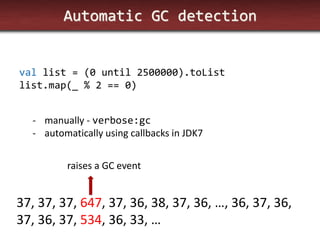
Automatic GC detection 
val list = (0 until 2500000).toList list.map(_ % 2 == 0) 
-manually - verbose:gc 
-automatically using callbacks in JDK7 
37, 37, 37, 647, 37, 36, 38, 37, 36, …, 36, 37, 36, 37, 36, 37, 534, 36, 33, … 
raises a GC event
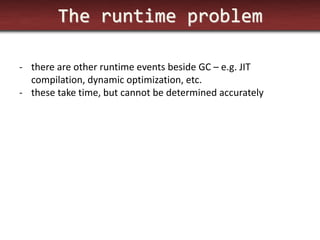
The runtime problem 
-there are other runtime events beside GC – e.g. JIT compilation, dynamic optimization, etc. 
-these take time, but cannot be determined accurately
The runtime problem 
-there are other runtime events beside GC – e.g. JIT compilation, dynamic optimization, etc. 
-these take time, but cannot be determined accurately 
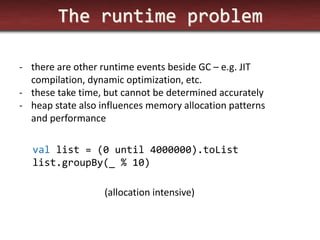
-heap state also influences memory allocation patterns and performance
The runtime problem 
-there are other runtime events beside GC – e.g. JIT compilation, dynamic optimization, etc. 
-these take time, but cannot be determined accurately 
-heap state also influences memory allocation patterns and performance 
val list = (0 until 4000000).toList 
list.groupBy(_ % 10) 
(allocation intensive)
The runtime problem 
-there are other runtime events beside GC – e.g. JIT compilation, dynamic optimization, etc. 
-these take time, but cannot be determined accurately 
-heap state also influences memory allocation patterns and performance 
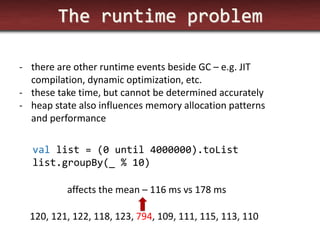
val list = (0 until 4000000).toList list.groupBy(_ % 10) 
120, 121, 122, 118, 123, 794, 109, 111, 115, 113, 110
The runtime problem 
-there are other runtime events beside GC – e.g. JIT compilation, dynamic optimization, etc. 
-these take time, but cannot be determined accurately 
-heap state also influences memory allocation patterns and performance 
val list = (0 until 4000000).toList list.groupBy(_ % 10) 
120, 121, 122, 118, 123, 794, 109, 111, 115, 113, 110 
affects the mean – 116 ms vs 178 ms
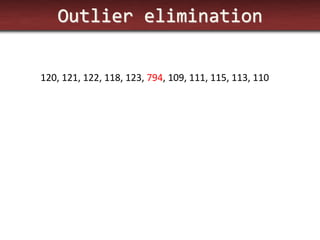
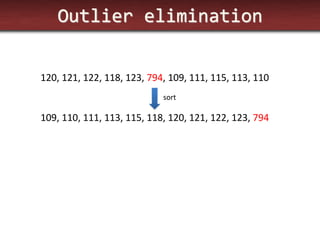
Outlier elimination 
120, 121, 122, 118, 123, 794, 109, 111, 115, 113, 110
Outlier elimination 
120, 121, 122, 118, 123, 794, 109, 111, 115, 113, 110 
109, 110, 111, 113, 115, 118, 120, 121, 122, 123, 794 
sort
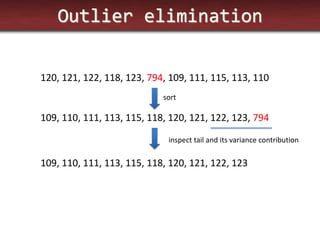
Outlier elimination 
120, 121, 122, 118, 123, 794, 109, 111, 115, 113, 110 
109, 110, 111, 113, 115, 118, 120, 121, 122, 123, 794 
sort 
inspect tail and its variance contribution 
109, 110, 111, 113, 115, 118, 120, 121, 122, 123
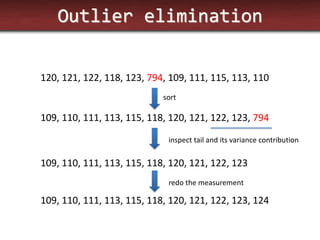
Outlier elimination 
120, 121, 122, 118, 123, 794, 109, 111, 115, 113, 110 
109, 110, 111, 113, 115, 118, 120, 121, 122, 123, 794 
sort 
inspect tail and its variance contribution 
109, 110, 111, 113, 115, 118, 120, 121, 122, 123 
109, 110, 111, 113, 115, 118, 120, 121, 122, 123, 124 
redo the measurement
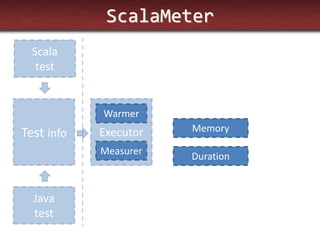
ScalaMeter 
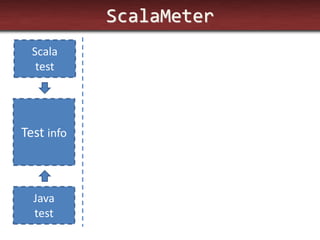
Test info
ScalaMeter 
Test info 
Scala test 
Java test
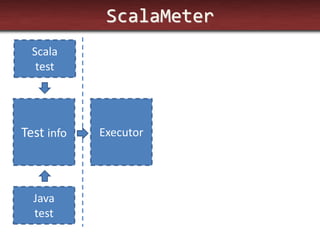
ScalaMeter 
Test info 
Executor 
Scala test 
Java test
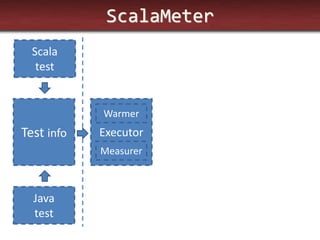
ScalaMeter 
Test info 
Executor 
Scala test 
Java test 
Warmer 
Measurer
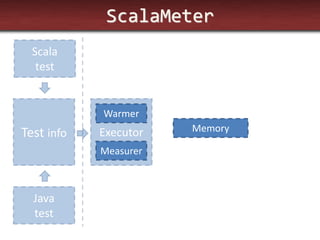
ScalaMeter 
Test info 
Executor 
Scala test 
Java test 
Warmer 
Measurer 
Memory
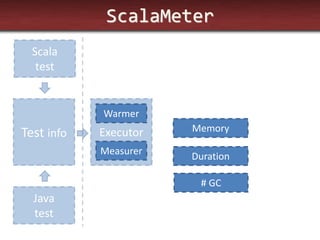
ScalaMeter 
Test info 
Executor 
Scala test 
Java test 
Warmer 
Measurer 
Memory 
Duration
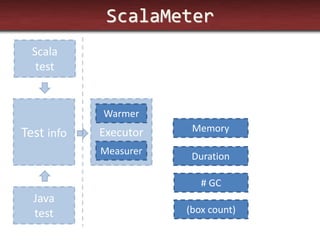
ScalaMeter 
Test info 
Executor 
Scala test 
Java test 
Warmer 
Measurer 
Memory 
Duration 
# GC
ScalaMeter 
Test info 
Executor 
Scala test 
Java test 
Warmer 
Measurer 
Memory 
Duration 
# GC 
(box count)
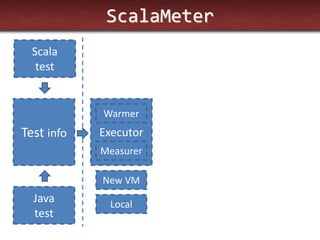
ScalaMeter 
Test info 
Executor 
Scala test 
Java test 
New VM 
Local 
Warmer 
Measurer
ScalaMeter 
Test info 
Executor 
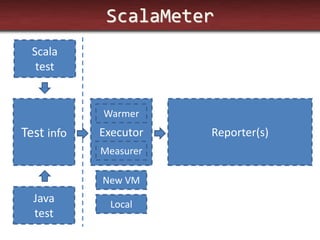
Reporter(s) 
Scala test 
Java test 
New VM 
Local 
Warmer 
Measurer
ScalaMeter 
Test info 
Executor 
Reporter(s) 
Scala test 
Java test 
New VM 
Local 
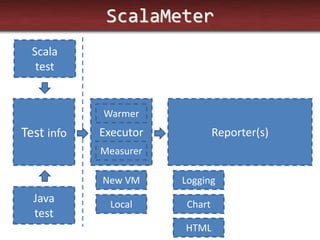
Logging 
Chart 
HTML 
Warmer 
Measurer
ScalaMeter 
Test info 
Executor 
Reporter(s) 
Scala test 
Java test 
New VM 
Local 
Logging 
Chart 
HTML 
Warmer 
Measurer 
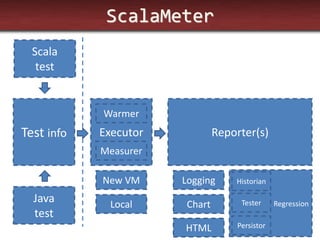
Regression 
Historian 
Tester 
Persistor
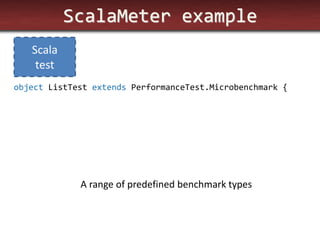
ScalaMeter example 
object ListTest extends PerformanceTest.Microbenchmark { 
A range of predefined benchmark types 
Scala test
ScalaMeter example 
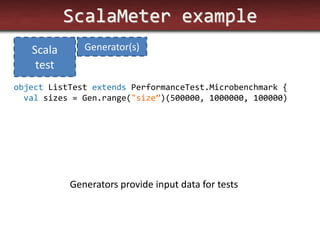
object ListTest extends PerformanceTest.Microbenchmark { val sizes = Gen.range("size”)(500000, 1000000, 100000) 
Generators provide input data for tests 
Scala test 
Generator(s)
ScalaMeter example 
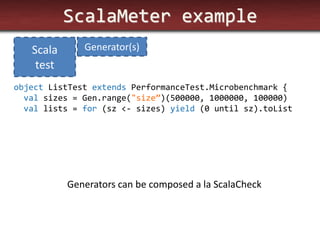
object ListTest extends PerformanceTest.Microbenchmark { val sizes = Gen.range("size”)(500000, 1000000, 100000) val lists = for (sz <- sizes) yield (0 until sz).toList 
Generators can be composed a la ScalaCheck 
Scala test 
Generator(s)
ScalaMeter example 
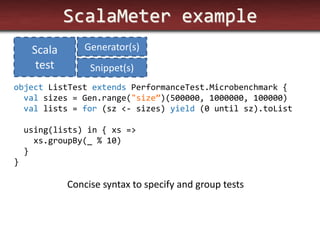
object ListTest extends PerformanceTest.Microbenchmark { val sizes = Gen.range("size”)(500000, 1000000, 100000) val lists = for (sz <- sizes) yield (0 until sz).toList using(lists) in { xs => xs.groupBy(_ % 10) } } 
Concise syntax to specify and group tests 
Scala test 
Generator(s) 
Snippet(s)
ScalaMeter example 
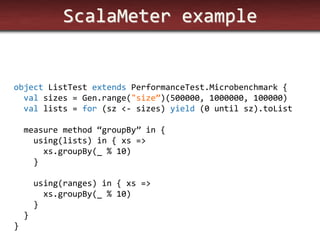
object ListTest extends PerformanceTest.Microbenchmark { val sizes = Gen.range("size”)(500000, 1000000, 100000) val lists = for (sz <- sizes) yield (0 until sz).toList measure method “groupBy” in { using(lists) in { xs => xs.groupBy(_ % 10) } using(ranges) in { xs => xs.groupBy(_ % 10) } } }
Automatic regression testing 
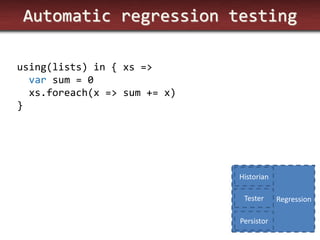
using(lists) in { xs => var sum = 0 xs.foreach(x => sum += x) } 
Regression 
Historian 
Tester 
Persistor
Automatic regression testing 
using(lists) in { xs => var sum = 0 xs.foreach(x => sum += x) } 
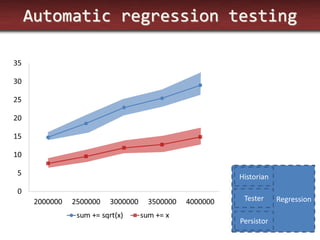
[info] Test group: foreach [info] - foreach.Test-0 measurements: [info] - at size -> 2000000, 1 alternatives: passed [info] (ci = <7.28, 8.22>, significance = 1.0E-10) 
Regression 
Historian 
Tester 
Persistor
Automatic regression testing 
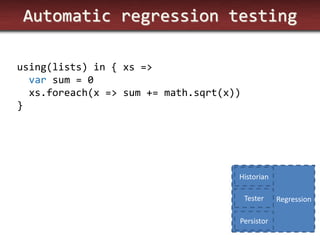
using(lists) in { xs => var sum = 0 xs.foreach(x => sum += math.sqrt(x)) } 
Regression 
Historian 
Tester 
Persistor
Automatic regression testing 
using(lists) in { xs => var sum = 0 xs.foreach(x => sum += math.sqrt(x)) } 
[info] Test group: foreach [info] - foreach.Test-0 measurements: [info] - at size -> 2000000, 2 alternatives: failed [info] (ci = <14.57, 15.38>, significance = 1.0E-10) [error] Failed confidence interval test: <-7.85, -6.60> [error] Previous (mean = 7.75, stdev = 0.44, ci = <7.28, 8.22>) [error] Latest (mean = 14.97, stdev = 0.38, ci = <14.57, 15.38>)
Automatic regression testing 
Regression 
Historian 
Tester 
Persistor
Report generation 
http://scala-blitz.github.io/home/documentation/benchmarks//chara.html
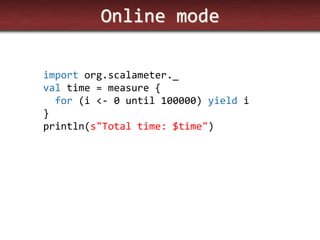
Online mode 
import org.scalameter._ val time = measure { for (i <- 0 until 100000) yield i } println(s"Total time: $time")
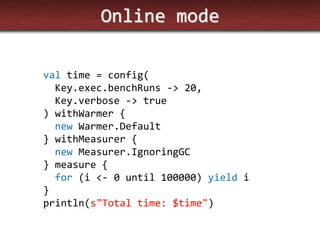
Online mode 
val time = config( Key.exec.benchRuns -> 20, Key.verbose -> true ) withWarmer { new Warmer.Default } withMeasurer { new Measurer.IgnoringGC } measure { for (i <- 0 until 100000) yield i } println(s"Total time: $time")
Tutorials online! 
http://scalameter.github.io 
Thank you!

ScalaMeter 2014

  • 1.
    ScalaMeter Performance regressiontesting framework Aleksandar Prokopec, Josh Suereth, Vlad Ureche, Roman Zoller, Ngoc Duy Pham, Alexey Romanov, Roger Vion, Eugene Platonov, Lukas Rytz, Paolo Giarusso, Dan Burkert, Christian Krause, and others
  • 2.
  • 3.
    Background Georges A.,Buytaert D., Eeckhout L. Statistically rigorous Java performance evaluation. OOPSLA '07
  • 4.
    Motivation List(1 to100000: _*).map(x => x * x) 26 ms
  • 5.
    Motivation List(1 to100000: _*).map(x => x * x) class List[+T] extends Seq[T] { // implementation 1 } 26 ms
  • 6.
    Motivation List(1 to100000: _*).map(x => x * x) class List[+T] extends Seq[T] { // implementation 1 } 26 ms
  • 7.
    Motivation List(1 to100000: _*).map(x => x * x) class List[+T] extends Seq[T] { // implementation 2 } 49 ms
  • 8.
    First example defmeasure() { val buffer = mutable.ArrayBuffer(0 until 2000000: _*) val start = System.currentTimeMillis() var sum = 0 buffer.foreach(sum += _) val end = System.currentTimeMillis() println(end - start) }
  • 9.
    First example defmeasure() { val buffer = mutable.ArrayBuffer(0 until 2000000: _*) val start = System.currentTimeMillis() var sum = 0 buffer.foreach(sum += _) val end = System.currentTimeMillis() println(end - start) }
  • 10.
    First example defmeasure() { val buffer = mutable.ArrayBuffer(0 until 2000000: _*) val start = System.currentTimeMillis() var sum = 0 buffer.foreach(sum += _) val end = System.currentTimeMillis() println(end - start) }
  • 11.
    First example defmeasure() { val buffer = mutable.ArrayBuffer(0 until 2000000: _*) val start = System.currentTimeMillis() var sum = 0 buffer.foreach(sum += _) val end = System.currentTimeMillis() println(end - start) }
  • 12.
    First example defmeasure() { val buffer = mutable.ArrayBuffer(0 until 2000000: _*) val start = System.currentTimeMillis() var sum = 0 buffer.foreach(sum += _) val end = System.currentTimeMillis() println(end - start) } measure()
  • 13.
    First example defmeasure() { val buffer = mutable.ArrayBuffer(0 until 2000000: _*) val start = System.currentTimeMillis() var sum = 0 buffer.foreach(sum += _) val end = System.currentTimeMillis() println(end - start) } measure() 26 ms
  • 14.
    The warmup problem def measure() { val buffer = mutable.ArrayBuffer(0 until 2000000: _*) val start = System.currentTimeMillis() var sum = 0 buffer.foreach(sum += _) val end = System.currentTimeMillis() println(end - start) } measure() measure() 26 ms, 11 ms
  • 15.
    The warmup problem def measure() { val buffer = mutable.ArrayBuffer(0 until 2000000: _*) val start = System.currentTimeMillis() var sum = 0 buffer.foreach(sum += _) val end = System.currentTimeMillis() println(end - start) } measure() measure() 26 ms, 11 ms Why? Mainly: - JIT compilation - dynamic optimization
  • 16.
    The warmup problem def measure() { val buffer = mutable.ArrayBuffer(0 until 2000000: _*) val start = System.currentTimeMillis() var sum = 0 buffer.foreach(sum += _) val end = System.currentTimeMillis() println(end - start) } measure() measure() 45 ms, 10 ms 26 ms, 11 ms
  • 17.
    The warmup problem def measure2() { val buffer = mutable.ArrayBuffer(0 until 4000000: _*) val start = System.currentTimeMillis() buffer.map(_ + 1) val end = System.currentTimeMillis() println(end - start) }
  • 18.
    The warmup problem def measure2() { val buffer = mutable.ArrayBuffer(0 until 4000000: _*) val start = System.currentTimeMillis() buffer.map(_ + 1) val end = System.currentTimeMillis() println(end - start) } 241, 238, 235, 236, 234
  • 19.
    The warmup problem def measure2() { val buffer = mutable.ArrayBuffer(0 until 4000000: _*) val start = System.currentTimeMillis() buffer.map(_ + 1) val end = System.currentTimeMillis() println(end - start) } 241, 238, 235, 236, 234, 429
  • 20.
    The warmup problem def measure2() { val buffer = mutable.ArrayBuffer(0 until 4000000: _*) val start = System.currentTimeMillis() buffer.map(_ + 1) val end = System.currentTimeMillis() println(end - start) } 241, 238, 235, 236, 234, 429, 209
  • 21.
    The warmup problem def measure2() { val buffer = mutable.ArrayBuffer(0 until 4000000: _*) val start = System.currentTimeMillis() buffer.map(_ + 1) val end = System.currentTimeMillis() println(end - start) } 241, 238, 235, 236, 234, 429, 209, 194, 195, 195
  • 22.
    The warmup problem Bottomline: benchmark has to be repeated until the running time becomes “stable”. The number of repetitions is not known in advance. 241, 238, 235, 236, 234, 429, 209, 194, 195, 195
  • 23.
    Warming up theJVM 241, 238, 235, 236, 234, 429, 209, 194, 195, 195, 194, 194, 193, 194, 196, 195, 195
  • 24.
    Warming up theJVM 241, 238, 235, 236, 234, 429, 209, 194, 195, 195, 194, 194, 193, 194, 196, 195, 195
  • 25.
    The interference problem val buffer = ArrayBuffer(0 until 900000: _*) buffer.map(_ + 1) val buffer = ListBuffer(0 until 900000: _*) buffer.map(_ + 1)
  • 26.
    The interference problem Lets measure the first map 3 times with 7 repetitions: val buffer = ArrayBuffer(0 until 900000: _*) buffer.map(_ + 1) val buffer = ListBuffer(0 until 900000: _*) buffer.map(_ + 1) 61, 54, 54, 54, 55, 55, 56 186, 54, 54, 54, 55, 54, 53 54, 54, 53, 53, 53, 54, 51
  • 27.
    The interference problem val buffer = ArrayBuffer(0 until 900000: _*) buffer.map(_ + 1) val buffer = ListBuffer(0 until 900000: _*) buffer.map(_ + 1) Now, lets measure the list buffer map in between: 61, 54, 54, 54, 55, 55, 56 186, 54, 54, 54, 55, 54, 53 54, 54, 53, 53, 53, 54, 51 59, 54, 54, 54, 54, 54, 54 44, 36, 36, 36, 35, 36, 36 45, 45, 45, 45, 44, 46, 45 18, 17, 18, 18, 17, 292, 16 45, 45, 44, 44, 45, 45, 44
  • 28.
    The interference problem val buffer = ArrayBuffer(0 until 900000: _*) buffer.map(_ + 1) val buffer = ListBuffer(0 until 900000: _*) buffer.map(_ + 1) Now, lets measure the list buffer map in between: 61, 54, 54, 54, 55, 55, 56 186, 54, 54, 54, 55, 54, 53 54, 54, 53, 53, 53, 54, 51 59, 54, 54, 54, 54, 54, 54 44, 36, 36, 36, 35, 36, 36 45, 45, 45, 45, 44, 46, 45 18, 17, 18, 18, 17, 292, 16 45, 45, 44, 44, 45, 45, 44
  • 29.
    Using separate JVM Bottomline: always run the tests in a new JVM.
  • 30.
    Using separate JVM Bottomline: always run the tests in a new JVM. This may not reflect a real-world scenario, but it gives a good idea of how different several alternatives are.
  • 31.
    Using separate JVM Bottomline: always run the tests in a new JVM. It results in a reproducible, more stable measurement.
  • 32.
    The List.map example val list = (0 until 2500000).toList list.map(_ % 2 == 0)
  • 33.
    The List.map example val list = (0 until 2500000).toList list.map(_ % 2 == 0) 37, 38, 37, 1175, 38, 37, 37, 37, 37, …, 38, 37, 37, 37, 37, 465, 35, 35, …
  • 34.
    The garbage collectionproblem val list = (0 until 2500000).toList list.map(_ % 2 == 0) 37, 38, 37, 1175, 38, 37, 37, 37, 37, …, 38, 37, 37, 37, 37, 465, 35, 35, … This benchmark triggers GC cycles!
  • 35.
    The garbage collectionproblem val list = (0 until 2500000).toList list.map(_ % 2 == 0) 37, 38, 37, 1175, 38, 37, 37, 37, 37, …, 38, 37, 37, 37, 37, 465, 35, 35, … -> mean: 47 ms This benchmark triggers GC cycles!
  • 36.
    The garbage collectionproblem val list = (0 until 2500000).toList list.map(_ % 2 == 0) 37, 38, 37, 1175, 38, 37, 37, 37, 37, …, 38, 37, 37, 37, 37, 465, 35, 35, … -> mean: 47 ms This benchmark triggers GC cycles! 37, 37, 37, 647, 37, 36, 38, 37, 36, …, 36, 37, 36, 37, 36, 37, 534, 36, 33, … -> mean: 39 ms
  • 37.
    The garbage collectionproblem val list = (0 until 2500000).toList list.map(_ % 2 == 0) Solutions: - repeat A LOT of times –an accurate mean, but takes A LONG time
  • 38.
    The garbage collectionproblem val list = (0 until 2500000).toList list.map(_ % 2 == 0) Solutions: - repeat A LOT of times –an accurate mean, but takes A LONG time - ignore the measurements with GC – gives a reproducible value, and less measurements
  • 39.
    The garbage collectionproblem val list = (0 until 2500000).toList list.map(_ % 2 == 0) Solutions: - repeat A LOT of times –an accurate mean, but takes A LONG time - ignore the measurements with GC – gives a reproducible value, and less measurements -how to do this?
  • 40.
    The garbage collectionproblem val list = (0 until 2500000).toList list.map(_ % 2 == 0) -manually - verbose:gc
  • 41.
    Automatic GC detection val list = (0 until 2500000).toList list.map(_ % 2 == 0) -manually - verbose:gc -automatically using callbacks in JDK7 37, 37, 37, 647, 37, 36, 38, 37, 36, …, 36, 37, 36, 37, 36, 37, 534, 36, 33, …
  • 42.
    Automatic GC detection val list = (0 until 2500000).toList list.map(_ % 2 == 0) -manually - verbose:gc -automatically using callbacks in JDK7 37, 37, 37, 647, 37, 36, 38, 37, 36, …, 36, 37, 36, 37, 36, 37, 534, 36, 33, … raises a GC event
  • 43.
    The runtime problem -there are other runtime events beside GC – e.g. JIT compilation, dynamic optimization, etc. -these take time, but cannot be determined accurately
  • 44.
    The runtime problem -there are other runtime events beside GC – e.g. JIT compilation, dynamic optimization, etc. -these take time, but cannot be determined accurately -heap state also influences memory allocation patterns and performance
  • 45.
    The runtime problem -there are other runtime events beside GC – e.g. JIT compilation, dynamic optimization, etc. -these take time, but cannot be determined accurately -heap state also influences memory allocation patterns and performance val list = (0 until 4000000).toList list.groupBy(_ % 10) (allocation intensive)
  • 46.
    The runtime problem -there are other runtime events beside GC – e.g. JIT compilation, dynamic optimization, etc. -these take time, but cannot be determined accurately -heap state also influences memory allocation patterns and performance val list = (0 until 4000000).toList list.groupBy(_ % 10) 120, 121, 122, 118, 123, 794, 109, 111, 115, 113, 110
  • 47.
    The runtime problem -there are other runtime events beside GC – e.g. JIT compilation, dynamic optimization, etc. -these take time, but cannot be determined accurately -heap state also influences memory allocation patterns and performance val list = (0 until 4000000).toList list.groupBy(_ % 10) 120, 121, 122, 118, 123, 794, 109, 111, 115, 113, 110 affects the mean – 116 ms vs 178 ms
  • 48.
    Outlier elimination 120,121, 122, 118, 123, 794, 109, 111, 115, 113, 110
  • 49.
    Outlier elimination 120,121, 122, 118, 123, 794, 109, 111, 115, 113, 110 109, 110, 111, 113, 115, 118, 120, 121, 122, 123, 794 sort
  • 50.
    Outlier elimination 120,121, 122, 118, 123, 794, 109, 111, 115, 113, 110 109, 110, 111, 113, 115, 118, 120, 121, 122, 123, 794 sort inspect tail and its variance contribution 109, 110, 111, 113, 115, 118, 120, 121, 122, 123
  • 51.
    Outlier elimination 120,121, 122, 118, 123, 794, 109, 111, 115, 113, 110 109, 110, 111, 113, 115, 118, 120, 121, 122, 123, 794 sort inspect tail and its variance contribution 109, 110, 111, 113, 115, 118, 120, 121, 122, 123 109, 110, 111, 113, 115, 118, 120, 121, 122, 123, 124 redo the measurement
  • 52.
  • 53.
    ScalaMeter Test info Scala test Java test
  • 54.
    ScalaMeter Test info Executor Scala test Java test
  • 55.
    ScalaMeter Test info Executor Scala test Java test Warmer Measurer
  • 56.
    ScalaMeter Test info Executor Scala test Java test Warmer Measurer Memory
  • 57.
    ScalaMeter Test info Executor Scala test Java test Warmer Measurer Memory Duration
  • 58.
    ScalaMeter Test info Executor Scala test Java test Warmer Measurer Memory Duration # GC
  • 59.
    ScalaMeter Test info Executor Scala test Java test Warmer Measurer Memory Duration # GC (box count)
  • 60.
    ScalaMeter Test info Executor Scala test Java test New VM Local Warmer Measurer
  • 61.
    ScalaMeter Test info Executor Reporter(s) Scala test Java test New VM Local Warmer Measurer
  • 62.
    ScalaMeter Test info Executor Reporter(s) Scala test Java test New VM Local Logging Chart HTML Warmer Measurer
  • 63.
    ScalaMeter Test info Executor Reporter(s) Scala test Java test New VM Local Logging Chart HTML Warmer Measurer Regression Historian Tester Persistor
  • 64.
    ScalaMeter example objectListTest extends PerformanceTest.Microbenchmark { A range of predefined benchmark types Scala test
  • 65.
    ScalaMeter example objectListTest extends PerformanceTest.Microbenchmark { val sizes = Gen.range("size”)(500000, 1000000, 100000) Generators provide input data for tests Scala test Generator(s)
  • 66.
    ScalaMeter example objectListTest extends PerformanceTest.Microbenchmark { val sizes = Gen.range("size”)(500000, 1000000, 100000) val lists = for (sz <- sizes) yield (0 until sz).toList Generators can be composed a la ScalaCheck Scala test Generator(s)
  • 67.
    ScalaMeter example objectListTest extends PerformanceTest.Microbenchmark { val sizes = Gen.range("size”)(500000, 1000000, 100000) val lists = for (sz <- sizes) yield (0 until sz).toList using(lists) in { xs => xs.groupBy(_ % 10) } } Concise syntax to specify and group tests Scala test Generator(s) Snippet(s)
  • 68.
    ScalaMeter example objectListTest extends PerformanceTest.Microbenchmark { val sizes = Gen.range("size”)(500000, 1000000, 100000) val lists = for (sz <- sizes) yield (0 until sz).toList measure method “groupBy” in { using(lists) in { xs => xs.groupBy(_ % 10) } using(ranges) in { xs => xs.groupBy(_ % 10) } } }
  • 69.
    Automatic regression testing using(lists) in { xs => var sum = 0 xs.foreach(x => sum += x) } Regression Historian Tester Persistor
  • 70.
    Automatic regression testing using(lists) in { xs => var sum = 0 xs.foreach(x => sum += x) } [info] Test group: foreach [info] - foreach.Test-0 measurements: [info] - at size -> 2000000, 1 alternatives: passed [info] (ci = <7.28, 8.22>, significance = 1.0E-10) Regression Historian Tester Persistor
  • 71.
    Automatic regression testing using(lists) in { xs => var sum = 0 xs.foreach(x => sum += math.sqrt(x)) } Regression Historian Tester Persistor
  • 72.
    Automatic regression testing using(lists) in { xs => var sum = 0 xs.foreach(x => sum += math.sqrt(x)) } [info] Test group: foreach [info] - foreach.Test-0 measurements: [info] - at size -> 2000000, 2 alternatives: failed [info] (ci = <14.57, 15.38>, significance = 1.0E-10) [error] Failed confidence interval test: <-7.85, -6.60> [error] Previous (mean = 7.75, stdev = 0.44, ci = <7.28, 8.22>) [error] Latest (mean = 14.97, stdev = 0.38, ci = <14.57, 15.38>)
  • 73.
    Automatic regression testing Regression Historian Tester Persistor
  • 74.
  • 75.
    Online mode importorg.scalameter._ val time = measure { for (i <- 0 until 100000) yield i } println(s"Total time: $time")
  • 76.
    Online mode valtime = config( Key.exec.benchRuns -> 20, Key.verbose -> true ) withWarmer { new Warmer.Default } withMeasurer { new Measurer.IgnoringGC } measure { for (i <- 0 until 100000) yield i } println(s"Total time: $time")
  • 77.