1
|
MTL: The Professional Development Programme
Learning and Change
LEARNING AND
CHANGE
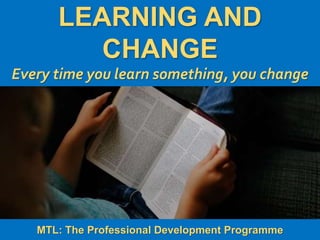
Every time you learn something, you change
MTL: The Professional Development Programme
2
|
MTL: The Professional Development Programme
Learning and Change
Attribution: All images are from sources where a Creative Commons license exists for commercial use. All icons are on subscription
from thenounproject. All clipart is from free sources. The MTL Professional Development Programme is copyright of Manage Train
Learn.
Learning and
Change
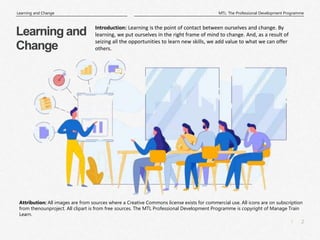
Introduction: Learning is the point of contact between ourselves and change. By
learning, we put ourselves in the right frame of mind to change. And, as a result of
seizing all the opportunities to learn new skills, we add value to what we can offer
others.
3
|
MTL: The Professional Development Programme
Learning and Change
https://unsplash.com/search/old?photo=1kdh6jBZMeA
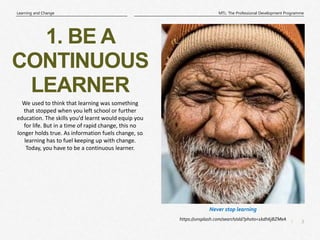
Never stop learning
1. BE A
CONTINUOUS
LEARNER
We used to think that learning was something
that stopped when you left school or further
education. The skills you'd learnt would equip you
for life. But in a time of rapid change, this no
longer holds true. As information fuels change, so
learning has to fuel keeping up with change.
Today, you have to be a continuous learner.
4
|
MTL: The Professional Development Programme
Learning and Change
2. BUILD A
LEARNING
ORGANISATION
https://unsplash.com/search/corporate?photo=Iboom5tbfvs
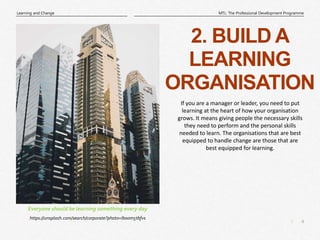
Everyone should be learning something every day
If you are a manager or leader, you need to put
learning at the heart of how your organisation
grows. It means giving people the necessary skills
they need to perform and the personal skills
needed to learn. The organisations that are best
equipped to handle change are those that are
best equipped for learning.
5
|
MTL: The Professional Development Programme
Learning and Change
https://www.flickr.com/photos/16210667@N02/13913799774/
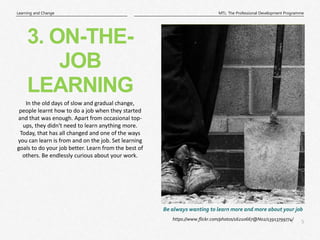
Be always wanting to learn more and more about your job
3. ON-THE-
JOB
LEARNING
In the old days of slow and gradual change,
people learnt how to do a job when they started
and that was enough. Apart from occasional top-
ups, they didn't need to learn anything more.
Today, that has all changed and one of the ways
you can learn is from and on the job. Set learning
goals to do your job better. Learn from the best of
others. Be endlessly curious about your work.
6
|
MTL: The Professional Development Programme
Learning and Change
4. OUT-OF-
THE-JOB
LEARNING
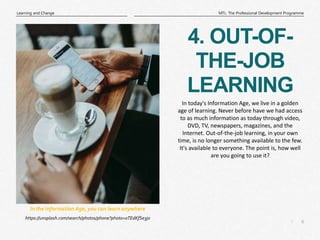
https://unsplash.com/search/photos/phone?photo=oTEdKfSe3j0
In the Information Age, you can learn anywhere
In today's Information Age, we live in a golden
age of learning. Never before have we had access
to as much information as today through video,
DVD, TV, newspapers, magazines, and the
Internet. Out-of-the-job learning, in your own
time, is no longer something available to the few.
It's available to everyone. The point is, how well
are you going to use it?
7
|
MTL: The Professional Development Programme
Learning and Change
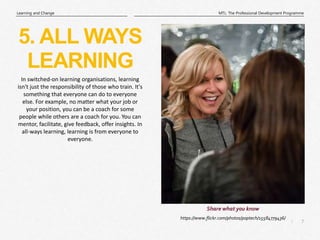
Share what you know
5. ALL WAYS
LEARNING
https://www.flickr.com/photos/poptech/15584779436/
In switched-on learning organisations, learning
isn't just the responsibility of those who train. It's
something that everyone can do to everyone
else. For example, no matter what your job or
your position, you can be a coach for some
people while others are a coach for you. You can
mentor, facilitate, give feedback, offer insights. In
all-ways learning, learning is from everyone to
everyone.
8
|
MTL: The Professional Development Programme
Learning and Change
6. ANARCHIC
LEARNING
https://www.flickr.com/photos/gdsteam/15813192774/
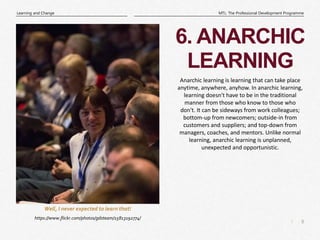
Well, I never expected to learn that!
Anarchic learning is learning that can take place
anytime, anywhere, anyhow. In anarchic learning,
learning doesn't have to be in the traditional
manner from those who know to those who
don't. It can be sideways from work colleagues;
bottom-up from newcomers; outside-in from
customers and suppliers; and top-down from
managers, coaches, and mentors. Unlike normal
learning, anarchic learning is unplanned,
unexpected and opportunistic.
9
|
MTL: The Professional Development Programme
Learning and Change
https://pixabay.com/en/rain-heavy-flood-extreme-weather-2085065/
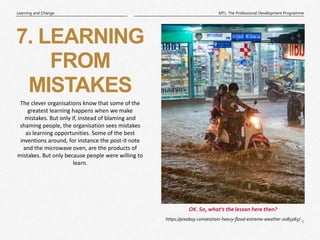
OK. So, what’s the lesson here then?
7. LEARNING
FROM
MISTAKES
The clever organisations know that some of the
greatest learning happens when we make
mistakes. But only if, instead of blaming and
shaming people, the organisation sees mistakes
as learning opportunities. Some of the best
inventions around, for instance the post-it note
and the microwave oven, are the products of
mistakes. But only because people were willing to
learn.
10
|
MTL: The Professional Development Programme
Learning and Change
This has been a Slide Topic from Manage Train Learn
AFinal
Word
Charles Handy said, "Those who are always learning are those who can ride the waves of change.
They are the enthusiasts of the new ways, forms, and ideas. If you want to be in control of your
change, learn."

Learning and Change

  • 1.
    1 | MTL: The ProfessionalDevelopment Programme Learning and Change LEARNING AND CHANGE Every time you learn something, you change MTL: The Professional Development Programme
  • 2.
    2 | MTL: The ProfessionalDevelopment Programme Learning and Change Attribution: All images are from sources where a Creative Commons license exists for commercial use. All icons are on subscription from thenounproject. All clipart is from free sources. The MTL Professional Development Programme is copyright of Manage Train Learn. Learning and Change Introduction: Learning is the point of contact between ourselves and change. By learning, we put ourselves in the right frame of mind to change. And, as a result of seizing all the opportunities to learn new skills, we add value to what we can offer others.
  • 3.
    3 | MTL: The ProfessionalDevelopment Programme Learning and Change https://unsplash.com/search/old?photo=1kdh6jBZMeA Never stop learning 1. BE A CONTINUOUS LEARNER We used to think that learning was something that stopped when you left school or further education. The skills you'd learnt would equip you for life. But in a time of rapid change, this no longer holds true. As information fuels change, so learning has to fuel keeping up with change. Today, you have to be a continuous learner.
  • 4.
    4 | MTL: The ProfessionalDevelopment Programme Learning and Change 2. BUILD A LEARNING ORGANISATION https://unsplash.com/search/corporate?photo=Iboom5tbfvs Everyone should be learning something every day If you are a manager or leader, you need to put learning at the heart of how your organisation grows. It means giving people the necessary skills they need to perform and the personal skills needed to learn. The organisations that are best equipped to handle change are those that are best equipped for learning.
  • 5.
    5 | MTL: The ProfessionalDevelopment Programme Learning and Change https://www.flickr.com/photos/16210667@N02/13913799774/ Be always wanting to learn more and more about your job 3. ON-THE- JOB LEARNING In the old days of slow and gradual change, people learnt how to do a job when they started and that was enough. Apart from occasional top- ups, they didn't need to learn anything more. Today, that has all changed and one of the ways you can learn is from and on the job. Set learning goals to do your job better. Learn from the best of others. Be endlessly curious about your work.
  • 6.
    6 | MTL: The ProfessionalDevelopment Programme Learning and Change 4. OUT-OF- THE-JOB LEARNING https://unsplash.com/search/photos/phone?photo=oTEdKfSe3j0 In the Information Age, you can learn anywhere In today's Information Age, we live in a golden age of learning. Never before have we had access to as much information as today through video, DVD, TV, newspapers, magazines, and the Internet. Out-of-the-job learning, in your own time, is no longer something available to the few. It's available to everyone. The point is, how well are you going to use it?
  • 7.
    7 | MTL: The ProfessionalDevelopment Programme Learning and Change Share what you know 5. ALL WAYS LEARNING https://www.flickr.com/photos/poptech/15584779436/ In switched-on learning organisations, learning isn't just the responsibility of those who train. It's something that everyone can do to everyone else. For example, no matter what your job or your position, you can be a coach for some people while others are a coach for you. You can mentor, facilitate, give feedback, offer insights. In all-ways learning, learning is from everyone to everyone.
  • 8.
    8 | MTL: The ProfessionalDevelopment Programme Learning and Change 6. ANARCHIC LEARNING https://www.flickr.com/photos/gdsteam/15813192774/ Well, I never expected to learn that! Anarchic learning is learning that can take place anytime, anywhere, anyhow. In anarchic learning, learning doesn't have to be in the traditional manner from those who know to those who don't. It can be sideways from work colleagues; bottom-up from newcomers; outside-in from customers and suppliers; and top-down from managers, coaches, and mentors. Unlike normal learning, anarchic learning is unplanned, unexpected and opportunistic.
  • 9.
    9 | MTL: The ProfessionalDevelopment Programme Learning and Change https://pixabay.com/en/rain-heavy-flood-extreme-weather-2085065/ OK. So, what’s the lesson here then? 7. LEARNING FROM MISTAKES The clever organisations know that some of the greatest learning happens when we make mistakes. But only if, instead of blaming and shaming people, the organisation sees mistakes as learning opportunities. Some of the best inventions around, for instance the post-it note and the microwave oven, are the products of mistakes. But only because people were willing to learn.
  • 10.
    10 | MTL: The ProfessionalDevelopment Programme Learning and Change This has been a Slide Topic from Manage Train Learn AFinal Word Charles Handy said, "Those who are always learning are those who can ride the waves of change. They are the enthusiasts of the new ways, forms, and ideas. If you want to be in control of your change, learn."