Sources: “Heat” by Frontline on PBS http://www.pbs.org/wgbh/pages/frontline/heat/ Sources: Union of Concerned Scientists http://www.ucsusa.org Sources: Alaska Conservation Solutions http://www.alaskaconservationsolutions.com/
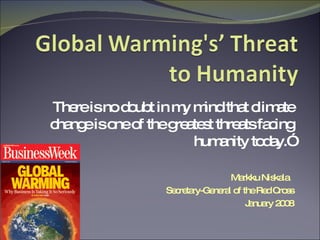
There is no doubt in my mind that climate change is one of the greatest threats facing humanity today.” Markku Niskala  Secretary-General of the Red Cross January 2008 magazine covers courtesy of Chris Rose
Sub-Title
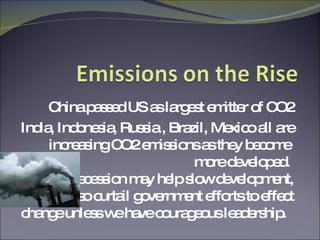
China passed US as largest emitter of CO2 India, Indonesia, Russia , Brazil, Mexico all are increasing CO2 emissions as they become  more developed.  Global recession may help slow development, but may also curtail government efforts to effect change unless we have courageous leadership.
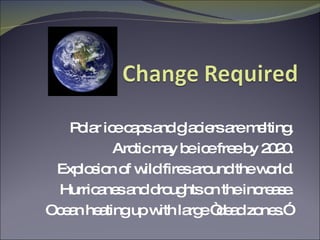
Polar ice caps and glaciers are melting. Arctic may be ice free by 2020. Explosion of wild fires around the world. Hurricanes and droughts on the increase. Ocean heating up with large “dead zones.”
80% of glacierized Himalaya and Tibet will be gone by 2030.  Half the world’s population depends on its  glacial melt for water.  This will effect India, China and other parts of Asia - shortages may lead to conflicts.  India will surpass China as the worlds most populous country by 2030
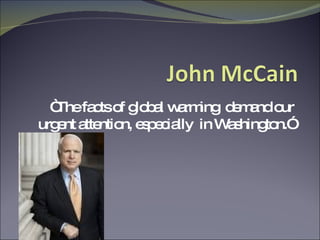
“ The facts of global warming  demand our urgent attention, especially  in Washington.”
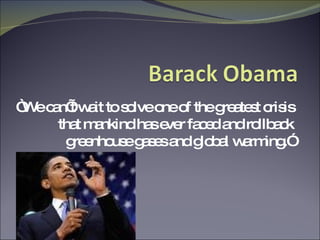
“ We can’t wait to solve one of the greatest crisis that mankind has ever faced and rollback greenhouse gases and global warming.”
“ The evidence is sufficient that we  should move towards the most  effective possible steps to reduce  carbon loading of the atmosphere,  and to do it  urgently .” Newt Gingrich  Former House Speaker 2007 magazine covers courtesy of Chris Rose
China builds 2 new coal plants every week. 52% of all US energy comes from coal. A single mine in Wyoming produces a  million tons of coal each day. Americans consume 1 billion tons of  coal per year.
It takes one pound of coal to  power your TV for four hours. Another pound to power your  bedside light for two evenings.  The average American household uses  nine and a  half tons of coal every year.
Although popularized by ad campaigns, “Clean Coal” faces significant challenges  and has not even been tested yet for mainstream energy production.  Government mandates are needed to drive  innovation for carbon capture and storage .  Infrastructure costs must be addressed.
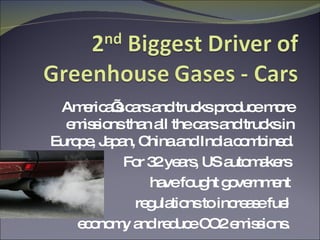
America’s cars and trucks produce more emissions than all the cars and trucks in Europe, Japan, China and India combined. For 32 years, US automakers  have fought government  regulations to increase fuel  economy and reduce CO2 emissions.
California’s Global Warming Solutions Act set aggressive goals to improve fuel economy to 42 mpg and reduce greenhouse gas emissions by 90% by mid-century.  18 other states were lined up to follow California’s lead.  Detroit lobbied hard and defeated the Act by leveraging their influence in the EPA and Congress.
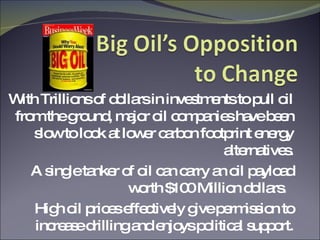
With Trillions of dollars in investments to pull oil from the ground, major oil companies have been slow to look at lower carbon footprint energy alternatives. A single tanker of oil can carry an oil payload worth $100 Million dollars.  High oil prices effectively give permission to increase drilling and enjoys political support.
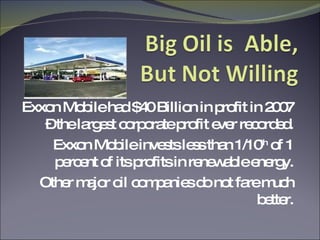
Exxon Mobile had $40 Billion in profit in 2007 – the largest corporate profit ever recorded. Exxon Mobile invests less than 1/10 th  of 1 percent of its profits in renewable energy. Other major oil companies do not fare much better.
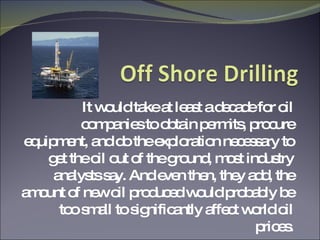
It would take at least a decade for oil companies to obtain permits, procure equipment, and do the exploration necessary to get the oil out of the ground, most industry analysts say. And even then, they add, the amount of new oil produced would probably be too small to significantly affect world oil prices.
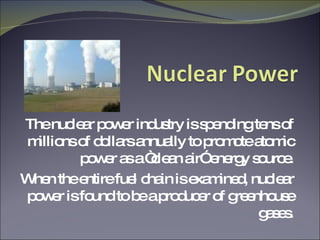
The nuclear power industry is spending tens of millions of dollars annually to promote atomic power as a “clean air” energy source. When the entire fuel chain is examined, nuclear power is found to be a producer of greenhouse gases.
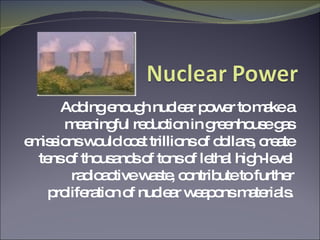
Adding enough nuclear power to make a meaningful reduction in greenhouse gas emissions would cost trillions of dollars, create tens of thousands of tons of lethal high-level radioactive waste, contribute to further proliferation of nuclear weapons materials.
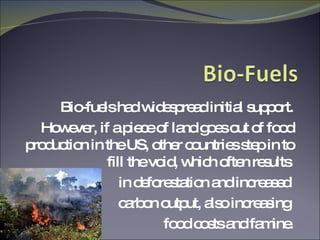
Bio-fuels had widespread initial support. However, if a piece of land goes out of food production in the US, other countries step in to fill the void, which often results  in deforestation and increased  carbon output, also increasing  food costs and famine.
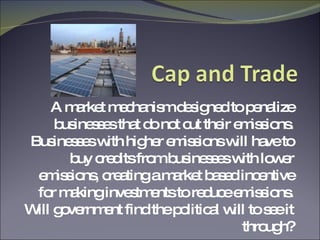
A market mechanism designed to penalize businesses that do not cut their emissions. Businesses with higher emissions will have to buy credits from businesses with lower emissions, creating a market based incentive for making investments to reduce emissions. Will government find the political will to see it through?
Conservation Recycling Alternate energy sources Wind Geothermal Hydroelectric Solar
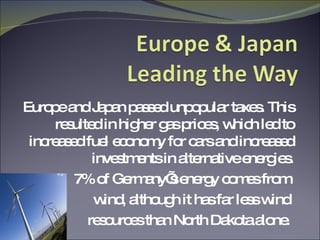
Europe and Japan passed unpopular taxes. This resulted in higher gas prices, which led to increased fuel economy for cars and increased investments in alternative energies. 7% of Germany’s energy comes from  wind, although it has far less wind  resources than North Dakota alone.
Make Better Cars and SUV's Modernize Electricity Systems with Renewable Energy Increase Energy Efficiency  Protect Threatened Forests Support American Ingenuity  & Innovation
Requires  technological innovation and the cooperation of businesses and governments. Requires  a behavioral shift on the part of individuals to change our habits and the way we live and work.  Requires  we take on responsibility to become the new “Greatest Generation”

Learn Share Act!

  • 1.
    Sources: “Heat” byFrontline on PBS http://www.pbs.org/wgbh/pages/frontline/heat/ Sources: Union of Concerned Scientists http://www.ucsusa.org Sources: Alaska Conservation Solutions http://www.alaskaconservationsolutions.com/
  • 2.
    There is nodoubt in my mind that climate change is one of the greatest threats facing humanity today.” Markku Niskala Secretary-General of the Red Cross January 2008 magazine covers courtesy of Chris Rose
  • 3.
  • 4.
    China passed USas largest emitter of CO2 India, Indonesia, Russia , Brazil, Mexico all are increasing CO2 emissions as they become more developed. Global recession may help slow development, but may also curtail government efforts to effect change unless we have courageous leadership.
  • 5.
    Polar ice capsand glaciers are melting. Arctic may be ice free by 2020. Explosion of wild fires around the world. Hurricanes and droughts on the increase. Ocean heating up with large “dead zones.”
  • 6.
    80% of glacierizedHimalaya and Tibet will be gone by 2030. Half the world’s population depends on its glacial melt for water. This will effect India, China and other parts of Asia - shortages may lead to conflicts. India will surpass China as the worlds most populous country by 2030
  • 7.
    “ The factsof global warming demand our urgent attention, especially in Washington.”
  • 8.
    “ We can’twait to solve one of the greatest crisis that mankind has ever faced and rollback greenhouse gases and global warming.”
  • 9.
    “ The evidenceis sufficient that we should move towards the most effective possible steps to reduce carbon loading of the atmosphere, and to do it urgently .” Newt Gingrich Former House Speaker 2007 magazine covers courtesy of Chris Rose
  • 10.
    China builds 2new coal plants every week. 52% of all US energy comes from coal. A single mine in Wyoming produces a million tons of coal each day. Americans consume 1 billion tons of coal per year.
  • 11.
    It takes onepound of coal to power your TV for four hours. Another pound to power your bedside light for two evenings. The average American household uses nine and a half tons of coal every year.
  • 12.
    Although popularized byad campaigns, “Clean Coal” faces significant challenges and has not even been tested yet for mainstream energy production. Government mandates are needed to drive innovation for carbon capture and storage . Infrastructure costs must be addressed.
  • 13.
    America’s cars andtrucks produce more emissions than all the cars and trucks in Europe, Japan, China and India combined. For 32 years, US automakers have fought government regulations to increase fuel economy and reduce CO2 emissions.
  • 14.
    California’s Global WarmingSolutions Act set aggressive goals to improve fuel economy to 42 mpg and reduce greenhouse gas emissions by 90% by mid-century. 18 other states were lined up to follow California’s lead. Detroit lobbied hard and defeated the Act by leveraging their influence in the EPA and Congress.
  • 15.
    With Trillions ofdollars in investments to pull oil from the ground, major oil companies have been slow to look at lower carbon footprint energy alternatives. A single tanker of oil can carry an oil payload worth $100 Million dollars. High oil prices effectively give permission to increase drilling and enjoys political support.
  • 16.
    Exxon Mobile had$40 Billion in profit in 2007 – the largest corporate profit ever recorded. Exxon Mobile invests less than 1/10 th of 1 percent of its profits in renewable energy. Other major oil companies do not fare much better.
  • 17.
    It would takeat least a decade for oil companies to obtain permits, procure equipment, and do the exploration necessary to get the oil out of the ground, most industry analysts say. And even then, they add, the amount of new oil produced would probably be too small to significantly affect world oil prices.
  • 18.
    The nuclear powerindustry is spending tens of millions of dollars annually to promote atomic power as a “clean air” energy source. When the entire fuel chain is examined, nuclear power is found to be a producer of greenhouse gases.
  • 19.
    Adding enough nuclearpower to make a meaningful reduction in greenhouse gas emissions would cost trillions of dollars, create tens of thousands of tons of lethal high-level radioactive waste, contribute to further proliferation of nuclear weapons materials.
  • 20.
    Bio-fuels had widespreadinitial support. However, if a piece of land goes out of food production in the US, other countries step in to fill the void, which often results in deforestation and increased carbon output, also increasing food costs and famine.
  • 21.
    A market mechanismdesigned to penalize businesses that do not cut their emissions. Businesses with higher emissions will have to buy credits from businesses with lower emissions, creating a market based incentive for making investments to reduce emissions. Will government find the political will to see it through?
  • 22.
    Conservation Recycling Alternateenergy sources Wind Geothermal Hydroelectric Solar
  • 23.
    Europe and Japanpassed unpopular taxes. This resulted in higher gas prices, which led to increased fuel economy for cars and increased investments in alternative energies. 7% of Germany’s energy comes from wind, although it has far less wind resources than North Dakota alone.
  • 24.
    Make Better Carsand SUV's Modernize Electricity Systems with Renewable Energy Increase Energy Efficiency Protect Threatened Forests Support American Ingenuity & Innovation
  • 25.
    Requires technologicalinnovation and the cooperation of businesses and governments. Requires a behavioral shift on the part of individuals to change our habits and the way we live and work. Requires we take on responsibility to become the new “Greatest Generation”