Let's Learn Ruby AQAP
As Quickly As Possible!
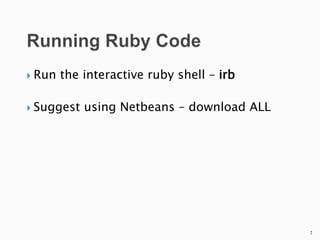
 Run the interactive ruby shell – irb
 Suggest using Netbeans – download ALL
2
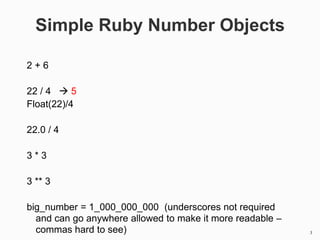
2 + 6
22 / 4  5
Float(22)/4
22.0 / 4
3 * 3
3 ** 3
big_number = 1_000_000_000 (underscores not required
and can go anywhere allowed to make it more readable –
commas hard to see)
Simple Ruby Number Objects
3
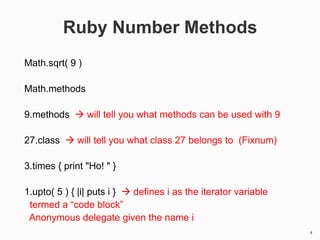
Math.sqrt( 9 )
Math.methods
9.methods  will tell you what methods can be used with 9
27.class  will tell you what class 27 belongs to (Fixnum)
3.times { print "Ho! " }
1.upto( 5 ) { |i| puts i }  defines i as the iterator variable
termed a “code block”
Anonymous delegate given the name i
Ruby Number Methods
4
one = "1"
two = "2"
one + two  string concat, right?
Integer( one ) + Integer( two )  casts and then adds
12.to_s  calls to string method, but wants you to request
conversion
print "Happy ", 12.to_s, "th Birthday!"
puts "Happy ", 12.to_s, "th Birthday!"
puts "Happy " + 12 + "th Birthday!"
Number Conversions
5
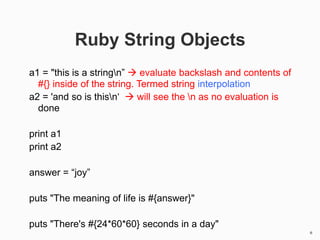
a1 = "this is a stringn”  evaluate backslash and contents of
#{} inside of the string. Termed string interpolation
a2 = 'and so is thisn‘  will see the n as no evaluation is
done
print a1
print a2
answer = “joy”
puts "The meaning of life is #{answer}"
puts "There's #{24*60*60} seconds in a day"
Ruby String Objects
6
formatted_text = <<END_OF_TEXT
Let us turn our thoughts today
To Martin Luther King
And recognize that there are ties between us
All men and women
Living on the Earth
Ties of hope and love
Sister and brotherhood
That we are bound together
In our desire to see the world become
A place in which our children
Can grow free and strong
END_OF_TEXT  any delimiter – as long as it matches
print formatted_text  interpretation does work
Ruby Here Documents
7
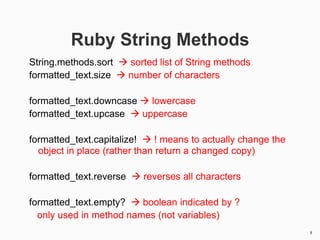
String.methods.sort  sorted list of String methods
formatted_text.size  number of characters
formatted_text.downcase  lowercase
formatted_text.upcase  uppercase
formatted_text.capitalize!  ! means to actually change the
object in place (rather than return a changed copy)
formatted_text.reverse  reverses all characters
formatted_text.empty?  boolean indicated by ?
only used in method names (not variables)
Ruby String Methods
8
song_lines = formatted_text.to_a  to array
(1..10).to_a  [1,2,3,4,5,6,7,8,9,10] from a range
(denoted ..)
(‘a’..’e’).to_a  [“a”, “b”, “c”, “d”, “e”]
print song_lines[1]
print song_lines[5]
print song_lines[99]  Gives nil if used when out of range,
will add to array if assign outside of range.
print song_lines
print formatted_text
song_lines.class  Array
formatted_text.class  String
Working with Ruby Strings
9
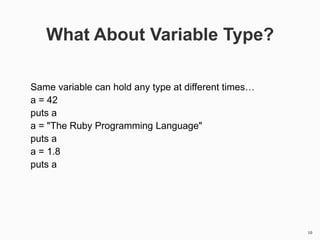
Same variable can hold any type at different times…
a = 42
puts a
a = "The Ruby Programming Language"
puts a
a = 1.8
puts a
What About Variable Type?
10
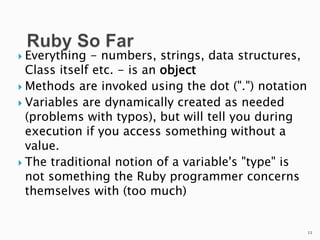
 Everything - numbers, strings, data structures,
Class itself etc. - is an object
 Methods are invoked using the dot (".") notation
 Variables are dynamically created as needed
(problems with typos), but will tell you during
execution if you access something without a
value.
 The traditional notion of a variable's "type" is
not something the Ruby programmer concerns
themselves with (too much)
11

Learn ruby intro

  • 1.
    Let's Learn RubyAQAP As Quickly As Possible!
  • 2.
     Run theinteractive ruby shell – irb  Suggest using Netbeans – download ALL 2
  • 3.
    2 + 6 22/ 4  5 Float(22)/4 22.0 / 4 3 * 3 3 ** 3 big_number = 1_000_000_000 (underscores not required and can go anywhere allowed to make it more readable – commas hard to see) Simple Ruby Number Objects 3
  • 4.
    Math.sqrt( 9 ) Math.methods 9.methods will tell you what methods can be used with 9 27.class  will tell you what class 27 belongs to (Fixnum) 3.times { print "Ho! " } 1.upto( 5 ) { |i| puts i }  defines i as the iterator variable termed a “code block” Anonymous delegate given the name i Ruby Number Methods 4
  • 5.
    one = "1" two= "2" one + two  string concat, right? Integer( one ) + Integer( two )  casts and then adds 12.to_s  calls to string method, but wants you to request conversion print "Happy ", 12.to_s, "th Birthday!" puts "Happy ", 12.to_s, "th Birthday!" puts "Happy " + 12 + "th Birthday!" Number Conversions 5
  • 6.
    a1 = "thisis a stringn”  evaluate backslash and contents of #{} inside of the string. Termed string interpolation a2 = 'and so is thisn‘  will see the n as no evaluation is done print a1 print a2 answer = “joy” puts "The meaning of life is #{answer}" puts "There's #{24*60*60} seconds in a day" Ruby String Objects 6
  • 7.
    formatted_text = <<END_OF_TEXT Letus turn our thoughts today To Martin Luther King And recognize that there are ties between us All men and women Living on the Earth Ties of hope and love Sister and brotherhood That we are bound together In our desire to see the world become A place in which our children Can grow free and strong END_OF_TEXT  any delimiter – as long as it matches print formatted_text  interpretation does work Ruby Here Documents 7
  • 8.
    String.methods.sort  sortedlist of String methods formatted_text.size  number of characters formatted_text.downcase  lowercase formatted_text.upcase  uppercase formatted_text.capitalize!  ! means to actually change the object in place (rather than return a changed copy) formatted_text.reverse  reverses all characters formatted_text.empty?  boolean indicated by ? only used in method names (not variables) Ruby String Methods 8
  • 9.
    song_lines = formatted_text.to_a to array (1..10).to_a  [1,2,3,4,5,6,7,8,9,10] from a range (denoted ..) (‘a’..’e’).to_a  [“a”, “b”, “c”, “d”, “e”] print song_lines[1] print song_lines[5] print song_lines[99]  Gives nil if used when out of range, will add to array if assign outside of range. print song_lines print formatted_text song_lines.class  Array formatted_text.class  String Working with Ruby Strings 9
  • 10.
    Same variable canhold any type at different times… a = 42 puts a a = "The Ruby Programming Language" puts a a = 1.8 puts a What About Variable Type? 10
  • 11.
     Everything -numbers, strings, data structures, Class itself etc. - is an object  Methods are invoked using the dot (".") notation  Variables are dynamically created as needed (problems with typos), but will tell you during execution if you access something without a value.  The traditional notion of a variable's "type" is not something the Ruby programmer concerns themselves with (too much) 11

Editor's Notes

  • #5 What do you notice that seems more “object oriented” than other languages?