

Learn how to Leverage
Kubernetes to Support 12
Factor for Enterprise Apps
Dr.	Brad	Topol
IBM	Distinguished	Engineer
@bradtopol
Michael	Elder
IBM	Distinguished	Engineer
@mdelder
Let’s deploy
our apps on
the cloud!
2© 2019 IBM Corporation
Why?
3© 2019 IBM Corporation
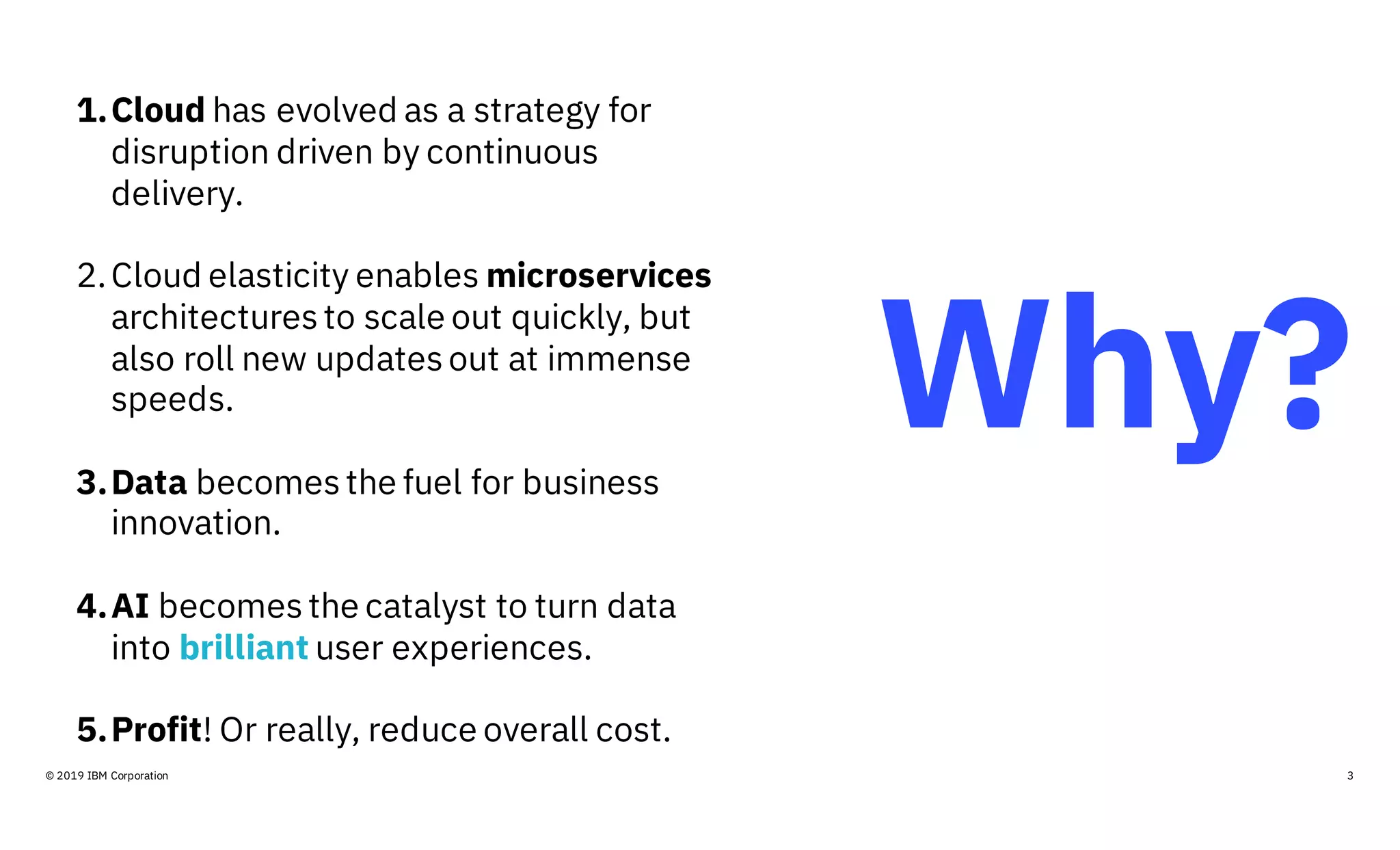
1.Cloud has evolved as a strategy for
disruption driven by continuous
delivery.
2.Cloud elasticity enables microservices
architectures to scale out quickly, but
also roll new updates out at immense
speeds.
3.Data becomes the fuel for business
innovation.
4.AI becomes the catalyst to turn data
into brilliant user experiences.
5.Profit! Or really, reduce overall cost.
4
What is a
12-factor
app?
https://12factor.net/
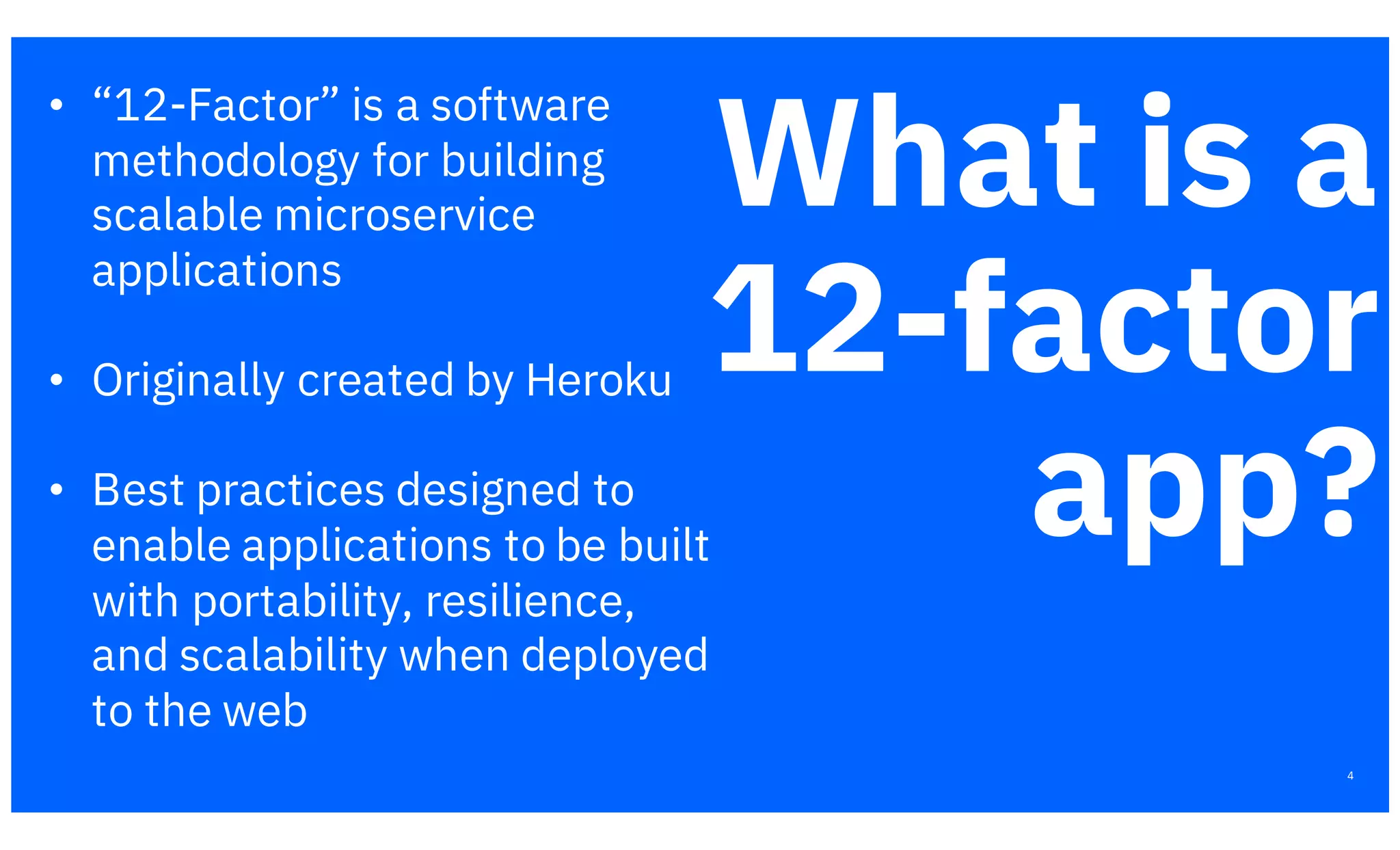
• “12-Factor” is a software
methodology for building
scalable microservice
applications
• Originally created by Heroku
• Best practices designed to
enable applications to be built
with portability, resilience,
and scalability when deployed
to the web
5
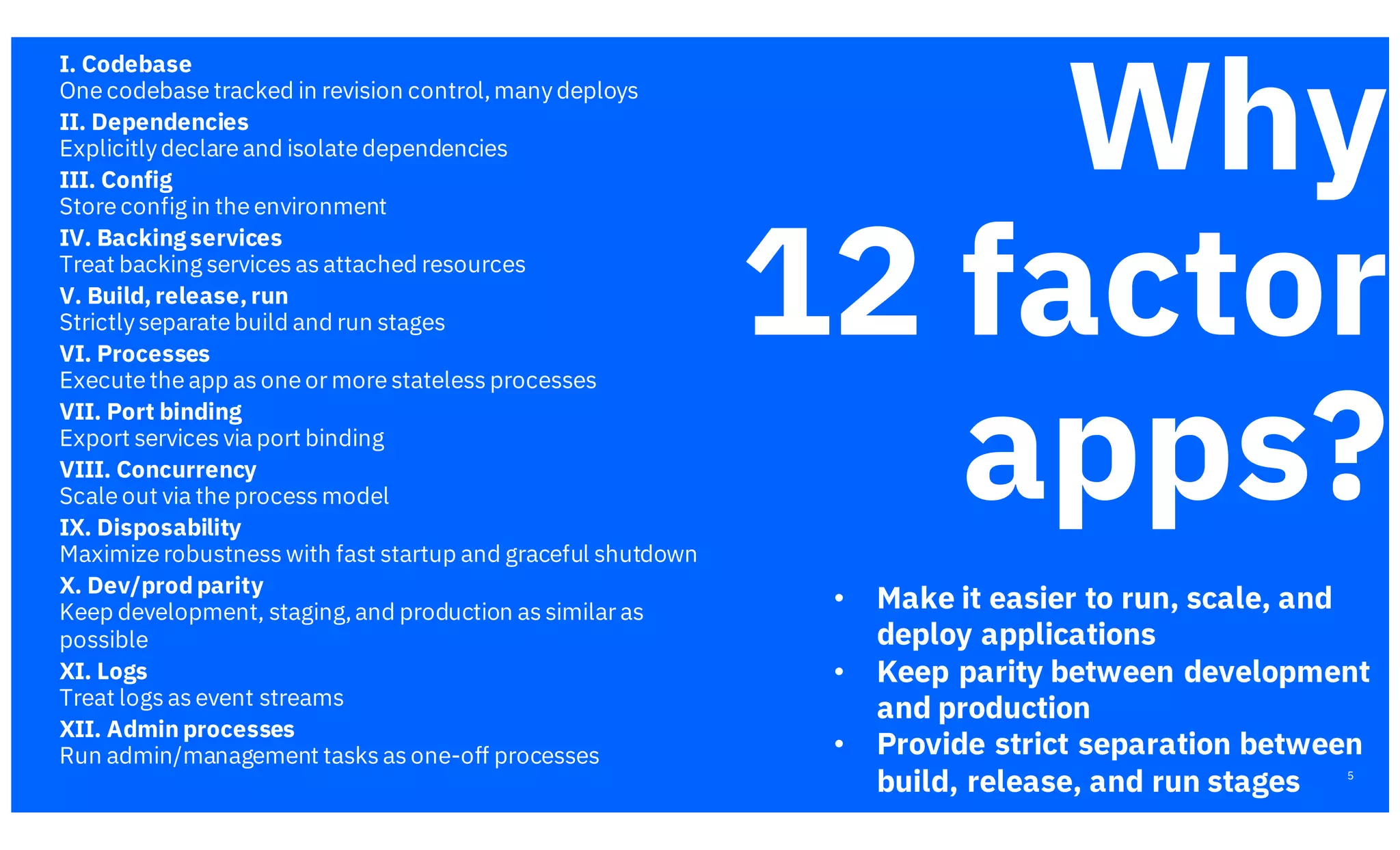
I. Codebase
One codebase tracked in revision control,manydeploys
II. Dependencies
Explicitlydeclare and isolate dependencies
III. Config
Store config in the environment
IV. Backing services
Treat backing services as attached resources
V. Build, release, run
Strictlyseparate build and run stages
VI. Processes
Execute the app as one or more stateless processes
VII. Port binding
Export services via port binding
VIII. Concurrency
Scale out via the process model
IX. Disposability
Maximize robustness with fast startup and graceful shutdown
X. Dev/prod parity
Keep development, staging,and production as similar as
possible
XI. Logs
Treat logs as event streams
XII. Admin processes
Run admin/management tasks as one-off processes
Why
12 factor
apps?
https://12factor.net/
• Make it easier to run, scale, and
deploy applications
• Keep parity between development
and production
• Provide strict separation between
build, release, and run stages
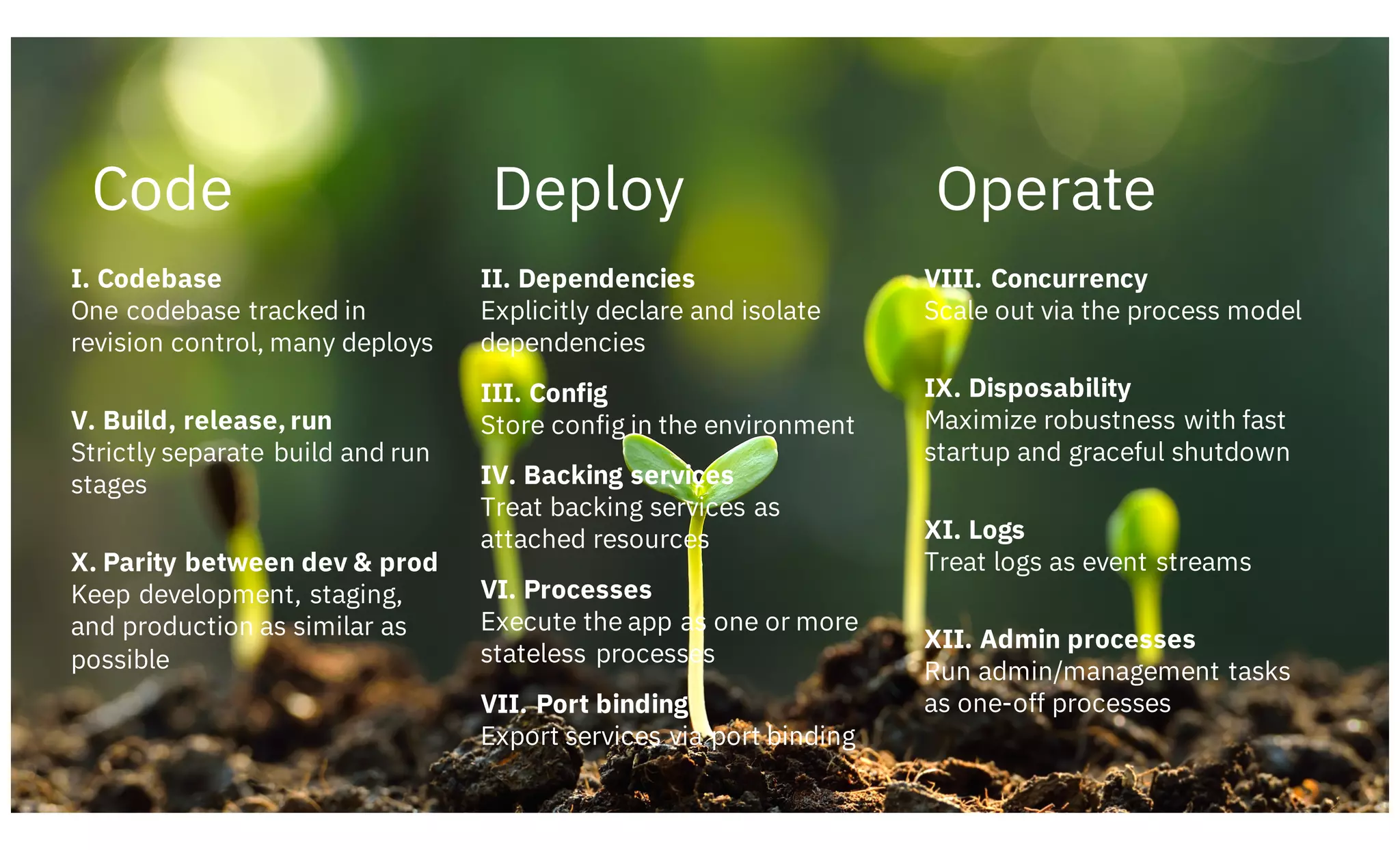
I. Codebase
One codebase tracked in
revision control, many deploys
II. Dependencies
Explicitly declare and isolate
dependencies
III. Config
Store config in the environment
IV. Backing services
Treat backing services as
attached resources
V. Build, release, run
Strictly separate build and run
stages
VI. Processes
Execute the app as one or more
stateless processes
VII. Port binding
Export services via port binding
VIII. Concurrency
Scale out via the process model
IX. Disposability
Maximize robustness with fast
startup and graceful shutdown
X. Parity between dev & prod
Keep development, staging,
and production as similar as
possible
XI. Logs
Treat logs as event streams
XII. Admin processes
Run admin/management tasks
as one-off processes
Code Deploy Operate
7
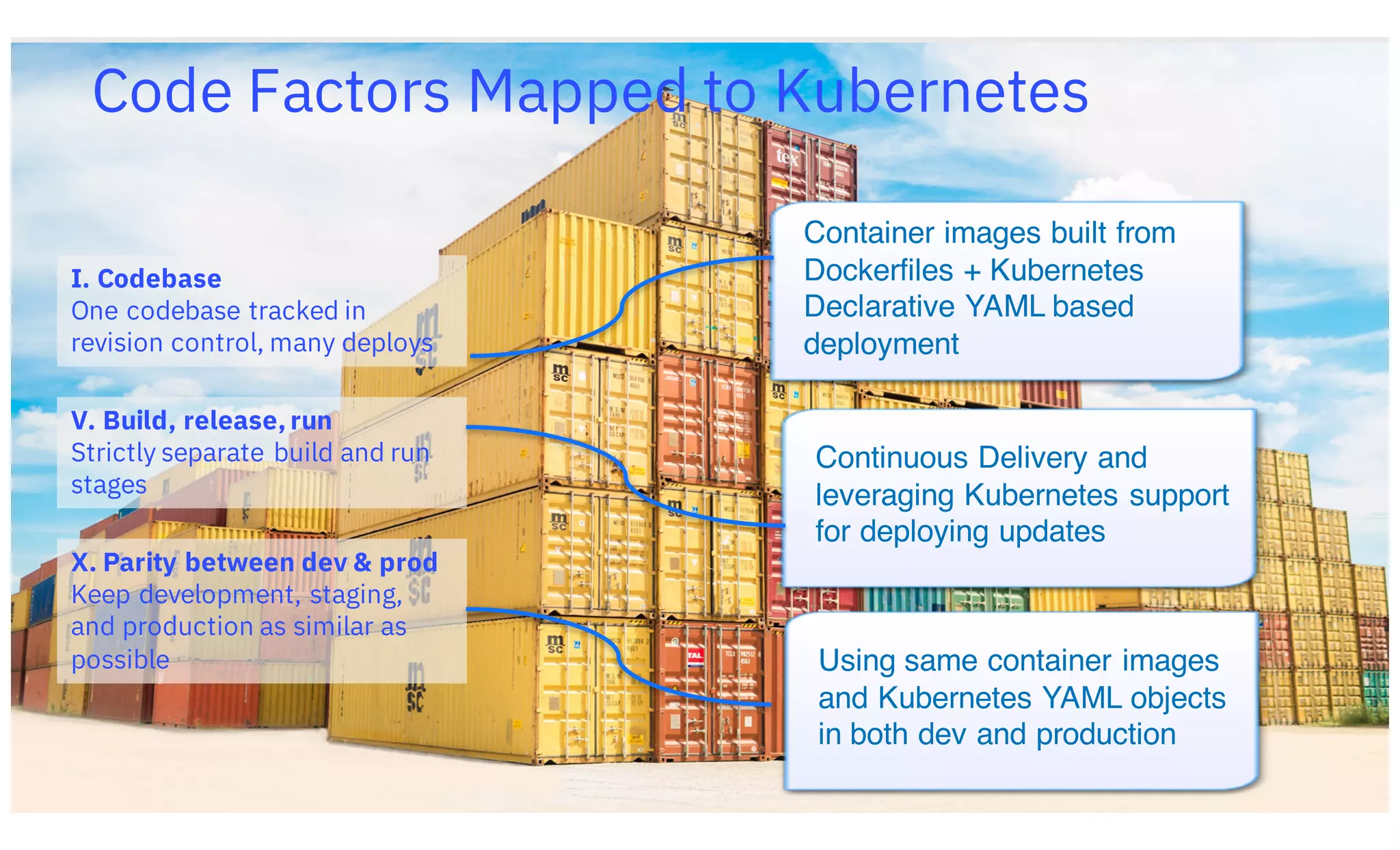
I. Codebase
One codebase tracked in
revision control, many deploys
V. Build, release, run
Strictly separate build and run
stages
X. Parity between dev & prod
Keep development, staging,
and production as similar as
possible
Code Factors Mapped to Kubernetes
Container images built from
Dockerfiles + Kubernetes
Declarative YAML based
deployment
Using same container images
and Kubernetes YAML objects
in both dev and production
Continuous Delivery and
leveraging Kubernetes support
for deploying updates
8
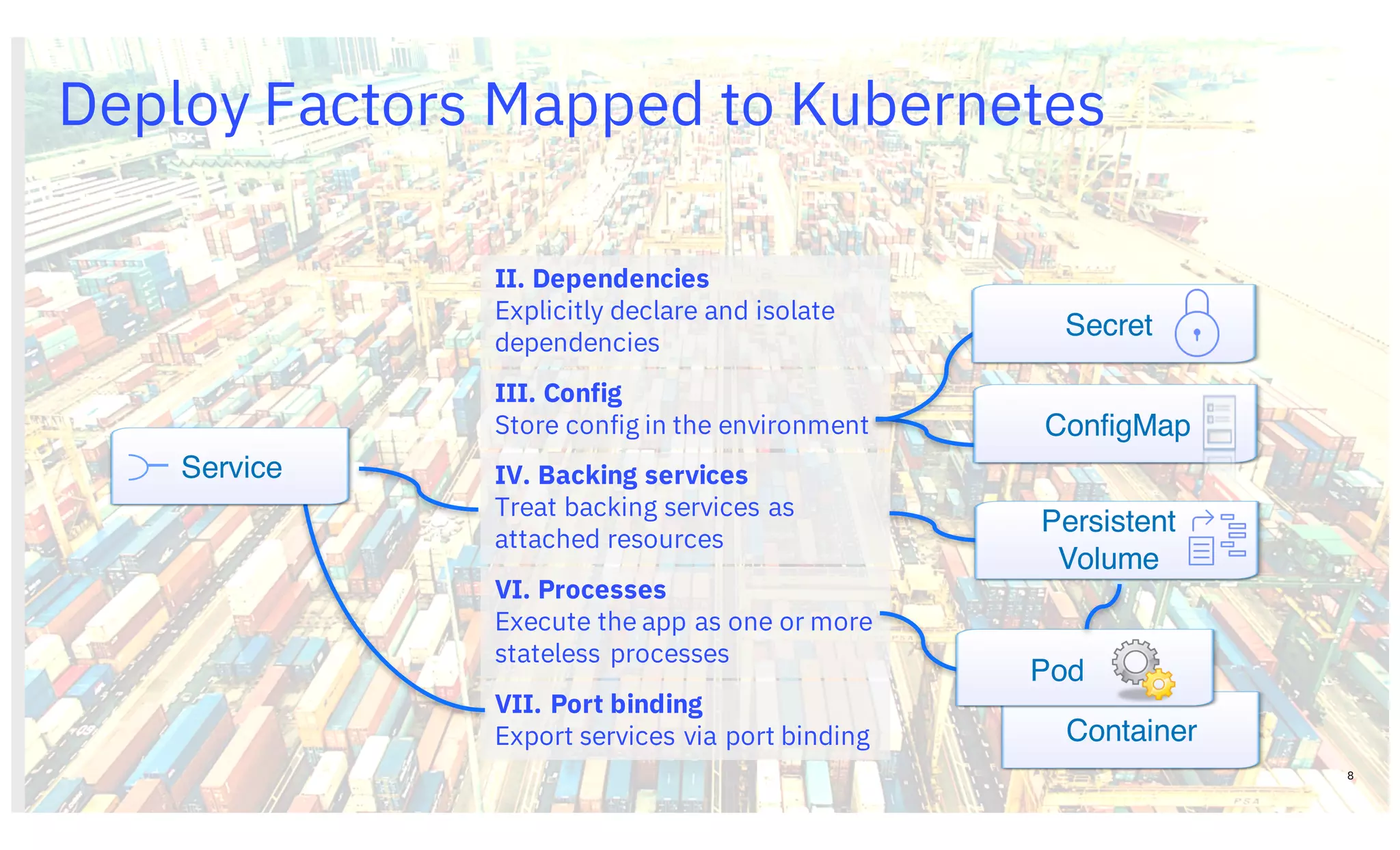
II. Dependencies
Explicitly declare and isolate
dependencies
III. Config
Store config in the environment
IV. Backing services
Treat backing services as
attached resources
VI. Processes
Execute the app as one or more
stateless processes
VII. Port binding
Export services via port binding
Deploy Factors Mapped to Kubernetes
Container
Secret
Service
ConfigMap
Persistent
Volume
Pod
IX. Disposability (Pods)
Maximize robustness with fast
startup and graceful shutdown
Common Services
(logging, monitoring,
audit, etc)
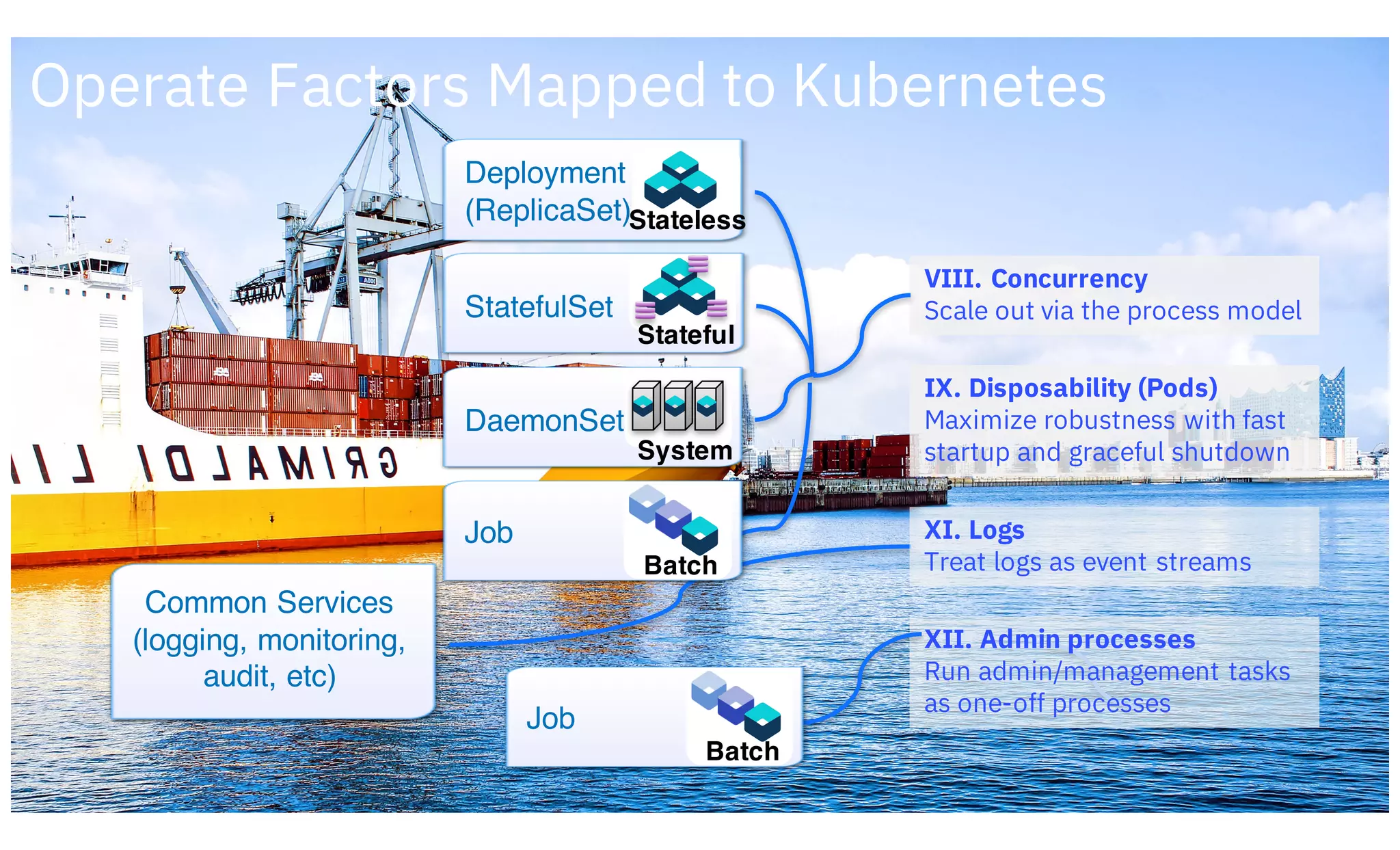
VIII. Concurrency
Scale out via the process model
XI. Logs
Treat logs as event streams
XII. Admin processes
Run admin/management tasks
as one-off processes
Operate Factors Mapped to Kubernetes
Deployment
(ReplicaSet)
Stateles
s
Stateless
StatefulSet
Stateful
Job
Batch
DaemonSet
System
Job
Batch
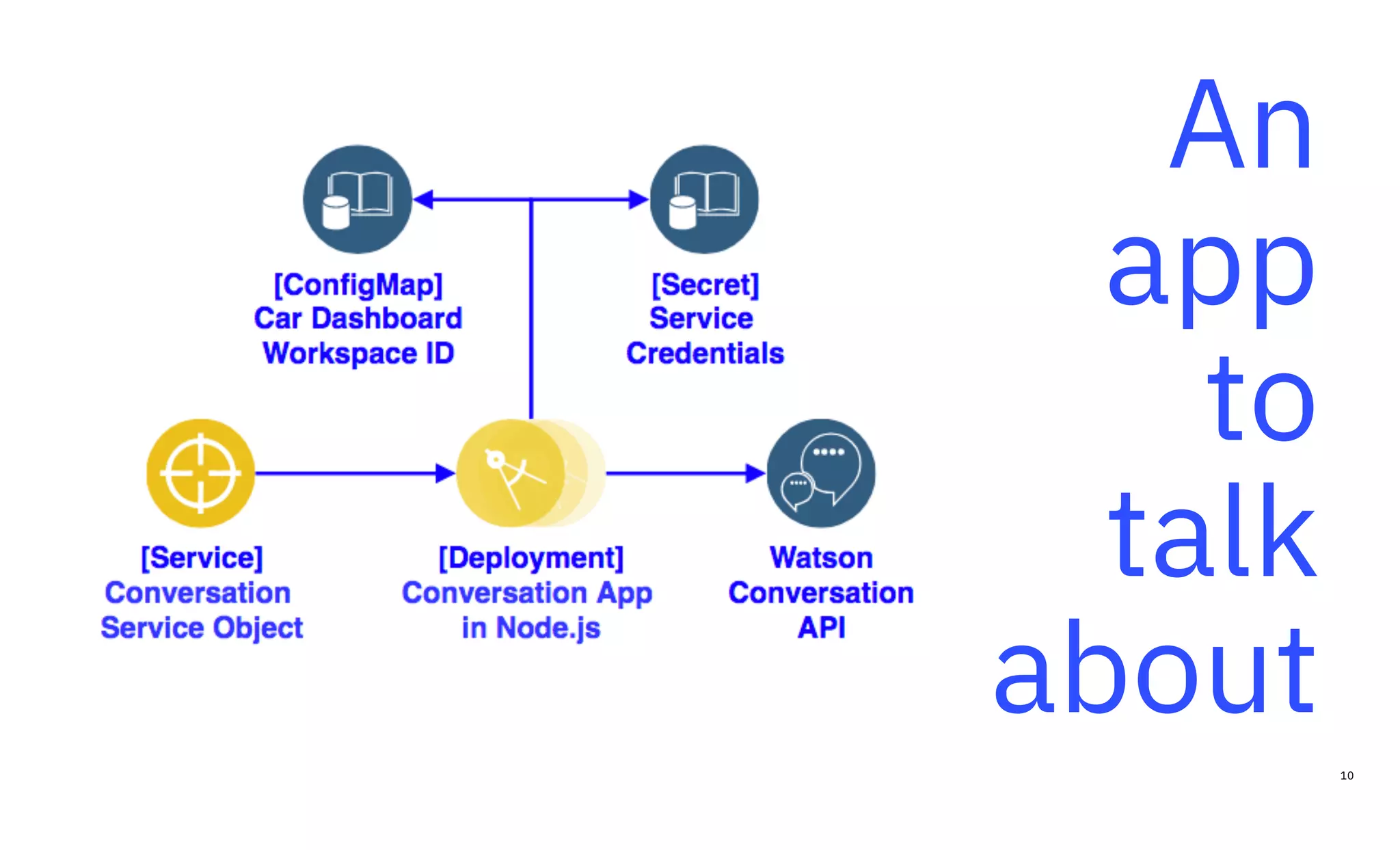
An
app
to
talk
about
10
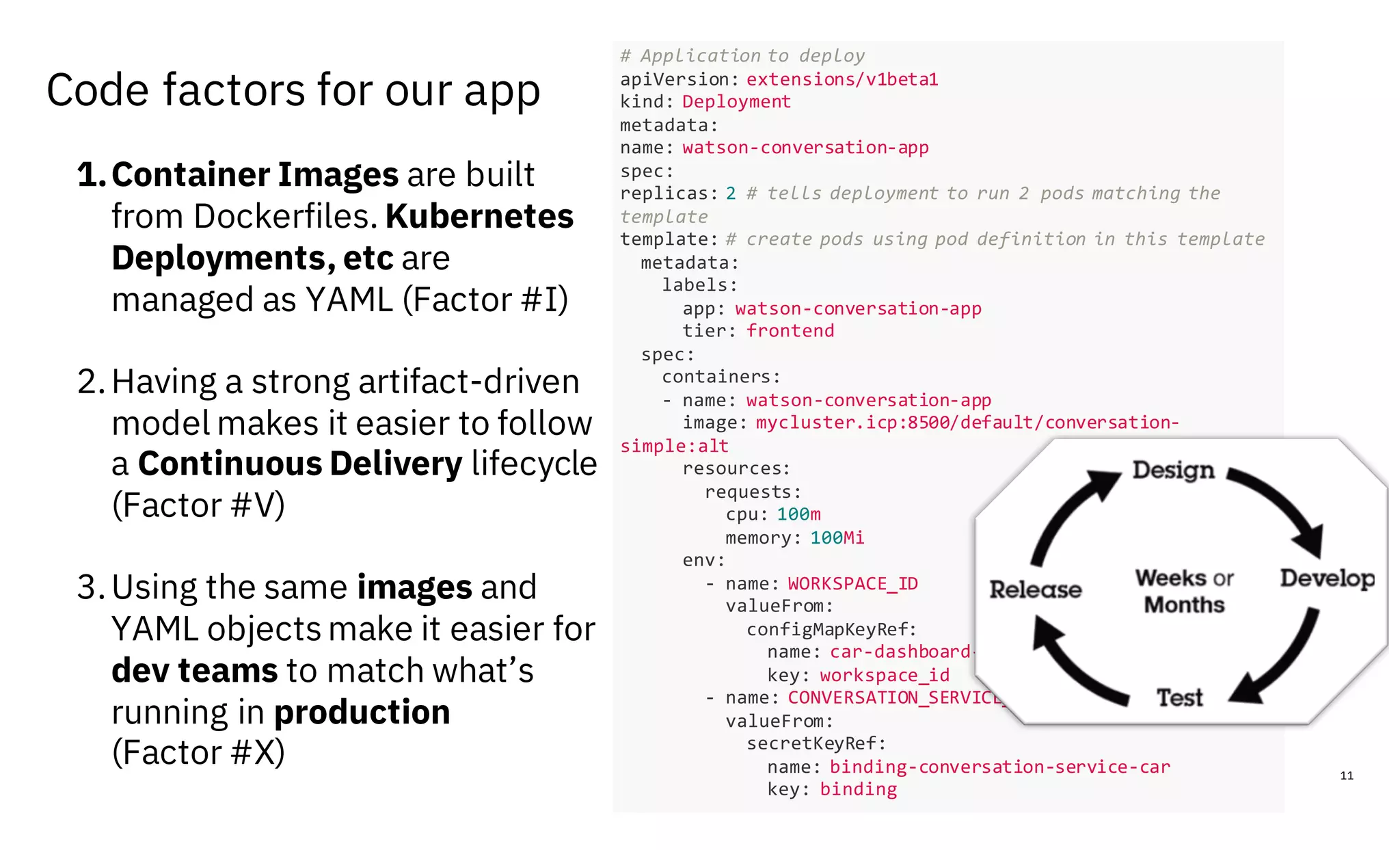
Code factors for our app
11
# Application to deploy
apiVersion: extensions/v1beta1
kind: Deployment
metadata:
name: watson-conversation-app
spec:
replicas: 2 # tells deployment to run 2 pods matching the
template
template: # create pods using pod definition in this template
metadata:
labels:
app: watson-conversation-app
tier: frontend
spec:
containers:
- name: watson-conversation-app
image: mycluster.icp:8500/default/conversation-
simple:alt
resources:
requests:
cpu: 100m
memory: 100Mi
env:
- name: WORKSPACE_ID
valueFrom:
configMapKeyRef:
name: car-dashboard-config
key: workspace_id
- name: CONVERSATION_SERVICE_CAR
valueFrom:
secretKeyRef:
name: binding-conversation-service-car
key: binding
1.Container Images are built
from Dockerfiles. Kubernetes
Deployments, etc are
managed as YAML (Factor #I)
2.Having a strong artifact-driven
model makes it easier to follow
a Continuous Delivery lifecycle
(Factor #V)
3.Using the same images and
YAML objects make it easier for
dev teams to match what’s
running in production
(Factor #X)
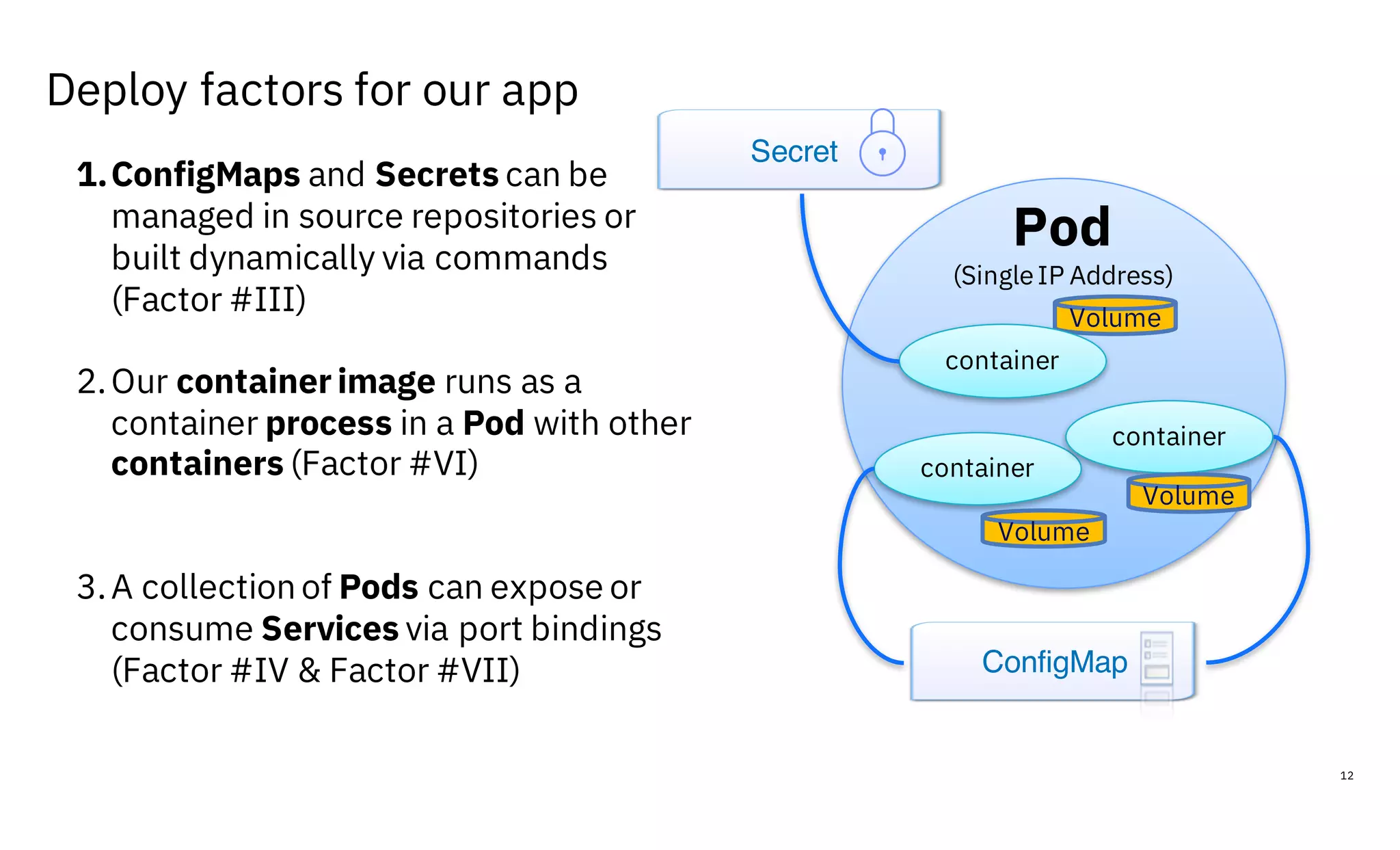
Deploy factors for our app
12
1.ConfigMaps and Secrets can be
managed in source repositories or
built dynamically via commands
(Factor #III)
2.Our container image runs as a
container process in a Pod with other
containers (Factor #VI)
3.A collection of Pods can expose or
consume Services via port bindings
(Factor #IV & Factor #VII)
Pod
(SingleIP Address)
Volume
Volume
container
container
container
Volume
Secret
ConfigMap
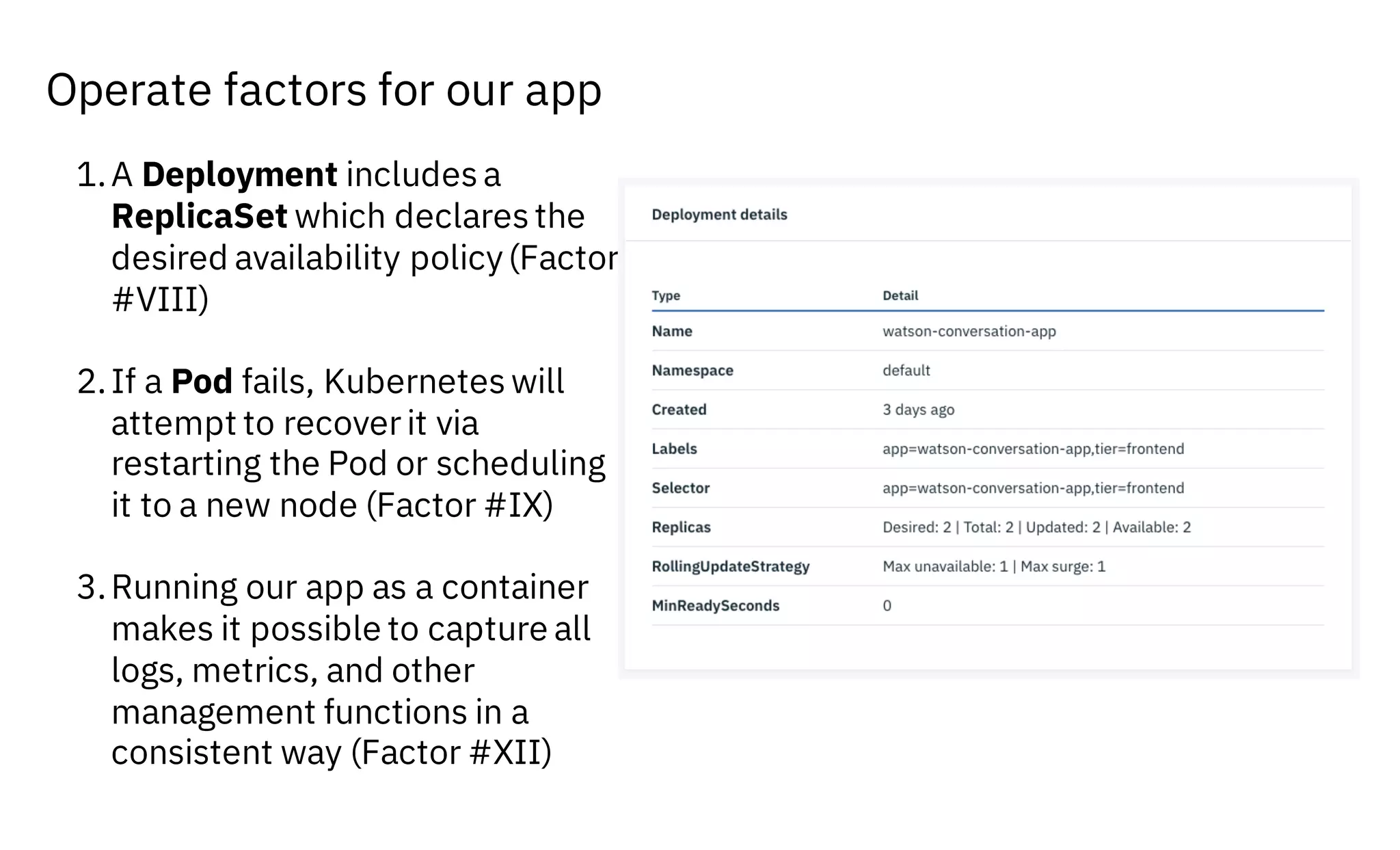
Operate factors for our app
1.A Deployment includes a
ReplicaSet which declares the
desired availability policy(Factor
#VIII)
2.If a Pod fails, Kubernetes will
attempt to recover it via
restarting the Pod or scheduling
it to a new node (Factor #IX)
3.Running our app as a container
makes it possible to capture all
logs, metrics, and other
management functions in a
consistent way (Factor #XII)
Great, but 95%
of my workloads
do not fit 12-
factor! 14
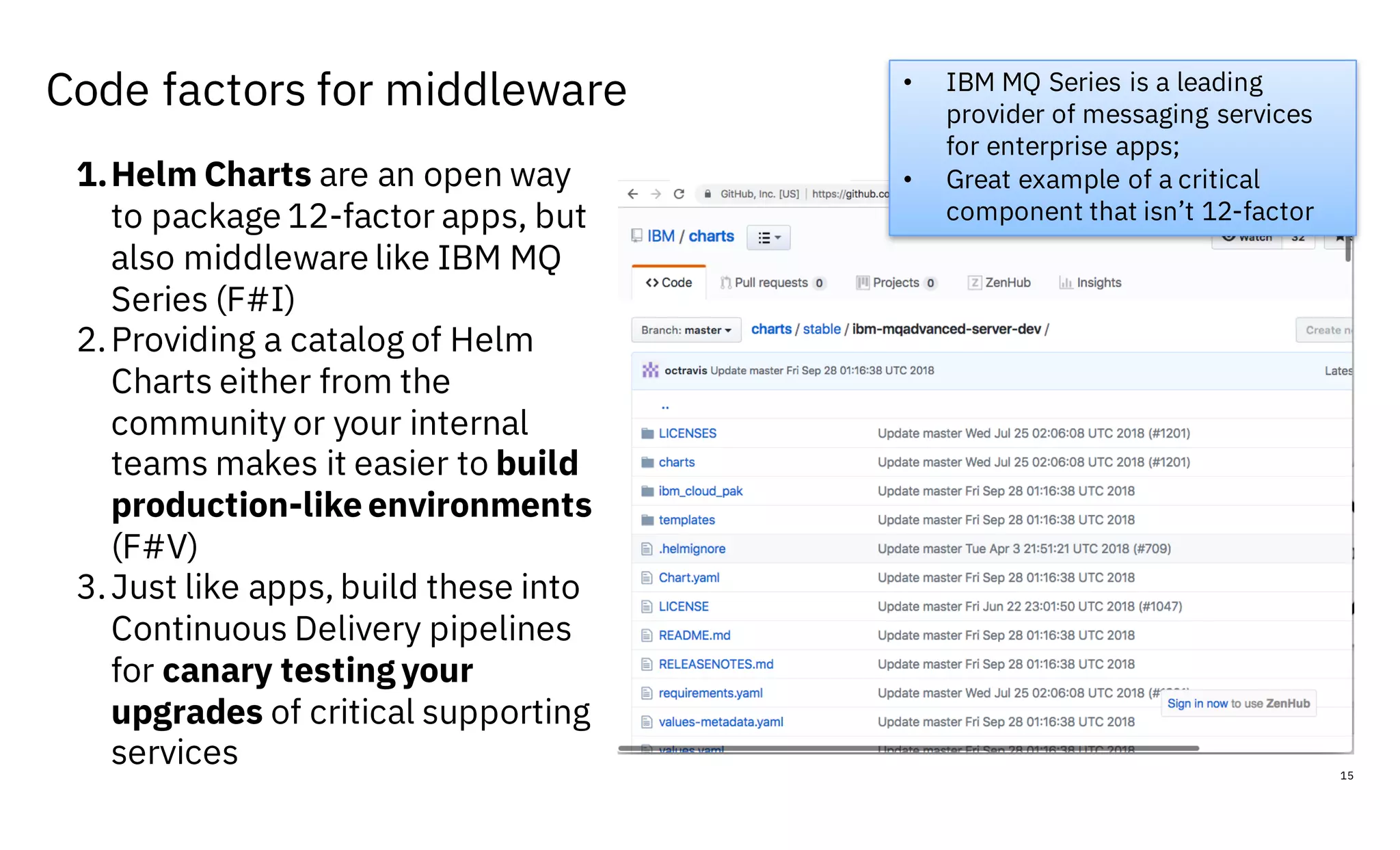
Code factors for middleware
15
1.Helm Charts are an open way
to package 12-factor apps, but
also middleware like IBM MQ
Series (F#I)
2.Providing a catalog of Helm
Charts either from the
community or your internal
teams makes it easier to build
production-like environments
(F#V)
3.Just like apps, build these into
Continuous Delivery pipelines
for canary testing your
upgrades of critical supporting
services
• IBM MQ Series is a leading
provider of messaging services
for enterprise apps;
• Great example of a critical
component that isn’t 12-factor
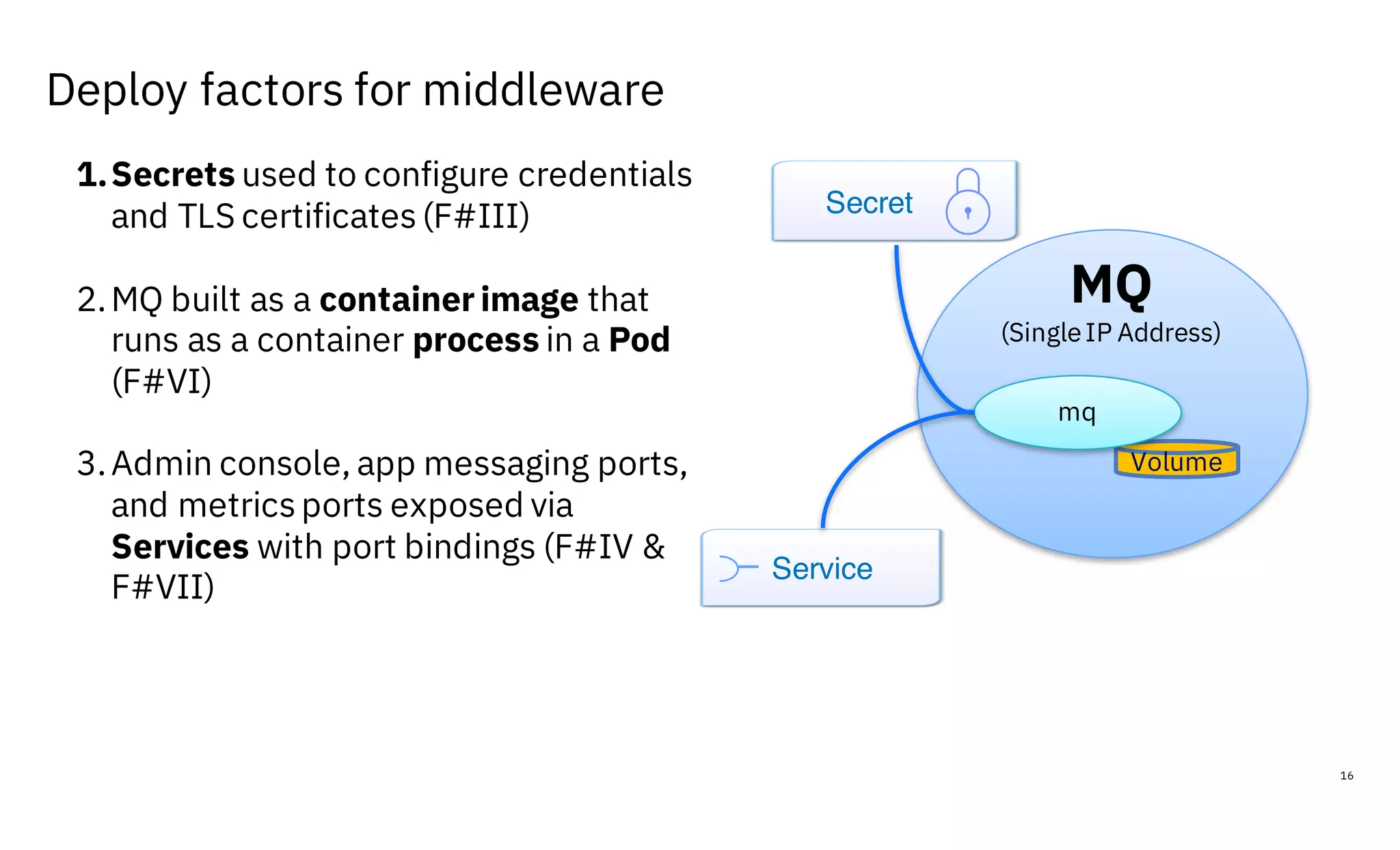
Deploy factors for middleware
16
1.Secrets used to configure credentials
and TLS certificates (F#III)
2.MQ built as a container image that
runs as a container process in a Pod
(F#VI)
3.Admin console, app messaging ports,
and metrics ports exposed via
Services with port bindings (F#IV &
F#VII)
MQ
(SingleIP Address)
Volume
mq
Secret
Service
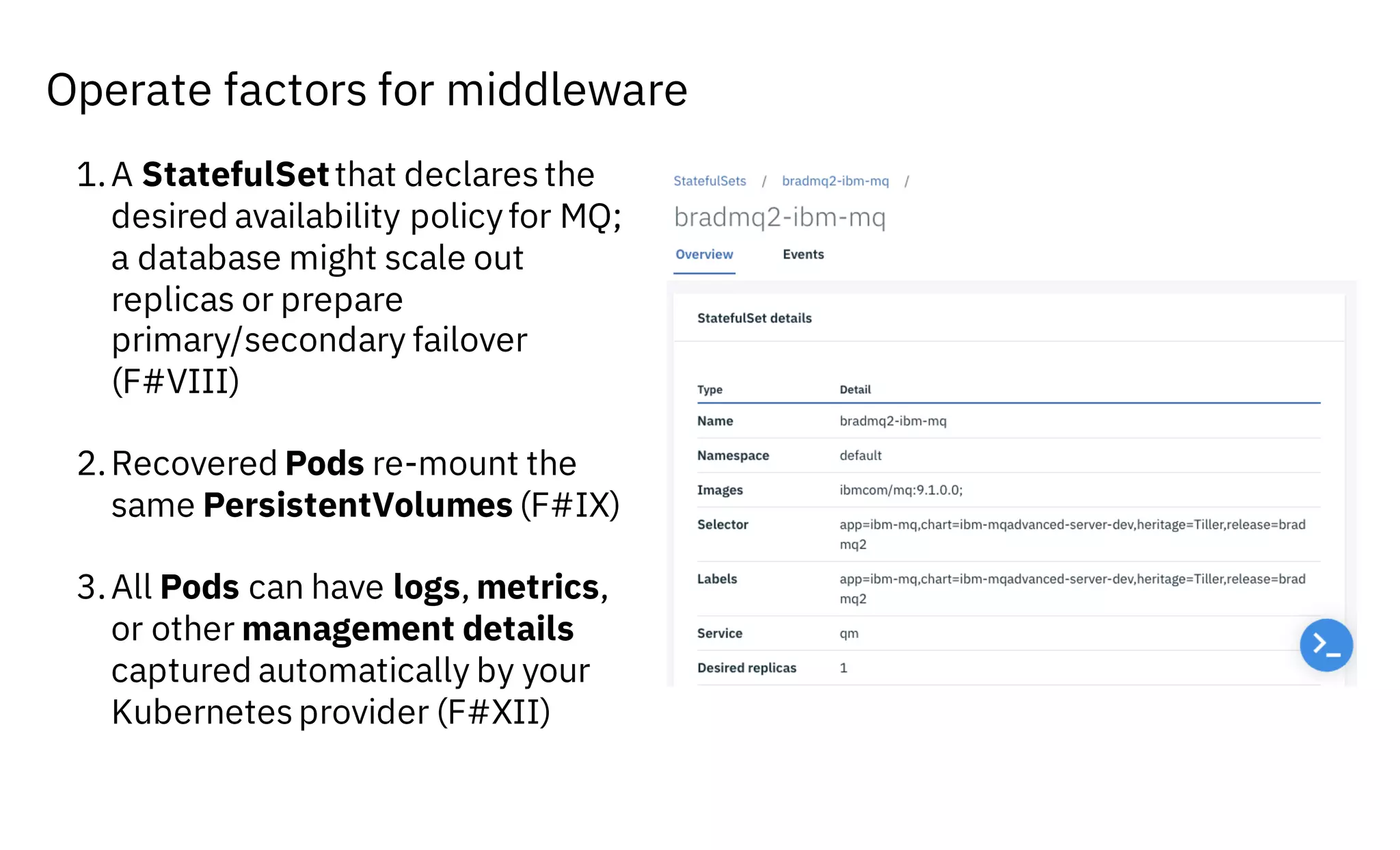
Operate factors for middleware
1.A StatefulSetthat declares the
desired availability policyfor MQ;
a database might scale out
replicas or prepare
primary/secondary failover
(F#VIII)
2.Recovered Pods re-mount the
same PersistentVolumes (F#IX)
3.All Pods can have logs, metrics,
or other management details
captured automatically by your
Kubernetes provider (F#XII)
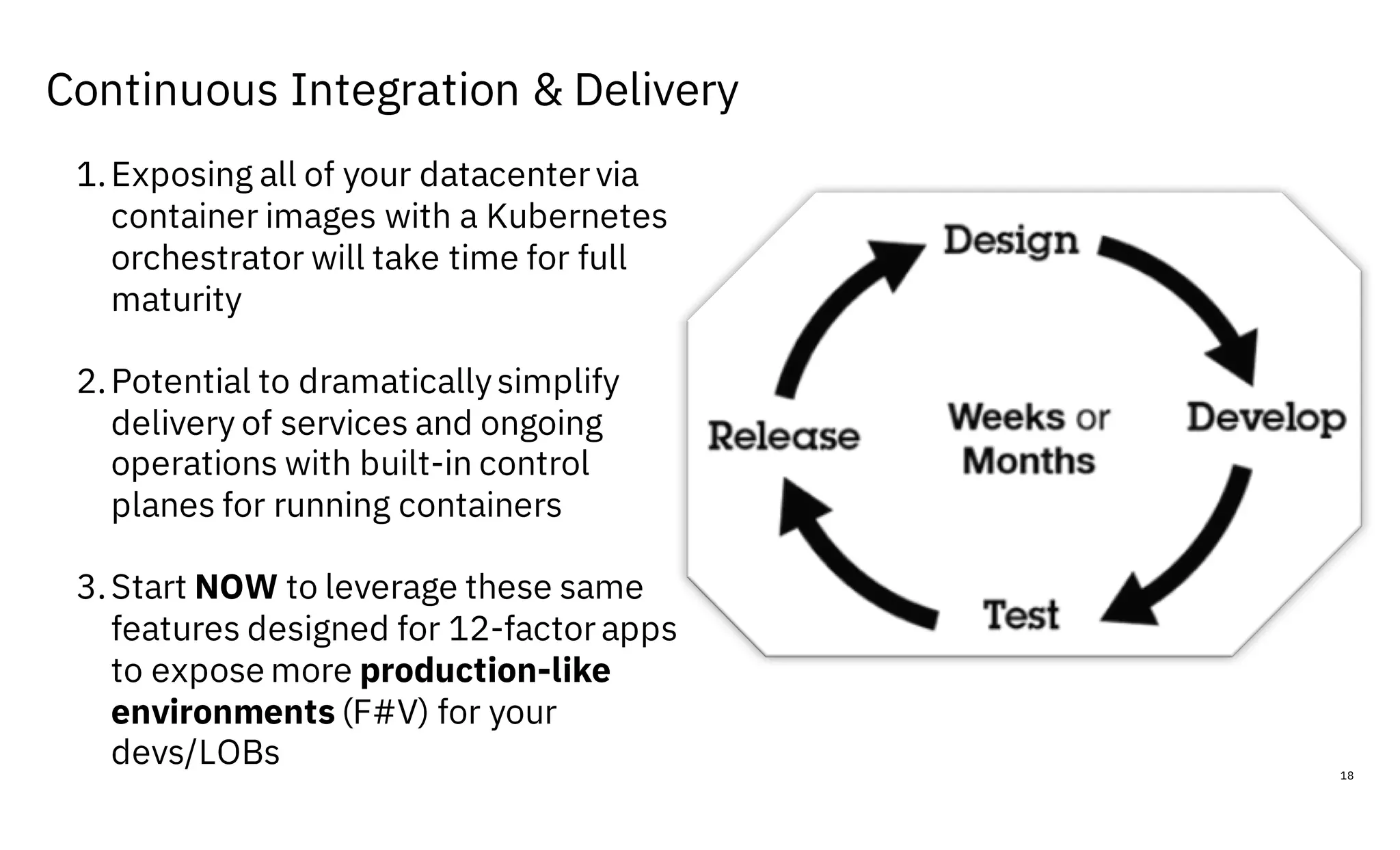
Continuous Integration & Delivery
18
1.Exposing all of your datacenter via
container images with a Kubernetes
orchestrator will take time for full
maturity
2.Potential to dramaticallysimplify
delivery of services and ongoing
operations with built-in control
planes for running containers
3.Start NOW to leverage these same
features designed for 12-factor apps
to expose more production-like
environments (F#V) for your
devs/LOBs
Enough
talking,
let’s see it
LIVE! 19
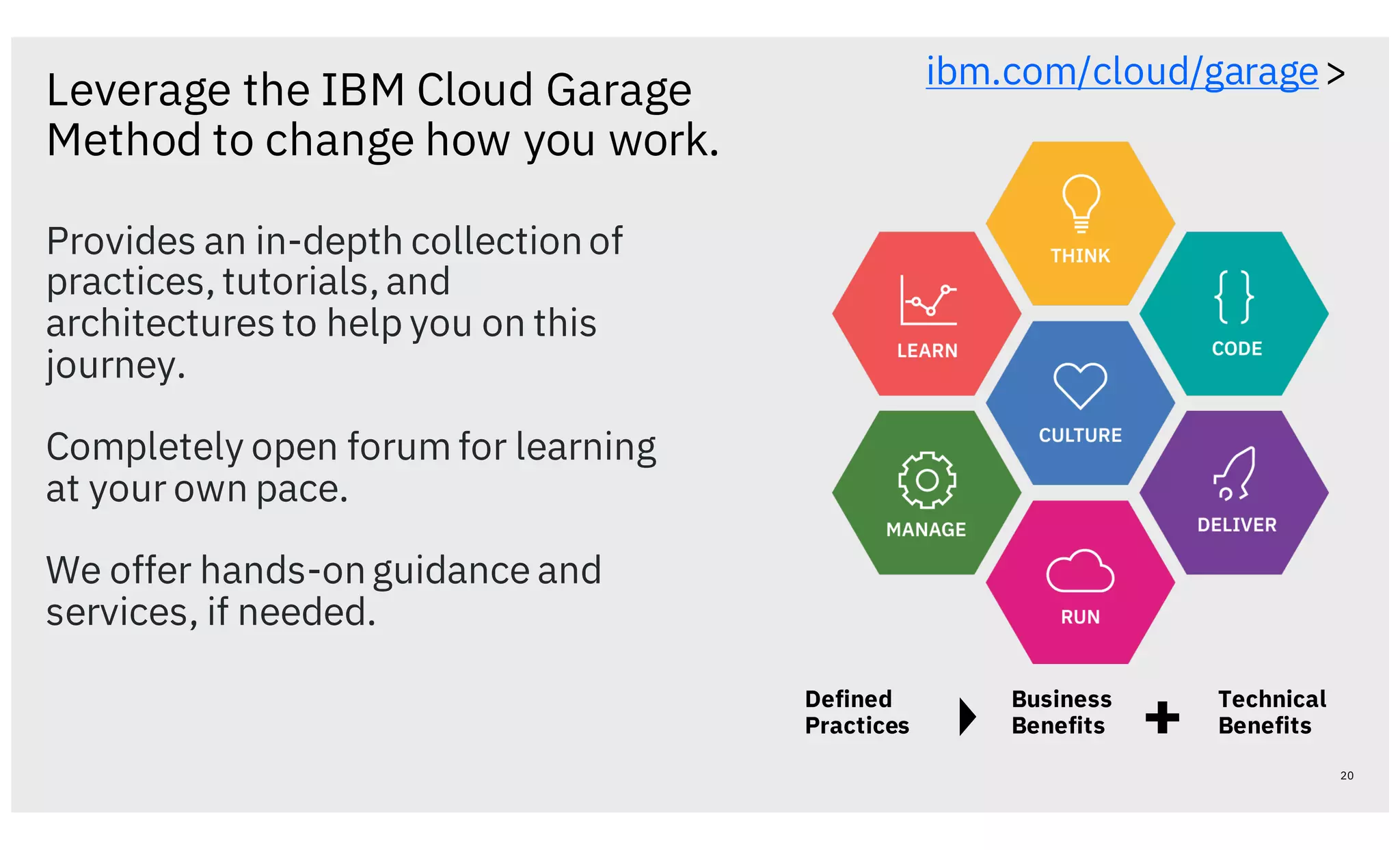
Leverage the IBM Cloud Garage
Method to change how you work.
20
Provides an in-depth collectionof
practices, tutorials, and
architectures to help you on this
journey.
Completely open forum for learning
at your own pace.
We offer hands-onguidance and
services, if needed.
Defined
Practices
Business
Benefits
Technical
Benefits
ibm.com/cloud/garage>
Find IBM Cloud Garages worldwide
21
AUSTIN COPENHAGEN DUBAI LONDON MELBOURNE
MUNICH NEW YORK NICE SANFRANCISCO SÃOPAULO
SINGAPORE TOKYO TORONTO
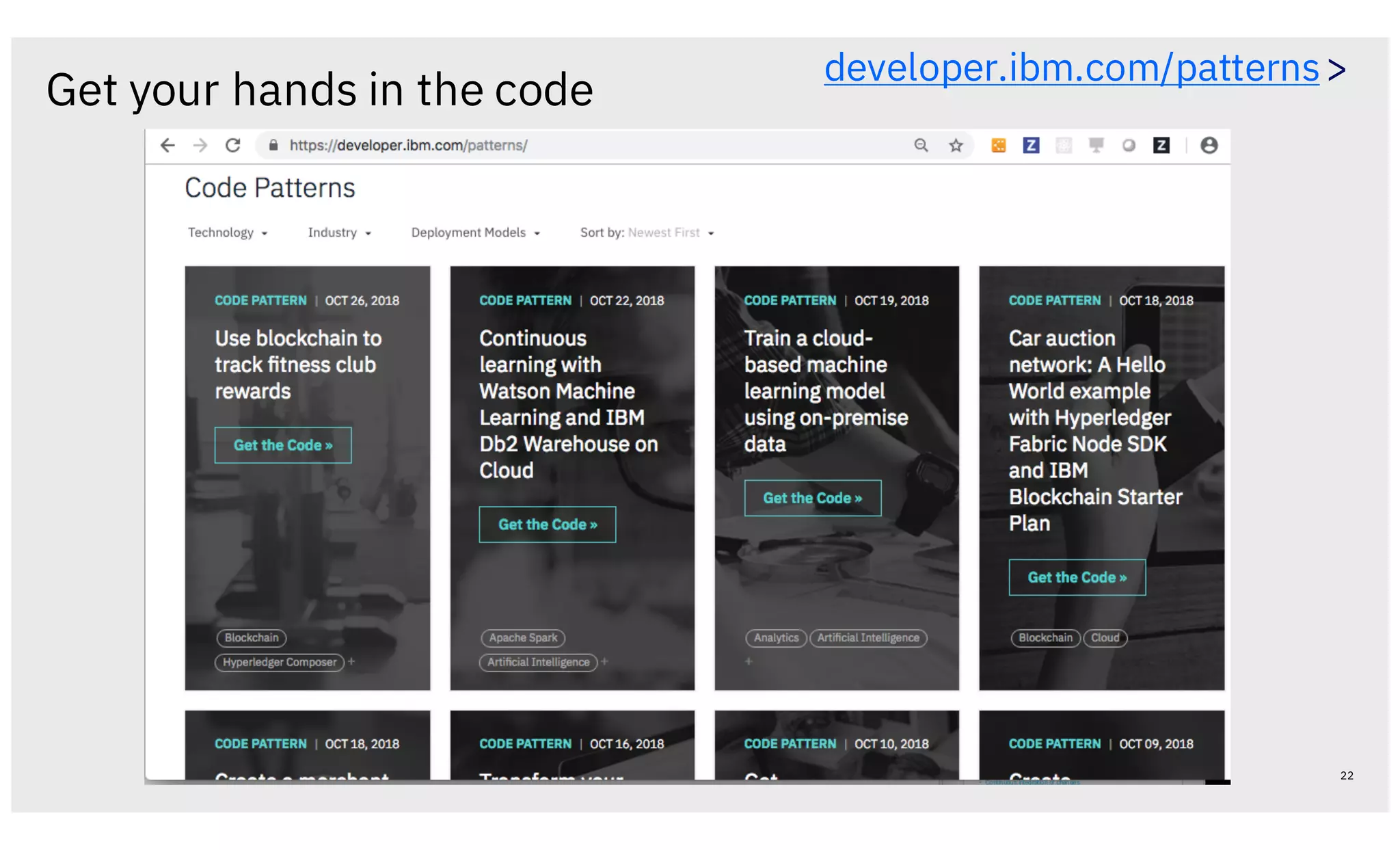
Get your hands in the code
22
developer.ibm.com/patterns>
232323
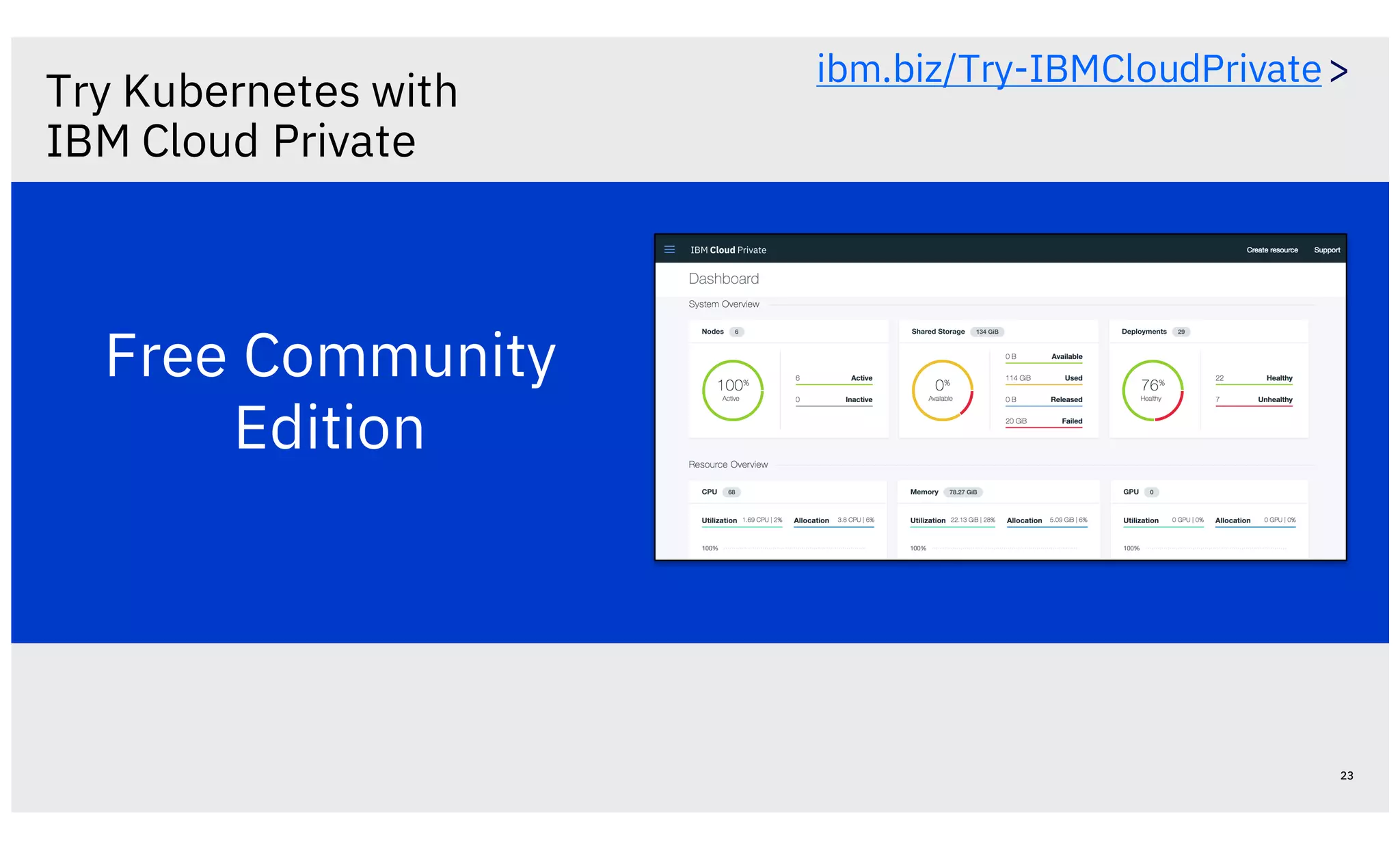
Free Community
Edition
Try Kubernetes with
IBM Cloud Private
ibm.biz/Try-IBMCloudPrivate>
24
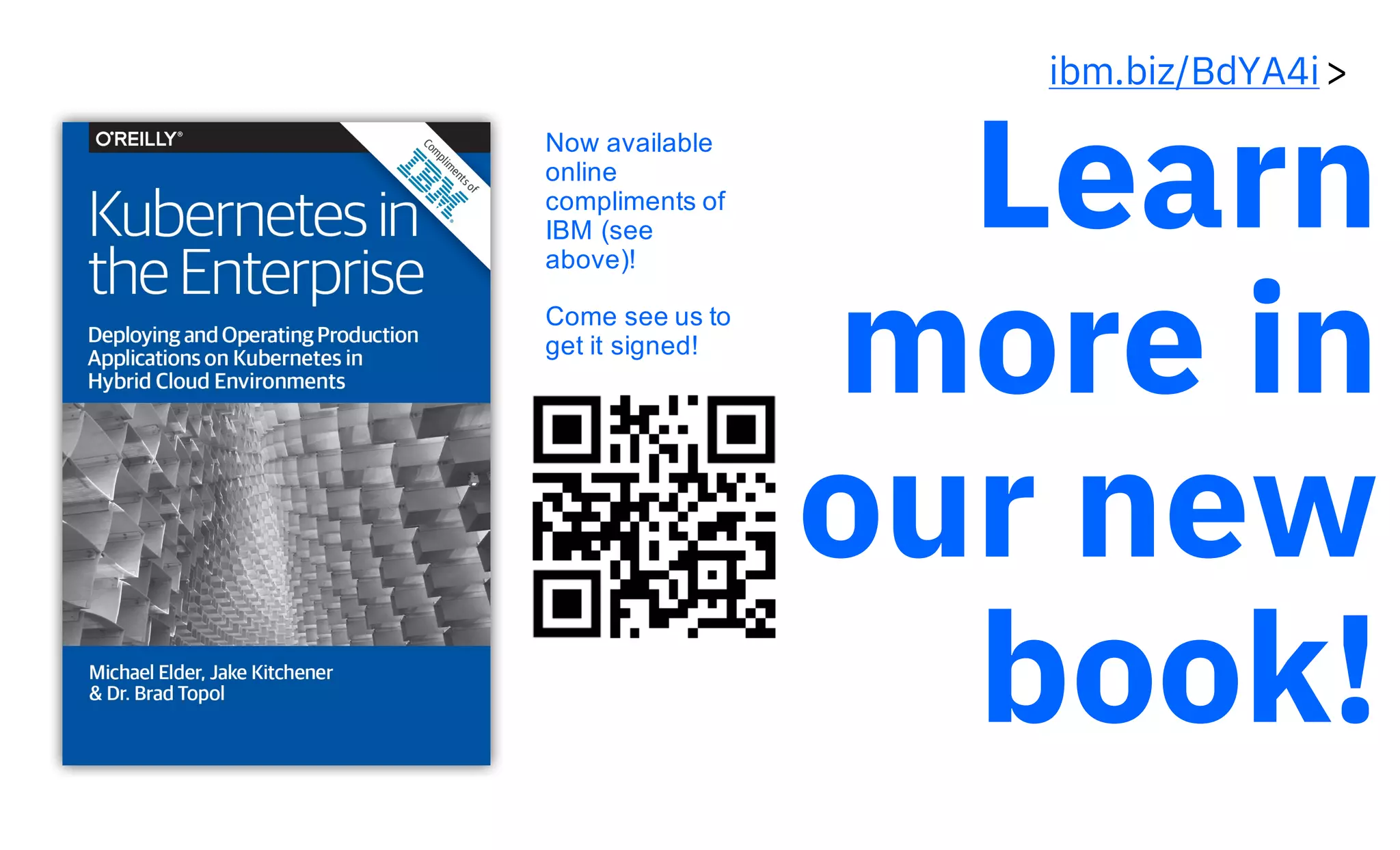
Learn
more in
our new
book!
Now available
online
compliments of
IBM (see
above)!
Come see us to
get it signed!
ibm.biz/BdYA4i>
25
Get a
copy of
these
slides
26

Learn how to Leverage Kubernetes to Support 12 Factor for Enterprise Apps

  • 1.
    Learn how toLeverage Kubernetes to Support 12 Factor for Enterprise Apps Dr. Brad Topol IBM Distinguished Engineer @bradtopol Michael Elder IBM Distinguished Engineer @mdelder
  • 2.
    Let’s deploy our appson the cloud! 2© 2019 IBM Corporation
  • 3.
    Why? 3© 2019 IBMCorporation 1.Cloud has evolved as a strategy for disruption driven by continuous delivery. 2.Cloud elasticity enables microservices architectures to scale out quickly, but also roll new updates out at immense speeds. 3.Data becomes the fuel for business innovation. 4.AI becomes the catalyst to turn data into brilliant user experiences. 5.Profit! Or really, reduce overall cost.
  • 4.
    4 What is a 12-factor app? https://12factor.net/ •“12-Factor” is a software methodology for building scalable microservice applications • Originally created by Heroku • Best practices designed to enable applications to be built with portability, resilience, and scalability when deployed to the web
  • 5.
    5 I. Codebase One codebasetracked in revision control,manydeploys II. Dependencies Explicitlydeclare and isolate dependencies III. Config Store config in the environment IV. Backing services Treat backing services as attached resources V. Build, release, run Strictlyseparate build and run stages VI. Processes Execute the app as one or more stateless processes VII. Port binding Export services via port binding VIII. Concurrency Scale out via the process model IX. Disposability Maximize robustness with fast startup and graceful shutdown X. Dev/prod parity Keep development, staging,and production as similar as possible XI. Logs Treat logs as event streams XII. Admin processes Run admin/management tasks as one-off processes Why 12 factor apps? https://12factor.net/ • Make it easier to run, scale, and deploy applications • Keep parity between development and production • Provide strict separation between build, release, and run stages
  • 6.
    I. Codebase One codebasetracked in revision control, many deploys II. Dependencies Explicitly declare and isolate dependencies III. Config Store config in the environment IV. Backing services Treat backing services as attached resources V. Build, release, run Strictly separate build and run stages VI. Processes Execute the app as one or more stateless processes VII. Port binding Export services via port binding VIII. Concurrency Scale out via the process model IX. Disposability Maximize robustness with fast startup and graceful shutdown X. Parity between dev & prod Keep development, staging, and production as similar as possible XI. Logs Treat logs as event streams XII. Admin processes Run admin/management tasks as one-off processes Code Deploy Operate
  • 7.
    7 I. Codebase One codebasetracked in revision control, many deploys V. Build, release, run Strictly separate build and run stages X. Parity between dev & prod Keep development, staging, and production as similar as possible Code Factors Mapped to Kubernetes Container images built from Dockerfiles + Kubernetes Declarative YAML based deployment Using same container images and Kubernetes YAML objects in both dev and production Continuous Delivery and leveraging Kubernetes support for deploying updates
  • 8.
    8 II. Dependencies Explicitly declareand isolate dependencies III. Config Store config in the environment IV. Backing services Treat backing services as attached resources VI. Processes Execute the app as one or more stateless processes VII. Port binding Export services via port binding Deploy Factors Mapped to Kubernetes Container Secret Service ConfigMap Persistent Volume Pod
  • 9.
    IX. Disposability (Pods) Maximizerobustness with fast startup and graceful shutdown Common Services (logging, monitoring, audit, etc) VIII. Concurrency Scale out via the process model XI. Logs Treat logs as event streams XII. Admin processes Run admin/management tasks as one-off processes Operate Factors Mapped to Kubernetes Deployment (ReplicaSet) Stateles s Stateless StatefulSet Stateful Job Batch DaemonSet System Job Batch
  • 10.
  • 11.
    Code factors forour app 11 # Application to deploy apiVersion: extensions/v1beta1 kind: Deployment metadata: name: watson-conversation-app spec: replicas: 2 # tells deployment to run 2 pods matching the template template: # create pods using pod definition in this template metadata: labels: app: watson-conversation-app tier: frontend spec: containers: - name: watson-conversation-app image: mycluster.icp:8500/default/conversation- simple:alt resources: requests: cpu: 100m memory: 100Mi env: - name: WORKSPACE_ID valueFrom: configMapKeyRef: name: car-dashboard-config key: workspace_id - name: CONVERSATION_SERVICE_CAR valueFrom: secretKeyRef: name: binding-conversation-service-car key: binding 1.Container Images are built from Dockerfiles. Kubernetes Deployments, etc are managed as YAML (Factor #I) 2.Having a strong artifact-driven model makes it easier to follow a Continuous Delivery lifecycle (Factor #V) 3.Using the same images and YAML objects make it easier for dev teams to match what’s running in production (Factor #X)
  • 12.
    Deploy factors forour app 12 1.ConfigMaps and Secrets can be managed in source repositories or built dynamically via commands (Factor #III) 2.Our container image runs as a container process in a Pod with other containers (Factor #VI) 3.A collection of Pods can expose or consume Services via port bindings (Factor #IV & Factor #VII) Pod (SingleIP Address) Volume Volume container container container Volume Secret ConfigMap
  • 13.
    Operate factors forour app 1.A Deployment includes a ReplicaSet which declares the desired availability policy(Factor #VIII) 2.If a Pod fails, Kubernetes will attempt to recover it via restarting the Pod or scheduling it to a new node (Factor #IX) 3.Running our app as a container makes it possible to capture all logs, metrics, and other management functions in a consistent way (Factor #XII)
  • 14.
    Great, but 95% ofmy workloads do not fit 12- factor! 14
  • 15.
    Code factors formiddleware 15 1.Helm Charts are an open way to package 12-factor apps, but also middleware like IBM MQ Series (F#I) 2.Providing a catalog of Helm Charts either from the community or your internal teams makes it easier to build production-like environments (F#V) 3.Just like apps, build these into Continuous Delivery pipelines for canary testing your upgrades of critical supporting services • IBM MQ Series is a leading provider of messaging services for enterprise apps; • Great example of a critical component that isn’t 12-factor
  • 16.
    Deploy factors formiddleware 16 1.Secrets used to configure credentials and TLS certificates (F#III) 2.MQ built as a container image that runs as a container process in a Pod (F#VI) 3.Admin console, app messaging ports, and metrics ports exposed via Services with port bindings (F#IV & F#VII) MQ (SingleIP Address) Volume mq Secret Service
  • 17.
    Operate factors formiddleware 1.A StatefulSetthat declares the desired availability policyfor MQ; a database might scale out replicas or prepare primary/secondary failover (F#VIII) 2.Recovered Pods re-mount the same PersistentVolumes (F#IX) 3.All Pods can have logs, metrics, or other management details captured automatically by your Kubernetes provider (F#XII)
  • 18.
    Continuous Integration &Delivery 18 1.Exposing all of your datacenter via container images with a Kubernetes orchestrator will take time for full maturity 2.Potential to dramaticallysimplify delivery of services and ongoing operations with built-in control planes for running containers 3.Start NOW to leverage these same features designed for 12-factor apps to expose more production-like environments (F#V) for your devs/LOBs
  • 19.
  • 20.
    Leverage the IBMCloud Garage Method to change how you work. 20 Provides an in-depth collectionof practices, tutorials, and architectures to help you on this journey. Completely open forum for learning at your own pace. We offer hands-onguidance and services, if needed. Defined Practices Business Benefits Technical Benefits ibm.com/cloud/garage>
  • 21.
    Find IBM CloudGarages worldwide 21 AUSTIN COPENHAGEN DUBAI LONDON MELBOURNE MUNICH NEW YORK NICE SANFRANCISCO SÃOPAULO SINGAPORE TOKYO TORONTO
  • 22.
    Get your handsin the code 22 developer.ibm.com/patterns>
  • 23.
    232323 Free Community Edition Try Kuberneteswith IBM Cloud Private ibm.biz/Try-IBMCloudPrivate>
  • 24.
    24 Learn more in our new book! Nowavailable online compliments of IBM (see above)! Come see us to get it signed! ibm.biz/BdYA4i>
  • 25.
  • 26.