Lean Leadership
John Shook
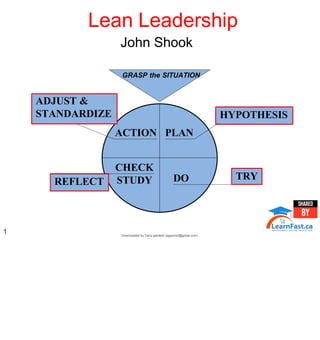
ACTION
CHECK
STUDY
PLAN
DO
GRASP the SITUATION
HYPOTHESIS
TRY
REFLECT
ADJUST &
STANDARDIZE
1 Downloaded by Tariq qandeel (egysms3@gmail.com)
The "Leader as Dictator" of the old days tried to tell everyone what to
do.
•No transfer, or Cascade of Responsibility
19 Downloaded by Tariq qandeel (egysms3@gmail.com)
The "Leader as Back-Slapper" of the 80s and 90s just set "goals"
(MBO) and let everyone do as they pleased.
•Loss of focus, direction, control
Lean Leadership
• The Lean Leader leads a very different
way:
. a s different from the commonly
accepted notion of the "enlightened
modern manager" as it is the old
command and control dictator.
20 Downloaded by Tariq qandeel (egysms3@gmail.com)
Lean Leadership
Toyota is Toyota.
We can learn from them, but we can't copy them exactly.
How can we operationalize the same principles in our own
companies?
21 Downloaded by Tariq qandeel (egysms3@gmail.com)
What can we do??
Impact of Lean Transformation at
different organizational levels
A Difficult Struggle at the Mid-management
and First Line Supervisory Level
FRONT LINES
SENIOR
MANAGEMENT
MIDDLE
MANAGEMENT
MUST PROVIDE VISION
AND INCENTIVE
MUST “DO”
MUST LEAD THE ACTUAL
OPERATIONAL CHANGE
Likes
the involvement
22 Downloaded by Tariq qandeel (egysms3@gmail.com)
Likes the results
Left with changed,
uncertain role
Role Impact
Muri:
Mura:
Muda:
overburden
variation
waste
• Muri - Overburden or unreasonableness to a
person or a machine
• Muda - Waste
Too much overtime!
Stress!
Not enough resources!
• Mura - Instability; Unevenness; Variability;
Inconsistency
- End of month deadlines with much overtime
followed by periods of not enough work!
- All projects scheduled in 1Q with none in 2Q!
- Extensive IT everywhere yet not enough
copy machines!
The Seven
Types of Waste
23 Downloaded by Tariq qandeel (egysms3@gmail.com)
System Design to Control the 3
M's
Basic problem to solve at different
levels of the enterprise
A Difficult Struggle at the Mid-management
and First Line Supervisory Level
FRONT LINES
SENIOR
MANAGEMENT
MIDDLE
MANAGEMENT
MUST PROVIDE VISION
AND INCENTIVE
MUST “DO”
MUST LEAD THE ACTUAL
OPERATIONAL CHANGE
Likes
the involvement
Wants to be
successful
Role Impact
Problem:
MUDA
Likes the results
Problem:
MURA & MURI
Problem:
MURA & MURA
Muri:
Mura:
Muda:
24 Downloaded by Tariq qandeel (egysms3@gmail.com)
overburden
variation
waste
PDCA Tools for different levels
Provide the right tool for the right job
FRONT LINES
SENIOR
MANAGEMENT
MIDDLE
MANAGEMENT
MUST PROVIDE VISION
AND INCENTIVE
MUST “DO”
MUST LEAD THE ACTUAL
OPERATIONAL CHANGE Needs the right tools
and skills to be
successful
Likes
the involvement
Role Impact
Problem:
MUDA
PDCA tool:
Policy Management
PDCA tool:
VSM or A3
PDCA tool:
Standardized Work
Likes the results
Problem:
MURA & MURI
Problem:
MURI & MURA
Muri:
Mura:
Muda:
25 Downloaded by Tariq qandeel (egysms3@gmail.com)
overburden
variation
waste
Mr. Cho of
Toyota:
Three Keys to
Lean Leadership
Go See.
• “Sr. Mgmt. must spend time on the plant floor.”
Ask Why.
• “Use the “Why?” technique daily.”
Show Respect.
• “Respect your people.”
26 Downloaded by Tariq qandeel (egysms3@gmail.com)
"Data is of course important,
but I place greater emphasis on
facts."
-Taiichi Ohno
27 Downloaded by Tariq qandeel (egysms3@gmail.com)
"Go see"
Core Toyota View:
28 Downloaded by Tariq qandeel (egysms3@gmail.com)
•"You can understand everything
that is really important about a
company by observing from a
good spot on the plant floor."
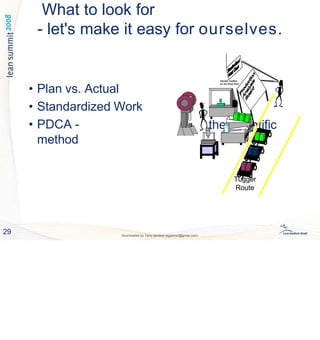
What to look for
- let's make it easy for ourselves.
the scientific
• Plan vs. Actual
• Standardized Work
• PDCA -
method
Tugger
Route
Visually Confirm
on the Shop Floor
29 Downloaded by Tariq qandeel (egysms3@gmail.com)
Mr. Cho
“Know normal from abnormal…
J
I
D
O
K
A
Best Quality - Lowest Cost - Shortest Lead Time
Operational Stability and Kaizen
J
I
T”
30 Downloaded by Tariq qandeel (egysms3@gmail.com)
…right now!”
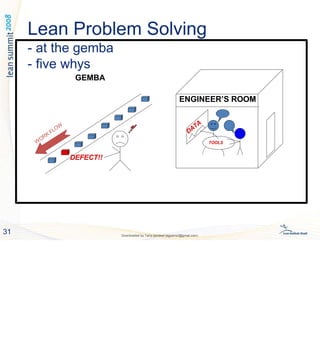
Lean Problem Solving
- at the gemba
- five whys
GEMBA
ENGINEER’S ROOM
DEFECT!!
31 Downloaded by Tariq qandeel (egysms3@gmail.com)
TOOLS
Respect for People
32 Downloaded by Tariq qandeel (egysms3@gmail.com)
Focus on the front line worker
Enable the worker
To work safely
To know his/her customer
To be involved, engaged
To be successful
Worker-out or the Front Lines-back principle
Build your operating system from the operator out
Remove wasteful steps from his work,
Giving it to support people: isolate the waste!
Until nothing is left but value-creating steps.
Don’t waste the operator’s time and effort!
• The Lean Leader leads a very different
way:
It is as different from the commonly accepted
notion of the "enlightened modern manager" as it
is the old command and control dictator.
33 Downloaded by Tariq qandeel (egysms3@gmail.com)
Lean Leadership
And what IS "Leadership"
anyway??
34 Downloaded by Tariq qandeel (egysms3@gmail.com)
"The greatest leaders of the 20th century
were Hitler, Stalin and Mao: If that is
"leadership", I want nothing to do with it."
- Peter Drucker
Lean Leadership
35 Downloaded by Tariq qandeel (egysms3@gmail.com)
Practice of Leadership
vs
Exercise of Power
"I could put a loaded gun to your head."
True leadership exists when people follow when
they don't have t o . "
(James MacGregor Burns)
Eiji Toyoda on Leadership
36 Downloaded by Tariq qandeel (egysms3@gmail.com)
"The people at the top are just flag-wavers. It
is pure MUDA to wave your flag and have no
one follow you. Waving that flag in a way
that makes people fall in line behind you is
what is important."
The Waste of Empty Flag-Waving
The leader's job at Toyota.
37 Downloaded by Tariq qandeel (egysms3@gmail.com)
• First, get each person to take initiative
to solve problems and improve his or
her job.
• Second, ensure that each persons'
job is aligned to provide value for the
customer and prosperity for the
company.
The Leader's job is to develop
his or her people
SPIRIT of Lean Mentorship:
"If the learner hasn't learned, the teacher hasn't taught"
38 Downloaded by Tariq qandeel (egysms3@gmail.com)
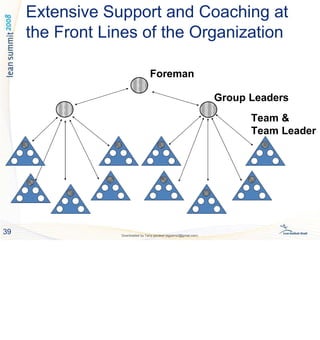
Extensive Support and Coaching at
the Front Lines of the Organization
Foreman
Group Leaders
Team &
Team Leader
39 Downloaded by Tariq qandeel (egysms3@gmail.com)
• The Lean Leader leads a very different way:
By setting the vision (more why than how)
 with nemawashi dialogue, HK planning
 and setting challenging expectations
- at the organizational level
- at the individual level
By building systems and processes that cascade
responsibility
 SW, KB, Stop-the-Line as tools that truly empower
 HR and HK as broader empowering systems
By influence and persuasion
 by example
 by being knowledgeable
 by getting into the messy details
 by coaching and teaching
- through PDCA learning cycles
- through questioning
40 Downloaded by Tariq qandeel (egysms3@gmail.com)
Lean Leadership
If “managing” is about
thinking...
41 Downloaded by Tariq qandeel (egysms3@gmail.com)
“leading” is about getting
other people to think.
-- David Verble
If improvement is about taking
responsibility and initiative
Leading is about getting other
people to take initiative
42 Downloaded by Tariq qandeel (egysms3@gmail.com)
How do you get other people
to think ?
43 Downloaded by Tariq qandeel (egysms3@gmail.com)
and take initiative?
Ask them Questions!
44 Downloaded by Tariq qandeel (egysms3@gmail.com)
What Questions?
PDCA Questions
CHECK -
STUDY
ACT PLAN
DO
What: is? is should
not? be?
might
be?
must
be?
How?
What?
Why?
When?
How?
How?
When? Who?
What is?
What is, is not?
Why?
How?
GRASP the SITUATION
What?
45 Downloaded by Tariq qandeel (egysms3@gmail.com)
What barriers
discourage people
from thinking and
taking responsibility?
46 Downloaded by Tariq qandeel (egysms3@gmail.com)
What barriers discourage people
from thinking and taking responsibility?
47 Downloaded by Tariq qandeel (egysms3@gmail.com)
•You, me or somebody
rushes in to give them the
answer.
•It is more important to give
them the right question than
the right answer.
The A3 Thinking Steps
48 Downloaded by Tariq qandeel (egysms3@gmail.com)
• What is the problem?
• Who owns the problem?
• What is the root cause of the problem?
• What are some possible countermeasures?
• How will you choose which countermeasure to propose?
• How will you get agreement among everyone concerned?
• What is your implementation plan? What timetable?
• How will you know if your countermeasure works?
• What follow-up issues can you anticipate? What problems may
occur during?
• How will ensure learning and continuous improvement?
49
Title: What you are talking about
Analysis
Plan
Followup
Background
Why you are talking about it.
Current Conditions
Where things stand today.
Show visually – pareto charts, graphs,
drawings, maps, etc.
Target/Goal(s)
The specific outcome required for the
business.
The root cause(s) of the problem.
Choose the simplest problem-solving tool for
this issue
A Gantt chart or facsimile that shows
actions/outcomes, timeline and
responsibilities. May include details on the
specific means of implementation.
Indicators of performance, of progress.
Remaining issues that can be anticipated.
Ensure ongoing P-D-C-A. Yokoten as
needed.
O
w
n
e
r
Proposed Countermeasure(s)
Your proposal to reach the future state, the
target condition.
How your recommended countermeasures
will impact the root cause to change the
current situation and achieve the target.
i
n
i
t
i
a
l
s
Downloaded by Tariq qandeel (egysms3@gmail.com)
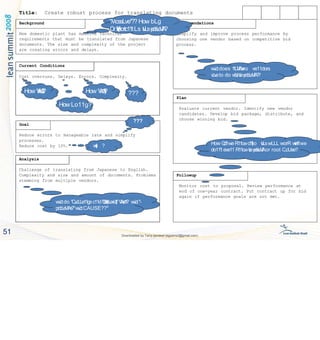
Title: Create robust process for translating documents
Plan
50 Downloaded by Tariq qandeel (egysms3@gmail.com)
Followup
Background
New domestic plant has massive technical
requirements that must be translated from Japanese
documents. The size and complexity of the project
are creating errors and delays.
Current Conditions
Cost overruns. Delays. Errors. Complexity.
Goal
Reduce errors to manageable rate and simplify
processes.
Reduce cost by 10%.
Analysis
Challenge of translating from Japanese to English.
Complexity and size and amount of documents. Problems
stemming from multiple vendors.
Recommendations
Simplify and improve process performance by
choosing one vendor based on competitive bid
process.
Monitor cost to proposal. Review performance at
end of one-year contract. Put contract up for bid
again if performance goals are not met.
Evaluate current vendor. Identify new vendor
candidates. Develop bid package, distribute, and
choose winning bid.
Title: Create robust process for translating documents
Background
Goal
Recommendations
Plan
Followup
New domestic plant has massive technical
requirements that must be translated from Japanese
documents. The size and complexity of the project
are creating errors and delays.
Reduce errors to manageable rate and simplify
processes.
Reduce cost by 10%.
Simplify and improve process performance by
choosing one vendor based on competitive bid
process.
Monitor cost to proposal. Review performance at
end of one-year contract. Put contract up for bid
again if performance goals are not met.
Evaluate current vendor. Identify new vendor
candidates. Develop bid package, distribute, and
choose winning bid.
Current Conditions
Cost overruns. Delays. Errors. Complexity.
How V

A
U
C
,
v
i
? How V

A
c
1
1
t
)
? ???
How Lo11g?
???
w
v
i
t
) ?
Analysis
Challenge of translating from Japanese to English.
Complexity and size and amount of documents. Problems
stemming from multiple vendors.
w
v
ictdo "
C
,
v
i
c
L
L
e
1
1
g
ec11d"
C
,
o
V

A
-
p
L
e
x
L
t
t
)
"V

A
e
c
1
1
? w
v
i
c
t"-
p
r
o
b
L
e
V

A
s
?
"w
v
i
c
tCAUSE??"
"/vcssLve"?? How bLg
OrL
V

A
-
portc11tLs t
v
i
L
s-
p
r
o
b
L
e
V

A
?
w
v
ictdoes 1
1
U
V

A
b
e
ro ve11dors
v
i
c
v
eto do w
L
t
v
it
v
i
e-
p
r
o
b
L
e
V

A
?
?
51 Downloaded by Tariq qandeel (egysms3@gmail.com)
How C
,
c
1
1weR11owc
1
1
t
)o t
v
i
L
swLLL worR w
v
i
e
1
1we
do11't eve11 R11owt
v
i
e-
p
r
o
b
L
e
V

Aor root C,cUse?
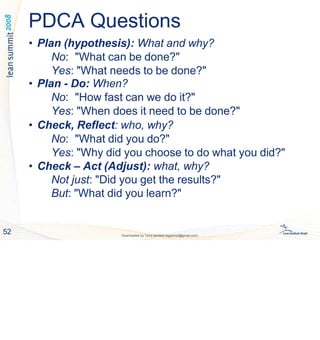
PDCA Questions
52 Downloaded by Tariq qandeel (egysms3@gmail.com)
• Plan (hypothesis): What and why?
No: "What can be done?"
Yes: "What needs to be done?"
• Plan - Do: When?
No: "How fast can we do it?"
Yes: "When does it need to be done?"
• Check, Reflect: who, why?
No: "What did you do?"
Yes: "Why did you choose to do what you did?"
• Check – Act (Adjust): what, why?
Not just: "Did you get the results?"
But: "What did you learn?"
Lean Leadership
• Traditional
“Leadership” as noun: “leaders are born”
• Lean

“Leadership” as verb: “take leadership”
• Traditional
 “Leadership” as noun: “leaders are born”
• Lean
 “Leadership” as verb: “take leadership”
53 Downloaded by Tariq qandeel (egysms3@gmail.com)
• How do you “Take leadership”?

Build systems and processes, look for
system/process solutions when things go wrong

Teach, or “Facilitate learning”

Influence right thinking and action
• How do you “Take leadership”?
Build systems and processes, look for
system/process solutions when things go wrong
Teach, or “Facilitate learning”
Influence right thinking and action
54 Downloaded by Tariq qandeel (egysms3@gmail.com)
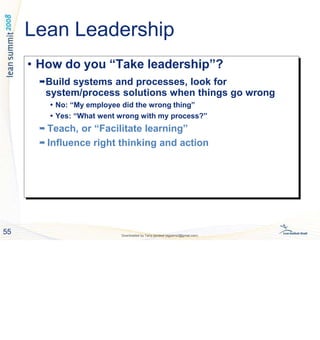
Lean Leadership
• How do you “Take leadership”?

Build systems and processes, look for
system/process solutions when things go wrong
 No: “My employee did the wrong thing”
 Yes: “What went wrong with my process?”

Teach, or “Facilitate learning”

Influence right thinking and action
• How do you “Take leadership”?
Build systems and processes, look for
system/process solutions when things go wrong
 No: “My employee did the wrong thing”
 Yes: “What went wrong with my process?”
 Teach, or “Facilitate learning”
 Influence right thinking and action
55 Downloaded by Tariq qandeel (egysms3@gmail.com)
Lean Leadership
• How do you “Take leadership”?

Build systems and processes, look for
system/process solutions when things go wrong

Teach, or “Facilitate learning”
 If the learner hasn’t learned, the teacher hasn’t taught
 Operations are a reflection of management

Influence right thinking and action
• How do you “Take leadership”?
Build systems and processes, look for
system/process solutions when things go wrong
 Teach, or “Facilitate learning”
 If the learner hasn’t learned, the teacher hasn’t taught
 Operations are a reflection of management
 Influence right thinking and action
56 Downloaded by Tariq qandeel (egysms3@gmail.com)
Lean Leadership
• How do you “Take leadership”?

Build systems and processes, look for
system/process solutions when things go wrong

Teach, or “Facilitate learning”

Aim to influence right actions and thinking
 Model the behavior (right actions)
 Look for the thinking behind the actions
• How do you “Take leadership”?
Build systems and processes, look for
system/process solutions when things go wrong
 Teach, or “Facilitate learning”
 Aim to influence right actions and thinking
 Model the behavior (right actions)
 Look for the thinking behind the actions
57 Downloaded by Tariq qandeel (egysms3@gmail.com)
Lean Leadership
The Thinking Production System
Just in Time
“The right part
at the right time
in the right amount”
•Continuous Flow
•Pull System
•Takt Time
Leveled Production
Production Lines
That Stop for
Abnormalities
•A
•Fixed Position Line Stop
•Error Proofing
•Visual Control
•Labor-Machine Efficiency
Standardized Work
Preventative Maintenance; 4S
Robust Products and Processes
Supplier Involvement
Best Quality - Lowest Cost - Short
Through Shortening the Production Flow B
es
st
t Le
ea
ad
d T
Ti
im
me
e
y E
El
li
im
mi
in
na
at
ti
in
ng
g W
Wa
as
st
te
e
J
Ji
id
do
ok
ka
a
“
“B
Bu
ui
il
lt
t-
-i
in
n Q
Qu
ua
al
li
it
ty
y”
”
utomatic Machine Stop
Operational Stability and Kaizen
Getting people
58 Downloaded by Tariq qandeel (egysms3@gmail.com)
to think and
take initiative
is the key!
Change - the leader's role.
59 Downloaded by Tariq qandeel (egysms3@gmail.com)
"John, I can't get my people to do this."
How can you get others to "do this".?
 Only one w a y .
Where Do You Start - From Top or Bottom?
Change Culture
First
(Conventional way)
Change System
First
(Lean Way)
Lean Enterprise Transformation
60 Downloaded by Tariq qandeel (egysms3@gmail.com)
Lean Enterprise Transformation
It’s easier to act
your way to a new
way of thinking
than to think your
way to a new way
of acting.
61 Downloaded by Tariq qandeel (egysms3@gmail.com)
FOCUS
Sr.
Mgmt.
Front
Lines
System Kaizen
Eliminate
Muri and Mura
Process-step Kaizen
Eliminate Muda
Middle
Mgmt.
62 Downloaded by Tariq qandeel (egysms3@gmail.com)

lean-leadership.pptx

  • 1.
    Lean Leadership John Shook ACTION CHECK STUDY PLAN DO GRASPthe SITUATION HYPOTHESIS TRY REFLECT ADJUST & STANDARDIZE 1 Downloaded by Tariq qandeel (egysms3@gmail.com)
  • 2.
    The "Leader asDictator" of the old days tried to tell everyone what to do. •No transfer, or Cascade of Responsibility 19 Downloaded by Tariq qandeel (egysms3@gmail.com) The "Leader as Back-Slapper" of the 80s and 90s just set "goals" (MBO) and let everyone do as they pleased. •Loss of focus, direction, control Lean Leadership
  • 3.
    • The LeanLeader leads a very different way: . a s different from the commonly accepted notion of the "enlightened modern manager" as it is the old command and control dictator. 20 Downloaded by Tariq qandeel (egysms3@gmail.com) Lean Leadership
  • 4.
    Toyota is Toyota. Wecan learn from them, but we can't copy them exactly. How can we operationalize the same principles in our own companies? 21 Downloaded by Tariq qandeel (egysms3@gmail.com) What can we do??
  • 5.
    Impact of LeanTransformation at different organizational levels A Difficult Struggle at the Mid-management and First Line Supervisory Level FRONT LINES SENIOR MANAGEMENT MIDDLE MANAGEMENT MUST PROVIDE VISION AND INCENTIVE MUST “DO” MUST LEAD THE ACTUAL OPERATIONAL CHANGE Likes the involvement 22 Downloaded by Tariq qandeel (egysms3@gmail.com) Likes the results Left with changed, uncertain role Role Impact Muri: Mura: Muda: overburden variation waste
  • 6.
    • Muri -Overburden or unreasonableness to a person or a machine • Muda - Waste Too much overtime! Stress! Not enough resources! • Mura - Instability; Unevenness; Variability; Inconsistency - End of month deadlines with much overtime followed by periods of not enough work! - All projects scheduled in 1Q with none in 2Q! - Extensive IT everywhere yet not enough copy machines! The Seven Types of Waste 23 Downloaded by Tariq qandeel (egysms3@gmail.com) System Design to Control the 3 M's
  • 7.
    Basic problem tosolve at different levels of the enterprise A Difficult Struggle at the Mid-management and First Line Supervisory Level FRONT LINES SENIOR MANAGEMENT MIDDLE MANAGEMENT MUST PROVIDE VISION AND INCENTIVE MUST “DO” MUST LEAD THE ACTUAL OPERATIONAL CHANGE Likes the involvement Wants to be successful Role Impact Problem: MUDA Likes the results Problem: MURA & MURI Problem: MURA & MURA Muri: Mura: Muda: 24 Downloaded by Tariq qandeel (egysms3@gmail.com) overburden variation waste
  • 8.
    PDCA Tools fordifferent levels Provide the right tool for the right job FRONT LINES SENIOR MANAGEMENT MIDDLE MANAGEMENT MUST PROVIDE VISION AND INCENTIVE MUST “DO” MUST LEAD THE ACTUAL OPERATIONAL CHANGE Needs the right tools and skills to be successful Likes the involvement Role Impact Problem: MUDA PDCA tool: Policy Management PDCA tool: VSM or A3 PDCA tool: Standardized Work Likes the results Problem: MURA & MURI Problem: MURI & MURA Muri: Mura: Muda: 25 Downloaded by Tariq qandeel (egysms3@gmail.com) overburden variation waste
  • 9.
    Mr. Cho of Toyota: ThreeKeys to Lean Leadership Go See. • “Sr. Mgmt. must spend time on the plant floor.” Ask Why. • “Use the “Why?” technique daily.” Show Respect. • “Respect your people.” 26 Downloaded by Tariq qandeel (egysms3@gmail.com)
  • 10.
    "Data is ofcourse important, but I place greater emphasis on facts." -Taiichi Ohno 27 Downloaded by Tariq qandeel (egysms3@gmail.com) "Go see"
  • 11.
    Core Toyota View: 28Downloaded by Tariq qandeel (egysms3@gmail.com) •"You can understand everything that is really important about a company by observing from a good spot on the plant floor."
  • 12.
    What to lookfor - let's make it easy for ourselves. the scientific • Plan vs. Actual • Standardized Work • PDCA - method Tugger Route Visually Confirm on the Shop Floor 29 Downloaded by Tariq qandeel (egysms3@gmail.com)
  • 13.
    Mr. Cho “Know normalfrom abnormal… J I D O K A Best Quality - Lowest Cost - Shortest Lead Time Operational Stability and Kaizen J I T” 30 Downloaded by Tariq qandeel (egysms3@gmail.com) …right now!”
  • 14.
    Lean Problem Solving -at the gemba - five whys GEMBA ENGINEER’S ROOM DEFECT!! 31 Downloaded by Tariq qandeel (egysms3@gmail.com) TOOLS
  • 15.
    Respect for People 32Downloaded by Tariq qandeel (egysms3@gmail.com) Focus on the front line worker Enable the worker To work safely To know his/her customer To be involved, engaged To be successful Worker-out or the Front Lines-back principle Build your operating system from the operator out Remove wasteful steps from his work, Giving it to support people: isolate the waste! Until nothing is left but value-creating steps. Don’t waste the operator’s time and effort!
  • 16.
    • The LeanLeader leads a very different way: It is as different from the commonly accepted notion of the "enlightened modern manager" as it is the old command and control dictator. 33 Downloaded by Tariq qandeel (egysms3@gmail.com) Lean Leadership
  • 17.
    And what IS"Leadership" anyway?? 34 Downloaded by Tariq qandeel (egysms3@gmail.com) "The greatest leaders of the 20th century were Hitler, Stalin and Mao: If that is "leadership", I want nothing to do with it." - Peter Drucker
  • 18.
    Lean Leadership 35 Downloadedby Tariq qandeel (egysms3@gmail.com) Practice of Leadership vs Exercise of Power "I could put a loaded gun to your head." True leadership exists when people follow when they don't have t o . " (James MacGregor Burns)
  • 19.
    Eiji Toyoda onLeadership 36 Downloaded by Tariq qandeel (egysms3@gmail.com) "The people at the top are just flag-wavers. It is pure MUDA to wave your flag and have no one follow you. Waving that flag in a way that makes people fall in line behind you is what is important." The Waste of Empty Flag-Waving
  • 20.
    The leader's jobat Toyota. 37 Downloaded by Tariq qandeel (egysms3@gmail.com) • First, get each person to take initiative to solve problems and improve his or her job. • Second, ensure that each persons' job is aligned to provide value for the customer and prosperity for the company.
  • 21.
    The Leader's jobis to develop his or her people SPIRIT of Lean Mentorship: "If the learner hasn't learned, the teacher hasn't taught" 38 Downloaded by Tariq qandeel (egysms3@gmail.com)
  • 22.
    Extensive Support andCoaching at the Front Lines of the Organization Foreman Group Leaders Team & Team Leader 39 Downloaded by Tariq qandeel (egysms3@gmail.com)
  • 23.
    • The LeanLeader leads a very different way: By setting the vision (more why than how)  with nemawashi dialogue, HK planning  and setting challenging expectations - at the organizational level - at the individual level By building systems and processes that cascade responsibility  SW, KB, Stop-the-Line as tools that truly empower  HR and HK as broader empowering systems By influence and persuasion  by example  by being knowledgeable  by getting into the messy details  by coaching and teaching - through PDCA learning cycles - through questioning 40 Downloaded by Tariq qandeel (egysms3@gmail.com) Lean Leadership
  • 24.
    If “managing” isabout thinking... 41 Downloaded by Tariq qandeel (egysms3@gmail.com) “leading” is about getting other people to think. -- David Verble
  • 25.
    If improvement isabout taking responsibility and initiative Leading is about getting other people to take initiative 42 Downloaded by Tariq qandeel (egysms3@gmail.com)
  • 26.
    How do youget other people to think ? 43 Downloaded by Tariq qandeel (egysms3@gmail.com) and take initiative?
  • 27.
    Ask them Questions! 44Downloaded by Tariq qandeel (egysms3@gmail.com) What Questions?
  • 28.
    PDCA Questions CHECK - STUDY ACTPLAN DO What: is? is should not? be? might be? must be? How? What? Why? When? How? How? When? Who? What is? What is, is not? Why? How? GRASP the SITUATION What? 45 Downloaded by Tariq qandeel (egysms3@gmail.com)
  • 29.
    What barriers discourage people fromthinking and taking responsibility? 46 Downloaded by Tariq qandeel (egysms3@gmail.com)
  • 30.
    What barriers discouragepeople from thinking and taking responsibility? 47 Downloaded by Tariq qandeel (egysms3@gmail.com) •You, me or somebody rushes in to give them the answer. •It is more important to give them the right question than the right answer.
  • 31.
    The A3 ThinkingSteps 48 Downloaded by Tariq qandeel (egysms3@gmail.com) • What is the problem? • Who owns the problem? • What is the root cause of the problem? • What are some possible countermeasures? • How will you choose which countermeasure to propose? • How will you get agreement among everyone concerned? • What is your implementation plan? What timetable? • How will you know if your countermeasure works? • What follow-up issues can you anticipate? What problems may occur during? • How will ensure learning and continuous improvement?
  • 32.
    49 Title: What youare talking about Analysis Plan Followup Background Why you are talking about it. Current Conditions Where things stand today. Show visually – pareto charts, graphs, drawings, maps, etc. Target/Goal(s) The specific outcome required for the business. The root cause(s) of the problem. Choose the simplest problem-solving tool for this issue A Gantt chart or facsimile that shows actions/outcomes, timeline and responsibilities. May include details on the specific means of implementation. Indicators of performance, of progress. Remaining issues that can be anticipated. Ensure ongoing P-D-C-A. Yokoten as needed. O w n e r Proposed Countermeasure(s) Your proposal to reach the future state, the target condition. How your recommended countermeasures will impact the root cause to change the current situation and achieve the target. i n i t i a l s Downloaded by Tariq qandeel (egysms3@gmail.com)
  • 33.
    Title: Create robustprocess for translating documents Plan 50 Downloaded by Tariq qandeel (egysms3@gmail.com) Followup Background New domestic plant has massive technical requirements that must be translated from Japanese documents. The size and complexity of the project are creating errors and delays. Current Conditions Cost overruns. Delays. Errors. Complexity. Goal Reduce errors to manageable rate and simplify processes. Reduce cost by 10%. Analysis Challenge of translating from Japanese to English. Complexity and size and amount of documents. Problems stemming from multiple vendors. Recommendations Simplify and improve process performance by choosing one vendor based on competitive bid process. Monitor cost to proposal. Review performance at end of one-year contract. Put contract up for bid again if performance goals are not met. Evaluate current vendor. Identify new vendor candidates. Develop bid package, distribute, and choose winning bid.
  • 34.
    Title: Create robustprocess for translating documents Background Goal Recommendations Plan Followup New domestic plant has massive technical requirements that must be translated from Japanese documents. The size and complexity of the project are creating errors and delays. Reduce errors to manageable rate and simplify processes. Reduce cost by 10%. Simplify and improve process performance by choosing one vendor based on competitive bid process. Monitor cost to proposal. Review performance at end of one-year contract. Put contract up for bid again if performance goals are not met. Evaluate current vendor. Identify new vendor candidates. Develop bid package, distribute, and choose winning bid. Current Conditions Cost overruns. Delays. Errors. Complexity. How V A U C , v i ? How V A c 1 1 t ) ? ??? How Lo11g? ??? w v i t ) ? Analysis Challenge of translating from Japanese to English. Complexity and size and amount of documents. Problems stemming from multiple vendors. w v ictdo " C , v i c L L e 1 1 g ec11d" C , o V A - p L e x L t t ) "V A e c 1 1 ? w v i c t"- p r o b L e V A s ? "w v i c tCAUSE??" "/vcssLve"?? How bLg OrL V A - portc11tLs t v i L s- p r o b L e V A ? w v ictdoes 1 1 U V A b e ro ve11dors v i c v eto do w L t v it v i e- p r o b L e V A ? ? 51 Downloaded by Tariq qandeel (egysms3@gmail.com) How C , c 1 1weR11owc 1 1 t )o t v i L swLLL worR w v i e 1 1we do11't eve11 R11owt v i e- p r o b L e V Aor root C,cUse?
  • 35.
    PDCA Questions 52 Downloadedby Tariq qandeel (egysms3@gmail.com) • Plan (hypothesis): What and why? No: "What can be done?" Yes: "What needs to be done?" • Plan - Do: When? No: "How fast can we do it?" Yes: "When does it need to be done?" • Check, Reflect: who, why? No: "What did you do?" Yes: "Why did you choose to do what you did?" • Check – Act (Adjust): what, why? Not just: "Did you get the results?" But: "What did you learn?"
  • 36.
    Lean Leadership • Traditional “Leadership”as noun: “leaders are born” • Lean  “Leadership” as verb: “take leadership” • Traditional  “Leadership” as noun: “leaders are born” • Lean  “Leadership” as verb: “take leadership” 53 Downloaded by Tariq qandeel (egysms3@gmail.com)
  • 37.
    • How doyou “Take leadership”?  Build systems and processes, look for system/process solutions when things go wrong  Teach, or “Facilitate learning”  Influence right thinking and action • How do you “Take leadership”? Build systems and processes, look for system/process solutions when things go wrong Teach, or “Facilitate learning” Influence right thinking and action 54 Downloaded by Tariq qandeel (egysms3@gmail.com) Lean Leadership
  • 38.
    • How doyou “Take leadership”?  Build systems and processes, look for system/process solutions when things go wrong  No: “My employee did the wrong thing”  Yes: “What went wrong with my process?”  Teach, or “Facilitate learning”  Influence right thinking and action • How do you “Take leadership”? Build systems and processes, look for system/process solutions when things go wrong  No: “My employee did the wrong thing”  Yes: “What went wrong with my process?”  Teach, or “Facilitate learning”  Influence right thinking and action 55 Downloaded by Tariq qandeel (egysms3@gmail.com) Lean Leadership
  • 39.
    • How doyou “Take leadership”?  Build systems and processes, look for system/process solutions when things go wrong  Teach, or “Facilitate learning”  If the learner hasn’t learned, the teacher hasn’t taught  Operations are a reflection of management  Influence right thinking and action • How do you “Take leadership”? Build systems and processes, look for system/process solutions when things go wrong  Teach, or “Facilitate learning”  If the learner hasn’t learned, the teacher hasn’t taught  Operations are a reflection of management  Influence right thinking and action 56 Downloaded by Tariq qandeel (egysms3@gmail.com) Lean Leadership
  • 40.
    • How doyou “Take leadership”?  Build systems and processes, look for system/process solutions when things go wrong  Teach, or “Facilitate learning”  Aim to influence right actions and thinking  Model the behavior (right actions)  Look for the thinking behind the actions • How do you “Take leadership”? Build systems and processes, look for system/process solutions when things go wrong  Teach, or “Facilitate learning”  Aim to influence right actions and thinking  Model the behavior (right actions)  Look for the thinking behind the actions 57 Downloaded by Tariq qandeel (egysms3@gmail.com) Lean Leadership
  • 41.
    The Thinking ProductionSystem Just in Time “The right part at the right time in the right amount” •Continuous Flow •Pull System •Takt Time Leveled Production Production Lines That Stop for Abnormalities •A •Fixed Position Line Stop •Error Proofing •Visual Control •Labor-Machine Efficiency Standardized Work Preventative Maintenance; 4S Robust Products and Processes Supplier Involvement Best Quality - Lowest Cost - Short Through Shortening the Production Flow B es st t Le ea ad d T Ti im me e y E El li im mi in na at ti in ng g W Wa as st te e J Ji id do ok ka a “ “B Bu ui il lt t- -i in n Q Qu ua al li it ty y” ” utomatic Machine Stop Operational Stability and Kaizen Getting people 58 Downloaded by Tariq qandeel (egysms3@gmail.com) to think and take initiative is the key!
  • 42.
    Change - theleader's role. 59 Downloaded by Tariq qandeel (egysms3@gmail.com) "John, I can't get my people to do this." How can you get others to "do this".?  Only one w a y .
  • 43.
    Where Do YouStart - From Top or Bottom? Change Culture First (Conventional way) Change System First (Lean Way) Lean Enterprise Transformation 60 Downloaded by Tariq qandeel (egysms3@gmail.com)
  • 44.
    Lean Enterprise Transformation It’seasier to act your way to a new way of thinking than to think your way to a new way of acting. 61 Downloaded by Tariq qandeel (egysms3@gmail.com)
  • 45.
    FOCUS Sr. Mgmt. Front Lines System Kaizen Eliminate Muri andMura Process-step Kaizen Eliminate Muda Middle Mgmt. 62 Downloaded by Tariq qandeel (egysms3@gmail.com)