Southern de Oro Philippines College
Julio Pcana St., licuan Cagayan de Oro City
JUNIOR HIGH SCHOOL
OFFICE OF THE PRINCIPAL
LEARNING PLAN
SY: 2025-2026
Subject Computer 8
Grade Level / Quarter Grade 8 / Quarter 1
Week / Duration Week 1 / 3 hrs per week
Content Standards The learner demonstrates understanding of photography as a medium of
expression and communication.
Performance Standards The learner is able to produce simple photos applying basic concepts of
photography.
Learning Competencies Acquisition (A): Define digital photography and its importance.
Acquisition (A): Identify parts and functions of a digital camera.
Make Meaning (M): Explain how photography helps communicate ideas.
Transfer (T): Capture 3 photos showing different perspectives.
Content / Topic Introduction to Photography
Photography is ubiquitous worldwide. We analyzed why people take, share, and
use personal photographs, independent of their specific cultural background.
These behaviors are still poorly understood. Experimental research on them is
scarce. Smartphone technology and social media have pushed the success of
photography, but cannot explain it, as not all smartphone features are widely
used just because they are available. We analyzed properties of human nature
that have made taking and using photographs functional behaviors. We did this
based on the four levels, which Nikolaas Tinbergen suggested for analyzing
why animals behave in a particular way. Including findings from multiple
disciplines, we developed a novel conceptual framework—the “Mental
Utilization Hypothesis of Photography.” It suggests that people adopt
photography because it matches with core human mental mechanisms mainly
from the social domain, and people use photography as a cognitive, primarily
social coping strategy. Our framework comprises a range of testable
predictions, provides a new theoretical basis for future empirical investigations
into photography, and has practical implications. We conclude that photography
has become a human universal, which is based on context-sensitive mental
predispositions and differentiates itself in the social and societal environment.
Motivational Activity
(Prior Knowledge Test)
Photo Hunt Activity (ICT-integrated):
Instructions for Students:
1. Watch the Slideshow
 Your teacher will show a slideshow with 4 random images (examples:
nature, people, objects, events).
 Pay close attention to each picture as it appears.
2. Think and Observe
 While looking at the images, ask yourself:
 “What do I notice in this picture?”
 “What message or story is this picture trying to tell without using
words?”
3. Discuss Quickly with a Seatmate (2 minutes)
 Turn to the person next to you.
 Share one idea each about what you think the pictures mean.
4. Write Your Response
 In your notebook, write 2–3 sentences answering this guide:
 What do these pictures show or mean?
 How can a picture communicate without words?
5. Share with the Class (Optional)
 Volunteers will be asked to read their answers aloud.
 The teacher will list common ideas on the board to connect to today’s
Southern de Oro Philippines College
Julio Pcana St., licuan Cagayan de Oro City
JUNIOR HIGH SCHOOL
OFFICE OF THE PRINCIPAL
LEARNING PLAN
SY: 2025-2026
lesson.
REFERENCES:
· Ghosh, D., Maji, A., Palai, D., & Chakravorty, N. (2020). Photography and
communication: A study of interrelationship. International Journal of English
Learning and Teaching Skills. Retrieved from https://www.ijeltsjournal.org/wp-
content/uploads/2020/01/36.Photography-And-Communication.pdf
ijeltsjournal.org
· “Hunters and Gatherers of Pictures: Why Photography Has Become a Human
Universal.” (2022). PMC. Retrieved from
https://pmc.ncbi.nlm.nih.gov/articles/PMC8217823/ PMC
· Kia-Keating, M., Santacrose, D., Liu, S. (2017). Photography and social
media use in community-based participatory research with youth: Ethical
considerations. American Journal of Community Psychology. PMC. Retrieved
from https://pmc.ncbi.nlm.nih.gov/articles/PMC5735042/ PMC
· “5 Ways to Use Photography to Improve Visual Literacy in the K-12 Art
Room.” The Art of Education. Retrieved from
https://theartofeducation.edu/2024/09/sept-5-ways-to-use-photography-to-
improve-visual-literacy-in-the-k-12-art-room/
 Adorama Learning Center. (2023, June 28). Parts of a camera. Adorama.
Retrieved September 12, 2025, from https://www.adorama.com/alc/parts-
of-a-camera/
Learning Objectives
(SMART)
1. By the end of the lesson, learners will be able to define digital photography
and its importance with at least 80% accuracy as shown in a short quiz.
2. By the end of the lesson, learners will be able to identify at least 5 major
parts of a digital camera and their functions in a labeling test.
3. By the end of the lesson, learners will be able to explain the ways
photography communicates ideas using a reflection worksheet.
4. By the end of the week, learners will be able to produce a 3-photo portfolio
using different perspectives, with captions, scoring at least 12/15 on a rubric.
PVMGO Integration Philosophy: Education for service through meaningful communication.
Vision: Learners as creative, expressive, and responsible digital citizens.
Mission: Integrate ICT and arts in promoting communication, creativity, and
values.
Goals & Objectives: Encourage learners to apply photography in real-life
communication while upholding SPC core values: Discipline, Respect, Faith
in God, Service.
Instructional Strategies • Lecture and Demonstration (for concepts and camera parts)
• Guided Practice (worksheet and labeling)
• Collaborative Discussion (group sharing on communication role of
photography)
• Hands-On Performance Task (outdoor photography activity) • Reflective
Writing (personal insights on photography’s impact)
Learning Tasks /
Activities
Acquisition:
Activity 1: Introduction to Digital Photography
Instructions for Students:
1. Listen carefully as your teacher explains digital photography and its
importance.
Southern de Oro Philippines College
Julio Pcana St., licuan Cagayan de Oro City
JUNIOR HIGH SCHOOL
OFFICE OF THE PRINCIPAL
LEARNING PLAN
SY: 2025-2026
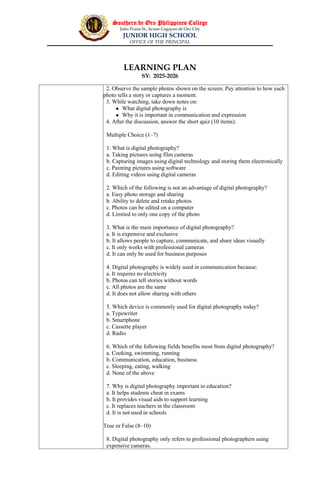
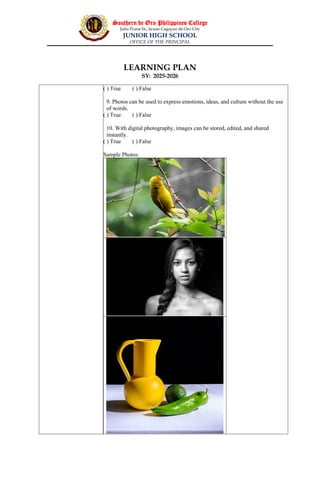
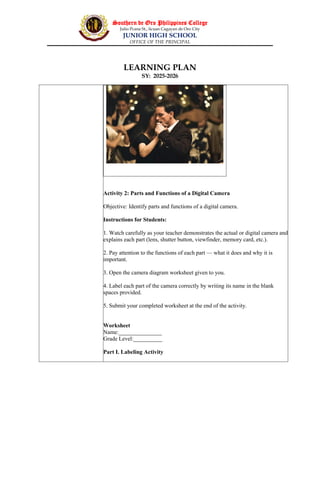
2. Observe the sample photos shown on the screen. Pay attention to how each
photo tells a story or captures a moment.
3. While watching, take down notes on:
 What digital photography is
 Why it is important in communication and expression
4. After the discussion, answer the short quiz (10 items).
Multiple Choice (1–7)
1. What is digital photography?
a. Taking pictures using film cameras
b. Capturing images using digital technology and storing them electronically
c. Painting pictures using software
d. Editing videos using digital cameras
2. Which of the following is not an advantage of digital photography?
a. Easy photo storage and sharing
b. Ability to delete and retake photos
c. Photos can be edited on a computer
d. Limited to only one copy of the photo
3. What is the main importance of digital photography?
a. It is expensive and exclusive
b. It allows people to capture, communicate, and share ideas visually
c. It only works with professional cameras
d. It can only be used for business purposes
4. Digital photography is widely used in communication because:
a. It requires no electricity
b. Photos can tell stories without words
c. All photos are the same
d. It does not allow sharing with others
5. Which device is commonly used for digital photography today?
a. Typewriter
b. Smartphone
c. Cassette player
d. Radio
6. Which of the following fields benefits most from digital photography?
a. Cooking, swimming, running
b. Communication, education, business
c. Sleeping, eating, walking
d. None of the above
7. Why is digital photography important in education?
a. It helps students cheat in exams
b. It provides visual aids to support learning
c. It replaces teachers in the classroom
d. It is not used in schools
True or False (8–10)
8. Digital photography only refers to professional photographers using
expensive cameras.
Southern de Oro Philippines College
Julio Pcana St., licuan Cagayan de Oro City
JUNIOR HIGH SCHOOL
OFFICE OF THE PRINCIPAL
LEARNING PLAN
SY: 2025-2026
( ) True ( ) False
9. Photos can be used to express emotions, ideas, and culture without the use
of words.
( ) True ( ) False
10. With digital photography, images can be stored, edited, and shared
instantly.
( ) True ( ) False
Sample Photos:
Southern de Oro Philippines College
Julio Pcana St., licuan Cagayan de Oro City
JUNIOR HIGH SCHOOL
OFFICE OF THE PRINCIPAL
LEARNING PLAN
SY: 2025-2026
Activity 2: Parts and Functions of a Digital Camera
Objective: Identify parts and functions of a digital camera.
Instructions for Students:
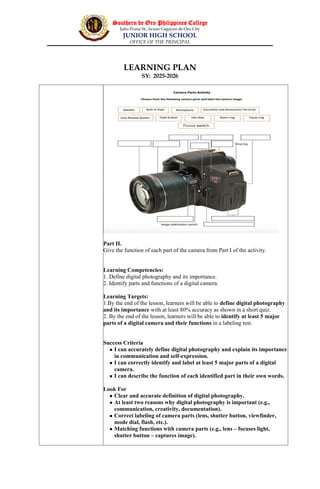
1. Watch carefully as your teacher demonstrates the actual or digital camera and
explains each part (lens, shutter button, viewfinder, memory card, etc.).
2. Pay attention to the functions of each part — what it does and why it is
important.
3. Open the camera diagram worksheet given to you.
4. Label each part of the camera correctly by writing its name in the blank
spaces provided.
5. Submit your completed worksheet at the end of the activity.
Worksheet
Name:_______________
Grade Level:__________
Part I. Labeling Activity
Southern de Oro Philippines College
Julio Pcana St., licuan Cagayan de Oro City
JUNIOR HIGH SCHOOL
OFFICE OF THE PRINCIPAL
LEARNING PLAN
SY: 2025-2026
Part II.
Give the function of each part of the camera from Part I of the activity.
Learning Competencies:
1. Define digital photography and its importance.
2. Identify parts and functions of a digital camera.
Learning Targets:
1.By the end of the lesson, learners will be able to define digital photography
and its importance with at least 80% accuracy as shown in a short quiz.
2. By the end of the lesson, learners will be able to identify at least 5 major
parts of a digital camera and their functions in a labeling test.
Success Criteria
 I can accurately define digital photography and explain its importance
in communication and self-expression.
 I can correctly identify and label at least 5 major parts of a digital
camera.
 I can describe the function of each identified part in their own words.
Look For
 Clear and accurate definition of digital photography.
 At least two reasons why digital photography is important (e.g.,
communication, creativity, documentation).
 Correct labeling of camera parts (lens, shutter button, viewfinder,
mode dial, flash, etc.).
 Matching functions with camera parts (e.g., lens – focuses light,
shutter button – captures image).
Southern de Oro Philippines College
Julio Pcana St., licuan Cagayan de Oro City
JUNIOR HIGH SCHOOL
OFFICE OF THE PRINCIPAL
LEARNING PLAN
SY: 2025-2026
REFERENCES:
· Ghosh, D., Maji, A., Palai, D., & Chakravorty, N. (2020). Photography and
communication: A study of interrelationship. International Journal of English
Learning and Teaching Skills. Retrieved from https://www.ijeltsjournal.org/wp-
content/uploads/2020/01/36.Photography-And-Communication.pdf
ijeltsjournal.org
· “Hunters and Gatherers of Pictures: Why Photography Has Become a Human
Universal.” (2022). PMC. Retrieved from
https://pmc.ncbi.nlm.nih.gov/articles/PMC8217823/ PMC
· Kia-Keating, M., Santacrose, D., Liu, S. (2017). Photography and social
media use in community-based participatory research with youth: Ethical
considerations. American Journal of Community Psychology. PMC. Retrieved
from https://pmc.ncbi.nlm.nih.gov/articles/PMC5735042/ PMC
· “5 Ways to Use Photography to Improve Visual Literacy in the K-12 Art
Room.” The Art of Education. Retrieved from
https://theartofeducation.edu/2024/09/sept-5-ways-to-use-photography-to-
improve-visual-literacy-in-the-k-12-art-room/
Adorama Learning Center. (2023, June 28). Parts of a camera. Adorama.
Retrieved September 12, 2025, from https://www.adorama.com/alc/parts-of-a-
camera/
Make Meaning:
Group discussion: “How does photography help us communicate ideas?”
Students share, then write individual reflections.
Reflection Worksheet
Topic: How Photography Helps Communicate Ideas
Name: _____________________
Date: _____________________
Grade/Section: _____________
Part A – Group Sharing
1. In your group, discuss:
 How can photography be used to share messages, emotions, or stories
without using words?
 Give at least two examples from real life (e.g., news photos, social
media posts, family pictures, advertisements).
Write down your group’s main ideas here:
_____________________________________________________________
_____________________________________________________________
_____________________________________________________________
_____________________________________________________________
Southern de Oro Philippines College
Julio Pcana St., licuan Cagayan de Oro City
JUNIOR HIGH SCHOOL
OFFICE OF THE PRINCIPAL
LEARNING PLAN
SY: 2025-2026
_____________________________________________________________
Part B – Personal Reflection
Now, answer the following individually in 5–7 sentences:
1. How do you think photography communicates ideas or messages?
____________________________________________________
____________________________________________________
____________________________________________________
2. Share a personal experience where a photo (one you took or saw) expressed
something important without words.
____________________________________________________
____________________________________________________
____________________________________________________
3. Why do you think photography is an important medium of communication
today?
____________________________________________________
____________________________________________________
____________________________________________________
Learning Competency:
Explain how photography helps communicate ideas.
Learning Target:
By the end of the lesson, learners will be able to explain the ways photography
communicates ideas using a reflection worksheet.
Success Criteria
 I can share at least two valid examples of how photography communicates
ideas.
 I can write a reflection of at least 5–7 sentences connecting photography to
communication.
 I can express personal insights clearly, with logical flow of ideas.
Look For
 Examples – Include at least two clear examples of how photography
Southern de Oro Philippines College
Julio Pcana St., licuan Cagayan de Oro City
JUNIOR HIGH SCHOOL
OFFICE OF THE PRINCIPAL
LEARNING PLAN
SY: 2025-2026
communicates ideas (e.g., telling stories, sharing emotions, documenting
events).
 Personal Connection – Relate the answer of your own experiences or
opinions (e.g., photos you’ve taken, pictures you’ve seen online).
REFERENCES:
· Ghosh, D., Maji, A., Palai, D., & Chakravorty, N. (2020). Photography and
communication: A study of interrelationship. International Journal of English
Learning and Teaching Skills. Retrieved from https://www.ijeltsjournal.org/wp-
content/uploads/2020/01/36.Photography-And-Communication.pdf
ijeltsjournal.org
· “Hunters and Gatherers of Pictures: Why Photography Has Become a Human
Universal.” (2022). PMC. Retrieved from
https://pmc.ncbi.nlm.nih.gov/articles/PMC8217823/ PMC
· Kia-Keating, M., Santacrose, D., Liu, S. (2017). Photography and social
media use in community-based participatory research with youth: Ethical
considerations. American Journal of Community Psychology. PMC. Retrieved
from https://pmc.ncbi.nlm.nih.gov/articles/PMC5735042/ PMC
· “5 Ways to Use Photography to Improve Visual Literacy in the K-12 Art
Room.” The Art of Education. Retrieved from
https://theartofeducation.edu/2024/09/sept-5-ways-to-use-photography-to-
improve-visual-literacy-in-the-k-12-art-room/
Adorama Learning Center. (2023, June 28). Parts of a camera. Adorama.
Retrieved September 12, 2025, from https://www.adorama.com/alc/parts-of-a-
camera/
Reflection Worksheet Rubric
Criteria Excellent (3 pts) Proficient (2 pts)
Needs
Improvement (1
pt)
Content &
Ideas
Provides 2 or
more clear
examples of how
photography
communicates
ideas; shows
deep
understanding.
Provides at least 1
clear example;
shows some
understanding.
Provides vague or
no examples;
shows limited
understanding.
Personal
Insight
Strongly
connects
reflection to
personal
experience or
opinion, showing
originality.
Some connection
to personal
experience or
opinion.
Little to no
personal
connection or
insight.
Clarity &
Organizati
on
Reflection is
well-structured,
easy to follow,
Reflection is
somewhat
organized but may
Reflection is
poorly organized
and hard to
Southern de Oro Philippines College
Julio Pcana St., licuan Cagayan de Oro City
JUNIOR HIGH SCHOOL
OFFICE OF THE PRINCIPAL
LEARNING PLAN
SY: 2025-2026
and logical. lack clarity in
places.
follow.
Completen
ess
Meets or exceeds
5–7 sentence
requirement.
Almost meets the
requirement (3–4
sentences).
Fewer than 3
sentences;
incomplete
response.
Grammar
&
Mechanics
Few or no errors
in grammar,
spelling, or
punctuation.
Some errors, but
meaning is still
clear.
Frequent errors
that make reading
difficult.
Transfer:
Outdoor activity: Students capture 3 photos (eye-level, high-angle, close-up).
Add captions explaining perspective and meaning. Submit as a printed
portfolio.
Format Requirements
1. File Type: Submit your portfolio as a Word file (.docx) or PDF.
2. File Name: Use this format -
Surname_Firstname_GradeSection_PhotoPortfolio
 Example: Santos_Ana_9A_PhotoPortfolio.pdf
3. Portfolio Content Order:
 Cover Page
 Title: Photography Portfolio – Perspectives
 Name, Grade & Section, Date
 Photo Entries (3 Required)
 Photo 1: Eye-level shot
 Caption (2–3 sentences explaining perspective and meaning)
 Photo 2: High-angle shot
 Caption (2–3 sentences explaining perspective and meaning)
 Photo 3: Close-up shot
 Caption (2–3 sentences explaining perspective and meaning)
4. Reflection (5 sentences minimum): What did you learn about using different
perspectives in photography?
Learning Competency:
Capture 3 photos showing different perspectives.
Learning Target:
By the end of the week, learners will be able to produce a 3-photo portfolio
using different perspectives, with captions, scoring at least 12/15 on a rubric.
Success Criteria
 I can capture three photos using eye-level, high-angle, and close-up
perspectives.
 I can provide a caption (2–3 sentences) for each photo explaining the
perspective and its meaning.
 I can demonstrate clarity, creativity, and relevance in my photos.
 I can organize my portfolio in the required format (cover page, labeled
photos, captions, reflection).
Look For
 Three distinct perspectives (eye-level, high-angle, close-up) are correctly
applied.
Southern de Oro Philippines College
Julio Pcana St., licuan Cagayan de Oro City
JUNIOR HIGH SCHOOL
OFFICE OF THE PRINCIPAL
LEARNING PLAN
SY: 2025-2026
 Captions explain perspective and meaning clearly, not just a description of
the photo.
 Photos are original, creative, and relevant to the task.
REFERENCES:
· Ghosh, D., Maji, A., Palai, D., & Chakravorty, N. (2020). Photography and
communication: A study of interrelationship. International Journal of English
Learning and Teaching Skills. Retrieved from https://www.ijeltsjournal.org/wp-
content/uploads/2020/01/36.Photography-And-Communication.pdf
ijeltsjournal.org
· “Hunters and Gatherers of Pictures: Why Photography Has Become a Human
Universal.” (2022). PMC. Retrieved from
https://pmc.ncbi.nlm.nih.gov/articles/PMC8217823/ PMC
· Kia-Keating, M., Santacrose, D., Liu, S. (2017). Photography and social
media use in community-based participatory research with youth: Ethical
considerations. American Journal of Community Psychology. PMC. Retrieved
from https://pmc.ncbi.nlm.nih.gov/articles/PMC5735042/ PMC
· “5 Ways to Use Photography to Improve Visual Literacy in the K-12 Art
Room.” The Art of Education. Retrieved from
https://theartofeducation.edu/2024/09/sept-5-ways-to-use-photography-to-
improve-visual-literacy-in-the-k-12-art-room/
Adorama Learning Center. (2023, June 28). Parts of a camera. Adorama.
Retrieved September 12, 2025, from https://www.adorama.com/alc/parts-of-a-
camera/
Rubric: Photography Portfolio (3 Perspectives)
Criteria
Excellent (3
pts)
Good (2 pts)
Needs
Improvement (1
pt)
Photo
Perspectives
All 3 required
perspectives
(eye-level, high-
angle, close-up)
are correct.
2 perspectives
correct; 1
missing/incorrect.
Only 1 or none
of the
perspectives
correct.
Creativity &
Composition
Photos are
original, well-
composed, and
engaging.
Some creativity
shown; composition
is adequate.
Minimal
creativity; poor
framing/subject
choice.
Captions/Expla
nations
Captions clearly
explain
perspective and
meaning.
Captions give basic
explanation with
limited detail.
Captions unclear,
incomplete, or
missing.
Technical
Quality
Photos are clear,
well-lit, and
properly
focused.
Most photos are
clear, 1 may be
blurry/poorly lit.
Several photos
blurry, dark, or
unclear.
Completion &
Submission
All
requirements
Most requirements
complete; submitted
Incomplete or
late submission.
Southern de Oro Philippines College
Julio Pcana St., licuan Cagayan de Oro City
JUNIOR HIGH SCHOOL
OFFICE OF THE PRINCIPAL
LEARNING PLAN
SY: 2025-2026
Prepared by:
JOB E. BALDON
Subject Teacher
Monitored by:
MARY JANE G. REDULLA
Assistant Principal/Academic Coordinator
Checked by:
GIEMARK H. LAGROSAS
School Principal
complete;
submitted on
time in proper
format.
on time.
Assessment Tools • Quiz (10 items MCQ/True-False) – Defining digital photography
• Labeling Test – Parts and functions of a camera
• Reflection Worksheet – Explaining how photography communicates ideas
(scored via rubric)
• Photo Portfolio Project – 3 photos with captions, scored with creativity and
relevance rubric
Materials and Resources
Projector, sample photos (slides), handouts, digital/DSLR cameras or
smartphones, worksheets
Technology Integration • Use of PowerPoint/Slides for showing sample photos
• Use of digital cameras or smartphones for capturing photos
• Option to submit portfolio digitally (USB, email, or online folder)
Reflection Notes Students actively engaged in hands-on and creative tasks. Many showed
excitement during the outdoor activity, though some needed more guidance on
perspective. Next time, I will allot more time for explaining photography
angles and framing techniques before the outdoor task. Overall, the
integration of ICT tools and real-life application motivated learners to
participate meaningfully.
leaning plan for computer 8 for teachers guide

  • 1.
    Southern de OroPhilippines College Julio Pcana St., licuan Cagayan de Oro City JUNIOR HIGH SCHOOL OFFICE OF THE PRINCIPAL LEARNING PLAN SY: 2025-2026 Subject Computer 8 Grade Level / Quarter Grade 8 / Quarter 1 Week / Duration Week 1 / 3 hrs per week Content Standards The learner demonstrates understanding of photography as a medium of expression and communication. Performance Standards The learner is able to produce simple photos applying basic concepts of photography. Learning Competencies Acquisition (A): Define digital photography and its importance. Acquisition (A): Identify parts and functions of a digital camera. Make Meaning (M): Explain how photography helps communicate ideas. Transfer (T): Capture 3 photos showing different perspectives. Content / Topic Introduction to Photography Photography is ubiquitous worldwide. We analyzed why people take, share, and use personal photographs, independent of their specific cultural background. These behaviors are still poorly understood. Experimental research on them is scarce. Smartphone technology and social media have pushed the success of photography, but cannot explain it, as not all smartphone features are widely used just because they are available. We analyzed properties of human nature that have made taking and using photographs functional behaviors. We did this based on the four levels, which Nikolaas Tinbergen suggested for analyzing why animals behave in a particular way. Including findings from multiple disciplines, we developed a novel conceptual framework—the “Mental Utilization Hypothesis of Photography.” It suggests that people adopt photography because it matches with core human mental mechanisms mainly from the social domain, and people use photography as a cognitive, primarily social coping strategy. Our framework comprises a range of testable predictions, provides a new theoretical basis for future empirical investigations into photography, and has practical implications. We conclude that photography has become a human universal, which is based on context-sensitive mental predispositions and differentiates itself in the social and societal environment. Motivational Activity (Prior Knowledge Test) Photo Hunt Activity (ICT-integrated): Instructions for Students: 1. Watch the Slideshow  Your teacher will show a slideshow with 4 random images (examples: nature, people, objects, events).  Pay close attention to each picture as it appears. 2. Think and Observe  While looking at the images, ask yourself:  “What do I notice in this picture?”  “What message or story is this picture trying to tell without using words?” 3. Discuss Quickly with a Seatmate (2 minutes)  Turn to the person next to you.  Share one idea each about what you think the pictures mean. 4. Write Your Response  In your notebook, write 2–3 sentences answering this guide:  What do these pictures show or mean?  How can a picture communicate without words? 5. Share with the Class (Optional)  Volunteers will be asked to read their answers aloud.  The teacher will list common ideas on the board to connect to today’s
  • 2.
    Southern de OroPhilippines College Julio Pcana St., licuan Cagayan de Oro City JUNIOR HIGH SCHOOL OFFICE OF THE PRINCIPAL LEARNING PLAN SY: 2025-2026 lesson. REFERENCES: · Ghosh, D., Maji, A., Palai, D., & Chakravorty, N. (2020). Photography and communication: A study of interrelationship. International Journal of English Learning and Teaching Skills. Retrieved from https://www.ijeltsjournal.org/wp- content/uploads/2020/01/36.Photography-And-Communication.pdf ijeltsjournal.org · “Hunters and Gatherers of Pictures: Why Photography Has Become a Human Universal.” (2022). PMC. Retrieved from https://pmc.ncbi.nlm.nih.gov/articles/PMC8217823/ PMC · Kia-Keating, M., Santacrose, D., Liu, S. (2017). Photography and social media use in community-based participatory research with youth: Ethical considerations. American Journal of Community Psychology. PMC. Retrieved from https://pmc.ncbi.nlm.nih.gov/articles/PMC5735042/ PMC · “5 Ways to Use Photography to Improve Visual Literacy in the K-12 Art Room.” The Art of Education. Retrieved from https://theartofeducation.edu/2024/09/sept-5-ways-to-use-photography-to- improve-visual-literacy-in-the-k-12-art-room/  Adorama Learning Center. (2023, June 28). Parts of a camera. Adorama. Retrieved September 12, 2025, from https://www.adorama.com/alc/parts- of-a-camera/ Learning Objectives (SMART) 1. By the end of the lesson, learners will be able to define digital photography and its importance with at least 80% accuracy as shown in a short quiz. 2. By the end of the lesson, learners will be able to identify at least 5 major parts of a digital camera and their functions in a labeling test. 3. By the end of the lesson, learners will be able to explain the ways photography communicates ideas using a reflection worksheet. 4. By the end of the week, learners will be able to produce a 3-photo portfolio using different perspectives, with captions, scoring at least 12/15 on a rubric. PVMGO Integration Philosophy: Education for service through meaningful communication. Vision: Learners as creative, expressive, and responsible digital citizens. Mission: Integrate ICT and arts in promoting communication, creativity, and values. Goals & Objectives: Encourage learners to apply photography in real-life communication while upholding SPC core values: Discipline, Respect, Faith in God, Service. Instructional Strategies • Lecture and Demonstration (for concepts and camera parts) • Guided Practice (worksheet and labeling) • Collaborative Discussion (group sharing on communication role of photography) • Hands-On Performance Task (outdoor photography activity) • Reflective Writing (personal insights on photography’s impact) Learning Tasks / Activities Acquisition: Activity 1: Introduction to Digital Photography Instructions for Students: 1. Listen carefully as your teacher explains digital photography and its importance.
  • 3.
    Southern de OroPhilippines College Julio Pcana St., licuan Cagayan de Oro City JUNIOR HIGH SCHOOL OFFICE OF THE PRINCIPAL LEARNING PLAN SY: 2025-2026 2. Observe the sample photos shown on the screen. Pay attention to how each photo tells a story or captures a moment. 3. While watching, take down notes on:  What digital photography is  Why it is important in communication and expression 4. After the discussion, answer the short quiz (10 items). Multiple Choice (1–7) 1. What is digital photography? a. Taking pictures using film cameras b. Capturing images using digital technology and storing them electronically c. Painting pictures using software d. Editing videos using digital cameras 2. Which of the following is not an advantage of digital photography? a. Easy photo storage and sharing b. Ability to delete and retake photos c. Photos can be edited on a computer d. Limited to only one copy of the photo 3. What is the main importance of digital photography? a. It is expensive and exclusive b. It allows people to capture, communicate, and share ideas visually c. It only works with professional cameras d. It can only be used for business purposes 4. Digital photography is widely used in communication because: a. It requires no electricity b. Photos can tell stories without words c. All photos are the same d. It does not allow sharing with others 5. Which device is commonly used for digital photography today? a. Typewriter b. Smartphone c. Cassette player d. Radio 6. Which of the following fields benefits most from digital photography? a. Cooking, swimming, running b. Communication, education, business c. Sleeping, eating, walking d. None of the above 7. Why is digital photography important in education? a. It helps students cheat in exams b. It provides visual aids to support learning c. It replaces teachers in the classroom d. It is not used in schools True or False (8–10) 8. Digital photography only refers to professional photographers using expensive cameras.
  • 4.
    Southern de OroPhilippines College Julio Pcana St., licuan Cagayan de Oro City JUNIOR HIGH SCHOOL OFFICE OF THE PRINCIPAL LEARNING PLAN SY: 2025-2026 ( ) True ( ) False 9. Photos can be used to express emotions, ideas, and culture without the use of words. ( ) True ( ) False 10. With digital photography, images can be stored, edited, and shared instantly. ( ) True ( ) False Sample Photos:
  • 5.
    Southern de OroPhilippines College Julio Pcana St., licuan Cagayan de Oro City JUNIOR HIGH SCHOOL OFFICE OF THE PRINCIPAL LEARNING PLAN SY: 2025-2026 Activity 2: Parts and Functions of a Digital Camera Objective: Identify parts and functions of a digital camera. Instructions for Students: 1. Watch carefully as your teacher demonstrates the actual or digital camera and explains each part (lens, shutter button, viewfinder, memory card, etc.). 2. Pay attention to the functions of each part — what it does and why it is important. 3. Open the camera diagram worksheet given to you. 4. Label each part of the camera correctly by writing its name in the blank spaces provided. 5. Submit your completed worksheet at the end of the activity. Worksheet Name:_______________ Grade Level:__________ Part I. Labeling Activity
  • 6.
    Southern de OroPhilippines College Julio Pcana St., licuan Cagayan de Oro City JUNIOR HIGH SCHOOL OFFICE OF THE PRINCIPAL LEARNING PLAN SY: 2025-2026 Part II. Give the function of each part of the camera from Part I of the activity. Learning Competencies: 1. Define digital photography and its importance. 2. Identify parts and functions of a digital camera. Learning Targets: 1.By the end of the lesson, learners will be able to define digital photography and its importance with at least 80% accuracy as shown in a short quiz. 2. By the end of the lesson, learners will be able to identify at least 5 major parts of a digital camera and their functions in a labeling test. Success Criteria  I can accurately define digital photography and explain its importance in communication and self-expression.  I can correctly identify and label at least 5 major parts of a digital camera.  I can describe the function of each identified part in their own words. Look For  Clear and accurate definition of digital photography.  At least two reasons why digital photography is important (e.g., communication, creativity, documentation).  Correct labeling of camera parts (lens, shutter button, viewfinder, mode dial, flash, etc.).  Matching functions with camera parts (e.g., lens – focuses light, shutter button – captures image).
  • 7.
    Southern de OroPhilippines College Julio Pcana St., licuan Cagayan de Oro City JUNIOR HIGH SCHOOL OFFICE OF THE PRINCIPAL LEARNING PLAN SY: 2025-2026 REFERENCES: · Ghosh, D., Maji, A., Palai, D., & Chakravorty, N. (2020). Photography and communication: A study of interrelationship. International Journal of English Learning and Teaching Skills. Retrieved from https://www.ijeltsjournal.org/wp- content/uploads/2020/01/36.Photography-And-Communication.pdf ijeltsjournal.org · “Hunters and Gatherers of Pictures: Why Photography Has Become a Human Universal.” (2022). PMC. Retrieved from https://pmc.ncbi.nlm.nih.gov/articles/PMC8217823/ PMC · Kia-Keating, M., Santacrose, D., Liu, S. (2017). Photography and social media use in community-based participatory research with youth: Ethical considerations. American Journal of Community Psychology. PMC. Retrieved from https://pmc.ncbi.nlm.nih.gov/articles/PMC5735042/ PMC · “5 Ways to Use Photography to Improve Visual Literacy in the K-12 Art Room.” The Art of Education. Retrieved from https://theartofeducation.edu/2024/09/sept-5-ways-to-use-photography-to- improve-visual-literacy-in-the-k-12-art-room/ Adorama Learning Center. (2023, June 28). Parts of a camera. Adorama. Retrieved September 12, 2025, from https://www.adorama.com/alc/parts-of-a- camera/ Make Meaning: Group discussion: “How does photography help us communicate ideas?” Students share, then write individual reflections. Reflection Worksheet Topic: How Photography Helps Communicate Ideas Name: _____________________ Date: _____________________ Grade/Section: _____________ Part A – Group Sharing 1. In your group, discuss:  How can photography be used to share messages, emotions, or stories without using words?  Give at least two examples from real life (e.g., news photos, social media posts, family pictures, advertisements). Write down your group’s main ideas here: _____________________________________________________________ _____________________________________________________________ _____________________________________________________________ _____________________________________________________________
  • 8.
    Southern de OroPhilippines College Julio Pcana St., licuan Cagayan de Oro City JUNIOR HIGH SCHOOL OFFICE OF THE PRINCIPAL LEARNING PLAN SY: 2025-2026 _____________________________________________________________ Part B – Personal Reflection Now, answer the following individually in 5–7 sentences: 1. How do you think photography communicates ideas or messages? ____________________________________________________ ____________________________________________________ ____________________________________________________ 2. Share a personal experience where a photo (one you took or saw) expressed something important without words. ____________________________________________________ ____________________________________________________ ____________________________________________________ 3. Why do you think photography is an important medium of communication today? ____________________________________________________ ____________________________________________________ ____________________________________________________ Learning Competency: Explain how photography helps communicate ideas. Learning Target: By the end of the lesson, learners will be able to explain the ways photography communicates ideas using a reflection worksheet. Success Criteria  I can share at least two valid examples of how photography communicates ideas.  I can write a reflection of at least 5–7 sentences connecting photography to communication.  I can express personal insights clearly, with logical flow of ideas. Look For  Examples – Include at least two clear examples of how photography
  • 9.
    Southern de OroPhilippines College Julio Pcana St., licuan Cagayan de Oro City JUNIOR HIGH SCHOOL OFFICE OF THE PRINCIPAL LEARNING PLAN SY: 2025-2026 communicates ideas (e.g., telling stories, sharing emotions, documenting events).  Personal Connection – Relate the answer of your own experiences or opinions (e.g., photos you’ve taken, pictures you’ve seen online). REFERENCES: · Ghosh, D., Maji, A., Palai, D., & Chakravorty, N. (2020). Photography and communication: A study of interrelationship. International Journal of English Learning and Teaching Skills. Retrieved from https://www.ijeltsjournal.org/wp- content/uploads/2020/01/36.Photography-And-Communication.pdf ijeltsjournal.org · “Hunters and Gatherers of Pictures: Why Photography Has Become a Human Universal.” (2022). PMC. Retrieved from https://pmc.ncbi.nlm.nih.gov/articles/PMC8217823/ PMC · Kia-Keating, M., Santacrose, D., Liu, S. (2017). Photography and social media use in community-based participatory research with youth: Ethical considerations. American Journal of Community Psychology. PMC. Retrieved from https://pmc.ncbi.nlm.nih.gov/articles/PMC5735042/ PMC · “5 Ways to Use Photography to Improve Visual Literacy in the K-12 Art Room.” The Art of Education. Retrieved from https://theartofeducation.edu/2024/09/sept-5-ways-to-use-photography-to- improve-visual-literacy-in-the-k-12-art-room/ Adorama Learning Center. (2023, June 28). Parts of a camera. Adorama. Retrieved September 12, 2025, from https://www.adorama.com/alc/parts-of-a- camera/ Reflection Worksheet Rubric Criteria Excellent (3 pts) Proficient (2 pts) Needs Improvement (1 pt) Content & Ideas Provides 2 or more clear examples of how photography communicates ideas; shows deep understanding. Provides at least 1 clear example; shows some understanding. Provides vague or no examples; shows limited understanding. Personal Insight Strongly connects reflection to personal experience or opinion, showing originality. Some connection to personal experience or opinion. Little to no personal connection or insight. Clarity & Organizati on Reflection is well-structured, easy to follow, Reflection is somewhat organized but may Reflection is poorly organized and hard to
  • 10.
    Southern de OroPhilippines College Julio Pcana St., licuan Cagayan de Oro City JUNIOR HIGH SCHOOL OFFICE OF THE PRINCIPAL LEARNING PLAN SY: 2025-2026 and logical. lack clarity in places. follow. Completen ess Meets or exceeds 5–7 sentence requirement. Almost meets the requirement (3–4 sentences). Fewer than 3 sentences; incomplete response. Grammar & Mechanics Few or no errors in grammar, spelling, or punctuation. Some errors, but meaning is still clear. Frequent errors that make reading difficult. Transfer: Outdoor activity: Students capture 3 photos (eye-level, high-angle, close-up). Add captions explaining perspective and meaning. Submit as a printed portfolio. Format Requirements 1. File Type: Submit your portfolio as a Word file (.docx) or PDF. 2. File Name: Use this format - Surname_Firstname_GradeSection_PhotoPortfolio  Example: Santos_Ana_9A_PhotoPortfolio.pdf 3. Portfolio Content Order:  Cover Page  Title: Photography Portfolio – Perspectives  Name, Grade & Section, Date  Photo Entries (3 Required)  Photo 1: Eye-level shot  Caption (2–3 sentences explaining perspective and meaning)  Photo 2: High-angle shot  Caption (2–3 sentences explaining perspective and meaning)  Photo 3: Close-up shot  Caption (2–3 sentences explaining perspective and meaning) 4. Reflection (5 sentences minimum): What did you learn about using different perspectives in photography? Learning Competency: Capture 3 photos showing different perspectives. Learning Target: By the end of the week, learners will be able to produce a 3-photo portfolio using different perspectives, with captions, scoring at least 12/15 on a rubric. Success Criteria  I can capture three photos using eye-level, high-angle, and close-up perspectives.  I can provide a caption (2–3 sentences) for each photo explaining the perspective and its meaning.  I can demonstrate clarity, creativity, and relevance in my photos.  I can organize my portfolio in the required format (cover page, labeled photos, captions, reflection). Look For  Three distinct perspectives (eye-level, high-angle, close-up) are correctly applied.
  • 11.
    Southern de OroPhilippines College Julio Pcana St., licuan Cagayan de Oro City JUNIOR HIGH SCHOOL OFFICE OF THE PRINCIPAL LEARNING PLAN SY: 2025-2026  Captions explain perspective and meaning clearly, not just a description of the photo.  Photos are original, creative, and relevant to the task. REFERENCES: · Ghosh, D., Maji, A., Palai, D., & Chakravorty, N. (2020). Photography and communication: A study of interrelationship. International Journal of English Learning and Teaching Skills. Retrieved from https://www.ijeltsjournal.org/wp- content/uploads/2020/01/36.Photography-And-Communication.pdf ijeltsjournal.org · “Hunters and Gatherers of Pictures: Why Photography Has Become a Human Universal.” (2022). PMC. Retrieved from https://pmc.ncbi.nlm.nih.gov/articles/PMC8217823/ PMC · Kia-Keating, M., Santacrose, D., Liu, S. (2017). Photography and social media use in community-based participatory research with youth: Ethical considerations. American Journal of Community Psychology. PMC. Retrieved from https://pmc.ncbi.nlm.nih.gov/articles/PMC5735042/ PMC · “5 Ways to Use Photography to Improve Visual Literacy in the K-12 Art Room.” The Art of Education. Retrieved from https://theartofeducation.edu/2024/09/sept-5-ways-to-use-photography-to- improve-visual-literacy-in-the-k-12-art-room/ Adorama Learning Center. (2023, June 28). Parts of a camera. Adorama. Retrieved September 12, 2025, from https://www.adorama.com/alc/parts-of-a- camera/ Rubric: Photography Portfolio (3 Perspectives) Criteria Excellent (3 pts) Good (2 pts) Needs Improvement (1 pt) Photo Perspectives All 3 required perspectives (eye-level, high- angle, close-up) are correct. 2 perspectives correct; 1 missing/incorrect. Only 1 or none of the perspectives correct. Creativity & Composition Photos are original, well- composed, and engaging. Some creativity shown; composition is adequate. Minimal creativity; poor framing/subject choice. Captions/Expla nations Captions clearly explain perspective and meaning. Captions give basic explanation with limited detail. Captions unclear, incomplete, or missing. Technical Quality Photos are clear, well-lit, and properly focused. Most photos are clear, 1 may be blurry/poorly lit. Several photos blurry, dark, or unclear. Completion & Submission All requirements Most requirements complete; submitted Incomplete or late submission.
  • 12.
    Southern de OroPhilippines College Julio Pcana St., licuan Cagayan de Oro City JUNIOR HIGH SCHOOL OFFICE OF THE PRINCIPAL LEARNING PLAN SY: 2025-2026 Prepared by: JOB E. BALDON Subject Teacher Monitored by: MARY JANE G. REDULLA Assistant Principal/Academic Coordinator Checked by: GIEMARK H. LAGROSAS School Principal complete; submitted on time in proper format. on time. Assessment Tools • Quiz (10 items MCQ/True-False) – Defining digital photography • Labeling Test – Parts and functions of a camera • Reflection Worksheet – Explaining how photography communicates ideas (scored via rubric) • Photo Portfolio Project – 3 photos with captions, scored with creativity and relevance rubric Materials and Resources Projector, sample photos (slides), handouts, digital/DSLR cameras or smartphones, worksheets Technology Integration • Use of PowerPoint/Slides for showing sample photos • Use of digital cameras or smartphones for capturing photos • Option to submit portfolio digitally (USB, email, or online folder) Reflection Notes Students actively engaged in hands-on and creative tasks. Many showed excitement during the outdoor activity, though some needed more guidance on perspective. Next time, I will allot more time for explaining photography angles and framing techniques before the outdoor task. Overall, the integration of ICT tools and real-life application motivated learners to participate meaningfully.