Lean Philosophy
C.J.Ratnayeke
Executive Dip in Business Administration(UOC)
Dip in Business Management (LVTC)
Dip in Productivity (NPS-Sri Lanka)
Earth
• Radius: 6,371 km
• Area: 510.1 million km²
• Surface area: 510.1 million km²
• Mass: 5.972 × 10^24 kg
• Distance from Sun: 149.6 million km
• Gravity: 9.807 m/s²
World Population
Year 1 1000 1500 1650 1804 1927 1960 1975 1990 1999 2011 2025
(For)
2043
(For)
2083
(For)
Population
(Billion)
0.2 0.3 0.5 0.5 1.0 2.0 3.0 4.0 5.3 6.0 7.0 8.0 9.0 10.0
Density
sqkm 0.39 0.54 0.88 0.98 1.96 3.92 5.88 7.84 10.39 11.76 13.72 15.68 17.64 19.60
Land per
human
sqkm 2.55 1.85 1.13 1.02 0.51 0.26 0.17 0.13 0.10 0.09 0.07 0.06 0.06 0.05
World population
0.0
5.0
10.0
15.0
20.0
25.0
1 1000 1500 1650 1804 1927 1960 1975 1990 1999 2011 2025 2043 2083
Year
Population(Billion)
Density sqkm
Land per human sqkm
Module Objectives
• Understand Waste Definition
• Understand the Seven forms of Waste
• Identify examples of each
• Understand the main weapon of eliminating waste
What are you paying for?
Pizza Dough ?
Sauce ?
Toppings ?
Box?
Toppings dropped on floor ?
Energy for ovens ?
Energy for ovens left open? Ovens left
on overnight ?
Phone ?
Idle Workers?
Focuses on the Customer
► The Customer is the ONLY one who defines the
VALUE of the product.
► Customers support suppliers who best meet their
needs with additional business
► Anything not adding Value to the product is WASTE.
► Ask yourself:
► Would the Customer pay for this?
Waste is:
- anything that takes time, resources or space but
does not add value to the product or service
delivered to the customer.
Lean :
Identifying & removing the waste from any
type of process.
සම්පුර්ණ ක්‍රියාවලියක නාස්තීන්
හඳුනාගෙන එය බැහැර කිරීගම් ක්‍රියාවලිය.
WASTE:
Adds CO$T -
without adding VALUE
THIS is the heart and soul of LEAN:
“Eliminate the Waste from the
System”.
The Ohno Circle
Muda
Waste
Mura
Unevenness
Muri
Overburden
Toyota’s Famous Pursuit of Waste
1. Muda- (Waste) The seven forms of
Waste, and the focus of this module
2. Muri- (Overburden) Overworking or
stressing of an operator or machine
3. Mura- (Unevenness) The imbalance
of workload amongst workers
Three Types of Activities
Value Add
Any activity that changes the shape, form, or function of material to
meet customer requirements
Non Value Add
Activities that add cost but not value to the product (WASTE), as
defined by the customer.
Incidental / Necessary
Work that needs to be done but does not add direct value to the part
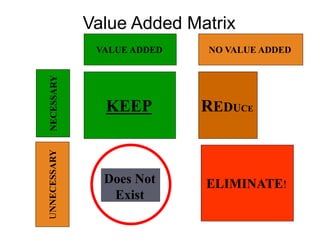
Value Added Matrix
VALUE ADDED NO VALUE ADDEDNECESSARYUNNECESSARY
KEEP REDUCE
ELIMINATE!Does Not
Exist
7 Forms of Waste
Transportation Movement between process steps that does
not add value
Waiting Idle time created when material, information,
people are not ready
Over-processing Effort that creates no additional value from the
customer’s perspective
Defects Work creating errors or lacking something
necessary for completion
Inventory More information, material, or projects on
hand than the customer needs right now
Movement or Motion Physical movement not adding value
Extra /Over-
Production
Generating more output than the customer
needs right now
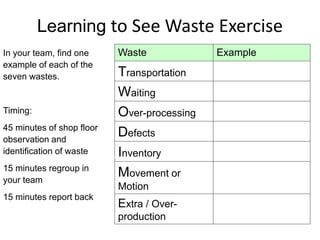
Learning to See Waste Exercise
In your team, find one
example of each of the
seven wastes.
Timing:
45 minutes of shop floor
observation and
identification of waste
15 minutes regroup in
your team
15 minutes report back
Waste Example
Transportation
Waiting
Over-processing
Defects
Inventory
Movement or
Motion
Extra / Over-
production
Automation Video
Q ) Find the wastes of below process
“Systems drive the behavior &
behavior drives the culture”
Iceberg of Lean
Activity – Personal PDCA
Summary
• Lean is a philosophy.
• Best way to learn lean is practice the lean
philosophy.
• Lean is a must.
• Start from your mind and spread it every
where.
• Use the lean tools after the lean meditation
(Gemba).

Lean philosophy

  • 1.
    Lean Philosophy C.J.Ratnayeke Executive Dipin Business Administration(UOC) Dip in Business Management (LVTC) Dip in Productivity (NPS-Sri Lanka)
  • 2.
    Earth • Radius: 6,371km • Area: 510.1 million km² • Surface area: 510.1 million km² • Mass: 5.972 × 10^24 kg • Distance from Sun: 149.6 million km • Gravity: 9.807 m/s²
  • 3.
    World Population Year 11000 1500 1650 1804 1927 1960 1975 1990 1999 2011 2025 (For) 2043 (For) 2083 (For) Population (Billion) 0.2 0.3 0.5 0.5 1.0 2.0 3.0 4.0 5.3 6.0 7.0 8.0 9.0 10.0 Density sqkm 0.39 0.54 0.88 0.98 1.96 3.92 5.88 7.84 10.39 11.76 13.72 15.68 17.64 19.60 Land per human sqkm 2.55 1.85 1.13 1.02 0.51 0.26 0.17 0.13 0.10 0.09 0.07 0.06 0.06 0.05
  • 4.
    World population 0.0 5.0 10.0 15.0 20.0 25.0 1 10001500 1650 1804 1927 1960 1975 1990 1999 2011 2025 2043 2083 Year Population(Billion) Density sqkm Land per human sqkm
  • 5.
    Module Objectives • UnderstandWaste Definition • Understand the Seven forms of Waste • Identify examples of each • Understand the main weapon of eliminating waste
  • 6.
    What are youpaying for? Pizza Dough ? Sauce ? Toppings ? Box? Toppings dropped on floor ? Energy for ovens ? Energy for ovens left open? Ovens left on overnight ? Phone ? Idle Workers?
  • 7.
    Focuses on theCustomer ► The Customer is the ONLY one who defines the VALUE of the product. ► Customers support suppliers who best meet their needs with additional business ► Anything not adding Value to the product is WASTE. ► Ask yourself: ► Would the Customer pay for this?
  • 8.
    Waste is: - anythingthat takes time, resources or space but does not add value to the product or service delivered to the customer. Lean : Identifying & removing the waste from any type of process. සම්පුර්ණ ක්‍රියාවලියක නාස්තීන් හඳුනාගෙන එය බැහැර කිරීගම් ක්‍රියාවලිය.
  • 9.
  • 10.
    THIS is theheart and soul of LEAN: “Eliminate the Waste from the System”.
  • 11.
  • 13.
    Toyota’s Famous Pursuitof Waste 1. Muda- (Waste) The seven forms of Waste, and the focus of this module 2. Muri- (Overburden) Overworking or stressing of an operator or machine 3. Mura- (Unevenness) The imbalance of workload amongst workers
  • 14.
    Three Types ofActivities Value Add Any activity that changes the shape, form, or function of material to meet customer requirements Non Value Add Activities that add cost but not value to the product (WASTE), as defined by the customer. Incidental / Necessary Work that needs to be done but does not add direct value to the part
  • 15.
    Value Added Matrix VALUEADDED NO VALUE ADDEDNECESSARYUNNECESSARY KEEP REDUCE ELIMINATE!Does Not Exist
  • 16.
    7 Forms ofWaste Transportation Movement between process steps that does not add value Waiting Idle time created when material, information, people are not ready Over-processing Effort that creates no additional value from the customer’s perspective Defects Work creating errors or lacking something necessary for completion Inventory More information, material, or projects on hand than the customer needs right now Movement or Motion Physical movement not adding value Extra /Over- Production Generating more output than the customer needs right now
  • 17.
    Learning to SeeWaste Exercise In your team, find one example of each of the seven wastes. Timing: 45 minutes of shop floor observation and identification of waste 15 minutes regroup in your team 15 minutes report back Waste Example Transportation Waiting Over-processing Defects Inventory Movement or Motion Extra / Over- production
  • 18.
    Automation Video Q )Find the wastes of below process
  • 19.
    “Systems drive thebehavior & behavior drives the culture”
  • 20.
  • 21.
  • 22.
    Summary • Lean isa philosophy. • Best way to learn lean is practice the lean philosophy. • Lean is a must. • Start from your mind and spread it every where. • Use the lean tools after the lean meditation (Gemba).