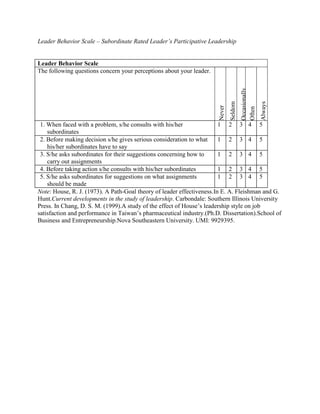
Leader Behavior Scale – Subordinate Rated Leader’s Participative Leadership


Leader Behavior Scale
The following questions concern your perceptions about your leader.


                                                                                       Occasionally
                                                                              Seldom


                                                                                                      Always
                                                                      Never


                                                                                       Often
 1. When faced with a problem, s/he consults with his/her               1 2 3 4 5
    subordinates
 2. Before making decision s/he gives serious consideration to what     1 2 3 4 5
    his/her subordinates have to say
 3. S/he asks subordinates for their suggestions concerning how to      1 2 3 4 5
    carry out assignments
 4. Before taking action s/he consults with his/her subordinates        1 2 3 4 5
 5. S/he asks subordinates for suggestions on what assignments          1 2 3 4 5
    should be made
Note: House, R. J. (1973). A Path-Goal theory of leader effectiveness.In E. A. Fleishman and G.
Hunt.Current developments in the study of leadership. Carbondale: Southern Illinois University
Press. In Chang, D. S. M. (1999).A study of the effect of House’s leadership style on job
satisfaction and performance in Taiwan’s pharmaceutical industry.(Ph.D. Dissertation).School of
Business and Entrepreneurship.Nova Southeastern University. UMI: 9929395.

Leader behavior scale

  • 1.
    Leader Behavior Scale– Subordinate Rated Leader’s Participative Leadership Leader Behavior Scale The following questions concern your perceptions about your leader. Occasionally Seldom Always Never Often 1. When faced with a problem, s/he consults with his/her 1 2 3 4 5 subordinates 2. Before making decision s/he gives serious consideration to what 1 2 3 4 5 his/her subordinates have to say 3. S/he asks subordinates for their suggestions concerning how to 1 2 3 4 5 carry out assignments 4. Before taking action s/he consults with his/her subordinates 1 2 3 4 5 5. S/he asks subordinates for suggestions on what assignments 1 2 3 4 5 should be made Note: House, R. J. (1973). A Path-Goal theory of leader effectiveness.In E. A. Fleishman and G. Hunt.Current developments in the study of leadership. Carbondale: Southern Illinois University Press. In Chang, D. S. M. (1999).A study of the effect of House’s leadership style on job satisfaction and performance in Taiwan’s pharmaceutical industry.(Ph.D. Dissertation).School of Business and Entrepreneurship.Nova Southeastern University. UMI: 9929395.