Submitted by:
Myanne Dobi P. Ontejo
Johann Dmitri Nagtalon
Paul Jaffas Roa
 Newton's laws of motion are three physical laws that together laid
the foundation for classical mechanics. They describe the
relationship between a body and the forces acting upon it, and its
motion in response to said forces.
 He had three laws:
1. Law of Inertia
2. Law of Acceleration
3. Law of Interaction
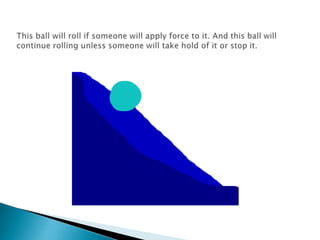
 Newton’s 1st Law of motion states that an object at rest stays at rest
unless an outside force causes it to move, or an object in motion
stays in motion unless a force is applied to stop it or change it’s
direction.
 If an object isn't moving at first, it won't move unless you force it to
move. If an object is moving (at a constant speed), it won't stop
unless you force it to slow down.
 Newton’s 2nd Law states that the acceleration of an object is directly
proportional to the force applied but inversely proportional to the
mass of the object
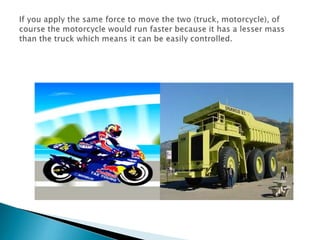
 The acceleration of an object depends on the strength of the net
force applied to it as well as on the mass of the object. The stronger
the force, the greater the acceleration of the object. The greater the
mass, the greater the mass will resist the force, and the smaller the
acceleration.
 Newton’s 3rd Law of Motion states that in every force of action, there
is an opposite and equal reaction.
 Forces come in action-reaction pairs. This means that for every
force there is a reaction force that is equal in size, but opposite in
direction. That is to say that whenever an object pushes
another object it gets pushed back in the opposite direction equally
hard.
Laws of motion 2
Laws of motion 2
Laws of motion 2

Laws of motion 2

  • 1.
    Submitted by: Myanne DobiP. Ontejo Johann Dmitri Nagtalon Paul Jaffas Roa
  • 3.
     Newton's lawsof motion are three physical laws that together laid the foundation for classical mechanics. They describe the relationship between a body and the forces acting upon it, and its motion in response to said forces.  He had three laws: 1. Law of Inertia 2. Law of Acceleration 3. Law of Interaction
  • 4.
     Newton’s 1stLaw of motion states that an object at rest stays at rest unless an outside force causes it to move, or an object in motion stays in motion unless a force is applied to stop it or change it’s direction.  If an object isn't moving at first, it won't move unless you force it to move. If an object is moving (at a constant speed), it won't stop unless you force it to slow down.
  • 6.
     Newton’s 2ndLaw states that the acceleration of an object is directly proportional to the force applied but inversely proportional to the mass of the object  The acceleration of an object depends on the strength of the net force applied to it as well as on the mass of the object. The stronger the force, the greater the acceleration of the object. The greater the mass, the greater the mass will resist the force, and the smaller the acceleration.
  • 8.
     Newton’s 3rdLaw of Motion states that in every force of action, there is an opposite and equal reaction.  Forces come in action-reaction pairs. This means that for every force there is a reaction force that is equal in size, but opposite in direction. That is to say that whenever an object pushes another object it gets pushed back in the opposite direction equally hard.