The                  EffectSusan ShanklesTPD Crime Lab SuperintendentHon. Teresa GodoySuperior Court Judge & Former Prosecutor
CSI effect – Many definitionsThe best-known definition states that CSI creates unreasonable expectations on the part of jurors, making it more difficult for prosecutors to obtain convictions. The second definition, which runs contrary to the first, refers to the way that CSI raises the stature of scientific evidence to virtual infallibility, thus making scientific evidence impenetrable.  The final definition focuses on CSI's increasing lay interest in forensics and science. Thus, viewers who serve as jurors will be more interested in and able to follow scientific evidence.  They may even become interested in academic training and careers in the forensics field.
CSI effect in the courtroom
Who does this “effect” affect?PoliceOver-collect evidence; higher expectations of the value of evidence in solving a caseAttorneysBurden to request tests to cover all eventualitiesMay dismiss certain cases for lack of forensic evidenceJuriesView a lack of forensic evidence as “reasonable doubt”Hold forensic evidence as infallible or unrebuttable proof of guiltForensic LabsCost overrunsBacklogs
Juror PerspectiveExpect to see solid physical evidence indicating the defendantLikely to ignore circumstantial evidence Always assume DNA evidence should be found at the sceneIf physical evidence is found, it is now much less likely to be questioned by jurors
CSI and the CourtroomExperts have claimed an incidence of the “CSI effect” in courtroomsTrend in which TV shows increase the expectations of victims’ and jury members’ concerning forensic evidence and the level of crime scene investigationEvidence is being presented differently at trial
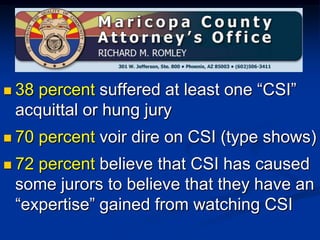
38 percent suffered at least one “CSI” acquittal or hung jury70 percent voir dire on CSI (type shows)72 percent believe that CSI has caused some jurors to believe that they have an “expertise” gained from watching CSI
Jurors demanding DNAIn a recent murder trial in Phoenix, a bloody coat was introduced as evidence. It was not tested for DNA. The jury informed the judge that testing was not performed on the coat even though it was not needed because the defendant admitted that the coat was his. The judge then determined that “television had taught the jury what DNA tests were but didn’t teach them in what circumstances they can be used in”
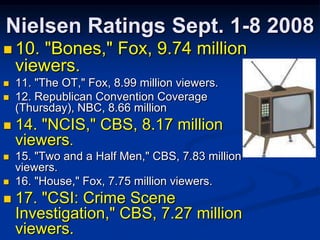
Nielsen Ratings Sept. 1-8 200810. "Bones," Fox, 9.74 million viewers. 11. "The OT," Fox, 8.99 million viewers.12. Republican Convention Coverage (Thursday), NBC, 8.66 million14. "NCIS," CBS, 8.17 million viewers.15. "Two and a Half Men," CBS, 7.83 million viewers.16. "House," Fox, 7.75 million viewers.17. "CSI: Crime Scene Investigation," CBS, 7.27 million viewers.
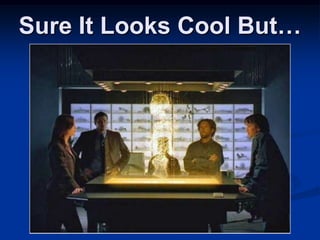
Sure It Looks Cool But…
Science vs. EntertainmentTruth doesn’t always make good fictionStory lines need to be “jazzed” to meet the current trends in entertainmentIt’s all about the ratings, not the facts of the caseDramatizations “clean up” the messy truthMore makeup and larger budgetsEverything gets solved in an hour
Interesting Facts“40 percent of the ‘forensic science’ in these shows does not even exist.  That’s why CSI won a Saturn Award for the best science fiction drama in 2004, beating out Buffy the Vampire Slayer.” –Jennifer Joyce, circuit attorneyThe real Miami Forensic Crime Lab has stated that the way CSI-Miami portrays one case would bankrupt the budget for the entire year.
CSI MythsMyth 1:  Laboratory Personnel can examine evidence as soon as it gets to the labUsually takes months before time permits an examination of the evidence due to back logs and quality control procedures
Myth 2:  One person can examine all types of evidenceThere are few ‘generalists’ in today’s forensicsThe expertise required for each section of forensics sometimes requires one piece of evidence to be examined by more than one individual
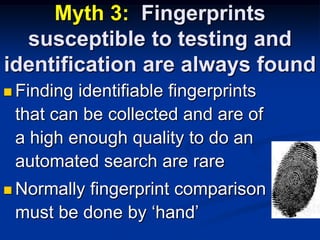
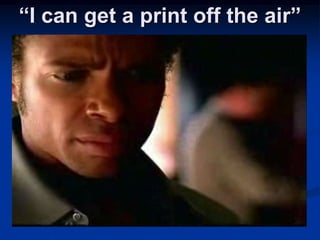
Myth 3:  Fingerprints susceptible to testing and identification are always foundFinding identifiable fingerprints that can be collected and are of a high enough quality to do an automated search are rareNormally fingerprint comparison must be done by ‘hand’
“I can get a print off the air”
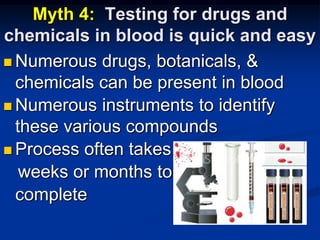
Myth 4:  Testing for drugs and chemicals in blood is quick and easyNumerous drugs, botanicals, & chemicals can be present in bloodNumerous instruments to identify these various compoundsProcess often takes    weeks or months to 	complete
Myth 5:  The cooperative crime sceneThe ‘perfect’ evidence is rarely thereTechnology has greatly improved evidence collection but no technological advancements can find nonexistent evidenceTime between occurrence and discovery of the crime is the biggest factor
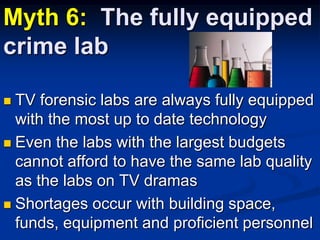
Myth 6:  The fully equipped crime labTV forensic labs are always fully equipped with the most up to date technologyEven the labs with the largest budgets cannot afford to have the same lab quality as the labs on TV dramasShortages occur with building space, funds, equipment and proficient personnel
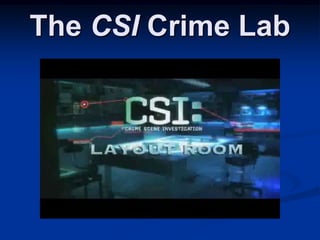
The CSI Crime Lab
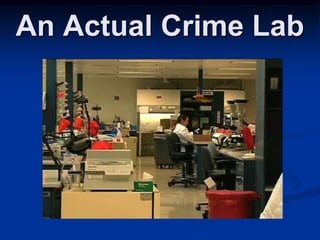
An Actual Crime Lab
Top 10 Reasons Forensic Science is Not Like CSI10. A forensic entomologist is never in charge.  9. Won't move to a new city to get better ratings.8. Real forensic labs can afford light bulbs.  7. Hummers are not standard issue work vehicles.  6. DNA results take weeks, not minutes or hours.  5. Weapons are microscopes and test tubes - not Glock 9s and Sig Sauer P229s  4. Not every sample gets run on the GC/MS.  3. Don’t interview suspects  2. Indoor crime scenes are very dirty and messy.  1. It takes longer than 1 hour to solve a case.
How Things Have ChangedNo DNA- blood typing is as good as it got.Fingerprint analysis was done completely by hand.Databases for fingerprints/DNA didn’t exist.Technology
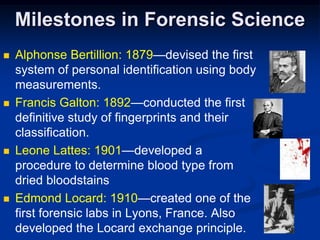
Milestones in Forensic ScienceAlphonse Bertillion: 1879—devised the first system of personal identification using body measurements.Francis Galton: 1892—conducted the first definitive study of fingerprints and their classification.Leone Lattes: 1901—developed a procedure to determine blood type from dried bloodstainsEdmond Locard: 1910—created one of the first forensic labs in Lyons, France. Also developed the Locard exchange principle.
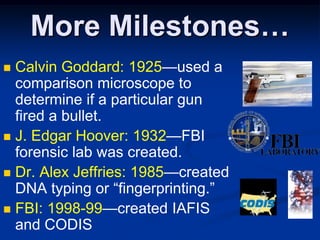
More Milestones…Calvin Goddard: 1925—used a comparison microscope to determine if a particular gun fired a bullet.J. Edgar Hoover: 1932—FBI forensic lab was created.Dr. Alex Jeffries: 1985—created DNA typing or “fingerprinting.”FBI: 1998-99—created IAFIS and CODIS
Another Effect:Increased Public Awareness of ForensicsSome people now look forward to jury dutyBetter sense of investigationsPopularized investigatory science programsShifting demographics in forensics field
Efforts to Minimize Potential EffectsIn Arizona prosecutors now use "negative evidence witnesses" to try to assure jurors that it is not unusual for real crime-scene investigators to fail to find DNA, fingerprints and other evidence at crime scenes.Prosecutors often question the jury about their TV viewing habits during voir dire.
Are You Interested in a Career in Forensic Science?Add CSI Summer School Video
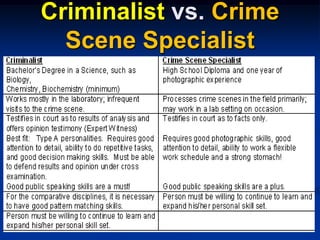
Criminalist vs. Crime Scene Specialist
Thank You

Law day presentation

  • 2.
    The EffectSusan ShanklesTPD Crime Lab SuperintendentHon. Teresa GodoySuperior Court Judge & Former Prosecutor
  • 3.
    CSI effect –Many definitionsThe best-known definition states that CSI creates unreasonable expectations on the part of jurors, making it more difficult for prosecutors to obtain convictions. The second definition, which runs contrary to the first, refers to the way that CSI raises the stature of scientific evidence to virtual infallibility, thus making scientific evidence impenetrable. The final definition focuses on CSI's increasing lay interest in forensics and science. Thus, viewers who serve as jurors will be more interested in and able to follow scientific evidence. They may even become interested in academic training and careers in the forensics field.
  • 4.
    CSI effect inthe courtroom
  • 5.
    Who does this“effect” affect?PoliceOver-collect evidence; higher expectations of the value of evidence in solving a caseAttorneysBurden to request tests to cover all eventualitiesMay dismiss certain cases for lack of forensic evidenceJuriesView a lack of forensic evidence as “reasonable doubt”Hold forensic evidence as infallible or unrebuttable proof of guiltForensic LabsCost overrunsBacklogs
  • 6.
    Juror PerspectiveExpect tosee solid physical evidence indicating the defendantLikely to ignore circumstantial evidence Always assume DNA evidence should be found at the sceneIf physical evidence is found, it is now much less likely to be questioned by jurors
  • 8.
    CSI and theCourtroomExperts have claimed an incidence of the “CSI effect” in courtroomsTrend in which TV shows increase the expectations of victims’ and jury members’ concerning forensic evidence and the level of crime scene investigationEvidence is being presented differently at trial
  • 9.
    38 percent sufferedat least one “CSI” acquittal or hung jury70 percent voir dire on CSI (type shows)72 percent believe that CSI has caused some jurors to believe that they have an “expertise” gained from watching CSI
  • 10.
    Jurors demanding DNAIna recent murder trial in Phoenix, a bloody coat was introduced as evidence. It was not tested for DNA. The jury informed the judge that testing was not performed on the coat even though it was not needed because the defendant admitted that the coat was his. The judge then determined that “television had taught the jury what DNA tests were but didn’t teach them in what circumstances they can be used in”
  • 11.
    Nielsen Ratings Sept.1-8 200810. "Bones," Fox, 9.74 million viewers. 11. "The OT," Fox, 8.99 million viewers.12. Republican Convention Coverage (Thursday), NBC, 8.66 million14. "NCIS," CBS, 8.17 million viewers.15. "Two and a Half Men," CBS, 7.83 million viewers.16. "House," Fox, 7.75 million viewers.17. "CSI: Crime Scene Investigation," CBS, 7.27 million viewers.
  • 12.
    Sure It LooksCool But…
  • 13.
    Science vs. EntertainmentTruthdoesn’t always make good fictionStory lines need to be “jazzed” to meet the current trends in entertainmentIt’s all about the ratings, not the facts of the caseDramatizations “clean up” the messy truthMore makeup and larger budgetsEverything gets solved in an hour
  • 14.
    Interesting Facts“40 percentof the ‘forensic science’ in these shows does not even exist. That’s why CSI won a Saturn Award for the best science fiction drama in 2004, beating out Buffy the Vampire Slayer.” –Jennifer Joyce, circuit attorneyThe real Miami Forensic Crime Lab has stated that the way CSI-Miami portrays one case would bankrupt the budget for the entire year.
  • 15.
    CSI MythsMyth 1: Laboratory Personnel can examine evidence as soon as it gets to the labUsually takes months before time permits an examination of the evidence due to back logs and quality control procedures
  • 16.
    Myth 2: One person can examine all types of evidenceThere are few ‘generalists’ in today’s forensicsThe expertise required for each section of forensics sometimes requires one piece of evidence to be examined by more than one individual
  • 17.
    Myth 3: Fingerprints susceptible to testing and identification are always foundFinding identifiable fingerprints that can be collected and are of a high enough quality to do an automated search are rareNormally fingerprint comparison must be done by ‘hand’
  • 18.
    “I can geta print off the air”
  • 19.
    Myth 4: Testing for drugs and chemicals in blood is quick and easyNumerous drugs, botanicals, & chemicals can be present in bloodNumerous instruments to identify these various compoundsProcess often takes weeks or months to complete
  • 20.
    Myth 5: The cooperative crime sceneThe ‘perfect’ evidence is rarely thereTechnology has greatly improved evidence collection but no technological advancements can find nonexistent evidenceTime between occurrence and discovery of the crime is the biggest factor
  • 21.
    Myth 6: The fully equipped crime labTV forensic labs are always fully equipped with the most up to date technologyEven the labs with the largest budgets cannot afford to have the same lab quality as the labs on TV dramasShortages occur with building space, funds, equipment and proficient personnel
  • 22.
  • 23.
  • 24.
    Top 10 ReasonsForensic Science is Not Like CSI10. A forensic entomologist is never in charge. 9. Won't move to a new city to get better ratings.8. Real forensic labs can afford light bulbs. 7. Hummers are not standard issue work vehicles. 6. DNA results take weeks, not minutes or hours. 5. Weapons are microscopes and test tubes - not Glock 9s and Sig Sauer P229s 4. Not every sample gets run on the GC/MS. 3. Don’t interview suspects 2. Indoor crime scenes are very dirty and messy. 1. It takes longer than 1 hour to solve a case.
  • 25.
    How Things HaveChangedNo DNA- blood typing is as good as it got.Fingerprint analysis was done completely by hand.Databases for fingerprints/DNA didn’t exist.Technology
  • 26.
    Milestones in ForensicScienceAlphonse Bertillion: 1879—devised the first system of personal identification using body measurements.Francis Galton: 1892—conducted the first definitive study of fingerprints and their classification.Leone Lattes: 1901—developed a procedure to determine blood type from dried bloodstainsEdmond Locard: 1910—created one of the first forensic labs in Lyons, France. Also developed the Locard exchange principle.
  • 27.
    More Milestones…Calvin Goddard:1925—used a comparison microscope to determine if a particular gun fired a bullet.J. Edgar Hoover: 1932—FBI forensic lab was created.Dr. Alex Jeffries: 1985—created DNA typing or “fingerprinting.”FBI: 1998-99—created IAFIS and CODIS
  • 28.
    Another Effect:Increased PublicAwareness of ForensicsSome people now look forward to jury dutyBetter sense of investigationsPopularized investigatory science programsShifting demographics in forensics field
  • 29.
    Efforts to MinimizePotential EffectsIn Arizona prosecutors now use "negative evidence witnesses" to try to assure jurors that it is not unusual for real crime-scene investigators to fail to find DNA, fingerprints and other evidence at crime scenes.Prosecutors often question the jury about their TV viewing habits during voir dire.
  • 30.
    Are You Interestedin a Career in Forensic Science?Add CSI Summer School Video
  • 31.
    Criminalist vs. CrimeScene Specialist
  • 32.