LATERAL VIOLENCE IN
PERIOPERATIVE
NURSING
NR. N.M SAMBO
RPON,MScN
 Introduction
 What is lateral violence
 What causes lateral violence
 Who is doing it?
 Types.
 Effects.
 What can be done
 Summary.
OUTLINE
 To identify terms use to describe negative
coworker behavior
 Describe an experience with negative coworker
behavior
 Discuss strategies to manage negative coworker
behavior
 Summary and conclusion
Objectives
 Lateral violence (LV) is disruptive, bullying, intimidating, or
unsettling behavior that occurs between nurses in the workplace.
 The perioperative setting fosters lateral violence because of the
inherent stress of performing surgery; high patient acuity; a
shortage of experienced personnel; work demands; and the
restriction and isolation of the OR, which allows negative
behaviors to be concealed more easily.
 Workplace violence can be classified according to its structure as
either vertical or horizontal. Vertical violence involves both
health care workers and patients, while horizontal violence
occurs exclusively between health care workers or patients
themselves
 Linda Rabyj, 2005
Introduction To LATERAL VIOLENCE
 Nurse-to-Nurse violence, incivility, and disruptive
behaviours, creates an unpleasant work environment
and has harmful effects on individual nurses, patient
safety, and health care organizations.
 Lateral Violence (LV) is a non-physical, aggressive,
hostile, and/or harmful behavior between coworkers.
 It is a spectrum, from seemingly ordinary behaviour
such as ; gossiping or criticism, to intimidation, racism,
hoarding of information, intentional exclusion ,
refusing to help and outright physical intimidation or
harm.ā€
Johnson, 2009 & Dimarino, 2011
Definition Lateral Violence (LV)
,
 Whatever form lateral violence may take, ā€œA
healthy work environment is primarily the
responsibility of the leader.
 The leader sets the expectations, the tone, and,
especially, the level of tolerance for the amount
of bullying or unhealthy behaviors in the
workplace.ā€
 The theatre manager must stress this to all
theatre users
IMPORTANCE OF THIS TOPIC TO PON
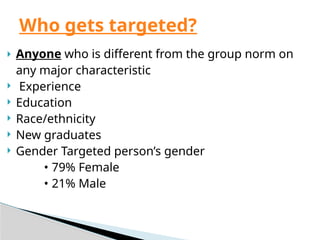
 Anyone who is different from the group norm on
any major characteristic
 Experience
 Education
 Race/ethnicity
 New graduates
 Gender Targeted person’s gender
• 79% Female
• 21% Male
Who gets targeted?
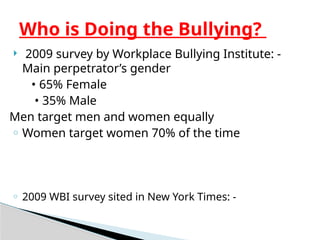
 2009 survey by Workplace Bullying Institute: -
Main perpetrator’s gender
• 65% Female
• 35% Male
Men target men and women equally
o Women target women 70% of the time
o 2009 WBI survey sited in New York Times: -
Who is Doing the Bullying?
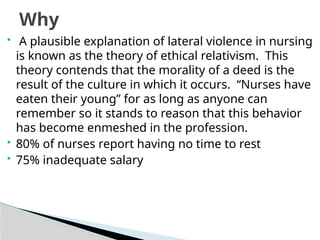
ļ‚§ A plausible explanation of lateral violence in nursing
is known as the theory of ethical relativism. This
theory contends that the morality of a deed is the
result of the culture in which it occurs. ā€œNurses have
eaten their youngā€ for as long as anyone can
remember so it stands to reason that this behavior
has become enmeshed in the profession.
ļ‚§ 80% of nurses report having no time to rest
ļ‚§ 75% inadequate salary
Why
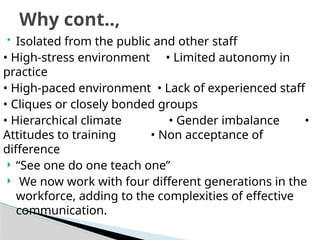
ļ‚§ Isolated from the public and other staff
• High-stress environment • Limited autonomy in
practice
• High-paced environment • Lack of experienced staff
• Cliques or closely bonded groups
• Hierarchical climate • Gender imbalance •
Attitudes to training • Non acceptance of
difference
 ā€œSee one do one teach oneā€
 We now work with four different generations in the
workforce, adding to the complexities of effective
communication.
Why cont..,
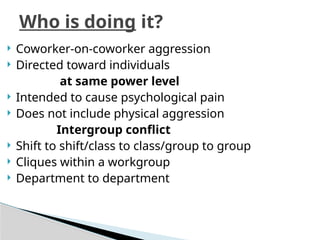
 Coworker-on-coworker aggression
 Directed toward individuals
at same power level
 Intended to cause psychological pain
 Does not include physical aggression
Intergroup conflict
 Shift to shift/class to class/group to group
 Cliques within a workgroup
 Department to department
Who is doing it?
Sydney based clinical psychologist and workplace
bullying specialist Keryl Egan has formulated three
workplace bully profiles:
1.Accidental bully
2.Narcissistic bully
3.Serial bully
Griffin. 2004
Three types of BULLIES
 Accidental bully This person is task orientated and
just wants to get things done, tends to panic when
things are not getting done, and goes into a rage
about it.
 This person is basically decent, they don’t really
think about the impact of what’s happening or what
they have done.
 They are responding to stress and it is believed that
they can be coached out of this behavior
Accidental
 Narcissistic Bully They are grandiose and have
dreams of breath taking achievement.
 They feel they deserve power and position.
 They can fly into a rage when reality confronts
them.
 This person is very destructive and manipulative,
they don’t set out in a callous way to annihilate any
person – it is purely an expression of their
superiority.
Narcissistic
 Serial Bully Has a sociopathic and psychopathic
personality. This type of bully is intentional, systematic
and organized and is often relentless. They usually get
things done in terms of self-interest. They employ
subtle techniques that are difficult to detect or prove.
Coaching is often ineffective. They exhibit the following:
 Grandiose, but charming • Authoritative,
aggressive and dominating
 Fearless and shameless
 Devoid of empathy or remorse
 Manipulative and deceptive
 Impulsive, chaotic or stimulus seeking
 Master of imitation or mimicry
Serial Bully
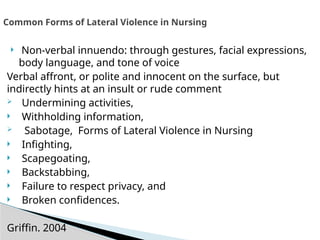
 Non-verbal innuendo: through gestures, facial expressions,
body language, and tone of voice
Verbal affront, or polite and innocent on the surface, but
indirectly hints at an insult or rude comment
 Undermining activities,
 Withholding information,
 Sabotage, Forms of Lateral Violence in Nursing
 Infighting,
 Scapegoating,
 Backstabbing,
 Failure to respect privacy, and
 Broken confidences.
Griffin. 2004
Common Forms of Lateral Violence in Nursing
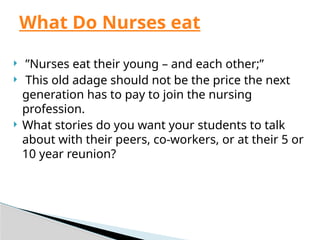
 ā€Nurses eat their young – and each other;ā€
 This old adage should not be the price the next
generation has to pay to join the nursing
profession.
 What stories do you want your students to talk
about with their peers, co-workers, or at their 5 or
10 year reunion?
What Do Nurses eat
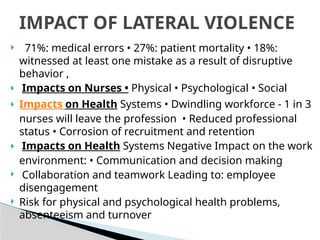
 71%: medical errors • 27%: patient mortality • 18%:
witnessed at least one mistake as a result of disruptive
behavior ,
 Impacts on Nurses • Physical • Psychological • Social
 Impacts on Health Systems • Dwindling workforce - 1 in 3
nurses will leave the profession • Reduced professional
status • Corrosion of recruitment and retention
 Impacts on Health Systems Negative Impact on the work
environment: • Communication and decision making
 Collaboration and teamwork Leading to: employee
disengagement
 Risk for physical and psychological health problems,
absenteeism and turnover
IMPACT OF LATERAL VIOLENCE
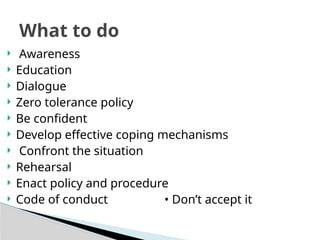
 Awareness
 Education
 Dialogue
 Zero tolerance policy
 Be confident
 Develop effective coping mechanisms
 Confront the situation
 Rehearsal
 Enact policy and procedure
 Code of conduct • Don’t accept it
What to do
 Involve everyone in solving problems related to LV.
 Develop a set of ā€œRIGHTSā€ for everyone.
 Effective anti-bullying practices must include a statement of
exactly what constitutes bullying.
 Takle the culture of Intimidation
 Open communication & increased communication to
nursing managers.
 Providing accessible professional development opportunities
for all staff.
 Developing a policy on bullying/lateral violence in the work-
place and conflict resolution mechanisms.
 Self-reflection and active feedback from our peers to
develop insight into our own behaviour
 ā€œWe’re 200% accountable for our work environment—100%
from me and 100% from you.
Teamwork and
Communication
 When there is an event that needs handling in the
OR a ā€œCode Pinkā€ is called.
 A group of available individuals from other theaters
will come to the perpetrators theater and stand
silently staring at them.
 As an example, the surgeon is shouting, being
verbally abusive or throwing equipment.
Mehallow, C. Verbal Abuse in Healthcare.
http://healthcare.monster.com/nursing/articles/verbalabuse/
Witnesses a Code Pink?
 Bullying in nursing is harmful to the targets of violence,
their co-workers, and ultimately their patients. Bullying
magnifies the marginalization of nursing
 Exposing nurses to a hostile workplace increases the
likelihood of mistakes, errors, and omissions in care
delivery.
 Nurses must draw on more than their knowledge base or
skill proficiencies to combat bullying.
 Leadership, conflict resolution, communication and
problem solving skills is what is needed to challenge
disruptive behaviors and foster a workspace that is positive,
inclusive, and professional.
 Communication, collaboration, respect, trust, and
teamwork are the building blocks of a safe, effective work
environment.
Summary/ Conclusion
THANK YOU FOR
YOUR TIME

LATERAL VIOLENCE IN PERIOPERATIVE NURSING

  • 1.
  • 2.
     Introduction  Whatis lateral violence  What causes lateral violence  Who is doing it?  Types.  Effects.  What can be done  Summary. OUTLINE
  • 3.
     To identifyterms use to describe negative coworker behavior  Describe an experience with negative coworker behavior  Discuss strategies to manage negative coworker behavior  Summary and conclusion Objectives
  • 4.
     Lateral violence(LV) is disruptive, bullying, intimidating, or unsettling behavior that occurs between nurses in the workplace.  The perioperative setting fosters lateral violence because of the inherent stress of performing surgery; high patient acuity; a shortage of experienced personnel; work demands; and the restriction and isolation of the OR, which allows negative behaviors to be concealed more easily.  Workplace violence can be classified according to its structure as either vertical or horizontal. Vertical violence involves both health care workers and patients, while horizontal violence occurs exclusively between health care workers or patients themselves  Linda Rabyj, 2005 Introduction To LATERAL VIOLENCE
  • 5.
     Nurse-to-Nurse violence,incivility, and disruptive behaviours, creates an unpleasant work environment and has harmful effects on individual nurses, patient safety, and health care organizations.  Lateral Violence (LV) is a non-physical, aggressive, hostile, and/or harmful behavior between coworkers.  It is a spectrum, from seemingly ordinary behaviour such as ; gossiping or criticism, to intimidation, racism, hoarding of information, intentional exclusion , refusing to help and outright physical intimidation or harm.ā€ Johnson, 2009 & Dimarino, 2011 Definition Lateral Violence (LV) ,
  • 6.
     Whatever formlateral violence may take, ā€œA healthy work environment is primarily the responsibility of the leader.  The leader sets the expectations, the tone, and, especially, the level of tolerance for the amount of bullying or unhealthy behaviors in the workplace.ā€  The theatre manager must stress this to all theatre users IMPORTANCE OF THIS TOPIC TO PON
  • 7.
     Anyone whois different from the group norm on any major characteristic  Experience  Education  Race/ethnicity  New graduates  Gender Targeted person’s gender • 79% Female • 21% Male Who gets targeted?
  • 8.
     2009 surveyby Workplace Bullying Institute: - Main perpetrator’s gender • 65% Female • 35% Male Men target men and women equally o Women target women 70% of the time o 2009 WBI survey sited in New York Times: - Who is Doing the Bullying?
  • 9.
    ļ‚§ A plausibleexplanation of lateral violence in nursing is known as the theory of ethical relativism. This theory contends that the morality of a deed is the result of the culture in which it occurs. ā€œNurses have eaten their youngā€ for as long as anyone can remember so it stands to reason that this behavior has become enmeshed in the profession. ļ‚§ 80% of nurses report having no time to rest ļ‚§ 75% inadequate salary Why
  • 10.
    ļ‚§ Isolated fromthe public and other staff • High-stress environment • Limited autonomy in practice • High-paced environment • Lack of experienced staff • Cliques or closely bonded groups • Hierarchical climate • Gender imbalance • Attitudes to training • Non acceptance of difference  ā€œSee one do one teach oneā€  We now work with four different generations in the workforce, adding to the complexities of effective communication. Why cont..,
  • 11.
     Coworker-on-coworker aggression Directed toward individuals at same power level  Intended to cause psychological pain  Does not include physical aggression Intergroup conflict  Shift to shift/class to class/group to group  Cliques within a workgroup  Department to department Who is doing it?
  • 12.
    Sydney based clinicalpsychologist and workplace bullying specialist Keryl Egan has formulated three workplace bully profiles: 1.Accidental bully 2.Narcissistic bully 3.Serial bully Griffin. 2004 Three types of BULLIES
  • 13.
     Accidental bullyThis person is task orientated and just wants to get things done, tends to panic when things are not getting done, and goes into a rage about it.  This person is basically decent, they don’t really think about the impact of what’s happening or what they have done.  They are responding to stress and it is believed that they can be coached out of this behavior Accidental
  • 14.
     Narcissistic BullyThey are grandiose and have dreams of breath taking achievement.  They feel they deserve power and position.  They can fly into a rage when reality confronts them.  This person is very destructive and manipulative, they don’t set out in a callous way to annihilate any person – it is purely an expression of their superiority. Narcissistic
  • 15.
     Serial BullyHas a sociopathic and psychopathic personality. This type of bully is intentional, systematic and organized and is often relentless. They usually get things done in terms of self-interest. They employ subtle techniques that are difficult to detect or prove. Coaching is often ineffective. They exhibit the following:  Grandiose, but charming • Authoritative, aggressive and dominating  Fearless and shameless  Devoid of empathy or remorse  Manipulative and deceptive  Impulsive, chaotic or stimulus seeking  Master of imitation or mimicry Serial Bully
  • 16.
     Non-verbal innuendo:through gestures, facial expressions, body language, and tone of voice Verbal affront, or polite and innocent on the surface, but indirectly hints at an insult or rude comment  Undermining activities,  Withholding information,  Sabotage, Forms of Lateral Violence in Nursing  Infighting,  Scapegoating,  Backstabbing,  Failure to respect privacy, and  Broken confidences. Griffin. 2004 Common Forms of Lateral Violence in Nursing
  • 17.
     ā€Nurses eattheir young – and each other;ā€  This old adage should not be the price the next generation has to pay to join the nursing profession.  What stories do you want your students to talk about with their peers, co-workers, or at their 5 or 10 year reunion? What Do Nurses eat
  • 18.
     71%: medicalerrors • 27%: patient mortality • 18%: witnessed at least one mistake as a result of disruptive behavior ,  Impacts on Nurses • Physical • Psychological • Social  Impacts on Health Systems • Dwindling workforce - 1 in 3 nurses will leave the profession • Reduced professional status • Corrosion of recruitment and retention  Impacts on Health Systems Negative Impact on the work environment: • Communication and decision making  Collaboration and teamwork Leading to: employee disengagement  Risk for physical and psychological health problems, absenteeism and turnover IMPACT OF LATERAL VIOLENCE
  • 19.
     Awareness  Education Dialogue  Zero tolerance policy  Be confident  Develop effective coping mechanisms  Confront the situation  Rehearsal  Enact policy and procedure  Code of conduct • Don’t accept it What to do
  • 20.
     Involve everyonein solving problems related to LV.  Develop a set of ā€œRIGHTSā€ for everyone.  Effective anti-bullying practices must include a statement of exactly what constitutes bullying.  Takle the culture of Intimidation  Open communication & increased communication to nursing managers.  Providing accessible professional development opportunities for all staff.  Developing a policy on bullying/lateral violence in the work- place and conflict resolution mechanisms.  Self-reflection and active feedback from our peers to develop insight into our own behaviour  ā€œWe’re 200% accountable for our work environment—100% from me and 100% from you. Teamwork and Communication
  • 21.
     When thereis an event that needs handling in the OR a ā€œCode Pinkā€ is called.  A group of available individuals from other theaters will come to the perpetrators theater and stand silently staring at them.  As an example, the surgeon is shouting, being verbally abusive or throwing equipment. Mehallow, C. Verbal Abuse in Healthcare. http://healthcare.monster.com/nursing/articles/verbalabuse/ Witnesses a Code Pink?
  • 22.
     Bullying innursing is harmful to the targets of violence, their co-workers, and ultimately their patients. Bullying magnifies the marginalization of nursing  Exposing nurses to a hostile workplace increases the likelihood of mistakes, errors, and omissions in care delivery.  Nurses must draw on more than their knowledge base or skill proficiencies to combat bullying.  Leadership, conflict resolution, communication and problem solving skills is what is needed to challenge disruptive behaviors and foster a workspace that is positive, inclusive, and professional.  Communication, collaboration, respect, trust, and teamwork are the building blocks of a safe, effective work environment. Summary/ Conclusion
  • 23.