Universal Design for Learning Assistive Technology
Assistive Technology Toolkit URL: http://projects.cbe.ab.ca/sss/ilscommunity/learningspaces/assistive-toolkit.asp What skills and knowledge do we already have to move forward with AT? What gaps are present in relation to knowledge and skills that need to be considered?
Results Now Underdeveloped literacy skills are the number one reason why students are retained, assigned to special education, given long-term remedial services, and why they fail to graduate from high school. Vincent Ferrandino and Gerald Tirozzi Adolescents entering the adult world in the 21 st  century will read and write more than at another time in human history.  They will need advanced levels of lteracy to perform their jobs, run their households, act as citizens, and conduct their personal lives. Richard Vaccas
What is Universal Design for Learning (UDL) Multiple means of representation  to give learners various ways of acquiring information and knowledge Multiple means of expression  to provide learners alternatives for demonstrating what they know, and Multiple means of engagement  to tap into learners' interests, challenge them appropriately, and motivate them to learn Cast Website
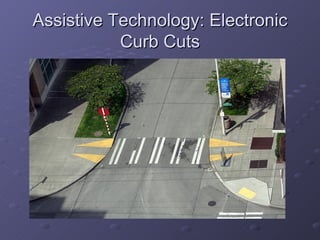
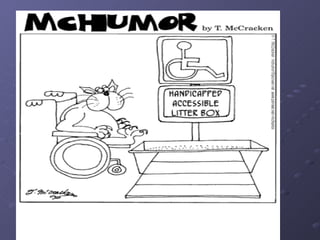
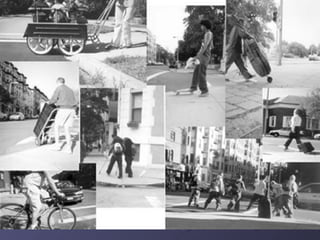
Assistive Technology: Electronic Curb Cuts


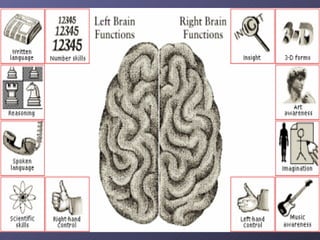
Assistive Technology  Feidorowicz (2005)concludes that” not that learning disabled students cannot learn, only that there are brain differences. Learning disabled students can learn, but they must learn in different ways, different rates, and possibly with different areas of the brain. (Fiedorowicz, 2005).
 
 
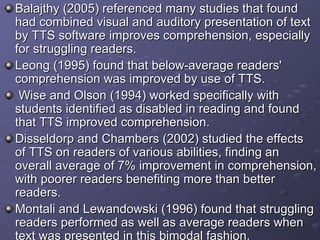
Balajthy (2005) referenced many studies that found had combined visual and auditory presentation of text by TTS software improves comprehension, especially for struggling readers.  Leong (1995) found that below-average readers' comprehension was improved by use of TTS. Wise and Olson (1994) worked specifically with students identified as disabled in reading and found that TTS improved comprehension.  Disseldorp and Chambers (2002) studied the effects of TTS on readers of various abilities, finding an overall average of 7% improvement in comprehension, with poorer readers benefiting more than better readers.  Montali and Lewandowski (1996) found that struggling readers performed as well as average readers when text was presented in this bimodal fashion.
Lailey's presentation

  • 1.
    Universal Design forLearning Assistive Technology
  • 2.
    Assistive Technology ToolkitURL: http://projects.cbe.ab.ca/sss/ilscommunity/learningspaces/assistive-toolkit.asp What skills and knowledge do we already have to move forward with AT? What gaps are present in relation to knowledge and skills that need to be considered?
  • 3.
    Results Now Underdevelopedliteracy skills are the number one reason why students are retained, assigned to special education, given long-term remedial services, and why they fail to graduate from high school. Vincent Ferrandino and Gerald Tirozzi Adolescents entering the adult world in the 21 st century will read and write more than at another time in human history. They will need advanced levels of lteracy to perform their jobs, run their households, act as citizens, and conduct their personal lives. Richard Vaccas
  • 4.
    What is UniversalDesign for Learning (UDL) Multiple means of representation to give learners various ways of acquiring information and knowledge Multiple means of expression to provide learners alternatives for demonstrating what they know, and Multiple means of engagement to tap into learners' interests, challenge them appropriately, and motivate them to learn Cast Website
  • 5.
  • 6.
  • 7.
  • 8.
  • 9.
  • 10.
    Assistive Technology Feidorowicz (2005)concludes that” not that learning disabled students cannot learn, only that there are brain differences. Learning disabled students can learn, but they must learn in different ways, different rates, and possibly with different areas of the brain. (Fiedorowicz, 2005).
  • 11.
  • 12.
  • 13.
    Balajthy (2005) referencedmany studies that found had combined visual and auditory presentation of text by TTS software improves comprehension, especially for struggling readers. Leong (1995) found that below-average readers' comprehension was improved by use of TTS. Wise and Olson (1994) worked specifically with students identified as disabled in reading and found that TTS improved comprehension. Disseldorp and Chambers (2002) studied the effects of TTS on readers of various abilities, finding an overall average of 7% improvement in comprehension, with poorer readers benefiting more than better readers. Montali and Lewandowski (1996) found that struggling readers performed as well as average readers when text was presented in this bimodal fashion.