Labs 21 is a Registered Provider with The American Institute of Architects Continuing Education Systems. Credit earned on completion of this program will be reported to CES Records for AIA members. Certificates of Completion for non-AIA members are available on request. This program is registered with the AIA/CES for continuing professional education. As such, it does not include content that may be deemed or construed to be an approval of endorsement by the AIA of any material of construction or any method of manner of handling, using, distributing, or dealing in any material or product. Questions related to specific materials, methods, and services will be addressed a the conclusion of this presentation. It is the opinion of this presenter that legal mumbo jumbo at the beginning of a presentation is a waste of electricity.
Eric Peabody Project Manager The Design Partnership www.dpsf.com  [email_address] Speaker's Expertise:  LEED Accredited Professional Led firm-wide transition to BIM Eric Peabody’s work as a laboratory designer includes: University of California San Francisco, Health Sciences West 4th Floor Pathology Lab University of California San Francisco, SB1953 Seismic Rehabilitation University of California San Francisco, Medical Science Improvements Phase 2 University of California San Francisco, Medical Research Building 1 and 2 Demolition University of California San Francisco, S380 S/M Remodel University of California San Francisco, MSB 409-427 Remodel San Francisco General Hospital, Radiology Assessment The Design Partnership
Christie Johnson Coffin Senior Architect / Planner The Design Partnership www.dpsf.com [email_address] Speaker's Expertise:  Architect / Planner / Adjunct Professor University of Oregon LEED Accredited Professional Christie Coffin’s work as a laboratory architect includes: University of Oregon Science Complex National Yang Ming University Biotechnology / Library Building National Taiwan University Children’s Hospital Research Institute University of California Santa Barbara Physical Sciences Buildings University of California Irvine Neuropsychiatric Institute Lawrence Berkeley National Laboratories, on-going services  University of California Merced, Castle Laboratory Renovations University of California Davis, Robbins Hall Renovations University of California San Francisco, Health Sciences West 4th Floor Pathology Lab The Design Partnership
Learning Objectives Lessons Learned: Successes Reuse & Remodel Instead Of Building New Increase Efficiency Prevent Over-ordering Prevent Rework Wastage Next Steps: Comprehensive Simulation Advanced Simulation Daylighting LEED Tracking The Design Partnership
BIM Augments Sustainability in UCSF Laboratory Renovation A Case Study in Successful BIM Use The Design Partnership
The Design Partnership Project Program University of California San Francisco Pathology Basic Research Laboratory University of California San Francisco at Parnassus Heights Campus 16 story H-8 laboratory building 1960’s Building with piecemeal upgrades  Large program / small space 5 high profile researchers Pathology basic cancer research
Project Program University of California San Francisco Pathology Basic Research Laboratory The Design Partnership Core Wet Bench Area For 55 Tissue Culture And Histology Necropsy Significant Microscopy Extensive Equipment Needs Social Core For Meetings And Lunches Offices
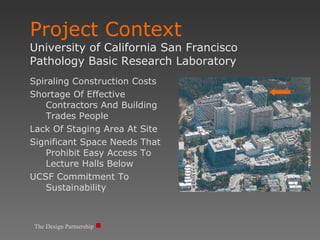
Project Context  University of California San Francisco Pathology Basic Research Laboratory The Design Partnership Spiraling Construction Costs Shortage Of Effective Contractors And Building Trades People Lack Of Staging Area At Site Significant Space Needs That Prohibit Easy Access To Lecture Halls Below UCSF Commitment To Sustainability
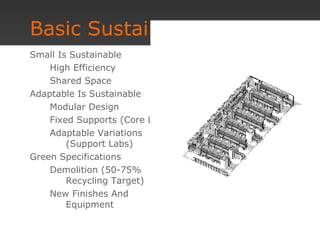
Basic Sustainability Issues  Small Is Sustainable High Efficiency Shared Space Adaptable Is Sustainable Modular Design Fixed Supports (Core Lab) Adaptable Variations (Support Labs) Green Specifications Demolition (50-75% Recycling Target) New Finishes And Equipment
Project Delivery Improvement BIM is Virtual Design & Construction The Design Partnership Automatic Document Coordination 3D Systems Coordination Virtual Building Simulation Direct Fabrication
Lessons Learned: Successes Specific advantages from BIM’s increased level of information and tighter coordination: Reuse & Remodel Instead Of Building New Prevent Rework Wastage Prevent Over-ordering Increase Efficiency The Design Partnership
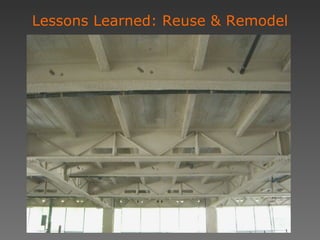
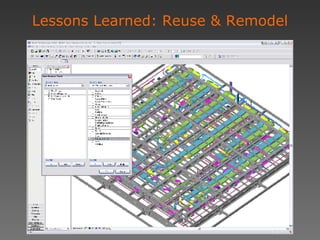
Lessons Learned: Reuse & Remodel The Design Partnership
Lessons Learned: Reuse & Remodel
Lessons Learned: Increase Efficiency The Design Partnership
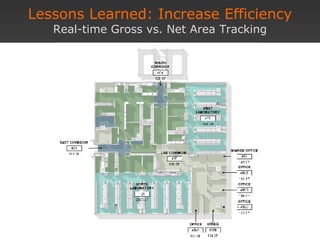
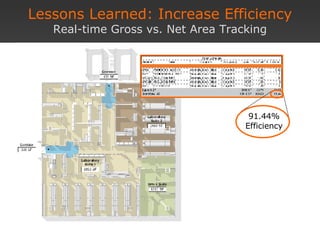
Lessons Learned: Increase Efficiency Real-time Gross vs. Net Area Tracking
Lessons Learned: Increase Efficiency Real-time Gross vs. Net Area Tracking 91.44% Efficiency
Lessons Learned: Prevent Over-ordering The Design Partnership
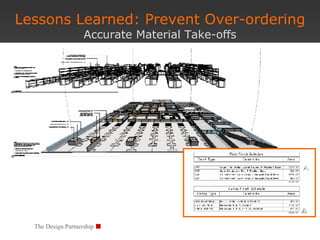
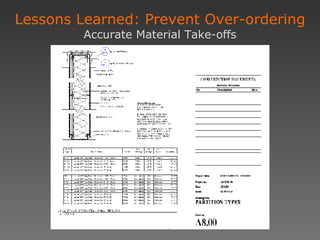
Lessons Learned: Prevent Over-ordering Accurate Material Take-offs The Design Partnership
Lessons Learned: Prevent Over-ordering Accurate Material Take-offs
The Design Partnership Lessons Learned: Prevent Rework
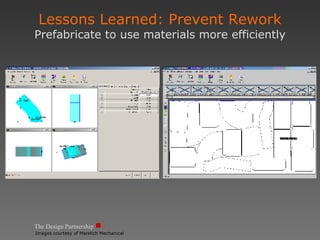
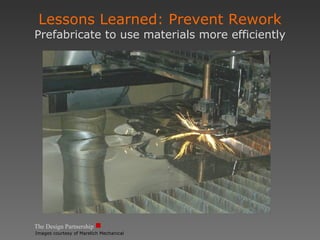
The Design Partnership Lessons Learned: Prevent Rework Prefabricate to use materials more efficiently Images courtesy of Marelich Mechanical
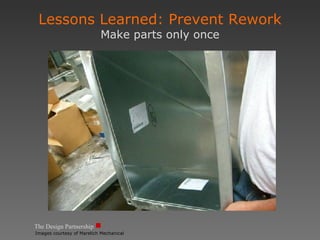
The Design Partnership Lessons Learned: Prevent Rework Make parts only once Images courtesy of Marelich Mechanical
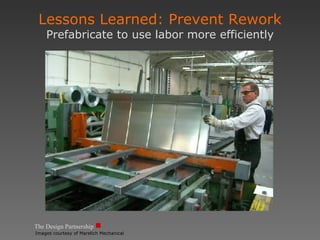
The Design Partnership Lessons Learned: Prevent Rework Prefabricate to use labor more efficiently Images courtesy of Marelich Mechanical
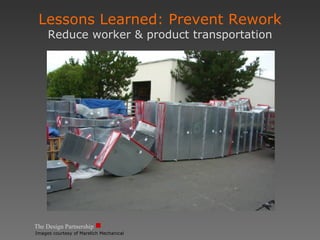
The Design Partnership Lessons Learned: Prevent Rework Reduce worker & product transportation Images courtesy of Marelich Mechanical
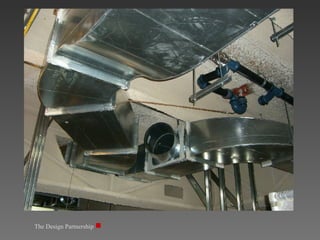
The Design Partnership Lessons Learned: Prevent Rework Complete Pre-installation Coordination
Image courtesy of Marelich Mechanical The Design Partnership
The Design Partnership
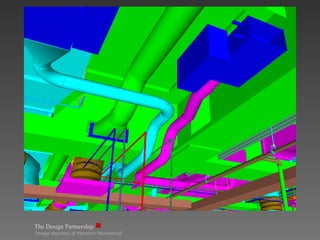
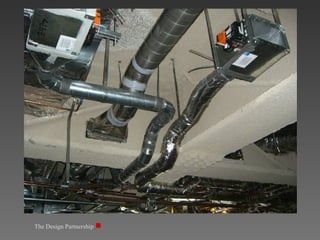
Image courtesy of Marelich Mechanical The Design Partnership
The Design Partnership
Next Steps: Simulation Extend the use of BIM through virtual prototyping and building simulation: Advanced Simulation Daylighting LEED Tracking The Design Partnership
Next Steps: Advanced Simulation The Design Partnership
3D model simplifies the transition to energy modeling packages: Programming & Schematic Design Green Building Studio Next Steps: Advanced Simulation The Design Partnership Design Development & Construction Documents Ecotect IES Virtual Environment DOE2 eQUEST 3D Studio/VIZ
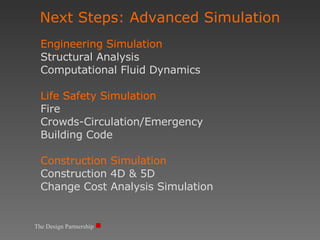
The Design Partnership Engineering Simulation Structural Analysis Computational Fluid Dynamics Life Safety Simulation Fire  Crowds-Circulation/Emergency  Building Code  Construction Simulation Construction 4D & 5D Change Cost Analysis Simulation Next Steps: Advanced Simulation
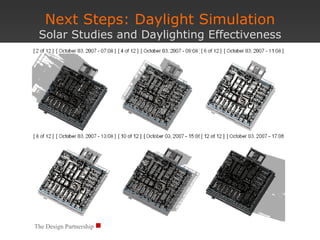
Next Steps: Daylight Simulation Solar Studies and Daylighting Effectiveness The Design Partnership
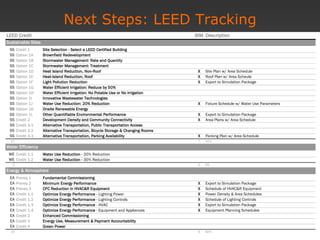
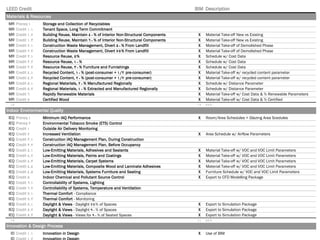
Next Steps: LEED Tracking The Design Partnership
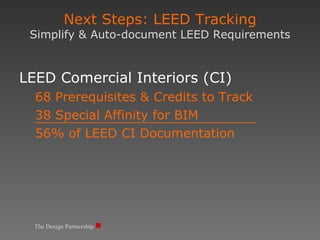
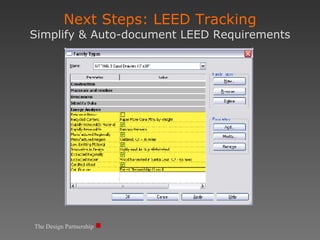
LEED Comercial Interiors (CI) 68 Prerequisites & Credits to Track 38 Special Affinity for BIM 56% of LEED CI Documentation Next Steps: LEED Tracking Simplify & Auto-document LEED Requirements The Design Partnership
Next Steps: LEED Tracking Simplify & Auto-document LEED Requirements The Design Partnership
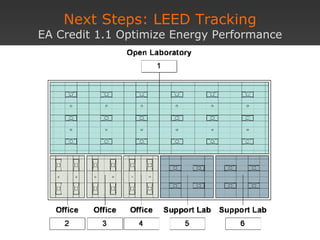
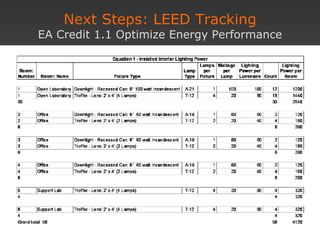
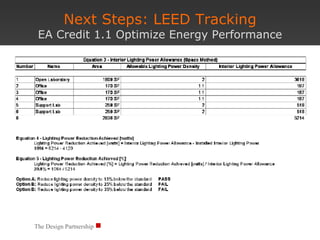
Next Steps: LEED Tracking EA Credit 1.1 Optimize Energy Performance
Next Steps: LEED Tracking EA Credit 1.1 Optimize Energy Performance The Design Partnership
Next Steps: LEED Tracking
 
Questions? Thank you for your time. The Design Partnership A PDF is available on our website at www.dpsf.com/Labs21BIM.pdf

Labs21 Conference: BIM for Sustainable Labs

  • 1.
    Labs 21 isa Registered Provider with The American Institute of Architects Continuing Education Systems. Credit earned on completion of this program will be reported to CES Records for AIA members. Certificates of Completion for non-AIA members are available on request. This program is registered with the AIA/CES for continuing professional education. As such, it does not include content that may be deemed or construed to be an approval of endorsement by the AIA of any material of construction or any method of manner of handling, using, distributing, or dealing in any material or product. Questions related to specific materials, methods, and services will be addressed a the conclusion of this presentation. It is the opinion of this presenter that legal mumbo jumbo at the beginning of a presentation is a waste of electricity.
  • 2.
    Eric Peabody ProjectManager The Design Partnership www.dpsf.com [email_address] Speaker's Expertise: LEED Accredited Professional Led firm-wide transition to BIM Eric Peabody’s work as a laboratory designer includes: University of California San Francisco, Health Sciences West 4th Floor Pathology Lab University of California San Francisco, SB1953 Seismic Rehabilitation University of California San Francisco, Medical Science Improvements Phase 2 University of California San Francisco, Medical Research Building 1 and 2 Demolition University of California San Francisco, S380 S/M Remodel University of California San Francisco, MSB 409-427 Remodel San Francisco General Hospital, Radiology Assessment The Design Partnership
  • 3.
    Christie Johnson CoffinSenior Architect / Planner The Design Partnership www.dpsf.com [email_address] Speaker's Expertise: Architect / Planner / Adjunct Professor University of Oregon LEED Accredited Professional Christie Coffin’s work as a laboratory architect includes: University of Oregon Science Complex National Yang Ming University Biotechnology / Library Building National Taiwan University Children’s Hospital Research Institute University of California Santa Barbara Physical Sciences Buildings University of California Irvine Neuropsychiatric Institute Lawrence Berkeley National Laboratories, on-going services University of California Merced, Castle Laboratory Renovations University of California Davis, Robbins Hall Renovations University of California San Francisco, Health Sciences West 4th Floor Pathology Lab The Design Partnership
  • 4.
    Learning Objectives LessonsLearned: Successes Reuse & Remodel Instead Of Building New Increase Efficiency Prevent Over-ordering Prevent Rework Wastage Next Steps: Comprehensive Simulation Advanced Simulation Daylighting LEED Tracking The Design Partnership
  • 5.
    BIM Augments Sustainabilityin UCSF Laboratory Renovation A Case Study in Successful BIM Use The Design Partnership
  • 6.
    The Design PartnershipProject Program University of California San Francisco Pathology Basic Research Laboratory University of California San Francisco at Parnassus Heights Campus 16 story H-8 laboratory building 1960’s Building with piecemeal upgrades Large program / small space 5 high profile researchers Pathology basic cancer research
  • 7.
    Project Program Universityof California San Francisco Pathology Basic Research Laboratory The Design Partnership Core Wet Bench Area For 55 Tissue Culture And Histology Necropsy Significant Microscopy Extensive Equipment Needs Social Core For Meetings And Lunches Offices
  • 8.
    Project Context University of California San Francisco Pathology Basic Research Laboratory The Design Partnership Spiraling Construction Costs Shortage Of Effective Contractors And Building Trades People Lack Of Staging Area At Site Significant Space Needs That Prohibit Easy Access To Lecture Halls Below UCSF Commitment To Sustainability
  • 9.
    Basic Sustainability Issues Small Is Sustainable High Efficiency Shared Space Adaptable Is Sustainable Modular Design Fixed Supports (Core Lab) Adaptable Variations (Support Labs) Green Specifications Demolition (50-75% Recycling Target) New Finishes And Equipment
  • 10.
    Project Delivery ImprovementBIM is Virtual Design & Construction The Design Partnership Automatic Document Coordination 3D Systems Coordination Virtual Building Simulation Direct Fabrication
  • 11.
    Lessons Learned: SuccessesSpecific advantages from BIM’s increased level of information and tighter coordination: Reuse & Remodel Instead Of Building New Prevent Rework Wastage Prevent Over-ordering Increase Efficiency The Design Partnership
  • 12.
    Lessons Learned: Reuse& Remodel The Design Partnership
  • 13.
  • 14.
  • 15.
    Lessons Learned: IncreaseEfficiency The Design Partnership
  • 16.
    Lessons Learned: IncreaseEfficiency Real-time Gross vs. Net Area Tracking
  • 17.
    Lessons Learned: IncreaseEfficiency Real-time Gross vs. Net Area Tracking 91.44% Efficiency
  • 18.
    Lessons Learned: PreventOver-ordering The Design Partnership
  • 19.
    Lessons Learned: PreventOver-ordering Accurate Material Take-offs The Design Partnership
  • 20.
    Lessons Learned: PreventOver-ordering Accurate Material Take-offs
  • 21.
    The Design PartnershipLessons Learned: Prevent Rework
  • 22.
    The Design PartnershipLessons Learned: Prevent Rework Prefabricate to use materials more efficiently Images courtesy of Marelich Mechanical
  • 23.
    The Design PartnershipLessons Learned: Prevent Rework Prefabricate to use materials more efficiently Images courtesy of Marelich Mechanical
  • 24.
    The Design PartnershipLessons Learned: Prevent Rework Make parts only once Images courtesy of Marelich Mechanical
  • 25.
    The Design PartnershipLessons Learned: Prevent Rework Prefabricate to use labor more efficiently Images courtesy of Marelich Mechanical
  • 26.
    The Design PartnershipLessons Learned: Prevent Rework Reduce worker & product transportation Images courtesy of Marelich Mechanical
  • 27.
    The Design PartnershipLessons Learned: Prevent Rework Complete Pre-installation Coordination
  • 28.
    Image courtesy ofMarelich Mechanical The Design Partnership
  • 29.
  • 30.
    Image courtesy ofMarelich Mechanical The Design Partnership
  • 31.
  • 32.
    Next Steps: SimulationExtend the use of BIM through virtual prototyping and building simulation: Advanced Simulation Daylighting LEED Tracking The Design Partnership
  • 33.
    Next Steps: AdvancedSimulation The Design Partnership
  • 34.
    3D model simplifiesthe transition to energy modeling packages: Programming & Schematic Design Green Building Studio Next Steps: Advanced Simulation The Design Partnership Design Development & Construction Documents Ecotect IES Virtual Environment DOE2 eQUEST 3D Studio/VIZ
  • 35.
    The Design PartnershipEngineering Simulation Structural Analysis Computational Fluid Dynamics Life Safety Simulation Fire Crowds-Circulation/Emergency Building Code Construction Simulation Construction 4D & 5D Change Cost Analysis Simulation Next Steps: Advanced Simulation
  • 36.
    Next Steps: DaylightSimulation Solar Studies and Daylighting Effectiveness The Design Partnership
  • 37.
    Next Steps: LEEDTracking The Design Partnership
  • 38.
    LEED Comercial Interiors(CI) 68 Prerequisites & Credits to Track 38 Special Affinity for BIM 56% of LEED CI Documentation Next Steps: LEED Tracking Simplify & Auto-document LEED Requirements The Design Partnership
  • 39.
    Next Steps: LEEDTracking Simplify & Auto-document LEED Requirements The Design Partnership
  • 40.
    Next Steps: LEEDTracking EA Credit 1.1 Optimize Energy Performance
  • 41.
    Next Steps: LEEDTracking EA Credit 1.1 Optimize Energy Performance
  • 42.
    Next Steps: LEEDTracking EA Credit 1.1 Optimize Energy Performance The Design Partnership
  • 43.
  • 44.
  • 45.
    Questions? Thank youfor your time. The Design Partnership A PDF is available on our website at www.dpsf.com/Labs21BIM.pdf