Labour Force Market and Statistics
Labour Force Market and Statistics
Labour Force Market and Statistics
Labour Force Market and Statistics
Labour Force Market and Statistics
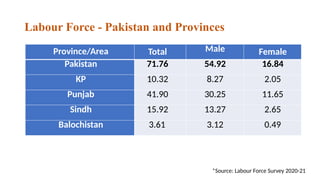
Labour Force -Pakistan and Provinces
Province/Area Total Male Female
Pakistan 71.76 54.92 16.84
KP 10.32 8.27 2.05
Punjab 41.90 30.25 11.65
Sindh 15.92 13.27 2.65
Balochistan 3.61 3.12 0.49
*Source: Labour Force Survey 2020-21
3.
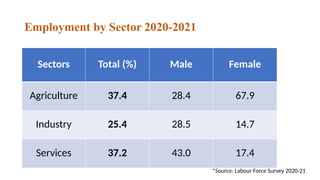
Employment by Sector2020-2021
Sectors Total (%) Male Female
Agriculture 37.4 28.4 67.9
Industry 25.4 28.5 14.7
Services 37.2 43.0 17.4
*Source: Labour Force Survey 2020-21
4.
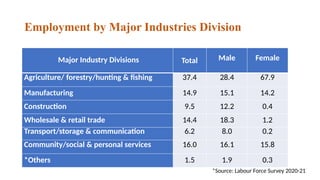
Employment by MajorIndustries Division
Major Industry Divisions Total Male Female
Agriculture/ forestry/hunting & fishing 37.4 28.4 67.9
Manufacturing 14.9 15.1 14.2
Construction 9.5 12.2 0.4
Wholesale & retail trade 14.4 18.3 1.2
Transport/storage & communication 6.2 8.0 0.2
Community/social & personal services 16.0 16.1 15.8
*Others 1.5 1.9 0.3
*Source: Labour Force Survey 2020-21
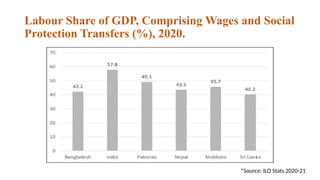
Labour Share ofGDP, Comprising Wages and Social
Protection Transfers (%), 2020.
*Source: ILO Stats 2020-21
7.
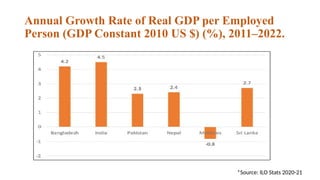
Annual Growth Rateof Real GDP per Employed
Person (GDP Constant 2010 US $) (%), 2011–2022.
*Source: ILO Stats 2020-21
8.
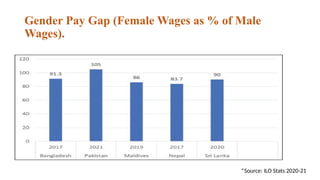
Gender Pay Gap(Female Wages as % of Male
Wages).
*Source: ILO Stats 2020-21
9.
Pakistan Industry
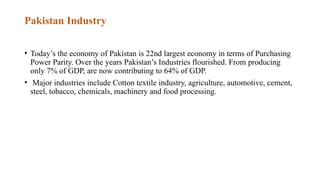
• Today’sthe economy of Pakistan is 22nd largest economy in terms of Purchasing
Power Parity. Over the years Pakistan’s Industries flourished. From producing
only 7% of GDP, are now contributing to 64% of GDP.
• Major industries include Cotton textile industry, agriculture, automotive, cement,
steel, tobacco, chemicals, machinery and food processing.
10.
Textile Industry
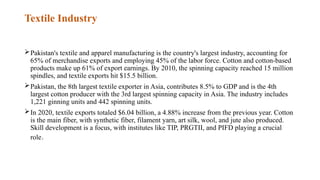
Pakistan's textileand apparel manufacturing is the country's largest industry, accounting for
65% of merchandise exports and employing 45% of the labor force. Cotton and cotton-based
products make up 61% of export earnings. By 2010, the spinning capacity reached 15 million
spindles, and textile exports hit $15.5 billion.
Pakistan, the 8th largest textile exporter in Asia, contributes 8.5% to GDP and is the 4th
largest cotton producer with the 3rd largest spinning capacity in Asia. The industry includes
1,221 ginning units and 442 spinning units.
In 2020, textile exports totaled $6.04 billion, a 4.88% increase from the previous year. Cotton
is the main fiber, with synthetic fiber, filament yarn, art silk, wool, and jute also produced.
Skill development is a focus, with institutes like TIP, PRGTII, and PIFD playing a crucial
role.
11.
Agriculture Industry
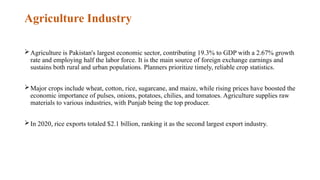
Agriculture isPakistan's largest economic sector, contributing 19.3% to GDP with a 2.67% growth
rate and employing half the labor force. It is the main source of foreign exchange earnings and
sustains both rural and urban populations. Planners prioritize timely, reliable crop statistics.
Major crops include wheat, cotton, rice, sugarcane, and maize, while rising prices have boosted the
economic importance of pulses, onions, potatoes, chilies, and tomatoes. Agriculture supplies raw
materials to various industries, with Punjab being the top producer.
In 2020, rice exports totaled $2.1 billion, ranking it as the second largest export industry.
12.
Automotive Industry
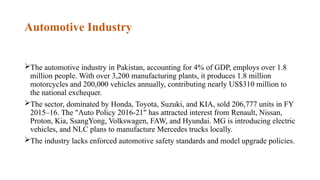
The automotiveindustry in Pakistan, accounting for 4% of GDP, employs over 1.8
million people. With over 3,200 manufacturing plants, it produces 1.8 million
motorcycles and 200,000 vehicles annually, contributing nearly US$310 million to
the national exchequer.
The sector, dominated by Honda, Toyota, Suzuki, and KIA, sold 206,777 units in FY
2015–16. The "Auto Policy 2016-21" has attracted interest from Renault, Nissan,
Proton, Kia, SsangYong, Volkswagen, FAW, and Hyundai. MG is introducing electric
vehicles, and NLC plans to manufacture Mercedes trucks locally.
The industry lacks enforced automotive safety standards and model upgrade policies.
13.
Mining Industry
• Miningis a crucial industry in Pakistan, with significant deposits of
coal, copper, gold, and various precious and semi-precious minerals.
• The Pakistan Mineral Development Corporation and Gemstones
Corporation of Pakistan oversee mining activities, with Balochistan
holding the most deposits.
• The federal government manages oil, gas, and nuclear minerals, while
provinces handle other minerals, with around 52 currently mined and
processed.
14.
Chemical Industry
• Theglobal chemical industry converts raw materials into over 70,000
products across various sectors. Pakistan's vibrant chemical industry
supports multiple industries like textiles, agriculture, and
pharmaceuticals, with potential for regional and global impact.
15.
Pharmaceutical Industry
• ThePakistani pharmaceutical market hosts approximately 759
companies, with fewer than 30 being multinationals. The industry
contributes about 1% to Pakistan's GDP annually. It fulfills over 95%
of the country's domestic pharmaceutical needs.
• In 2020, pharmaceutical exports reached $235.75 million, according
to the UN COMTRADE database. Exports saw a 23% year-on-year
increase, hitting $68.1 million in the first quarter of 2020/21.
16.
Leather Industry
• Pakistanis a hub for high-quality leather, with over 800 tanneries
producing top-grade leather from cow, buffalo, sheep, and goat skins.
The leather industry, a key economic driver, exports significant
volumes and employs over 500,000 people. In 2020, leather exports
grew by 5.25% compared to the previous year.
17.
Services Industry
• Theservices sector, accounting for over 50% of Pakistan's GDP and
one-third of employment, outpaces agriculture and industry in growth.
Key areas include construction, IT, engineering, banking, insurance,
communication, tourism, and professional services.