Expriemental Laboratory Animals
Name :- Sujit Ramesh Mhaske
Subject:- Pharmacological Toxicology And Screening Method
Guide:- Proff.Pagar Sir.
Presented On Topic :-
Presented by:-
Laboratory Animals
⚫ “Laboratory Animals” are defined as animals which are used for experimental and diagnosis
purpose which may resemble in result with human beings.
⚫ They can be very well used for carrying out various biological experiments and research in
biomedical as well as veterinary and animal sciences.
⚫ They are smaller in size, early puberty, high fecundity, short gestation, high position in evolutionary
scale
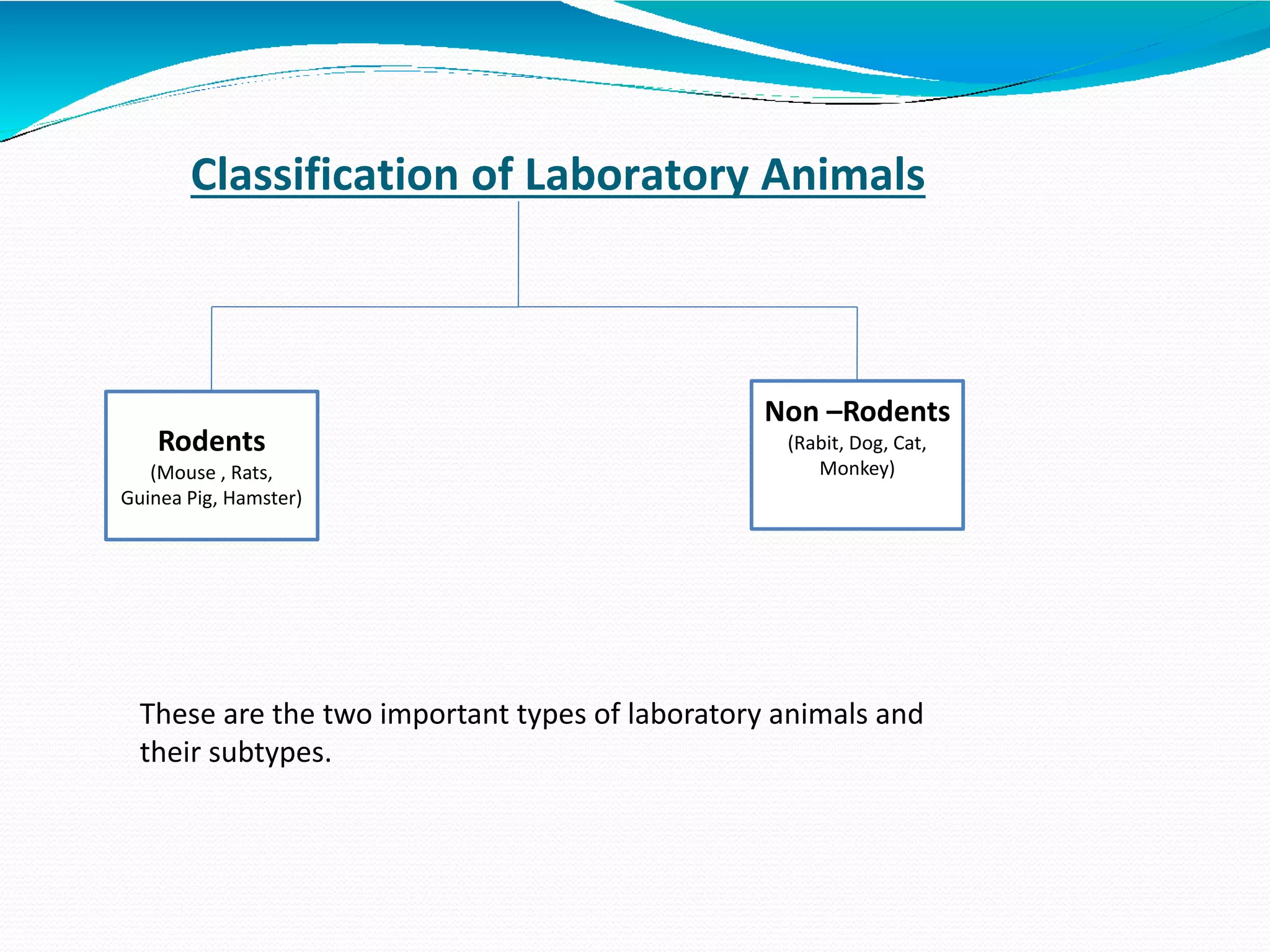
Classification of Laboratory Animals
Rodents
(Mouse , Rats,
Guinea Pig, Hamster)
Non –Rodents
(Rabit, Dog, Cat,
Monkey)
These are the two important types of laboratory animals and
their subtypes.
⚫ Mice (Mus Musculus): are used for toxicological purpose, microbiological and vaccine
assay, insulin testing, ID, LD-50, studies on cancer tissues various drug studies, especially
toxicologyof various drugs.
⚫80 % of experiments are done on rodents animal
⚫About 70% of experiments aredoneon mice.
⚫It is a smallest laboratory animal, easy to keep and handle required small place for breeding.
⚫It is common starin swiss albino mice
⚫It is very sensitive to small doses of drug.
⚫They have similar reproductive and nervous system to humans, and suffer from same disease
such as Cancer, Diabetes.
⚫ The mice take short gestastion period (19-21).
⚫The mice having short lifespan (1.5-2.0) years.
⚫The mice is small in size
Mice
-The rat has short hair, a long naked tail, rounded erect ears, protruding eyes, a
pointed snout with long whisker (vibrissae) and five toes on each foot.
- Rats have no gall bladder.
Rattus norvegicus (brown rat) has a short tail compared to Rattus rattus (black
rat), which has a much longer tail.
- Rats are burrowers and take advantage of that whenever the opportunity
presented.
Rats have a four to five-day estrous cycle.
- Rats are often used to study behaviour in psychology experiments.
Rats (Ratuus Norvegicus) :
⚫ Rats are used for pharmacological studies of various drugs.
⚫ Pharmacological Studies
Pharmacological Studies
Of Rat
Insuline
Research
Diabetes
Various
Toxicological Test
- These are the three important types of Pharmacological studies of Rat
Rat
⚫ Guinea Pigs (Cavia Porcellus): Guinea Pig are used for pharmacological studies of various
drugs. Allergic, Anaphylactic shock and preparation of anti sera.
⚫ Guinea pigs are used in lab. Diagnosis of T.B. Because lesions of T. B. are prominent in Guinea
pigs.
⚫ The guinea pig is also widely used to provide tissues and organs for research. Guinea pig
blood components are widely used, and isolated organ preparations such as guinea pig lung
and intestine are extensively used in research to develop new medicines.
- The four main areas that guinea pigs are used in research today are:
(1) Allergies and respiratory diseases
(2) utritional research
(3) Hearing
(4) Safety testing
Guinea pig
Rabbit (Oryctolagus Cunniculus) :-
- Rabit is a Docile animals.
- Rabit is used for testing of large volume parentral drug.
- One of the most common uses of rabbits in the laboratory is for the
production of antibodies.
- They are complex molecules which can only be produced by the immune
system of a living animal
- The rabbit has provided an excellent model system to simulate the response of
human tissue to the radiation produced by surgical lasers.
Rabbit
The Rabits are used for:
⚫ Pyrogen testing
⚫ Insulin potency testing
⚫ Immunological research
⚫ Reproductive studies
⚫ Virological research.
Importance (Utility/Role) of Laboratory Animals
Laboratory animals are used in basic biological research, diseases medicines and
Diagnosis, Immunology
, Virology
, applied demonstration.
1. Pharmacology
2. Toxicology
3. Physiology
4. Experimental surgery
5. Diagnosis-Virology, Bacteriology, Pathology
6. Pregnancy testing
7. Bio-assay-vaccines, drugs and infusion fluids
8. Preparation of immune sera.
Thank you

Laboratory-animals PPT-1.pptx

  • 1.
    Expriemental Laboratory Animals Name:- Sujit Ramesh Mhaske Subject:- Pharmacological Toxicology And Screening Method Guide:- Proff.Pagar Sir. Presented On Topic :- Presented by:-
  • 2.
    Laboratory Animals ⚫ “LaboratoryAnimals” are defined as animals which are used for experimental and diagnosis purpose which may resemble in result with human beings. ⚫ They can be very well used for carrying out various biological experiments and research in biomedical as well as veterinary and animal sciences. ⚫ They are smaller in size, early puberty, high fecundity, short gestation, high position in evolutionary scale
  • 3.
    Classification of LaboratoryAnimals Rodents (Mouse , Rats, Guinea Pig, Hamster) Non –Rodents (Rabit, Dog, Cat, Monkey) These are the two important types of laboratory animals and their subtypes.
  • 5.
    ⚫ Mice (MusMusculus): are used for toxicological purpose, microbiological and vaccine assay, insulin testing, ID, LD-50, studies on cancer tissues various drug studies, especially toxicologyof various drugs. ⚫80 % of experiments are done on rodents animal ⚫About 70% of experiments aredoneon mice. ⚫It is a smallest laboratory animal, easy to keep and handle required small place for breeding. ⚫It is common starin swiss albino mice ⚫It is very sensitive to small doses of drug. ⚫They have similar reproductive and nervous system to humans, and suffer from same disease such as Cancer, Diabetes. ⚫ The mice take short gestastion period (19-21). ⚫The mice having short lifespan (1.5-2.0) years. ⚫The mice is small in size
  • 6.
  • 7.
    -The rat hasshort hair, a long naked tail, rounded erect ears, protruding eyes, a pointed snout with long whisker (vibrissae) and five toes on each foot. - Rats have no gall bladder. Rattus norvegicus (brown rat) has a short tail compared to Rattus rattus (black rat), which has a much longer tail. - Rats are burrowers and take advantage of that whenever the opportunity presented. Rats have a four to five-day estrous cycle. - Rats are often used to study behaviour in psychology experiments. Rats (Ratuus Norvegicus) :
  • 8.
    ⚫ Rats areused for pharmacological studies of various drugs. ⚫ Pharmacological Studies Pharmacological Studies Of Rat Insuline Research Diabetes Various Toxicological Test - These are the three important types of Pharmacological studies of Rat
  • 9.
  • 10.
    ⚫ Guinea Pigs(Cavia Porcellus): Guinea Pig are used for pharmacological studies of various drugs. Allergic, Anaphylactic shock and preparation of anti sera. ⚫ Guinea pigs are used in lab. Diagnosis of T.B. Because lesions of T. B. are prominent in Guinea pigs. ⚫ The guinea pig is also widely used to provide tissues and organs for research. Guinea pig blood components are widely used, and isolated organ preparations such as guinea pig lung and intestine are extensively used in research to develop new medicines. - The four main areas that guinea pigs are used in research today are: (1) Allergies and respiratory diseases (2) utritional research (3) Hearing (4) Safety testing
  • 11.
  • 12.
    Rabbit (Oryctolagus Cunniculus):- - Rabit is a Docile animals. - Rabit is used for testing of large volume parentral drug. - One of the most common uses of rabbits in the laboratory is for the production of antibodies. - They are complex molecules which can only be produced by the immune system of a living animal - The rabbit has provided an excellent model system to simulate the response of human tissue to the radiation produced by surgical lasers.
  • 13.
  • 14.
    The Rabits areused for: ⚫ Pyrogen testing ⚫ Insulin potency testing ⚫ Immunological research ⚫ Reproductive studies ⚫ Virological research.
  • 15.
    Importance (Utility/Role) ofLaboratory Animals Laboratory animals are used in basic biological research, diseases medicines and Diagnosis, Immunology , Virology , applied demonstration. 1. Pharmacology 2. Toxicology 3. Physiology 4. Experimental surgery 5. Diagnosis-Virology, Bacteriology, Pathology 6. Pregnancy testing 7. Bio-assay-vaccines, drugs and infusion fluids 8. Preparation of immune sera.
  • 16.