LAB SAFETY TRAINING
WELCOME TO THE ZAIKINA LAB!
GETTING STARTED
 Complete online safety training through https://www.ehs.iastate.edu/training
 Print certificates of completion and give them to the safety representative
Required Courses
 Print this form: Laboratory Check-In Form
 Initial all items that have been covered (won’t be totally completed before you enter the lab)
 Complete the Hazard Inventory Form
 Review all provided and recommended SOP/Training documents
Laboratory Safety: Core Concepts
Emergency Response Guide Video
Fire Safety and Extinguisher Training
Hazardous Materials Shipping Awareness
X-ray Safety Fundamentals
Laboratory Safety: Chemical Storage
Laboratory Safety: Spill Procedures
Laboratory Safety: Fume Hoods
Laboratory Safety: Compressed Gas Cylinders
ASSIGNMENT
 Supervisor: Dr. Julia Zaikina
 Lab rooms: 2221, 2241, and 2241A
 Offices: 2225 and 2235
LAB-SPECIFIC TRAINING
 You must be fully trained and authorized to use any equipment within the lab
 You are responsible for maintaining your work area as well as shared-use areas/equipment
STANDARD OPERATING PROCEDURE (SOP)
 Each piece major piece of equipment has a corresponding SOP
 It is expected that you review the SOP prior to equipment specific training
 Upon completion of training, you and the person in charge of your training will sign the respective SOP
to authorize you to use said equipment
WORKING ALONE
 You should not work alone in the lab under any circumstances
 If in the case of an emergency, you must agree to notify a friend/supervisor every 30 min (or other
designated time) to ensure your safety
SAFETY DATA SHEETS (SDS)
 All SDSs are stored at the group computer in 2225 Hach
 SDSs can also be obtained online at the manufacturer website
 Please review the SDS of any chemical you plan to use during an experiment
PERSONAL PROTECTIVE EQUIPMENT (PPE)
 All necessary PPE will be supplied
 A lab coat, gloves, and safety glasses/goggles must be worn in the lab at all times
 Some equipment requires additional PPE
 This will be noted in the SOP
WASTE DISPOSAL
 Waste must be properly disposed of in accordance to Waste Disposal Guidelines
 All waste from within the glovebox must be allowed to fully oxidize in the Safe Oxidation Fume Hood
prior to disposal
 Once oxidized, the material must be placed into the small white plastic jars and properly labeled with an orange
waste tag
 You are in charge of your own waste
 Once your container is full place it into the Satellite Accumulation Area (SAA) under the fume hood
 Notify EH&S to come pick up your waste containers here
 Liquid waste must be poured into its respective jug in the fume hood in 2241 lab
 Plastic waste bags are provided for large waste such as contaminated paper towels, gloves, etc.
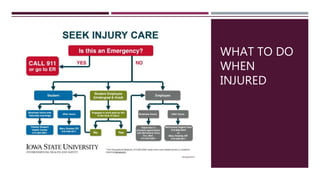
WHAT TO DO
WHEN
INJURED
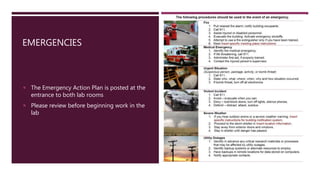
EMERGENCIES
 The Emergency Action Plan is posted at the
entrance to both lab rooms
 Please review before beginning work in the
lab
EMERGENCY EQUIPMENT
 Please know the location of safety equipment and their function in the laboratories
THANK YOU
AND STAY
SAFE!

Lab safety training

  • 1.
    LAB SAFETY TRAINING WELCOMETO THE ZAIKINA LAB!
  • 2.
    GETTING STARTED  Completeonline safety training through https://www.ehs.iastate.edu/training  Print certificates of completion and give them to the safety representative Required Courses  Print this form: Laboratory Check-In Form  Initial all items that have been covered (won’t be totally completed before you enter the lab)  Complete the Hazard Inventory Form  Review all provided and recommended SOP/Training documents Laboratory Safety: Core Concepts Emergency Response Guide Video Fire Safety and Extinguisher Training Hazardous Materials Shipping Awareness X-ray Safety Fundamentals Laboratory Safety: Chemical Storage Laboratory Safety: Spill Procedures Laboratory Safety: Fume Hoods Laboratory Safety: Compressed Gas Cylinders
  • 3.
    ASSIGNMENT  Supervisor: Dr.Julia Zaikina  Lab rooms: 2221, 2241, and 2241A  Offices: 2225 and 2235
  • 4.
    LAB-SPECIFIC TRAINING  Youmust be fully trained and authorized to use any equipment within the lab  You are responsible for maintaining your work area as well as shared-use areas/equipment
  • 5.
    STANDARD OPERATING PROCEDURE(SOP)  Each piece major piece of equipment has a corresponding SOP  It is expected that you review the SOP prior to equipment specific training  Upon completion of training, you and the person in charge of your training will sign the respective SOP to authorize you to use said equipment
  • 6.
    WORKING ALONE  Youshould not work alone in the lab under any circumstances  If in the case of an emergency, you must agree to notify a friend/supervisor every 30 min (or other designated time) to ensure your safety
  • 7.
    SAFETY DATA SHEETS(SDS)  All SDSs are stored at the group computer in 2225 Hach  SDSs can also be obtained online at the manufacturer website  Please review the SDS of any chemical you plan to use during an experiment
  • 8.
    PERSONAL PROTECTIVE EQUIPMENT(PPE)  All necessary PPE will be supplied  A lab coat, gloves, and safety glasses/goggles must be worn in the lab at all times  Some equipment requires additional PPE  This will be noted in the SOP
  • 9.
    WASTE DISPOSAL  Wastemust be properly disposed of in accordance to Waste Disposal Guidelines  All waste from within the glovebox must be allowed to fully oxidize in the Safe Oxidation Fume Hood prior to disposal  Once oxidized, the material must be placed into the small white plastic jars and properly labeled with an orange waste tag  You are in charge of your own waste  Once your container is full place it into the Satellite Accumulation Area (SAA) under the fume hood  Notify EH&S to come pick up your waste containers here  Liquid waste must be poured into its respective jug in the fume hood in 2241 lab  Plastic waste bags are provided for large waste such as contaminated paper towels, gloves, etc.
  • 10.
  • 11.
    EMERGENCIES  The EmergencyAction Plan is posted at the entrance to both lab rooms  Please review before beginning work in the lab
  • 12.
    EMERGENCY EQUIPMENT  Pleaseknow the location of safety equipment and their function in the laboratories
  • 13.