IsolationandIdentificationof
Staphylococci
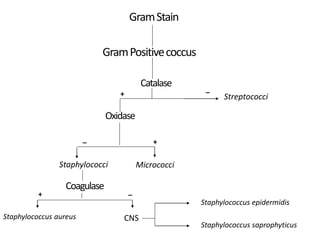
GramPositivecoccus
Catalase
Oxidase
Staphylococci
Streptococci
+
_
GramStain
_ +
Micrococci
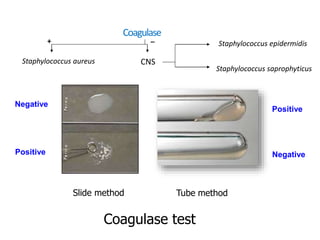
Coagulase
Staphylococcus aureus
_
+
CNS
Staphylococcus epidermidis
Staphylococcus saprophyticus
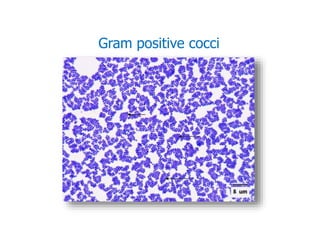
Gram positive cocci
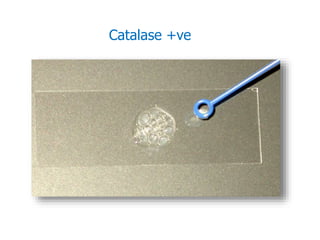
Catalase +ve
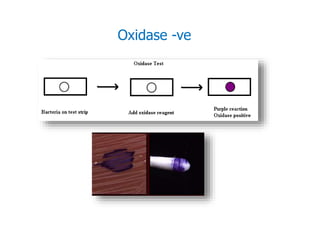
Oxidase -ve
Coagulase test
Negative
Positive
Slide method
Negative
Positive
Tube method
Coagulase
Staphylococcus aureus CNS
Staphylococcus epidermidis
Staphylococcus saprophyticus
+ _
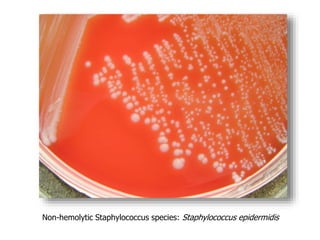
Non-hemolytic Staphylococcus species: Staphylococcus epidermidis
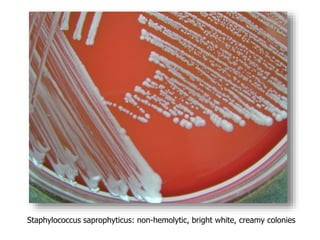
Staphylococcus saprophyticus: non-hemolytic, bright white, creamy colonies
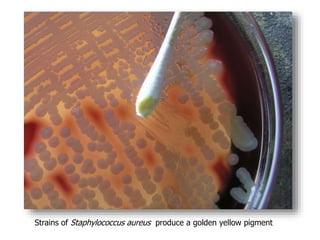
Strains of Staphylococcus aureus produce a golden yellow pigment
Strains of Staphylococcus aureus not a golden yellow pigment producer
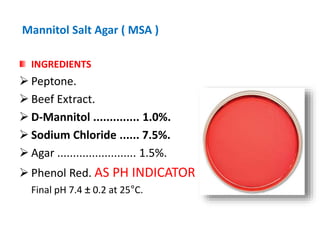
Mannitol Salt Agar ( MSA )
INGREDIENTS
 Peptone.
 Beef Extract.
 D-Mannitol .............. 1.0%.
 Sodium Chloride ...... 7.5%.
 Agar ......................... 1.5%.
 Phenol Red. AS PH INDICATOR
Final pH 7.4 ± 0.2 at 25°C.
• Principle and results
 Mannitol Salt Agar is a nutritive medium due to its content of
peptones and beef extract, which supply essential growth
factors, such as nitrogen, carbon, sulfur and trace nutrients.
 The 7.5% concentration of sodium chloride results in the
inhibition of bacterial organisms other than staphylococci.
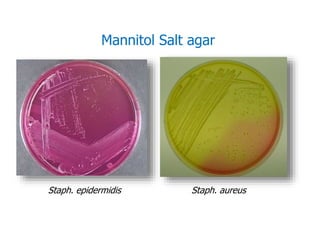
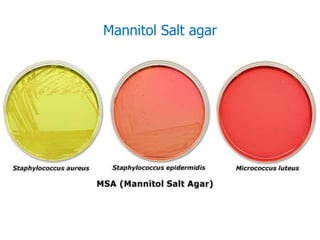
 Mannitol fermentation, as indicated by a change in the phenol
red indicator, aids in the differentiation of staphylococcal
species.
Mannitol Salt agar
Staph. aureus
Staph. epidermidis
Mannitol Salt agar
Procedure:
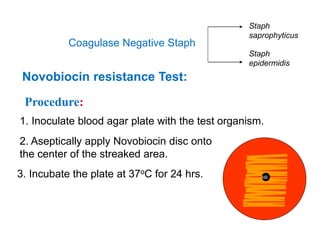
1. Inoculate blood agar plate with the test organism.
NB
2. Aseptically apply Novobiocin disc onto
the center of the streaked area.
3. Incubate the plate at 37oC for 24 hrs.
Novobiocin resistance Test:
Coagulase Negative Staph
Staph
saprophyticus
Staph
epidermidis
Novobiocin test
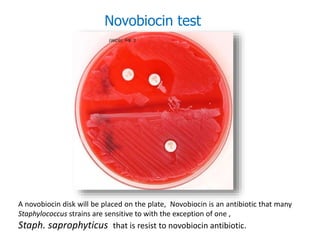
A novobiocin disk will be placed on the plate, Novobiocin is an antibiotic that many
Staphylococcus strains are sensitive to with the exception of one ,
Staph. saprophyticus that is resist to novobiocin antibiotic.
Staphylococcusepidermidis Growing
on BloodAgar
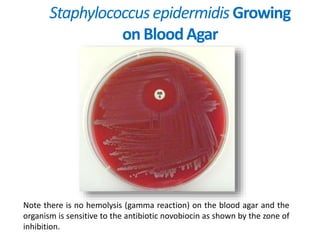
Note there is no hemolysis (gamma reaction) on the blood agar and the
organism is sensitive to the antibiotic novobiocin as shown by the zone of
inhibition.
Staphylococcus saprophyticus Growing
on BloodAgar
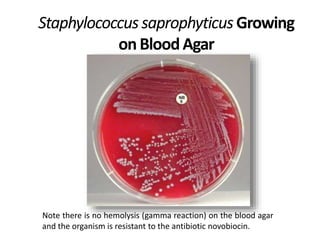
Note there is no hemolysis (gamma reaction) on the blood agar
and the organism is resistant to the antibiotic novobiocin.
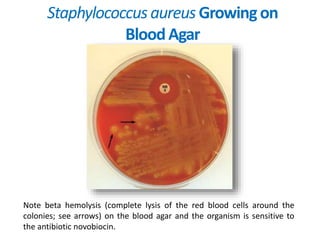
Staphylococcusaureus Growingon
BloodAgar
Note beta hemolysis (complete lysis of the red blood cells around the
colonies; see arrows) on the blood agar and the organism is sensitive to
the antibiotic novobiocin.
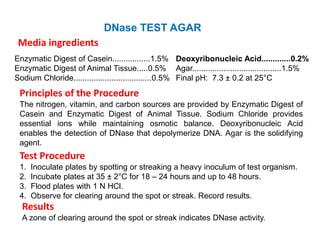
Enzymatic Digest of Casein.................1.5%
Enzymatic Digest of Animal Tissue.....0.5%
Sodium Chloride...................................0.5%
DNase TEST AGAR
Media ingredients
Principles of the Procedure
The nitrogen, vitamin, and carbon sources are provided by Enzymatic Digest of
Casein and Enzymatic Digest of Animal Tissue. Sodium Chloride provides
essential ions while maintaining osmotic balance. Deoxyribonucleic Acid
enables the detection of DNase that depolymerize DNA. Agar is the solidifying
agent.
Test Procedure
1. Inoculate plates by spotting or streaking a heavy inoculum of test organism.
2. Incubate plates at 35 ± 2°C for 18 – 24 hours and up to 48 hours.
3. Flood plates with 1 N HCl.
4. Observe for clearing around the spot or streak. Record results.
Deoxyribonucleic Acid.............0.2%
Agar........................................1.5%
Final pH: 7.3 ± 0.2 at 25°C
Results
A zone of clearing around the spot or streak indicates DNase activity.
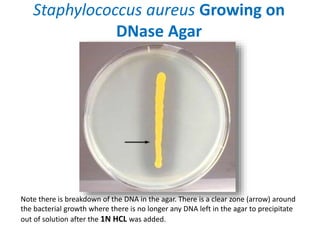
Staphylococcus aureus Growing on
DNase Agar
Note there is breakdown of the DNA in the agar. There is a clear zone (arrow) around
the bacterial growth where there is no longer any DNA left in the agar to precipitate
out of solution after the 1N HCL was added.
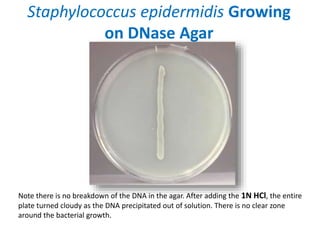
Staphylococcus epidermidis Growing
on DNase Agar
Note there is no breakdown of the DNA in the agar. After adding the 1N HCl, the entire
plate turned cloudy as the DNA precipitated out of solution. There is no clear zone
around the bacterial growth.
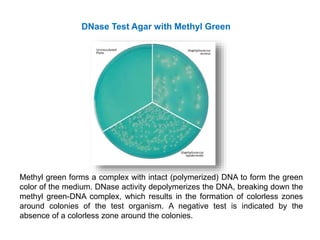
DNase Test Agar with Methyl Green
Methyl green forms a complex with intact (polymerized) DNA to form the green
color of the medium. DNase activity depolymerizes the DNA, breaking down the
methyl green-DNA complex, which results in the formation of colorless zones
around colonies of the test organism. A negative test is indicated by the
absence of a colorless zone around the colonies.
24
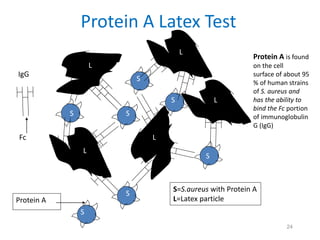
Protein A Latex Test
S
S
S
S
S
L
L
L
L
L
IgG
S=S.aureus with Protein A
L=Latex particle
Protein A
S
Fc
S
Protein A is found
on the cell
surface of about 95
% of human strains
of S. aureus and
has the ability to
bind the Fc portion
of immunoglobulin
G (IgG)
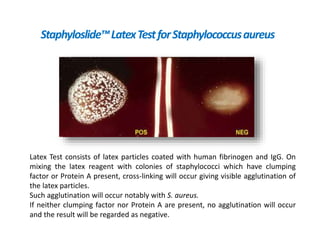
Staphyloslide™LatexTestforStaphylococcusaureus
Latex Test consists of latex particles coated with human fibrinogen and IgG. On
mixing the latex reagent with colonies of staphylococci which have clumping
factor or Protein A present, cross-linking will occur giving visible agglutination of
the latex particles.
Such agglutination will occur notably with S. aureus.
If neither clumping factor nor Protein A are present, no agglutination will occur
and the result will be regarded as negative.

Lab. 2 Staphylococcus.ppt

  • 1.
  • 2.
  • 3.
  • 4.
  • 5.
  • 6.
    Coagulase test Negative Positive Slide method Negative Positive Tubemethod Coagulase Staphylococcus aureus CNS Staphylococcus epidermidis Staphylococcus saprophyticus + _
  • 7.
    Non-hemolytic Staphylococcus species:Staphylococcus epidermidis
  • 8.
    Staphylococcus saprophyticus: non-hemolytic,bright white, creamy colonies
  • 9.
    Strains of Staphylococcusaureus produce a golden yellow pigment
  • 10.
    Strains of Staphylococcusaureus not a golden yellow pigment producer
  • 11.
    Mannitol Salt Agar( MSA ) INGREDIENTS  Peptone.  Beef Extract.  D-Mannitol .............. 1.0%.  Sodium Chloride ...... 7.5%.  Agar ......................... 1.5%.  Phenol Red. AS PH INDICATOR Final pH 7.4 ± 0.2 at 25°C.
  • 12.
    • Principle andresults  Mannitol Salt Agar is a nutritive medium due to its content of peptones and beef extract, which supply essential growth factors, such as nitrogen, carbon, sulfur and trace nutrients.  The 7.5% concentration of sodium chloride results in the inhibition of bacterial organisms other than staphylococci.  Mannitol fermentation, as indicated by a change in the phenol red indicator, aids in the differentiation of staphylococcal species.
  • 13.
    Mannitol Salt agar Staph.aureus Staph. epidermidis
  • 14.
  • 15.
    Procedure: 1. Inoculate bloodagar plate with the test organism. NB 2. Aseptically apply Novobiocin disc onto the center of the streaked area. 3. Incubate the plate at 37oC for 24 hrs. Novobiocin resistance Test: Coagulase Negative Staph Staph saprophyticus Staph epidermidis
  • 16.
    Novobiocin test A novobiocindisk will be placed on the plate, Novobiocin is an antibiotic that many Staphylococcus strains are sensitive to with the exception of one , Staph. saprophyticus that is resist to novobiocin antibiotic.
  • 17.
    Staphylococcusepidermidis Growing on BloodAgar Notethere is no hemolysis (gamma reaction) on the blood agar and the organism is sensitive to the antibiotic novobiocin as shown by the zone of inhibition.
  • 18.
    Staphylococcus saprophyticus Growing onBloodAgar Note there is no hemolysis (gamma reaction) on the blood agar and the organism is resistant to the antibiotic novobiocin.
  • 19.
    Staphylococcusaureus Growingon BloodAgar Note betahemolysis (complete lysis of the red blood cells around the colonies; see arrows) on the blood agar and the organism is sensitive to the antibiotic novobiocin.
  • 20.
    Enzymatic Digest ofCasein.................1.5% Enzymatic Digest of Animal Tissue.....0.5% Sodium Chloride...................................0.5% DNase TEST AGAR Media ingredients Principles of the Procedure The nitrogen, vitamin, and carbon sources are provided by Enzymatic Digest of Casein and Enzymatic Digest of Animal Tissue. Sodium Chloride provides essential ions while maintaining osmotic balance. Deoxyribonucleic Acid enables the detection of DNase that depolymerize DNA. Agar is the solidifying agent. Test Procedure 1. Inoculate plates by spotting or streaking a heavy inoculum of test organism. 2. Incubate plates at 35 ± 2°C for 18 – 24 hours and up to 48 hours. 3. Flood plates with 1 N HCl. 4. Observe for clearing around the spot or streak. Record results. Deoxyribonucleic Acid.............0.2% Agar........................................1.5% Final pH: 7.3 ± 0.2 at 25°C Results A zone of clearing around the spot or streak indicates DNase activity.
  • 21.
    Staphylococcus aureus Growingon DNase Agar Note there is breakdown of the DNA in the agar. There is a clear zone (arrow) around the bacterial growth where there is no longer any DNA left in the agar to precipitate out of solution after the 1N HCL was added.
  • 22.
    Staphylococcus epidermidis Growing onDNase Agar Note there is no breakdown of the DNA in the agar. After adding the 1N HCl, the entire plate turned cloudy as the DNA precipitated out of solution. There is no clear zone around the bacterial growth.
  • 23.
    DNase Test Agarwith Methyl Green Methyl green forms a complex with intact (polymerized) DNA to form the green color of the medium. DNase activity depolymerizes the DNA, breaking down the methyl green-DNA complex, which results in the formation of colorless zones around colonies of the test organism. A negative test is indicated by the absence of a colorless zone around the colonies.
  • 24.
    24 Protein A LatexTest S S S S S L L L L L IgG S=S.aureus with Protein A L=Latex particle Protein A S Fc S Protein A is found on the cell surface of about 95 % of human strains of S. aureus and has the ability to bind the Fc portion of immunoglobulin G (IgG)
  • 25.
    Staphyloslide™LatexTestforStaphylococcusaureus Latex Test consistsof latex particles coated with human fibrinogen and IgG. On mixing the latex reagent with colonies of staphylococci which have clumping factor or Protein A present, cross-linking will occur giving visible agglutination of the latex particles. Such agglutination will occur notably with S. aureus. If neither clumping factor nor Protein A are present, no agglutination will occur and the result will be regarded as negative.