Current Divider Rule and KCL
Lecture 6
A.V.Ramachandran
31-Oct-2022
(ECE and CCE)
Syllabus
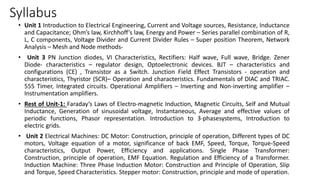
• Unit 1 Introduction to Electrical Engineering, Current and Voltage sources, Resistance, Inductance
and Capacitance; Ohm’s law, Kirchhoff’s law, Energy and Power – Series parallel combination of R,
L, C components, Voltage Divider and Current Divider Rules – Super position Theorem, Network
Analysis – Mesh and Node methods-
• Unit 3 PN Junction diodes, VI Characteristics, Rectifiers: Half wave, Full wave, Bridge. Zener
Diode- characteristics – regulator design, Optoelectronic devices. BJT – characteristics and
configurations (CE) , Transistor as a Switch. Junction Field Effect Transistors - operation and
characteristics, Thyristor (SCR)– Operation and characteristics. Fundamentals of DIAC and TRIAC.
555 Timer, Integrated circuits. Operational Amplifiers – Inverting and Non-inverting amplifier –
Instrumentation amplifiers.
• Rest of Unit-1: Faraday’s Laws of Electro-magnetic Induction, Magnetic Circuits, Self and Mutual
Inductance, Generation of sinusoidal voltage, Instantaneous, Average and effective values of
periodic functions, Phasor representation. Introduction to 3-phasesystems, Introduction to
electric grids.
• Unit 2 Electrical Machines: DC Motor: Construction, principle of operation, Different types of DC
motors, Voltage equation of a motor, significance of back EMF, Speed, Torque, Torque-Speed
characteristics, Output Power, Efficiency and applications. Single Phase Transformer:
Construction, principle of operation, EMF Equation. Regulation and Efficiency of a Transformer.
Induction Machine: Three Phase Induction Motor: Construction and Principle of Operation, Slip
and Torque, Speed Characteristics. Stepper motor: Construction, principle and mode of operation.
Text Books and References
• Textbook(s)
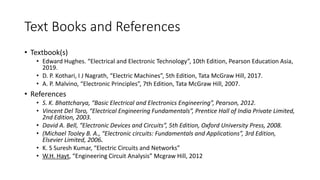
• Edward Hughes. “Electrical and Electronic Technology”, 10th Edition, Pearson Education Asia,
2019.
• D. P. Kothari, I J Nagrath, “Electric Machines”, 5th Edition, Tata McGraw Hill, 2017.
• A. P. Malvino, “Electronic Principles”, 7th Edition, Tata McGraw Hill, 2007.
• References
• S. K. Bhattcharya, “Basic Electrical and Electronics Engineering”, Pearson, 2012.
• Vincent Del Toro, “Electrical Engineering Fundamentals”, Prentice Hall of India Private Limited,
2nd Edition, 2003.
• David A. Bell, “Electronic Devices and Circuits”, 5th Edition, Oxford University Press, 2008.
• (Michael Tooley B. A., “Electronic circuits: Fundamentals and Applications”, 3rd Edition,
Elsevier Limited, 2006.
• K. S Suresh Kumar, “Electric Circuits and Networks”
• W.H. Hayt, “Engineering Circuit Analysis” Mcgraw Hill, 2012
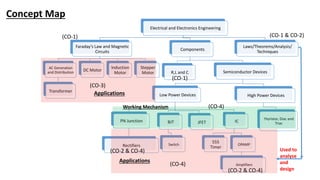
Electrical and Electronics Engineering
Faraday’s Law and Magnetic
Circuits
AC Generation
and Distribution
Transformer
DC Motor
Induction
Motor
Stepper
Motor
Components
R,L and C Semiconductor Devices
Low Power Devices
PN Junction
Rectifiers
BJT
Switch
JFET IC
555
Timer
OPAMP
Amplifiers
High Power Devices
Thyristor, Diac and
Triac
Laws/Theorems/Analysis/
Techniques
Applications
Applications
Working Mechanism
(CO-3)
(CO-4)
(CO-1 & CO-2)
(CO-1)
(CO-4)
(CO-1)
(CO-2 & CO-4)
(CO-2 & CO-4)
Concept Map
Used to
analyse
and
design
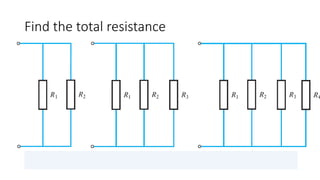
Find the total resistance
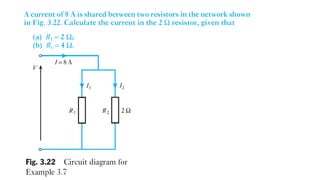
Also calculate the effective resistance as well
Current divider rule?
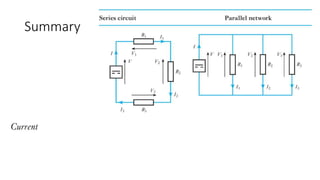
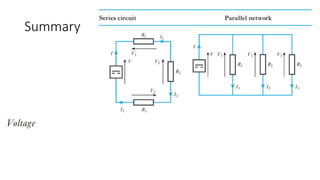
Summary
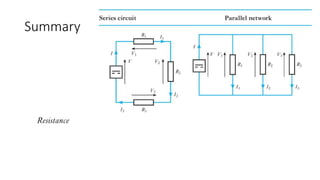
Summary
Summary
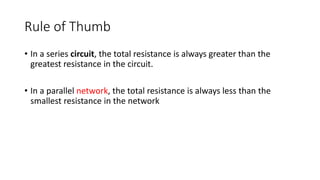
Rule of Thumb
• In a series circuit, the total resistance is always greater than the
greatest resistance in the circuit.
• In a parallel network, the total resistance is always less than the
smallest resistance in the network
Kirchhoff’s law
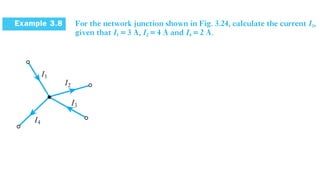
• First (current) law. At any instant the algebraic sum of
the currents at a junction in a network is zero.
Gustav Kirchhoff
[Source: Wikipedia]
Electric circuits,
Optics,
Spectroscopy,
Thermochemistry
etc..
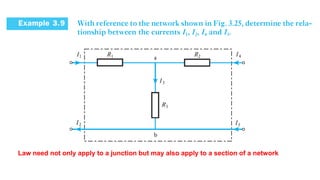
Law need not only apply to a junction but may also apply to a section of a network
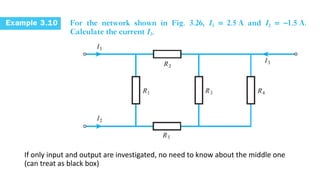
If only input and output are investigated, no need to know about the middle one
(can treat as black box)

L6_Current Divider_KCL.pptx

  • 1.
    Current Divider Ruleand KCL Lecture 6 A.V.Ramachandran 31-Oct-2022 (ECE and CCE)
  • 2.
    Syllabus • Unit 1Introduction to Electrical Engineering, Current and Voltage sources, Resistance, Inductance and Capacitance; Ohm’s law, Kirchhoff’s law, Energy and Power – Series parallel combination of R, L, C components, Voltage Divider and Current Divider Rules – Super position Theorem, Network Analysis – Mesh and Node methods- • Unit 3 PN Junction diodes, VI Characteristics, Rectifiers: Half wave, Full wave, Bridge. Zener Diode- characteristics – regulator design, Optoelectronic devices. BJT – characteristics and configurations (CE) , Transistor as a Switch. Junction Field Effect Transistors - operation and characteristics, Thyristor (SCR)– Operation and characteristics. Fundamentals of DIAC and TRIAC. 555 Timer, Integrated circuits. Operational Amplifiers – Inverting and Non-inverting amplifier – Instrumentation amplifiers. • Rest of Unit-1: Faraday’s Laws of Electro-magnetic Induction, Magnetic Circuits, Self and Mutual Inductance, Generation of sinusoidal voltage, Instantaneous, Average and effective values of periodic functions, Phasor representation. Introduction to 3-phasesystems, Introduction to electric grids. • Unit 2 Electrical Machines: DC Motor: Construction, principle of operation, Different types of DC motors, Voltage equation of a motor, significance of back EMF, Speed, Torque, Torque-Speed characteristics, Output Power, Efficiency and applications. Single Phase Transformer: Construction, principle of operation, EMF Equation. Regulation and Efficiency of a Transformer. Induction Machine: Three Phase Induction Motor: Construction and Principle of Operation, Slip and Torque, Speed Characteristics. Stepper motor: Construction, principle and mode of operation.
  • 3.
    Text Books andReferences • Textbook(s) • Edward Hughes. “Electrical and Electronic Technology”, 10th Edition, Pearson Education Asia, 2019. • D. P. Kothari, I J Nagrath, “Electric Machines”, 5th Edition, Tata McGraw Hill, 2017. • A. P. Malvino, “Electronic Principles”, 7th Edition, Tata McGraw Hill, 2007. • References • S. K. Bhattcharya, “Basic Electrical and Electronics Engineering”, Pearson, 2012. • Vincent Del Toro, “Electrical Engineering Fundamentals”, Prentice Hall of India Private Limited, 2nd Edition, 2003. • David A. Bell, “Electronic Devices and Circuits”, 5th Edition, Oxford University Press, 2008. • (Michael Tooley B. A., “Electronic circuits: Fundamentals and Applications”, 3rd Edition, Elsevier Limited, 2006. • K. S Suresh Kumar, “Electric Circuits and Networks” • W.H. Hayt, “Engineering Circuit Analysis” Mcgraw Hill, 2012
  • 4.
    Electrical and ElectronicsEngineering Faraday’s Law and Magnetic Circuits AC Generation and Distribution Transformer DC Motor Induction Motor Stepper Motor Components R,L and C Semiconductor Devices Low Power Devices PN Junction Rectifiers BJT Switch JFET IC 555 Timer OPAMP Amplifiers High Power Devices Thyristor, Diac and Triac Laws/Theorems/Analysis/ Techniques Applications Applications Working Mechanism (CO-3) (CO-4) (CO-1 & CO-2) (CO-1) (CO-4) (CO-1) (CO-2 & CO-4) (CO-2 & CO-4) Concept Map Used to analyse and design
  • 5.
    Find the totalresistance
  • 6.
    Also calculate theeffective resistance as well Current divider rule?
  • 12.
  • 13.
  • 14.
  • 15.
    Rule of Thumb •In a series circuit, the total resistance is always greater than the greatest resistance in the circuit. • In a parallel network, the total resistance is always less than the smallest resistance in the network
  • 16.
    Kirchhoff’s law • First(current) law. At any instant the algebraic sum of the currents at a junction in a network is zero. Gustav Kirchhoff [Source: Wikipedia] Electric circuits, Optics, Spectroscopy, Thermochemistry etc..
  • 18.
    Law need notonly apply to a junction but may also apply to a section of a network
  • 19.
    If only inputand output are investigated, no need to know about the middle one (can treat as black box)