REPRESENTING INSTRUCTIONS IN
THE COMPUTER
REPRESENTING INSTRUCTIONS IN THE COMPUTER
 Instructions are kept in the computer as a series of high and low
electronic signals, represented as numbers
 Each piece of an instruction can be considered as an individual
number
 Placing these numbers side by side forms the instruction
 Translating ARM Assembly Instructions into a Machine Instructions
 Real ARM language version of the instruction represented
symbolically as ADD r5, r1, r2
 First as a combination of decimal numbers and then of binary
numbers
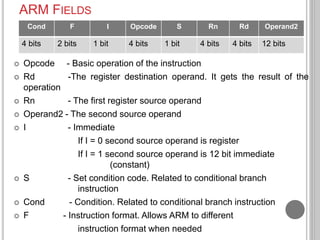
ARM FIELDS
 Opcode - Basic operation of the instruction
 Rd -The register destination operand. It gets the result of the
operation
 Rn - The first register source operand
 Operand2 - The second source operand
 I - Immediate
If I = 0 second source operand is register
If I = 1 second source operand is 12 bit immediate
(constant)
 S - Set condition code. Related to conditional branch
instruction
 Cond - Condition. Related to conditional branch instruction
 F - Instruction format. Allows ARM to different
instruction format when needed
Cond F I Opcode S Rn Rd Operand2
4 bits 2 bits 1 bit 4 bits 1 bit 4 bits 4 bits 12 bits
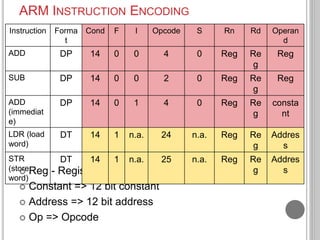
ARM INSTRUCTION ENCODING
 Reg - Register number between 0 and 15
 Constant => 12 bit constant
 Address => 12 bit address
 Op => Opcode
Instruction Forma
t
Cond F I Opcode S Rn Rd Operan
d
ADD DP 14 0 0 4 0 Reg Re
g
Reg
SUB DP 14 0 0 2 0 Reg Re
g
Reg
ADD
(immediat
e)
DP 14 0 1 4 0 Reg Re
g
consta
nt
LDR (load
word)
DT 14 1 n.a. 24 n.a. Reg Re
g
Addres
s
STR
(store
word)
DT 14 1 n.a. 25 n.a. Reg Re
g
Addres
s
DECIMAL REPRESENTATION OF INSTRUCTION
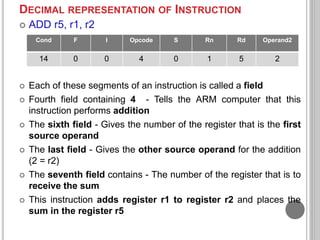
 ADD r5, r1, r2
 Each of these segments of an instruction is called a field
 Fourth field containing 4 - Tells the ARM computer that this
instruction performs addition
 The sixth field - Gives the number of the register that is the first
source operand
 The last field - Gives the other source operand for the addition
(2 = r2)
 The seventh field contains - The number of the register that is to
receive the sum
 This instruction adds register r1 to register r2 and places the
sum in the register r5
Cond F I Opcode S Rn Rd Operand2
14 0 0 4 0 1 5 2
INSTRUCTION FORMAT
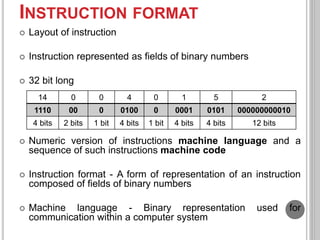
 Layout of instruction
 Instruction represented as fields of binary numbers
 32 bit long
 Numeric version of instructions machine language and a
sequence of such instructions machine code
 Instruction format - A form of representation of an instruction
composed of fields of binary numbers
 Machine language - Binary representation used for
communication within a computer system
14 0 0 4 0 1 5 2
1110 00 0 0100 0 0001 0101 000000000010
4 bits 2 bits 1 bit 4 bits 1 bit 4 bits 4 bits 12 bits
ARM INSTRUCTION FORMAT
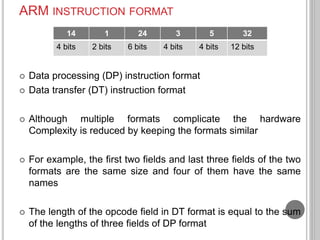
 Data processing (DP) instruction format
 Data transfer (DT) instruction format
 Although multiple formats complicate the hardware
Complexity is reduced by keeping the formats similar
 For example, the first two fields and last three fields of the two
formats are the same size and four of them have the same
names
 The length of the opcode field in DT format is equal to the sum
of the lengths of three fields of DP format
14 1 24 3 5 32
4 bits 2 bits 6 bits 4 bits 4 bits 12 bits
ARM FIELDS (2)
 ADD r3, r3, #4 ; r3=r3+4
 Constant 4 is placed in operand 2 field and the I field is set to 1
 LDR r5, [r3, #32] ; Temporary register r5 gets A[8]
 Load and store use a different instruction format from above
with 6 fields
 Field F = 1 => Tell ARM that format is different
 Data transfer instruction format
 Opcode field 24 => instruction perform load word
 Offset2 field has 32 as the offset to add to the base register
14 0 1 4 0 3 3 4
Cond F Opcode Rn Rd Offset2
4 bits 2 bits 6 bits 4 bits 4 bits 12 bits
TRANSLATING ARM ASSEMBLY LANGUAGE
INTO MACHINE LANGUAGE
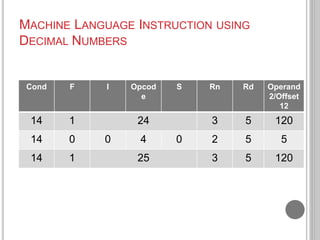
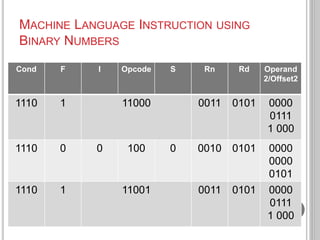
 Consider an example all the way from what the
programmer writes to what the computer executes
 If r3 has the base of the array A and r2 corresponds to h,
the assignment statement
 A[30] = h + A[30]; is compiled into
 LDR r5, [r3, #120] # Temporary reg r5 gets A[30]
 ADD r5, r2, r5 # Temporary reg r5 gets h + A[30]
 STR r5, [r3, #120] # Stores h + A[30] back into A[30]
 What is the ARM machine language code for these three
instructions?
MACHINE LANGUAGE INSTRUCTION USING
DECIMAL NUMBERS
Cond F I Opcod
e
S Rn Rd Operand
2/Offset
12
14 1 24 3 5 120
14 0 0 4 0 2 5 5
14 1 25 3 5 120
MACHINE LANGUAGE INSTRUCTION USING
BINARY NUMBERS
Cond F I Opcode S Rn Rd Operand
2/Offset2
1110 1 11000 0011 0101 0000
0111
1 000
1110 0 0 100 0 0010 0101 0000
0000
0101
1110 1 11001 0011 0101 0000
0111
1 000
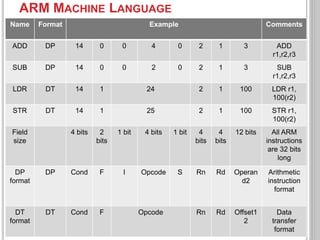
ARM MACHINE LANGUAGE
Name Format Example Comments
ADD DP 14 0 0 4 0 2 1 3 ADD
r1,r2,r3
SUB DP 14 0 0 2 0 2 1 3 SUB
r1,r2,r3
LDR DT 14 1 24 2 1 100 LDR r1,
100(r2)
STR DT 14 1 25 2 1 100 STR r1,
100(r2)
Field
size
4 bits 2
bits
1 bit 4 bits 1 bit 4
bits
4
bits
12 bits All ARM
instructions
are 32 bits
long
DP
format
DP Cond F I Opcode S Rn Rd Operan
d2
Arithmetic
instruction
format
DT
format
DT Cond F Opcode Rn Rd Offset1
2
Data
transfer
format
What ARM instruction does this represent?
 ADD r0, r1, r2
 ADD r1, r0, r2
 ADD r2, r1, r0
 SUB r2, r0, r1
Cond F I Opcod
e
S Rn Rd Operand
2
14 0 0 4 0 0 1 2

L3_Representing Instructions in the Computer.pptx

  • 1.
  • 2.
    REPRESENTING INSTRUCTIONS INTHE COMPUTER  Instructions are kept in the computer as a series of high and low electronic signals, represented as numbers  Each piece of an instruction can be considered as an individual number  Placing these numbers side by side forms the instruction  Translating ARM Assembly Instructions into a Machine Instructions  Real ARM language version of the instruction represented symbolically as ADD r5, r1, r2  First as a combination of decimal numbers and then of binary numbers
  • 3.
    ARM FIELDS  Opcode- Basic operation of the instruction  Rd -The register destination operand. It gets the result of the operation  Rn - The first register source operand  Operand2 - The second source operand  I - Immediate If I = 0 second source operand is register If I = 1 second source operand is 12 bit immediate (constant)  S - Set condition code. Related to conditional branch instruction  Cond - Condition. Related to conditional branch instruction  F - Instruction format. Allows ARM to different instruction format when needed Cond F I Opcode S Rn Rd Operand2 4 bits 2 bits 1 bit 4 bits 1 bit 4 bits 4 bits 12 bits
  • 4.
    ARM INSTRUCTION ENCODING Reg - Register number between 0 and 15  Constant => 12 bit constant  Address => 12 bit address  Op => Opcode Instruction Forma t Cond F I Opcode S Rn Rd Operan d ADD DP 14 0 0 4 0 Reg Re g Reg SUB DP 14 0 0 2 0 Reg Re g Reg ADD (immediat e) DP 14 0 1 4 0 Reg Re g consta nt LDR (load word) DT 14 1 n.a. 24 n.a. Reg Re g Addres s STR (store word) DT 14 1 n.a. 25 n.a. Reg Re g Addres s
  • 5.
    DECIMAL REPRESENTATION OFINSTRUCTION  ADD r5, r1, r2  Each of these segments of an instruction is called a field  Fourth field containing 4 - Tells the ARM computer that this instruction performs addition  The sixth field - Gives the number of the register that is the first source operand  The last field - Gives the other source operand for the addition (2 = r2)  The seventh field contains - The number of the register that is to receive the sum  This instruction adds register r1 to register r2 and places the sum in the register r5 Cond F I Opcode S Rn Rd Operand2 14 0 0 4 0 1 5 2
  • 6.
    INSTRUCTION FORMAT  Layoutof instruction  Instruction represented as fields of binary numbers  32 bit long  Numeric version of instructions machine language and a sequence of such instructions machine code  Instruction format - A form of representation of an instruction composed of fields of binary numbers  Machine language - Binary representation used for communication within a computer system 14 0 0 4 0 1 5 2 1110 00 0 0100 0 0001 0101 000000000010 4 bits 2 bits 1 bit 4 bits 1 bit 4 bits 4 bits 12 bits
  • 7.
    ARM INSTRUCTION FORMAT Data processing (DP) instruction format  Data transfer (DT) instruction format  Although multiple formats complicate the hardware Complexity is reduced by keeping the formats similar  For example, the first two fields and last three fields of the two formats are the same size and four of them have the same names  The length of the opcode field in DT format is equal to the sum of the lengths of three fields of DP format 14 1 24 3 5 32 4 bits 2 bits 6 bits 4 bits 4 bits 12 bits
  • 8.
    ARM FIELDS (2) ADD r3, r3, #4 ; r3=r3+4  Constant 4 is placed in operand 2 field and the I field is set to 1  LDR r5, [r3, #32] ; Temporary register r5 gets A[8]  Load and store use a different instruction format from above with 6 fields  Field F = 1 => Tell ARM that format is different  Data transfer instruction format  Opcode field 24 => instruction perform load word  Offset2 field has 32 as the offset to add to the base register 14 0 1 4 0 3 3 4 Cond F Opcode Rn Rd Offset2 4 bits 2 bits 6 bits 4 bits 4 bits 12 bits
  • 9.
    TRANSLATING ARM ASSEMBLYLANGUAGE INTO MACHINE LANGUAGE  Consider an example all the way from what the programmer writes to what the computer executes  If r3 has the base of the array A and r2 corresponds to h, the assignment statement  A[30] = h + A[30]; is compiled into  LDR r5, [r3, #120] # Temporary reg r5 gets A[30]  ADD r5, r2, r5 # Temporary reg r5 gets h + A[30]  STR r5, [r3, #120] # Stores h + A[30] back into A[30]  What is the ARM machine language code for these three instructions?
  • 10.
    MACHINE LANGUAGE INSTRUCTIONUSING DECIMAL NUMBERS Cond F I Opcod e S Rn Rd Operand 2/Offset 12 14 1 24 3 5 120 14 0 0 4 0 2 5 5 14 1 25 3 5 120
  • 11.
    MACHINE LANGUAGE INSTRUCTIONUSING BINARY NUMBERS Cond F I Opcode S Rn Rd Operand 2/Offset2 1110 1 11000 0011 0101 0000 0111 1 000 1110 0 0 100 0 0010 0101 0000 0000 0101 1110 1 11001 0011 0101 0000 0111 1 000
  • 12.
    ARM MACHINE LANGUAGE NameFormat Example Comments ADD DP 14 0 0 4 0 2 1 3 ADD r1,r2,r3 SUB DP 14 0 0 2 0 2 1 3 SUB r1,r2,r3 LDR DT 14 1 24 2 1 100 LDR r1, 100(r2) STR DT 14 1 25 2 1 100 STR r1, 100(r2) Field size 4 bits 2 bits 1 bit 4 bits 1 bit 4 bits 4 bits 12 bits All ARM instructions are 32 bits long DP format DP Cond F I Opcode S Rn Rd Operan d2 Arithmetic instruction format DT format DT Cond F Opcode Rn Rd Offset1 2 Data transfer format
  • 13.
    What ARM instructiondoes this represent?  ADD r0, r1, r2  ADD r1, r0, r2  ADD r2, r1, r0  SUB r2, r0, r1 Cond F I Opcod e S Rn Rd Operand 2 14 0 0 4 0 0 1 2