Philosophy and Education in Malaysia
Topic 2:
Viewpoints of Western Philosophers on
Knowledge, Education and
Branches of Philosophy
OVERVIEW
1) Branches of Philosophy
2) Viewpoints of Western Philosophers
on Knowledge and Education
3) Source of knowledge and goals of
Western Education
BRANCHES OF PHILOSOPHY
1) Ontology (Existence or Reality)
2) Epistemology (Knowledge)
3) Axiology (Values)
4) Logic
Sources: http://www.thefreedictionary.com/Ontology http://www.dictionary.com/browse/metaphysics
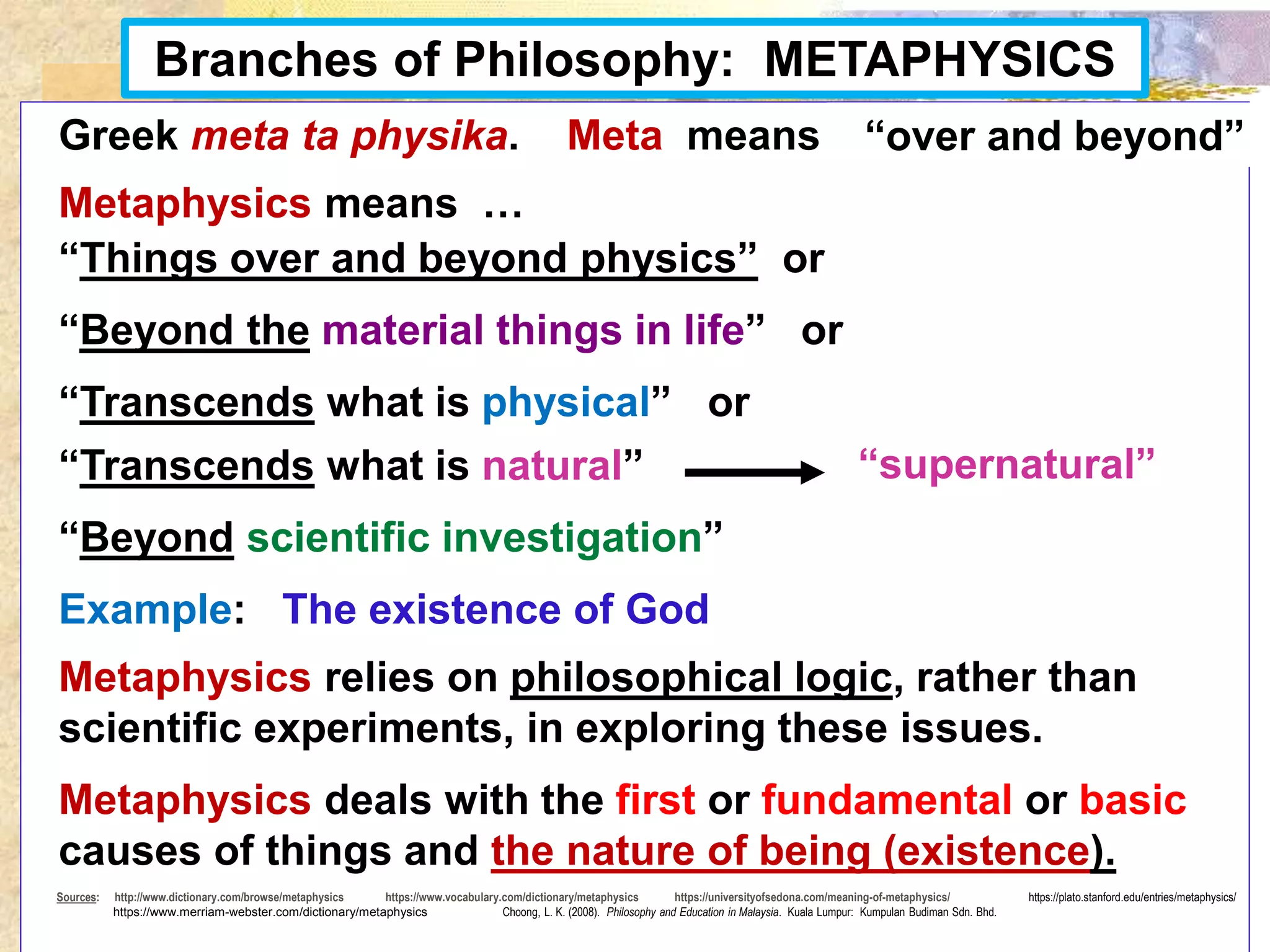
Branches of Philosophy: METAPHYSICS
Greek meta ta physika. Meta means …..
Metaphysics means …
“Things over and beyond physics” or
“Beyond the material things in life” or
“Transcends what is physical” or
“Transcends what is natural”
“Beyond scientific investigation”
Example: The existence of God
Metaphysics relies on philosophical logic, rather than
scientific experiments, in exploring these issues.
Metaphysics deals with the first or fundamental or basic
causes of things and the nature of being (existence).
Sources: http://www.dictionary.com/browse/metaphysics https://www.vocabulary.com/dictionary/metaphysics https://universityofsedona.com/meaning-of-metaphysics/ https://plato.stanford.edu/entries/metaphysics/
https://www.merriam-webster.com/dictionary/metaphysics Choong, L. K. (2008). Philosophy and Education in Malaysia. Kuala Lumpur: Kumpulan Budiman Sdn. Bhd.
“supernatural”
“over and beyond”
ONTOLOGY
Ontology, at its simplest, is the study of existence.
• It is about how we determine if things exist or not.
• It attempts to take things that are abstract and
establish that they are, in fact, real.
Sources: http://study.com/academy/lesson/what-is-ontology-definition-examples.html metaphysics Choong, L. K. (2008). Philosophy and Education in Malaysia. Kuala Lumpur: Kumpulan Budiman Sdn. Bhd.
Ontology is speculative and focuses on the
cause-and-effect relationship of
things and phenomena.
* Speculative = forming of a theory without firm evidence
or on the basis of incomplete information.
* Abstract = existing in thought or as an idea but not
having a physical or concrete existence.
Does God exist ?
Ontological Question:
What is the nature (intrinsic characteristic) of an alien?
• How do you know?
• What is the source of your knowledge?
Epistemological Questions:
• How do you know?
• What is the source of your knowledge?
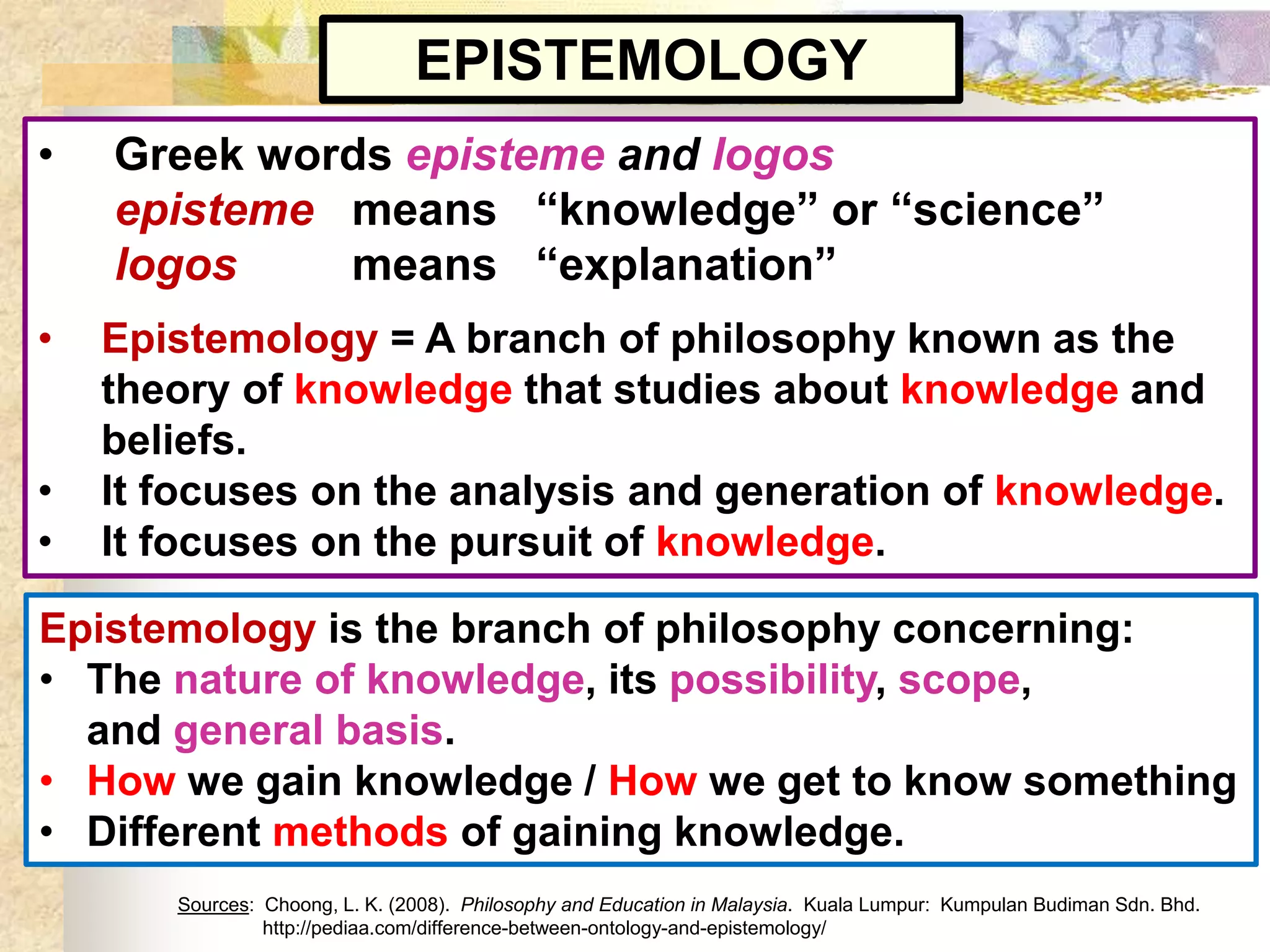
EPISTEMOLOGY
• Greek words episteme and logos
episteme means “knowledge” or “science”
logos means “explanation”
• Epistemology = A branch of philosophy known as the
theory of knowledge that studies about knowledge and
beliefs.
• It focuses on the analysis and generation of knowledge.
• It focuses on the pursuit of knowledge.
Sources: Choong, L. K. (2008). Philosophy and Education in Malaysia. Kuala Lumpur: Kumpulan Budiman Sdn. Bhd.
http://pediaa.com/difference-between-ontology-and-epistemology/
Epistemology is the branch of philosophy concerning:
• The nature of knowledge, its possibility, scope,
and general basis.
• How we gain knowledge / How we get to know something
• Different methods of gaining knowledge.
EPISTEMOLOGY as:
 The theory of knowledge
 The nature of knowledge
 The intrinsic characteristics of knowledge
 The very important and basic characteristics of knowledge
Epistemology attempts to answer the following questions:
• What is knowledge?
• What are the sources of knowledge?
• What does mankind know?
• How do we know that we know something?
Example: How do you know if someone is lying?
How do you know that she was smoking?
• Is knowledge static or dynamic (continuously changing)?
• How do I separate true ideas from false ideas?
Source: Choong, L. K. (2008). Philosophy and Education in Malaysia. Kuala Lumpur: Kumpulan Budiman Sdn. Bhd.
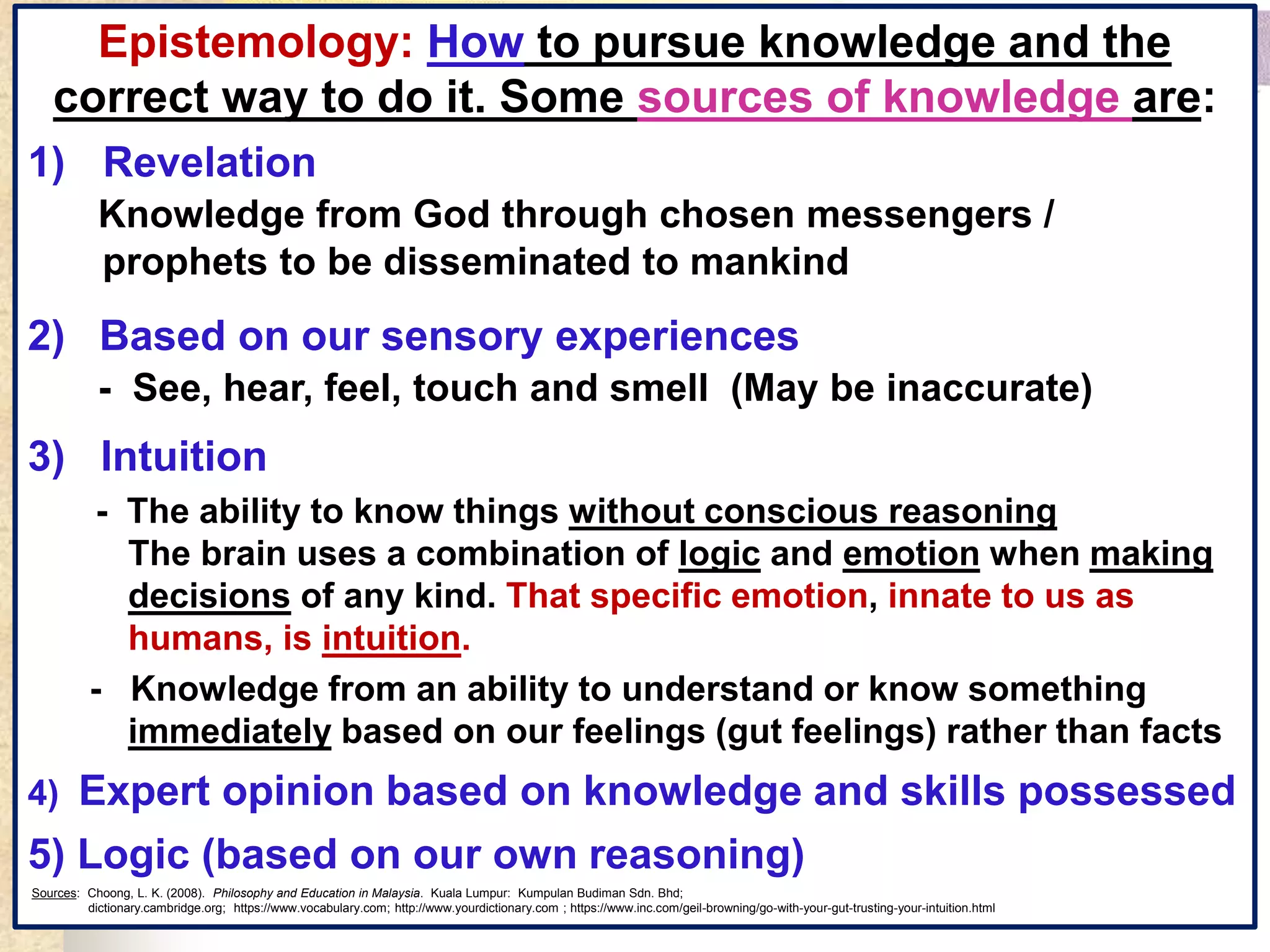
Epistemology: How to pursue knowledge and the
correct way to do it. Some sources of knowledge are:
1) Revelation
Knowledge from God through chosen messengers /
prophets to be disseminated to mankind
2) Based on our sensory experiences
- See, hear, feel, touch and smell (May be inaccurate)
3) Intuition
- The ability to know things without conscious reasoning
The brain uses a combination of logic and emotion when making
decisions of any kind. That specific emotion, innate to us as
humans, is intuition.
- Knowledge from an ability to understand or know something
immediately based on our feelings (gut feelings) rather than facts
4) Expert opinion based on knowledge and skills possessed
5) Logic (based on our own reasoning)
Sources: Choong, L. K. (2008). Philosophy and Education in Malaysia. Kuala Lumpur: Kumpulan Budiman Sdn. Bhd;
dictionary.cambridge.org; https://www.vocabulary.com; http://www.yourdictionary.com ; https://www.inc.com/geil-browning/go-with-your-gut-trusting-your-intuition.html
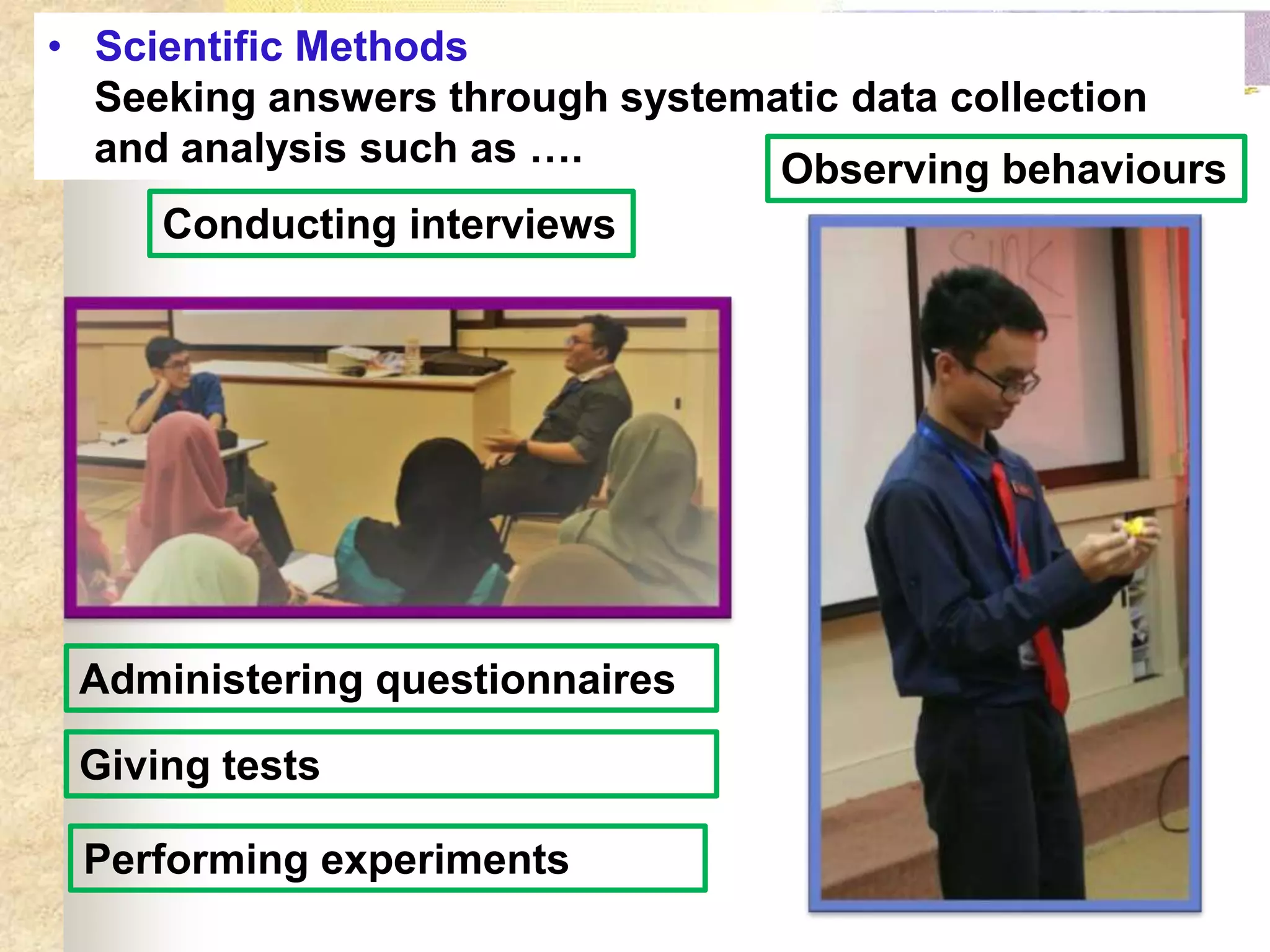
• Scientific Methods
Seeking answers through systematic data collection
and analysis such as ….
Conducting interviews
Observing behaviours
Administering questionnaires
Giving tests
Performing experiments
Greek
(logos)
reason
Greek
(logikē
tekhnē )
Art of reason
Late
Latin
logica
Old
French
logique
Late Middle
English
LOGIC
Sources: Choong, L. K. (2008). Philosophy and Education in Malaysia. Kuala Lumpur: Kumpulan Budiman Sdn. Bhd.; Online Etymology Dictionary http://www.etymonline.com/
LOGIC
• Logic explains the relationship between ideas.
• Logic gives reasons for the suggested answers.
• Logic tries to differentiate between what is true and
what is false; what is valid and what is doubtful.
Analyse this scenario and indicate
which is logical and which is not logical (illogical).
Jacky did not attend the Physical Education class at 8 am
because he said he had diarrhoea.
The class organised a pizza party during recess time
at 10 am and Jacky ate a lot.
Generally, there are two types of logical reasoning:
Inductive Reasoning
Deductive Reasoning
Deductive reasoning
proceeds from
general premises to
a specific conclusion.
Inductive reasoning
proceeds from
specific premises to
a general conclusion.
Both are based on logical inference.
A logical inference is a connection from
a first statement to a second statement
for which the rules of logic
show that if the initial statement is true,
the second statement should be true.
First Statement
(Premise)
Second Statement
(Conclusion)
Sources: http://whatis.techtarget.com/definition/deductive-reasoning http://philosophyterms.com/deductive-reasoning/
Deductive Reasoning
Deductive Logic
Example
Starts from general premises
Generate a specific conclusion
• All men are mortal.
• Socrates is a man.
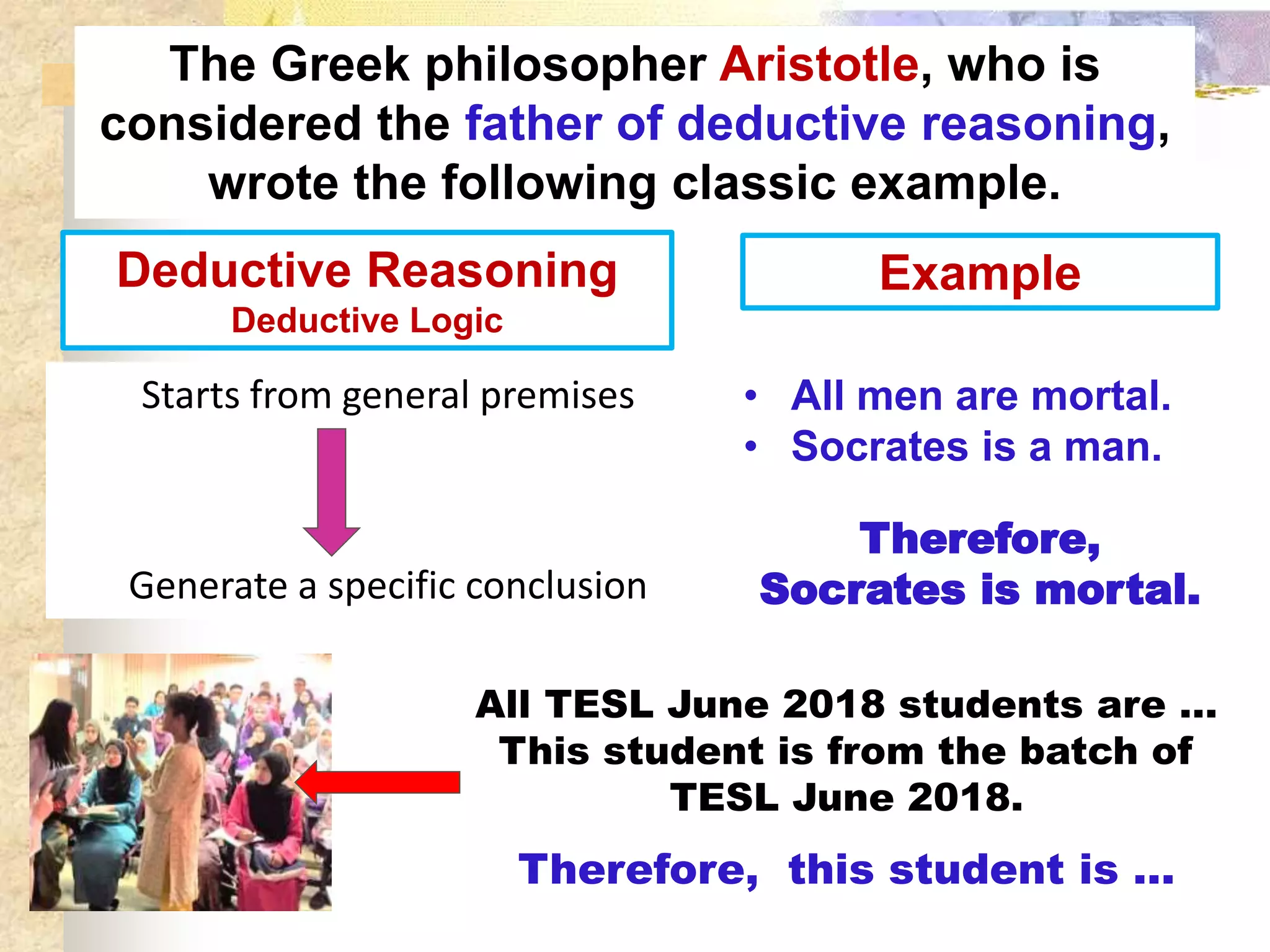
The Greek philosopher Aristotle, who is
considered the father of deductive reasoning,
wrote the following classic example.
All TESL June 2018 students are …
This student is from the batch of
TESL June 2018.
Therefore, this student is …
Therefore,
Socrates is mortal.
Inductive Reasoning
Inductive logic
Starts with specific premises
Followed by Reasoning
Form a general conclusion
Example
Leela likes to play with dolls.
Jill likes to play with dolls.
Nani likes to play with dolls.
Leela, Jill and Nani are girls.
All girls like to play with dolls.
The first
creature
looks like
a cat.
These creatures are aliens.
Therefore, all aliens look like cats.
The 2nd … The 3rd … The 4th … The 5th …
AXIOLOGY
Axiology:
Greek word Axios meaning Worth or Value
• Axiology is the branch of practical philosophy
which studies the nature of value.
• Axiologists study value in general.
• It is the study of value and value judgments.
• It deals with the types of value such as in
• morals, ethics, aesthetics and religion.
Example of Axiological Questions:
Good or Bad? True or False?
Right or Wrong? Beautiful or Ugly?
It can be classified into 2 aspects:
Ethics and Aesthetics.
Webster's New World College Dictionary, Fifth Edition Copyright © 2014 by Houghton Mifflin Harcourt Publishing Company. All rights reserved.
Read more at http://www.yourdictionary.com/axiology
Ethics focuses on the moral and behaviour of mankind.
It investigates the goodness of a person, society and life.
It can be categorised into 3 basic types:
1) Meta Ethics: The study about the Concept of Ethics
2) Normative Ethics: The study about how to determine
ethical values
3) Applied Ethics: The Study about the application of
ethical values.
Example of Questions on Ethics:
• What should we do about this?
• What is the best thing to do?
• What is goodness?
• What are some of the behavioural characteristics of
being good?
• What determines a good action?
Sources: Choong, L. K. (2008). Philosophy and Education in Malaysia. Kuala Lumpur: Kumpulan Budiman Sdn. Bhd.; Online Etymology Dictionary http://www.etymonline.com/
Aesthetics refers to beauty
in the arts, environment and life.
It focuses more on taste and sentiments.
Example of Questions on Aesthetics:
• What is beauty?
• How do we appreciate beauty in our
natural environment?
Sources: Choong, L. K. (2008). Philosophy and Education in Malaysia. Kuala Lumpur: Kumpulan Budiman Sdn. Bhd.;
Western Philosophy of Education
1) Traditional – Perennialism, Essentialism
2) Modern – Progressivism, Reconstructivism, Existentialism
PERENNIALISM
• Perennial means Do not Change or Fixed
Truth is defined as perennial and therefore, education
should focus on the search and dissemination of
knowledge which is fixed.
• The focus is to teach truths or ideas that are everlasting,
to seek enduring truths which are constant, not
changing, as the natural and human worlds at their most
basic level, do not change. Teaching these unchanging
principles is critical. These ideas have the potential for
solving problems in any era. E.g. Attaining Cultural Literacy:
the great works of literature and art, the laws or principles of science
Source: https://oregonstate.edu/instruct/ed416/PP3.html
Education Goals
• Education is for teaching universal knowledge and
values which are everlasting and not constrained by
time limits.
• However, some of the contents in the curriculum
taught in schools may not be relevant any more at that
present time. In such an instance, the school
authorities may have to take the necessary steps to
overcome this problem. Why?
• This is necessary because schools have the
responsibility to prepare our young people to face life’s
challenges after they leave school and go out ito the
working world.
Concept: According to perennialists, human beings, by
nature have universal characteristics which are constant.
One of these is rationality which must be nurtured from
young while we are still in school.
Sources: Choong, L. K. (2008). Philosophy and Education in Malaysia. Kuala Lumpur: Kumpulan Budiman Sdn. Bhd.;
ESSENTIALISM
• Originated from Realism (Aristotle) and Idealism (Plato)
• Essentialists believe that there is a common core of
knowledge that needs to be transmitted to students in a
systematic, disciplined way.
• The emphasis is on intellectual and moral standards that
schools should teach.
• It should focus on facts and "the basics," training
students to read, write, speak, and compute clearly and
logically.
• Students should be taught hard work, respect for
authority, and discipline. Teachers are to help students
keep their non-productive instincts in check, such as
aggression or mindlessness.
• Essentialists accept the idea that this core curriculum may
change. Schooling should be practical, preparing students to
become valuable members of society. Source: https://oregonstate.edu/instruct/ed416/PP3.html
• Essentialists places importance on the basics
that an individual needs to know in order to
become a productive person.
• Therefore, this basic knowledge can change
from time to time to cater to the needs of the
current society.
• In this sense, essentialism is said to be both
practical and pragmatic.
Education Goals are to teach factual information
which needs to be learnt, appreciated and stored
by our pupils as well as how to appreciate culture.
Source: Choong, L. K. (2008). Philosophy and Education in Malaysia. Kuala Lumpur: Kumpulan Budiman Sdn. Bhd.;
PROGRESSIVISM
• Progressivism was developed from pragmatism. Pragmatists
believe that learners should apply their knowledge to real
situations through experimental inquiry.
• John Dewey was the foremost proponent of progressivism.
• CONCEPT
Progressivist believe that change is the core of reality.
Knowledge which is used to explain the present reality is
both relative and tentative. Thus, it is not an everlasting truth.
Reality undergoes continuous changes.
What then is an educated person?
An educated person is one who has the insight which enables
him to adapt to changes in his environment.
In contrast to perennialists, progressivists do not believe in
the existence of permanent and pertinent truth that needs to
be mastered by our pupils.
Source: Choong, L. K. (2008). Philosophy and Education in Malaysia. Kuala Lumpur: Kumpulan Budiman Sdn. Bhd.;
Education Goals
The aim of education for progressivists is to prepare pupils
to accommodate to changes in their everyday lives.
An educated person is thus able to look for alternative
solutions which are relevant to the problems they face.
Progressivists believe that education should focus on the
whole child, rather than on the content or the teacher.
This educational philosophy stresses that students should
test ideas by active experimentation.
Learning is rooted in the questions of learners that arise
through experiencing the world. It is active, not passive.
The learner is a problem solver and thinker who makes
meaning through his or her individual experience in the
physical and cultural context. Effective teachers provide
experiences so that students can learn by doing.
Sources: Choong, L. K. (2008). Philosophy and Education in Malaysia. Kuala Lumpur: Kumpulan Budiman Sdn. Bhd.; and https://oregonstate.edu/instruct/ed416/PP3.html
Curriculum content is derived from student interests and
questions.
The scientific method is used by progressivist educators
so that students can study matter and events
systematically and first hand.
The emphasis is on process-how one comes to know.
The Progressive education philosophy was established
in America from the mid 1920s through the mid 1950s.
One of the tenets was that the school should improve the
way of life of our citizens through experiencing freedom
and democracy in schools.
Shared decision making, planning of teachers with
students, student-selected topics are all aspects.
Books are tools, rather than authority.
Source: https://oregonstate.edu/instruct/ed416/PP3.html
RECONSTRUCTIVISM
• Reconstructivism stems from progressivism.
• Social reconstructionism is a philosophy that
emphasizes the addressing of social questions and a
quest to create a better society and worldwide
democracy.
• Reconstructionist educators focus on a curriculum that
highlights social reform as the aim of education.
• Theodore Brameld (1904-1987) was the founder of social
reconstructionism, in reaction against the realities of
World War II.
• He recognized the potential for either human
annihilation through technology and human cruelty or
the capacity to create a beneficent society using
technology and human compassion.
Sources: Choong, L. K. (2008). Philosophy and Education in Malaysia. Kuala Lumpur: Kumpulan Budiman Sdn. Bhd.; and https://oregonstate.edu/instruct/ed416/PP3.html
Social reconstructionists, believe that systems must be
changed to overcome oppression and improve human
conditions.
Example: Paulo Freire (1921-1997) was a Brazilian whose
experiences living in poverty led him to champion
education and literacy as the vehicle for social change.
In his view, humans must learn to resist oppression and
not become its victims, nor oppress others.
To do so requires dialog and critical consciousness, the
development of awareness to overcome domination and
oppression.
Sources: Choong, L. K. (2008). Philosophy and Education in Malaysia. Kuala Lumpur: Kumpulan Budiman Sdn. Bhd.; and https://oregonstate.edu/instruct/ed416/PP3.html
Rather than "teaching as banking," in which the educator
deposits information into students' heads, Freire saw
teaching and learning as a process of inquiry in which
the child must invent and reinvent the world.
For social reconstructionists, curriculum focuses on
student experience and taking social action on real
problems, such as violence, hunger, international
terrorism, inflation, and inequality.
Strategies for dealing with controversial issues
(particularly in social studies and literature), inquiry,
dialogue, and multiple perspectives are the focus.
Community-based learning and bringing the world into
the classroom are also strategies.
Source: https://oregonstate.edu/instruct/ed416/PP3.html
• Reconstructivism recommends that we improve and
reconstruct our society.
• According to reconstructivists, schools are the main
catalyst for improving the state of human beings
through educational and social innovations.
• Schools are the best platforms to build a new
society for the purpose of identifying social
problems which obstruct the development of society
and create cultural crises.
• GOALS OF EDUCATION
To lay the foundation for a new cultural pattern and
to eradicate social ills or social problems.
Sources: Choong, L. K. (2008). Philosophy and Education in Malaysia. Kuala Lumpur: Kumpulan Budiman Sdn. Bhd.; and https://oregonstate.edu/instruct/ed416/PP3.html
Dr. Chin Mei Chin 2018
EXISTENTIALISM
• Existentialists focus on the nature of the existence of man.
• Human beings are considered born without any aim or
purpose in life.
• The nature of reality for Existentialists is subjective, and
lies within the individual.
• The physical world has no essential meaning outside of
human existence. So, individual choice and individual
standards rather than external standards are central.
• We define ourselves in relationship to existence by the
choices we make.
• We should not accept anyone else's predetermined
philosophical system; rather, we must take responsibility
for deciding who we are.
• The focus is on freedom, the development of authentic
individuals, as we make meaning of our lives.
Sources: Choong, L. K. (2008). Philosophy and Education in Malaysia. Kuala Lumpur: Kumpulan Budiman Sdn. Bhd.; and https://oregonstate.edu/instruct/ed416/PP2.html
There are several different orientations within the
existentialist philosophy.
Soren Kierkegaard (1813-1855), a Danish minister and
philosopher, is considered to be the founder of
existentialism had a Christian orientation.
Another group of existentialists, largely European,
believes that our existence is not guaranteed in an after
life, so there is tension about life and the certainty of
death, of hope or despair.
The more austere European approaches where the
universe is seen as meaningless when faced with the
certainty of the end of existence.
American existentialists focused more on human
potential and the quest for personal meaning.
Source: https://oregonstate.edu/instruct/ed416/PP2.html
EXISTENTIALISM
CONCEPT
An individual is responsible for himself and has the
autonomy to determine his goals and make his own
decisions without referring to outside authorities.
The subject matter should be a matter of personal choice.
Character development emphasizes individual responsibility
for decisions.
GOAL OF EDUCATION
• It implies that the school system or teacher does not have
the right to impose the goals of education. As such,
educational goals are not outlined.
• Existentialists are opposed to thinking about students as
objects to be measured, tracked, or standardized.
• The educational experience focuses on creating
opportunities for self-direction and self actualization. They
start with the student, rather than on curriculum content.
Source: Choong, L. K. (2008). Philosophy and Education in Malaysia. Kuala Lumpur: Kumpulan Budiman Sdn. Bhd.;
Additional Notes on
1) Idealism
2) Realism
3) Pragmatism also known as
Experientialism
• Plato is the father of Idealism.
• Idealism is in search for truth, beauty, and justice that is
enduring and everlasting, the focus is on conscious
reasoning in the mind.
• In idealism, the aim of education is to discover and develop
each individual's abilities and full moral excellence in order
to better serve society.
• The curricular emphasis is subject matter of mind:
literature, history, philosophy, and religion.
• Teaching methods focus on handling ideas through
lecture, discussion, and Socratic dialogue.
• Character is developed through imitating examples and
heroes.
Source: https://oregonstate.edu/instruct/ed416/PP2.html
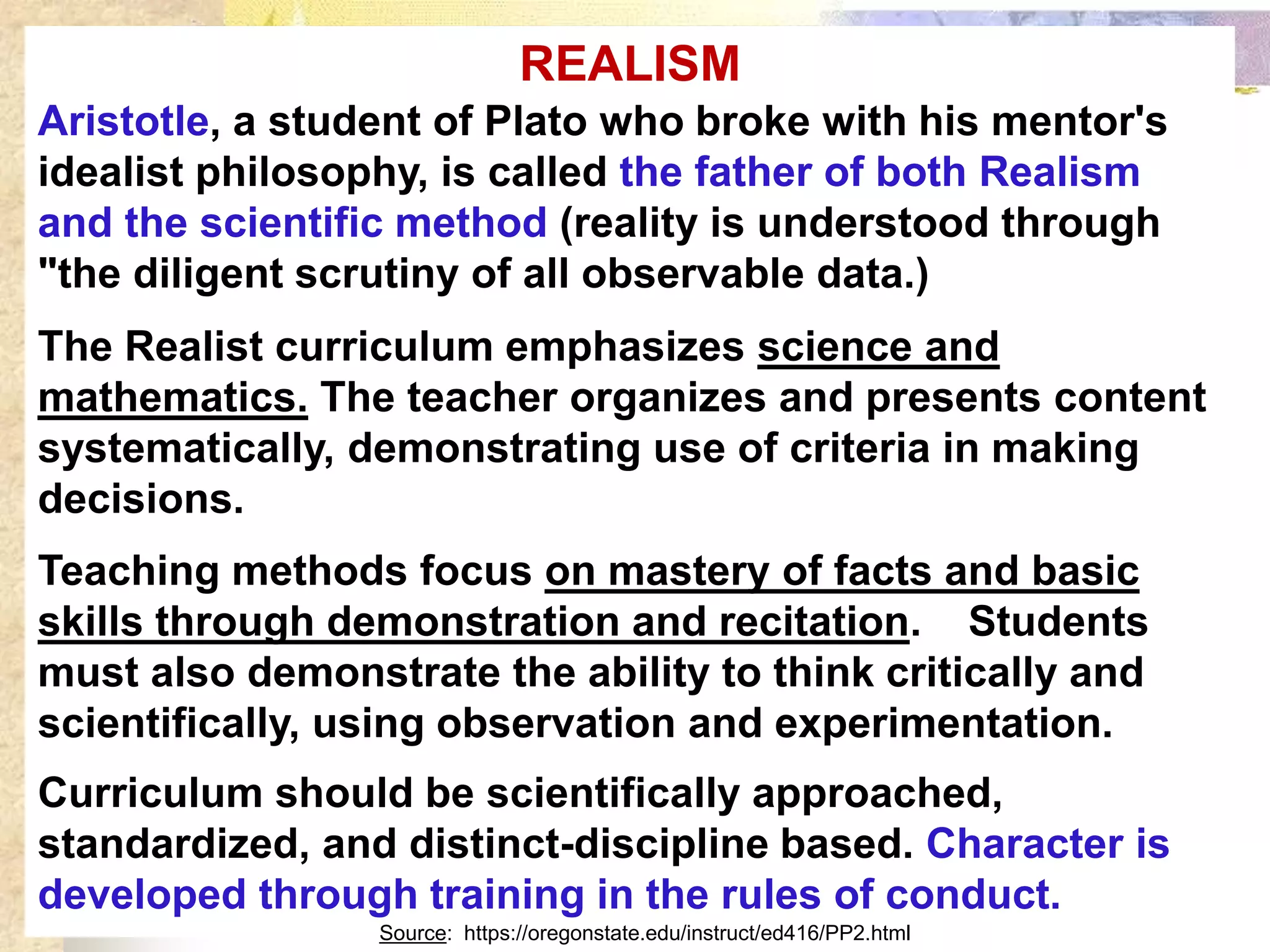
REALISM
Aristotle, a student of Plato who broke with his mentor's
idealist philosophy, is called the father of both Realism
and the scientific method (reality is understood through
"the diligent scrutiny of all observable data.)
The Realist curriculum emphasizes science and
mathematics. The teacher organizes and presents content
systematically, demonstrating use of criteria in making
decisions.
Teaching methods focus on mastery of facts and basic
skills through demonstration and recitation. Students
must also demonstrate the ability to think critically and
scientifically, using observation and experimentation.
Curriculum should be scientifically approached,
standardized, and distinct-discipline based. Character is
developed through training in the rules of conduct.
Source: https://oregonstate.edu/instruct/ed416/PP2.html
PRAGMATISM
(EXPERIENTIALISM)
For pragmatists, only those things that are experienced or
observed are real. The focus is on the reality of experience.
Pragmatists believe that reality is constantly changing and
that we learn best through applying our experiences and
thoughts to problems, as they arise.
The universe is dynamic and evolving, a "becoming" view
of the world. There is no absolute and unchanging truth, but
rather, truth is what works. Pragmatism is derived from the
teaching of Charles Sanders Peirce (1839-1914), who
believed that thought must produce action, rather than
linger in the mind and lead to indecisiveness.
Source: https://oregonstate.edu/instruct/ed416/PP2.html
John Dewey (1859-1952) applied pragmatist
philosophy in his progressive approaches. He
believed that learners must adapt to each other
and to their environment.
Schools should emphasize the subject matter of
social experience.
All learning is dependent on the context of place,
time, and circumstance.
Different cultural and ethnic groups learn to work
cooperatively and contribute to a democratic
society. The ultimate purpose is the creation of a
new social order. Character development is based
on making group decisions in light of
consequences.
Source: https://oregonstate.edu/instruct/ed416/PP2.html
For Pragmatists, teaching methods focus on
hands-on problem solving, experimenting, and
projects, often having students work in groups.
Curriculum should bring the disciplines together
to focus on solving problems in an
interdisciplinary way. Rather than passing down
organized bodies of knowledge to new learners,
Pragmatists believe that learners should apply
their knowledge to real situations through
experimental inquiry.
This prepares students for citizenship, daily living,
and future careers.
Source: https://oregonstate.edu/instruct/ed416/PP2.html

L2_Viewpoints of Islamic, Western and Eastern Philosophers on Knowledge, Education and Branches of Philosophy.pptx

  • 1.
    Philosophy and Educationin Malaysia Topic 2: Viewpoints of Western Philosophers on Knowledge, Education and Branches of Philosophy
  • 2.
    OVERVIEW 1) Branches ofPhilosophy 2) Viewpoints of Western Philosophers on Knowledge and Education 3) Source of knowledge and goals of Western Education
  • 3.
    BRANCHES OF PHILOSOPHY 1)Ontology (Existence or Reality) 2) Epistemology (Knowledge) 3) Axiology (Values) 4) Logic Sources: http://www.thefreedictionary.com/Ontology http://www.dictionary.com/browse/metaphysics
  • 4.
    Branches of Philosophy:METAPHYSICS Greek meta ta physika. Meta means ….. Metaphysics means … “Things over and beyond physics” or “Beyond the material things in life” or “Transcends what is physical” or “Transcends what is natural” “Beyond scientific investigation” Example: The existence of God Metaphysics relies on philosophical logic, rather than scientific experiments, in exploring these issues. Metaphysics deals with the first or fundamental or basic causes of things and the nature of being (existence). Sources: http://www.dictionary.com/browse/metaphysics https://www.vocabulary.com/dictionary/metaphysics https://universityofsedona.com/meaning-of-metaphysics/ https://plato.stanford.edu/entries/metaphysics/ https://www.merriam-webster.com/dictionary/metaphysics Choong, L. K. (2008). Philosophy and Education in Malaysia. Kuala Lumpur: Kumpulan Budiman Sdn. Bhd. “supernatural” “over and beyond”
  • 5.
    ONTOLOGY Ontology, at itssimplest, is the study of existence. • It is about how we determine if things exist or not. • It attempts to take things that are abstract and establish that they are, in fact, real. Sources: http://study.com/academy/lesson/what-is-ontology-definition-examples.html metaphysics Choong, L. K. (2008). Philosophy and Education in Malaysia. Kuala Lumpur: Kumpulan Budiman Sdn. Bhd. Ontology is speculative and focuses on the cause-and-effect relationship of things and phenomena. * Speculative = forming of a theory without firm evidence or on the basis of incomplete information. * Abstract = existing in thought or as an idea but not having a physical or concrete existence. Does God exist ?
  • 6.
    Ontological Question: What isthe nature (intrinsic characteristic) of an alien? • How do you know? • What is the source of your knowledge? Epistemological Questions: • How do you know? • What is the source of your knowledge?
  • 7.
    EPISTEMOLOGY • Greek wordsepisteme and logos episteme means “knowledge” or “science” logos means “explanation” • Epistemology = A branch of philosophy known as the theory of knowledge that studies about knowledge and beliefs. • It focuses on the analysis and generation of knowledge. • It focuses on the pursuit of knowledge. Sources: Choong, L. K. (2008). Philosophy and Education in Malaysia. Kuala Lumpur: Kumpulan Budiman Sdn. Bhd. http://pediaa.com/difference-between-ontology-and-epistemology/ Epistemology is the branch of philosophy concerning: • The nature of knowledge, its possibility, scope, and general basis. • How we gain knowledge / How we get to know something • Different methods of gaining knowledge.
  • 8.
    EPISTEMOLOGY as:  Thetheory of knowledge  The nature of knowledge  The intrinsic characteristics of knowledge  The very important and basic characteristics of knowledge Epistemology attempts to answer the following questions: • What is knowledge? • What are the sources of knowledge? • What does mankind know? • How do we know that we know something? Example: How do you know if someone is lying? How do you know that she was smoking? • Is knowledge static or dynamic (continuously changing)? • How do I separate true ideas from false ideas? Source: Choong, L. K. (2008). Philosophy and Education in Malaysia. Kuala Lumpur: Kumpulan Budiman Sdn. Bhd.
  • 9.
    Epistemology: How topursue knowledge and the correct way to do it. Some sources of knowledge are: 1) Revelation Knowledge from God through chosen messengers / prophets to be disseminated to mankind 2) Based on our sensory experiences - See, hear, feel, touch and smell (May be inaccurate) 3) Intuition - The ability to know things without conscious reasoning The brain uses a combination of logic and emotion when making decisions of any kind. That specific emotion, innate to us as humans, is intuition. - Knowledge from an ability to understand or know something immediately based on our feelings (gut feelings) rather than facts 4) Expert opinion based on knowledge and skills possessed 5) Logic (based on our own reasoning) Sources: Choong, L. K. (2008). Philosophy and Education in Malaysia. Kuala Lumpur: Kumpulan Budiman Sdn. Bhd; dictionary.cambridge.org; https://www.vocabulary.com; http://www.yourdictionary.com ; https://www.inc.com/geil-browning/go-with-your-gut-trusting-your-intuition.html
  • 10.
    • Scientific Methods Seekinganswers through systematic data collection and analysis such as …. Conducting interviews Observing behaviours Administering questionnaires Giving tests Performing experiments
  • 11.
    Greek (logos) reason Greek (logikē tekhnē ) Art ofreason Late Latin logica Old French logique Late Middle English LOGIC Sources: Choong, L. K. (2008). Philosophy and Education in Malaysia. Kuala Lumpur: Kumpulan Budiman Sdn. Bhd.; Online Etymology Dictionary http://www.etymonline.com/ LOGIC • Logic explains the relationship between ideas. • Logic gives reasons for the suggested answers. • Logic tries to differentiate between what is true and what is false; what is valid and what is doubtful. Analyse this scenario and indicate which is logical and which is not logical (illogical). Jacky did not attend the Physical Education class at 8 am because he said he had diarrhoea. The class organised a pizza party during recess time at 10 am and Jacky ate a lot.
  • 12.
    Generally, there aretwo types of logical reasoning: Inductive Reasoning Deductive Reasoning Deductive reasoning proceeds from general premises to a specific conclusion. Inductive reasoning proceeds from specific premises to a general conclusion. Both are based on logical inference. A logical inference is a connection from a first statement to a second statement for which the rules of logic show that if the initial statement is true, the second statement should be true. First Statement (Premise) Second Statement (Conclusion) Sources: http://whatis.techtarget.com/definition/deductive-reasoning http://philosophyterms.com/deductive-reasoning/
  • 13.
    Deductive Reasoning Deductive Logic Example Startsfrom general premises Generate a specific conclusion • All men are mortal. • Socrates is a man. The Greek philosopher Aristotle, who is considered the father of deductive reasoning, wrote the following classic example. All TESL June 2018 students are … This student is from the batch of TESL June 2018. Therefore, this student is … Therefore, Socrates is mortal.
  • 14.
    Inductive Reasoning Inductive logic Startswith specific premises Followed by Reasoning Form a general conclusion Example Leela likes to play with dolls. Jill likes to play with dolls. Nani likes to play with dolls. Leela, Jill and Nani are girls. All girls like to play with dolls. The first creature looks like a cat. These creatures are aliens. Therefore, all aliens look like cats. The 2nd … The 3rd … The 4th … The 5th …
  • 15.
    AXIOLOGY Axiology: Greek word Axiosmeaning Worth or Value • Axiology is the branch of practical philosophy which studies the nature of value. • Axiologists study value in general. • It is the study of value and value judgments. • It deals with the types of value such as in • morals, ethics, aesthetics and religion. Example of Axiological Questions: Good or Bad? True or False? Right or Wrong? Beautiful or Ugly? It can be classified into 2 aspects: Ethics and Aesthetics. Webster's New World College Dictionary, Fifth Edition Copyright © 2014 by Houghton Mifflin Harcourt Publishing Company. All rights reserved. Read more at http://www.yourdictionary.com/axiology
  • 16.
    Ethics focuses onthe moral and behaviour of mankind. It investigates the goodness of a person, society and life. It can be categorised into 3 basic types: 1) Meta Ethics: The study about the Concept of Ethics 2) Normative Ethics: The study about how to determine ethical values 3) Applied Ethics: The Study about the application of ethical values. Example of Questions on Ethics: • What should we do about this? • What is the best thing to do? • What is goodness? • What are some of the behavioural characteristics of being good? • What determines a good action? Sources: Choong, L. K. (2008). Philosophy and Education in Malaysia. Kuala Lumpur: Kumpulan Budiman Sdn. Bhd.; Online Etymology Dictionary http://www.etymonline.com/
  • 17.
    Aesthetics refers tobeauty in the arts, environment and life. It focuses more on taste and sentiments. Example of Questions on Aesthetics: • What is beauty? • How do we appreciate beauty in our natural environment? Sources: Choong, L. K. (2008). Philosophy and Education in Malaysia. Kuala Lumpur: Kumpulan Budiman Sdn. Bhd.;
  • 18.
    Western Philosophy ofEducation 1) Traditional – Perennialism, Essentialism 2) Modern – Progressivism, Reconstructivism, Existentialism PERENNIALISM • Perennial means Do not Change or Fixed Truth is defined as perennial and therefore, education should focus on the search and dissemination of knowledge which is fixed. • The focus is to teach truths or ideas that are everlasting, to seek enduring truths which are constant, not changing, as the natural and human worlds at their most basic level, do not change. Teaching these unchanging principles is critical. These ideas have the potential for solving problems in any era. E.g. Attaining Cultural Literacy: the great works of literature and art, the laws or principles of science Source: https://oregonstate.edu/instruct/ed416/PP3.html
  • 19.
    Education Goals • Educationis for teaching universal knowledge and values which are everlasting and not constrained by time limits. • However, some of the contents in the curriculum taught in schools may not be relevant any more at that present time. In such an instance, the school authorities may have to take the necessary steps to overcome this problem. Why? • This is necessary because schools have the responsibility to prepare our young people to face life’s challenges after they leave school and go out ito the working world. Concept: According to perennialists, human beings, by nature have universal characteristics which are constant. One of these is rationality which must be nurtured from young while we are still in school. Sources: Choong, L. K. (2008). Philosophy and Education in Malaysia. Kuala Lumpur: Kumpulan Budiman Sdn. Bhd.;
  • 20.
    ESSENTIALISM • Originated fromRealism (Aristotle) and Idealism (Plato) • Essentialists believe that there is a common core of knowledge that needs to be transmitted to students in a systematic, disciplined way. • The emphasis is on intellectual and moral standards that schools should teach. • It should focus on facts and "the basics," training students to read, write, speak, and compute clearly and logically. • Students should be taught hard work, respect for authority, and discipline. Teachers are to help students keep their non-productive instincts in check, such as aggression or mindlessness. • Essentialists accept the idea that this core curriculum may change. Schooling should be practical, preparing students to become valuable members of society. Source: https://oregonstate.edu/instruct/ed416/PP3.html
  • 21.
    • Essentialists placesimportance on the basics that an individual needs to know in order to become a productive person. • Therefore, this basic knowledge can change from time to time to cater to the needs of the current society. • In this sense, essentialism is said to be both practical and pragmatic. Education Goals are to teach factual information which needs to be learnt, appreciated and stored by our pupils as well as how to appreciate culture. Source: Choong, L. K. (2008). Philosophy and Education in Malaysia. Kuala Lumpur: Kumpulan Budiman Sdn. Bhd.;
  • 22.
    PROGRESSIVISM • Progressivism wasdeveloped from pragmatism. Pragmatists believe that learners should apply their knowledge to real situations through experimental inquiry. • John Dewey was the foremost proponent of progressivism. • CONCEPT Progressivist believe that change is the core of reality. Knowledge which is used to explain the present reality is both relative and tentative. Thus, it is not an everlasting truth. Reality undergoes continuous changes. What then is an educated person? An educated person is one who has the insight which enables him to adapt to changes in his environment. In contrast to perennialists, progressivists do not believe in the existence of permanent and pertinent truth that needs to be mastered by our pupils. Source: Choong, L. K. (2008). Philosophy and Education in Malaysia. Kuala Lumpur: Kumpulan Budiman Sdn. Bhd.;
  • 23.
    Education Goals The aimof education for progressivists is to prepare pupils to accommodate to changes in their everyday lives. An educated person is thus able to look for alternative solutions which are relevant to the problems they face. Progressivists believe that education should focus on the whole child, rather than on the content or the teacher. This educational philosophy stresses that students should test ideas by active experimentation. Learning is rooted in the questions of learners that arise through experiencing the world. It is active, not passive. The learner is a problem solver and thinker who makes meaning through his or her individual experience in the physical and cultural context. Effective teachers provide experiences so that students can learn by doing. Sources: Choong, L. K. (2008). Philosophy and Education in Malaysia. Kuala Lumpur: Kumpulan Budiman Sdn. Bhd.; and https://oregonstate.edu/instruct/ed416/PP3.html
  • 24.
    Curriculum content isderived from student interests and questions. The scientific method is used by progressivist educators so that students can study matter and events systematically and first hand. The emphasis is on process-how one comes to know. The Progressive education philosophy was established in America from the mid 1920s through the mid 1950s. One of the tenets was that the school should improve the way of life of our citizens through experiencing freedom and democracy in schools. Shared decision making, planning of teachers with students, student-selected topics are all aspects. Books are tools, rather than authority. Source: https://oregonstate.edu/instruct/ed416/PP3.html
  • 25.
    RECONSTRUCTIVISM • Reconstructivism stemsfrom progressivism. • Social reconstructionism is a philosophy that emphasizes the addressing of social questions and a quest to create a better society and worldwide democracy. • Reconstructionist educators focus on a curriculum that highlights social reform as the aim of education. • Theodore Brameld (1904-1987) was the founder of social reconstructionism, in reaction against the realities of World War II. • He recognized the potential for either human annihilation through technology and human cruelty or the capacity to create a beneficent society using technology and human compassion. Sources: Choong, L. K. (2008). Philosophy and Education in Malaysia. Kuala Lumpur: Kumpulan Budiman Sdn. Bhd.; and https://oregonstate.edu/instruct/ed416/PP3.html
  • 26.
    Social reconstructionists, believethat systems must be changed to overcome oppression and improve human conditions. Example: Paulo Freire (1921-1997) was a Brazilian whose experiences living in poverty led him to champion education and literacy as the vehicle for social change. In his view, humans must learn to resist oppression and not become its victims, nor oppress others. To do so requires dialog and critical consciousness, the development of awareness to overcome domination and oppression. Sources: Choong, L. K. (2008). Philosophy and Education in Malaysia. Kuala Lumpur: Kumpulan Budiman Sdn. Bhd.; and https://oregonstate.edu/instruct/ed416/PP3.html
  • 27.
    Rather than "teachingas banking," in which the educator deposits information into students' heads, Freire saw teaching and learning as a process of inquiry in which the child must invent and reinvent the world. For social reconstructionists, curriculum focuses on student experience and taking social action on real problems, such as violence, hunger, international terrorism, inflation, and inequality. Strategies for dealing with controversial issues (particularly in social studies and literature), inquiry, dialogue, and multiple perspectives are the focus. Community-based learning and bringing the world into the classroom are also strategies. Source: https://oregonstate.edu/instruct/ed416/PP3.html
  • 28.
    • Reconstructivism recommendsthat we improve and reconstruct our society. • According to reconstructivists, schools are the main catalyst for improving the state of human beings through educational and social innovations. • Schools are the best platforms to build a new society for the purpose of identifying social problems which obstruct the development of society and create cultural crises. • GOALS OF EDUCATION To lay the foundation for a new cultural pattern and to eradicate social ills or social problems. Sources: Choong, L. K. (2008). Philosophy and Education in Malaysia. Kuala Lumpur: Kumpulan Budiman Sdn. Bhd.; and https://oregonstate.edu/instruct/ed416/PP3.html Dr. Chin Mei Chin 2018
  • 29.
    EXISTENTIALISM • Existentialists focuson the nature of the existence of man. • Human beings are considered born without any aim or purpose in life. • The nature of reality for Existentialists is subjective, and lies within the individual. • The physical world has no essential meaning outside of human existence. So, individual choice and individual standards rather than external standards are central. • We define ourselves in relationship to existence by the choices we make. • We should not accept anyone else's predetermined philosophical system; rather, we must take responsibility for deciding who we are. • The focus is on freedom, the development of authentic individuals, as we make meaning of our lives. Sources: Choong, L. K. (2008). Philosophy and Education in Malaysia. Kuala Lumpur: Kumpulan Budiman Sdn. Bhd.; and https://oregonstate.edu/instruct/ed416/PP2.html
  • 30.
    There are severaldifferent orientations within the existentialist philosophy. Soren Kierkegaard (1813-1855), a Danish minister and philosopher, is considered to be the founder of existentialism had a Christian orientation. Another group of existentialists, largely European, believes that our existence is not guaranteed in an after life, so there is tension about life and the certainty of death, of hope or despair. The more austere European approaches where the universe is seen as meaningless when faced with the certainty of the end of existence. American existentialists focused more on human potential and the quest for personal meaning. Source: https://oregonstate.edu/instruct/ed416/PP2.html
  • 31.
    EXISTENTIALISM CONCEPT An individual isresponsible for himself and has the autonomy to determine his goals and make his own decisions without referring to outside authorities. The subject matter should be a matter of personal choice. Character development emphasizes individual responsibility for decisions. GOAL OF EDUCATION • It implies that the school system or teacher does not have the right to impose the goals of education. As such, educational goals are not outlined. • Existentialists are opposed to thinking about students as objects to be measured, tracked, or standardized. • The educational experience focuses on creating opportunities for self-direction and self actualization. They start with the student, rather than on curriculum content. Source: Choong, L. K. (2008). Philosophy and Education in Malaysia. Kuala Lumpur: Kumpulan Budiman Sdn. Bhd.;
  • 32.
    Additional Notes on 1)Idealism 2) Realism 3) Pragmatism also known as Experientialism
  • 33.
    • Plato isthe father of Idealism. • Idealism is in search for truth, beauty, and justice that is enduring and everlasting, the focus is on conscious reasoning in the mind. • In idealism, the aim of education is to discover and develop each individual's abilities and full moral excellence in order to better serve society. • The curricular emphasis is subject matter of mind: literature, history, philosophy, and religion. • Teaching methods focus on handling ideas through lecture, discussion, and Socratic dialogue. • Character is developed through imitating examples and heroes. Source: https://oregonstate.edu/instruct/ed416/PP2.html
  • 34.
    REALISM Aristotle, a studentof Plato who broke with his mentor's idealist philosophy, is called the father of both Realism and the scientific method (reality is understood through "the diligent scrutiny of all observable data.) The Realist curriculum emphasizes science and mathematics. The teacher organizes and presents content systematically, demonstrating use of criteria in making decisions. Teaching methods focus on mastery of facts and basic skills through demonstration and recitation. Students must also demonstrate the ability to think critically and scientifically, using observation and experimentation. Curriculum should be scientifically approached, standardized, and distinct-discipline based. Character is developed through training in the rules of conduct. Source: https://oregonstate.edu/instruct/ed416/PP2.html
  • 35.
    PRAGMATISM (EXPERIENTIALISM) For pragmatists, onlythose things that are experienced or observed are real. The focus is on the reality of experience. Pragmatists believe that reality is constantly changing and that we learn best through applying our experiences and thoughts to problems, as they arise. The universe is dynamic and evolving, a "becoming" view of the world. There is no absolute and unchanging truth, but rather, truth is what works. Pragmatism is derived from the teaching of Charles Sanders Peirce (1839-1914), who believed that thought must produce action, rather than linger in the mind and lead to indecisiveness. Source: https://oregonstate.edu/instruct/ed416/PP2.html
  • 36.
    John Dewey (1859-1952)applied pragmatist philosophy in his progressive approaches. He believed that learners must adapt to each other and to their environment. Schools should emphasize the subject matter of social experience. All learning is dependent on the context of place, time, and circumstance. Different cultural and ethnic groups learn to work cooperatively and contribute to a democratic society. The ultimate purpose is the creation of a new social order. Character development is based on making group decisions in light of consequences. Source: https://oregonstate.edu/instruct/ed416/PP2.html
  • 37.
    For Pragmatists, teachingmethods focus on hands-on problem solving, experimenting, and projects, often having students work in groups. Curriculum should bring the disciplines together to focus on solving problems in an interdisciplinary way. Rather than passing down organized bodies of knowledge to new learners, Pragmatists believe that learners should apply their knowledge to real situations through experimental inquiry. This prepares students for citizenship, daily living, and future careers. Source: https://oregonstate.edu/instruct/ed416/PP2.html