University Institute of Engineering (UIE)
Department of Computer Science and Engineering (CSE)
Digital Signatures
www. cuchd.in Campus : Gharaun, Mohali
University Institute of Engineering (UIE)
Department of Computer Science and Engineering (CSE)
Why Digital Signatures?
 Message authentication protects two parties who exchange
messages from any third party.
 However, it does not protect the two parties against each
other.
 Several forms of dispute between the two are possible.
University Institute of Engineering (UIE)
Department of Computer Science and Engineering (CSE)
Why Digital Signatures?
Example-1 : John sends an authenticated message to Mary.
Here two disputes may arise:
1. Mary may forge a different message and claim that it came
from John. Mary would create a message and append an
authentication code using the key that John and Mary
share.
2. John can deny sending the message. Because it is possible
for Mary to forge a message, there is no way to prove that
John did in fact send the message.
University Institute of Engineering (UIE)
Department of Computer Science and Engineering (CSE)
Why Digital Signatures?
Example-2
An electronic funds transfer takes place, and the receiver
increases the amount of funds transferred and claims that
the larger amount had arrived from the sender.
Example-3
An electronic mail message contains instructions to a
stockbroker for a transaction that subsequently turns out
badly. The sender pretends that the message was never sent.
University Institute of Engineering (UIE)
Department of Computer Science and Engineering (CSE)
Why Digital Signatures?
 In situations where there is not complete trust between
sender and receiver, something more than authentication is
needed.
 The most attractive solution to this problem is the digital
signature.
University Institute of Engineering (UIE)
Department of Computer Science and Engineering (CSE)
Why Digital Signatures?
 Digital signature is an authentication mechanism that
enables the creator of a message to attach a code that acts
as a signature.
 Typically the signature is formed by taking the hash of the
message and encrypting the message with the creator’s
private key.
 The signature guarantees the source and integrity of the
message.
University Institute of Engineering (UIE)
Department of Computer Science and Engineering (CSE)
Why Digital Signatures?
 The digital signature standard (DSS) is a standard that uses
the secure hash algorithm (SHA).
 Most important development under public-key
cryptography.
University Institute of Engineering (UIE)
Department of Computer Science and Engineering (CSE)
Generic Model of Digital Signature Process
University Institute of Engineering (UIE)
Department of Computer Science and Engineering (CSE)
Generic Model of Digital Signature Process
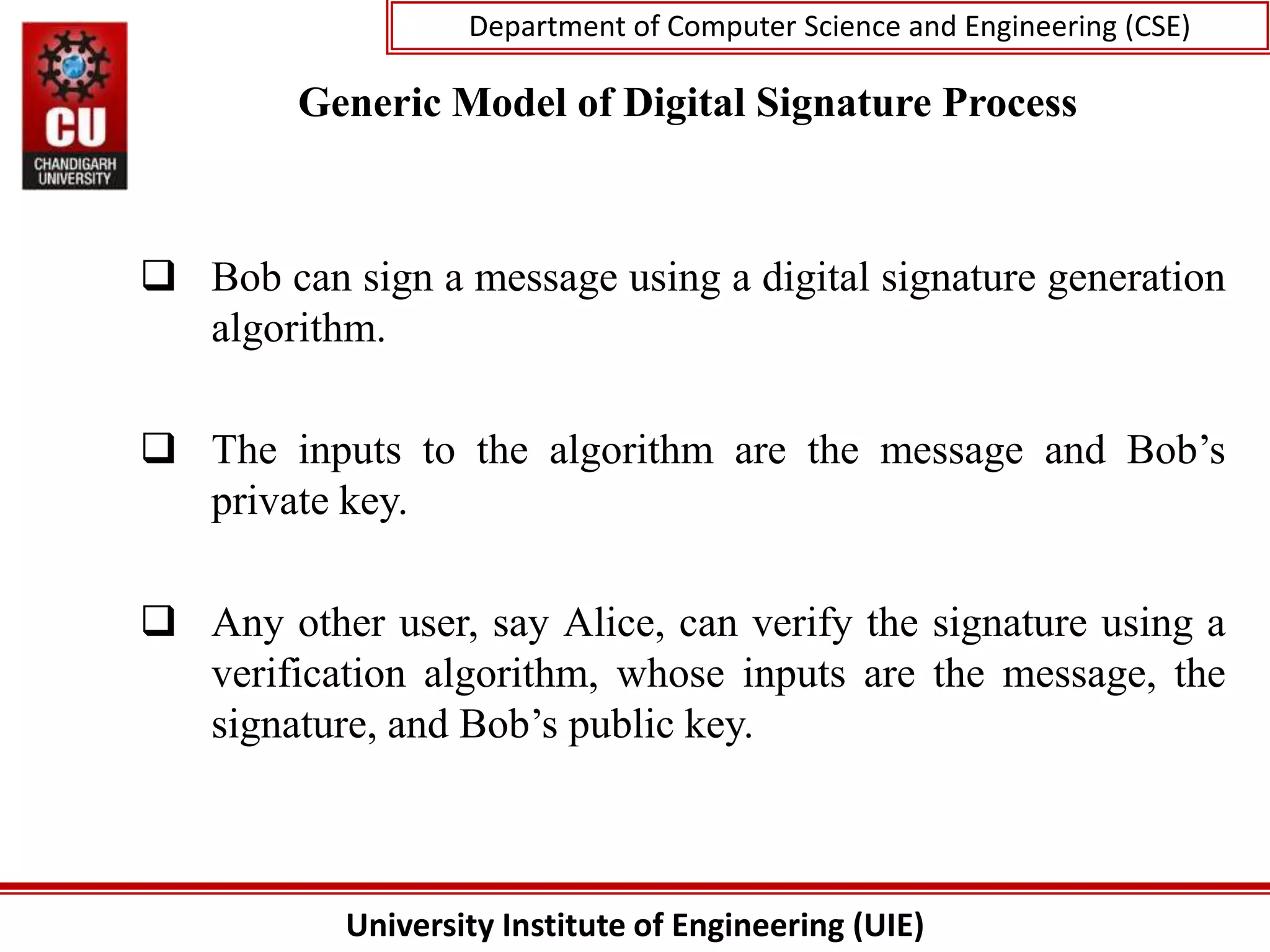
 Bob can sign a message using a digital signature generation
algorithm.
 The inputs to the algorithm are the message and Bob’s
private key.
 Any other user, say Alice, can verify the signature using a
verification algorithm, whose inputs are the message, the
signature, and Bob’s public key.
University Institute of Engineering (UIE)
Department of Computer Science and Engineering (CSE)
Elements of Digital Signature Process
University Institute of Engineering (UIE)
Department of Computer Science and Engineering (CSE)
Properties of Digital Signature
 It must verify the author and the date and time of the signature.
 It must authenticate the contents at the time of the signature.
 It must be verifiable by third parties, to resolve disputes.
 Thus, the digital signature function includes the authentication
function.
University Institute of Engineering (UIE)
Department of Computer Science and Engineering (CSE)
Digital Signature Requirement
 The signature must be a bit pattern that depends on the message
being signed.
 The signature must use some information unique to the sender to
prevent both forgery and denial.
 It must be relatively easy to produce the digital signature.
 It must be relatively easy to recognize and verify the digital
signature.
University Institute of Engineering (UIE)
Department of Computer Science and Engineering (CSE)
Digital Signature Requirement
 It must be computationally infeasible to forge a digital signature,
either by constructing a new message for an existing digital
signature or by constructing a fraudulent digital signature for a
given message.
 It must be practical to retain a copy of the digital signature in
storage.
 Generic process and elements of digital signature fulfill these
requirements.
University Institute of Engineering (UIE)
Department of Computer Science and Engineering (CSE)
Direct Digital Signature
 The term direct digital signature refers to a digital signature
scheme that involves only the communicating parties (source,
destination).
 It is assumed that the destination knows the public key of the
source.
 Generally Confidentiality can be provided by encrypting the
entire message plus signature with a shared secret key
(symmetric encryption)
University Institute of Engineering (UIE)
Department of Computer Science and Engineering (CSE)
Direct Digital Signature
 It is important to perform the signature function first and then an outer
confidentiality function. (Why?)
 In case of dispute, some third party must view the message and its
signature.
 If the signature is calculated on an encrypted message, then the third
party also needs access to the decryption key to read the original
message.
 However, if the signature is the inner operation, then the recipient can
store the plaintext message and its signature for later use in dispute
resolution.
University Institute of Engineering (UIE)
Department of Computer Science and Engineering (CSE)
Direct Digital Signature
 The validity of this scheme depends on the security of the
sender’s private key.
 If a sender later wishes to deny sending a particular message, the
sender can claim that the private key was lost or stolen and that
someone else forged his or her signature.
 Administrative controls relating to the security of private keys
can be employed to thwart or at least weaken this ploy, but the
threat is still there, at least to some degree.
University Institute of Engineering (UIE)
Department of Computer Science and Engineering (CSE)
Direct Digital Signature
 The validity of this scheme depends on the security of the
sender’s private key.
 If a sender later wishes to deny sending a particular message, the
sender can claim that the private key was lost or stolen and that
someone else forged his or her signature.
 Administrative controls relating to the security of private keys
can be employed to thwart or at least weaken this ploy, but the
threat is still there, at least to some degree.
University Institute of Engineering (UIE)
Department of Computer Science and Engineering (CSE)
Direct Digital Signature
 Example : Every signed message to include a timestamp (date
and time) and to require prompt reporting of compromised keys
to a central authority.
 Another threat is that some private key might actually be stolen
from X at time T. The opponent can then send a message signed
with X’s signature and stamped with a time before or equal to T.
 The universally accepted technique for dealing with these threats
is the use of a digital certificate and certificate authorities.
University Institute of Engineering (UIE)
Department of Computer Science and Engineering (CSE)
References
• http://www.brainkart.com/article/Classical-Encryption-
Techniques_8339/
• https://www.tutorialspoint.com/cryptography/index.htm
• https://www.geeksforgeeks.org/cryptography-introduction/
• https://www.techopedia.com/definition/1770/cryptography
#:~:text=Cryptography%20involves%20creating%20written
%20or,information%20to%20be%20kept%20secret.&text=In
formation%20security%20uses%20cryptography%20on,tran
sit%20and%20while%20being%20stored.
• https://www2.slideshare.net/lineking/classical-encryption-
techniques-in-network-security?qid=e388c29f-793d-4f2b-
bcaf-9d22e9ca07b5&v=&b=&from_search=1
University Institute of Engineering (UIE)
Department of Computer Science and Engineering (CSE)
E- Books Recommended
• https://www.pdfdrive.com/cyber-security-books.html
• https://bookauthority.org/books/new-cyber-security-
ebooks
• https://bookauthority.org/books/best-cyber-security-
ebooks
• https://www.freetechbooks.com/information-security-
f52.html

L-2.10 Digital Signatures.pptx

  • 1.
    University Institute ofEngineering (UIE) Department of Computer Science and Engineering (CSE) Digital Signatures www. cuchd.in Campus : Gharaun, Mohali
  • 2.
    University Institute ofEngineering (UIE) Department of Computer Science and Engineering (CSE) Why Digital Signatures?  Message authentication protects two parties who exchange messages from any third party.  However, it does not protect the two parties against each other.  Several forms of dispute between the two are possible.
  • 3.
    University Institute ofEngineering (UIE) Department of Computer Science and Engineering (CSE) Why Digital Signatures? Example-1 : John sends an authenticated message to Mary. Here two disputes may arise: 1. Mary may forge a different message and claim that it came from John. Mary would create a message and append an authentication code using the key that John and Mary share. 2. John can deny sending the message. Because it is possible for Mary to forge a message, there is no way to prove that John did in fact send the message.
  • 4.
    University Institute ofEngineering (UIE) Department of Computer Science and Engineering (CSE) Why Digital Signatures? Example-2 An electronic funds transfer takes place, and the receiver increases the amount of funds transferred and claims that the larger amount had arrived from the sender. Example-3 An electronic mail message contains instructions to a stockbroker for a transaction that subsequently turns out badly. The sender pretends that the message was never sent.
  • 5.
    University Institute ofEngineering (UIE) Department of Computer Science and Engineering (CSE) Why Digital Signatures?  In situations where there is not complete trust between sender and receiver, something more than authentication is needed.  The most attractive solution to this problem is the digital signature.
  • 6.
    University Institute ofEngineering (UIE) Department of Computer Science and Engineering (CSE) Why Digital Signatures?  Digital signature is an authentication mechanism that enables the creator of a message to attach a code that acts as a signature.  Typically the signature is formed by taking the hash of the message and encrypting the message with the creator’s private key.  The signature guarantees the source and integrity of the message.
  • 7.
    University Institute ofEngineering (UIE) Department of Computer Science and Engineering (CSE) Why Digital Signatures?  The digital signature standard (DSS) is a standard that uses the secure hash algorithm (SHA).  Most important development under public-key cryptography.
  • 8.
    University Institute ofEngineering (UIE) Department of Computer Science and Engineering (CSE) Generic Model of Digital Signature Process
  • 9.
    University Institute ofEngineering (UIE) Department of Computer Science and Engineering (CSE) Generic Model of Digital Signature Process  Bob can sign a message using a digital signature generation algorithm.  The inputs to the algorithm are the message and Bob’s private key.  Any other user, say Alice, can verify the signature using a verification algorithm, whose inputs are the message, the signature, and Bob’s public key.
  • 10.
    University Institute ofEngineering (UIE) Department of Computer Science and Engineering (CSE) Elements of Digital Signature Process
  • 11.
    University Institute ofEngineering (UIE) Department of Computer Science and Engineering (CSE) Properties of Digital Signature  It must verify the author and the date and time of the signature.  It must authenticate the contents at the time of the signature.  It must be verifiable by third parties, to resolve disputes.  Thus, the digital signature function includes the authentication function.
  • 12.
    University Institute ofEngineering (UIE) Department of Computer Science and Engineering (CSE) Digital Signature Requirement  The signature must be a bit pattern that depends on the message being signed.  The signature must use some information unique to the sender to prevent both forgery and denial.  It must be relatively easy to produce the digital signature.  It must be relatively easy to recognize and verify the digital signature.
  • 13.
    University Institute ofEngineering (UIE) Department of Computer Science and Engineering (CSE) Digital Signature Requirement  It must be computationally infeasible to forge a digital signature, either by constructing a new message for an existing digital signature or by constructing a fraudulent digital signature for a given message.  It must be practical to retain a copy of the digital signature in storage.  Generic process and elements of digital signature fulfill these requirements.
  • 14.
    University Institute ofEngineering (UIE) Department of Computer Science and Engineering (CSE) Direct Digital Signature  The term direct digital signature refers to a digital signature scheme that involves only the communicating parties (source, destination).  It is assumed that the destination knows the public key of the source.  Generally Confidentiality can be provided by encrypting the entire message plus signature with a shared secret key (symmetric encryption)
  • 15.
    University Institute ofEngineering (UIE) Department of Computer Science and Engineering (CSE) Direct Digital Signature  It is important to perform the signature function first and then an outer confidentiality function. (Why?)  In case of dispute, some third party must view the message and its signature.  If the signature is calculated on an encrypted message, then the third party also needs access to the decryption key to read the original message.  However, if the signature is the inner operation, then the recipient can store the plaintext message and its signature for later use in dispute resolution.
  • 16.
    University Institute ofEngineering (UIE) Department of Computer Science and Engineering (CSE) Direct Digital Signature  The validity of this scheme depends on the security of the sender’s private key.  If a sender later wishes to deny sending a particular message, the sender can claim that the private key was lost or stolen and that someone else forged his or her signature.  Administrative controls relating to the security of private keys can be employed to thwart or at least weaken this ploy, but the threat is still there, at least to some degree.
  • 17.
    University Institute ofEngineering (UIE) Department of Computer Science and Engineering (CSE) Direct Digital Signature  The validity of this scheme depends on the security of the sender’s private key.  If a sender later wishes to deny sending a particular message, the sender can claim that the private key was lost or stolen and that someone else forged his or her signature.  Administrative controls relating to the security of private keys can be employed to thwart or at least weaken this ploy, but the threat is still there, at least to some degree.
  • 18.
    University Institute ofEngineering (UIE) Department of Computer Science and Engineering (CSE) Direct Digital Signature  Example : Every signed message to include a timestamp (date and time) and to require prompt reporting of compromised keys to a central authority.  Another threat is that some private key might actually be stolen from X at time T. The opponent can then send a message signed with X’s signature and stamped with a time before or equal to T.  The universally accepted technique for dealing with these threats is the use of a digital certificate and certificate authorities.
  • 19.
    University Institute ofEngineering (UIE) Department of Computer Science and Engineering (CSE) References • http://www.brainkart.com/article/Classical-Encryption- Techniques_8339/ • https://www.tutorialspoint.com/cryptography/index.htm • https://www.geeksforgeeks.org/cryptography-introduction/ • https://www.techopedia.com/definition/1770/cryptography #:~:text=Cryptography%20involves%20creating%20written %20or,information%20to%20be%20kept%20secret.&text=In formation%20security%20uses%20cryptography%20on,tran sit%20and%20while%20being%20stored. • https://www2.slideshare.net/lineking/classical-encryption- techniques-in-network-security?qid=e388c29f-793d-4f2b- bcaf-9d22e9ca07b5&v=&b=&from_search=1
  • 20.
    University Institute ofEngineering (UIE) Department of Computer Science and Engineering (CSE) E- Books Recommended • https://www.pdfdrive.com/cyber-security-books.html • https://bookauthority.org/books/new-cyber-security- ebooks • https://bookauthority.org/books/best-cyber-security- ebooks • https://www.freetechbooks.com/information-security- f52.html