QUANTUM MECHANICS
MODULE - I
A.Prakash Reddy. Assistant Professor 1
Wave - particle duality
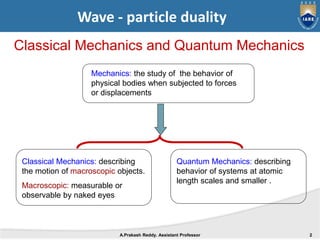
Classical Mechanics and Quantum Mechanics
Mechanics: the study of the behavior of
physical bodies when subjected to forces
or displacements
Classical Mechanics: describing
the motion of macroscopic objects.
Macroscopic: measurable or
observable by naked eyes
Quantum Mechanics: describing
behavior of systems at atomic
length scales and smaller .
A.Prakash Reddy. Assistant Professor 2
Wave - particle duality
Quantum Mechanics
It is able to explain
1. Photo electric effect
2. Black body radiation
3. Compton effect
4. Emission of line spectra
The most outstanding development in modern science was the
conception of Quantum Mechanics in 1925. This new approach
was highly successful in explaining about the behavior of atoms,
molecules and nuclei.
3
Wave - particle duality
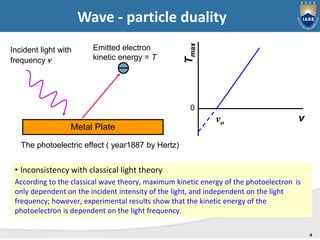
Metal Plate
Incident light with
frequency ν
Emitted electron
kinetic energy = T
T
max
0
ν
νo
• Inconsistency with classical light theory
According to the classical wave theory, maximum kinetic energy of the photoelectron is
only dependent on the incident intensity of the light, and independent on the light
frequency; however, experimental results show that the kinetic energy of the
photoelectron is dependent on the light frequency.
The photoelectric effect ( year1887 by Hertz)
4
Wave - particle duality
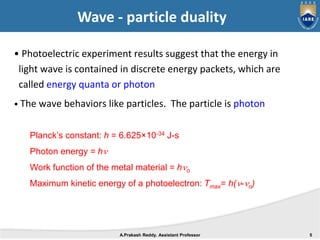
• Photoelectric experiment results suggest that the energy in
light wave is contained in discrete energy packets, which are
called energy quanta or photon
• The wave behaviors like particles. The particle is photon
Planck’s constant: h = 6.625×10⁻³⁴ J-s
Photon energy = hn
Work function of the metal material = hno
Maximum kinetic energy of a photoelectron: Tmax= h(n-no)
A.Prakash Reddy. Assistant Professor 5
Wave - particle duality
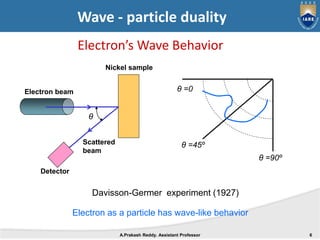
Electron’s Wave Behavior
Electron beam
Nickel sample
Detector
Scattered
beam
θ
θ =0
θ =45º
θ =90º
Davisson-Germer experiment (1927)
Electron as a particle has wave-like behavior
A.Prakash Reddy. Assistant Professor 6
Wave - particle duality
7
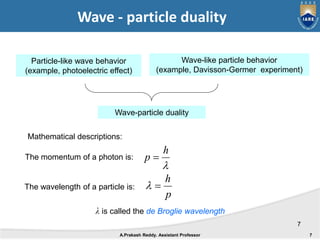
Particle-like wave behavior
(example, photoelectric effect)
Wave-like particle behavior
(example, Davisson-Germer experiment)
Wave-particle duality
Mathematical descriptions:
The momentum of a photon is:

h
p 
The wavelength of a particle is:
p
h


λ is called the de Broglie wavelength
A.Prakash Reddy. Assistant Professor 7
Wave - particle duality
Light can exhibit both kind of nature of waves and
particles so the light shows wave-particle dual nature. In
some cases like interference, diffraction and
polarization it behaves as wave while in other cases like
photoelectric and compton effect it behaves as particles
(photon).
A.Prakash Reddy. Assistant Professor 8
A.Prakash Reddy. Assistant Professor 9

L_2 WAVE PARTICAL DUALITY.pptx

  • 1.
    QUANTUM MECHANICS MODULE -I A.Prakash Reddy. Assistant Professor 1
  • 2.
    Wave - particleduality Classical Mechanics and Quantum Mechanics Mechanics: the study of the behavior of physical bodies when subjected to forces or displacements Classical Mechanics: describing the motion of macroscopic objects. Macroscopic: measurable or observable by naked eyes Quantum Mechanics: describing behavior of systems at atomic length scales and smaller . A.Prakash Reddy. Assistant Professor 2
  • 3.
    Wave - particleduality Quantum Mechanics It is able to explain 1. Photo electric effect 2. Black body radiation 3. Compton effect 4. Emission of line spectra The most outstanding development in modern science was the conception of Quantum Mechanics in 1925. This new approach was highly successful in explaining about the behavior of atoms, molecules and nuclei. 3
  • 4.
    Wave - particleduality Metal Plate Incident light with frequency ν Emitted electron kinetic energy = T T max 0 ν νo • Inconsistency with classical light theory According to the classical wave theory, maximum kinetic energy of the photoelectron is only dependent on the incident intensity of the light, and independent on the light frequency; however, experimental results show that the kinetic energy of the photoelectron is dependent on the light frequency. The photoelectric effect ( year1887 by Hertz) 4
  • 5.
    Wave - particleduality • Photoelectric experiment results suggest that the energy in light wave is contained in discrete energy packets, which are called energy quanta or photon • The wave behaviors like particles. The particle is photon Planck’s constant: h = 6.625×10⁻³⁴ J-s Photon energy = hn Work function of the metal material = hno Maximum kinetic energy of a photoelectron: Tmax= h(n-no) A.Prakash Reddy. Assistant Professor 5
  • 6.
    Wave - particleduality Electron’s Wave Behavior Electron beam Nickel sample Detector Scattered beam θ θ =0 θ =45º θ =90º Davisson-Germer experiment (1927) Electron as a particle has wave-like behavior A.Prakash Reddy. Assistant Professor 6
  • 7.
    Wave - particleduality 7 Particle-like wave behavior (example, photoelectric effect) Wave-like particle behavior (example, Davisson-Germer experiment) Wave-particle duality Mathematical descriptions: The momentum of a photon is:  h p  The wavelength of a particle is: p h   λ is called the de Broglie wavelength A.Prakash Reddy. Assistant Professor 7
  • 8.
    Wave - particleduality Light can exhibit both kind of nature of waves and particles so the light shows wave-particle dual nature. In some cases like interference, diffraction and polarization it behaves as wave while in other cases like photoelectric and compton effect it behaves as particles (photon). A.Prakash Reddy. Assistant Professor 8
  • 9.