UNIT –I Introductionto Artificial Intelligence:
Introduction, History, Intelligent Systems, Foundations of AI, Applications, Tic-tac
toe game playing, development of AI languages, Current trends in AI.
1. Artificial Intelligence
❑ Modeling human cognition or mental faculties using computers
❑ Study of making computers do things which at the moment peopleare
better
❑ Making computers do things which require intelligence
1.1 More Formal Definition of AI
◼ AI is a branch of computer science which is concerned with the
study and creation of computer systems that exhibit
❑ some form of intelligence
OR
❑ those characteristics which we associate with
intelligence in human behavior
❑ AI is a broad area consisting of different fields, from machine vision,
expert systems to the creation of machines that can "think".
❑ In order to classify machines as "thinking", it is necessary to define
intelligence.
2. History
The history of Artificial Intelligence (AI) began in antiquity, with myths, stories and
rumors of artificial beings endowed with intelligence or consciousness by master
craftsmen. The seeds of modern AI were planted by classical philosophers who
attempted to describe the process of human thinking as the mechanical manipulation of
symbols. This work culminated in the invention of the programmable digital
computer in the 1940s, a machine based on the abstract essence of mathematical
reasoning. This device and the ideas behind it inspired a handful of scientists to
begin seriously discussing the possibility of building an electronic brain.
The field of AI research was founded at a workshop held on the campus of
Dartmouth College during the summer of 1956. Those who attended would become the
leaders of AI research for decades. Many of them predicted that a
2.
machine as intelligentas a human being would exist in no more than ageneration and
they were given millions of dollars to make this vision come true.
Eventually, it became obvious that they had grossly underestimated the difficulty of
the project. In 1973, in response to the criticism from James Lighthill and ongoing
pressure from congress, the U.S. and British Governments stopped funding
undirected research into artificial intelligence, and the difficult years that followed
would later be known as an "AI winter". Seven years later, a visionary initiative by
the Japanese Government inspired governments and industry to provide AI with
billions of dollars, but by the late 80s the investors became disillusioned by the
absence of the needed computer power (hardware) and withdrew funding again.
In the 1980s a form of AI program called "expert systems" was adopted by
corporations around the world and knowledge became the focus of mainstream AI
research. In those same years, the Japanese government aggressively funded AI
with its fifth generation computer project. Another encouraging event in the early
1980s was the revival of connectionism in the work of John Hopfield and David
Rumelhart. Once again, AI had achieved success.
In the first decades of the 21st century, access to large amounts of data (known as
"big data"), cheaper and faster computers and advanced machine learning
techniques were successfully applied to many problems throughout the economy. In
fact, McKinsey Global Institute estimated in their famous paper "Big data: The
next frontier for innovation, competition, and productivity"that "by 2009, nearly all
sectors in the US economy had at least an average of 200 terabytes of stored data".
By 2016, the market for AI-related products, hardware, and software reached more
than 8 billion dollars, and the New York Times reported that interest in AI had
reached a "frenzy". The applications of big data began to reach into other fields as
well, such as training models in ecology and for various applications in
economics. Advances in deep learning (particularly deep convolutional neural
networks and recurrent neural networks) drove progress and research in image and
video processing, text analysis, and even speech recognition.
Investment and interest in AI boomed in the first decades of the 21st century, when
machine learning was successfully applied to many problems in academia and
industry due to new methods, the application of powerful computer hardware, and
the collection of immense data sets.
3. What is Intelligence?
◼ Intelligence is a property of mind that encompasses many related mental
abilities, such as the capabilities to
3.
❑ reason
❑ plan
❑solve problems
❑ think abstractly
❑ comprehend ideas and language and
❑ learn
3.1. Characteristics of AI systems
◼ learn new concepts and tasks
◼ reason and draw useful conclusions about the world around us
❑ remember complicated interrelated facts and draw conclusionsfrom
them (inference)
◼ understand a natural language or perceive and comprehend a visual
scene
❑ look through cameras and see what's there (vision), to move
themselves and objects around in the real world (robotics)
◼ plan sequences of actions to complete a goal
◼ offer advice based on rules and situations
◼ may not necessarily imitate human senses and thought processes
❑ but indeed, in performing some tasks differently, they may actually
exceed human abilities
◼ capable of performing intelligent tasks effectively and efficiently
◼ perform tasks that require high levels of intelligence
3.2. Understanding of AI
◼ AI techniques and ideas seem to be harder to understand than most
things in computer science
◼ AI shows best on complex problems for which general principles don'thelp
much, though there are a few useful general principles
4.
◼ Artificial intelligenceis also difficult to understand by its content.
◼ Boundaries of AI are not well defined.
◼ Often it means the advanced software engineering, sophisticated software
techniques for hard problems that can't be solved in any easy way.
◼ AI programs - like people - are usually not perfect, and even make
mistakes.
◼ It often means, nonnumeric ways of solving problems, since people can't
handle numbers well.
◼ Nonnumeric ways are generally "common sense" ways, not necessarilythe
best ones.
◼ Understanding of AI also requires an understanding of related terms such as
intelligence, knowledge, reasoning, thought, cognition, learning,and a
number of other computer related terms.
3.3. Categories of AI System
◼ Systems that think like humans
◼ Systems that act like humans
◼ Systems that think rationally
◼ Systems that act rationally
3.3.1. Systems that think like humans
◼ Most of the time it is a black box where we are not clear about our
thought process.
◼ One has to know functioning of brain and its mechanism for prossessing
information.
◼ It is an area of cognitive science.
❑ The stimuli are converted into mental representation.
❑ Cognitive processes manipulate representation to build new
representations that are used to generate actions.
◼ Neural network is a computing model for processing information similarto
brain.
5.
3.3.2. Systems thatact like humans
◼ The overall behaviour of the system should be human like.
◼ It could be achieved by observation
3.3.3. Systems that think rationally
◼ Such systems rely on logic rather than human to measure correctness.
◼ For thinking rationally or logically, logic formulas and theories are usedfor
synthesizing outcomes.
◼ For example,
❑ given John is a human and all humans are mortal then one can
conclude logically that John is mortal
◼ Not all intelligent behavior are mediated by logical deliberation.
3.3.4. Systems that act rationally
◼ Rational behavior means doing right thing.
◼ Even if method is illogical, the observed behavior must be rational.
3.4.The Turing Test
Turing proposed operational test for intelligent behavior in 1950.
6.
3.5.ELIZA
◼ Eliza wasfirst program developed by Joseph Wiezbaum to converse in
English in mid 1960's
❑ It passed turing test.
◼ The following passage shows Eliza’s talking to a teenage girl. Blue text
Eliza’s response
Men are all alike.
IN WHAT WAY
They're always bugging us about something or other.
CAN YOU THINK OF A SPECIFIC EXAMPLE
Well, my boyfriend made me come here.
YOUR BOYFRIEND MADE YOU COME
HERE
He says that I am depressed all the time.
I AM SORRY TO HEAR THAT YOU ARE DEPRESSED
It's true that I am unhappy
DO YOU THINK COMING HERE WILL HELP YOU NOT TO BE UNHAPPY
I need help, that seems certain.
WHAT WOULD IT MEAN IF YOU GOT SOME HELP
Perhaps I could learn to get along with my mother.
TELL ME MORE ABOUT YOUR FAMILY
My mother takes care of me.
WHO ELSE IN YOUR FAMILY TAKES CARE OF YOU
My father.
YOUR
FATHER
You are like my father in some ways.
7.
WHAT RESEMBLANCE DOYOU SEE
You are not very aggressive but I think you don't want me to notice that.WHAT
MAKES YOU THINK THAT I AM NOT VERY AGGRESSIVE
You don’t argue with me.
WHY DO YOU THINK I DON’T ARGUE WITH YOU
You are afraid of me.
DOES IT PLEASE YOU TO BELIEVE, I AM AFRAID OF YOU
My father is afraid of everybody.
WHAT ELSE COMES TO MIND WHEN YOU THINK OF YOUR FATHER
Bullies.
DOES THAT HAVE ANYTHING TO DO WITH THE FACT THAT YOUR BOYFRIEND
MADE YOU COME HERE
4. Foundations of AI
◼ Foundation of AI is based on
❑ Mathematics
❑ Neuroscience
❑ Control Theory
❑ Linguistics
4.1. Foundations – Mathematics
◼ More formal logical methods
❑ Boolean logic
❑ Fuzzy logic
◼ Uncertainty
❑ The basis for most modern approaches to handle
uncertainty in AI applications can be handled by
8.
✓ Probability theory
✓Modal and Temporal logics
4.2. Foundations – Neuroscience
◼ How do the brain works?
❑ Early studies (1824) relied on injured and abnormal people to
understand what parts of brain work
❑ More recent studies use accurate sensors to correlate brain activityto
human thought
◼ By monitoring individual neurons, monkeys can now controla
computer mouse using thought alone
❑ Moore’s law states that computers will have as many gates as
humans have neurons in 2020
❑ How close are we to have a mechanical brain?
◼ Parallel computation, remapping, interconnections,….
4.3. Foundations – Control Theory
❑ Machines can modify their behavior in response to the
environment (sense/action loop)
◼ Water-flow regulator, steam engine governor, thermostat
❑ The theory of stable feedback systems (1894)
◼ Build systems that transition from initial
state to goal state with minimum energy
◼ In 1950, control theory could only describe
linear systems and AI largely rose as a
response to this shortcoming
4.4. Foundations – Linguistics
◼ Speech demonstrates so much of human intelligence
9.
❑ Analysis ofhuman language reveals thought taking place in waysnot
understood in other settings
◼ Children can create sentences they have never heard before
◼ Language and thought are believed to be tightly intertwined
4.5. Two Views of AI Goals
◼ AI is about duplicating what the (human) brain DOES
❑ Cognitive Science
◼ AI is about duplicating what the (human) brain SHOULD do
❑ Rationality (doing things logically)
4.6. Cool Stuff in AI
◼ Game playing agents
◼ Machine learning
◼ Speech
◼ Language
◼ Vision
◼ Data Mining
◼ Web agents
4.7. Useful Stuff
◼ Medical Diagnosis
◼ Fraud Detection
◼ Object Identification
◼ Space Shuttle Scheduling
◼ Information Retrieval
10.
5. AI Techniques
◼Rule-based
◼ Fuzzy Logic
◼ Neural Networks
◼ Genetic Algorithms
6. Components of AI Program
◼ AI techniques must be independent of the problem domain as far as
possible.
◼ AI program should have
❑ knowledge base
❑ navigational capability
❑ inferencing
6.1. Knowledge Base
◼ AI programs should be learning in nature and update its knowledge
accordingly.
◼ Knowledge base consists of facts and rules.
◼ Characteristics of Knowledge:
❑ It is voluminous in nature and requires proper structuring
❑ It may be incomplete and imprecise
❑ It may keep on changing (dynamic)
6.2. Navigational Capability
◼ Navigational capability contains various control strategies
◼ Control Strategy
❑ determines the rule to be applied
❑ some heuristics (thump rule) may be applied
11.
6.3. Inferencing
◼ Inferencingrequires
❑ search through knowledge base
and
❑ derive new knowledge
7. Sub-areas of AI
◼ Sub areas of AI are:
❑ Knowledge representation
❑ Theorem proving
❑ Game playing
❑ Vommon sense reasoning dealing with uncertainty and decision
making
❑ Learning models, inference techniques, pattern recognition, searchand
matching etc.
❑ Logic (fuzzy, temporal, modal) in AI
❑ Planning and scheduling
❑ Natural language understanding
❑ Computer vision
❑ Understanding spoken utterances
❑ Intelligent tutoring systems
❑ Robotics
❑ Machine translation systems
❑ Expert problem solving
❑ Neural Networks, AI tools etc
12.
8. Applications ofAI:
◼ Some of the applications are given below:
❑ Business : Financial strategies, give advice
❑ Engineering: check design, offer suggestions to create new
product
❑ Manufacturing: Assembly, inspection & maintenance
❑ Mining: used when conditions are dangerous
❑ Hospital : monitoring, diagnosing & prescribing
❑ Education : In teaching
❑ household : Advice on cooking, shopping etc.
❑ farming : prune trees & selectively harvest mixed crops.
8.1. Latest Perception of AI
8.2. Recent AI
◼ Heavy use of
❑ probability theory
❑ decision theory
❑ statistics
13.
❑ logic (fuzzy,modal, temporal)
9. Tic Tac Toe Game playing strategies
◼ Two players
❑ human
❑ computer.
◼ The objective is to write a computer program in such a way that
computer wins most of the time.
◼ Three approaches are presented to play this game which increase in
❑ Complexity
❑ Use of generalization
❑ Clarity of their knowledge
❑ Extensibility of their approach
◼ These approaches will move towards being representations of what wewill
call AI techniques.
Tic Tac Toe Board- (or Noughts and crosses, Xs and Os)
It is two players, X and O, game who take turns marking the spaces in a 3×3grid.
The player who succeeds in placing three respective marks in a horizontal, vertical,
or diagonal row wins the game.
14.
Approach 1
◼ DataStructure
❑ Consider a Board having nine elements vector.
❑ Each element will contain
● 0 for blank
● 1 indicating X player move
● 2 indicating O player move
❑ Computer may play as X or O player.
❑ First player who so ever is always plays X.
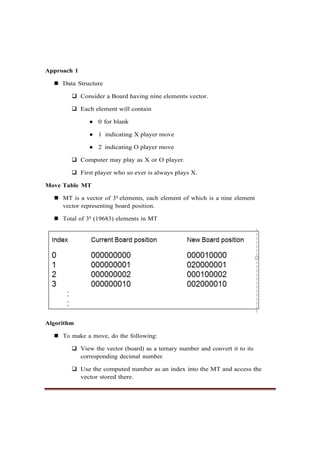
Move Table MT
◼ MT is a vector of 39 elements, each element of which is a nine element
vector representing board position.
◼ Total of 39 (19683) elements in MT
Algorithm
◼ To make a move, do the following:
❑ View the vector (board) as a ternary number and convert it to its
corresponding decimal number.
❑ Use the computed number as an index into the MT and access the
vector stored there.
15.
● The selectedvector represents the way the board will look
after the move.
❑ Set board equal to that vector.
Comments
◼ Very efficient in terms of time but has several disadvantages.
❑ Lot of space to store the move table.
❑ Lot of work to specify all the entries in move table.
❑ Highly error prone as the data is voluminous.
❑ Poor extensibility
● 3D tic-tac-toe = 327 board position to be stored.
❑ Not intelligent at all.
Approach 2
◼ Data Structure
❑ Board: A nine-element vector representing the board: B[1..9]
❑ Following conventions are used
2 - indicates blank
3 - X
5 - 0
❑ Turn: An integer
1 - First move
9 - Last move
Procedures Used
◼ Make_2 Tries to make valid 2
❑ Make_2 first tries to play in the center if free and returns 5 (square
number).
16.
❑ If notpossible, then it tries the various suitable non corner squareand
returns square number.
❑ Go(n) makes a move in square ‘n’ which is blank represented by2.
Procedure – PossWin
◼ PossWin (P) Returns
❑ 0, if player P cannot win in its next move,
❑ otherwise the number of square that constitutes a winning movefor
P.
❑ Rule
❑ If PossWin (P) = 0 {P can not win} then find whether opponent can
win. If so, then block it.
Strategy used by PosWin
◼ PosWin checks one at a time, for each rows /columns and diagonals as
follows.
❑ If 3 * 3 * 2 = 18 then player X can win
❑ else if 5 * 5 * 2 = 50 then player O can win
❑ These procedures are used in the algorithm are showed below.
Algorithm
◼ Assumptions
❑ The first player always uses symbol X.
❑ There are in all 8 moves in the worst case.
❑ Computer is represented by C and Human is represented by H.
❑ Convention used in algorithm on next slide
◼ If C plays first (Computer plays X, Human plays O) - Odd
moves
17.
◼ If Hplays first (Human plays X, Computer plays O) - Even
moves
◼ For the sake of clarity, we use C and H.
Algo - Computer plays first – C plays odd moves
◼ Move 1: Go (5)
◼ Move 2: H plays
◼ Move 3: If B[9] is blank, then Go(9) else Go(3) {make 2}
◼ Move 4: H plays
◼ Move 5: {By now computer has played 2 chances}
❑ If PossWin(C) then {won} Go(PossWin(C))
❑ else {block H} if PossWin(H) then Go(PossWin(H)) else if B[7] is
blank then Go(7) else Go(3)
◼ Move 6: H plays
◼ Moves 7 & 9 :
❑ If PossWin(C) then {won} Go(PossWin(C))
❑ else {block H} if PossWin(H) then Go(PossWin(H)) else
Go(Anywhere)
◼ Move 8: H plays
Algo - Human plays first – C plays even moves
◼ Move 1: H plays
◼ Move 2: If B[5] is blank, then Go(5) else Go(1)
◼ Move 3: H plays
◼ Move 4: {By now H has played 2 chances}
❑ If PossWin(H) then {block H} Go (PossWin(H))
❑ else Go (Make_2)
◼ Move 5: H plays
18.
◼ Move 6:{By now both have played 2 chances}
❑ If PossWin(C) then {won} Go(PossWin(C))
❑ else {block H} if PossWin(H) then Go(PossWin(H)) else Go(Make_2)
◼ Moves 7 & 9 : H plays
◼ Move 8: {By now computer has played 3 chances}
❑ If PossWin(C) then {won} Go(PossWin(C))
❑ else {block H} if PossWin(H) then Go(PossWin(H)) else
Go(Anywhere)
Complete Algorithm – Odd moves or even moves for C playing first or second
◼ Move 1: go (5)
◼ Move 2: If B[5] is blank, then Go(5) else Go(1)
◼ Move 3: If B[9] is blank, then Go(9) else Go(3) {make 2}
◼ Move 4: {By now human (playing X) has played 2 chances} If
PossWin(X) then {block H} Go (PossWin(X)) else Go (Make_2)
◼ Move 5: {By now computer has played 2 chances} If PossWin(X) then
{won} Go(PossWin(X)) else {block H} if PossWin(O) then Go(PossWin(O))else
if B[7] is blank then Go(7) else Go(3)
◼ Move 6: {By now both have played 2 chances} If PossWin(O) then
{won} Go(PossWin(O)) else {block H} if PossWin(X) then Go(PossWin(X))else
Go(Make_2)
◼ Moves 7 & 9 : {By now human (playing O) has played 3 chances} If
PossWin(X) then {won} Go(PossWin(X)) else {block H} if PossWin(O) then
Go(PossWin(O)) else Go(Anywhere)
◼ Move 8: {By now computer has played 3 chances} If PossWin(O) then
{won} Go(PossWin(O)) else {block H} if PossWin(X) then Go(PossWin(X))else
Go(Anywhere)
Comments
◼ Not as efficient as first one in terms of time.
◼ Several conditions are checked before each move.
19.
◼ It ismemory efficient.
◼ Easier to understand & complete strategy has been determined in
advance
◼ Still can not generalize to 3-D.
Approach 3
◼ Same as approach 2 except for one change in the representation of the
board.
❑ Board is considered to be a magic square of size 3 X 3 with 9
blocks numbered by numbers indicated by magic square.
◼ This representation makes process of checking for a possible win more
simple.
Board Layout – Magic Square
◼ Board Layout as magic square. Each row, column and diagonals add to15.
Strategy for possible win for one player
◼ Maintain the list of each player’s blocks in which he has played.
❑ Consider each pair of blocks that player owns.
20.
❑ Compute differenceD between 15 and the sum of the two blocks.
❑ If D < 0 or D > 9 then
◼ these two blocks are not collinear and so can be ignored
◼ otherwise if the block representing difference is blank (i.e.,not
in either list) then a move in that block will produce a win.
Working Example of algorithm
◼ Assume that the following lists are maintained up to 3rd move.
◼ Consider the magic block shown in slide 18.
❑ First Player X (Human)
8 3
❑ Second Player O (Computer)5
◼ Strategy is same as in approach 2
❑ First check if computer can win.
◼ If not then check if opponent can win.
◼ If so, then block it and proceed further.
◼ Steps involved in the play are:
❑ First chance, H plays in block numbered as 8
❑ Next C plays in block numbered as 5
❑ H plays in block numbered 3
Now there is a turn of computer
◼ Strategy by computer: Since H has played two turns and C has played
only one turn, C checks if H can win or not.
21.
❑ Compute sumof blocks played by H
◼ S = 8 + 3 = 11
◼ Compute D = 15 – 11 = 4
◼ Block 4 is a winning block for H.
◼ So block this block and play in block numbered 4.
◼ The list of C gets updated with block number 4 as follows:H
8 3 C 5 4
◼ Assume that H plays in block numbered 6.
◼ Now it’s a turn of C.
❑ C checks, if C can win as follows:
◼ Compute sum of blocks played by C
◼ S = 5 + 4 = 9
◼ Compute D = 15 – 9 = 6
◼ Block 6 is not free, so C can not win at this turn.
❑ Now check if H can win.
◼ Compute sum of new pairs (8, 6) and (3, 6) from the list of H
◼ S = 8 + 6 = 14
◼ Compute D = 15 – 14 = 1
◼ Block 1 is not used by either player, so C plays in block
numbered as 1
◼ The updated lists at 6th move looks as follows:
❑ First Player H
8 3 6
❑ Second Player C
5 4 1
22.
◼ Assume thatnow H plays in 2.
◼ Using same strategy, C checks its pair (5, 1) and (4, 1) and finds
bock numbered as 9 {15-6 = 9}.
◼ Block 9 is free, so C plays in 9 and win the game.
Comments
◼ This program will require more time than two others as
❑ it has to search a tree representing all possible move sequences
before making each move.
◼ This approach is extensible to handle
❑ 3-dimensional tic-tac-toe.
❑ games more complicated than tic-tac-toe.
3D Tic Tac Toe (Magic cube)
◼ All lines parallel to the faces of a cube, and all 4 triagonals sum correctlyto
42 defined by
S = m(m3 + 1)/2 , where m=3
◼ No planar diagonals of outer surfaces sum to 42. so there are probablyno
magic squares in the cube.
8 24 10 15 1 26 19 17 6
12 7 23 25 14 3 5 21 16
22 11 9 2 27 13 18 4 20
23.
8 24 1015 1 26 19 17 6
12 7 23 25 14 3 5 21 16
22 11 9 2 27 13 18 4 20
• Magic Cube has 6 outer and 3 inner and 2 diagonal surfaces
• Outer 6 surfaces are not magic squares as diagonals are not added to42.
• Inner 5 surfaces are magic square.







![● The selected vector represents the way the board will look
after the move.
❑ Set board equal to that vector.
Comments
◼ Very efficient in terms of time but has several disadvantages.
❑ Lot of space to store the move table.
❑ Lot of work to specify all the entries in move table.
❑ Highly error prone as the data is voluminous.
❑ Poor extensibility
● 3D tic-tac-toe = 327 board position to be stored.
❑ Not intelligent at all.
Approach 2
◼ Data Structure
❑ Board: A nine-element vector representing the board: B[1..9]
❑ Following conventions are used
2 - indicates blank
3 - X
5 - 0
❑ Turn: An integer
1 - First move
9 - Last move
Procedures Used
◼ Make_2 Tries to make valid 2
❑ Make_2 first tries to play in the center if free and returns 5 (square
number).](https://image.slidesharecdn.com/unit01ai-250826151243-30414384/85/Artificial-Intelligence_-Basics-Artificial-Intelligence_-Basics-15-320.jpg)

![◼ If H plays first (Human plays X, Computer plays O) - Even
moves
◼ For the sake of clarity, we use C and H.
Algo - Computer plays first – C plays odd moves
◼ Move 1: Go (5)
◼ Move 2: H plays
◼ Move 3: If B[9] is blank, then Go(9) else Go(3) {make 2}
◼ Move 4: H plays
◼ Move 5: {By now computer has played 2 chances}
❑ If PossWin(C) then {won} Go(PossWin(C))
❑ else {block H} if PossWin(H) then Go(PossWin(H)) else if B[7] is
blank then Go(7) else Go(3)
◼ Move 6: H plays
◼ Moves 7 & 9 :
❑ If PossWin(C) then {won} Go(PossWin(C))
❑ else {block H} if PossWin(H) then Go(PossWin(H)) else
Go(Anywhere)
◼ Move 8: H plays
Algo - Human plays first – C plays even moves
◼ Move 1: H plays
◼ Move 2: If B[5] is blank, then Go(5) else Go(1)
◼ Move 3: H plays
◼ Move 4: {By now H has played 2 chances}
❑ If PossWin(H) then {block H} Go (PossWin(H))
❑ else Go (Make_2)
◼ Move 5: H plays](https://image.slidesharecdn.com/unit01ai-250826151243-30414384/85/Artificial-Intelligence_-Basics-Artificial-Intelligence_-Basics-17-320.jpg)
![◼ Move 6: {By now both have played 2 chances}
❑ If PossWin(C) then {won} Go(PossWin(C))
❑ else {block H} if PossWin(H) then Go(PossWin(H)) else Go(Make_2)
◼ Moves 7 & 9 : H plays
◼ Move 8: {By now computer has played 3 chances}
❑ If PossWin(C) then {won} Go(PossWin(C))
❑ else {block H} if PossWin(H) then Go(PossWin(H)) else
Go(Anywhere)
Complete Algorithm – Odd moves or even moves for C playing first or second
◼ Move 1: go (5)
◼ Move 2: If B[5] is blank, then Go(5) else Go(1)
◼ Move 3: If B[9] is blank, then Go(9) else Go(3) {make 2}
◼ Move 4: {By now human (playing X) has played 2 chances} If
PossWin(X) then {block H} Go (PossWin(X)) else Go (Make_2)
◼ Move 5: {By now computer has played 2 chances} If PossWin(X) then
{won} Go(PossWin(X)) else {block H} if PossWin(O) then Go(PossWin(O))else
if B[7] is blank then Go(7) else Go(3)
◼ Move 6: {By now both have played 2 chances} If PossWin(O) then
{won} Go(PossWin(O)) else {block H} if PossWin(X) then Go(PossWin(X))else
Go(Make_2)
◼ Moves 7 & 9 : {By now human (playing O) has played 3 chances} If
PossWin(X) then {won} Go(PossWin(X)) else {block H} if PossWin(O) then
Go(PossWin(O)) else Go(Anywhere)
◼ Move 8: {By now computer has played 3 chances} If PossWin(O) then
{won} Go(PossWin(O)) else {block H} if PossWin(X) then Go(PossWin(X))else
Go(Anywhere)
Comments
◼ Not as efficient as first one in terms of time.
◼ Several conditions are checked before each move.](https://image.slidesharecdn.com/unit01ai-250826151243-30414384/85/Artificial-Intelligence_-Basics-Artificial-Intelligence_-Basics-18-320.jpg)


