Written by Thomas J. Kalb, Ph.D., Extension Horticulturist, North Dakota State University
Extension Service

Contact information:
North Dakota State University
3715 E. Bismarck Expressway
Bismarck, ND 58501
Tel: (701) 221-6865
tom.kalb@ndsu.edu

This is an academic report published for educational purposes only. The author gratefully
acknowledges the sources of the descriptions of the varieties tested in this project:
Burpee Seeds, Evergreen Seeds, Gurney’s Seed, Harris Seeds, Johnny’s Selected Seeds,
Jordan Seeds, Jung Seed, Park Seed, Seed Savers Exchange, Seeds of Change, Stokes
Seeds, Territorial Seed, Twilley Seed, and Vesey’s Seeds.

Updated January 7, 2011
North Dakota State University Extension Service

North Dakota
Home Garden Variety Trials
2010 Results
Table of Contents
                                                                                                                        Page
Chapter 1   Introduction                                                                                                  1
Chapter 2   Summary of Results for 2010                                                                                       4
Chapter 3   Vegetable Trial Reports for 2010                                                                                 11
            1      Bean, Dry (‘Arikara Yellow’ and ‘Hutterite’) . . . . . . . . . . . . . . . . . . . . . . . . . . . . .    11
            2      Bean, Green Flat Pod (‘Greencrop’ and ‘Roma II’) . . . . . . . . . . . . . . . . . . . . . . .            12
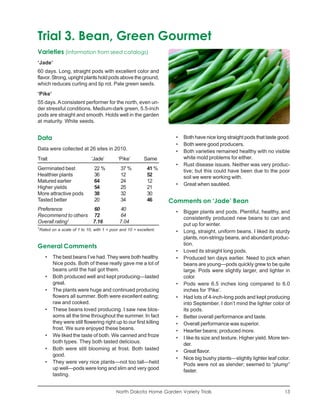
            3      Bean, Green Gourmet (‘Jade’ and ‘Pike’) . . . . . . . . . . . . . . . . . . . . . . . . . . . . .         13
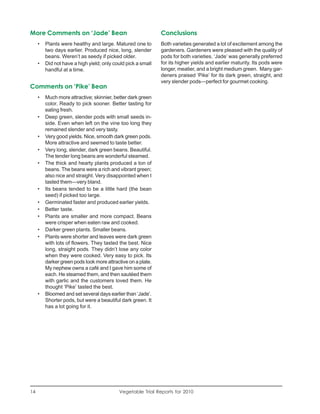
            4      Bean, Green Standard (‘Provider’ and ‘Top Crop’) . . . . . . . . . . . . . . . . . . . . . . . .          15
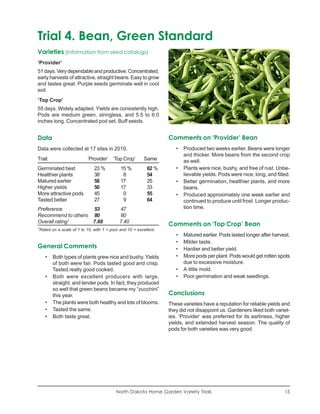
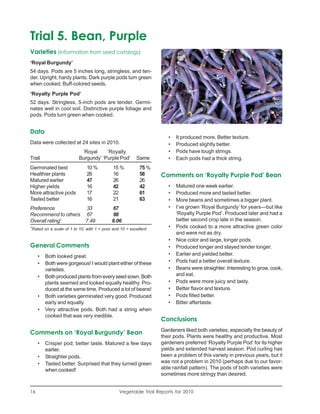
            5      Bean, Purple (‘Royal Burgundy’ and ‘Royalty Purple Pod’) . . . . . . . . . . . . . . . . .                16

            6         Bean, Vegetable Soybean (‘Envy’ and ‘Fiskeby’) . . . . . . . . . . . . . . . . . . . . . . . .         17
            7         Bean, Wax (‘Carson’ and ‘Slenderwax’) . . . . . . . . . . . . . . . . . . . . . . . . . . . . . .      18
            8         Bean, Yardlong (‘Gita’ and ‘Red Stripe’) . . . . . . . . . . . . . . . . . . . . . . . . . . . . . .   19
            9         Beet (‘Detroit Dark Red’ and ‘Red Ace’) . . . . . . . . . . . . . . . . . . . . . . . . . . . . . .    20
            10        Carrot, Colorful (‘Rainbow’ and ‘Sugarsnax 54’) . . . . . . . . . . . . . . . . . . . . . . . . . .    21

            11        Carrot, Orange (‘Mokum’ and ‘Nelson’) . . . . . . . . . . . . . . . . . . . . . . . . . . . . . . .    23
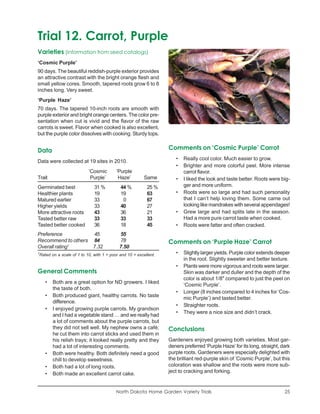
            12        Carrot, Purple (‘Cosmic Purple’ and ‘Purple Haze’) . . . . . . . . . . . . . . . . . . . . . . .       25
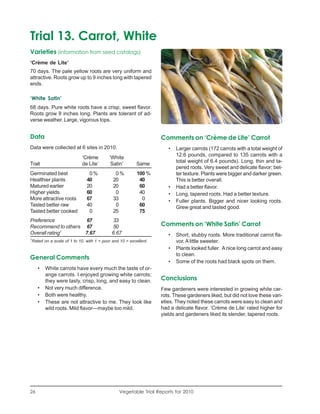
            13        Carrot, White (‘Crème de Lite’ and ‘White Satin’) . . . . . . . . . . . . . . . . . . . . . . . .      26
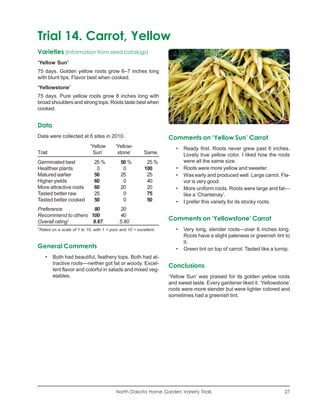
            14        Carrot, Yellow (‘Yellow Sun’ and ‘Yellowstone’) . . . . . . . . . . . . . . . . . . . . . . . . . .    27
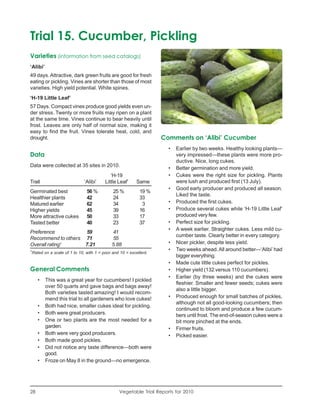
            15        Cucumber, Pickling (‘Alibi’ and ‘H-19 Little Leaf’) . . . . . . . . . . . . . . . . . . . . . . . .    28

            16        Cucumber, Slicing Asian (‘Orient Express II’ and ‘Suyo Long’) . . . . . . . . . . . . . . .            30
            17        Cucumber, Slicing Belt Alpha (‘Diva’ and ‘Sultan’) . . . . . . . . . . . . . . . . . . . . . . . .     31
            18        Cucumber, Slicing Burpless (‘Sweet Slice’ and ‘Sweeter Yet’) . . . . . . . . . . . . . . .             32
            19        Cucumber, Slicing Classic (‘Longfellow’ and ‘Marketmore 76’) . . . . . . . . . . . . . .               34
            20        Cucumber, Slicing Standard (‘General Lee’ and ‘Raider’). . . . . . . . . . . . . . . . . . . .         35

            21        Greens, Mizuna (‘Kyona Mizuna’ and ‘Purple Mizuna’) . . . . . . . . . . . . . . . . . . . . 36
            22        Greens, Mustard (‘Osaka Purple’ and ‘Red Giant’) . . . . . . . . . . . . . . . . . . . . . . . 37
            23        Kohlrabi (‘Early White Vienna’ and ’Winner’) . . . . . . . . . . . . . . . . . . . . . . . . . . . . 38
            24        Lettuce, Green Leaf (’Salad Bowl’ and ‘Slobolt’) . . . . . . . . . . . . . . . . . . . . . . . . . 40
            25        Lettuce, Red Leaf (‘New Red Fire’ and ‘Red Sails’) . . . . . . . . . . . . . . . . . . . . . . . 42


                                 North Dakota Home Garden Variety Trials                                                          i
Table of Contents (continued)

             26   Lettuce, Specialty (‘Buttercrunch’ and ‘Nevada’) . . . . . . . . . . . . . . . . . . . . . . . .             44
             27   Melon, Asian (‘Early Silver Line’ and ’Sun Jewel’) . . . . . . . . . . . . . . . . . . . . . . . .           46
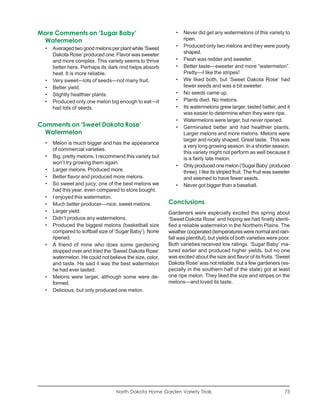
             28   Melon, Cantaloupe Classic (‘Delicious 51’ and ’Hearts of Gold’) . . . . . . . . . . . .                      47
             29   Melon, Cantaloupe Classic Large (‘Iroquois’ and ’Pride of Wisconsin’) . . . . . . . .                        48
             30   Melon, Cantaloupe Hybrid (‘Athena’ and ’Goddess’) . . . . . . . . . . . . . . . . . . . . . .                49

             31   Melon, Galia (‘Arava’ and ’Passport’) . . . . . . . . . . . . . . . . . . . . . . . . . . . . . . . . .      50
             32   Pea, Shelling (‘Early Frosty’ and ‘Lincoln’) . . . . . . . . . . . . . . . . . . . . . . . . . . . . .       51
             33   Pea, Snap (‘Cascadia’ and ‘Sugar Sprint’) . . . . . . . . . . . . . . . . . . . . . . . . . . . . .          53
             34   Pumpkin, Jack-O’-Lantern (‘Neon’ and ‘Racer’) . . . . . . . . . . . . . . . . . . . . . . . . . .            54
             35   Radish, French (‘D’Avignon’ and ‘French Breakfast’) . . . . . . . . . . . . . . . . . . . . . .              55

             36   Radish, Pink (‘Pink Beauty’ and ‘Pretty in Pink’) . . . . . . . . . . . . . . . . . . . . . . . . . 56
             37   Radish, Red (‘Champion’ and ‘Cherry Belle’) . . . . . . . . . . . . . . . . . . . . . . . . . . . . 57
             38   Radish, White (‘Hailstone’ and ‘Ping Pong’) . . . . . . . . . . . . . . . . . . . . . . . . . . . . 58
             39   Spinach, Red Stem (‘Bordeaux’ and ‘Red Cardinal’) . . . . . . . . . . . . . . . . . . . . . . . 59
             40   Spinach, Smooth Leaf (‘Olympia’ and ‘Space’) . . . . . . . . . . . . . . . . . . . . . . . . . . 60

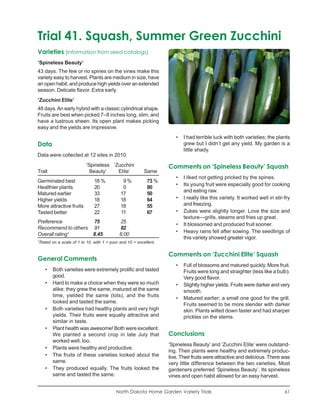
             41   Squash, Summer Green Zucchini (‘Spineless Beauty’ and ‘Zucchini Elite’) . . . . . . 61
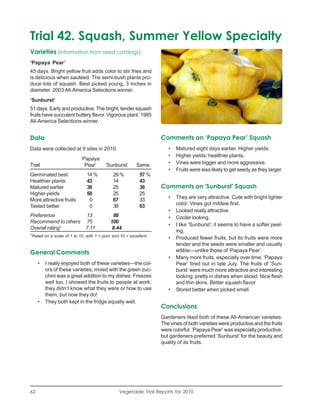
             42   Squash, Summer Yellow Specialty (‘Papaya Pear’ and ‘Sunburst’) . . . . . . . . . . . . 62
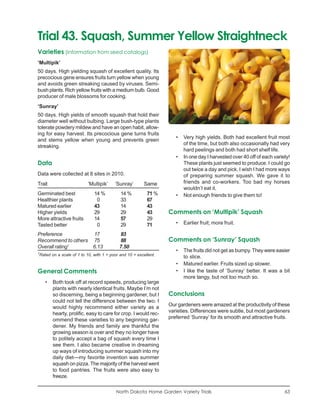
             43   Squash, Summer Yellow Straightneck (‘Multipik’ and ‘Sunray’) . . . . . . . . . . . . . . . 63
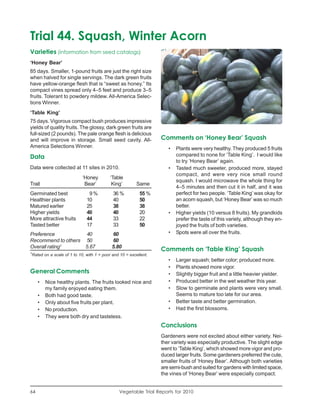
             44   Squash, Winter Acorn (‘Honey Bear’ and ‘Table King’) . . . . . . . . . . . . . . . . . . . . . 64
             45   Squash, Winter Buttercup (‘Burgess’ and ‘Uncle David’s Dakota Dessert’) . . . . . . .65

             46   Squash, Winter Butternut (‘Early Butternut’ and ‘Waltham’) . . . . . . . . . . . . . . . . . 66
             47   Squash, Winter Hubbard (‘Lakota’ and ‘Red Kuri’) . . . . . . . . . . . . . . . . . . . . . . . . 67
             48   Swiss Chard, Gold (‘Bright Yellow’ and ‘Orange Fantasia’) . . . . . . . . . . . . . . . . . . 68
             49   Swiss Chard, Red (‘Magenta Sunset’ and ‘Rhubarb’) . . . . . . . . . . . . . . . . . . . . . . 69
             50   Swiss Chard, White (‘Fordhook Giant’ and ‘Lucullus’) . . . . . . . . . . . . . . . . . . . . . 70

             51   Watermelon, Gold (‘Golden Flower’ and ‘Orangeglo’) . . . . . . . . . . . . . . . . . . . . . . 71
             52   Watermelon, Red (‘Sweet Dakota Rose’ and ‘Sugar Baby’) . . . . . . . . . . . . . . . . . 72
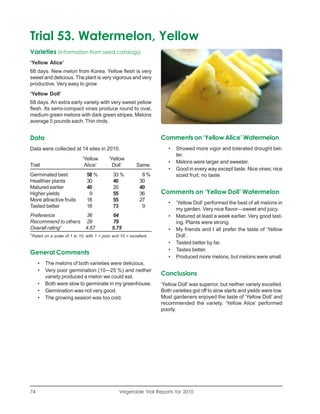
             53   Watermelon, Yellow (‘Yellow Alice’ and ‘Yellow Doll’) . . . . . . . . . . . . . . . . . . . . . . 74
Appendixes
             1.   Welcome Letter . . . . . . . . . . . . . . . . . . . . . . . . . . . . . . . . . . . . . . . . . . . . . . . . 75
             2.   Example of Evaluation Form . . . . . . . . . . . . . . . . . . . . . . . . . . . . . . . . . . . . . . . 76
             3.   Acknowledgements . . . . . . . . . . . . . . . . . . . . . . . . . . . . . . . . . . . . . . . . . . . . . 77


ii                                            Table of Contents
Chapter 1

Introduction
The Need for Better Research                                  vide some insight into the characteristics of a variety,
                                                              but they do not test varieties under actual gardening
The first step in growing a successful garden is to se-       conditions. The environment at a field research station
lect a superior variety.                                      is dramatically different than at a home garden.
    Gardeners who sow a superior variety can grow                • The soils at field research stations are similar to
plants that will yield abundantly, resist diseases, and              soils at a farm, that is, relatively fertile and un-
produce quality food. In contrast, gardeners who sow                 disturbed. Soils in a backyard garden have been
an inferior variety are headed for frustrations. No mat-             highly disturbed from home construction and land
ter how hard they work in preparing the soil, watering               grading activities, and are intensively managed.
and weeding, they may have disappointing results.
                                                                 • Trials at research stations utilize tractors, large-
    The benefits of selecting superior varieties for gar-            scale irrigation equipment, and herbicides. Back-
dens are great. The National Gardening Association                   yard gardeners use shovels, hoes (maybe a roto-
(NGA) estimates approximately one-third of households                tiller), garden hoses, and watering cans.
in North Dakota grow a vegetable garden.1 Thus, there
                                                                 • Trials conducted at research stations are out in
are approximately 86,000 households in North Dakota
                                                                     full sun. Many home gardens have shade for at
with vegetable gardens.
                                                                     least part of the day.
    There are significant economic benefits to garden-
ing. A national study by the NGA showed the average           The Bottom Line
family with a vegetable garden spends $70 on it and
grows an estimated $600 worth of vegetables.2 Using           To identify superior varieties for home gardeners, it
this information, families in North Dakota reap a profit      makes sense to determine which varieties perform best
of approximately $45.6 million per year in their gardens.     in home gardens under the management of home gar-
                                                              deners.
    There is an important public health dimension to
gardening. Vegetables and fruits are nature’s richest         Objectives
source of micronutrients, minerals, and dietary fiber. A
diet rich in vegetables and fruits is associated with a       This program has three major objectives:
decreased risk of obesity and certain chronic diseases           1. Home gardeners will identify superior varieties of
such as cardiovascular disease, diabetes, and some                  vegetables.
cancers. Nevertheless, only 11 percent of adults eat
enough vegetables and fruits for a healthy diet.3 We need        2. Home gardeners will become more aware of new
to eat more vegetables—growing a productive garden                  varieties and differences among varieties. This
can obviously help with this.                                       increased level of awareness will affect the way
                                                                    they select vegetable varieties in the future.
   Very little vegetable research is conducted at re-            3. Partnerships between local families and North
search stations in North Dakota. These few plots pro-               Dakota State University will be strengthened.

1
  National Gardening Association. 2008. Personal com-         Selecting Varieties to be Tested
munication with Bruce Butterfield, Market Research Direc-
                                                              Seed catalogs are carefully studied to identify varieties
tor.
                                                              that are widely available and appear promising for North
2
 Templin, N. (2008, April 16). How much green can grow-       Dakota. In many situations, a promising new variety is
ing a vegetable garden save you? Wall Street Journal.         compared with a variety that is widely grown in the state.
<www.wallstreetjournal.com>
                                                              In 2010, 53 trials were established.
3
  Elsevier Health Sciences (2007, March 19). Americans
still not eating enough fruits and vegetables, according to
studies. Science Daily. <www.sciencedaily.com>.


                                      North Dakota Home Garden Variety Trials                                          1
Preparation of Seed Packets                                  growing season was long, and extreme weather-related
                                                             events were rare.
Seeds are ordered in bulk from seed companies. Seeds
are packaged in coin envelopes. Adhesive labels that            Spring was very pleasant with few surprises. Tem-
contain planting instructions (variety name, vegetable       peratures were warm in April and the spring rains were
type, time to plant, and recommended spacing for sow-        regular (Figure 1). There were no freak snowfalls. Many
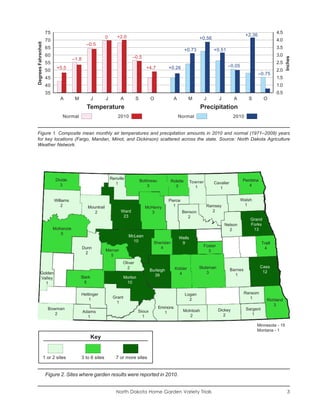
ing and thinning) are affixed on each seed packet. Un-       gardeners experienced their last killing frost around May
treated seed is used.                                        8–10 (near normal). The far eastern part of the state
                                                             received their last killing frost in mid April (about two
Distribution of Seeds and Supplies                           weeks earlier than normal).
                                                               Temperatures stayed normal throughout the sum-
This program is promoted by NDSU Extension Service
                                                             mer. Rainfall was extremely favorable in most areas.
faculty and staff across the state. Information is also
available at the web site <www.dakotagardener.com>.              Above average rains continued throughout the sum-
Interested gardeners in Spring 2010 were allowed to          mer until in October, when the climate became unusu-
participate in up to five trials. The fee was $1 per trial   ally warm and dry.
along with $2.50 for handling and postage. Any inter-
ested child was allowed to receive seeds of one trial for        Light snow fell in the western half of the state on
free.                                                        September 17, but most gardeners in that region did
                                                             not experience a killing frost until the first week of Oc-
   In all cases, gardeners sign a pledge before receiv-      tober (about one week later than normal). Much of the
ing seeds, promising to do all they can to evaluate the      eastern part of the state avoided a killing frost until mid
varieties fairly.                                            to late October (again, about one week later than nor-
                                                             mal).
    Besides seeds, growers also receive row labels to
mark rows, and a string to help them lay out the 10-
foot-long plots. Gardeners receive simple, yet detailed      Compiling the Data
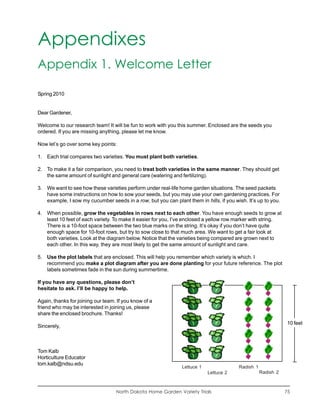
instructions on laying out their plots (Appendix 1). We
                                                             Gardeners compared the two varieties in each trial for a
encourage a 10-foot plot length to be minimal at getting
                                                             series of traits, which included germination rate, plant
quality data.
                                                             health, earliness, yield, and quality of harvested prod-
   Gardeners are responsible for managing their crops.       uct. We asked them if they would recommend the vari-
This includes fertilizing, watering, mulching, and using     eties to other gardeners and which of the two varieties
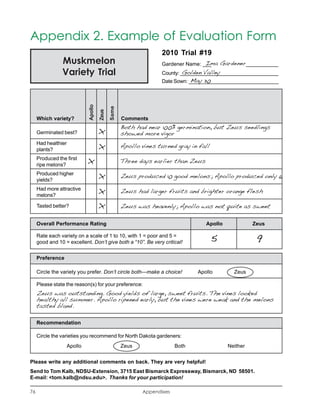
pesticides. They are encouraged to use their own gar-        they preferred (Appendix 2). Comments were strongly
dening practices so the varieties are tested under ac-       encouraged.
tual home garden conditions.
                                                                Comments of growers regarding their taste prefer-
                                                             ences of the vegetables are a noteworthy bonus of this
Quantity and Quality of Participation                        grass-roots research approach.
In 2010, over 200 households submitted results from              Approximately 5% of the reports showed data with
their trials (this accounts for approximately 75% of         inconsistencies; these reports were eliminated from the
households who received seeds). Results from approxi-        final analysis.
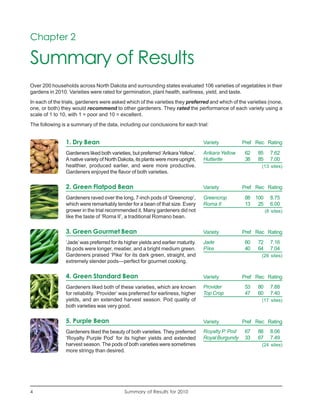
mately 830 research trials were submitted. Data were
obtained in 46 of the state’s 53 counties (Figure 2). No        A selection of representative comments of garden-
other program in the USA can match this program for          ers on each variety is included in this report. In multi-
its scope of participation and number of varieties tested.   year trials, emphasis was placed on comments from
                                                             2010. Reports of previous years are available on-line to
    A pleasant finding of this program was the quality of    see more comments of growers from previous years.
research conducted by home gardeners. These fami-
lies demonstrated extraordinary enthusiasm in this           Reporting the Final Results
project. Besides carefully filling out report forms, they
often wrote detailed letters on their trials.                The final results are reported to interested seed com-
                                                             panies and NDSU educators. Newspaper columns are
Weather in 2010                                              written to report findings and public presentations are
                                                             made to garden clubs and University faculty. Partici-
The growing season of 2010 will be remembered as a           pating gardeners receive a summary of the results (see
good one for most of the state’s gardeners. The rainfall     page 4) and a certificate to recognize their participation
was regular, the temperatures were near normal, the          in the program.

2                                                    Introduction
75                                                                                                                                                4.5
                                                           0       +2.0                                                                              +2.36
Degrees Fahrenheit    70                                                                                                +0.56                                           4.0
                                              –0.5
                      65                                                                                        +0.73            +0.51                                  3.5
                      60                                                    –0.5                                                                                        3.0


                                                                                                                                                                              Inches
                                      –1.8
                      55                                                                                                                                                2.5
                            +5.5                                                      +4.7          +0.26                                –0.05
                      50                                                                                                                                                2.0
                                                                                                                                                             –0.75
                      45                                                                                                                                                1.5
                      40                                                                                                                                                1.0
                      35                                                                                                                                                0.5
                              A        M           J       J        A          S         O              A        M           J     J         A        S         O
                                              Temperature                                                                Precipitation
                               Normal                              2010                                     Normal                           2010


Figure 1. Composite mean monthly air temperatures and precipitation amounts in 2010 and normal (1971–2009) years
for key locations (Fargo, Mandan, Minot, and Dickinson) scattered across the state. Source: North Dakota Agriculture
Weather Network.


                            Divide                             Renville                                                                           Pembina
                                                                                   Bottineau          Rolette       Towner
                              3                                  1                                                               Cavalier
                                                                                       3                3             1                              4
                                                                                                                                    1

                           Williams                                                                 Pierce                                       Walsh
                               2                                                                      1                      Ramsey               1
                                               Mountrail                             McHenry
                                                  2                  Ward               3                    Benson            2
                                                                      23                                       2
                                                                                                                                                       Grand
                                                                                                                                       Nelson          Forks
                           McKenzie                                                                                                      2              13
                              5
                                                                          McLean                            Wells
                                                                            10             Sheridan          9                                                 Traill
                                             Dunn                                             4                           Foster
                                                                                                                                                                 4
                                                           Mercer                                                           3
                                              2
                                                             5
                                                                      Oliver
                                                                        2                               Kidder          Stutsman                              Cass
                                                                                         Burleigh                                           Barnes             12
         Golden                                                                                           4                 3
                                                                                           39                                                 1
         Valley                            Stark                        Morton
           1                                 5                           10

                                           Hettinger                                                            Logan                                Ransom
                                               1                Grant                                                                                   1
                                                                                                                  2                                               Richland
                                                                  1
                                                                                                                                                                     3
                       Bowman                                                                  Emmons                                                Sargent
                                             Adams                               Sioux                        McIntosh             Dickey
                          2                                                                      1                                                      1
                                               1                                   1                             2                    2

                                                                                                                                                          Minnesota - 15
                                                                                                                                                          Montana - 1
                                                   Key


                     1 or 2 sites          3 to 6 sites           7 or more sites


                      Figure 2. Sites where garden results were reported in 2010.


                                                                  North Dakota Home Garden Variety Trials                                                                      3
Chapter 2

Summary of Results
Over 200 households across North Dakota and surrounding states evaluated 106 varieties of vegetables in their
gardens in 2010. Varieties were rated for germination, plant health, earliness, yield, and taste.
In each of the trials, gardeners were asked which of the varieties they preferred and which of the varieties (none,
one, or both) they would recommend to other gardeners. They rated the performance of each variety using a
scale of 1 to 10, with 1 = poor and 10 = excellent.
The following is a summary of the data, including our conclusions for each trial:


                1. Dry Bean                                                        Variety          Pref Rec Rating

                Gardeners liked both varieties, but preferred ‘Arikara Yellow’.    Arikara Yellow    62   85     7.62
                A native variety of North Dakota, its plants were more upright,    Hutterite         38   85     7.00
                healthier, produced earlier, and were more productive.                                     (13 sites)
                Gardeners enjoyed the flavor of both varieties.

                2. Green Flatpod Bean                                              Variety          Pref Rec Rating
                Gardeners raved over the long, 7-inch pods of ‘Greencrop’,         Greencrop         88 100      8.75
                which were remarkably tender for a bean of that size. Every        Roma II           13 25       6.00
                grower in the trial recommended it. Many gardeners did not                                     (8 sites)
                like the taste of ‘Roma II’, a traditional Romano bean.

                3. Green Gourmet Bean                                              Variety          Pref Rec Rating
                ‘Jade’ was preferred for its higher yields and earlier maturity.   Jade              60   72     7.16
                Its pods were longer, meatier, and a bright medium green.          Pike              40   64     7.04
                Gardeners praised ‘Pike’ for its dark green, straight, and                                 (26 sites)
                extremely slender pods—perfect for gourmet cooking.

                4. Green Standard Bean                                             Variety          Pref Rec Rating
                Gardeners liked both of these varieties, which are known           Provider          53   80     7.88
                for reliability. ‘Provider’ was preferred for earliness, higher    Top Crop          47   60     7.40
                yields, and an extended harvest season. Pod quality of                                     (17 sites)
                both varieties was very good.

                5. Purple Bean                                                     Variety          Pref Rec Rating
                Gardeners liked the beauty of both varieties. They preferred       Royalty P. Pod    67   88     8.06
                ‘Royalty Purple Pod’ for its higher yields and extended            Royal Burgundy    33   67     7.49
                harvest season. The pods of both varieties were sometimes                                  (24 sites)
                more stringy than desired.


4                                           Summary of Results for 2010
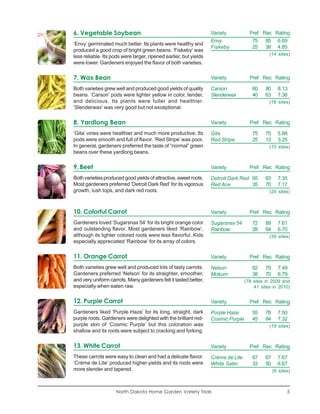
6. Vegetable Soybean                                               Variety           Pref Rec Rating
                                                                   Envy               75 85 6.69
‘Envy’ germinated much better. Its plants were healthy and
                                                                   Fiskeby            25 38 4.85
produced a good crop of bright green beans. ‘Fiskeby’ was
                                                                                              (14 sites)
less reliable. Its pods were larger, ripened earlier, but yields
were lower. Gardeners enjoyed the flavor of both varieties.

7. Wax Bean                                                        Variety           Pref Rec Rating

Both varieties grew well and produced good yields of quality       Carson             60    80     8.13
beans. ‘Carson’ pods were lighter yellow in color, tender,         Slenderwax         40    63     7.38
and delicious. Its plants were fuller and healthier.                                          (16 sites)
‘Slenderwax’ was very good but not exceptional.

8. Yardlong Bean                                                   Variety           Pref Rec Rating

‘Gita’ vines were healthier and much more productive. Its          Gita               75    75     5.88
pods were smooth and full of flavor. ‘Red Stripe’ was poor.        Red Stripe         25    13     3.25
In general, gardeners preferred the taste of “normal” green                                   (10 sites)
beans over these yardlong beans.

9. Beet                                                            Variety           Pref Rec Rating

Both varieties produced good yields of attractive, sweet roots.    Detroit Dark Red 65      83     7.35
Most gardeners preferred ‘Detroit Dark Red’ for its vigorous       Red Ace          35      70     7.17
growth, lush tops, and dark red roots.                                                        (25 sites)


10. Colorful Carrot                                                Variety           Pref Rec Rating
Gardeners loved ‘Sugarsnax 54’ for its bright orange color         Sugarsnax 54       72    89     7.61
and outstanding flavor. Most gardeners liked ‘Rainbow’,            Rainbow            28    64     6.70
although its lighter colored roots were less flavorful. Kids                                  (39 sites)
especially appreciated ‘Rainbow’ for its array of colors.

11. Orange Carrot                                                  Variety           Pref Rec Rating
Both varieties grew well and produced lots of tasty carrots.       Nelson             62    79     7.49
Gardeners preferred ‘Nelson’ for its straighter, smoother,         Mokum              38    70     6.79
and very uniform carrots. Many gardeners felt it tasted better,                    (78 sites in 2009 and
especially when eaten raw.                                                             41 sites in 2010)


12. Purple Carrot                                                  Variety           Pref Rec Rating
Gardeners liked ‘Purple Haze’ for its long, straight, dark         Purple Haze        55    78     7.50
purple roots. Gardeners were delighted with the brilliant red-     Cosmic Purple      45    84     7.32
purple skin of ‘Cosmic Purple’ but this coloration was                                        (19 sites)
shallow and its roots were subject to cracking and forking.

13. White Carrot                                                   Variety           Pref Rec Rating
These carrots were easy to clean and had a delicate flavor.        Crème de Lite      67    67     7.67
‘Crème de Lite’ produced higher yields and its roots were          White Satin        33    50     6.67
more slender and tapered.                                                                        (6 sites)


                     North Dakota Home Garden Variety Trials                                            5
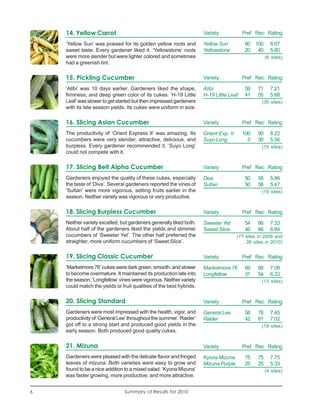
14. Yellow Carrot                                                Variety            Pref Rec Rating

    ‘Yellow Sun’ was praised for its golden yellow roots and         Yellow Sun          80 100       8.67
    sweet taste. Every gardener liked it. ‘Yellowstone’ roots        Yellowstone         20 40        5.80
    were more slender but were lighter colored and sometimes                                        (6 sites)
    had a greenish tint.

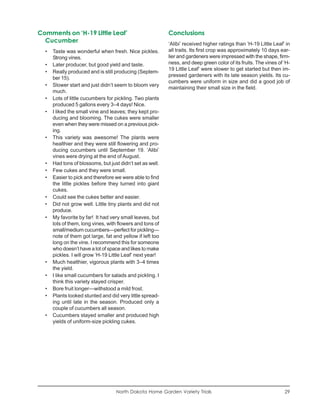
    15. Pickling Cucumber                                            Variety            Pref Rec Rating

    ‘Alibi’ was 10 days earlier. Gardeners liked the shape,          Alibi               59    71     7.21
    firmness, and deep green color of its cukes. ‘H-19 Little        H-19 Little Leaf    41    55     5.88
    Leaf’ was slower to get started but then impressed gardeners                                 (35 sites)
    with its late season yields. Its cukes were uniform in size.

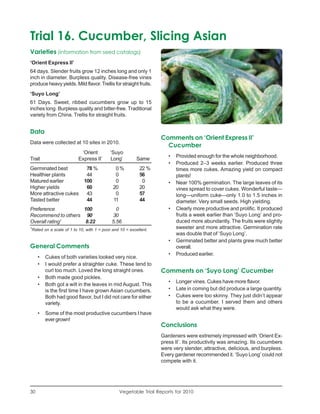
    16. Slicing Asian Cucumber                                       Variety            Pref Rec Rating

    The productivity of ‘Orient Express II’ was amazing. Its         Orient Exp. II     100    90     8.22
    cucumbers were very slender, attractive, delicious, and          Suyo Long            0    30     5.56
    burpless. Every gardener recommended it. ‘Suyo Long’                                         (10 sites)
    could not compete with it.

    17. Slicing Beit Alpha Cucumber                                  Variety            Pref Rec Rating

    Gardeners enjoyed the quality of these cukes, especially         Diva                50    58     5.86
    the taste of ‘Diva’. Several gardeners reported the vines of     Sultan              50    58     5.47
    ‘Sultan’ were more vigorous, setting fruits earlier in the                                   (19 sites)
    season. Neither variety was vigorous or very productive.

    18. Slicing Burpless Cucumber                                    Variety            Pref Rec Rating
    Neither variety excelled, but gardeners generally liked both.    Sweeter Yet         54    66     7.33
    About half of the gardeners liked the yields and slimmer         Sweet Slice         46    66     6.84
    cucumbers of ‘Sweeter Yet’. The other half preferred the                          (77 sites in 2009 and
    straighter, more uniform cucumbers of ‘Sweet Slice’.                                  26 sites in 2010)


    19. Slicing Classic Cucumber                                     Variety            Pref Rec Rating
    ‘Marketmore 76’ cukes were dark green, smooth, and slower        Marketmore 76       69    69     7.08
    to become overmature. It maintained its production late into     Longfellow          31    54     6.33
    the season. ‘Longfellow’ vines were vigorous. Neither variety                                (13 sites)
    could match the yields or fruit qualities of the best hybrids.

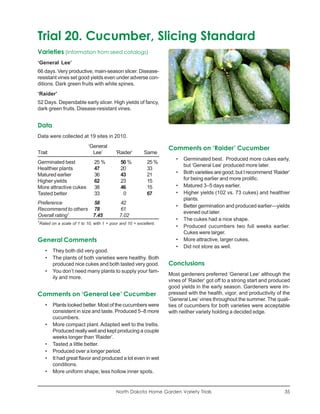
    20. Slicing Standard                                             Variety            Pref Rec Rating
    Gardeners were most impressed with the health, vigor, and        General Lee         58    78     7.45
    productivity of ‘General Lee’ throughout the summer. ‘Raider’    Raider              42    61     7.02
    got off to a strong start and produced good yields in the                                    (19 sites)
    early season. Both produced good quality cukes.

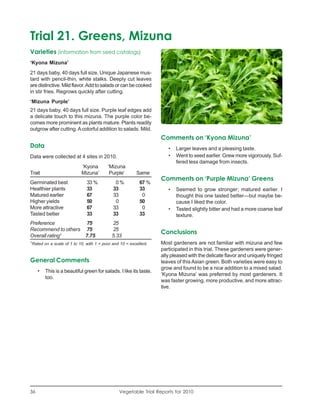
    21. Mizuna                                                       Variety            Pref Rec Rating
    Gardeners were pleased with the delicate flavor and fringed      Kyona Mizuna        75    75     7.75
    leaves of mizuna. Both varieties were easy to grow and           Mizuna Purple       25    25     5.33
    found to be a nice addition to a mixed salad. ‘Kyona Mizuna’                                    (4 sites)
    was faster growing, more productive, and more attractive.


6                              Summary of Results for 2010
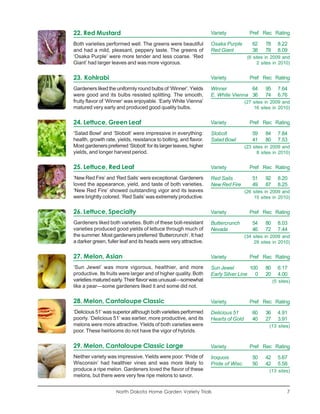
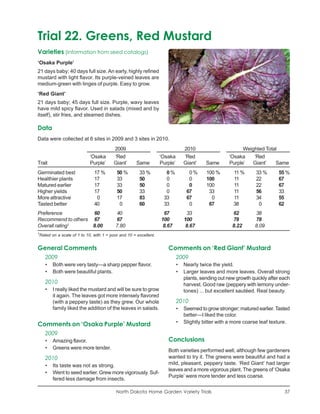
22. Red Mustard                                                    Variety            Pref Rec Rating

Both varieties performed well. The greens were beautiful           Osaka Purple        62     78     8.22
and had a mild, pleasant, peppery taste. The greens of             Red Giant           38     78     8.09
‘Osaka Purple’ were more tender and less coarse. ‘Red                                (6 sites in 2009 and
Giant’ had larger leaves and was more vigorous.                                           2 sites in 2010)


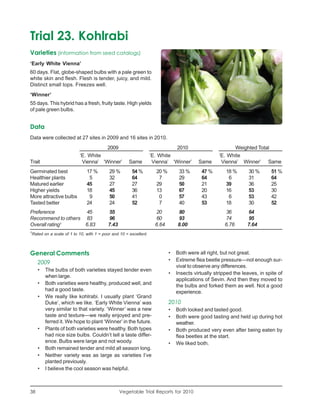
23. Kohlrabi                                                       Variety            Pref Rec Rating

Gardeners liked the uniformly round bulbs of ‘Winner’. Yields      Winner          64         95     7.64
were good and its bulbs resisted splitting. The smooth,            E. White Vienna 36         74     6.76
fruity flavor of ‘Winner’ was enjoyable. ‘Early White Vienna’                       (27 sites in 2009 and
matured very early and produced good quality bulbs.                                     16 sites in 2010)


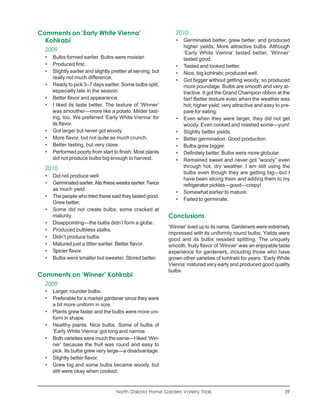
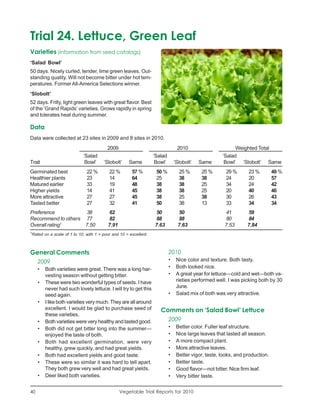
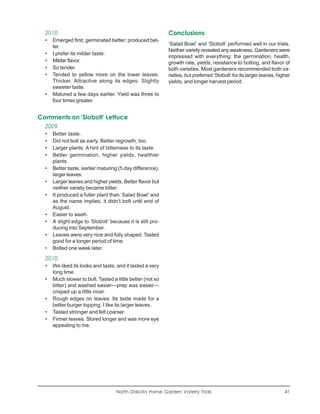
24. Lettuce, Green Leaf                                            Variety            Pref Rec Rating

‘Salad Bowl’ and ‘Slobolt’ were impressive in everything:          Slobolt             59     84     7.84
health, growth rate, yields, resistance to bolting, and flavor.    Salad Bowl          41     80     7.53
Most gardeners preferred ‘Slobolt’ for its larger leaves, higher                    (23 sites in 2009 and
yields, and longer harvest period.                                                        8 sites in 2010)


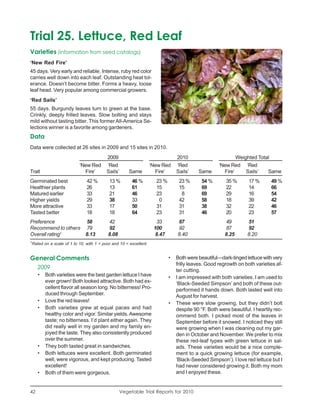
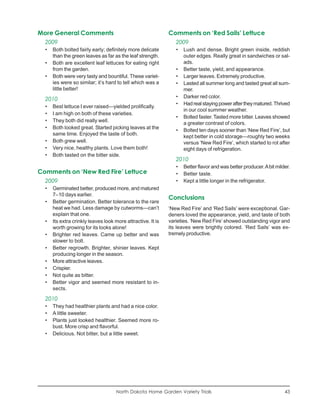
25. Lettuce, Red Leaf                                              Variety            Pref Rec Rating

‘New Red Fire’ and ‘Red Sails’ were exceptional. Gardeners         Red Sails           51     92     8.20
loved the appearance, yield, and taste of both varieties.          New Red Fire        49     87     8.25
‘New Red Fire’ showed outstanding vigor and its leaves                              (26 sites in 2009 and
were brightly colored. ‘Red Sails’ was extremely productive.                            15 sites in 2010)


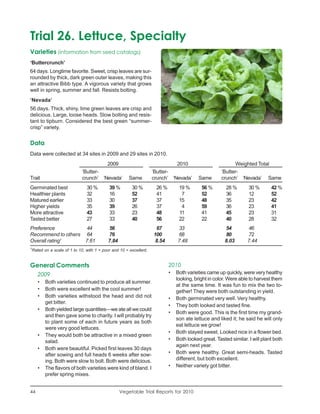
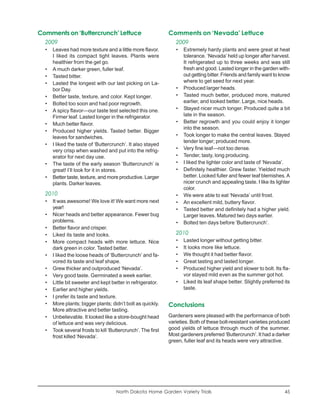
26. Lettuce, Specialty                                             Variety            Pref Rec Rating
Gardeners liked both varieties. Both of these bolt-resistant       Buttercrunch        54     80     8.03
varieties produced good yields of lettuce through much of          Nevada              46     72     7.44
the summer. Most gardeners preferred ‘Buttercrunch’. It had                         (34 sites in 2009 and
a darker green, fuller leaf and its heads were very attractive.                         29 sites in 2010)


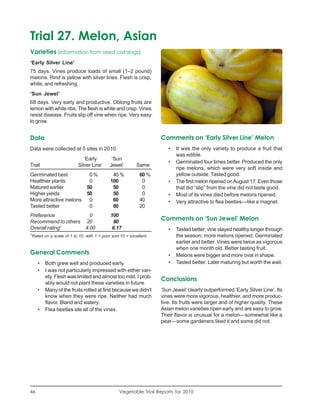
27. Melon, Asian                                                   Variety            Pref Rec Rating
‘Sun Jewel’ was more vigorous, healthier, and more                 Sun Jewel         100      80     6.17
productive. Its fruits were larger and of higher quality. Both     Early Silver Line   0      20     4.00
varieties matured early. Their flavor was unusual—somewhat                                         (5 sites)
like a pear—some gardeners liked it and some did not.

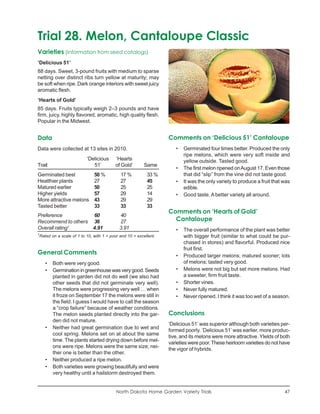
28. Melon, Cantaloupe Classic                                      Variety            Pref Rec Rating
‘Delicious 51’ was superior although both varieties performed      Delicious 51        60     36     4.91
poorly. ‘Delicious 51’ was earlier, more productive, and its       Hearts of Gold      40     27     3.91
melons were more attractive. YIelds of both varieties were                                      (13 sites)
poor. These heirlooms do not have the vigor of hybrids.

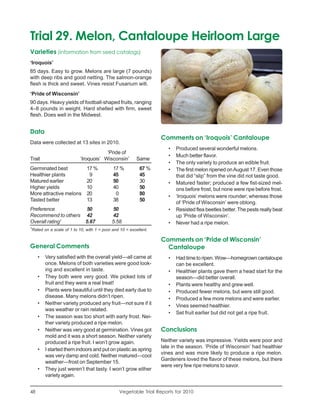
29. Melon, Cantaloupe Classic Large                                Variety            Pref Rec Rating
Neither variety was impressive. Yields were poor. ‘Pride of        Iroquois            50     42     5.67
Wisconsin’ had healthier vines and was more likely to              Pride of Wisc.      50     42     5.58
produce a ripe melon. Gardeners loved the flavor of these                                       (13 sites)
melons, but there were very few ripe melons to savor.


                     North Dakota Home Garden Variety Trials                                              7
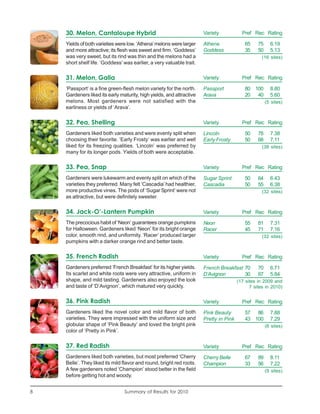
30. Melon, Cantaloupe Hybrid                                      Variety            Pref Rec Rating

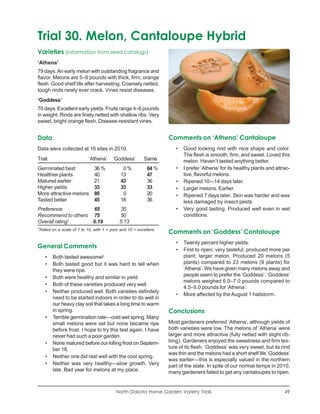
    Yields of both varieties were low. ‘Athena’ melons were larger    Athena              65     75     6.19
    and more attractive; its flesh was sweet and firm. ‘Goddess’      Goddess             35     50     5.13
    was very sweet, but its rind was thin and the melons had a                                     (16 sites)
    short shelf life. ‘Goddess’ was earlier, a very valuable trait.

    31. Melon, Galia                                                  Variety            Pref Rec Rating

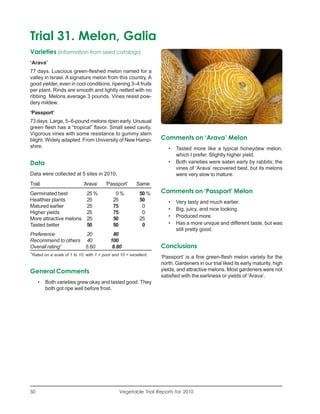
    ‘Passport’ is a fine green-flesh melon variety for the north.     Passport            80 100        8.80
    Gardeners liked its early maturity, high yields, and attractive   Arava               20 40         5.60
    melons. Most gardeners were not satisfied with the                                                (5 sites)
    earliness or yields of ‘Arava’.

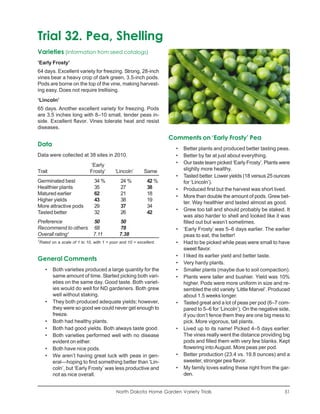
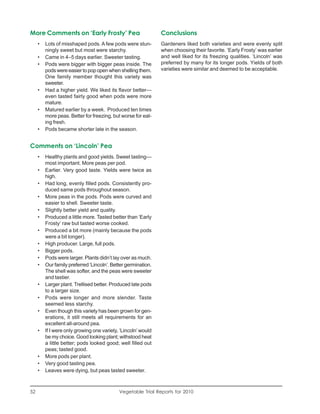
    32. Pea, Shelling                                                 Variety            Pref Rec Rating

    Gardeners liked both varieties and were evenly split when         Lincoln             50     78     7.38
    choosing their favorite. ‘Early Frosty’ was earlier and well      Early Frosty        50     68     7.11
    liked for its freezing qualities. ‘Lincoln’ was preferred by                                   (38 sites)
    many for its longer pods. Yields of both were acceptable.

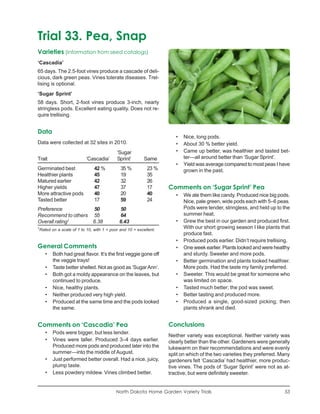
    33. Pea, Snap                                                     Variety            Pref Rec Rating

    Gardeners were lukewarm and evenly split on which of the          Sugar Sprint        50     64     6.43
    varieties they preferred. Many felt ‘Cascadia’ had healthier,     Cascadia            50     55     6.38
    more productive vines. The pods of ‘Sugar Sprint’ were not                                     (32 sites)
    as attractive, but were definitely sweeter.

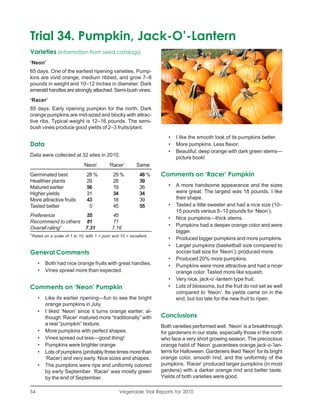
    34. Jack-O’-Lantern Pumpkin                                       Variety            Pref Rec Rating
    The precocious habit of ‘Neon’ guarantees orange pumpkins         Neon                55     81     7.31
    for Halloween. Gardeners liked ‘Neon’ for its bright orange       Racer               45     71     7.16
    color, smooth rind, and uniformity. ‘Racer’ produced larger                                    (32 sites)
    pumpkins with a darker orange rind and better taste.

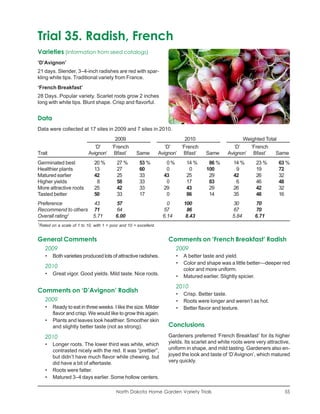
    35. French Radish                                                 Variety            Pref Rec Rating
    Gardeners preferred ‘French Breakfast’ for its higher yields.     French Breakfast 70        70     6.71
    Its scarlet and white roots were very attractive, uniform in      D’Avignon        30        67     5.84
    shape, and mild tasting. Gardeners also enjoyed the look                           (17 sites in 2009 and
    and taste of ‘D’Avignon’, which matured very quickly.                                    7 sites in 2010)


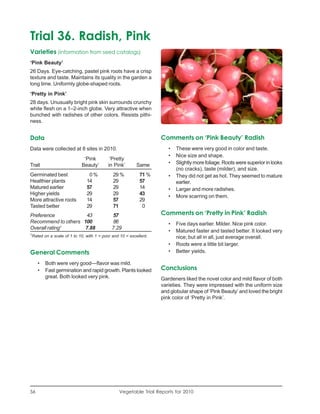
    36. Pink Radish                                                   Variety            Pref Rec Rating
    Gardeners liked the novel color and mild flavor of both           Pink Beauty         57 86         7.88
    varieties. They were impressed with the uniform size and          Pretty in Pink      43 100        7.29
    globular shape of ‘Pink Beauty’ and loved the bright pink                                         (8 sites)
    color of ‘Pretty in Pink’.

    37. Red Radish                                                    Variety            Pref Rec Rating
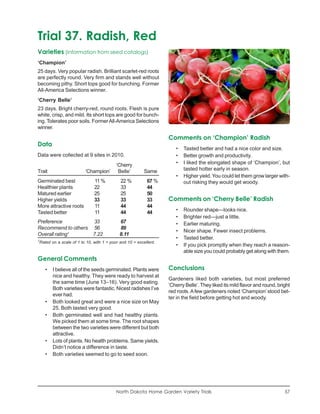
    Gardeners liked both varieties, but most preferred ‘Cherry        Cherry Belle        67     89     8.11
    Belle’. They liked its mild flavor and round, bright red roots.   Champion            33     56     7.22
    A few gardeners noted ‘Champion’ stood better in the field                                        (9 sites)
    before getting hot and woody.


8                               Summary of Results for 2010
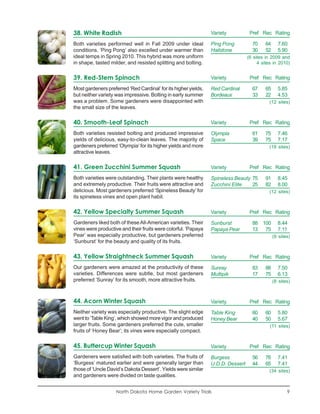
38. White Radish                                                 Variety           Pref Rec Rating

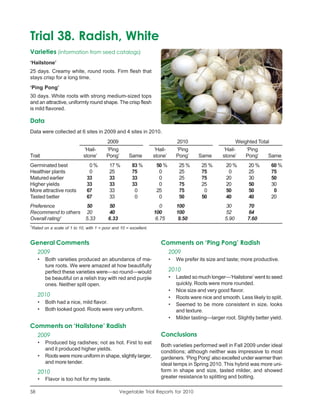
Both varieties performed well in Fall 2009 under ideal           Ping Pong          70     64     7.60
conditions. ‘Ping Pong’ also excelled under warmer than          Hailstone          30     52     5.90
ideal temps in Spring 2010. This hybrid was more uniform                          (6 sites in 2009 and
in shape, tasted milder, and resisted splitting and bolting.                           4 sites in 2010)


39. Red-Stem Spinach                                             Variety           Pref Rec Rating

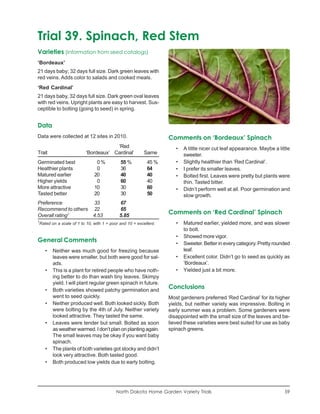
Most gardeners preferred ‘Red Cardinal’ for its higher yields,   Red Cardinal       67     65     5.85
but neither variety was impressive. Bolting in early summer      Bordeaux           33     22     4.53
was a problem. Some gardeners were disappointed with                                        (12 sites)
the small size of the leaves.

40. Smooth-Leaf Spinach                                          Variety           Pref Rec Rating

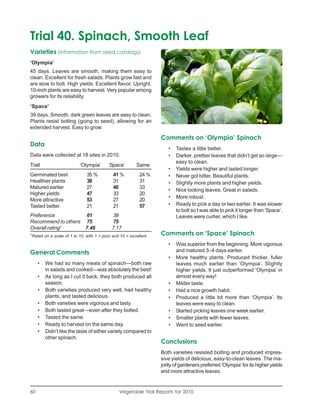
Both varieties resisted bolting and produced impressive          Olympia            61     75     7.46
yields of delicious, easy-to-clean leaves. The majority of       Space              39     75     7.17
gardeners preferred ‘Olympia’ for its higher yields and more                                (18 sites)
attractive leaves.

41. Green Zucchini Summer Squash                                 Variety           Pref Rec Rating

Both varieties were outstanding. Their plants were healthy       Spineless Beauty 75       91     8.45
and extremely productive. Their fruits were attractive and       Zucchini Elite   25       82     8.00
delicious. Most gardeners preferred ‘Spineless Beauty’ for                                  (12 sites)
its spineless vines and open plant habit.

42. Yellow Specialty Summer Squash                               Variety           Pref Rec Rating
Gardeners liked both of these All-American varieties. Their      Sunburst           88 100        8.44
vines were productive and their fruits were colorful. ‘Papaya    Papaya Pear        13 75         7.11
Pear’ was especially productive, but gardeners preferred                                        (9 sites)
‘Sunburst’ for the beauty and quality of its fruits.

43. Yellow Straightneck Summer Squash                            Variety           Pref Rec Rating
Our gardeners were amazed at the productivity of these           Sunray             83     88     7.50
varieties. Differences were subtle, but most gardeners           Multipik           17     75     6.13
preferred ‘Sunray’ for its smooth, more attractive fruits.                                      (8 sites)


44. Acorn Winter Squash                                          Variety           Pref Rec Rating
Neither variety was especially productive. The slight edge       Table King         60     60     5.80
went to ‘Table King’, which showed more vigor and produced       Honey Bear         40     50     5.67
larger fruits. Some gardeners preferred the cute, smaller                                    (11 sites)
fruits of ‘Honey Bear’; its vines were especially compact.

45. Buttercup Winter Squash                                      Variety           Pref Rec Rating
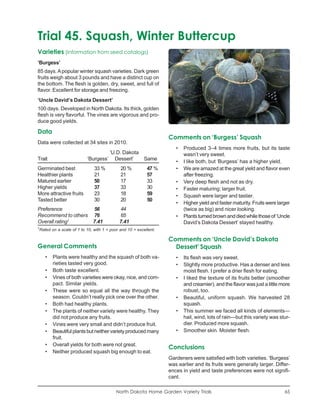
Gardeners were satisfied with both varieties. The fruits of      Burgess            56     76     7.41
‘Burgess’ matured earlier and were generally larger than         U.D.D. Dessert     44     65     7.41
those of ‘Uncle David’s Dakota Dessert’. Yields were similar                                (34 sites)
and gardeners were divided on taste qualities.


                    North Dakota Home Garden Variety Trials                                            9
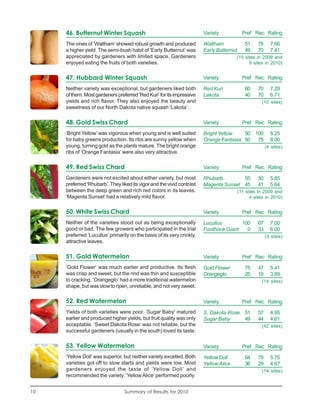
46. Butternut Winter Squash                                        Variety             Pref Rec Rating

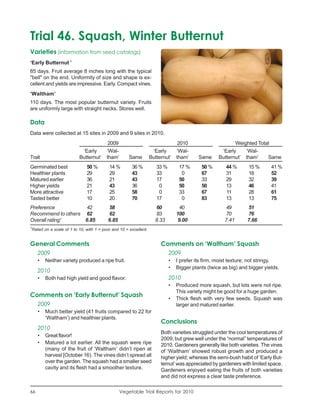
     The vines of ‘Waltham’ showed robust growth and produced           Waltham              51     76     7.66
     a higher yield. The semi-bush habit of ‘Early Butternut’ was       Early Butternut      49     70     7.41
     appreciated by gardeners with limited space. Gardeners                            (15 sites in 2009 and
     enjoyed eating the fruits of both varieties.                                            9 sites in 2010)


     47. Hubbard Winter Squash                                          Variety             Pref Rec Rating

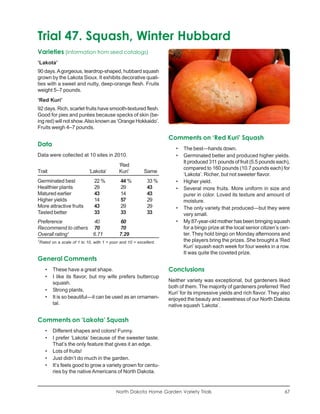
     Neither variety was exceptional, but gardeners liked both          Red Kuri             60     70     7.29
     of them. Most gardeners preferred ‘Red Kuri’ for its impressive    Lakota               40     70     6.71
     yields and rich flavor. They also enjoyed the beauty and                                         (10 sites)
     sweetness of our North Dakota native squash ‘Lakota’.

     48. Gold Swiss Chard                                               Variety             Pref Rec Rating

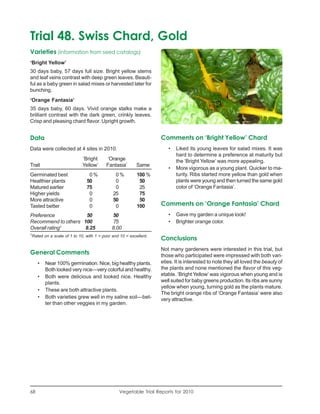
     ‘Bright Yellow’ was vigorous when young and is well suited         Bright Yellow   50 100             8.25
     for baby greens production. Its ribs are sunny yellow when         Orange Fantasia 50 75              8.00
     young, turning gold as the plants mature. The bright orange                                         (4 sites)
     ribs of ‘Orange Fantasia’ were also very attractive.

     49. Red Swiss Chard                                                Variety             Pref Rec Rating

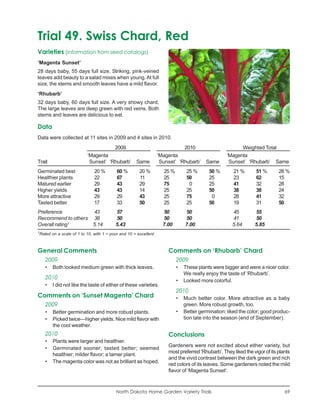
     Gardeners were not excited about either variety, but most          Rhubarb        55           50     5.85
     preferred ‘Rhubarb’. They liked its vigor and the vivid contrast   Magenta Sunset 45           41     5.64
     between the deep green and rich red colors in its leaves.                            (11 sites in 2009 and
     ‘Magenta Sunset’ had a relatively mild flavor.                                             4 sites in 2010)


     50. White Swiss Chard                                              Variety             Pref Rec Rating
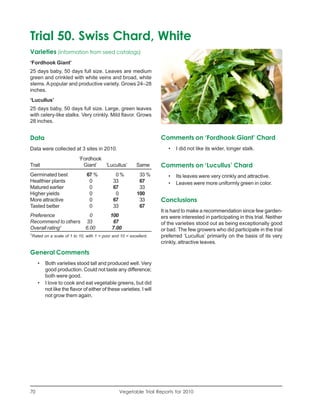
     Neither of the varieties stood out as being exceptionally          Lucullus       100          67     7.00
     good or bad. The few growers who participated in the trial         Fordhook Giant   0          33     6.00
     preferred ‘Lucullus’ primarily on the basis of its very crinkly,                                    (3 sites)
     attractive leaves.

     51. Gold Watermelon                                                Variety             Pref Rec Rating
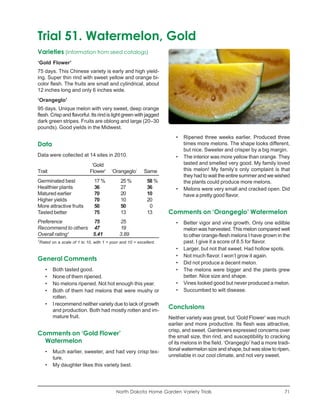
     ‘Gold Flower’ was much earlier and productive. Its flesh           Gold Flower          75     47     5.41
     was crisp and sweet, but the rind was thin and susceptible         Orangeglo            25     19     3.89
     to cracking. ‘Orangeglo’ had a more traditional watermelon                                       (14 sites)
     shape, but was slow to ripen, unreliable, and not very sweet.

     52. Red Watermelon                                                 Variety             Pref Rec Rating
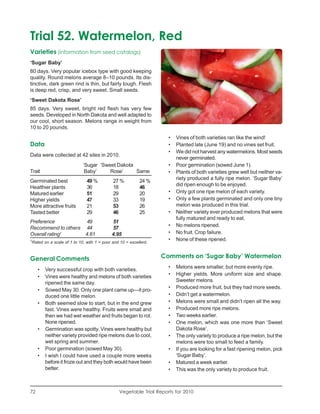
     Yields of both varieties were poor. ‘Sugar Baby’ matured           S. Dakota Rose 51           57     4.95
     earlier and produced higher yields, but fruit quality was only     Sugar Baby     49           44     4.61
     acceptable. ‘Sweet Dakota Rose’ was not reliable, but the                                        (42 sites)
     successful gardeners (usually in the south) loved its taste.

     53. Yellow Watermelon                                              Variety             Pref Rec Rating
     ‘Yellow Doll’ was superior, but neither variety excelled. Both     Yellow Doll          64     79     5.75
     varieties got off to slow starts and yields were low. Most         Yellow Alice         36     29     4.67
     gardeners enjoyed the taste of ‘Yellow Doll’ and                                                 (14 sites)
     recommended the variety. ‘Yellow Alice’ performed poorly.


10                               Summary of Results for 2010
Chapter 3

Vegetable Trial Reports
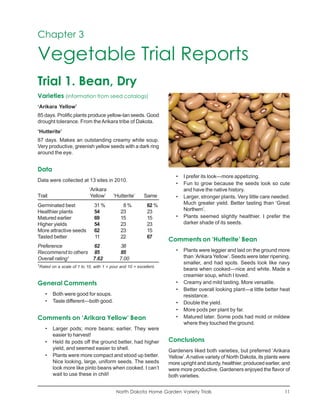
Trial 1. Bean, Dry
Varieties (information from seed catalogs)
‘Arikara Yellow’
85 days. Prolific plants produce yellow-tan seeds. Good
drought tolerance. From the Arikara tribe of Dakota.
‘Hutterite’
87 days. Makes an outstanding creamy white soup.
Very productive, greenish yellow seeds with a dark ring
around the eye.


Data
                                                                        •   I prefer its look—more appetizing.
Data were collected at 13 sites in 2010.
                                                                        •   Fun to grow because the seeds look so cute
                              ‘Arikara                                      and have the native history.
Trait                          Yellow’     ‘Hutterite’      Same        •   Larger, stronger plants. Very little care needed.
Germinated best                  31 %           8%           62 %           Much greater yield. Better tasting than ‘Great
Healthier plants                 54            23            23             Northern’.
Matured earlier                  69            15            15         •   Plants seemed slightly healthier. I prefer the
Higher yields                    54            23            23             darker shade of its seeds.
More attractive seeds            62            23            15
Tasted better                    11            22            67
                                                                     Comments on ‘Hutterite’ Bean
Preference          62                        38
Recommend to others 85                        85                        •   Plants were leggier and laid on the ground more
Overall rating1     7.62                      7.00                          than ‘Arikara Yellow’. Seeds were later ripening,
1
                                                                            smaller, and had spots. Seeds look like navy
    Rated on a scale of 1 to 10, with 1 = poor and 10 = excellent.
                                                                            beans when cooked—nice and white. Made a
                                                                            creamier soup, which I loved.
General Comments                                                        •   Creamy and mild tasting. More versatile.
                                                                        •   Better overall looking plant—a little better heat
       •   Both were good for soups.                                        resistance.
       •   Taste different—both good.                                   •   Double the yield.
                                                                        •   More pods per plant by far.
Comments on ‘Arikara Yellow’ Bean                                       •   Matured later. Some pods had mold or mildew
                                                                            where they touched the ground.
       •   Larger pods; more beans; earlier. They were
           easier to harvest!
       •   Held its pods off the ground better, had higher           Conclusions
           yield, and seemed easier to shell.                        Gardeners liked both varieties, but preferred ‘Arikara
       •   Plants were more compact and stood up better.             Yellow’. A native variety of North Dakota, its plants were
           Nice looking, large, uniform seeds. The seeds             more upright and sturdy, healthier, produced earlier, and
           look more like pinto beans when cooked. I can’t           were more productive. Gardeners enjoyed the flavor of
           wait to use these in chili!                               both varieties.


                                             North Dakota Home Garden Variety Trials                                        11
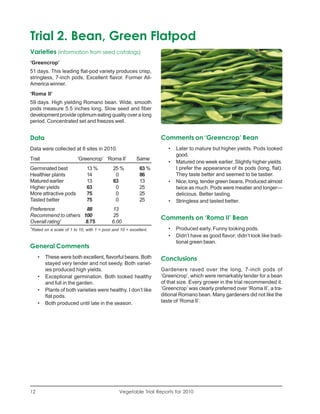
Trial 2. Bean, Green Flatpod
Varieties (information from seed catalogs)
‘Greencrop’
51 days. This leading flat-pod variety produces crisp,
stringless, 7-inch pods. Excellent flavor. Former All-
America winner.
‘Roma II’
59 days. High yielding Romano bean. Wide, smooth
pods measure 5.5 inches long. Slow seed and fiber
development provide optimum eating quality over a long
period. Concentrated set and freezes well.


Data                                                                 Comments on ‘Greencrop’ Bean
Data were collected at 8 sites in 2010.                                 •   Later to mature but higher yields. Pods looked
                                                                            good.
Trait                       ‘Greencrop’ ‘Roma II’           Same
                                                                        •   Matured one week earlier. Slightly higher yields.
Germinated best                  13 %          25 %          63 %           I prefer the appearance of its pods (long, flat).
Healthier plants                 14             0            86             They taste better and seemed to be tastier.
Matured earlier                  13            63            13         •   Nice, long, tender green beans. Produced almost
Higher yields                    63             0            25             twice as much. Pods were meatier and longer—
More attractive pods             75             0            25             delicious. Better tasting.
Tasted better                    75             0            25         •   Stringless and tasted better.
Preference           88                       13
Recommend to others 100                       25
                                                                     Comments on ‘Roma II’ Bean
Overall rating1      8.75                     6.00
1
    Rated on a scale of 1 to 10, with 1 = poor and 10 = excellent.      •   Produced early. Funny looking pods.
                                                                        •   Didn’t have as good flavor; didn’t look like tradi-
                                                                            tional green bean.
General Comments
       •   These were both excellent, flavorful beans. Both          Conclusions
           stayed very tender and not seedy. Both variet-
           ies produced high yields.                                 Gardeners raved over the long, 7-inch pods of
       •   Exceptional germination. Both looked healthy              ‘Greencrop’, which were remarkably tender for a bean
           and full in the garden.                                   of that size. Every grower in the trial recommended it.
       •   Plants of both varieties were healthy. I don’t like       ‘Greencrop’ was clearly preferred over ‘Roma II’, a tra-
           flat pods.                                                ditional Romano bean. Many gardeners did not like the
       •   Both produced until late in the season.                   taste of ‘Roma II’.


12                                                Vegetable Trial Reports for 2010
Trial 3. Bean, Green Gourmet
Varieties (information from seed catalogs)
‘Jade’
60 days. Long, straight pods with excellent color and
flavor. Strong, upright plants hold pods above the ground,
which reduces curling and tip rot. Pale green seeds.
‘Pike’
55 days. A consistent performer for the north, even un-
der stressful conditions. Medium-dark green, 5.5-inch
pods are straight and smooth. Holds well in the garden
at maturity. White seeds.


Data                                                                   •   Both have nice long straight pods that taste good.
                                                                       •   Both were good producers.
Data were collected at 26 sites in 2010.                               •   Both varieties remained healthy with no visible
Trait                          ‘Jade’         ‘Pike’        Same           white mold problems for either.
                                                                       •   Rust disease issues. Neither was very produc-
Germinated best                  22 %          37 %          41 %          tive; but this could have been due to the poor
Healthier plants                 36            12            52            soil we were working with.
Matured earlier                  64            24            12
                                                                       •   Great when sautéed.
Higher yields                    54            25            21
More attractive pods             38            32            30
Tasted better                    20            34            46      Comments on ‘Jade’ Bean
Preference          60                        40
                                                                       •   Bigger plants and pods. Plentiful, healthy, and
Recommend to others 72                        64
                                                                           consistently produced new beans to can and
Overall rating1     7.16                      7.04
                                                                           put up for winter.
1
    Rated on a scale of 1 to 10, with 1 = poor and 10 = excellent.     •   Long, straight, uniform beans. I liked its sturdy
                                                                           plants, non-stringy beans, and abundant produc-
                                                                           tion.
General Comments
                                                                       •   Loved its straight long pods.
       •   The best beans I’ve had. They were both healthy.            •   Produced ten days earlier. Need to pick when
           Nice pods. Both of these really gave me a lot of                beans are young—pods quickly grew to be quite
           beans until the hail got them.                                  large. Pods were slightly larger, and lighter in
       •   Both produced well and kept producing—tasted                    color.
           great.                                                      •   Pods were 6.5 inches long compared to 6.0
       •   The plants were huge and continued producing                    inches for ‘Pike’.
           flowers all summer. Both were excellent eating;             •   Had lots of 4-inch-long pods and kept producing
           raw and cooked.                                                 into September. I don’t mind the lighter color of
       •   These beans loved producing. I saw new blos-                    its pods.
           soms all the time throughout the summer. In fact            •   Better overall performance and taste.
           they were still flowering right up to our first killing     •   Overall performance was superior.
           frost. We sure enjoyed these beans.                         •   Heartier beans; produced more.
       •   We liked the taste of both. We canned and froze             •   I like its size and texture. Higher yield. More ten-
           both types. They both tasted delicious.                         der.
       •   Both were still blooming at frost. Both tasted              •   Great flavor.
           good.
                                                                       •   Nice big bushy plants—slightly lighter leaf color.
       •   They were very nice plants—not too tall—held                    Pods were not as slender; seemed to “plump”
           up well—pods were long and slim and very good                   faster.
           tasting.


                                             North Dakota Home Garden Variety Trials                                        13
More Comments on ‘Jade’ Bean                                  Conclusions
     •   Plants were healthy and large. Matured one to        Both varieties generated a lot of excitement among the
         two days earlier. Produced nice, long, slender       gardeners. Gardeners were pleased with the quality of
         beans. Weren’t as seedy if picked older.             pods for both varieties. ‘Jade’ was generally preferred
     •   Did not have a high yield; only could pick a small   for its higher yields and earlier maturity. Its pods were
         handful at a time.                                   longer, meatier, and a bright medium green. Many gar-
                                                              deners praised ‘Pike’ for its dark green, straight, and
                                                              very slender pods—perfect for gourmet cooking.
Comments on ‘Pike’ Bean
     •   Much more attractive; skinnier, better dark green
         color. Ready to pick sooner. Better tasting for
         eating fresh.
     •   Deep green, slender pods with small seeds in-
         side. Even when left on the vine too long they
         remained slender and very tasty.
     •   Very good yields. Nice, smooth dark green pods.
         More attractive and seemed to taste better.
     •   Very long, slender, dark green beans. Beautiful.
         The tender long beans are wonderful steamed.
     •   The thick and hearty plants produced a ton of
         beans. The beans were a rich and vibrant green;
         also nice and straight. Very disappointed when I
         tasted them—very bland.
     •   Its beans tended to be a little hard (the bean
         seed) if picked too large.
     •   Germinated faster and produced earlier yields.
     •   Better taste.
     •   Plants are smaller and more compact. Beans
         were crisper when eaten raw and cooked.
     •   Darker green plants. Smaller beans.
     •   Plants were shorter and leaves were dark green
         with lots of flowers. They tasted the best. Nice
         long, straight pods. They didn’t lose any color
         when they were cooked. Very easy to pick. Its
         darker green pods look more attractive on a plate.
         My nephew owns a café and I gave him some of
         each. He steamed them, and then sautéed them
         with garlic and the customers loved them. He
         thought ‘Pike’ tasted the best.
     •   Bloomed and set several days earlier than ‘Jade’.
         Shorter pods, but were a beautiful dark green. It
         has a lot going for it.


14                                         Vegetable Trial Reports for 2010
Trial 4. Bean, Green Standard
Varieties (information from seed catalogs)
‘Provider’
51 days. Very dependable and productive. Concentrated,
early harvests of attractive, straight beans. Easy to grow
and tastes great. Purple seeds germinate well in cool
soil.
‘Top Crop’
55 days. Widely adapted. Yields are consistently high.
Pods are medium green, stringless, and 5.5 to 6.0
inches long. Concentrated pod set. Buff seeds.


Data                                                                 Comments on ‘Provider’ Bean
Data were collected at 17 sites in 2010.                                •   Produced two weeks earlier. Beans were longer
                                                                            and thicker. More beans from the second crop
Trait                        ‘Provider’ ‘Top Crop’          Same            as well.
Germinated best                  23 %          15 %          62 %       •   Plants were nice, bushy, and free of rust. Unbe-
Healthier plants                 38             8            54             lievable yields. Pods were nice, long, and filled.
Matured earlier                  58            17            25         •   Better germination, healthier plants, and more
Higher yields                    50            17            33             beans.
More attractive pods             45             0            55         •   Produced approximately one week earlier and
Tasted better                    27             9            64             continued to produce until frost. Longer produc-
Preference          53                        47                            tion time.
Recommend to others 80                        60
Overall rating1     7.88                      7.40
                                                                     Comments on ‘Top Crop’ Bean
1
    Rated on a scale of 1 to 10, with 1 = poor and 10 = excellent.
                                                                        •   Matured earlier. Pods lasted longer after harvest.
                                                                        •   Milder taste.
General Comments                                                        •   Hardier and better yield.
       •   Both types of plants grew nice and bushy. Yields             •   More pods per plant. Pods would get rotten spots
           of both were fair. Pods tasted good and crisp.                   due to excessive moisture.
           Tasted really good cooked.                                   •   A little mold.
       •   Both were excellent producers with large,                    •   Poor germination and weak seedlings.
           straight, and tender pods. In fact, they produced
           so well that green beans became my “zucchini”
           this year.                                                Conclusions
       •   The plants were both healthy and lots of blooms.          These varieties have a reputation for reliable yields and
       •   Tasted the same.                                          they did not disappoint us. Gardeners liked both variet-
       •   Both taste great.                                         ies. ‘Provider’ was preferred for its earliness, higher
                                                                     yields, and extended harvest season. The quality of
                                                                     pods for both varieties was very good.


                                             North Dakota Home Garden Variety Trials                                       15
Trial 5. Bean, Purple
Varieties (information from seed catalogs)
‘Royal Burgundy’
54 days. Pods are 5 inches long, stringless, and ten-
der. Upright, hardy plants. Dark purple pods turn green
when cooked. Buff-colored seeds.
‘Royalty Purple Pod’
52 days. Stringless, 5-inch pods are tender. Germi-
nates well in cool soil. Distinctive purple foliage and
pods. Pods turn green when cooked.


Data
                                                                        •   It produced more. Better texture.
Data were collected at 24 sites in 2010.                                •   Produced slightly better.
                              ‘Royal     ‘Royalty                       •   Pods have tough strings.
Trait                        Burgundy’ ‘Purple Pod’         Same        •   Each pods had a thick string.
Germinated best                  10 %          15 %          75 %
Healthier plants                 26            16            58      Comments on ‘Royalty Purple Pod’ Bean
Matured earlier                  47            26            26
Higher yields                    16            42            42         •   Matured one week earlier.
More attractive pods             17            22            61         •   Produced more and tasted better.
Tasted better                    16            21            63         •   More beans and sometimes a bigger plant.
Preference          33                        67                        •   I’ve grown ‘Royal Burgundy’ for years—but like
Recommend to others 67                        88                            ‘Royalty Purple Pod’. Produced later and had a
Overall rating1     7.49                      8.06                          better second crop late in the season.
1
    Rated on a scale of 1 to 10, with 1 = poor and 10 = excellent.      •   Pods cooked to a more attractive green color
                                                                            and were not as dry.
                                                                        •   Nice color and large, longer pods.
General Comments                                                        •   Produced longer and stayed tender longer.
       •   Both looked great.                                           •   Earlier and yielded better.
       •   Both were gorgeous! I would plant either of these            •   Pods had a better overall texture.
           varieties.                                                   •   Beans were straighter. Interesting to grow, cook,
       •   Both produced plants from every seed sown. Both                  and eat.
           plants seemed and looked equally healthy. Pro-               •   Pods were more juicy and tasty.
           duced at the same time. Produced a lot of beans!             •   Better flavor and texture.
       •   Both varieties germinated very good. Produced                •   Pods filled better.
           early and equally.                                           •   Bitter aftertaste.
       •   Very attractive pods. Both had a string when
           cooked that was very inedible.
                                                                     Conclusions
                                                                     Gardeners liked both varieties, especially the beauty of
Comments on ‘Royal Burgundy’ Bean
                                                                     their pods. Plants were healthy and productive. Most
       •   Crisper pod; better taste. Matured a few days             gardeners preferred ‘Royalty Purple Pod’ for its higher
           earlier.                                                  yields and extended harvest season. Pod curling has
       •   Straighter pods.                                          been a problem of this variety in previous years, but it
       •   Tasted better. Surprised that they turned green           was not a problem in 2010 (perhaps due to our favor-
           when cooked!                                              able rainfall pattern). The pods of both varieties were
                                                                     sometimes more stringy than desired.


16                                                Vegetable Trial Reports for 2010
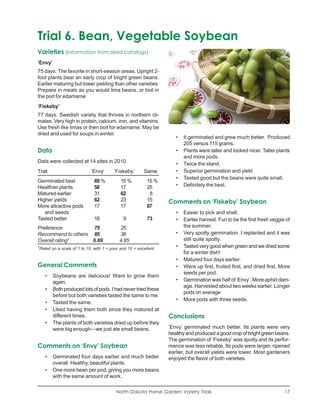
Trial 6. Bean, Vegetable Soybean
Varieties (information from seed catalogs)
‘Envy’
75 days. The favorite in short-season areas. Upright 2-
foot plants bear an early crop of bright green beans.
Earlier maturing but lower yielding than other varieties.
Prepare in meals as you would lima beans, or boil in
the pod for edamame.
‘Fiskeby’
77 days. Swedish variety that thrives in northern cli-
mates. Very high in protein, calcium, iron, and vitamins.
Use fresh like limas or then boil for edamame. May be
dried and used for soups in winter.
                                                                        •   It germinated and grew much better. Produced
                                                                            205 versus 115 grams.
Data                                                                    •   Plants were taller and looked nicer. Taller plants
                                                                            and more pods.
Data were collected at 14 sites in 2010.                                •   Twice the stand.
Trait                          ‘Envy’       ‘Fiskeby’       Same        •   Superior germination and yield.
                                                                        •   Tasted good but the beans were quite small.
Germinated best                  69 %          15 %          15 %
Healthier plants                 58            17            25         •   Definitely the best.
Matured earlier                  31            62             8
Higher yields                    62            23            15      Comments on ‘Fiskeby’ Soybean
More attractive pods             17            17            67
   and seeds                                                            •   Easier to pick and shell.
Tasted better                    18              9           73         •   Earlier harvest. Fun to be the first fresh veggie of
Preference          75                        25                            the summer.
Recommend to others 85                        38                        •   Very spotty germination. I replanted and it was
Overall rating1     6.69                      4.85                          still quite spotty.
1
    Rated on a scale of 1 to 10, with 1 = poor and 10 = excellent.      •   Tasted very good when green and we dried some
                                                                            for a winter dish!
                                                                        •   Matured four days earlier.
General Comments                                                        •   Were up first, fruited first, and dried first. More
                                                                            seeds per pod.
       •   Soybeans are delicious! Want to grow them
           again.                                                       •   Germination was half of ‘Envy’. More aphid dam-
                                                                            age. Harvested about two weeks earlier. Longer
       •   Both produced lots of pods. I had never tried these
                                                                            pods on average.
           before but both varieties tasted the same to me.
                                                                        •   More pods with three seeds.
       •   Tasted the same.
       •   Liked having them both since they matured at
           different times.                                          Conclusions
       •   The plants of both varieties dried up before they
           were big enough—we just ate small beans.                  ‘Envy’ germinated much better. Its plants were very
                                                                     healthy and produced a good crop of bright green beans.
                                                                     The germination of ‘Fiskeby’ was spotty and its perfor-
Comments on ‘Envy’ Soybean                                           mance was less reliable. Its pods were larger, ripened
                                                                     earlier, but overall yields were lower. Most gardeners
       •   Germinated four days earlier and much better              enjoyed the flavor of both varieties.
           overall. Healthy, beautiful plants.
       •   One more bean per pod, giving you more beans
           with the same amount of work.

                                             North Dakota Home Garden Variety Trials                                         17
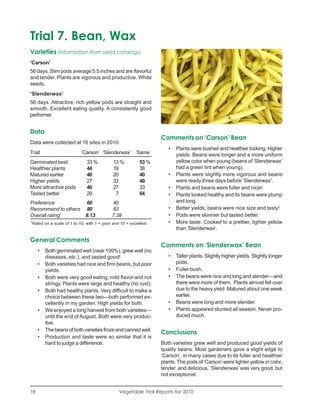
Trial 7. Bean, Wax
Varieties (information from seed catalogs)
‘Carson’
56 days. Slim pods average 5.5 inches and are flavorful
and tender. Plants are vigorous and productive. White
seeds.
‘Slenderwax’
56 days. Attractive, rich yellow pods are straight and
smooth. Excellent eating quality. A consistently good
performer.


Data
                                                                     Comments on ‘Carson’ Bean
Data were collected at 16 sites in 2010.
                                                                        •   Plants were bushier and healthier looking. Higher
Trait                         ‘Carson’ ‘Slenderwax’         Same            yields. Beans were longer and a more uniform
Germinated best                  33 %          13 %          53 %           yellow color when young (beans of ‘Slenderwax’
Healthier plants                 44            19            38             had a green tint when young).
Matured earlier                  40            20            40         •   Plants were slightly more vigorous and beans
Higher yields                    27            33            40             were ready three days before ‘Slenderwax’.
More attractive pods             40            27            33         •   Plants and beans were fuller and nicer.
Tasted better                    29             7            64         •   Plants looked healthy and its beans were plump
Preference          60                        40                            and long.
Recommend to others 80                        63                        •   Better yields; beans were nice size and tasty!
Overall rating1     8.13                      7.38                      •   Pods were skinnier but tasted better.
1
    Rated on a scale of 1 to 10, with 1 = poor and 10 = excellent.      •   More taste. Cooked to a prettier, lighter yellow
                                                                            than ‘Slenderwax’.

General Comments
                                                                     Comments on ‘Slenderwax’ Bean
       •   Both germinated well (near 100%), grew well (no
           diseases, etc.), and tasted good!                            •   Taller plants. Slightly higher yields. Slightly longer
       •   Both varieties had nice and firm beans, but poor                 pods.
           yields.                                                      •   Fuller bush.
       •   Both were very good eating; mild flavor and not              •   The beans were nice and long and slender—and
           stringy. Plants were large and healthy (no rust).                there were more of them. Plants almost fell over
       •   Both had healthy plants. Very difficult to make a                due to the heavy yield. Matured about one week
           choice between these two—both performed ex-                      earlier.
           cellently in my garden. High yields for both.                •   Beans were long and more slender.
       •   We enjoyed a long harvest from both varieties—               •   Plants appeared stunted all season. Never pro-
           until the end of August. Both were very produc-                  duced much.
           tive.
       •   The beans of both varieties froze and canned well.
                                                                     Conclusions
       •   Production and taste were so similar that it is
           hard to judge a difference.                               Both varieties grew well and produced good yields of
                                                                     quality beans. Most gardeners gave a slight edge to
                                                                     ‘Carson’, in many cases due to its fuller and healthier
                                                                     plants. The pods of ‘Carson’ were lighter yellow in color,
                                                                     tender, and delicious. ‘Slenderwax’ was very good, but
                                                                     not exceptional.


18                                                Vegetable Trial Reports for 2010
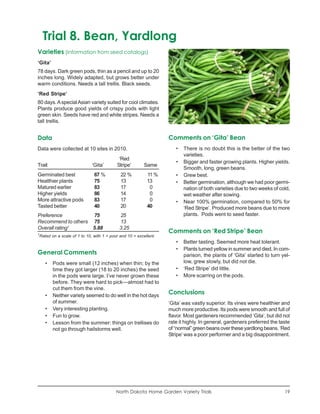
Trial 8. Bean, Yardlong
Varieties (information from seed catalogs)
‘Gita’
78 days. Dark green pods, thin as a pencil and up to 20
inches long. Widely adapted, but grows better under
warm conditions. Needs a tall trellis. Black seeds.
‘Red Stripe’
80 days. A special Asian variety suited for cool climates.
Plants produce good yields of crispy pods with light
green skin. Seeds have red and white stripes. Needs a
tall trellis.


Data                                                                 Comments on ‘Gita’ Bean
Data were collected at 10 sites in 2010.                                •   There is no doubt this is the better of the two
                                                                            varieties.
                                              ‘Red
                                                                        •   Bigger and faster growing plants. Higher yields.
Trait                           ‘Gita’       Stripe’        Same
                                                                            Smooth, long, green beans.
Germinated best                  67 %          22 %          11 %       •   Grew best.
Healthier plants                 75            13            13         •   Better germination, although we had poor germi-
Matured earlier                  83            17             0             nation of both varieties due to two weeks of cold,
Higher yields                    86            14             0             wet weather after sowing.
More attractive pods             83            17             0         •   Near 100% germination, compared to 50% for
Tasted better                    40            20            40             ‘Red Stripe’. Produced more beans due to more
Preference          75                        25                            plants. Pods went to seed faster.
Recommend to others 75                        13
Overall rating1     5.88                      3.25
1
                                                                     Comments on ‘Red Stripe’ Bean
    Rated on a scale of 1 to 10, with 1 = poor and 10 = excellent.
                                                                        •   Better tasting. Seemed more heat tolerant.
                                                                        •   Plants turned yellow in summer and died. In com-
General Comments                                                            parison, the plants of ‘Gita’ started to turn yel-
       •   Pods were small (12 inches) when thin; by the                    low, grew slowly, but did not die.
           time they got larger (18 to 20 inches) the seed              •   ‘Red Stripe’ did little.
           in the pods were large. I’ve never grown these               •   More scarring on the pods.
           before. They were hard to pick—almost had to
           cut them from the vine.
       •   Neither variety seemed to do well in the hot days
                                                                     Conclusions
           of summer.                                                ‘Gita’ was vastly superior. Its vines were healthier and
       •   Very interesting planting.                                much more productive. Its pods were smooth and full of
       •   Fun to grow.                                              flavor. Most gardeners recommended ‘Gita’, but did not
       •   Lesson from the summer: things on trellises do            rate it highly. In general, gardeners preferred the taste
           not go through hailstorms well.                           of “normal” green beans over these yardlong beans. ‘Red
                                                                     Stripe’ was a poor performer and a big disappointment.


                                             North Dakota Home Garden Variety Trials                                       19
Trial 9. Beet
Varieties (information from seed catalogs)
‘Detroit Dark Red’
59 Days. Classic variety. Early, very dark red, and
sweet. Thinned plants can be used as greens.
‘Red Ace’
50 Days. One of the best all-around beets. The round,
smooth, deep red roots develop quickly, with high uni-
formity. They maintain their sweet tenderness when
larger and older. Medium-tall, red-veined greens for
bunching.


Data                                                                    •   Had a swirl pattern which added interest.
                                                                        •   Really produced nice greens and roots.
Data were collected at 25 sites in 2010.                                •   Larger roots. Beet greens were better.
                              ‘Detroit                                  •   Stronger plants and larger roots.
Trait                        Dark Red’ ‘Red Ace’            Same        •   More uniform—not too large and sweeter taste.
Germinated best                  44 %          12 %          44 %       •   Big beets; healthy plant; higher yield; sweet.
Healthier plants                 32            24            44
Matured earlier                  27            32            41      Comments on ‘Red Ace’ Beet
Higher yields                    39            26            35
More attractive roots            45            27            27         •   Earlier and better yield and taste.
Tasted better                    26            26            47         •   Bigger yield and bigger in size. Definitely will plant
Preference          65                        35                            ‘Red Ace’ again.
Recommend to others 83                        70                        •   Did not germinate as well, but had much nicer
Overall rating1     7.35                      7.17                          plants.
1
    Rated on a scale of 1 to 10, with 1 = poor and 10 = excellent.      •   Didn’t mature enough to pick either for roots or
                                                                            greens.
                                                                        •   Matured faster, more hardy, and yielded better.
General Comments                                                        •   Overall better tasting and sweeter. Stored well.
       •  Good germination; healthy plants; loved the                   •   Did seem to perform slightly better and had a
          sweetness of both.                                                somewhat better taste.
       • Both tasted quite good.                                        •   Earlier; produced more; good flavor.
       • The plants were lush.                                          •   Smaller beets; poor yield; poor taste.
       • Both were healthy and hardy.
       ·• Tolerated lots of rain. We got a good yield.               Conclusions
       • Yields were about the same—not great. Both
          were excellent to eat.                                     Gardeners liked both ‘Detroit Dark Red’ and ‘Red Ace’.
                                                                     Both varieties produced good yields of attractive, sweet
                                                                     roots. Most of our gardeners preferred ‘Detroit Dark Red’,
Comments on ‘Detroit Dark Red’ Beet                                  the most popular beet variety among home gardeners
                                                                     for years. They liked its vigorous growth, lush tops, and
       •   Very large, healthy tops; my favorite. Heavy, early       dark red roots.
           producer.
       •   Dark red color.
       •   Uniform quality and good yield.
       •   More vigorous growth—big tops—larger beets—
           matured earlier!


20                                                Vegetable Trial Reports for 2010
Trial 10. Carrot, Colorful
Varieties (information from seed catalogs)
‘Rainbow’
67 days. A colorful array of yellow, white, coral, and
orange carrots. The flavor varies slightly depending on
root color, but all are tender and sweet. Roots are 7–9
inches long with strong tops. Fun to grow with kids!
‘Sugarsnax 54’
68 days. Very colorful and supersweet. The rich orange
roots are high in beta-carotene, the key source of vita-
min A. Roots are smooth, uniform, 9 inches long, and
tapered.
                                                                     Comments on ‘Rainbow’ Carrot
Data                                                                   •   Its color was weaker.
                                                                       •   Much sweeter in our blind taste test.
Data were collected at 39 sites in 2010.
                                                                       •   Slightly earlier. Better yield and much sweeter
                                          ‘Sugarsnax                       taste.
Trait                        ‘Rainbow’        54’           Same       •   Bushier plants. Need to harvest early as they
                                                                           grow very large.
Germinated best                  16 %          18 %          66 %
                                                                       •   We liked the taste better—raw and cooked.
Healthier plants                 16            11            73
Matured earlier                  30            19            51        •   The root tops turned green very quick.
Higher yields                    24            32            43        •   Its color was not as pleasing, but they definitely
More attractive roots            29            47            24            taste better.
Tasted better raw                24            47            29        •   Straighter roots.
Tasted better cooked             18            47            35        •   The white carrots were not as sweet; the pale
                                                                           orange ones were really good.
Preference          28                        72
Recommend to others 64                        89                       •   My family did not care for this variety at all,
Overall rating1     6.70                      7.61                         whether cooked or raw.
1                                                                      •   Seemed sweeter.
    Rated on a scale of 1 to 10, with 1 = poor and 10 = excellent.
                                                                       •   More bland/lacking in flavor.
                                                                       •   My kids liked ‘Rainbow’ for the colors. My daugh-
General Comments                                                           ter loved picking ‘Rainbow’ to see the colors.
                                                                           ‘Rainbow’ is fun for kids. We will plant these again
       •   Plants of both varieties were dark green and                    if it makes the kid eat veggies! They looked nice
           healthy.                                                        on salads and on the table too. Tasted a little
       •   They both germinated great. Plants looked great                 bitter when raw.
           all summer. Both varieties had roots at least a             •   Got fat—a lot of them split. Roots grew 8–10
           foot long and they were fat as well! Tasted the                 inches long (two inches shorter than ‘Sugarsnax
           same when cooked.                                               54’) The colors were great. They looked nice in a
       •   Both varieties did well. Late heat and early cool               relish tray but they did not sell well at the mar-
           weather did not seem to be a problem.                           ket.
       •   Both produced huge carrots—bigger than usual.               •   I did not like the appearance of ‘Rainbow’. It was
       •   They both were nice plants. I really liked the                  mostly white and dull. It reminded me of pars-
           looks of both of these carrots.                                 nips.
       •   I wasn’t overly impressed with the yield from ei-           •   Nice shape and good taste and a variety of col-
           ther variety.                                                   ors. Carrots were longer and straighter.
       •   Very healthy. Very colorful. Tasted very good.              •   More roots with forks.
       •   Neither variety was sweet or stored well.


                                             North Dakota Home Garden Variety Trials                                        21
More Comments on ‘Rainbow’ Carrot                                  •   Flavor was excellent.
                                                                   •   I prefer its “typical” orange color and flavor.
     •   Loved its colors, but some have a squash flavor.
                                                                   •   Tasted better—more sweet. Looked nice.
     •   Didn’t care for its colors.
                                                                   •   Roots were smoother. Better overall performance.
     •   Really enjoyed its flavor. Its roots were similar in
                                                                   •   Nice carrots—long and straight. Looked good and
         size from top to nicely rounded tip. The yellow
                                                                       tasted great. One carrot was 15 inches long.
         ones were very attractive when cooked. Disap-
                                                                   •   Grew better. Green tops were much thicker and
         pointed that I got no red or purple. White ones
                                                                       fuller. Yielded much more. I have never ever seen
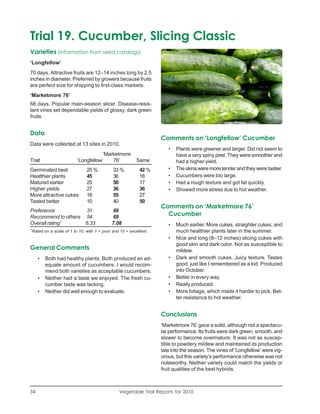
         are not as attractive. Seems to be doing better
                                                                       such long carrots in my life—14 inches long—
         in storage.
                                                                       and nice and straight. Tasted good and sweet.
     •   Tasted good; then got 1+ inches around and then
                                                                   •   I like the orange color of its carrots. It had a stron-
         got harder to chew and tasted flat.
                                                                       ger carrot flavor.
     •   Plants were much bigger and healthier looking.
                                                                   •   More split roots.
         Much higher yield. Roots have beautiful colors
         but are not as sweet and have a wood texture.             •   Sweeter and more attractive roots.
                                                                   •   Sweet carrot flavor.
                                                                   •   Roots were much larger and were hard to dig.
Comments on ‘Sugarsnax 54’ Carrot                                  •   Didn’t get as big and tasted better. Stayed hard
     •   Kids preferred this variety.                                  longer.
     •   I like its orange color. A little better flavor—both      •   Much sweeter and had nice, big straight, tapered
         raw and cooked.                                               roots.
     •   Roots were not smooth. Harder to harvest in a             •   Had many side roots.
         heavy clay soil because of their length.
     •   Tasted better when raw. Sweeter. Roots were            Conclusions
         larger and more attractive in size.
     •   Long, narrow, deep orange roots. No woody cen-         Gardeners loved ‘Sugarsnax 54’ for its bright orange
         ters. Sweeter.                                         color and outstanding flavor (both raw and cooked). It is
     •   Twice the germination; grew twice as well; higher      a solid performer. Most gardeners liked ‘Rainbow’, but
         yields; roots looked more attractive.                  some felt the lighter-colored roots lacked flavor. Kids
                                                                especially appreciated the variety of colors, but if that
     •   Its orange color seems more natural.
                                                                is paramount they may prefer a variety that included
     •   Roots had multiple arms. Much sweeter, more
                                                                purple and red roots, too.
         flavorful. Nice large size.


22                                           Vegetable Trial Reports for 2010
Trial 11. Carrot, Orange
Varieties (information from seed catalogs)
‘Mokum’
54 days. A very early variety ‘Nantes’ type with very
sweet flavor. Slender roots are good for bunching. Short
tops. Widely adapted.
‘Nelson’
56 days. Sweet flavor and outstanding tolerance to heat.
The roots of this hybrid are deep orange, smooth, 6
inches long, with blunt tips. Early. Medium tops.

Data
Data were collected at 78 sites in 2009 and 41 sites in 2010.
                                        2009                                   2010                        Weighted Total
Trait                         ‘Mokum’ ‘Nelson’          Same         ‘Mokum’ ‘Nelson’       Same      ‘Mokum’ ‘Nelson’ Same
Germinated best                  28 %        25 %        47 %          33 %        21 %       45 %       30 %       24 %      46 %
Healthier plants                 14          24          61            15          28         58         14         25        60
Matured earlier                  28          24          49            15          29         56         24         26        51
Higher yields                    30          28          42            20          38         43         27         31        42
More attractive roots            26          46          28            21          45         34         24         46        30
Tasted better raw                24          40          37            29          37         34         26         39        36
Tasted better cooked             18          25          57            23          39         39         20         30        51
Preference          41                      59                        32          68                    38         62
Recommend to others 69                      77                        73          83                    70         79
Overall rating1     6.85                    7.42                      6.68        7.63                  6.79       7.49
1
    Rated on a scale of 1 to 10, with 1 = poor and 10 = excellent.


General Comments                                                              •   Both were generally smaller in size than normal
                                                                                  carrots.
       2009
                                                                              •   Both produced mostly bizarre and multi-legged
       •   Both germinated well and had good foliage with                         carrots.
           strong tops. Both were tasty.
                                                                              •   Neither variety did well in our cool, late spring/
       •   Both were very healthy. They both produced very                        early summer. Neither was as sweet or flavorful
           well! I love these carrots.                                            as I would like—most disappointing.
       •   Both grew nicely and I would grow both again.
           Matured at the same time. Very few odd-shaped                      2010
           carrots. Both had good taste but I didn’t think                    •   Healthy plants, good yields, and healthy roots
           they were overly sweet or tasty.                                       for both varieties.
       •   Lots of carrots. Beautiful tops.                                   •   Some of the best tasting carrots ever.
       •   Both had strong tops.                                              •   Both varieties were much better than store-bought
       •   Both tasted great raw and cooked.                                      carrots.
       •   Both have very long roots.                                         •   Both produced very large carrots: about 8 inches
       •   Both varieties grew well and tasted good.                              long and 3 inches around.
       •   Both produced very well. Both make excellent                       •   They were both beautiful until the mice found
           cake and bread!                                                        them. They were so similar in taste. I have tasted
       •   Both produced very well. I had enough carrots                          sweeter carrots than these.
           to share with my sister and mother.                                •   Both were nice and crisp.


                                             North Dakota Home Garden Variety Trials                                             23
Comments on ‘Mokum’ Carrot                                        •   Very sweet raw and good flavor when cooked.
                                                                  •   Exhibited these carrots at the North Dakota State
     2009
                                                                      Fair, Future Farmers of America Division and got
     •   Tasted sweeter and had a bigger burst of flavor.             Reserve Champion. Sweeter and look nice.
     •   Sweeter, more carrot flavor.                             •   Nicer, straighter roots for peeling.
     •   Larger, thicker roots. Very sweet and crisp.             •   Tasted better (more flavor) and better root shape.
     •   Much larger, more even roots. Very good!                 •   Straighter roots and a lot sweeter.
     •   Many had odd roots.                                      •   Sweet when cooked, but rather flavorless raw.
     •   Better tasting and overall bigger carrot.                •   Very nice and straight. No fingers on them.
     •   Roots were straighter.                                   •   More crunchy and sweeter.
     •   Carrots were longer and thinner. Sweeter when            •   A bit nicer looking. We leave our carrots in the
         raw and better tasting when cooked.                          ground until frost, for sweetness. ‘Nelson’ did not
     •   Looked very good! Tasted very sweet!                         overgrow.
     •   Nice carrot flavor—both cooked and raw. Nice
         even color.                                              2010
     •   Longer roots; didn’t grow into funny shapes; easy        •   Better flavor; higher yields. Our grandchildren ate
         to grow.                                                     them right out of the garden!
                                                                  •   Nicer looking and sweeter flavor.
     2010                                                         •   Nice shape.
     •   All carrots were nice and straight.                      •   Grew slightly better in the garden.
     •   Big, knobby roots. Better taste—sweet.                   •   Higher yields (16 vs. 9 pounds).
     •   Matured a few days earlier. Slightly higher yields,      •   Better taste and yield.
         but had more carrots with multiple roots.
                                                                  •   Seemed to be sweeter at a young age. Lots of
     •   Tasted sweeter than ‘Nelson’ when eaten as a                 deformed carrots.
         raw carrot.
                                                                  •   Tasted sweeter than ‘Mokum’ when cooked.
     •   Nice, dark green, thick tops.
                                                                  •   Bigger and more robust roots (almost twice the
     •   More flavor and more attractive roots. Their roots           size) and slightly better flavor.
         were thicker and easier to dig in our clay soil.
                                                                  •   I liked its sweet and tangy taste. It cooked up
     •   Short and stubby roots.                                      nice as well.
     •   Very poor root form, with roots and splits. Sweeter      •   Its roots did not fork.
         and more tender.
                                                                  •   Seemed a bit crunchier.
     •   Better germination rate and matured a few days
                                                                  •   Sweeter taste and is nice and crisp. It also had
         sooner. Nicely shaped, slender carrots. Sweeter
                                                                      healthy plants and good yields.
         tasting.
                                                                  •   So smooth and sweet.
     •   More carrots with multiple roots and double legs.
                                                                  •   Taller greens, a stronger bottom root, and a bet-
     •   Roots were slimmer and longer.
                                                                      ter cooked carrot.
     •   Nicely shaped carrots.
                                                                  •   Sweeter and crispier.
     •   Both tasted good, but this one matured earlier.
                                                                  •   Longer and thicker carrots. A little firmer carrot
                                                                      after cooked.
Comments on ‘Nelson’ Carrot                                       •   Sweeter and a nicer formed carrot.
     2009                                                         •   Good color and flavor. A little sweeter when eaten
                                                                      raw; good texture when cooked.
     •   Deep orange color and smoother shape. Not at
         all crooked either. Easier to clean.
     •   Smooth skins—rich orange color. Crunchy and           Conclusions
         sweet. Delicious fresh, cooked, and frozen.
     •   Roots split less often. The best carrots I have       ‘Mokum’ and “Nelson’ grew well and produced lots of
         ever planted—grew long and straight.                  tasty carrots in most gardens. The majority of garden-
                                                               ers preferred ‘Nelson’. They liked its remarkably straight,
     •   Plants looked better and had better foliage. Ma-
                                                               smooth-skinned, and very uniform carrots. Many gar-
         tured about one week earlier. Nice, straight car-
                                                               deners felt it tasted better, especially when eaten raw.
         rots, but some had green cores. Canned much
                                                               Several gardeners noted ‘Mokum’ produced larger roots
         better than ‘Mokum’.
                                                               and its roots were more subject to forking.


24                                          Vegetable Trial Reports for 2010
Trial 12. Carrot, Purple
Varieties (information from seed catalogs)
‘Cosmic Purple’
90 days. The beautiful reddish-purple exterior provides
an attractive contrast with the bright orange flesh and
small yellow cores. Smooth, tapered roots grow 6 to 8
inches long. Very sweet.
‘Purple Haze’
70 days. The tapered 10-inch roots are smooth with
purple exterior and bright orange centers. The color pre-
sentation when cut is vivid and the flavor of the raw
carrots is sweet. Flavor when cooked is also excellent,
but the purple color dissolves with cooking. Sturdy tops.


Data                                                                 Comments on ‘Cosmic Purple’ Carrot
                                                                        •   Really cool color. Much easier to grow.
Data were collected at 19 sites in 2010.
                                                                        •   Brighter and more colorful peel. More intense
                              ‘Cosmic        ‘Purple                        carrot flavor.
Trait                          Purple’        Haze’         Same        •   I liked the look and taste better. Roots were big-
Germinated best                  31 %          44 %          25 %           ger and more uniform.
Healthier plants                 19            19            63         •   Roots were so large and had such personality
Matured earlier                  33             0            67             that I can’t help loving them. Some came out
Higher yields                    33            40            27             looking like mandrakes with several appendages!
More attractive roots            43            36            21         •   Grew large and had splits late in the season.
Tasted better raw                33            33            33             Had a more pure carrot taste when cooked.
Tasted better cooked             36            18            45         •   Roots were fatter and often cracked.
Preference          45                        55
Recommend to others 84                        78                     Comments on ‘Purple Haze’ Carrot
Overall rating1     7.32                      7.50
1
    Rated on a scale of 1 to 10, with 1 = poor and 10 = excellent.      •   Slightly larger yields. Purple color extends deeper
                                                                            in the root. Slightly sweeter and better texture.
                                                                        •   Plants were more vigorous and roots were larger.
General Comments                                                            Skin was darker and duller and the depth of the
                                                                            color is about 1/8" compared to just the peel on
       •   Both are a great option for ND growers. I liked
                                                                            ‘Cosmic Purple’.
           the taste of both.
                                                                        •   Longer (8 inches compared to 4 inches for ‘Cos-
       •   Both produced giant, healthy carrots. No taste
                                                                            mic Purple’) and tasted better.
           difference.
                                                                        •   Straighter roots.
       •   I enjoyed growing purple carrots. My grandson
                                                                        •   They were a nice size and didn’t crack.
           and I had a vegetable stand … and we really had
           a lot of comments about the purple carrots, but
           they did not sell well. My nephew owns a café;            Conclusions
           he cut them into carrot sticks and used them in
           his relish trays; it looked really pretty and they        Gardeners enjoyed growing both varieties. Most gar-
           had a lot of interesting comments.                        deners preferred ‘Purple Haze’ for its long, straight, dark
       •   Both were healthy. Both definitely need a good            purple roots. Gardeners were especially delighted with
           chill to develop sweetness.                               the brilliant red-purple skin of ‘Cosmic Purple’, but this
       •   Both had a lot of long roots.                             coloration was shallow and the roots were more sub-
       •   Both made an excellent carrot cake.                       ject to cracking and forking.


                                             North Dakota Home Garden Variety Trials                                         25
Trial 13. Carrot, White
Varieties (information from seed catalogs)
‘Crème de Lite’
70 days. The pale yellow roots are very uniform and
attractive. Roots grow up to 9 inches long with tapered
ends.

‘White Satin’
68 days. Pure white roots have a crisp, sweet flavor.
Roots grow 8 inches long. Plants are tolerant of ad-
verse weather. Large, vigorous tops.


Data                                                                 Comments on ‘Crème de Lite’ Carrot
Data were collected at 6 sites in 2010.                                 •   Larger carrots (172 carrots with a total weight of
                                                                            12.6 pounds, compared to 135 carrots with a
                              ‘Crème         ‘White
                                                                            total weight of 6.4 pounds). Long, thin and ta-
Trait                         de Lite’        Satin’        Same
                                                                            pered roots. Very sweet and delicate flavor; bet-
Germinated best                   0%            0%          100 %           ter texture. Plants were bigger and darker green.
Healthier plants                 40            20            40             This is better overall.
Matured earlier                  20            20            60         •   Had a better flavor.
Higher yields                    60             0            40         •   Long, tapered roots. Had a better texture.
More attractive roots            67            33             0         •   Fuller plants. Bigger and nicer looking roots.
Tasted better raw                40             0            60             Grew great and tasted good.
Tasted better cooked              0            25            75
Preference          67                        33
Recommend to others 67                        50                     Comments on ‘White Satin’ Carrot
Overall rating1     7.67                      6.67                      •   Short, stubby roots. More traditional carrot fla-
1
    Rated on a scale of 1 to 10, with 1 = poor and 10 = excellent.          vor. A little sweeter.
                                                                        •   Plants looked fuller. A nice long carrot and easy
                                                                            to clean.
General Comments
                                                                        •   Some of the roots had black spots on them.
       •   White carrots have every much the taste of or-
           ange carrots. I enjoyed growing white carrots;
           they were tasty, crisp, long, and easy to clean.          Conclusions
       •   Not very much difference.                                 Few gardeners were interested in growing white car-
       •   Both were healthy.                                        rots. These gardeners liked, but did not love these vari-
       •   These are not attractive to me. They look like            eties. They noted these carrots were easy to clean and
           wild roots. Mild flavor—maybe too mild.                   had a delicate flavor. ‘Crème de Lite’ rated higher for
                                                                     yields and gardeners liked its slender, tapered roots.


26                                                Vegetable Trial Reports for 2010
Trial 14. Carrot, Yellow
Varieties (information from seed catalogs)
‘Yellow Sun’
75 days. Golden yellow roots grow 6–7 inches long
with blunt tips. Flavor best when cooked.
‘Yellowstone’
75 days. Pure yellow roots grow 8 inches long with
broad shoulders and strong tops. Roots taste best when
cooked.


Data
Data were collected at 6 sites in 2010.                              Comments on ‘Yellow Sun’ Carrot
                               ‘Yellow      ‘Yellow-                    •   Ready first. Roots never grew past 6 inches.
Trait                            Sun’        stone’         Same            Lovely true yellow color. I liked how the roots
Germinated best                  25 %          50 %          25 %           were all the same size.
Healthier plants                  0             0           100         •   Roots were more yellow and sweeter.
Matured earlier                  50            25            25         •   Was early and produced well. Large carrot. Fla-
Higher yields                    60             0            40             vor is very good.
More attractive roots            60            20            20         •   More uniform roots. Roots were large and fat—
Tasted better raw                25             0            75             like a ‘Chantenay’.
Tasted better cooked             50             0            50         •   I prefer this variety for its stocky roots.
Preference           80                       20
Recommend to others 100                       40
Overall rating1      8.67                     5.80
                                                                     Comments on ‘Yellowstone’ Carrot
1
    Rated on a scale of 1 to 10, with 1 = poor and 10 = excellent.      •   Very long, slender roots—over 6 inches long.
                                                                            Roots have a slight paleness or greenish tint to
                                                                            it.
General Comments                                                        •   Green tint on top of carrot. Tasted like a turnip.
       •   Both had beautiful, feathery tops. Both had at-
           tractive roots—neither got fat or woody. Excel-
                                                                     Conclusions
           lent flavor and colorful in salads and mixed veg-
           etables.                                                  ‘Yellow Sun’ was praised for its golden yellow roots
                                                                     and sweet taste. Every gardener liked it. ‘Yellowstone’
                                                                     roots were more slender but were lighter colored and
                                                                     sometimes had a greenish tint.


                                             North Dakota Home Garden Variety Trials                                       27
Trial 15. Cucumber, Pickling
Varieties (information from seed catalogs)
‘Alibi’
49 days. Attractive, dark green fruits are good for fresh
eating or pickling. Vines are shorter than those of most
varieties. High yield potential. White spines.
‘H-19 Little Leaf’
57 Days. Compact vines produce good yields even un-
der stress. Twenty or more fruits may ripen on a plant
at the same time. Vines continue to bear heavily until
frost. Leaves are only half of normal size, making it
easy to find the fruit. Vines tolerate heat, cold, and
drought.                                                             Comments on ‘Alibi’ Cucumber
                                                                       •   Earlier by two weeks. Healthy looking plants—
Data                                                                       very impressed—these plants were more pro-
                                                                           ductive. Nice, long cukes.
Data were collected at 35 sites in 2010.
                                                                       •   Better germination and more yield.
                                              ‘H-19                    •   Cukes were the right size for pickling. Plants
Trait                           ‘Alibi’    Little Leaf’     Same           were lush and produced first (13 July).
                                                                       •   Good early producer and produced all season.
Germinated best                  56 %          25 %          19 %
                                                                           Liked the taste.
Healthier plants                 42            24            33
Matured earlier                  62            34             3        •   Produced the first cukes.
Higher yields                    45            39            16        •   Produce several cukes while ‘H-19 Little Leaf’
More attractive cukes            50            33            17            produced very few.
Tasted better                    40            23            37        •   Perfect size for pickling.
                                                                       •   A week earlier. Straighter cukes. Less mild cu-
Preference          59                        41
                                                                           cumber taste. Clearly better in every category.
Recommend to others 71                        55
Overall rating1     7.21                      5.88                     •   Nicer pickler, despite less yield.
1                                                                      •   Two weeks ahead. All around better—‘Alibi’ had
    Rated on a scale of 1 to 10, with 1 = poor and 10 = excellent.
                                                                           bigger everything.
                                                                       •   Made cute little cukes perfect for pickles.
General Comments                                                       •   Higher yield (132 versus 110 cucumbers).
                                                                       •   Earlier (by three weeks) and the cukes were
       •   This was a great year for cucumbers! I pickled
                                                                           fleshier. Smaller and fewer seeds; cukes were
           over 50 quarts and gave bags and bags away!
                                                                           also a little bigger.
           Both varieties tasted amazing! I would recom-
           mend this trial to all gardeners who love cukes!            •   Produced enough for small batches of pickles,
                                                                           although not all good-looking cucumbers; then
       •   Both had nice, smaller cukes ideal for pickling.
                                                                           continued to bloom and produce a few cucum-
       •   Both were great producers.                                      bers until frost. The end-of-season cukes were a
       •   One or two plants are the most needed for a                     bit more pinched at the ends.
           garden.                                                     •   Firmer fruits.
       •   Both were very good producers.                              •   Picked easier.
       •   Both made good pickles.
       •   Did not notice any taste difference—both were
           good.
       •   Froze on May 8 in the ground—no emergence.


28                                                Vegetable Trial Reports for 2010
Comments on ‘H-19 Little Leaf’                             Conclusions
  Cucumber                                                 ‘Alibi’ received higher ratings than ‘H-19 Little Leaf’ in
  •   Taste was wonderful when fresh. Nice pickles.        all traits. Its first crop was approximately 10 days ear-
      Strong vines.                                        lier and gardeners were impressed with the shape, firm-
  •   Later producer, but good yield and taste.            ness, and deep green color of its fruits. The vines of ‘H-
                                                           19 Little Leaf’ were slower to get started but then im-
  •   Really produced and is still producing (Septem-
                                                           pressed gardeners with its late season yields. Its cu-
      ber 15).
                                                           cumbers were uniform in size and did a good job of
  •   Slower start and just didn’t seem to bloom very
                                                           maintaining their small size in the field.
      much.
  •   Lots of little cucumbers for pickling. Two plants
      produced 5 gallons every 3–4 days! Nice.
  •   I liked the small vine and leaves; they kept pro-
      ducing and blooming. The cukes were smaller
      even when they were missed on a previous pick-
      ing.
  •   This variety was awesome! The plants were
      healthier and they were still flowering and pro-
      ducing cucumbers until September 19. ‘Alibi’
      vines were drying at the end of August.
  •   Had tons of blossoms, but just didn’t set as well.
  •   Few cukes and they were small.
  •   Easier to pick and therefore we were able to find
      the little pickles before they turned into giant
      cukes.
  •   Could see the cukes better and easier.
  •   Did not grow well. Little tiny plants and did not
      produce.
  •   My favorite by far! It had very small leaves, but
      lots of them, long vines, with flowers and tons of
      small/medium cucumbers—perfect for pickling—
      note of them got large, fat and yellow if left too
      long on the vine. I recommend this for someone
      who doesn’t have a lot of space and likes to make
      pickles. I will grow ‘H-19 Little Leaf’ next year!
  •   Much healthier, vigorous plants with 3–4 times
      the yield.
  •   I like small cucumbers for salads and pickling. I
      think this variety stayed crisper.
  •   Bore fruit longer—withstood a mild frost.
  •   Plants looked stunted and did very little spread-
      ing until late in the season. Produced only a
      couple of cucumbers all season.
  •   Cucumbers stayed smaller and produced high
      yields of uniform-size pickling cukes.


                                   North Dakota Home Garden Variety Trials                                        29
Trial 16. Cucumber, Slicing Asian
Varieties (information from seed catalogs)
‘Orient Express II’
64 days. Slender fruits grow 12 inches long and only 1
inch in diameter. Burpless quality. Disease-free vines
produce heavy yields. Mild flavor. Trellis for straight fruits.
‘Suyo Long’
61 Days. Sweet, ribbed cucumbers grow up to 15
inches long. Burpless quality and bitter-free. Traditional
variety from China. Trellis for straight fruits.


Data
                                                                     Comments on ‘Orient Express II’
Data were collected at 10 sites in 2010.
                                                                       Cucumber
                             ‘Orient          ‘Suyo
                                                                        •   Provided enough for the whole neighborhood.
Trait                       Express II’       Long’         Same
                                                                        •   Produced 2–3 weeks earlier. Produced three
Germinated best                  78 %           0%           22 %           times more cukes. Amazing yield on compact
Healthier plants                 44             0            56             plants!
Matured earlier                 100             0             0         •   Near 100% germination. The large leaves of its
Higher yields                    60            20            20             vines spread to cover cukes. Wonderful taste—
More attractive cukes            43             0            57             long—uniform cuke—only 1.0 to 1.5 inches in
Tasted better                    44            11            44             diameter. Very small seeds. High yielding.
Preference          100                         0                       •   Clearly more productive and prolific. It produced
Recommend to others 90                        30                            fruits a week earlier than ‘Suyo Long’ and pro-
Overall rating1      8.22                     5.56                          duced more abundantly. The fruits were slightly
1
    Rated on a scale of 1 to 10, with 1 = poor and 10 = excellent.          sweeter and more attractive. Germination rate
                                                                            was double that of ‘Suyo Long’.
                                                                        •   Germinated better and plants grew much better
General Comments                                                            overall.
                                                                        •   Produced earlier.
       •   Cukes of both varieties looked very nice.
       •   I would prefer a straighter cuke. These tend to
           curl too much. Loved the long straight ones.              Comments on ‘Suyo Long’ Cucumber
       •   Both made good pickles.
                                                                        •   Longer vines. Cukes have more flavor.
       •   Both got a wilt in the leaves in mid August. This
           is the first time I have grown Asian cucumbers.              •   Late in coming but did produce a large quantity.
           Both had good flavor, but I did not care for either          •   Cukes were too skinny. They just didn’t appear
           variety.                                                         to be a cucumber. I served them and others
                                                                            would ask what they were.
       •   Some of the most productive cucumbers I have
           ever grown!
                                                                     Conclusions
                                                                     Gardeners were extremely impressed with ‘Orient Ex-
                                                                     press II’. Its productivity was amazing. Its cucumbers
                                                                     were very slender, attractive, delicious, and burpless.
                                                                     Every gardener recommended it. ‘Suyo Long’ could not
                                                                     compete with it.


30                                                Vegetable Trial Reports for 2010
Trial 17. Cucumber, Slicing Beit Alpha
Varieties (information from seed catalogs)
‘Diva’
58 Days. Gourmet quality. The all-female flowers don't
require pollen to set fruit, so yields are higher and fruits
are nearly seedless. Lots of bright green, spineless
cukes. No peeling is required of its skin.
‘Sultan’
58 Days. Crispy, sweet cukes are produced on a vigor-
ous vine. A Middle Eastern type that yields well through
summer.


Data                                                                 Comments on ‘Diva’ Cucumber
Data were collected at 19 sites in 2010.                                •   Grew better and produced more.
                                                                        •   Gave the most cukes (65 vs. 52). The vines
Trait                           ‘Diva’      ‘Sultan’        Same            weren’t as aggressive and took up less space. It
Germinated best                  24 %          35 %          41 %           was slower to get started, but once it got started
Healthier plants                 29            43            29             it was good.
Matured earlier                  29            64             7         •   Produced slightly more. I like the look of its cukes
Higher yields                    46            54             0             better. Much better taste.
More attractive cukes            30            30            40         •   Produced more and was more vigorous. Tasted
Tasted better                    50             8            42             better.
Preference          50                        50                        •   Cukes were light green—not as pretty.
Recommend to others 58                        58
Overall rating1     5.86                      5.47                   Comments on ‘Sultan’ Cucumber
1
    Rated on a scale of 1 to 10, with 1 = poor and 10 = excellent.
                                                                        •   Tasted way better.
                                                                        •   Performed better overall.
General Comments                                                        •   Healthier plants.
       •   Both were nice, long and slender cukes. Both                 •   More plants came up. Cukes weren’t as uniform.
           tasted great; they had thin skins I didn’t have to               They were harder to eat because the seeds were
           peel; they were very crisp and tasty with small                  big.
           seeds.                                                       •   Enormous yield.
       •   We like the taste of both varieties.                         •   Neither was great but ‘Sultan’ was tougher.
       •   Both had high yields and lacked bitterness.                  •   Developed a blight disease.
       •   Both varieties produced nice plants but yield was            •   Had some browning on the leaves. Produced a
           overall fair at best.                                            few days earlier and produced 20% more over-
       •   Our other cucumbers produced 8-inch cukes                        all. Brighter green cucumbers.
           before either variety flowered.
       •   Neither germinated well. Both produced nice look-         Conclusions
           ing cucumbers with nice flavor.
       •   Both were very tasty, but did not keep well. They         Gardeners enjoyed the quality of cucumbers produced
           had to be used right away or they got mushy.              by both varieties, especially the taste of ‘Diva’. Several
       •   The freeze on May 8 prevented any seeds from              gardeners found the vines of ‘Sultan’ to be more vigor-
           germinating.                                              ous, setting fruits earlier in the season and producing
       •   Rabbits liked both varieties equally as well.             higher yields overall. In the big picture, neither variety
                                                                     excelled. Concerns include lack of vine vigor (especially
                                                                     when young) and low yields.


                                             North Dakota Home Garden Variety Trials                                         31
Trial 18. Cucumber, Slicing Burpless
Varieties (information from seed catalogs)
‘Sweet Slice’
63 days. Very mild and sweet. Pick when the fruit is 6–
8 inches long for best flavor, and the plants will produce
excellent yields over a long season.
‘Sweeter Yet’
45 Days. Very early. Dark green, crisp fruit with a pleas-
ingly sweet flavor. Best harvested at 10–12 inches. Com-
pact, semi-bush plants bear continuously.


Data
Data were collected at 77 sites in 2009 and 26 sites in 2010.
                                        2009                                  2010                           Weighted Total
                               ‘Sweet ‘Sweeter                       ‘Sweet ‘Sweeter                  ‘Sweet ‘Sweeter
Trait                           Slice’  Yet’            Same          Slice’  Yet’         Same        Slice’    Yet’     Same
Germinated best                  37 %        17 %        45 %         35 %        19 %       46 %       36 %       18 %      45 %
Healthier plants                 22          32          47           35          15         50         25         28        48
Matured earlier                  49          40          11           68          28          4         54         37         9
Higher yields                    30          50          20           32          48         20         31         49        20
More attractive cukes            38          40          21           48          24         28         41         36        23
Tasted better                    29          27          45           24          40         36         28         30        43
Preference          47                      53                        43         57                    46         54
Recommend to others 67                      65                        62         69                    66         66
Overall rating1     6.85                    7.42                      6.81       7.07                  6.84       7.33
1
    Rated on a scale of 1 to 10, with 1 = poor and 10 = excellent.


General Comments                                                             •   Not much difference between the varieties—both
                                                                                 were good producers.
       2009
                                                                             •   We had endless cukes from these trials! Kept
       •   Both did better than the varieties I’ve used in pre-                  producing until frost.
           vious years. Both were vigorous growers with lots
                                                                             •   Both had odd-shaped cucumbers. Not uniform.
           of fruit.
                                                                                 Skins were tough and spiny. Neither seemed to
       •   They both grew lots of cucumbers. I supplied                          have flavor.
           lots of friends with cucumbers.
                                                                             •   Both had strong plants, even as indoor seed-
       •   Both had great vines, excellent yields, attractive                    lings. Once the harvest started we ate them non-
           cukes, and great flavor.                                              stop, even in the combine!
       •   Both varieties will satisfy the palette. Their plants
           looked tough; didn’t think they would yield much;                 2010
           but were impressed on how many cukes were                         •   Both had so much fruit I couldn’t eat fast enough.
           produced by just a few plants.                                    •   Both produced well. Both had great flavor.
       •   Neither became “seedy” when large.                                •   Both varieties tended to curl. Both were very good
       •   Many fruits were misshaped.                                           and crisp—never bitter and no burps!
       •   Really didn’t like either of them. They both pro-                 •   They twisted up and had brown on them. Both
           duced cukes that curled.                                              did not taste as good as ‘Raider’ in the garden.


32                                                 Vegetable Trial Reports for 2010
Comments on ‘Sweet Slice’ Cucumber                            •   Steady stream of consistent fruit. We ate 5 gal-
                                                                  lons of pickles and still had plenty to share!
  2009
                                                              •   Much higher yields later in the season.
  •   The vines were healthier and the cukes were
                                                              •   Very few seeds inside fruit.
      sweeter and more uniform.
                                                              •   Nice shaped (straight and uniform) fruits that
  •   Produced nine days earlier and produced later
                                                                  tasted great.
      into the fall. The cucumbers seemed to have a
      firmer crunch and were uniform in shape.                •   Sweet taste and the fruits are long and narrow—
                                                                  loved them!
  •   Firmer fruits and tasted sweeter.
                                                              •   Healthier plants and produced much better.
  •   Cukes were straighter but shorter.
                                                              •   The cucumbers taste good (extremely good in
  •   They were a nice slicer; not prone to getting fat!
                                                                  cucumber salad), but sometimes look funny.
  •   Plants were not as prone to browning. They pro-
                                                              •   Produced like no other cucumber. I was surprised
      duced one week earlier and produced 30% more
                                                                  how many we got. The cucumbers were slim and
      cucumbers. A nice mild, juicy flavor.
                                                                  long. Milder flavor. The cucumbers did not get so
  •   Fruit had a tendency to curl.                               bitter—you can eat the skins—seed were no
  •   Fruit were straighter and longer—easier to slice.           problem.
      Seeds seemed smaller.                                   •   A little more productive. Sweet and juicy—none
  •   Plants were hardier in early spring. Cucumbers              were bitter tasting.
      had tough skin and were not real tasty.                 •   Were very tasty! Produced well.
  •   Cucumbers were more slender—and less seeds.             •   Bigger yield and longer harvest season. Good
      The skin was a little more tender.                          taste.
  •   Even-sized cukes. Great for pickling.
                                                              2010
  2010                                                        •   Better yield (64 versus 48 cukes). We prefer its
  •   Straighter cucumbers for slicing.                           taste.
  •   Delicious. Thin skinned with small seeds. Suc-          •   Twice as many cucumbers. We liked them pick-
      culent cucumbers and very prolific.                         led.
  •   Produced longer.                                        •   Produced more and kept producing for a longer
  •   A nice cucumber–grew straight, good flavor. It              period of time.
      truly was good and sweet.                               •   Didn’t have a “normal” cuke shape. Some looked
  •   More vigorous plants. Ready one week earlier.               more like gourds. Better taste.
      Higher yield. The cukes didn’t curl. They were          •   Better tasting, somewhat milder taste, too. Never
      slender with crisper flesh and smaller seeds.               a bitter cuke in the bunch!
  •   Great for making pickles—all the slices were the        •   Cukes were straighter and deeper colored.
      same size. Easy to peel; mild flavor.                   •   Good yield. Cukes were good size and shape. I
                                                                  really don’t care for it due to a lack of flavor.
Comments on ‘Sweeter Yet’ Cucumber                            •   Better tasting and gave a consistent supply of
                                                                  fruit for the entire season.
  2009
                                                              •   Good taste and its cukes did not size up as fast.
  •   They had nicer plants and the cukes were a lot
      like the more expensive English cukes at the
      store. They were a little curled, but crisp and      Conclusions
      good!
  •   Fantastic yield, even with cold summer. Fruits       Some results from this trial are unexpected. ‘Sweeter
      look almost like an English cucumber. Incred-        Yet’ is an ultra-early variety and yet it produced cukes
      ible taste. Kept producing even after we had mil-    later than ‘Sweet Slice’ at many of the sites. ‘Sweet
      dew problems. We liked both varieties but            Slice’ has a reputation for productivity, but it produced
      ‘Sweeter Yet’ was a favorite of everyone.            lower yields than ‘Sweeter Yet’ at many of the sites.
                                                           Neither variety excelled, but gardeners generally liked
  •   Better looking plants. Produced cukes three days
                                                           both. About half of the gardeners liked the yields and
      earlier. Produced larger and better looking cukes.
                                                           slimmer cucumbers of ‘Sweeter Yet’. The other half pre-
      Tasted great.
                                                           ferred the straighter, more uniform cucumbers of ‘Sweet
  •   Very vigorous grower and very prolific yields.       Slice’.
      Cukes had better form, size and color, but were
      a bit sour tasting. Inner seeds were bigger.

                                   North Dakota Home Garden Variety Trials                                       33
Trial 19. Cucumber, Slicing Classic
Varieties (information from seed catalogs)
‘Longfellow’
70 days. Attractive fruits are 12–14 inches long by 2.5
inches in diameter. Preferred by growers because fruits
are perfect size for shipping to first-class markets.
‘Marketmore 76’
68 days. Popular main-season slicer. Disease-resis-
tant vines set dependable yields of glossy, dark green
fruits.


Data
                                                                     Comments on ‘Longfellow’ Cucumber
Data were collected at 13 sites in 2010.
                                                                        •   Plants were greener and larger. Did not seem to
                                       ‘Marketmore                          have a very spiny peel. They were smoother and
Trait                       ‘Longfellow’   76’              Same            had a higher yield.
Germinated best                  25 %          33 %          42 %       •   The skins were more tender and they were tastier.
Healthier plants                 45            36            18         •   Cucumbers were too large.
Matured earlier                  25            58            17         •   Had a rough texture and got fat quickly.
Higher yields                    27            36            36         •   Showed more stress due to hot weather.
More attractive cukes            18            55            27
Tasted better                    10            40            50
                                                                     Comments on ‘Marketmore 76’
Preference          31                        69
Recommend to others 54                        69
                                                                       Cucumber
Overall rating1     6.33                      7.08                      •   Much earlier. More cukes, straighter cukes, and
1
    Rated on a scale of 1 to 10, with 1 = poor and 10 = excellent.          much healthier plants later in the summer.
                                                                        •   Nice and long (8–12 inches) slicing cukes with
                                                                            good skin and dark color. Not as susceptible to
General Comments                                                            mildew.
       •   Both had healthy plants. Both produced an ad-                •   Dark and smooth cukes. Juicy texture. Tastes
           equate amount of cucumbers. I would recom-                       good, just like I remembered as a kid. Produced
           mend both varieties as acceptable cucumbers.                     into October.
       •   Neither had a taste we enjoyed. The fresh cu-                •   Better in every way.
           cumber taste was lacking.                                    •   Really produced.
       •   Neither did well enough to evaluate.                         •   More foliage, which made it harder to pick. Bet-
                                                                            ter resistance to hot weather.


                                                                     Conclusions
                                                                     ‘Marketmore 76’ gave a solid, although not a spectacu-
                                                                     lar performance. Its fruits were dark green, smooth, and
                                                                     slower to become overmature. It was not as suscep-
                                                                     tible to powdery mildew and maintained its production
                                                                     late into the season. The vines of ‘Longfellow’ were vig-
                                                                     orous, but this variety’s performance otherwise was not
                                                                     noteworthy. Neither variety could match the yields or
                                                                     fruit qualities of the best hybrids.


34                                                Vegetable Trial Reports for 2010
Trial 20. Cucumber, Slicing Standard
Varieties (information from seed catalogs)
‘General Lee’
66 days. Very productive, main-season slicer. Disease-
resistant vines set good yields even under adverse con-
ditions. Dark green fruits with white spines.
‘Raider’
52 Days. Dependable early slicer. High yields of fancy,
dark green fruits. Disease-resistant vines.


Data
Data were collected at 19 sites in 2010.
                              ‘General                               Comments on ‘Raider’ Cucumber
Trait                           Lee’        ‘Raider’        Same
                                                                        •   Germinated best. Produced more cukes early,
Germinated best                  25 %          50 %          25 %
                                                                            but ‘General Lee’ produced more later.
Healthier plants                 47            20            33
Matured earlier                  36            43            21         •   Both varieties are good, but I recommend ‘Raider’
Higher yields                    62            23            15             for being earlier and more prolific.
More attractive cukes            38            46            15         •   Matured 3–5 days earlier.
Tasted better                    33             0            67         •   Higher yields (102 vs. 73 cukes) and healthier
                                                                            plants.
Preference          58                        42
                                                                        •   Better germination and produced earlier—yields
Recommend to others 78                        61
                                                                            evened out later.
Overall rating1     7.45                      7.02
1
                                                                        •   The cukes had a nice shape.
    Rated on a scale of 1 to 10, with 1 = poor and 10 = excellent.
                                                                        •   Produced cucumbers two full weeks earlier.
                                                                            Cukes were larger.
General Comments                                                        •   More attractive, larger cukes.
                                                                        •   Did not store as well.
       •   They both did very good.
       •   The plants of both varieties were healthy. Both
           produced nice cukes and both tasted very good.            Conclusions
       •   You don’t need many plants to supply your fam-
                                                                     Most gardeners preferred ‘General Lee’ although the
           ily and more.
                                                                     vines of ‘Raider’ got off to a strong start and produced
                                                                     good yields in the early season. Gardeners were im-
Comments on ‘General Lee’ Cucumber                                   pressed with the health, vigor, and productivity of the
                                                                     ‘General Lee’ vines throughout the summer. The quali-
       •   Plants looked better. Most of the cucumbers were          ties of cucumbers for both varieties were acceptable
           consistent in size and taste. Produced 5–8 more           with neither variety holding a decided edge.
           cucumbers.
       •   More compact plant. Adapted well to the trellis.
           Produced really well and kept producing a couple
           weeks longer than ‘Raider’.
       •   Tasted a little better.
       •   Produced over a longer period.
       •   It had great flavor and produced a lot even in wet
           conditions.
       •   More uniform shape; less hollow inner spots.


                                             North Dakota Home Garden Variety Trials                                      35
Trial 21. Greens, Mizuna
Varieties (information from seed catalogs)
‘Kyona Mizuna’
21 days baby, 40 days full size. Unique Japanese mus-
tard with pencil-thin, white stalks. Deeply cut leaves
are distinctive. Mild flavor. Add to salads or can be cooked
in stir fries. Regrows quickly after cutting.
‘Mizuna Purple’
21 days baby, 40 days full size. Purple leaf edges add
a delicate touch to this mizuna. The purple color be-
comes more prominent as plants mature. Plants readily
outgrow after cutting. A colorful addition to salads. Mild.
                                                                     Comments on ‘Kyona Mizuna’
Data                                                                    •   Larger leaves and a pleasing taste.
Data were collected at 4 sites in 2010.                                 •   Went to seed earlier. Grew more vigorously. Suf-
                                                                            fered less damage from insects.
                              ‘Kyona        ‘Mizuna
Trait                         Mizuna’        Purple’        Same
                                                                     Comments on ‘Purple Mizuna’ Greens
Germinated best                  33 %           0%           67 %
Healthier plants                 33            33            33         •   Seemed to grow stronger; matured earlier. I
Matured earlier                  67            33             0             thought this one tasted better—but maybe be-
Higher yields                    50             0            50             cause I liked the color.
More attractive                  67            33             0         •   Tasted slightly bitter and had a more coarse leaf
Tasted better                    33            33            33             texture.
Preference          75                        25
Recommend to others 75                        25
                                                                     Conclusions
Overall rating1     7.75                      5.33
1
    Rated on a scale of 1 to 10, with 1 = poor and 10 = excellent.   Most gardeners are not familiar with mizuna and few
                                                                     participated in this trial. These gardeners were gener-
                                                                     ally pleased with the delicate flavor and uniquely fringed
General Comments                                                     leaves of this Asian green. Both varieties were easy to
                                                                     grow and found to be a nice addition to a mixed salad.
       •   This is a beautiful green for salads. I like its taste,
                                                                     ‘Kyona Mizuna’ was preferred by most gardeners. It
           too.
                                                                     was faster growing, more productive, and more attrac-
                                                                     tive.


36                                                Vegetable Trial Reports for 2010
Trial 22. Greens, Red Mustard
Varieties (information from seed catalogs)
‘Osaka Purple’
21 days baby; 40 days full size. An early, highly refined
mustard with light flavor. Its purple-veined leaves are
medium-green with tinges of purple. Easy to grow.
‘Red Giant’
21 days baby; 45 days full size. Purple, wavy leaves
have mild spicy flavor. Used in salads (mixed and by
itself), stir fries, and steamed dishes.

Data
Data were collected at 6 sites in 2009 and 3 sites in 2010.
                                           2009                                    2010                       Weighted Total
                               ‘Osaka      ‘Red                      ‘Osaka        ‘Red                 ‘Osaka    ‘Red
Trait                          Purple’     Giant’       Same         Purple’       Giant’    Same       Purple’  Giant’    Same
Germinated best                  17 %        50 %        33 %          0%            0%      100 %        11 %      33 %      55 %
Healthier plants                 17          33          50            0             0       100          11        22        67
Matured earlier                  17          33          50            0             0       100          11        22        67
Higher yields                    17          50          33            0            67        33          11        56        33
More attractive                   0          17          83           33            67         0          11        34        55
Tasted better                    40           0          60           33             0        67          38         0        62
Preference          60                      40                        67            33                   62        38
Recommend to others 67                      67                       100           100                   78        78
Overall rating1     8.00                    7.80                      8.67          8.67                 8.22      8.09
1
    Rated on a scale of 1 to 10, with 1 = poor and 10 = excellent.


General Comments                                                        Comments on ‘Red Giant’ Mustard
       2009                                                                    2009
       •   Both were very tasty—a sharp pepper flavor.                         •   Nearly twice the yield.
       •   Both were beautiful plants.                                         •   Larger leaves and more leaves. Overall strong
                                                                                   plants, sending out new growth quickly after each
       2010                                                                        harvest. Good raw (peppery with lemony under-
       •   I really liked the mustard and will be sure to grow                     tones) ... but excellent sautéed. Real beauty.
           it again. The leaves got more intensely flavored
           (with a peppery taste) as they grew. Our whole                      2010
           family liked the addition of the leaves in salads.                  •   Seemed to grow stronger; matured earlier. Tasted
                                                                                   better—I liked the color.
Comments on ‘Osaka Purple’ Mustard                                             •   Slightly bitter with a more coarse leaf texture.

       2009
       •   Amazing flavor.                                              Conclusions
       •   Greens were more tender.
                                                                        Both varieties performed well, although few gardeners
       2010                                                             wanted to try it. The greens were beautiful and had a
       •   Its taste was not as strong.                                 mild, pleasant, peppery taste. ‘Red Giant’ had larger
                                                                        leaves and a more vigorous plant. The greens of ‘Osaka
       •   Went to seed earlier. Grew more vigorously. Suf-
                                                                        Purple’ were more tender and less coarse.
           fered less damage from insects.

                                             North Dakota Home Garden Variety Trials                                             37
Trial 23. Kohlrabi
Varieties (information from seed catalogs)
‘Early White Vienna’
60 days. Flat, globe-shaped bulbs with a pale green to
white skin and flesh. Flesh is tender, juicy, and mild.
Distinct small tops. Freezes well.
‘Winner’
55 days. This hybrid has a fresh, fruity taste. High yields
of pale green bulbs.


Data
Data were collected at 27 sites in 2009 and 16 sites in 2010.
                                            2009                                  2010                       Weighted Total
                             ‘E. White                               ‘E. White                        ‘E. White
Trait                         Vienna’ ‘Winner’          Same          Vienna’ ‘Winner’      Same       Vienna’ Winner’ Same
Germinated best                  17 %        29 %        54 %          20 %        33 %       47 %       18 %       30 %      51 %
Healthier plants                  5          32          64             7          29         64          6         31        64
Matured earlier                  45          27          27            29          50         21         39         36        25
Higher yields                    18          45          36            13          67         20         16         53        30
More attractive bulbs             9          50          41             0          57         43          6         53        42
Tasted better                    24          24          52             7          40         53         18         30        52
Preference          45                      55                         20         80                    36         64
Recommend to others 83                      96                         60         93                    74         95
Overall rating1     6.83                    7.43                       6.64       8.00                  6.76       7.64
1
    Rated on a scale of 1 to 10, with 1 = poor and 10 = excellent.


General Comments                                                              •   Both were all right, but not great.
                                                                              •   Extreme flea beetle pressure—not enough sur-
       2009
                                                                                  vival to observe any differences.
       •   The bulbs of both varieties stayed tender even
                                                                              •   Insects virtually stripped the leaves, in spite of
           when large.
                                                                                  applications of Sevin. And then they moved to
       •   Both varieties were healthy, produced well, and                        the bulbs and forked them as well. Not a good
           had a good taste.                                                      experience.
       •   We really like kohlrabi. I usually plant ‘Grand
           Duke’, which we like. ‘Early White Vienna’ was                     2010
           very similar to that variety. ‘Winner’ was a new                   •   Both looked and tasted good.
           taste and texture—we really enjoyed and pre-                       •   Both were good tasting and held up during hot
           ferred it. We hope to plant ‘Winner’ in the future.                    weather.
       •   Plants of both varieties were healthy. Both types                  •   Both produced very even after being eaten by
           had nice size bulbs. Couldn’t tell a taste differ-                     flea beetles at the start.
           ence. Bulbs were large and not woody.                              •   We liked both.
       •   Both remained tender and mild all season long.
       •   Neither variety was as large as varieties I’ve
           planted previously.
       •   I believe the cool season was helpful.


38                                                 Vegetable Trial Reports for 2010
Comments on ‘Early White Vienna’                                  2010
  Kohlrabi                                                        •   Germinated better, grew better, and produced
                                                                      higher yields. More attractive bulbs. Although
  2009
                                                                      ‘Early White Vienna’ tasted better, ‘Winner’
  •   Bulbs formed earlier. Bulbs were moister.                       tasted good.
  •   Produced first.                                             •   Tasted and looked better.
  •   Slightly earlier and slightly prettier at serving, but      •   Nice, big kohlrabi; produced well.
      really not much difference.
                                                                  •   Got bigger without getting woody; so produced
  •   Ready to pick 3–7 days earlier. Some bulbs split,               more poundage. Bulbs are smooth and very at-
      especially late in the season.                                  tractive. It got the Grand Champion ribbon at the
  •   Better flavor and appearance.                                   fair! Better texture even when the weather was
  •   I liked its taste better. The texture of ‘Winner’               hot; higher yield; very attractive and easy to pre-
      was smoother—more like a potato. Milder tast-                   pare for eating.
      ing, too. We preferred ‘Early White Vienna’ for             •   Even when they were larger, they did not get
      its flavor.                                                     woody. Even cooked and mashed some—yum!
  •   Got larger but never got woody.                             •   Slightly better yields.
  •   More flavor, but not quite as much crunch.                  •   Better germination. Good production.
  •   Better tasting, but very close.                             •   Bulbs grew bigger.
  •   Performed poorly from start to finish. Most plants          •   Definitely better. Bulbs were more globular.
      did not produce bulbs big enough to harvest.                •   Remained sweet and never got “woody” even
  2010                                                                through hot, dry weather. I am still using the
                                                                      bulbs even though they are getting big—but I
  •   Did not produce well.
                                                                      have been slicing them and adding them to my
  •   Germinated earlier. Ate these weeks earlier. Twice              refrigerator pickles—good—crispy!
      as much yield.
                                                                  •   Somewhat earlier to mature.
  •   The people who tried these said they tasted good.
                                                                  •   Failed to germinate.
      Grew better.
  •   Some did not create bulbs; some cracked at
      maturity.                                                Conclusions
  •   Disappointing—the bulbs didn’t form a globe.
                                                               ‘Winner’ lived up to its name. Gardeners were extremely
  •   Produced bulbless stalks.
                                                               impressed with its uniformly round bulbs. Yields were
  •   Didn’t produce bulbs.                                    good and its bulbs resisted splitting. The uniquely
  •   Matured just a littler earlier. Better flavor.           smooth, fruity flavor of ‘Winner’ was an enjoyable taste
  •   Spicier flavor.                                          experience for gardeners, including those who have
  •   Bulbs were smaller but sweeter. Stored better.           grown other varieties of kohlrabi for years. ‘Early White
                                                               Vienna’ matured very early and produced good quality
                                                               bulbs.
Comments on ‘Winner’ Kohlrabi
  2009
  •   Larger, rounder bulbs.
  •   Preferable for a market gardener since they were
      a bit more uniform in size.
  •   Plants grew faster and the bulbs were more uni-
      form in shape.
  •   Healthy plants. Nice bulbs. Some of bulbs of
      ‘Early White Vienna’ got long and narrow.
  •   Both varieties were much the same—I liked ‘Win-
      ner’ because the fruit was round and easy to
      pick. Its bulbs grew very large—a disadvantage.
  •   Slightly better flavor.
  •   Grew big and some bulbs became woody, but
      still were okay when cooked.


                                      North Dakota Home Garden Variety Trials                                         39
Trial 24. Lettuce, Green Leaf
Varieties (information from seed catalogs)
‘Salad Bowl’
50 days. Nicely curled, tender, lime green leaves. Out-
standing quality. Will not become bitter under hot tem-
peratures. Former All-America Selections winner.
‘Slobolt’
52 days. Frilly, light green leaves with great flavor. Best
of the ‘Grand Rapids’ varieties. Grows rapidly in spring
and tolerates heat during summer.

Data
Data were collected at 23 sites in 2009 and 8 sites in 2010.
                                            2009                                   2010                       Weighted Total
                               ‘Salad                                ‘Salad                             ‘Salad
Trait                           Bowl’     ‘Slobolt’     Same          Bowl’       ‘Slobolt’   Same       Bowl’ ‘Slobolt’ Same
Germinated best                  22 %        22 %        57 %         50 %          25 %      25 %        29 %      23 %         49 %
Healthier plants                 23          14          64           25            38        38          24        20           57
Matured earlier                  33          19          48           38            38        25          34        24           42
Higher yields                    14          41          45           38            38        25          20        40           40
More attractive                  27          27          45           38            25        38          30        26           43
Tasted better                    27          32          41           50            38        13          33        34           34
Preference          38                      62                       50             50                   41         59
Recommend to others 77                      82                       88             88                   80         84
Overall rating1     7.50                    7.91                     7.63           7.63                 7.53       7.84
1
    Rated on a scale of 1 to 10, with 1 = poor and 10 = excellent.


General Comments                                                              2010
       2009                                                                   •    Nice color and texture. Both tasty.
       •   Both varieties were great. There was a long har-                   •    Both looked nice.
           vesting season without getting bitter.                             •    A great year for lettuce—cold and wet—both va-
       •   These were two wonderful types of seeds. I have                         rieties performed well. I was picking both by 30
           never had such lovely lettuce. I will try to get this                   June.
           seed again.                                                        •    Salad mix of both was very attractive.
       •   I like both varieties very much. They are all around
           excellent. I would be glad to purchase seed of               Comments on ‘Salad Bowl’ Lettuce
           these varieties.
       •   Both varieties were very healthy and tasted good.                  2009
       •   Both did not get bitter long into the summer—                      •    Better color. Fuller leaf structure.
           enjoyed the taste of both.                                         •    Nice large leaves that lasted all season.
       •   Both had excellent germination, were very                          •    A more compact plant.
           healthy, grew quickly, and had great yields.                       •    More attractive leaves.
       •   Both had excellent yields and good taste.                          •    Better vigor, taste, looks, and production.
       •   These were so similar it was hard to tell apart.                   •    Better taste.
           They both grew very well and had great yields.                     •    Good flavor—not bitter. Nice firm leaf.
       •   Deer liked both varieties.                                         •    Very bitter taste.


40                                                 Vegetable Trial Reports for 2010
2010                                                      Conclusions
  •   Emerged first; germinated better; produced bet-
                                                            ‘Salad Bowl’ and ‘Slobolt’ performed well in our trials.
      ter.
                                                            Neither variety revealed any weakness. Gardeners were
  •   I prefer its milder taste.
                                                            impressed with everything: the germination, health,
  •   Milder flavor.                                        growth rate, yields, resistance to bolting, and flavor of
  •   So tender.                                            both varieties. Most gardeners recommended both va-
  •   Tended to yellow more on the lower leaves.            rieties, but preferred ‘Slobolt’ for its larger leaves, higher
      Thicker. Attractive along its edges. Slightly         yields, and longer harvest period.
      sweeter taste.
  •   Matured a few days earlier. Yield was three to
      four times greater.


Comments on ‘Slobolt’ Lettuce
  2009
  •   Better taste.
  •   Did not bolt as early. Better regrowth, too.
  •   Larger plants. A hint of bitterness to its taste.
  •   Better germination, higher yields, healthier
      plants.
  •   Better taste, earlier maturing (5 day difference),
      larger leaves.
  •   Larger leaves and higher yields. Better flavor but
      neither variety became bitter.
  •   It produced a fuller plant than ‘Salad Bowl’ and
      as the name implies, it didn’t bolt until end of
      August.
  •   Easier to wash.
  •   A slight edge to ‘Slobolt’ because it is still pro-
      ducing into September.
  •   Leaves were very nice and fully shaped. Tasted
      good for a longer period of time.
  •   Bolted one week later.

  2010
  •   We liked its looks and taste, and it lasted a very
      long time.
  •   Much slower to bolt. Tasted a little better (not so
      bitter) and washed easier—prep was easier—
      crisped up a little nicer.
  •   Rough edges on leaves. Its taste made for a
      better burger topping. I like its larger leaves.
  •   Tasted stronger and felt coarser.
  •   Firmer leaves. Stored longer and was more eye
      appealing to me.


                                    North Dakota Home Garden Variety Trials                                            41
Trial 25. Lettuce, Red Leaf
Varieties (information from seed catalogs)
‘New Red Fire’
45 days. Very early and reliable. Intense, ruby red color
carries well down into each leaf. Outstanding heat tol-
erance. Doesn’t become bitter. Forms a heavy, loose
leaf head. Very popular among commercial growers.
‘Red Sails’
55 days. Burgundy leaves turn to green at the base.
Crinkly, deeply frilled leaves. Slow bolting and stays
mild without tasting bitter. This former All-America Se-
lections winner is a favorite among gardeners.
Data
Data were collected at 26 sites in 2009 and 15 sites in 2010.
                                            2009                                  2010                        Weighted Total
                             ‘New Red       ‘Red                     ‘New Red     ‘Red                ‘New Red ‘Red
Trait                          Fire’        Sails’       Same          Fire’      Sails’    Same        Fire’     Sails’   Same
Germinated best                  42 %        13 %         46 %         23 %        23 %       54 %        35 %      17 %       49 %
Healthier plants                 26          13           61           15          15         69          22        14         66
Matured earlier                  33          21           46           23           8         69          29        16         54
Higher yields                    29          38           33            0          42         58          18        39         42
More attractive                  33          17           50           31          31         38          32        22         46
Tasted better                    18          18           64           23          31         46          20        23         57
Preference          58                      42                         33         67                     49         51
Recommend to others 79                      92                        100         92                     87         92
Overall rating1     8.13                    8.08                       8.47       8.40                   8.25       8.20
1
    Rated on a scale of 1 to 10, with 1 = poor and 10 = excellent.


General Comments                                                              •   Both were beautiful—dark-tinged lettuce with very
                                                                                  frilly leaves. Good regrowth on both varieties af-
       2009                                                                       ter cutting.
       •   Both varieties were the best garden lettuce I have                 •   I am impressed with both varieties. I am used to
           ever grown! Both looked attractive. Both had ex-                       ‘Black-Seeded Simpson’ and both of these out-
           cellent flavor all season long. No bitterness! Pro-                    performed it hands down. Both lasted well into
           duced through September.                                               August for harvest.
       •   Love the red leaves!                                               •   These were slow growing, but they didn’t bolt
       •   Both varieties grew at equal paces and had                             despite 90 °F. Both were beautiful. I heartily rec-
           healthy color and vigor. Similar yields. Awesome                       ommend both. I picked most of the leaves in
           taste; no bitterness. I’d plant either again. They                     September before it snowed. I noticed they still
           did really well in my garden and my family en-                         were growing when I was cleaning out my gar-
           joyed the taste. They also consistently produced                       den in October and November. We prefer to mix
           over the summer.                                                       these red-leaf types with green lettuce in sal-
       •   They both tasted great in sandwiches.                                  ads. These varieties would be a nice comple-
       •   Both lettuces were excellent. Both germinated                          ment to a quick growing lettuce (for example,
           well, were vigorous, and kept producing. Tasted                        ‘Black-Seeded Simpson’). I love red lettuce but I
           excellent!                                                             had never considered growing it. Both my mom
       •   Both of them were gorgeous.                                            and I enjoyed these.


42                                                   Vegetable Trial Reports for 2010
More General Comments                                        Comments on ‘Red Sails’ Lettuce
  2009                                                          2009
  •   Both bolted fairly early; definitely more delicate        •   Lush and dense. Bright green inside, reddish
      than the green leaves as far as the leaf strength.            outer edges. Really great in sandwiches or sal-
  •   Both are excellent leaf lettuces for eating right             ads.
      from the garden.                                          •   Better taste, yield, and appearance.
  •   Both were very tasty and bountiful. These variet-         •   Larger leaves. Extremely productive.
      ies were so similar; it’s hard to tell which was a        •   Lasted all summer long and tasted great all sum-
      little better!                                                mer.
                                                                •   Darker red color.
  2010
                                                                •   Had real staying power after they matured. Thrived
  •   Best lettuce I ever raised—yielded prolifically.
                                                                    in our cool summer weather.
  •   I am high on both of these varieties.
                                                                •   Bolted faster. Tasted more bitter. Leaves showed
  •   They both did really well.
                                                                    a greater contrast of colors.
  •   Both looked great. Started picking leaves at the
                                                                •   Bolted ten days sooner than ‘New Red Fire’, but
      same time. Enjoyed the taste of both.
                                                                    kept better in cold storage—roughly two weeks
  •   Both grew well.                                               versus ‘New Red Fire’, which started to rot after
  •   Very nice, healthy plants. Love them both!                    eight days of refrigeration.
  •   Both tasted on the bitter side.
                                                                2010
                                                                •   Better flavor and was better producer. A bit milder.
Comments on ‘New Red Fire’ Lettuce                              •   Better taste.
  2009                                                          •   Kept a little longer in the refrigerator.
  •   Germinated better, produced more, and matured
      7–10 days earlier.
                                                             Conclusions
  •   Better germination. Better tolerance to the rare
      heat we had. Less damage by cutworms—can’t             ‘New Red Fire’ and ‘Red Sails’ were exceptional. Gar-
      explain that one.                                      deners loved the appearance, yield, and taste of both
  •   Its extra crinkly leaves look more attractive. It is   varieties. ‘New Red Fire’ showed outstanding vigor and
      worth growing for its looks alone!                     its leaves were brightly colored. ‘Red Sails’ was ex-
  •   Brighter red leaves. Came up better and was            tremely productive.
      slower to bolt.
  •   Better regrowth. Brighter, shinier leaves. Kept
      producing longer in the season.
  •   More attractive leaves.
  •   Crispier.
  •   Not quite as bitter.
  •   Better vigor and seemed more resistant to in-
      sects.

  2010
  •   They had healthier plants and had a nice color.
  •   A little sweeter.
  •   Plants just looked healthier. Seemed more ro-
      bust. More crisp and flavorful.
  •   Delicious. Not bitter, but a little sweet.


                                     North Dakota Home Garden Variety Trials                                         43
Trial 26. Lettuce, Specialty
Varieties (information from seed catalogs)
‘Buttercrunch’
64 days. Longtime favorite. Sweet, crisp leaves are sur-
rounded by thick, dark green outer leaves, making this
an attractive Bibb type. A vigorous variety that grows
well in spring, summer and fall. Resists bolting.
‘Nevada’
56 days. Thick, shiny, lime green leaves are crisp and
delicious. Large, loose heads. Slow bolting and resis-
tant to tipburn. Considered the best green “summer-
crisp” variety.


Data
Data were collected at 34 sites in 2009 and 29 sites in 2010.
                                        2009                                   2010                           Weighted Total
                              ‘Butter-                               ‘Butter-                          ‘Butter-
Trait                         crunch’ ‘Nevada’          Same         crunch’ ‘Nevada’       Same       crunch’ ‘Nevada’ Same
Germinated best                  30 %        39 %        30 %         26 %        19 %       56 %        28 %       30 %       42 %
Healthier plants                 32          16          52           41           7         52          36         12         52
Matured earlier                  33          30          37           37          15         48          35         23         42
Higher yields                    35          39          26           37           4         59          36         23         41
More attractive                  43          33          23           48          11         41          45         23         31
Tasted better                    27          33          40           56          22         22          40         28         32
Preference          44                      56                        67         33                     54         46
Recommend to others 64                      76                       100         68                     80         72
Overall rating1     7.61                    7.84                      8.54       7.48                   8.03       7.44
1
    Rated on a scale of 1 to 10, with 1 = poor and 10 = excellent.


General Comments                                                             2010
       2009                                                                  •   Both varieties came up quickly, were very healthy
                                                                                 looking, bright in color. Were able to harvest them
       •   Both varieties continued to produce all summer.
                                                                                 at the same time. It was fun to mix the two to-
       •   Both were excellent with the cool summer!                             gether! They were both outstanding in yield.
       •   Both varieties withstood the head and did not                     •   Both germinated very well. Very healthy.
           get bitter.
                                                                             •   They both looked and tasted fine.
       •   Both yielded large quantities—we ate all we could
                                                                             •   Both were good. This is the first time my grand-
           and then gave some to charity. I will probably try
                                                                                 son ate lettuce and liked it; he said he will only
           to plant some of each in future years as both
                                                                                 eat lettuce we grow!
           were very good lettuces.
                                                                             •   Both stayed sweet. Looked nice in a flower bed.
       •   They would both be attractive in a mixed green
           salad.                                                            •   Both looked great. Tasted similar. I will plant both
                                                                                 again next year.
       •   Both were beautiful. Picked first leaves 30 days
           after sowing and full heads 6 weeks after sow-                    •   Both were healthy. Great semi-heads. Tasted
           ing. Both were slow to bolt. Both were delicious.                     different, but both excellent.
       •   The flavors of both varieties were kind of bland. I               •   Neither variety got bitter.
           prefer spring mixes.


44                                                 Vegetable Trial Reports for 2010
Comments on ‘Buttercrunch’ Lettuce                            Comments on ‘Nevada’ Lettuce
  2009                                                           2009
  •   Leaves had more texture and a little more flavor.          •   Extremely hardy plants and were great at heat
      I liked its compact tight leaves. Plants were                  tolerance. ‘Nevada’ held up longer after harvest.
      healthier from the get go.                                     It refrigerated up to three weeks and was still
  •   A much darker green, fuller leaf.                              fresh and good. Lasted longer in the garden with-
  •   Tasted bitter.                                                 out getting bitter. Friends and family want to know
  •   Lasted the longest with our last picking on La-                where to get seed for next year.
      bor Day.                                                   •   Produced larger heads.
  •   Better taste, texture, and color. Kept longer.             •   Tasted much better, produced more, matured
  •   Bolted too soon and had poor regrowth.                         earlier, and looked better. Large, nice heads.
  •   A spicy flavor—our taste test selected this one.           •   Stayed nicer much longer. Produced quite a bit
      Firmer leaf. Lasted longer in the refrigerator.                late in the season.
  •   Much better flavor.                                        •   Better regrowth and you could enjoy it longer
                                                                     into the season.
  •   Produced higher yields. Tasted better. Bigger
      leaves for sandwiches.                                     •   Took longer to make the central leaves. Stayed
                                                                     tender longer; produced more.
  •   I liked the taste of ‘Buttercrunch’. It also stayed
      very crisp when washed and put into the refrig-            •   Very fine leaf—not too dense.
      erator for next day use.                                   •   Tender, tasty, long producing.
  •   The taste of the early season ‘Buttercrunch’ is            •   I liked the lighter color and taste of ‘Nevada’.
      great! I’ll look for it in stores.                         •   Definitely healthier. Grew faster. Yielded much
  •   Better taste, texture, and more productive. Larger             better. Looked fuller and fewer leaf blemishes. A
      plants. Darker leaves.                                         nicer crunch and appealing taste. I like its lighter
                                                                     color.
  2010                                                           •   We were able to eat ‘Nevada’ until frost.
  •   It was awesome! We love it! We want more next              •   An excellent mild, buttery flavor.
      year!                                                      •   Tasted better and definitely had a higher yield.
  •   Nicer heads and better appearance. Fewer bug                   Larger leaves. Matured two days earlier.
      problems.                                                  •   Bolted ten days before ‘Buttercrunch’.
  •   Better flavor and crisper.
  •   Liked its taste and looks.                                 2010
  •   More compact heads with more lettuce. Nice                 •   Lasted longer without getting bitter.
      dark green in color. Tasted better.                        •   It looks more like lettuce.
  •   I liked the loose heads of ‘Buttercrunch’ and fa-          •   We thought it had better flavor.
      vored its taste and leaf shape.                            •   Great tasting and lasted longer.
  •   Grew thicker and outproduced ‘Nevada’.                     •   Produced higher yield and slower to bolt. Its fla-
  •   Very good taste. Germinated a week earlier.                    vor stayed mild even as the summer got hot.
  •   Little bit sweeter and kept better in refrigerator.        •   Liked its leaf shape better. Slightly preferred its
  •   Earlier and higher yields.                                     taste.
  •   I prefer its taste and texture.
  •   More plants; bigger plants; didn’t bolt as quickly.     Conclusions
      More attractive and better tasting.
  •   Unbelievable. It looked like a store-bought head        Gardeners were pleased with the performance of both
      of lettuce and was very delicious.                      varieties. Both of these bolt-resistant varieties produced
  •   Took several frosts to kill ‘Buttercrunch’. The first   good yields of lettuce through much of the summer.
      frost killed ‘Nevada’.                                  Most gardeners preferred ‘Buttercrunch’. It had a darker
                                                              green, fuller leaf and its heads were very attractive.


                                     North Dakota Home Garden Variety Trials                                          45
Trial 27. Melon, Asian
Varieties (information from seed catalogs)
‘Early Silver Line’
75 days. Vines produce loads of small (1–2 pound)
melons. Rind is yellow with silver lines. Flesh is crisp,
white, and refreshing.
‘Sun Jewel’
68 days. Very early and productive. Oblong fruits are
lemon with white ribs. The flesh is white and crisp. Vines
resist disease. Fruits slip off vine when ripe. Very easy
to grow.


Data                                                                 Comments on ‘Early Silver Line’ Melon
Data were collected at 5 sites in 2010.                                 •   It was the only variety to produce a fruit that
                                                                            was edible.
                               ‘Early         ‘Sun
                                                                        •   Germinated four times better. Produced the only
Trait                       Silver Line’     Jewel’         Same
                                                                            ripe melons, which were very soft inside and
Germinated best                   0%           40 %          60 %           yellow outside. Tasted good.
Healthier plants                  0           100             0         •   The first melon ripened on August 17. Even those
Matured earlier                  50            50             0             that did “slip” from the vine did not taste good.
Higher yields                    50            50             0         •   Most of its vines died before melons ripened.
More attractive melons            0            60            40         •   Very attractive to flea beetles—like a magnet.
Tasted better                     0            80            20
Preference            0                       100
Recommend to others 20                         80
                                                                     Comments on ‘Sun Jewel’ Melon
Overall rating1     4.00                       6.17                     •   Tasted better; vine stayed healthy longer through
1
    Rated on a scale of 1 to 10, with 1 = poor and 10 = excellent.          the season; more melons ripened. Germinated
                                                                            earlier and better. Vines were twice as vigorous
                                                                            when one month old. Better tasting fruit.
General Comments                                                        •   Melons were bigger and more oval in shape.
       •   Both grew well and produced early.                           •   Tasted better. Later maturing but worth the wait.
       •   I was not particularly impressed with either vari-
           ety. Flesh was limited and almost too mild. I prob-
                                                                     Conclusions
           ably would not plant these varieties in future.
       •   Many of the fruits rotted at first because we didn’t      ‘Sun Jewel’ clearly outperformed ‘Early Silver Line’. Its
           know when they were ripe. Neither had much                vines were more vigorous, healthier, and more produc-
           flavor. Bland and watery.                                 tive. Its fruits were larger and of higher quality. These
       •   Flea beetles ate all of the vines.                        Asian melon varieties ripen early and are easy to grow.
                                                                     Their flavor is unusual for a melon—somewhat like a
                                                                     pear—some gardeners liked it and some did not.


46                                                Vegetable Trial Reports for 2010
Trial 28. Melon, Cantaloupe Classic
Varieties (information from seed catalogs)
‘Delicious 51’
88 days. Sweet, 3-pound fruits with medium to sparse
netting over distinct ribs turn yellow at maturity; may
be soft when ripe. Dark orange interiors with sweet juicy
aromatic flesh.
‘Hearts of Gold’
85 days. Fruits typically weigh 2–3 pounds and have
firm, juicy, highly flavored, aromatic, high quality flesh.
Popular in the Midwest.


Data                                                                 Comments on ‘Delicious 51’ Cantaloupe
Data were collected at 13 sites in 2010.                                •   Germinated four times better. Produced the only
                                                                            ripe melons, which were very soft inside and
                             ‘Delicious     ‘Hearts                         yellow outside. Tasted good.
Trait                           51’         of Gold’        Same
                                                                        •   The first melon ripened on August 17. Even those
Germinated best                  50 %          17 %          33 %           that did “slip” from the vine did not taste good.
Healthier plants                 27            27            45         •   It was the only variety to produce a fruit that was
Matured earlier                  50            25            25             edible.
Higher yields                    57            29            14         •   Good taste. A better variety all around.
More attractive melons           43            29            29
Tasted better                    33            33            33
                                                                     Comments on ‘Hearts of Gold’
Preference          60                        40
Recommend to others 36                        27                       Cantaloupe
Overall rating1     4.91                      3.91                      •   The overall performance of the plant was better
1
    Rated on a scale of 1 to 10, with 1 = poor and 10 = excellent.          with bigger fruit (similar to what could be pur-
                                                                            chased in stores) and flavorful. Produced nice
                                                                            fruit first.
General Comments                                                        •   Produced larger melons; matured sooner; lots
       •   Both were very good.                                             of melons; tasted very good.
       •   Germination in greenhouse was very good. Seeds               •   Melons were not big but set more melons. Had
           planted in garden did not do well (we also had                   a sweeter, firm fruit taste.
           other seeds that did not germinate very well).               •   Shorter vines.
           The melons were progressing very well … when                 •   Never fully matured.
           it froze on September 17 the melons were still in            •   Never ripened. I think it was too wet of a season.
           the field. I guess I would have to call the season
           a “crop failure” because of weather conditions.
           The melon seeds planted directly into the gar-            Conclusions
           den did not mature.
                                                                     ‘Delicious 51’ was superior although both varieties per-
       •   Neither had great germination due to wet and
                                                                     formed poorly. ‘Delicious 51’ was earlier, more produc-
           cool spring. Melons set on at about the same
                                                                     tive, and its melons were more attractive. YIelds of both
           time. The plants started drying down before mel-
                                                                     varieties were poor. These heirloom varieties do not have
           ons were ripe. Melons were the same size; nei-
                                                                     the vigor of hybrids.
           ther one is better than the other.
       •   Neither produced a ripe melon.
       •   Both varieties were growing beautifully and were
           very healthy until a hailstorm destroyed them.


                                             North Dakota Home Garden Variety Trials                                        47
Trial 29. Melon, Cantaloupe Heirloom Large
Varieties (information from seed catalogs)
‘Iroquois’
85 days. Easy to grow. Melons are large (7 pounds)
with deep ribs and good netting. The salmon-orange
flesh is thick and sweet. Vines resist Fusarium wilt.
‘Pride of Wisconsin’
90 days. Heavy yields of football-shaped fruits, ranging
4–8 pounds in weight. Hard shelled with firm, sweet
flesh. Does well in the Midwest.


Data
                                                                     Comments on ‘Iroquois’ Cantaloupe
Data were collected at 13 sites in 2010.
                                                                        •   Produced several wonderful melons.
                                          ‘Pride of
                                                                        •   Much better flavor.
Trait                         ‘Iroquois’ Wisconsin’         Same
                                                                        •   The only variety to produce an edible fruit.
Germinated best                  17 %          17 %          67 %       •   The first melon ripened on August 17. Even those
Healthier plants                  9            45            45             that did “slip” from the vine did not taste good.
Matured earlier                  20            50            30         •   Matured faster; produced a few fist-sized mel-
Higher yields                    10            40            50             ons before frost, but none were ripe before frost.
More attractive melons           20             0            80
                                                                        •   ‘Iroquois’ melons were rounder; whereas those
Tasted better                    13            38            50
                                                                            of ‘Pride of Wisconsin’ were oblong.
Preference          50                        50                        •   Resisted flea beetles better. The pests really beat
Recommend to others 42                        42                            up ‘Pride of Wisconsin’.
Overall rating1     5.67                      5.58                      •   Never had a ripe melon.
1
    Rated on a scale of 1 to 10, with 1 = poor and 10 = excellent.

                                                                     Comments on ‘Pride of Wisconsin’
General Comments                                                       Cantaloupe
       •   Very satisfied with the overall yield—all came at            •   Had time to ripen. Wow—homegrown cantaloupe
           once. Melons of both varieties were good look-                   can be excellent.
           ing and excellent in taste.                                  •   Healthier plants gave them a head start for the
       •   They both were very good. We picked lots of                      season—did better overall.
           fruit and they were a real treat!                            •   Plants were healthy and grew well.
       •   Plants were beautiful until they died early due to           •   Produced fewer melons, but were still good.
           disease. Many melons didn’t ripen.                           •   Produced a few more melons and were earlier.
       •   Neither variety produced any fruit—not sure if it            •   Vines seemed healthier.
           was weather or rain related.
                                                                        •   Set fruit earlier but did not get a ripe fruit.
       •   The season was too short with early frost. Nei-
           ther variety produced a ripe melon.
       •   Neither was very good at germination. Vines got           Conclusions
           mold and it was a short season. Neither variety
           produced a ripe fruit. I won’t grow again.                Neither variety was impressive. Yields were poor and
                                                                     late in the season. ‘Pride of Wisconsin’ had healthier
       •   I started them indoors and put on plastic as spring
                                                                     vines and was more likely to produce a ripe melon.
           was very damp and cold. Neither matured—cool
                                                                     Gardeners loved the flavor of these melons, but there
           weather—frost on September 15.
                                                                     were very few ripe melons to savor.
       •   They just weren’t that tasty. I won’t grow either
           variety again.


48                                                Vegetable Trial Reports for 2010
Trial 30. Melon, Cantaloupe Hybrid
Varieties (information from seed catalogs)
‘Athena’
79 days. An early melon with outstanding fragrance and
flavor. Melons are 5–6 pounds with thick, firm, orange
flesh. Good shelf life after harvesting. Coarsely netted,
tough rinds rarely ever crack. Vines resist diseases.
‘Goddess’
70 days. Excellent early yields. Fruits range 4–6 pounds
in weight. Rinds are finely netted with shallow ribs. Very
sweet, bright orange flesh. Disease-resistant vines.


Data                                                                 Comments on ‘Athena’ Cantaloupe
Data were collected at 16 sites in 2010.                                •   Good looking rind with nice shape and color.
                                                                            The flesh is smooth, firm, and sweet. Loved this
Trait                         ‘Athena’     ‘Goddess’        Same            melon. Haven’t tasted anything better.
Germinated best                  36 %           0%           64 %       •   I prefer ‘Athena’ for its healthy plants and attrac-
Healthier plants                 40            13            47             tive, flavorful melons.
Matured earlier                  21            43            36         •   Ripened 10-–14 days later.
Higher yields                    33            33            33         •   Larger melons. Earlier.
More attractive melons           80             0            20         •   Ripened 7 days later. Skin was harder and was
Tasted better                    45            18            36             less damaged by insect pests.
Preference          65                        35                        •   Very good tasting. Produced well even in wet
Recommend to others 75                        50                            conditions.
Overall rating1     6.19                      5.13
1
    Rated on a scale of 1 to 10, with 1 = poor and 10 = excellent.
                                                                     Comments on ‘Goddess’ Cantaloupe
                                                                        •   Twenty percent higher yields.
General Comments                                                        •   First to ripen; very tasteful; produced more per
       •   Both tasted awesome!                                             plant; larger melon. Produced 20 melons (5
       •   Both tasted good but it was hard to tell when                    plants) compared to 23 melons (9 plants) for
           they were ripe.                                                  ‘Athena’. We have given many melons away and
       •   Both were healthy and similar in yield.                          people seem to prefer the ‘Goddess’. ‘Goddess’
                                                                            melons weighed 6.0–7.0 pounds compared to
       •   Both of these varieties produced very well.
                                                                            4.5–5.0 pounds for ‘Athena’.
       •   Neither produced well. Both varieties definitely
                                                                        •   More affected by the August 1 hailstorm.
           need to be started indoors in order to do well in
           our heavy clay soil that takes a long time to warm
           in spring.                                                Conclusions
       •   Terrible germination rate—cold wet spring. Many
           small melons were set but none became ripe                Most gardeners preferred ‘Athena’, although yields of
           before frost. I hope to try this test again. I have       both varieties were low. The melons of ‘Athena’ were
           never had such a poor garden.                             larger and more attractive (fully netted with slight rib-
       •   None matured before our killing frost on Septem-          bing). Gardeners enjoyed the sweetness and firm tex-
           ber 18.                                                   ture of its flesh. ‘Goddess’ was very sweet, but its rind
                                                                     was thin and the melons had a short shelf life.‘Goddess’
       •   Neither one did real well with the cool spring.
                                                                     was earlier—this is especially valued in the northern
       •   Neither was very healthy—slow growth. Very                part of the state. In spite of our normal temps in 2010,
           late. Bad year for melons at my place.                    many gardeners failed to get any cantaloupes to ripen.


                                             North Dakota Home Garden Variety Trials                                         49
Trial 31. Melon, Galia
Varieties (information from seed catalogs)
‘Arava’
77 days. Luscious green-fleshed melon named for a
valley in Israel. A signature melon from this country. A
good yielder, even in cool conditions, ripening 3–4 fruits
per plant. Rinds are smooth and lightly netted with no
ribbing. Melons average 3 pounds. Vines resist pow-
dery mildew.
‘Passport’
73 days. Large, 5–6-pound melons ripen early. Unusual
green flesh has a “tropical” flavor. Small seed cavity.
Vigorous vines with some resistance to gummy stem
blight. Widely adapted. From University of New Hamp-                 Comments on ‘Arava’ Melon
shire.                                                                  •   Tasted more like a typical honeydew melon,
                                                                            which I prefer. Slightly higher yield.
Data                                                                    •   Both varieties were eaten early by rabbits; the
                                                                            vines of ‘Arava’ recovered best, but its melons
Data were collected at 5 sites in 2010.                                     were very slow to mature.
Trait                          ‘Arava’     ‘Passport’       Same
Germinated best                  25 %           0%           50 %    Comments on ‘Passport’ Melon
Healthier plants                 25            25            50         •   Very tasty and much earlier.
Matured earlier                  25            75             0
                                                                        •   Big, juicy, and nice looking.
Higher yields                    25            75             0
More attractive melons           25            50            25         •   Produced more.
Tasted better                    50            50             0         •   Has a more unique and different taste, but was
                                                                            still pretty good.
Preference          20                         80
Recommend to others 40                        100
Overall rating1     5.60                       8.80                  Conclusions
1
    Rated on a scale of 1 to 10, with 1 = poor and 10 = excellent.
                                                                     ‘Passport’ is a fine green-flesh melon variety for the
                                                                     north. Gardeners in our trial liked its early maturity, high
General Comments                                                     yields, and attractive melons. Most gardeners were not
                                                                     satisfied with the earliness or yields of ‘Arava’.
       •   Both varieties grew okay and tasted good. They
           both got ripe well before frost.


50                                                Vegetable Trial Reports for 2010
Trial 32. Pea, Shelling
Varieties (information from seed catalogs)
‘Early Frosty’
64 days. Excellent variety for freezing. Strong, 28-inch
vines bear a heavy crop of dark green, 3.5-inch pods.
Pods are borne on the top of the vine, making harvest-
ing easy. Does not require trellising.
‘Lincoln’
65 days. Another excellent variety for freezing. Pods
are 3.5 inches long with 8–10 small, tender peas in-
side. Excellent flavor. Vines tolerate heat and resist
diseases.

                                                                     Comments on ‘Early Frosty’ Pea
Data
                                                                       •   Better plants and produced better tasting peas.
Data were collected at 38 sites in 2010.                               •   Better by far at just about everything.
                               ‘Early                                  •   Our taste team picked ‘Early Frosty’. Plants were
Trait                          Frosty’      ‘Lincoln’       Same           slightly more healthy.
                                                                       •   Tasted better. Lower yields (18 versus 25 ounces
Germinated best                  34 %          24 %          42 %          for ‘Lincoln’).
Healthier plants                 35            27            38        •   Produced first but the harvest was short lived.
Matured earlier                  62            21            18
                                                                       •   More than double the amount of pods. Grew bet-
Higher yields                    43            38            19
                                                                           ter. Way healthier and tasted almost as good.
More attractive pods             29            37            34
                                                                       •   Grew too tall and should probably be staked. It
Tasted better                    32            26            42
                                                                           was also harder to shell and looked like it was
Preference                      50            50                           filled out but wasn’t sometimes.
Recommend to others             68            78                       •   ‘Early Frosty’ was 5–6 days earlier. The earlier
Overall rating1                 7.11          7.38                         peas to eat, the better!
1
    Rated on a scale of 1 to 10, with 1 = poor and 10 = excellent.     •   Had to be picked while peas were small to have
                                                                           sweet flavor.
                                                                       •   I liked its earlier yield and better taste.
General Comments
                                                                       •   Very hardy plants.
       •   Both varieties produced a large quantity for the            •   Smaller plants (maybe due to soil compaction).
           same amount of time. Started picking both vari-             •   Plants were taller and bushier. Yield was 10%
           eties on the same day. Good taste. Both variet-                 higher. Pods were more uniform in size and re-
           ies would do well for ND gardeners. Both grew                   sembled the old variety ‘Little Marvel’. Produced
           well without staking.                                           about 1.5 weeks longer.
       •   They both produced adequate yields; however,                •   Tasted great and a lot of peas per pod (6–7 com-
           they were so good we could never get enough to                  pared to 5–6 for ‘Lincoln’). On the negative side,
           freeze.                                                         if you don’t fence them they are one big mess to
       •   Both had healthy plants.                                        pick. More vigorous, tall plants.
       •   Both had good yields. Both always taste good.               •   Lived up to its name! Picked 4–5 days earlier.
       •   Both varieties performed well with no disease                   The vines really went the distance providing big
           evident on either.                                              pods and filled them with very few blanks. Kept
       •   Both have nice pods.                                            flowering into August. More peas per pod.
       •   We aren’t having great luck with peas in gen-               •   Better production (23.4 vs. 19.8 ounces) and a
           eral—hoping to find something better than ‘Lin-                 sweeter, stronger pea flavor.
           coln’, but ‘Early Frosty’ was less productive and           •   My family loves eating these right from the gar-
           not as nice overall.                                            den.


                                             North Dakota Home Garden Variety Trials                                      51
More Comments on ‘Early Frosty’ Pea                            Conclusions
     •   Lots of misshaped pods. A few pods were stun-         Gardeners liked both varieties and were evenly split
         ningly sweet but most were starchy.                   when choosing their favorite. ‘Early Frosty’ was earlier
     •   Came in 4–5 days earlier. Sweeter tasting.            and well liked for its freezing qualities. ‘Lincoln’ was
     •   Pods were bigger with bigger peas inside. The         preferred by many for its longer pods. Yields of both
         pods were easier to pop open when shelling them.      varieties were similar and deemed to be acceptable.
         One family member thought this variety was
         sweeter.
     •   Had a higher yield. We liked its flavor better—
         even tasted fairly good when pods were more
         mature.
     •   Matured earlier by a week. Produced ten times
         more peas. Better for freezing, but worse for eat-
         ing fresh.
     •   Pods became shorter late in the season.


Comments on ‘Lincoln’ Pea
     •   Healthy plants and good yields. Sweet tasting—
         most important. More peas per pod.
     •   Earlier. Very good taste. Yields were twice as
         high.
     •   Had long, evenly filled pods. Consistently pro-
         duced same pods throughout season.
     •   More peas in the pods. Pods were curved and
         easier to shell. Sweeter taste.
     •   Slightly better yield and quality.
     •   Produced a little more. Tasted better than ‘Early
         Frosty’ raw but tasted worse cooked.
     •   Produced a bit more (mainly because the pods
         were a bit longer).
     •   High producer. Large, full pods.
     •   Bigger pods.
     •   Pods were larger. Plants didn’t lay over as much.
     •   Our family preferred ‘Lincoln’. Better germination.
         The shell was softer, and the peas were sweeter
         and tastier.
     •   Larger plant. Trellised better. Produced late pods
         to a larger size.
     •   Pods were longer and more slender. Taste
         seemed less starchy.
     •   Even though this variety has been grown for gen-
         erations, it still meets all requirements for an
         excellent all-around pea.
     •   If I were only growing one variety, ‘Lincoln’ would
         be my choice. Good looking plant; withstood heat
         a little better; pods looked good; well filled out
         peas; tasted good.
     •   More pods per plant.
     •   Very good tasting pea.
     •   Leaves were dying, but peas tasted sweeter.


52                                          Vegetable Trial Reports for 2010
Trial 33. Pea, Snap
Varieties (information from seed catalogs)
‘Cascadia’
65 days. The 2.5-foot vines produce a cascade of deli-
cious, dark green peas. Vines tolerate diseases. Trel-
lising is optional.
‘Sugar Sprint’
58 days. Short, 2-foot vines produce 3-inch, nearly
stringless pods. Excellent eating quality. Does not re-
quire trellising.


Data
                                                                        •   Nice, long pods.
Data were collected at 32 sites in 2010.                                •   About 30 % better yield.
                                             ‘Sugar                     •   Came up better, was healthier and tasted bet-
Trait                        ‘Cascadia’      Sprint’        Same            ter—all around better than ‘Sugar Sprint’.
                                                                        •   Yield was average compared to most peas I have
Germinated best                  42 %          35 %          23 %           grown in the past.
Healthier plants                 45            19            35
Matured earlier                  42            32            26
Higher yields                    47            37            17      Comments on ‘Sugar Sprint’ Pea
More attractive pods             40            20            40         •   We ate them like candy. Produced nice big pods.
Tasted better                    17            59            24             Nice, pale green, wide pods each with 5–6 peas.
Preference          50                        50                            Pods were tender, stringless, and held up to the
Recommend to others 55                        64                            summer heat.
Overall rating1     6.38                      6.43                      •   Grew the best in our garden and produced first.
1
    Rated on a scale of 1 to 10, with 1 = poor and 10 = excellent.
                                                                            With our short growing season I like plants that
                                                                            produce fast.
                                                                        •   Produced pods earlier. Didn’t require trellising.
General Comments                                                        •   One week earlier. Plants looked and were healthy
       •   Both had great flavor. It’s the first veggie gone off            and sturdy. Sweeter and more pods.
           the veggie trays!                                            •   Better germination and plants looked healthier.
       •   Taste better shelled. Not as good as ‘Sugar Ann’.                More pods. Had the taste my family preferred.
       •   Both got a moldy appearance on the leaves, but               •   Sweeter. This would be great for someone who
           continued to produce.                                            was limited on space.
       •   Nice, healthy plants.                                        •   Tasted much better; the pod was sweet.
       •   Neither produced very high yield.                            •   Better tasting and produced more.
       •   Produced at the same time and the pods looked                •   Produced a single, good-sized picking; then
           the same.                                                        plants shrank and died.


Comments on ‘Cascadia’ Pea                                           Conclusions
       •   Pods were bigger, but less tender.
                                                                     Neither variety was exceptional. Neither variety was
       •   Vines were taller. Produced 3–4 days earlier.             clearly better than the other. Gardeners were generally
           Produced more pods and produced later into the            lukewarm on their recommendations and were evenly
           summer—into the middle of August.                         split on which of the two varieties they preferred. Many
       •   Just performed better overall. Had a nice, juicy,         gardeners felt ‘Cascadia’ had healthier, more produc-
           plump taste.                                              tive vines. The pods of ‘Sugar Sprint’ were not as at-
       •   Less powdery mildew. Vines climbed better.                tractive, but were definitely sweeter.


                                             North Dakota Home Garden Variety Trials                                      53
Trial 34. Pumpkin, Jack-O’-Lantern
Varieties (information from seed catalogs)
‘Neon’
65 days. One of the earliest ripening varieties. Pump-
kins are vivid orange, medium ribbed, and grow 7–8
pounds in weight and 10–12 inches in diameter. Dark
emerald handles are strongly attached. Semi-bush vines.
‘Racer’
85 days. Early ripening pumpkin for the north. Dark
orange pumpkins are mid-sized and blocky with attrac-
tive ribs. Typical weight is 12–16 pounds. The semi-
bush vines produce good yields of 2–3 fruits/plant.
                                                                        •   I like the smooth look of its pumpkins better.
Data                                                                    •   More pumpkins. Less flavor.
                                                                        •   Beautiful, deep orange with dark green stems—
Data were collected at 32 sites in 2010.                                    picture book!
                               ‘Neon’        ‘Racer’        Same
Germinated best                  28 %          29 %          48 %    Comments on ‘Racer’ Pumpkin
Healthier plants                 29            28            39
Matured earlier                  56            19            26         •   A more handsome appearance and the sizes
Higher yields                    31            34            34             were great. The largest was 18 pounds. I like
More attractive fruits           43            18            39             their shape.
Tasted better                     0            45            55         •   Tasted a little sweeter and had a nice size (10–
                                                                            15 pounds versus 5–10 pounds for ‘Neon’).
Preference          55                        45
                                                                        •   Nice pumpkins—thick stems.
Recommend to others 81                        71
                                                                        •   Pumpkins had a deeper orange color and were
Overall rating1     7.31                      7.16
1
                                                                            bigger.
    Rated on a scale of 1 to 10, with 1 = poor and 10 = excellent.
                                                                        •   Produced bigger pumpkins and more pumpkins.
                                                                        •   Larger pumpkins (basketball size compared to
General Comments                                                            soccer ball size for ‘Neon’); produced more.
                                                                        •   Produced 20% more pumpkins.
       •   Both had nice orange fruits with great handles.              •   Pumpkins were more attractive and had a nicer
       •   Vines sprawl more than expected.                                 orange color. Tasted more like squash.
                                                                        •   Very nice, jack-o’-lantern type fruit.
Comments on ‘Neon’ Pumpkin                                              •   Lots of blossoms, but the fruit do not set as well
                                                                            compared to ‘Neon’. Its yields came on in the
       •   Like its earlier ripening—fun to see the bright                  end, but too late for the new fruit to ripen.
           orange pumpkins in July.
       •   I liked ‘Neon’ since it turns orange earlier, al-
           though ‘Racer’ matured more “traditionally” with          Conclusions
           a real “pumpkin” texture.                                 Both varieties performed well. ‘Neon’ is a breakthrough
       •   More pumpkins with perfect shapes.                        for gardeners in our state, especially those in the north
       •   Vines spread out less—good thing!                         who face a very short growing season. The precocious
       •   Pumpkins were brighter orange.                            orange habit of ‘Neon’ guarantees orange jack-o-’lan-
       •   Lots of pumpkins (probably three times more than          terns for Halloween. Gardeners liked ‘Neon’ for its bright
           ‘Racer) and very early. Nice sizes and shapes.            orange color, smooth rind, and the uniformity of the
       •   The pumpkins were ripe and uniformly colored              pumpkins. ‘Racer’ produced larger pumpkins (in most
           by early September. ‘Racer’ was mostly green              gardens) with a darker orange rind and better taste.
           by the end of September.                                  Yields of both varieties were good.

54                                                Vegetable Trial Reports for 2010
Trial 35. Radish, French
Varieties (information from seed catalogs)
‘D’Avignon’
21 days. Slender, 3–4-inch radishes are red with spar-
kling white tips. Traditional variety from France.
‘French Breakfast’
28 Days. Popular variety. Scarlet roots grow 2 inches
long with white tips. Blunt shape. Crisp and flavorful.


Data
Data were collected at 17 sites in 2009 and 7 sites in 2010.
                                         2009                                   2010                       Weighted Total
                                 ‘D’   ‘French                          ‘D’   ‘French                  ‘D’    ‘French
Trait                         Avignon’ Bfast’           Same         Avignon’ Bfast’      Same      Avignon’ Bfast’     Same
Germinated best                  20 %        27 %        53 %           0%        14 %     86 %        14 %       23 %      63 %
Healthier plants                 13          27          60             0          0      100           9         19        72
Matured earlier                  42          25          33            43         25       29          42         26        32
Higher yields                     8          58          33             0         17       83           6         46        48
More attractive roots            25          42          33            29         43       29          26         42        32
Tasted better                    50          33          17             0         86       14          35         48        16
Preference          43                      57                          0        100                  30         70
Recommend to others 71                      64                        57          86                  67         70
Overall rating1     5.71                    6.00                      6.14        8.43                5.84       6.71
1
    Rated on a scale of 1 to 10, with 1 = poor and 10 = excellent.


General Comments                                                         Comments on ‘French Breakfast’ Radish
       2009                                                                  2009
       •   Both varieties produced lots of attractive radishes.              •   A better taste and yield.
                                                                             •   Color and shape was a little better—deeper red
       2010
                                                                                 color and more uniform.
       •   Great vigor. Good yields. Mild taste. Nice roots.
                                                                             •   Matured earlier. Slightly spicier.
                                                                             2010
Comments on ‘D’Avignon’ Radish
                                                                             •   Crisp. Better taste.
       2009                                                                  •   Roots were longer and weren’t as hot.
       •   Ready to eat in three weeks. I like the size. Milder              •   Better flavor and texture.
           flavor and crisp. We would like to grow this again.
       •   Plants and leaves look healthier. Smoother skin
           and slightly better taste (not as strong).                    Conclusions
       2010                                                              Gardeners preferred ‘French Breakfast’ for its higher
       •   Longer roots. The lower third was white, which                yields. Its scarlet and white roots were very attractive,
           contrasted nicely with the red. It was “prettier”,            uniform in shape, and mild tasting. Gardeners also en-
           but didn’t have much flavor while chewing, but                joyed the look and taste of ‘D’Avignon’, which matured
           did have a bit of aftertaste.                                 very quickly.
       •   Roots were fatter.
       •   Matured 3–4 days earlier. Some hollow centers.

                                             North Dakota Home Garden Variety Trials                                           55
Trial 36. Radish, Pink
Varieties (information from seed catalogs)
‘Pink Beauty’
26 Days. Eye-catching, pastel pink roots have a crisp
texture and taste. Maintains its quality in the garden a
long time. Uniformly globe-shaped roots.
‘Pretty in Pink’
28 days. Unusually bright pink skin surrounds crunchy
white flesh on a 1–2-inch globe. Very attractive when
bunched with radishes of other colors. Resists pithi-
ness.


Data                                                                 Comments on ‘Pink Beauty’ Radish
Data were collected at 8 sites in 2010.                                 •   These were very good in color and taste.
                                                                        •   Nice size and shape.
                               ‘Pink         ‘Pretty
Trait                         Beauty’       in Pink’        Same        •   Slightly more foliage. Roots were superior in looks
                                                                            (no cracks), taste (milder), and size.
Germinated best                   0%           29 %          71 %       •   They did not get as hot. They seemed to mature
Healthier plants                 14            29            57             earlier.
Matured earlier                  57            29            14         •   Larger and more radishes.
Higher yields                    29            29            43
                                                                        •   More scarring on them.
More attractive roots            14            57            29
Tasted better                    29            71             0
Preference           43                       57                     Comments on ‘Pretty in Pink’ Radish
Recommend to others 100                       86                        •   Five days earlier. Milder. Nice pink color.
Overall rating1      7.88                     7.29
                                                                        •   Matured faster and tasted better. It looked very
1
    Rated on a scale of 1 to 10, with 1 = poor and 10 = excellent.          nice; but all in all, just average overall.
                                                                        •   Roots were a little bit larger.
General Comments                                                        •   Better yields.

       •   Both were very good—flavor was mild.
       •   Fast germination and rapid growth. Plants looked          Conclusions
           great. Both looked very pink.                             Gardeners liked the novel color and mild flavor of both
                                                                     varieties. They were impressed with the uniform size
                                                                     and globular shape of ‘Pink Beauty’ and loved the bright
                                                                     pink color of ‘Pretty in Pink’.


56                                                Vegetable Trial Reports for 2010
Trial 37. Radish, Red
Varieties (information from seed catalogs)
‘Champion’
25 days. Very popular radish. Brilliant scarlet-red roots
are perfectly round. Very firm and stands well without
becoming pithy. Short tops good for bunching. Former
All-America Selections winner.
‘Cherry Belle’
23 days. Bright cherry-red, round roots. Flesh is pure
white, crisp, and mild. Its short tops are good for bunch-
ing. Tolerates poor soils. Former All-America Selections
winner.

                                                                     Comments on ‘Champion’ Radish
Data
                                                                        •   Tasted better and had a nice color and size.
Data were collected at 9 sites in 2010.                                 •   Better growth and productivity.
                                             ‘Cherry                    •   I liked the elongated shape of ‘Champion’, but
Trait                       ‘Champion’        Belle’        Same            tasted hotter early in season.
                                                                        •   Higher yield. You could let them grow larger with-
Germinated best                  11 %          22 %          67 %           out risking they would get woody.
Healthier plants                 22            33            44
Matured earlier                  25            25            50
Higher yields                    33            33            33      Comments on ‘Cherry Belle’ Radish
More attractive roots            11            44            44
Tasted better                    11            44            44         •   Rounder shape—looks nice.
                                                                        •   Brighter red—just a little.
Preference          33                         67                       •   Earlier maturing.
Recommend to others 56                         89
                                                                        •   Nicer shape. Fewer insect problems.
Overall rating1     7.22                       8.11
1
                                                                        •   Tasted better.
    Rated on a scale of 1 to 10, with 1 = poor and 10 = excellent.
                                                                        •   If you pick promptly when they reach a reason-
                                                                            able size you could probably get along with them.
General Comments
       •   I believe all of the seeds germinated. Plants were        Conclusions
           nice and healthy. They were ready to harvest at
                                                                     Gardeners liked both varieties, but most preferred
           the same time (June 13–16). Very good eating.
                                                                     ‘Cherry Belle’. They liked its mild flavor and round, bright
           Both varieties were fantastic. Nicest radishes I’ve
                                                                     red roots. A few gardeners noted ‘Champion’ stood bet-
           ever had.
                                                                     ter in the field before getting hot and woody.
       •   Both looked great and were a nice size on May
           25. Both tasted very good.
       •   Both germinated well and had healthy plants.
           We picked them at some time. The root shapes
           between the two varieties were different but both
           attractive.
       •   Lots of plants. No health problems. Same yields.
           Didn’t notice a difference in taste.
       •   Both varieties seemed to go to seed soon.


                                             North Dakota Home Garden Variety Trials                                          57
Trial 38. Radish, White
Varieties (information from seed catalogs)
‘Hailstone’
25 days. Creamy white, round roots. Firm flesh that
stays crisp for a long time.
‘Ping Pong’
30 days. White roots with strong medium-sized tops
and an attractive, uniformly round shape. The crisp flesh
is mild flavored.

Data
Data were collected at 6 sites in 2009 and 4 sites in 2010.
                                            2009                                  2010                        Weighted Total
                               ‘Hail-       ‘Ping                    ‘Hail-       ‘Ping                ‘Hail-     ‘Ping
Trait                          stone’       Pong’       Same         stone’       Pong’     Same       stone’     Pong’    Same
Germinated best                   0%         17 %        83 %         50 %         25 %       25 %       20 %       20 %      60 %
Healthier plants                  0          25          75            0           25         75          0         25        75
Matured earlier                  33          33          33            0           25         75         20         30        50
Higher yields                    33          33          33            0           75         25         20         50        30
More attractive roots            67          33           0           25           75          0         50         50         0
Tasted better                    67          33           0            0           50         50         40         40        20
Preference          50                      50                          0         100                   30         70
Recommend to others 20                      40                       100          100                   52         64
Overall rating1     5.33                    6.33                      6.75         9.50                 5.90       7.60
1
    Rated on a scale of 1 to 10, with 1 = poor and 10 = excellent.


General Comments                                                        Comments on ‘Ping Pong’ Radish
       2009                                                                   2009
       •   Both varieties produced an abundance of ma-                        •   We prefer its size and taste; more productive.
           ture roots. We were amazed at how beautifully
           perfect these varieties were—so round—would                        2010
           be beautiful on a relish tray with red and purple                  •   Lasted so much longer—‘Hailstone’ went to seed
           ones. Neither split open.                                              quickly. Roots were more rounded.
                                                                              •   Nice size and very good flavor.
       2010                                                                   •   Roots were nice and smooth. Less likely to split.
       •   Both had a nice, mild flavor.                                      •   Seemed to be more consistent in size, looks
       •   Both looked good. Roots were very uniform.                             and texture.
                                                                              •   Milder tasting—larger root. Slightly better yield.
Comments on ‘Hailstone’ Radish
       2009                                                             Conclusions
       •   Produced big radishes; not as hot. First to eat
                                                                        Both varieties performed well in Fall 2009 under ideal
           and it produced higher yields.
                                                                        conditions; although neither was impressive to most
       •   Roots were more uniform in shape, slightly larger,           gardeners. ‘Ping Pong’ also excelled under warmer than
           and more tender.                                             ideal temps in Spring 2010. This hybrid was more uni-
       2010                                                             form in shape and size, tasted milder, and showed
       •   Flavor is too hot for my taste.                              greater resistance to splitting and bolting.

58                                                 Vegetable Trial Reports for 2010
Trial 39. Spinach, Red Stem
Varieties (information from seed catalogs)
‘Bordeaux’
21 days baby; 32 days full size. Dark green leaves with
red veins. Adds color to salads and cooked meals.
‘Red Cardinal’
21 days baby, 32 days full size. Dark green oval leaves
with red veins. Upright plants are easy to harvest. Sus-
ceptible to bolting (going to seed) in spring.


Data
Data were collected at 12 sites in 2010.                             Comments on ‘Bordeaux’ Spinach
                                        ‘Red                            •   A little nicer cut leaf appearance. Maybe a little
Trait                       ‘Bordeaux’ Cardinal’            Same            sweeter.
Germinated best                   0%           55 %          45 %       •   Slightly healthier than ‘Red Cardinal’.
Healthier plants                  0            36            64         •   I prefer its smaller leaves.
Matured earlier                  20            40            40         •   Bolted first. Leaves were pretty but plants were
Higher yields                     0            60            40             thin. Tasted bitter.
More attractive                  10            30            60         •   Didn’t perform well at all. Poor germination and
Tasted better                    20            30            50             slow growth.
Preference          33                        67
Recommend to others 22                        65
Overall rating1     4.53                      5.85
                                                                     Comments on ‘Red Cardinal’ Spinach
1
    Rated on a scale of 1 to 10, with 1 = poor and 10 = excellent.      •   Matured earlier, yielded more, and was slower
                                                                            to bolt.
                                                                        •   Showed more vigor.
General Comments                                                        •   Sweeter. Better in every category. Pretty rounded
       •   Neither was much good for freezing because                       leaf.
           leaves were smaller, but both were good for sal-             •   Excellent color. Didn’t go to seed as quickly as
           ads.                                                             ‘Bordeaux’.
       •   This is a plant for retired people who have noth-            •   Yielded just a bit more.
           ing better to do than wash tiny leaves. Skimpy
           yield. I will plant regular green spinach in future.
       •   Both varieties showed patchy germination and
                                                                     Conclusions
           went to seed quickly.                                     Most gardeners preferred ‘Red Cardinal’ for its higher
       •   Neither produced well. Both looked sickly. Both           yields, but neither variety was impressive. Bolting in
           were bolting by the 4th of July. Neither variety          early summer was a problem. Some gardeners were
           looked attractive. They tasted the same.                  disappointed with the small size of the leaves and be-
       •   Leaves were tender but small. Bolted as soon              lieved these varieties were best suited for use as baby
           as weather warmed. I don’t plan on planting again.        spinach greens.
           The small leaves may be okay if you want baby
           spinach.
       •   The plants of both varieties got stocky and didn’t
           look very attractive. Both tasted good.
       •   Both produced low yields due to early bolting.


                                             North Dakota Home Garden Variety Trials                                       59
Trial 40. Spinach, Smooth Leaf
Varieties (information from seed catalogs)
‘Olympia’
45 days. Leaves are smooth, making them easy to
clean. Excellent for fresh salads. Plants grow fast and
are slow to bolt. High yields. Excellent flavor. Upright,
10-inch plants are easy to harvest. Very popular among
growers for its reliability.
‘Space’
39 days. Smooth, dark green leaves are easy to clean.
Plants resist bolting (going to seed), allowing for an
extended harvest. Easy to grow.

                                                                     Comments on ‘Olympia’ Spinach
Data
                                                                        •   Tastes a little better.
Data were collected at 18 sites in 2010.                                •   Darker, prettier leaves that didn’t get so large—
                                                                            easy to clean.
Trait                        ‘Olympia’       ‘Space’        Same
                                                                        •   Yields were higher and lasted longer.
Germinated best                  35 %          41 %          24 %       •   Never got bitter. Beautiful plants.
Healthier plants                 38            31            31         •   Slightly more plants and higher yields.
Matured earlier                  27            40            33
                                                                        •   Nice looking leaves. Great in salads.
Higher yields                    47            33            20
                                                                        •   More robust.
More attractive                  53            27            20
Tasted better                    21            21            57         •   Ready to pick a day or two earlier. It was slower
                                                                            to bolt so I was able to pick it longer than ‘Space’.
Preference          61                        39                            Leaves were curlier, which I like.
Recommend to others 75                        75
Overall rating1     7.46                      7.17
1
    Rated on a scale of 1 to 10, with 1 = poor and 10 = excellent.   Comments on ‘Space’ Spinach
                                                                        •   Was superior from the beginning. More vigorous
General Comments                                                            and matured 3–4 days earlier.
                                                                        •   More healthy plants. Produced thicker, fuller
       •   We had so many meals of spinach—both raw                         leaves much earlier than ‘Olympia’. Slightly
           in salads and cooked—was absolutely the best!                    higher yields. It just outperformed ‘Olympia’ in
       •   As long as I cut it back, they both produced all                 almost every way!
           season.                                                      •   Milder taste.
       •   Both varieties produced very well, had healthy               •   Had a nice growth habit.
           plants, and tasted delicious.                                •   Produced a little bit more than ‘Olympia’. Its
       •   Both varieties were vigorous and tasty.                          leaves were easy to clean.
       •   Both tasted great—even after they bolted.                    •   Started picking leaves one week earlier.
       •   Tasted the same.                                             •   Smaller plants with fewer leaves.
       •   Ready to harvest on the same day.                            •   Went to seed earlier.
       •   Didn’t like the taste of either variety compared to
           other spinach.
                                                                     Conclusions
                                                                     Both varieties resisted bolting and produced impres-
                                                                     sive yields of delicious, easy-to-clean leaves. The ma-
                                                                     jority of gardeners preferred ‘Olympia’ for its higher yields
                                                                     and more attractive leaves.


60                                                Vegetable Trial Reports for 2010
Trial 41. Squash, Summer Green Zucchini
Varieties (information from seed catalogs)
‘Spineless Beauty’
43 days. The few or no spines on the vines make this
variety easy to harvest. Plants are medium in size, have
an open habit, and produce high yields over an extended
season. Delicate flavor. Extra early.
‘Zucchini Elite’
48 days. An early hybrid with a classic cylindrical shape.
Fruits are best when picked 7–8 inches long, slim, and
have a lustrous sheen. Its open plant makes picking
easy and the yields are impressive.
                                                                        •   I had terrible luck with both varieties; the plants
Data                                                                        grew but I didn’t get any yield. My garden is a
                                                                            little shady.
Data were collected at 12 sites in 2010.
                             ‘Spineless ‘Zucchini                    Comments on ‘Spineless Beauty’ Squash
Trait                          Beauty’    Elite’            Same
                                                                        •   I liked not getting pricked by the spines.
Germinated best                  18 %           9%           73 %
                                                                        •   Its young fruit were especially good for cooking
Healthier plants                 20             0            80
                                                                            and eating raw.
Matured earlier                  33            17            50
Higher yields                    18            18            64         •   I really like this variety. It worked well in stir-fry
More attractive fruits           27            18            55             and freezing.
Tasted better                    22            11            67         •   Zukes were slightly longer. Love the size and
                                                                            texture—grills, steams and fries up great.
Preference          75                        25
                                                                        •   It blossomed and produced fruit sooner.
Recommend to others 91                        82
                                                                        •   Heavy rains fell after sowing. The seedlings of
Overall rating1     8.45                      8.00
1
                                                                            this variety showed greater vigor.
    Rated on a scale of 1 to 10, with 1 = poor and 10 = excellent.


                                                                     Comments on ‘Zucchini Elite’ Squash
General Comments
                                                                        •   Full of blossoms and matured quickly. More fruit.
       •   Both varieties were extremely prolific and tasted                Fruits were long and straighter (less like a bulb).
           good.                                                            Very good flavor.
       •   Hard to make a choice when they were so much                 •   Slightly higher yields. Fruits were darker and very
           alike: they grew the same, matured at the same                   smooth.
           time, yielded the same (lots), and the fruits
                                                                        •   Matured earlier; a small one good for the grill.
           looked and tasted the same.
                                                                            Fruits seemed to be more slender with darker
       •   Both varieties had healthy plants and very high                  skin. Plants wilted down faster and had sharper
           yields. Their fruits were equally attractive and                 prickles on the stems.
           similar in taste.
       •   Plant health was awesome! Both were excellent.
           We planted a second crop in late July that                Conclusions
           worked well, too.
                                                                     ‘Spineless Beauty’ and ‘Zucchini Elite’ were outstand-
       •   Plants were healthy and productive.
                                                                     ing. Their plants were healthy and extremely produc-
       •   The fruits of these varieties looked about the            tive. Their fruits were attractive and delicious. There was
           same.                                                     very little difference between the two varieties. Most
       •   They produced equally. The fruits looked the              gardeners preferred ‘Spineless Beauty’. Its spineless
           same and tasted the same.                                 vines and open habit allowed for an easy harvest.


                                             North Dakota Home Garden Variety Trials                                           61
Trial 42. Squash, Summer Yellow Specialty
Varieties (information from seed catalogs)
‘Papaya Pear’
45 days. Bright yellow fruit adds color to stir fries and
is delicious when sautéed. The semi-bush plants pro-
duce lots of squash. Best picked young, 3 inches in
diameter. 2003 All-America Selections winner.
‘Sunburst’
51 days. Early and productive. The bright, tender squash
fruits have succulent buttery flavor. Vigorous plant. 1985
All-America Selections winner.


Data                                                                 Comments on ‘Papaya Pear’ Squash
Data were collected at 9 sites in 2010.                                 •   Matured eight days earlier. Higher yields.
                                                                        •   Higher yields; healthier plants.
                              ‘Papaya
Trait                           Pear’      ‘Sunburst’       Same        •   Vines were bigger and more aggressive.
                                                                        •   Fruits were less likely to get seedy as they larger.
Germinated best                  14 %          29 %          57 %
Healthier plants                 43            14            43
Matured earlier                  38            25            38      Comments on ‘Sunburst’ Squash
Higher yields                    50            25            25
More attractive fruits            0            67            33         •   They are very attractive. Cute with bright lighter
Tasted better                     0            38            63             color. Vines got mildew first.
                                                                        •   Looked really attractive.
Preference                      13             88                       •   Cooler looking.
Recommend to others             75            100
                                                                        •   I like ‘Sunburst’; it seems to have a softer peel-
Overall rating1                 7.11           8.44
                                                                            ing.
1
    Rated on a scale of 1 to 10, with 1 = poor and 10 = excellent.
                                                                        •   Produced fewer fruits, but its fruits were more
                                                                            tender and the seeds were smaller and usually
General Comments                                                            edible—unlike those of ‘Papaya Pear’.
                                                                        •   Many more fruits, especially over time. ‘Papaya
       •   I really enjoyed both of these varieties—the col-                Pear’ tired out in late July. The fruits of ‘Sun-
           ors of these varieties, mixed with the green zuc-                burst’ were much more attractive and interesting
           chini was a great addition to my dishes. Freezes                 looking; pretty in dishes when sliced. Nice flesh
           well too. I showed the fruits to people at work;                 and thin skins. Better squash flavor
           they didn’t know what they were or how to use                •   Stored better when picked small.
           them, but now they do!
       •   They both kept in the fridge equally well.
                                                                     Conclusions
                                                                     Gardeners liked both of these All-American varieties.
                                                                     The vines of both varieties were productive and the fruits
                                                                     were colorful. ‘Papaya Pear’ was especially productive,
                                                                     but gardeners preferred ‘Sunburst’ for the beauty and
                                                                     quality of its fruits.


62                                                Vegetable Trial Reports for 2010
Trial 43. Squash, Summer Yellow Straightneck
Varieties (information from seed catalogs)
‘Multipik’
50 days. High yielding squash of excellent quality. Its
precocious gene ensures fruits turn yellow when young
and avoids green streaking caused by viruses. Semi-
bush plants. Rich yellow fruits with a medium bulb. Good
producer of male blossoms for cooking.
‘Sunray’
50 days. High yields of smooth squash that hold their
diameter well without bulbing. Large bush-type plants
tolerate powdery mildew and have an open habit, allow-
ing for easy harvest. Its precocious gene turns fruits
                                                                        •   Very high yields. Both had excellent fruit most
and stems yellow when young and prevents green
                                                                            of the time, but both also occasionally had very
streaking.
                                                                            hard peelings and both had short shelf life.
                                                                        •   In one day I harvested over 40 off of each variety!
Data                                                                        These plants just seemed to produce. I could go
                                                                            out twice a day and pick. I wish I had more ways
Data were collected at 8 sites in 2010.                                     of preparing summer squash. We gave it to
Trait                         ‘Multipik’    ‘Sunray’        Same            friends and co-workers. Too bad my horses
                                                                            wouldn’t eat it.
Germinated best                  14 %          14 %          71 %       •   Not enough friends to give them to!
Healthier plants                  0            33            67
Matured earlier                  43            14            43
Higher yields                    29            29            43      Comments on ‘Multipik’ Squash
More attractive fruits           14            57            29
Tasted better                     0            29            71         •   Earlier fruit; more fruit.

Preference          17                        83
Recommend to others 75                        88                     Comments on ‘Sunray’ Squash
Overall rating1     6.13                      7.50
1
                                                                        •   The fruits did not get as bumpy. They were easier
    Rated on a scale of 1 to 10, with 1 = poor and 10 = excellent.
                                                                            to slice.
                                                                        •   Matured earlier. Fruits sized up slower.
General Comments                                                        •   I like the taste of ‘Sunray’ better. It was a bit
                                                                            more tangy, but not too much so.
       •   Both took off at record speeds, producing large
           plants with nearly identical fruits. Maybe I’m not
           so discerning, being a beginning gardener, but I          Conclusions
           could not tell the difference between the two. I
           would highly recommend either variety as a                Our gardeners were amazed at the productivity of these
           hearty, prolific, easy to care for crop. I would rec-     varieties. Differences were subtle, but most gardeners
           ommend these varieties to any beginning gar-              preferred ‘Sunray’ for its smooth and attractive fruits.
           dener. My friends and family are thankful the
           growing season is over and they no longer have
           to politely accept a bag of squash every time I
           see them. I also became creative in dreaming
           up ways of introducing summer squash into my
           daily diet—my favorite invention was summer
           squash on pizza. The majority of the harvest went
           to food pantries. The fruits were also easy to
           freeze.

                                             North Dakota Home Garden Variety Trials                                        63
Trial 44. Squash, Winter Acorn
Varieties (information from seed catalogs)
‘Honey Bear’
85 days. Smaller, 1-pound fruits are just the right size
when halved for single servings. The dark green fruits
have yellow-orange flesh that is “sweet as honey.” Its
compact vines spread only 4–5 feet and produce 3–5
fruits. Tolerant to powdery mildew. All-America Selec-
tions Winner.
‘Table King’
75 days. Vigorous compact bush produces impressive
yields of quality fruits. The glossy, dark green fruits are
full-sized (2 pounds). The pale orange flesh is delicious
and will improve in storage. Small seed cavity. All-                 Comments on ‘Honey Bear’ Squash
America Selections Winner.                                              •   Plants were very healthy. They produced 5 fruits
Data                                                                        compared to none for ‘Table King’. I would like
                                                                            to try ‘Honey Bear’ again.
Data were collected at 11 sites in 2010.                                •   Tasted much sweeter, produced more, stayed
                                                                            compact, and were very nice small round
                               ‘Honey         ‘Table
                                                                            squash. I would microwave the whole thing for
Trait                           Bear’          King’        Same
                                                                            4–5 minutes and then cut it in half, and it was
Germinated best                   9%           36 %          55 %           perfect for two people. ‘Table King’ was okay for
Healthier plants                 10            40            50             an acorn squash, but ‘Honey Bear’ was so much
Matured earlier                  25            38            38             better.
Higher yields                    40            40            20         •   Higher yields (10 versus 8 fruits). My grandkids
More attractive fruits           44            33            22             prefer the taste of this variety, although they en-
Tasted better                    17            33            50             joyed the fruits of both varieties.
Preference          40                        60                        •   Spots were all over the fruits.
Recommend to others 50                        60
Overall rating1     5.67                      5.80
                                                                     Comments on ‘Table King’ Squash
1
    Rated on a scale of 1 to 10, with 1 = poor and 10 = excellent.
                                                                        •   Larger squash; better color; produced more.
                                                                        •   Plants showed more vigor.
General Comments                                                        •   Slightly bigger fruit and a little heavier yielder.
       •   Nice healthy plants. The fruits looked nice and              •   Produced better in the wet weather this year.
           my family enjoyed eating them.                               •   Slow to germinate and plants were very small.
       •   Both had good taste.                                             Seems to mature too late for our area.
       •   Only about five fruits per plant.                            •   Better taste and better germination.
       •   No production.                                               •   Had the first blossoms.
       •   They were both dry and tasteless.
                                                                     Conclusions
                                                                     Gardeners were not excited about either variety. Nei-
                                                                     ther variety was especially productive. The slight edge
                                                                     went to ‘Table King’, which showed more vigor and pro-
                                                                     duced larger fruits. Some gardeners preferred the cute,
                                                                     smaller fruits of ‘Honey Bear’. Although both varieties
                                                                     are semi-bush and suited for gardens with limited space,
                                                                     the vines of ‘Honey Bear’ were especially compact.


64                                                Vegetable Trial Reports for 2010
Trial 45. Squash, Winter Buttercup
Varieties (information from seed catalogs)
‘Burgess’
85 days. A popular winter squash varieties. Dark green
fruits weigh about 3 pounds and have a distinct cup on
the bottom. The flesh is golden, dry, sweet, and full of
flavor. Excellent for storage and freezing.
‘Uncle David’s Dakota Dessert’
100 days. Developed in North Dakota. Its thick, golden
flesh is very flavorful. The vines are vigorous and pro-
duce good yields.

Data
                                                                     Comments on ‘Burgess’ Squash
Data were collected at 34 sites in 2010.
                                                                        •   Produced 3–4 times more fruits, but its taste
                                      ‘U.D. Dakota                          wasn’t very sweet.
Trait                        ‘Burgess’ Dessert’    Same
                                                                        •   I like both, but ‘Burgess’ has a higher yield.
Germinated best                  33 %          20 %          47 %       •   We are amazed at the great yield and flavor even
Healthier plants                 21            21            57             after freezing.
Matured earlier                  50            17            33         •   Very deep flesh and not as dry.
Higher yields                    37            33            30         •   Faster maturing; larger fruit.
More attractive fruits           23            18            59         •   Squash were larger and tastier.
Tasted better                    30            20            50
                                                                        •   Higher yield and faster maturity. Fruits were larger
Preference          56                        44                            (twice as big) and nicer looking.
Recommend to others 76                        65                        •   Plants turned brown and died while those of ‘Uncle
Overall rating1     7.41                      7.41                          David’s Dakota Dessert’ stayed healthy.
1
    Rated on a scale of 1 to 10, with 1 = poor and 10 = excellent.

                                                                     Comments on ‘Uncle David’s Dakota
General Comments                                                       Dessert’ Squash
       •   Plants were healthy and the squash of both va-               •   Its flesh was very sweet.
           rieties tasted very good.                                    •   Slightly more productive. Has a denser and less
       •   Both taste excellent.                                            moist flesh. I prefer a drier flesh for eating.
       •   Vines of both varieties were okay, nice, and com-            •   I liked the texture of its fruits better (smoother
           pact. Similar yields.                                            and creamier), and the flavor was just a little more
       •   These were so equal all the way through the                      robust, too.
           season. Couldn’t really pick one over the other.             •   Beautiful, uniform squash. We harvested 28
       •   Both had healthy plants.                                         squash.
       •   The plants of neither variety were healthy. They             •   This summer we faced all kinds of elements—
           did not produce any fruits.                                      hail, wind, lots of rain—but this variety was stur-
       •   Vines were very small and didn’t produce fruit.                  dier. Produced more squash.
       •   Beautiful plants but neither variety produced many           •   Smoother skin. Moister flesh.
           fruit.
       •   Overall yields for both were not great.
                                                                     Conclusions
       •   Neither produced squash big enough to eat.
                                                                     Gardeners were satisfied with both varieties. ‘Burgess’
                                                                     was earlier and its fruits were generally larger. Differ-
                                                                     ences in yield and taste preferences were not signifi-
                                                                     cant.

                                             North Dakota Home Garden Variety Trials                                         65
Trial 46. Squash, Winter Butternut
Varieties (information from seed catalogs)
‘Early Butternut ’
85 days. Fruit average 8 inches long with the typical
"bell" on the end. Uniformity of size and shape is ex-
cellent and yields are impressive. Early. Compact vines.
‘Waltham’
110 days. The most popular butternut variety. Fruits
are uniformly large with straight necks. Stores well.

Data
Data were collected at 15 sites in 2009 and 9 sites in 2010.
                                             2009                                   2010                     Weighted Total
                              ‘Early        ‘Wal-                     ‘Early       ‘Wal-               ‘Early    ‘Wal-
Trait                        Butternut’     tham’       Same         Butternut’    tham’     Same     Butternut’ tham’    Same
Germinated best                  50 %        14 %        36 %           33 %        17 %      50 %       44 %       15 %      41 %
Healthier plants                 29          29          43             33           0        67         31         18        52
Matured earlier                  36          21          43             17          50        33         29         32        39
Higher yields                    21          43          36              0          50        50         13         46        41
More attractive                  17          25          58              0          33        67         11         28        61
Tasted better                    10          20          70             17           0        83         13         13        75
Preference          42                      58                         60           40                   49        51
Recommend to others 62                      62                         83          100                   70        76
Overall rating1     6.85                    6.85                       8.33         9.00                 7.41      7.66
1
    Rated on a scale of 1 to 10, with 1 = poor and 10 = excellent.


General Comments                                                          Comments on ‘Waltham’ Squash
       2009                                                                    2009
       •   Neither variety produced a ripe fruit.                              •   I prefer its firm, moist texture; not stringy.
                                                                               •   Bigger plants (twice as big) and bigger yields.
       2010
       •   Both had high yield and good flavor.                                2010
                                                                               •   Produced more squash, but lots were not ripe.
                                                                                   This variety might be good for a huge garden.
Comments on ‘Early Butternut’ Squash
                                                                               •   Thick flesh with very few seeds. Squash was
       2009                                                                        larger and matured earlier.
       •   Much better yield (41 fruits compared to 22 for
           ‘Waltham’) and healthier plants.
                                                                          Conclusions
       2010
                                                                          Both varieties struggled under the cool temperatures of
       •   Great flavor!
                                                                          2009, but grew well under the “normal” temperatures of
       •   Matured a lot earlier. All the squash were ripe                2010. Gardeners generally like both varieties. The vines
           (many of the fruit of ‘Waltham’ didn’t ripen at                of ‘Waltham’ showed robust growth and produced a
           harvest [October 16). The vines didn’t spread all              higher yield; whereas the semi-bush habit of ‘Early But-
           over the garden. The squash had a smaller seed                 ternut’ was appreciated by gardeners with limited space.
           cavity and its flesh had a smoother texture.                   Gardeners enjoyed eating the fruits of both varieties
                                                                          and did not express a clear taste preference.

66                                                  Vegetable Trial Reports for 2010
Trial 47. Squash, Winter Hubbard
Varieties (information from seed catalogs)
‘Lakota’
90 days. A gorgeous, teardrop-shaped, hubbard squash
grown by the Lakota Sioux. It exhibits decorative quali-
ties with a sweet and nutty, deep-orange flesh. Fruits
weight 5–7 pounds.
‘Red Kuri’
92 days. Rich, scarlet fruits have smooth-textured flesh.
Good for pies and purées because specks of skin (be-
ing red) will not show. Also known as ‘Orange Hokkaido’.
Fruits weigh 4–7 pounds.

                                                                     Comments on ‘Red Kuri’ Squash
Data
                                                                        •   The best—hands down.
Data were collected at 10 sites in 2010.                                •   Germinated better and produced higher yields.
                                                                            It produced 311 pounds of fruit (5.5 pounds each),
                                              ‘Red
                                                                            compared to 160 pounds (10.7 pounds each) for
Trait                         ‘Lakota’        Kuri’         Same
                                                                            ‘Lakota’. Richer, but not sweeter flavor.
Germinated best                  22 %          44 %          33 %       •   Higher yield.
Healthier plants                 29            29            43         •   Several more fruits. More uniform in size and
Matured earlier                  43            14            43             purer in color. Loved its texture and amount of
Higher yields                    14            57            29             moisture.
More attractive fruits           43            29            29         •   The only variety that produced—but they were
Tasted better                    33            33            33             very small.
Preference          40                        60                        •   My 87-year-old mother has been bringing squash
Recommend to others 70                        70                            for a bingo prize at the local senior citizen’s cen-
Overall rating1     6.71                      7.29                          ter. They hold bingo on Monday afternoons and
1
    Rated on a scale of 1 to 10, with 1 = poor and 10 = excellent.          the players bring the prizes. She brought a ‘Red
                                                                            Kuri’ squash each week for four weeks in a row.
                                                                            It was quite the coveted prize.
General Comments
       •   These have a great shape.                                 Conclusions
       •   I like its flavor, but my wife prefers buttercup
           squash.                                                   Neither variety was exceptional, but gardeners liked
                                                                     both of them. The majority of gardeners preferred ‘Red
       •   Strong plants.
                                                                     Kuri’ for its impressive yields and rich flavor. They also
       •   It is so beautiful—it can be used as an ornamen-          enjoyed the beauty and sweetness of our North Dakota
           tal.                                                      native squash ‘Lakota’.

Comments on ‘Lakota’ Squash
       •   Different shapes and colors! Funny.
       •   I prefer ‘Lakota’ because of the sweeter taste.
           That’s the only feature that gives it an edge.
       •   Lots of fruits!
       •   Just didn’t do much in the garden.
       •   It’s feels good to grow a variety grown for centu-
           ries by the native Americans of North Dakota.


                                             North Dakota Home Garden Variety Trials                                         67
Trial 48. Swiss Chard, Gold
Varieties (information from seed catalogs)
‘Bright Yellow’
30 days baby, 57 days full size. Bright yellow stems
and leaf veins contrast with deep green leaves. Beauti-
ful as a baby green in salad mixes or harvested later for
bunching.
‘Orange Fantasia’
35 days baby, 60 days. Vivid orange stalks make a
brilliant contrast with the dark green, crinkly leaves.
Crisp and pleasing chard flavor. Upright growth.


Data                                                                 Comments on ‘Bright Yellow’ Chard
Data were collected at 4 sites in 2010.                                 •   Liked its young leaves for salad mixes. It was
                                                                            hard to determine a preference at maturity but
                               ‘Bright     ‘Orange                          the ‘Bright Yellow’ was more appealing.
Trait                          Yellow’     Fantasia’        Same
                                                                        •   More vigorous as a young plant. Quicker to ma-
Germinated best                   0%            0%          100 %           turity. Ribs started more yellow than gold when
Healthier plants                 50             0            50             plants were young and then turned the same gold
Matured earlier                  75             0            25             color of ‘Orange Fantasia’.
Higher yields                     0            25            75
More attractive                   0            50            50
Tasted better                     0             0           100      Comments on ‘Orange Fantasia’ Chard
Preference           50                       50                        •   Gave my garden a unique look!
Recommend to others 100                       75                        •   Brighter orange color.
Overall rating1      8.25                     8.00
1
    Rated on a scale of 1 to 10, with 1 = poor and 10 = excellent.
                                                                     Conclusions
                                                                     Not many gardeners were interested in this trial, but
General Comments                                                     those who participated were impressed with both vari-
       •   Near 100% germination. Nice, big healthy plants.          eties. It is interested to note they all loved the beauty of
           Both looked very nice—very colorful and healthy.          the plants and none mentioned the flavor of this veg-
       •   Both were delicious and looked nice. Healthy              etable. ‘Bright Yellow’ was vigorous when young and is
           plants.                                                   well suited for baby greens production. Its ribs are sunny
                                                                     yellow when young, turning gold as the plants mature.
       •   These are both attractive plants.
                                                                     The bright orange ribs of ‘Orange Fantasia’ were also
       •   Both varieties grew well in my saline soil—bet-           very attractive.
           ter than other veggies in my garden.


68                                                Vegetable Trial Reports for 2010
Trial 49. Swiss Chard, Red
Varieties (information from seed catalogs)
‘Magenta Sunset’
28 days baby, 55 days full size. Striking, pink-veined
leaves add beauty to a salad mixes when young. At full
size, the stems and smooth leaves have a mild flavor.
‘Rhubarb’
32 days baby, 60 days full size. A very showy chard.
The large leaves are deep green with red veins. Both
stems and leaves are delicious to eat.

Data
Data were collected at 11 sites in 2009 and 4 sites in 2010.
                                            2009                                  2010                     Weighted Total
                             ‘Magenta                                ‘Magenta                        ‘Magenta
Trait                         Sunset’ ‘Rhubarb’         Same          Sunset’ ‘Rhubarb’     Same      Sunset’ ‘Rhubarb’ Same
Germinated best                  20 %        60 %        20 %          25 %        25 %      50 %        21 %       51 %       28 %
Healthier plants                 22          67          11            25          50        25          23         62         15
Matured earlier                  29          43          29            75           0        25          41         32         28
Higher yields                    43          43          14            25          25        50          38         38         24
More attractive                  29          29          43            25          75         0          28         41         32
Tasted better                    17          33          50            25          25        50          19         31         50
Preference          43                      57                         50         50                    45         55
Recommend to others 38                      50                         50         50                    41         50
Overall rating1     5.14                    5.43                       7.00       7.00                  5.64       5.85
1
    Rated on a scale of 1 to 10, with 1 = poor and 10 = excellent.


General Comments                                                         Comments on ‘Rhubarb’ Chard
       2009                                                                   2009
       •   Both looked medium green with thick leaves.                        •   These plants were bigger and were a nicer color.
                                                                                  We really enjoy the taste of ‘Rhubarb’.
       2010
                                                                              •   Looked more colorful.
       •   I did not like the taste of either of these varieties.
                                                                              2010
Comments on ‘Sunset Magenta’ Chard                                            •   Much better color. More attractive as a baby
       2009                                                                       green. More robust growth, too.
       •   Better germination and more robust plants.                         •   Better germination; liked the color; good produc-
       •   Picked twice—higher yields. Nice mild flavor with                      tion late into the season (end of September).
           the cool weather.
       2010                                                              Conclusions
       •   Plants were larger and healthier.
                                                                         Gardeners were not excited about either variety, but
       •   Germinated sooner; tasted better; seemed
                                                                         most preferred ‘Rhubarb’. They liked the vigor of its plants
           healthier; milder flavor; a tamer plant.
                                                                         and the vivid contrast between the dark green and rich
       •   The magenta color was not as brilliant as hoped.
                                                                         red colors of its leaves. Some gardeners noted the mild
                                                                         flavor of ‘Magenta Sunset’.


                                             North Dakota Home Garden Variety Trials                                              69
Trial 50. Swiss Chard, White
Varieties (information from seed catalogs)
‘Fordhook Giant’
25 days baby, 50 days full size. Leaves are medium
green and crinkled with white veins and broad, white
stems. A popular and productive variety. Grows 24–28
inches.
‘Lucullus’
25 days baby, 50 days full size. Large, green leaves
with celery-like stalks. Very crinkly. Mild flavor. Grows
28 inches.


Data                                                                  Comments on ‘Fordhook Giant’ Chard
Data were collected at 3 sites in 2010.                                  •   I did not like its wider, longer stalk.
                             ‘Fordhook
Trait                          Giant’  ‘Lucullus’           Same      Comments on ‘Lucullus’ Chard
Germinated best                  67 %           0%           33 %        •   Its leaves were very crinkly and attractive.
Healthier plants                  0            33            67          •   Leaves were more uniformly green in color.
Matured earlier                   0            67            33
Higher yields                     0             0           100
More attractive                   0            67            33       Conclusions
Tasted better                     0            33            67
                                                                      It is hard to make a recommendation since few garden-
Preference            0                       100                     ers were interested in participating in this trial. Neither
Recommend to others 33                         67                     of the varieties stood out as being exceptionally good
Overall rating1     6.00                       7.00                   or bad. The few growers who did participate in the trial
1
    Rated on a scale of 1 to 10, with 1 = poor and 10 = excellent.    preferred ‘Lucullus’ primarily on the basis of its very
                                                                      crinkly, attractive leaves.

General Comments
       •   Both varieties stood tall and produced well. Very
           good production. Could not taste any difference;
           both were good.
       •   I love to cook and eat vegetable greens, but did
           not like the flavor of either of these varieties. I will
           not grow them again.


70                                                Vegetable Trial Reports for 2010
Trial 51. Watermelon, Gold
Varieties (information from seed catalogs)
‘Gold Flower’
75 days. This Chinese variety is early and high yield-
ing. Super thin rind with sweet yellow and orange bi-
color flesh. The fruits are small and cylindrical, about
12 inches long and only 6 inches wide.
‘Orangeglo’
95 days. Unique melon with very sweet, deep orange
flesh. Crisp and flavorful. Its rind is light green with jagged
dark green stripes. Fruits are oblong and large (20–30
pounds). Good yields in the Midwest.
                                                                        •   Ripened three weeks earlier. Produced three
Data                                                                        times more melons. The shape looks different,
                                                                            but nice. Sweeter and crisper by a big margin.
Data were collected at 14 sites in 2010.                                •   The interior was more yellow than orange. They
                                ‘Gold                                       tasted and smelled very good. My family loved
Trait                          Flower’    ‘Orangeglo’       Same            this melon! My family’s only complaint is that
                                                                            they had to wait the entire summer and we wished
Germinated best                  17 %          25 %          58 %           the plants could produce more melons.
Healthier plants                 36            27            36         •   Melons were very small and cracked open. Did
Matured earlier                  70            20            10             have a pretty good flavor.
Higher yields                    70            10            20
More attractive fruits           50            50             0
Tasted better                    75            13            13      Comments on ‘Orangeglo’ Watermelon
Preference          75                        25                        •   Better vigor and vine growth. Only one edilble
Recommend to others 47                        19                            melon was harvested. This melon compared well
Overall rating1     5.41                      3.89                          to other orange-flesh melons I have grown in the
1
    Rated on a scale of 1 to 10, with 1 = poor and 10 = excellent.          past. I give it a score of 8.5 for flavor.
                                                                        •   Larger, but not that sweet. Had hollow spots.
                                                                        •   Not much flavor. I won’t grow it again.
General Comments
                                                                        •   Did not produce a decent melon.
       •   Both tasted good.                                            •   The melons were bigger and the plants grew
       •   None of them ripened.                                            better. Nice size and shape.
       •   No melons ripened. Not hot enough this year.                 •   Vines looked good but never produced a melon.
       •   Both of them had melons that were mushy or                   •   Succumbed to wilt disease.
           rotten.
       •   I recommend neither variety due to lack of growth
           and production. Both had mostly rotten and im-
                                                                     Conclusions
           mature fruit.                                             Neither variety was great, but ‘Gold Flower’ was much
                                                                     earlier and more productive. Its flesh was attractive,
                                                                     crisp, and sweet. Gardeners expressed concerns over
Comments on ‘Gold Flower’                                            the small size, thin rind, and susceptibility to cracking
  Watermelon                                                         of its melons in the field. ‘Orangeglo’ had a more tradi-
       •   Much earlier, sweeter, and had very crisp tex-            tional watermelon size and shape, but was slow to ripen,
           ture.                                                     unreliable in our cool climate, and not very sweet.
       •   My daughter likes this variety best.


                                             North Dakota Home Garden Variety Trials                                       71
Trial 52. Watermelon, Red
Varieties (information from seed catalogs)
‘Sugar Baby’
80 days. Very popular icebox type with good keeping
quality. Round melons average 8–10 pounds. Its dis-
tinctive, dark green rind is thin, but fairly tough. Flesh
is deep red, crisp, and very sweet. Small seeds.
‘Sweet Dakota Rose’
85 days. Very sweet, bright red flesh has very few
seeds. Developed in North Dakota and well adapted to
our cool, short season. Melons range in weight from
10 to 20 pounds.
                                                                       •   Vines of both varieties ran like the wind!
Data                                                                   •   Planted late (June 19) and no vines set fruit.
                                                                       •   We did not harvest any watermelons. Most seeds
Data were collected at 42 sites in 2010.
                                                                           never germinated.
                               ‘Sugar ‘Sweet Dakota                    •   Poor germination (sowed June 1).
Trait                           Baby’     Rose’     Same               •   Plants of both varieties grew well but neither va-
                                                                           riety produced a fully ripe melon. ‘Sugar Baby’
Germinated best                  49 %          27 %          24 %
                                                                           did ripen enough to be enjoyed.
Healthier plants                 36            18            46
Matured earlier                  51            29            20        •   Only got one ripe melon of each variety.
Higher yields                    47            33            19        •   Only a few plants germinated and only one tiny
More attractive fruits           21            53            26            melon was produced in this trial.
Tasted better                    29            46            25        •   Neither variety ever produced melons that were
                                                                           fully matured and ready to eat.
Preference          49                        51
                                                                       •   No melons ripened.
Recommend to others 44                        57
Overall rating1     4.61                      4.95                     •   No fruit. Crop failure.
1                                                                      •   None of these ripened.
    Rated on a scale of 1 to 10, with 1 = poor and 10 = excellent.


General Comments                                                     Comments on ‘Sugar Baby’ Watermelon
                                                                       •   Melons were smaller, but more evenly ripe.
       •   Very successful crop with both varieties.
                                                                       •   Higher yields. More uniform size and shape.
       •   Vines were healthy and melons of both varieties
                                                                           Sweeter melons.
           ripened the same day.
                                                                       •   Produced more fruit, but they had more seeds.
       •   Sowed May 30. Only one plant came up—it pro-
           duced one little melon.                                     •   Didn’t get a watermelon.
       •   Both seemed slow to start, but in the end grew              •   Melons were small and didn’t ripen all the way.
           fast. Vines were healthy. Fruits were small and             •   Produced more ripe melons.
           then we had wet weather and fruits began to rot.            •   Two weeks earlier.
           None ripened.                                               •   One melon, which was one more than ‘Sweet
       •   Germination was spotty. Vines were healthy but                  Dakota Rose’.
           neither variety provided ripe melons due to cool,           •   The only variety to produce a ripe melon, but the
           wet spring and summer.                                          melons were too small to feed a family.
       •   Poor germination (sowed May 30).                            •   If you are looking for a fast ripening melon, pick
       •   I wish I could have used a couple more weeks                    ‘Sugar Baby’.
           before it froze out and they both would have been           •   Matured a week earlier.
           better.                                                     •   This was the only variety to produce fruit.


72                                                Vegetable Trial Reports for 2010
More Comments on ‘Sugar Baby’                                •   Never did get any watermelons of this variety to
 Watermelon                                                      ripen.
  •   Averaged two good melons per plant while ‘Sweet        •   Produced only two melons and they were poorly
      Dakota Rose’ produced one. Flavor was sweeter              shaped.
      and more complex. This variety seems to thrive         •   Flesh was redder and sweeter.
      better here. Perhaps its dark rind helps absorb        •   Better taste—sweeter and more “watermelon”.
      heat. It is more reliable.                                 Pretty—I like the stripes!
  •   Very sweet—lots of seeds—not many fruit.               •   We liked both, but ‘Sweet Dakota Rose’ had
  •   Better yield.                                              fewer seeds and was a bit sweeter.
  •   Slightly healthier plants.                             •   No seeds came up.
  •   Produced only one melon big enough to eat—it           •   Plants died. No melons.
      had lots of seeds.                                     •   Its watermelons grew larger, tasted better, and it
                                                                 was easier to determine when they were ripe.
                                                             •   Watermelons were larger, but never ripened.
Comments on ‘Sweet Dakota Rose’                              •   Germinated better and had healthier plants.
  Watermelon                                                     Larger melons and more melons. Melons were
                                                                 larger and nicely shaped. Great taste. This was
  •   Melon is much bigger and has the appearance
                                                                 a very long growing season. In a shorter season,
      of commercial varieties.
                                                                 this variety might not perform as well because it
  •   Big, pretty melons. I recommend this variety but           is a fairly late melon.
      won’t try growing them again.
                                                             •   Only produced one melon (‘Sugar Baby’ produced
  •   Larger melons. Produced more.                              three). I like its striped fruit. The fruit was sweeter
  •   Better flavor and produced more melons.                    and seemed to have fewer seeds.
  •   So sweet and juicy; one of the best melons we          •   Never got bigger than a baseball.
      had this year, even compared to store bought.
  •   I enjoyed this watermelon.
  •   Much better producer—nice, sweet melons.            Conclusions
  •   Larger yield.                                       Gardeners were especially excited this spring about
  •   Didn’t produce any watermelons.                     ‘Sweet Dakota Rose’ and hoping we had finally identi-
  •   Produced the biggest melons (basketball size        fied a reliable watermelon in the Northern Plains. The
      compared to softball size of ‘Sugar Baby’). None    weather cooperated (temperatures were normal and rain-
      ripened.                                            fall was plentiful), but yields of both varieties were poor.
  •   A friend of mine who does some gardening            Both varieties received low ratings. ‘Sugar Baby’ ma-
      stopped over and tried the ‘Sweet Dakota Rose’      tured earlier and produced higher yields, but no one
      watermelon. He could not believe the size, color,   was excited about the size and flavor of its fruits. ‘Sweet
      and taste. He said it was the best watermelon       Dakota Rose’ was not reliable, but a few gardeners (es-
      he had ever tasted.                                 pecially in the southern half of the state) got at least
  •   Melons were larger, although some were de-          one ripe melon. They liked the size and stripes on the
      formed.                                             melons—and loved its taste.
  •   Delicious, but only produced one melon.


                                   North Dakota Home Garden Variety Trials                                           73
Trial 53. Watermelon, Yellow
Varieties (information from seed catalogs)
‘Yellow Alice’
68 days. New melon from Korea. Yellow flesh is very
sweet and delicious. The plant is very vigorous and very
productive. Very easy to grow.
‘Yellow Doll’
68 days. An extra early variety with very sweet yellow
flesh. Its semi-compact vines produce round to oval,
medium green melons with dark green stripes. Melons
average 5 pounds each. Thin rinds.


Data                                                                 Comments on ‘Yellow Alice’ Watermelon
Data were collected at 14 sites in 2010.                                •   Showed more vigor and tolerated drought bet-
                                                                            ter.
                               ‘Yellow       ‘Yellow
                                                                        •   Melons were larger and sweeter.
Trait                           Alice’         Doll’        Same
                                                                        •   Good in every way except taste. Nice vines; nice
Germinated best                  58 %          33 %           8%            sized fruit; no taste.
Healthier plants                 30            40            30
Matured earlier                  40            20            40
Higher yields                     9            55            36      Comments on ‘Yellow Doll’ Watermelon
More attractive fruits           18            55            27
                                                                        •   ‘Yellow Doll’ performed the best of all melons in
Tasted better                    18            73             9
                                                                            my garden. Very nice flavor—sweet and juicy.
Preference          36                        64                        •   Matured at least a week earlier. Very good tast-
Recommend to others 29                        79                            ing. Plants were strong.
Overall rating1     4.67                      5.75                      •   My friends and I all prefer the taste of ‘Yellow
1
    Rated on a scale of 1 to 10, with 1 = poor and 10 = excellent.          Doll’.
                                                                        •   Tasted better by far.
                                                                        •   Tastes better.
General Comments
                                                                        •   Produced more melons, but melons were small.
       •   The melons of both varieties were delicious.
       •   Very poor germination (10-–25 %) and neither
           variety produced a melon we could eat.
                                                                     Conclusions
       •   Both were slow to germinate in my greenhouse.             ‘Yellow Doll’ was superior, but neither variety excelled.
       •   Germination was not very good.                            Both varieties got off to slow starts and yields were low.
       •   The growing season was too cold.                          Most gardeners enjoyed the taste of ‘Yellow Doll’ and
                                                                     recommended the variety. ‘Yellow Alice’ performed
                                                                     poorly.


74                                                Vegetable Trial Reports for 2010
Appendixes
Appendix 1. Welcome Letter

Spring 2010


Dear Gardener,

Welcome to our research team! It will be fun to work with you this summer. Enclosed are the seeds you
ordered. If you are missing anything, please let me know.

Now let’s go over some key points:

1. Each trial compares two varieties. You must plant both varieties.

2. To make it a fair comparison, you need to treat both varieties in the same manner. They should get
   the same amount of sunlight and general care (watering and fertilizing).

3. We want to see how these varieties perform under real-life home garden situations. The seed packets
   have some instructions on how to sow your seeds, but you may use your own gardening practices. For
   example, I sow my cucumber seeds in a row, but you can plant them in hills, if you wish. It’s up to you.

4. When possible, grow the vegetables in rows next to each other. You have enough seeds to grow at
   least 10 feet of each variety. To make it easier for you, I’ve enclosed a yellow row marker with string.
   There is a 10-foot space between the two blue marks on the string. It’s okay if you don’t have quite
   enough space for 10-foot rows, but try to sow close to that much area. We want to get a fair look at
   both varieties. Look at the diagram below. Notice that the varieties being compared are grown next to
   each other. In this way, they are most likely to get the same amount of sunlight and care.

5. Use the plot labels that are enclosed. This will help you remember which variety is which. I
   recommend you make a plot diagram after you are done planting for your future reference. The plot
   labels sometimes fade in the sun during summertime.

If you have any questions, please don’t
hesitate to ask. I’ll be happy to help.

Again, thanks for joining our team. If you know of a
friend who may be interested in joining us, please
share the enclosed brochure. Thanks!
                                                                                                              10 feet
Sincerely,


Tom Kalb
Horticulture Educator
tom.kalb@ndsu.edu
                                                               Lettuce 1                Radish 1
                                                                           Lettuce 2               Radish 2


                                   North Dakota Home Garden Variety Trials                                    75
Appendix 2. Example of Evaluation Form
                                                                   2010 Trial #19
                Muskmelon                                                          Ima Gardener ___________
                                                                   Gardener Name: ___
                Variety Trial                                               Golden Valley
                                                                   County: ___________________________________
                                                                               May 30
                                                                   Date Sown: ________________________________
                              Apollo


                                              Same
                                       Zeus


     Which variety?                                  Comments
                                                     Both had near 100% germination, but Zeus seedlings
     Germinated best?                  x             showed more vigor
     Had healthier
     plants?                           x             Apollo vines turned gray in fall

     Produced the first
     ripe melons?             x                      Three days earlier than Zeus

     Produced higher
     yields?
                                       x             Zeus produced 10 good melons; Apollo produced only 6

     Had more attractive
     melons?
                                       x             Zeus had larger fruits and brighter orange flesh

     Tasted better?                    x             Zeus was heavenly; Apollo was not quite as sweet


     Overall Performance Rating                                                     Apollo             Zeus

     Rate each variety on a scale of 1 to 10, with 1 = poor and 5 =
     good and 10 = excellent. Don’t give both a “10”. Be very critical!
                                                                                        5               9
     Preference

     Circle the variety you prefer. Don’t circle both—make a choice!            Apollo         Zeus

     Please state the reason(s) for your preference:
     Zeus was outstanding. Good yields of large, sweet fruits. The vines looked
     healthy all summer. Apollo ripened early, but the vines were weak and the melons
     tasted bland.


     Recommendation

     Circle the varieties you recommend for North Dakota gardeners:
                     Apollo                          Zeus                Both                Neither


Please write any additional comments on back. They are very helpful!
Send to Tom Kalb, NDSU-Extension, 3715 East Bismarck Expressway, Bismarck, ND 58501.
E-mail: <tom.kalb@ndsu.edu>. Thanks for your participation!

76                                                          Appendixes
Appendix 3. Acknowledgements
Gardeners
North Dakota State University Extension Service is very thankful to the following gardeners who provided results
from their research plots:

Sharon Aanerud                         Anne R. Evinger                        Mackenzie and Riley Johnson
Judith Adamec                          Shirley Faydo                          Marilyn and Irving Johnson
Marlys Albright                        Sandra Fettig                          Nancy Johnson
Joanne Anderson                        Donna and Paige Fisher                 Marie L. Kaiser
Ken D. Anderson                        Alice, Nathan and Mariah Fitterer      Maria and Joe Kalb
Mary Ann and Carissa Anderson          Lon and Isaac Flage                    Jerome Kapaun
Orren Anderson                         Lori Flaten                            Gail Kartes
Nancy Arstein                          Renee and Allen Flom                   Betty Kennedy
Sue B. and Danny Balcom                Nadine Florhaug                        Mike Kiernan
Jennifer Barnhart                      Joyce and Garth Ford                   Steve Klabo
Dwain Barondeau                        Julie, Carly, and Nicole Fornshell     Laurie, Marie, Rose, and Daniel
Marty Becker                           Amanda Frank                               Kraemer
Duane R. Bentz                         Ruby, Jeremiah, and Caleb              Mathew Krogen
Adella Benz                                Franklin                           Sue Krohn
Twila, Danielle, and Hannah Benz       David & Laura Fransen                  Kathy Kroshus
Kristi Berdal                          Jackie Friedt                          Darcy Lackman
Kari Berg                              Angie Gapp                             Mary Lass
Melisa Bernard                         Geraldine Geiger                       Jan Lauer
Donna Bernhardt                        Jason and Aneta Goltz                  Hazelann Lee
Marjean C. Boe                         Marietta & Steve Good                  Amy Lenertz
Ruth Bornsen                           Arlene Gray                            Tracy L. Lesmann
Harriet and Danika Bracken             Michael, Zachary, and Joshua           Ellin, Adam, and Andrew Lindee
Lorna Bradbury                             Grosz                              Barbara Linrud
Leroy Brice                            Jennifer, Ethan, and Evan Grove        Lord of Life Youth
Betty K. Brown                         Dennis Hagen                           Angela Lorentz
Kevin, Everett, Heather, and           Judy Hall                              Lesley Lubenow
    Clayton Brown                      Kaylie Halvorson                       Amanda, Selah, and Kaiyah
Ivy Brye                               Sue and Jordan Hamilton                    Luethy
Krista and Emma Burman                 Sylvia Hansen                          Kathy Lund
Gail, Katelin, and Dale Chinn          Lauri L. Hanson                        Pat & Enid Lynch
Robert Cummings                        Eric Harildstad                        Carol Manifold
Dahly Family                           Clarence Hauck                         Marla and Kids
Karen K. Daly                          Kari Hedman                            Thomas Marple
Joyce A. Dammen                        Kathy, Austin, and Lucas               Cheryl Marshall
Harriet Deplazes                           Hendrickson                        Becky McCleary
Louise & Bob Dignan                    James Henry                            Peter, Ingrid, and Alena Meberg
Terrie, Samantha, Joseph,              Pat Hermanson-Burleigh                 Brandon, Renae, La’tish, and Tara
    Timothy and Roselynn Dignan        HIT, Inc.                                  Mehlhoff
Bonnie, Elliot, Caleb, and Kendra      Pam Hoff                               Mercer County Junior Master
    Dockter                            Alicia Hoffarth                            Gardeners
Virgina Dockter-Burleigh               Sharon Hoffman                         Floramay Miller
Kelsey Dunnell                         Kathy Holte                            Jolene Miller
Lisa, Michael, and Allyson Durkin      Joseph Holzer                          Terri Miller
Joan Dybdahl                           Hope Family                            Janice Mills
Kaitlyn, John, and Jacob Ebel          Arlene L. Isaak                        David Monroe
Gerry Eichele                          Verna M. Jackson                       Diane and Mason Moran
Ronald Erickson                        Anthony Johnson                        Brenda Morelli
Caleb, Noah, and Ava Ericson           Erv Johnson                            Eileen Morris


                                    North Dakota Home Garden Variety Trials                                  77
Sheila Morris                        Sabrina and Hannah Richard            Mason Smith
Karen Morrison                       Sacha and Matt Ridley                 Rosie Sprynczynatyk
Dave Mueller                         Terri, Kade, Kendyl, and Beau         Jeff, Lahni, and Nathan Stachler
Jon Mueller                             Rindahl                            Gary and Kathleen Stegmiller
Linda Ness                           Arlene Ritzke                         Carol Steig
Forrest and Emily Nielsen            Ron Rodenbiker                        Patricia Stockdill
NUDAY FARM                           Larry J. Roth                         Vicki R. Stolz
Carolyn Nyberg                       Michael Ruelle                        Denyse Sturges
Cindy Olson                          Rena and Haylee Rustad                Lee, Tucker, and Cooper
Aaron, Carrie, Natalie, Levi and     Judy Ryen                                  Svangstu
    Garin Opdahl                     Richard Sabol                         Mary Swafford
Zona O’Shea                          Bonnie Sanders                        Gilberta Taylor
Jakob and Aiyana Parisien            Alta Schaar                           Rebecca, Alexander, and Isabella
Elizabeth, Owen, and Kari            Robert Schank                              Ternes
    Patterson                        Crystal Schaunaman                    Jessica Thiel
Jane Pesek                           Sylva Schell                          Patricia K. Torgerson
Chuck Peterson                       Chad Schlemmer                        Bonnie Trom
Sheri Peterson                       Maynard Schmidt                       Erica, Andrina, Carlton, Corynna,
PM Gardeners                         Rebecca and Bryan Schmidt                  and Samantha Turnquist
De Laine Poppke                      Nancy,Paul, Kayla, and Jenna          Ashley Ueckert
Ted Poppke                              Schneider                          Dianne Volk
Megan Porter                         Lois Schott                           Lillian Volochenko
Shelley Porter                       Natalie Schumacher                    Kendyl Wacha
Prairie Rose Horticulture Club       Laura Schumacker                      Joyce Ann Waldock
Melanee and Lucy Pulver              Clayton Schumaker                     Julie Wangler
Lynette Rambousek                    Doug Schumaker                        Mike Weihemuller
Fraye and Jean Ranstrom              Mark Schumaker                        James Wheeler
Emilie, Michael, and Myer Rath       Gertrude Schwalbe                     Greta Whelan
Rodger Rau                           Peg Seidel                            Kathleen Wiese
Rick, Maria, Megan, Brianna, and     Dorothy Shertzer                      Melinda, Garrett, and Trent
    Brittany Regner                  Sarah and Allison Skogen                   Williams
Mel Reierson                         Joanne Slanger                        Gina Wilson
Thomas Reiffenberger                 Deb Sletten                           Brian Wolf


Photo Credits
Photos in this document are adapted from photos made available under Creative Commons licenses specified by
the photographer, all allowing for adaptation, modification or building upon:
Cover: “watermelon” by Rafael Moreno, <http://www.flickr.com/photos/moreno415/2830413211/>;
Trial 1: “‘Arikara Yellow’ dry bean seed” by Tom Kalb;
2: “Flat green beans?” by Le foto di Paolo, <http://www.flickr.com/photos/fotodipablo/4169515274/>;
3: “Green Beans” by Tito Perez, <http://www.flickr.com/photos/titoperez/4137891214/>;
4: “Green Beans” by Market Manager, La Grande Farmers Market, <http://www.flickr.com/photos/
     37884983@N03/3816130317/>;
5: “Purple Beans” by NatalieMaynor, <http://www.flickr.com/photos/nataliemaynor/591565154/>;
6: “edamame” by yomi yomi, <http://www.flickr.com/photos/yomi955/836246437/>;
7: “Wax beans Joe Jackson’s Michigan Fruit Stand” by benjamin s Tone, <http://www.flickr.com/photos/
     benchilada/2827994512/>;
8: “Vigna unguiculata ssp. Sesquipedalis” by Eric in SF, <http://www.flickr.com/photos/ericinsf/1087842934/>;
9: “Beets at the Alhambra Farmers’ Market…” by Nathan Gray, <http://www.flickr.com/photos/a-culinary-
     photo-journal/3133566149/>;
10: “Carrots of Many Colors” by Mason Masteka, <http://www.flickr.com/photos/masonmasteka/4804733566/>;


78                                              Appendixes
11:   “A Bunny Dance” by Nöel Zia Lee, <http://www.flickr.com/photos/noelzialee/507654262/>;
12:   “Blue Carrots” by Brouhaha (Jonathan), <http://www.flickr.com/photos/brouhahapics/2232238304/>;
13:   “Yellow Carrots” by George Brett, <http://www.flickr.com/photos/orpost/3686968989/>;
14:   “yellow carrots” by Vilseskogen, <http://www.flickr.com/photos/vilseskogen/>;
15:   “Pickle Wanna’ be” by georbott, <http://www.flickr.com/photos/deep_6/2167979208/>;
16:   “asian cucumbers” by Howard Walfish, <http://www.flickr.com/photos/h-bomb/4846517862/>;
17:   “Mediterranean Cucumbers” by Darya Pino, <http://www.flickr.com/photos/summertomato/3439266619/>;
18:   “Sliced for Pickling” by jmackinnell, <http://www.flickr.com/photos/50932639@N00/3765726847/>;
19:   “cool as a cucumber” by bgblogging, <http://www.flickr.com/photos/bg/4805022477/>;
20:   “Cucumber” by Dan Klimke, <http://www.flickr.com/photos/dklimke/4639932167/>;
21:   “Mizuna” by Farmer_Jay, <http://www.flickr.com/photos/farmerjay/3778481020/>;
22:   “red-mustard-richness” by Strata Chalup, <http://www.flickr.com/photos/strata/2098057483/>;
23:   “Kohlrabi” by Lisa Norwood, <http://www.flickr.com/photos/lisanorwood/949106804/>;
24:   “Red and Green Leaf Lettuce” by ilovebutter, <http://www.flickr.com/photos/jdickert/604500438/>;
25:   “P1290005” by keepps, <http://www.flickr.com/photos/isg-online/4313870434/>;
26:   “Lettuce” by Dwight Sipler, <http://www.flickr.com/photos/photofarmer/4988502260/>;
27:   “Yellow squash” by Dan Iggers, <http://www.flickr.com/photos/fortinbras/4923740547/>;
28:   “cantaloupe” by Kabsik Park/Royalty-free image collection, <http://www.flickr.com/photos/royalty-free-images/>;
29:   “Cantaloupes” by Indiana Public Media/WFIU Public Radio, <http://www.flickr.com/photos/wfiupublicradio/
      4856142697/>;
30:   “Sliced Open” by Bruno Girin, <http://www.flickr.com/photos/brunogirin/74503976/>;
31:   “mellow fruitfulness #2” by the sea the sea, <http://www.flickr.com/photos/through-this-window/1593415116/>;
32:   “Peas in a pod” by Dave Gunn, <http://www.flickr.com/photos/shelley_dave/2696663858/>;
33:   “Sugar Snap Peas” by Your Secret Admiral/Julie, <http://www.flickr.com/photos/yoursecretadmiral/4707352649/>;
34:   Pumpkin Harvest by fishin widow, <http://www.flickr.com/photos/ann_blairs_photos/2952184260/>;
35:   “French Breakfast Radishes” by Clyde Robinson, <http://www.flickr.com/photos/crobj/4039215993/>;
36:   “P8070082.JPG” by keepps, < http://www.flickr.com/photos/isg-online/2741257865/>;
37:   “Farmers Marker - Radishes” by Cleber Mori, <http://www.flickr.com/photos/cleber/2549978707/>;
38:   “Troy Farmers Market 11.21.2009” by B Campbell, <http://www.flickr.com/photos/bvcphoto/4121996239/>;
39:   “Red Spinach” by Stewart Butterfield, <http://www.flickr.com/photos/stewart/3497995169/>
40:   “baby spinach” by slave2thetea, <http://www.flickr.com/photos/goofygouda/4670222381/>;
41:   “Organic Zucchini” by ilovebutter, <http://www.flickr.com/photos/jdickert/852904568/>;
42:   “Squash” by Mark H. Anbinder, <http://www.flickr.com/photos/mhaithaca/3781503805/>;
43:   “yellow squash at the farmers market” by Kristen Taylor, <http://www.flickr.com/photos/kthread/4664729822/>;
44:   “acorn squash” by Howard Walfish, <http://www.flickr.com/photos/h-bomb/2811248750/>;
45:   “Buttercup Squash at the Boulders Farmers’ Market” by Boulder County Farmers’ Market, <http://
      picasaweb.google.com/lh/photo/Z38_5aLq-xMsbI9Ri43bKQ>;
46:   “Butternut squash” by Jeremy Keith, <http://www.flickr.com/photos/adactio/5012800553/>;
47:   “Orange Hokkaido (Red Kuri) Squash” by CUESA, <http://www.flickr.com/photos/cuesa/4077929069/>;
48:   “Rhubarb” by keepps, <http://www.flickr.com/photos/isg-online/29474190/>;
49:   “Bright Red Swiss Chard” by Megan, <http://www.flickr.com/photos/meganpru/3630814394/>;
50:   “Swiss Chard” by Robb & Jessie Stankey, <http://www.flickr.com/photos/robbplusjessie/2786212493/>;
51:   “IMG_5734” by Ken Tam, <http://www.flickr.com/photos/kanuck/4725859448/>;
52:   “Watermelon is love” by Edward O’Connor, <http://www.flickr.com/photos/hober/168648375/>;
53:   “IMG_5742” by Ken Tam, <http://www.flickr.com/photos/kanuck/4725218047/>.


                                   North Dakota Home Garden Variety Trials                                   79
80   Appendixes

North Dakota Home Garden Variety Trials

  • 2.
    Written by ThomasJ. Kalb, Ph.D., Extension Horticulturist, North Dakota State University Extension Service Contact information: North Dakota State University 3715 E. Bismarck Expressway Bismarck, ND 58501 Tel: (701) 221-6865 tom.kalb@ndsu.edu This is an academic report published for educational purposes only. The author gratefully acknowledges the sources of the descriptions of the varieties tested in this project: Burpee Seeds, Evergreen Seeds, Gurney’s Seed, Harris Seeds, Johnny’s Selected Seeds, Jordan Seeds, Jung Seed, Park Seed, Seed Savers Exchange, Seeds of Change, Stokes Seeds, Territorial Seed, Twilley Seed, and Vesey’s Seeds. Updated January 7, 2011
  • 3.
    North Dakota StateUniversity Extension Service North Dakota Home Garden Variety Trials 2010 Results Table of Contents Page Chapter 1 Introduction 1 Chapter 2 Summary of Results for 2010 4 Chapter 3 Vegetable Trial Reports for 2010 11 1 Bean, Dry (‘Arikara Yellow’ and ‘Hutterite’) . . . . . . . . . . . . . . . . . . . . . . . . . . . . . 11 2 Bean, Green Flat Pod (‘Greencrop’ and ‘Roma II’) . . . . . . . . . . . . . . . . . . . . . . . 12 3 Bean, Green Gourmet (‘Jade’ and ‘Pike’) . . . . . . . . . . . . . . . . . . . . . . . . . . . . . 13 4 Bean, Green Standard (‘Provider’ and ‘Top Crop’) . . . . . . . . . . . . . . . . . . . . . . . . 15 5 Bean, Purple (‘Royal Burgundy’ and ‘Royalty Purple Pod’) . . . . . . . . . . . . . . . . . 16 6 Bean, Vegetable Soybean (‘Envy’ and ‘Fiskeby’) . . . . . . . . . . . . . . . . . . . . . . . . 17 7 Bean, Wax (‘Carson’ and ‘Slenderwax’) . . . . . . . . . . . . . . . . . . . . . . . . . . . . . . 18 8 Bean, Yardlong (‘Gita’ and ‘Red Stripe’) . . . . . . . . . . . . . . . . . . . . . . . . . . . . . . 19 9 Beet (‘Detroit Dark Red’ and ‘Red Ace’) . . . . . . . . . . . . . . . . . . . . . . . . . . . . . . 20 10 Carrot, Colorful (‘Rainbow’ and ‘Sugarsnax 54’) . . . . . . . . . . . . . . . . . . . . . . . . . . 21 11 Carrot, Orange (‘Mokum’ and ‘Nelson’) . . . . . . . . . . . . . . . . . . . . . . . . . . . . . . . 23 12 Carrot, Purple (‘Cosmic Purple’ and ‘Purple Haze’) . . . . . . . . . . . . . . . . . . . . . . . 25 13 Carrot, White (‘Crème de Lite’ and ‘White Satin’) . . . . . . . . . . . . . . . . . . . . . . . . 26 14 Carrot, Yellow (‘Yellow Sun’ and ‘Yellowstone’) . . . . . . . . . . . . . . . . . . . . . . . . . . 27 15 Cucumber, Pickling (‘Alibi’ and ‘H-19 Little Leaf’) . . . . . . . . . . . . . . . . . . . . . . . . 28 16 Cucumber, Slicing Asian (‘Orient Express II’ and ‘Suyo Long’) . . . . . . . . . . . . . . . 30 17 Cucumber, Slicing Belt Alpha (‘Diva’ and ‘Sultan’) . . . . . . . . . . . . . . . . . . . . . . . . 31 18 Cucumber, Slicing Burpless (‘Sweet Slice’ and ‘Sweeter Yet’) . . . . . . . . . . . . . . . 32 19 Cucumber, Slicing Classic (‘Longfellow’ and ‘Marketmore 76’) . . . . . . . . . . . . . . 34 20 Cucumber, Slicing Standard (‘General Lee’ and ‘Raider’). . . . . . . . . . . . . . . . . . . . 35 21 Greens, Mizuna (‘Kyona Mizuna’ and ‘Purple Mizuna’) . . . . . . . . . . . . . . . . . . . . 36 22 Greens, Mustard (‘Osaka Purple’ and ‘Red Giant’) . . . . . . . . . . . . . . . . . . . . . . . 37 23 Kohlrabi (‘Early White Vienna’ and ’Winner’) . . . . . . . . . . . . . . . . . . . . . . . . . . . . 38 24 Lettuce, Green Leaf (’Salad Bowl’ and ‘Slobolt’) . . . . . . . . . . . . . . . . . . . . . . . . . 40 25 Lettuce, Red Leaf (‘New Red Fire’ and ‘Red Sails’) . . . . . . . . . . . . . . . . . . . . . . . 42 North Dakota Home Garden Variety Trials i
  • 4.
    Table of Contents(continued) 26 Lettuce, Specialty (‘Buttercrunch’ and ‘Nevada’) . . . . . . . . . . . . . . . . . . . . . . . . 44 27 Melon, Asian (‘Early Silver Line’ and ’Sun Jewel’) . . . . . . . . . . . . . . . . . . . . . . . . 46 28 Melon, Cantaloupe Classic (‘Delicious 51’ and ’Hearts of Gold’) . . . . . . . . . . . . 47 29 Melon, Cantaloupe Classic Large (‘Iroquois’ and ’Pride of Wisconsin’) . . . . . . . . 48 30 Melon, Cantaloupe Hybrid (‘Athena’ and ’Goddess’) . . . . . . . . . . . . . . . . . . . . . . 49 31 Melon, Galia (‘Arava’ and ’Passport’) . . . . . . . . . . . . . . . . . . . . . . . . . . . . . . . . . 50 32 Pea, Shelling (‘Early Frosty’ and ‘Lincoln’) . . . . . . . . . . . . . . . . . . . . . . . . . . . . . 51 33 Pea, Snap (‘Cascadia’ and ‘Sugar Sprint’) . . . . . . . . . . . . . . . . . . . . . . . . . . . . . 53 34 Pumpkin, Jack-O’-Lantern (‘Neon’ and ‘Racer’) . . . . . . . . . . . . . . . . . . . . . . . . . . 54 35 Radish, French (‘D’Avignon’ and ‘French Breakfast’) . . . . . . . . . . . . . . . . . . . . . . 55 36 Radish, Pink (‘Pink Beauty’ and ‘Pretty in Pink’) . . . . . . . . . . . . . . . . . . . . . . . . . 56 37 Radish, Red (‘Champion’ and ‘Cherry Belle’) . . . . . . . . . . . . . . . . . . . . . . . . . . . . 57 38 Radish, White (‘Hailstone’ and ‘Ping Pong’) . . . . . . . . . . . . . . . . . . . . . . . . . . . . 58 39 Spinach, Red Stem (‘Bordeaux’ and ‘Red Cardinal’) . . . . . . . . . . . . . . . . . . . . . . . 59 40 Spinach, Smooth Leaf (‘Olympia’ and ‘Space’) . . . . . . . . . . . . . . . . . . . . . . . . . . 60 41 Squash, Summer Green Zucchini (‘Spineless Beauty’ and ‘Zucchini Elite’) . . . . . . 61 42 Squash, Summer Yellow Specialty (‘Papaya Pear’ and ‘Sunburst’) . . . . . . . . . . . . 62 43 Squash, Summer Yellow Straightneck (‘Multipik’ and ‘Sunray’) . . . . . . . . . . . . . . . 63 44 Squash, Winter Acorn (‘Honey Bear’ and ‘Table King’) . . . . . . . . . . . . . . . . . . . . . 64 45 Squash, Winter Buttercup (‘Burgess’ and ‘Uncle David’s Dakota Dessert’) . . . . . . .65 46 Squash, Winter Butternut (‘Early Butternut’ and ‘Waltham’) . . . . . . . . . . . . . . . . . 66 47 Squash, Winter Hubbard (‘Lakota’ and ‘Red Kuri’) . . . . . . . . . . . . . . . . . . . . . . . . 67 48 Swiss Chard, Gold (‘Bright Yellow’ and ‘Orange Fantasia’) . . . . . . . . . . . . . . . . . . 68 49 Swiss Chard, Red (‘Magenta Sunset’ and ‘Rhubarb’) . . . . . . . . . . . . . . . . . . . . . . 69 50 Swiss Chard, White (‘Fordhook Giant’ and ‘Lucullus’) . . . . . . . . . . . . . . . . . . . . . 70 51 Watermelon, Gold (‘Golden Flower’ and ‘Orangeglo’) . . . . . . . . . . . . . . . . . . . . . . 71 52 Watermelon, Red (‘Sweet Dakota Rose’ and ‘Sugar Baby’) . . . . . . . . . . . . . . . . . 72 53 Watermelon, Yellow (‘Yellow Alice’ and ‘Yellow Doll’) . . . . . . . . . . . . . . . . . . . . . . 74 Appendixes 1. Welcome Letter . . . . . . . . . . . . . . . . . . . . . . . . . . . . . . . . . . . . . . . . . . . . . . . . 75 2. Example of Evaluation Form . . . . . . . . . . . . . . . . . . . . . . . . . . . . . . . . . . . . . . . 76 3. Acknowledgements . . . . . . . . . . . . . . . . . . . . . . . . . . . . . . . . . . . . . . . . . . . . . 77 ii Table of Contents
  • 5.
    Chapter 1 Introduction The Needfor Better Research vide some insight into the characteristics of a variety, but they do not test varieties under actual gardening The first step in growing a successful garden is to se- conditions. The environment at a field research station lect a superior variety. is dramatically different than at a home garden. Gardeners who sow a superior variety can grow • The soils at field research stations are similar to plants that will yield abundantly, resist diseases, and soils at a farm, that is, relatively fertile and un- produce quality food. In contrast, gardeners who sow disturbed. Soils in a backyard garden have been an inferior variety are headed for frustrations. No mat- highly disturbed from home construction and land ter how hard they work in preparing the soil, watering grading activities, and are intensively managed. and weeding, they may have disappointing results. • Trials at research stations utilize tractors, large- The benefits of selecting superior varieties for gar- scale irrigation equipment, and herbicides. Back- dens are great. The National Gardening Association yard gardeners use shovels, hoes (maybe a roto- (NGA) estimates approximately one-third of households tiller), garden hoses, and watering cans. in North Dakota grow a vegetable garden.1 Thus, there • Trials conducted at research stations are out in are approximately 86,000 households in North Dakota full sun. Many home gardens have shade for at with vegetable gardens. least part of the day. There are significant economic benefits to garden- ing. A national study by the NGA showed the average The Bottom Line family with a vegetable garden spends $70 on it and grows an estimated $600 worth of vegetables.2 Using To identify superior varieties for home gardeners, it this information, families in North Dakota reap a profit makes sense to determine which varieties perform best of approximately $45.6 million per year in their gardens. in home gardens under the management of home gar- deners. There is an important public health dimension to gardening. Vegetables and fruits are nature’s richest Objectives source of micronutrients, minerals, and dietary fiber. A diet rich in vegetables and fruits is associated with a This program has three major objectives: decreased risk of obesity and certain chronic diseases 1. Home gardeners will identify superior varieties of such as cardiovascular disease, diabetes, and some vegetables. cancers. Nevertheless, only 11 percent of adults eat enough vegetables and fruits for a healthy diet.3 We need 2. Home gardeners will become more aware of new to eat more vegetables—growing a productive garden varieties and differences among varieties. This can obviously help with this. increased level of awareness will affect the way they select vegetable varieties in the future. Very little vegetable research is conducted at re- 3. Partnerships between local families and North search stations in North Dakota. These few plots pro- Dakota State University will be strengthened. 1 National Gardening Association. 2008. Personal com- Selecting Varieties to be Tested munication with Bruce Butterfield, Market Research Direc- Seed catalogs are carefully studied to identify varieties tor. that are widely available and appear promising for North 2 Templin, N. (2008, April 16). How much green can grow- Dakota. In many situations, a promising new variety is ing a vegetable garden save you? Wall Street Journal. compared with a variety that is widely grown in the state. <www.wallstreetjournal.com> In 2010, 53 trials were established. 3 Elsevier Health Sciences (2007, March 19). Americans still not eating enough fruits and vegetables, according to studies. Science Daily. <www.sciencedaily.com>. North Dakota Home Garden Variety Trials 1
  • 6.
    Preparation of SeedPackets growing season was long, and extreme weather-related events were rare. Seeds are ordered in bulk from seed companies. Seeds are packaged in coin envelopes. Adhesive labels that Spring was very pleasant with few surprises. Tem- contain planting instructions (variety name, vegetable peratures were warm in April and the spring rains were type, time to plant, and recommended spacing for sow- regular (Figure 1). There were no freak snowfalls. Many ing and thinning) are affixed on each seed packet. Un- gardeners experienced their last killing frost around May treated seed is used. 8–10 (near normal). The far eastern part of the state received their last killing frost in mid April (about two Distribution of Seeds and Supplies weeks earlier than normal). Temperatures stayed normal throughout the sum- This program is promoted by NDSU Extension Service mer. Rainfall was extremely favorable in most areas. faculty and staff across the state. Information is also available at the web site <www.dakotagardener.com>. Above average rains continued throughout the sum- Interested gardeners in Spring 2010 were allowed to mer until in October, when the climate became unusu- participate in up to five trials. The fee was $1 per trial ally warm and dry. along with $2.50 for handling and postage. Any inter- ested child was allowed to receive seeds of one trial for Light snow fell in the western half of the state on free. September 17, but most gardeners in that region did not experience a killing frost until the first week of Oc- In all cases, gardeners sign a pledge before receiv- tober (about one week later than normal). Much of the ing seeds, promising to do all they can to evaluate the eastern part of the state avoided a killing frost until mid varieties fairly. to late October (again, about one week later than nor- mal). Besides seeds, growers also receive row labels to mark rows, and a string to help them lay out the 10- foot-long plots. Gardeners receive simple, yet detailed Compiling the Data instructions on laying out their plots (Appendix 1). We Gardeners compared the two varieties in each trial for a encourage a 10-foot plot length to be minimal at getting series of traits, which included germination rate, plant quality data. health, earliness, yield, and quality of harvested prod- Gardeners are responsible for managing their crops. uct. We asked them if they would recommend the vari- This includes fertilizing, watering, mulching, and using eties to other gardeners and which of the two varieties pesticides. They are encouraged to use their own gar- they preferred (Appendix 2). Comments were strongly dening practices so the varieties are tested under ac- encouraged. tual home garden conditions. Comments of growers regarding their taste prefer- ences of the vegetables are a noteworthy bonus of this Quantity and Quality of Participation grass-roots research approach. In 2010, over 200 households submitted results from Approximately 5% of the reports showed data with their trials (this accounts for approximately 75% of inconsistencies; these reports were eliminated from the households who received seeds). Results from approxi- final analysis. mately 830 research trials were submitted. Data were obtained in 46 of the state’s 53 counties (Figure 2). No A selection of representative comments of garden- other program in the USA can match this program for ers on each variety is included in this report. In multi- its scope of participation and number of varieties tested. year trials, emphasis was placed on comments from 2010. Reports of previous years are available on-line to A pleasant finding of this program was the quality of see more comments of growers from previous years. research conducted by home gardeners. These fami- lies demonstrated extraordinary enthusiasm in this Reporting the Final Results project. Besides carefully filling out report forms, they often wrote detailed letters on their trials. The final results are reported to interested seed com- panies and NDSU educators. Newspaper columns are Weather in 2010 written to report findings and public presentations are made to garden clubs and University faculty. Partici- The growing season of 2010 will be remembered as a pating gardeners receive a summary of the results (see good one for most of the state’s gardeners. The rainfall page 4) and a certificate to recognize their participation was regular, the temperatures were near normal, the in the program. 2 Introduction
  • 7.
    75 4.5 0 +2.0 +2.36 Degrees Fahrenheit 70 +0.56 4.0 –0.5 65 +0.73 +0.51 3.5 60 –0.5 3.0 Inches –1.8 55 2.5 +5.5 +4.7 +0.26 –0.05 50 2.0 –0.75 45 1.5 40 1.0 35 0.5 A M J J A S O A M J J A S O Temperature Precipitation Normal 2010 Normal 2010 Figure 1. Composite mean monthly air temperatures and precipitation amounts in 2010 and normal (1971–2009) years for key locations (Fargo, Mandan, Minot, and Dickinson) scattered across the state. Source: North Dakota Agriculture Weather Network. Divide Renville Pembina Bottineau Rolette Towner 3 1 Cavalier 3 3 1 4 1 Williams Pierce Walsh 2 1 Ramsey 1 Mountrail McHenry 2 Ward 3 Benson 2 23 2 Grand Nelson Forks McKenzie 2 13 5 McLean Wells 10 Sheridan 9 Traill Dunn 4 Foster 4 Mercer 3 2 5 Oliver 2 Kidder Stutsman Cass Burleigh Barnes 12 Golden 4 3 39 1 Valley Stark Morton 1 5 10 Hettinger Logan Ransom 1 Grant 1 2 Richland 1 3 Bowman Emmons Sargent Adams Sioux McIntosh Dickey 2 1 1 1 1 2 2 Minnesota - 15 Montana - 1 Key 1 or 2 sites 3 to 6 sites 7 or more sites Figure 2. Sites where garden results were reported in 2010. North Dakota Home Garden Variety Trials 3
  • 8.
    Chapter 2 Summary ofResults Over 200 households across North Dakota and surrounding states evaluated 106 varieties of vegetables in their gardens in 2010. Varieties were rated for germination, plant health, earliness, yield, and taste. In each of the trials, gardeners were asked which of the varieties they preferred and which of the varieties (none, one, or both) they would recommend to other gardeners. They rated the performance of each variety using a scale of 1 to 10, with 1 = poor and 10 = excellent. The following is a summary of the data, including our conclusions for each trial: 1. Dry Bean Variety Pref Rec Rating Gardeners liked both varieties, but preferred ‘Arikara Yellow’. Arikara Yellow 62 85 7.62 A native variety of North Dakota, its plants were more upright, Hutterite 38 85 7.00 healthier, produced earlier, and were more productive. (13 sites) Gardeners enjoyed the flavor of both varieties. 2. Green Flatpod Bean Variety Pref Rec Rating Gardeners raved over the long, 7-inch pods of ‘Greencrop’, Greencrop 88 100 8.75 which were remarkably tender for a bean of that size. Every Roma II 13 25 6.00 grower in the trial recommended it. Many gardeners did not (8 sites) like the taste of ‘Roma II’, a traditional Romano bean. 3. Green Gourmet Bean Variety Pref Rec Rating ‘Jade’ was preferred for its higher yields and earlier maturity. Jade 60 72 7.16 Its pods were longer, meatier, and a bright medium green. Pike 40 64 7.04 Gardeners praised ‘Pike’ for its dark green, straight, and (26 sites) extremely slender pods—perfect for gourmet cooking. 4. Green Standard Bean Variety Pref Rec Rating Gardeners liked both of these varieties, which are known Provider 53 80 7.88 for reliability. ‘Provider’ was preferred for earliness, higher Top Crop 47 60 7.40 yields, and an extended harvest season. Pod quality of (17 sites) both varieties was very good. 5. Purple Bean Variety Pref Rec Rating Gardeners liked the beauty of both varieties. They preferred Royalty P. Pod 67 88 8.06 ‘Royalty Purple Pod’ for its higher yields and extended Royal Burgundy 33 67 7.49 harvest season. The pods of both varieties were sometimes (24 sites) more stringy than desired. 4 Summary of Results for 2010
  • 9.
    6. Vegetable Soybean Variety Pref Rec Rating Envy 75 85 6.69 ‘Envy’ germinated much better. Its plants were healthy and Fiskeby 25 38 4.85 produced a good crop of bright green beans. ‘Fiskeby’ was (14 sites) less reliable. Its pods were larger, ripened earlier, but yields were lower. Gardeners enjoyed the flavor of both varieties. 7. Wax Bean Variety Pref Rec Rating Both varieties grew well and produced good yields of quality Carson 60 80 8.13 beans. ‘Carson’ pods were lighter yellow in color, tender, Slenderwax 40 63 7.38 and delicious. Its plants were fuller and healthier. (16 sites) ‘Slenderwax’ was very good but not exceptional. 8. Yardlong Bean Variety Pref Rec Rating ‘Gita’ vines were healthier and much more productive. Its Gita 75 75 5.88 pods were smooth and full of flavor. ‘Red Stripe’ was poor. Red Stripe 25 13 3.25 In general, gardeners preferred the taste of “normal” green (10 sites) beans over these yardlong beans. 9. Beet Variety Pref Rec Rating Both varieties produced good yields of attractive, sweet roots. Detroit Dark Red 65 83 7.35 Most gardeners preferred ‘Detroit Dark Red’ for its vigorous Red Ace 35 70 7.17 growth, lush tops, and dark red roots. (25 sites) 10. Colorful Carrot Variety Pref Rec Rating Gardeners loved ‘Sugarsnax 54’ for its bright orange color Sugarsnax 54 72 89 7.61 and outstanding flavor. Most gardeners liked ‘Rainbow’, Rainbow 28 64 6.70 although its lighter colored roots were less flavorful. Kids (39 sites) especially appreciated ‘Rainbow’ for its array of colors. 11. Orange Carrot Variety Pref Rec Rating Both varieties grew well and produced lots of tasty carrots. Nelson 62 79 7.49 Gardeners preferred ‘Nelson’ for its straighter, smoother, Mokum 38 70 6.79 and very uniform carrots. Many gardeners felt it tasted better, (78 sites in 2009 and especially when eaten raw. 41 sites in 2010) 12. Purple Carrot Variety Pref Rec Rating Gardeners liked ‘Purple Haze’ for its long, straight, dark Purple Haze 55 78 7.50 purple roots. Gardeners were delighted with the brilliant red- Cosmic Purple 45 84 7.32 purple skin of ‘Cosmic Purple’ but this coloration was (19 sites) shallow and its roots were subject to cracking and forking. 13. White Carrot Variety Pref Rec Rating These carrots were easy to clean and had a delicate flavor. Crème de Lite 67 67 7.67 ‘Crème de Lite’ produced higher yields and its roots were White Satin 33 50 6.67 more slender and tapered. (6 sites) North Dakota Home Garden Variety Trials 5
  • 10.
    14. Yellow Carrot Variety Pref Rec Rating ‘Yellow Sun’ was praised for its golden yellow roots and Yellow Sun 80 100 8.67 sweet taste. Every gardener liked it. ‘Yellowstone’ roots Yellowstone 20 40 5.80 were more slender but were lighter colored and sometimes (6 sites) had a greenish tint. 15. Pickling Cucumber Variety Pref Rec Rating ‘Alibi’ was 10 days earlier. Gardeners liked the shape, Alibi 59 71 7.21 firmness, and deep green color of its cukes. ‘H-19 Little H-19 Little Leaf 41 55 5.88 Leaf’ was slower to get started but then impressed gardeners (35 sites) with its late season yields. Its cukes were uniform in size. 16. Slicing Asian Cucumber Variety Pref Rec Rating The productivity of ‘Orient Express II’ was amazing. Its Orient Exp. II 100 90 8.22 cucumbers were very slender, attractive, delicious, and Suyo Long 0 30 5.56 burpless. Every gardener recommended it. ‘Suyo Long’ (10 sites) could not compete with it. 17. Slicing Beit Alpha Cucumber Variety Pref Rec Rating Gardeners enjoyed the quality of these cukes, especially Diva 50 58 5.86 the taste of ‘Diva’. Several gardeners reported the vines of Sultan 50 58 5.47 ‘Sultan’ were more vigorous, setting fruits earlier in the (19 sites) season. Neither variety was vigorous or very productive. 18. Slicing Burpless Cucumber Variety Pref Rec Rating Neither variety excelled, but gardeners generally liked both. Sweeter Yet 54 66 7.33 About half of the gardeners liked the yields and slimmer Sweet Slice 46 66 6.84 cucumbers of ‘Sweeter Yet’. The other half preferred the (77 sites in 2009 and straighter, more uniform cucumbers of ‘Sweet Slice’. 26 sites in 2010) 19. Slicing Classic Cucumber Variety Pref Rec Rating ‘Marketmore 76’ cukes were dark green, smooth, and slower Marketmore 76 69 69 7.08 to become overmature. It maintained its production late into Longfellow 31 54 6.33 the season. ‘Longfellow’ vines were vigorous. Neither variety (13 sites) could match the yields or fruit qualities of the best hybrids. 20. Slicing Standard Variety Pref Rec Rating Gardeners were most impressed with the health, vigor, and General Lee 58 78 7.45 productivity of ‘General Lee’ throughout the summer. ‘Raider’ Raider 42 61 7.02 got off to a strong start and produced good yields in the (19 sites) early season. Both produced good quality cukes. 21. Mizuna Variety Pref Rec Rating Gardeners were pleased with the delicate flavor and fringed Kyona Mizuna 75 75 7.75 leaves of mizuna. Both varieties were easy to grow and Mizuna Purple 25 25 5.33 found to be a nice addition to a mixed salad. ‘Kyona Mizuna’ (4 sites) was faster growing, more productive, and more attractive. 6 Summary of Results for 2010
  • 11.
    22. Red Mustard Variety Pref Rec Rating Both varieties performed well. The greens were beautiful Osaka Purple 62 78 8.22 and had a mild, pleasant, peppery taste. The greens of Red Giant 38 78 8.09 ‘Osaka Purple’ were more tender and less coarse. ‘Red (6 sites in 2009 and Giant’ had larger leaves and was more vigorous. 2 sites in 2010) 23. Kohlrabi Variety Pref Rec Rating Gardeners liked the uniformly round bulbs of ‘Winner’. Yields Winner 64 95 7.64 were good and its bulbs resisted splitting. The smooth, E. White Vienna 36 74 6.76 fruity flavor of ‘Winner’ was enjoyable. ‘Early White Vienna’ (27 sites in 2009 and matured very early and produced good quality bulbs. 16 sites in 2010) 24. Lettuce, Green Leaf Variety Pref Rec Rating ‘Salad Bowl’ and ‘Slobolt’ were impressive in everything: Slobolt 59 84 7.84 health, growth rate, yields, resistance to bolting, and flavor. Salad Bowl 41 80 7.53 Most gardeners preferred ‘Slobolt’ for its larger leaves, higher (23 sites in 2009 and yields, and longer harvest period. 8 sites in 2010) 25. Lettuce, Red Leaf Variety Pref Rec Rating ‘New Red Fire’ and ‘Red Sails’ were exceptional. Gardeners Red Sails 51 92 8.20 loved the appearance, yield, and taste of both varieties. New Red Fire 49 87 8.25 ‘New Red Fire’ showed outstanding vigor and its leaves (26 sites in 2009 and were brightly colored. ‘Red Sails’ was extremely productive. 15 sites in 2010) 26. Lettuce, Specialty Variety Pref Rec Rating Gardeners liked both varieties. Both of these bolt-resistant Buttercrunch 54 80 8.03 varieties produced good yields of lettuce through much of Nevada 46 72 7.44 the summer. Most gardeners preferred ‘Buttercrunch’. It had (34 sites in 2009 and a darker green, fuller leaf and its heads were very attractive. 29 sites in 2010) 27. Melon, Asian Variety Pref Rec Rating ‘Sun Jewel’ was more vigorous, healthier, and more Sun Jewel 100 80 6.17 productive. Its fruits were larger and of higher quality. Both Early Silver Line 0 20 4.00 varieties matured early. Their flavor was unusual—somewhat (5 sites) like a pear—some gardeners liked it and some did not. 28. Melon, Cantaloupe Classic Variety Pref Rec Rating ‘Delicious 51’ was superior although both varieties performed Delicious 51 60 36 4.91 poorly. ‘Delicious 51’ was earlier, more productive, and its Hearts of Gold 40 27 3.91 melons were more attractive. YIelds of both varieties were (13 sites) poor. These heirlooms do not have the vigor of hybrids. 29. Melon, Cantaloupe Classic Large Variety Pref Rec Rating Neither variety was impressive. Yields were poor. ‘Pride of Iroquois 50 42 5.67 Wisconsin’ had healthier vines and was more likely to Pride of Wisc. 50 42 5.58 produce a ripe melon. Gardeners loved the flavor of these (13 sites) melons, but there were very few ripe melons to savor. North Dakota Home Garden Variety Trials 7
  • 12.
    30. Melon, CantaloupeHybrid Variety Pref Rec Rating Yields of both varieties were low. ‘Athena’ melons were larger Athena 65 75 6.19 and more attractive; its flesh was sweet and firm. ‘Goddess’ Goddess 35 50 5.13 was very sweet, but its rind was thin and the melons had a (16 sites) short shelf life. ‘Goddess’ was earlier, a very valuable trait. 31. Melon, Galia Variety Pref Rec Rating ‘Passport’ is a fine green-flesh melon variety for the north. Passport 80 100 8.80 Gardeners liked its early maturity, high yields, and attractive Arava 20 40 5.60 melons. Most gardeners were not satisfied with the (5 sites) earliness or yields of ‘Arava’. 32. Pea, Shelling Variety Pref Rec Rating Gardeners liked both varieties and were evenly split when Lincoln 50 78 7.38 choosing their favorite. ‘Early Frosty’ was earlier and well Early Frosty 50 68 7.11 liked for its freezing qualities. ‘Lincoln’ was preferred by (38 sites) many for its longer pods. Yields of both were acceptable. 33. Pea, Snap Variety Pref Rec Rating Gardeners were lukewarm and evenly split on which of the Sugar Sprint 50 64 6.43 varieties they preferred. Many felt ‘Cascadia’ had healthier, Cascadia 50 55 6.38 more productive vines. The pods of ‘Sugar Sprint’ were not (32 sites) as attractive, but were definitely sweeter. 34. Jack-O’-Lantern Pumpkin Variety Pref Rec Rating The precocious habit of ‘Neon’ guarantees orange pumpkins Neon 55 81 7.31 for Halloween. Gardeners liked ‘Neon’ for its bright orange Racer 45 71 7.16 color, smooth rind, and uniformity. ‘Racer’ produced larger (32 sites) pumpkins with a darker orange rind and better taste. 35. French Radish Variety Pref Rec Rating Gardeners preferred ‘French Breakfast’ for its higher yields. French Breakfast 70 70 6.71 Its scarlet and white roots were very attractive, uniform in D’Avignon 30 67 5.84 shape, and mild tasting. Gardeners also enjoyed the look (17 sites in 2009 and and taste of ‘D’Avignon’, which matured very quickly. 7 sites in 2010) 36. Pink Radish Variety Pref Rec Rating Gardeners liked the novel color and mild flavor of both Pink Beauty 57 86 7.88 varieties. They were impressed with the uniform size and Pretty in Pink 43 100 7.29 globular shape of ‘Pink Beauty’ and loved the bright pink (8 sites) color of ‘Pretty in Pink’. 37. Red Radish Variety Pref Rec Rating Gardeners liked both varieties, but most preferred ‘Cherry Cherry Belle 67 89 8.11 Belle’. They liked its mild flavor and round, bright red roots. Champion 33 56 7.22 A few gardeners noted ‘Champion’ stood better in the field (9 sites) before getting hot and woody. 8 Summary of Results for 2010
  • 13.
    38. White Radish Variety Pref Rec Rating Both varieties performed well in Fall 2009 under ideal Ping Pong 70 64 7.60 conditions. ‘Ping Pong’ also excelled under warmer than Hailstone 30 52 5.90 ideal temps in Spring 2010. This hybrid was more uniform (6 sites in 2009 and in shape, tasted milder, and resisted splitting and bolting. 4 sites in 2010) 39. Red-Stem Spinach Variety Pref Rec Rating Most gardeners preferred ‘Red Cardinal’ for its higher yields, Red Cardinal 67 65 5.85 but neither variety was impressive. Bolting in early summer Bordeaux 33 22 4.53 was a problem. Some gardeners were disappointed with (12 sites) the small size of the leaves. 40. Smooth-Leaf Spinach Variety Pref Rec Rating Both varieties resisted bolting and produced impressive Olympia 61 75 7.46 yields of delicious, easy-to-clean leaves. The majority of Space 39 75 7.17 gardeners preferred ‘Olympia’ for its higher yields and more (18 sites) attractive leaves. 41. Green Zucchini Summer Squash Variety Pref Rec Rating Both varieties were outstanding. Their plants were healthy Spineless Beauty 75 91 8.45 and extremely productive. Their fruits were attractive and Zucchini Elite 25 82 8.00 delicious. Most gardeners preferred ‘Spineless Beauty’ for (12 sites) its spineless vines and open plant habit. 42. Yellow Specialty Summer Squash Variety Pref Rec Rating Gardeners liked both of these All-American varieties. Their Sunburst 88 100 8.44 vines were productive and their fruits were colorful. ‘Papaya Papaya Pear 13 75 7.11 Pear’ was especially productive, but gardeners preferred (9 sites) ‘Sunburst’ for the beauty and quality of its fruits. 43. Yellow Straightneck Summer Squash Variety Pref Rec Rating Our gardeners were amazed at the productivity of these Sunray 83 88 7.50 varieties. Differences were subtle, but most gardeners Multipik 17 75 6.13 preferred ‘Sunray’ for its smooth, more attractive fruits. (8 sites) 44. Acorn Winter Squash Variety Pref Rec Rating Neither variety was especially productive. The slight edge Table King 60 60 5.80 went to ‘Table King’, which showed more vigor and produced Honey Bear 40 50 5.67 larger fruits. Some gardeners preferred the cute, smaller (11 sites) fruits of ‘Honey Bear’; its vines were especially compact. 45. Buttercup Winter Squash Variety Pref Rec Rating Gardeners were satisfied with both varieties. The fruits of Burgess 56 76 7.41 ‘Burgess’ matured earlier and were generally larger than U.D.D. Dessert 44 65 7.41 those of ‘Uncle David’s Dakota Dessert’. Yields were similar (34 sites) and gardeners were divided on taste qualities. North Dakota Home Garden Variety Trials 9
  • 14.
    46. Butternut WinterSquash Variety Pref Rec Rating The vines of ‘Waltham’ showed robust growth and produced Waltham 51 76 7.66 a higher yield. The semi-bush habit of ‘Early Butternut’ was Early Butternut 49 70 7.41 appreciated by gardeners with limited space. Gardeners (15 sites in 2009 and enjoyed eating the fruits of both varieties. 9 sites in 2010) 47. Hubbard Winter Squash Variety Pref Rec Rating Neither variety was exceptional, but gardeners liked both Red Kuri 60 70 7.29 of them. Most gardeners preferred ‘Red Kuri’ for its impressive Lakota 40 70 6.71 yields and rich flavor. They also enjoyed the beauty and (10 sites) sweetness of our North Dakota native squash ‘Lakota’. 48. Gold Swiss Chard Variety Pref Rec Rating ‘Bright Yellow’ was vigorous when young and is well suited Bright Yellow 50 100 8.25 for baby greens production. Its ribs are sunny yellow when Orange Fantasia 50 75 8.00 young, turning gold as the plants mature. The bright orange (4 sites) ribs of ‘Orange Fantasia’ were also very attractive. 49. Red Swiss Chard Variety Pref Rec Rating Gardeners were not excited about either variety, but most Rhubarb 55 50 5.85 preferred ‘Rhubarb’. They liked its vigor and the vivid contrast Magenta Sunset 45 41 5.64 between the deep green and rich red colors in its leaves. (11 sites in 2009 and ‘Magenta Sunset’ had a relatively mild flavor. 4 sites in 2010) 50. White Swiss Chard Variety Pref Rec Rating Neither of the varieties stood out as being exceptionally Lucullus 100 67 7.00 good or bad. The few growers who participated in the trial Fordhook Giant 0 33 6.00 preferred ‘Lucullus’ primarily on the basis of its very crinkly, (3 sites) attractive leaves. 51. Gold Watermelon Variety Pref Rec Rating ‘Gold Flower’ was much earlier and productive. Its flesh Gold Flower 75 47 5.41 was crisp and sweet, but the rind was thin and susceptible Orangeglo 25 19 3.89 to cracking. ‘Orangeglo’ had a more traditional watermelon (14 sites) shape, but was slow to ripen, unreliable, and not very sweet. 52. Red Watermelon Variety Pref Rec Rating Yields of both varieties were poor. ‘Sugar Baby’ matured S. Dakota Rose 51 57 4.95 earlier and produced higher yields, but fruit quality was only Sugar Baby 49 44 4.61 acceptable. ‘Sweet Dakota Rose’ was not reliable, but the (42 sites) successful gardeners (usually in the south) loved its taste. 53. Yellow Watermelon Variety Pref Rec Rating ‘Yellow Doll’ was superior, but neither variety excelled. Both Yellow Doll 64 79 5.75 varieties got off to slow starts and yields were low. Most Yellow Alice 36 29 4.67 gardeners enjoyed the taste of ‘Yellow Doll’ and (14 sites) recommended the variety. ‘Yellow Alice’ performed poorly. 10 Summary of Results for 2010
  • 15.
    Chapter 3 Vegetable TrialReports Trial 1. Bean, Dry Varieties (information from seed catalogs) ‘Arikara Yellow’ 85 days. Prolific plants produce yellow-tan seeds. Good drought tolerance. From the Arikara tribe of Dakota. ‘Hutterite’ 87 days. Makes an outstanding creamy white soup. Very productive, greenish yellow seeds with a dark ring around the eye. Data • I prefer its look—more appetizing. Data were collected at 13 sites in 2010. • Fun to grow because the seeds look so cute ‘Arikara and have the native history. Trait Yellow’ ‘Hutterite’ Same • Larger, stronger plants. Very little care needed. Germinated best 31 % 8% 62 % Much greater yield. Better tasting than ‘Great Healthier plants 54 23 23 Northern’. Matured earlier 69 15 15 • Plants seemed slightly healthier. I prefer the Higher yields 54 23 23 darker shade of its seeds. More attractive seeds 62 23 15 Tasted better 11 22 67 Comments on ‘Hutterite’ Bean Preference 62 38 Recommend to others 85 85 • Plants were leggier and laid on the ground more Overall rating1 7.62 7.00 than ‘Arikara Yellow’. Seeds were later ripening, 1 smaller, and had spots. Seeds look like navy Rated on a scale of 1 to 10, with 1 = poor and 10 = excellent. beans when cooked—nice and white. Made a creamier soup, which I loved. General Comments • Creamy and mild tasting. More versatile. • Better overall looking plant—a little better heat • Both were good for soups. resistance. • Taste different—both good. • Double the yield. • More pods per plant by far. Comments on ‘Arikara Yellow’ Bean • Matured later. Some pods had mold or mildew where they touched the ground. • Larger pods; more beans; earlier. They were easier to harvest! • Held its pods off the ground better, had higher Conclusions yield, and seemed easier to shell. Gardeners liked both varieties, but preferred ‘Arikara • Plants were more compact and stood up better. Yellow’. A native variety of North Dakota, its plants were Nice looking, large, uniform seeds. The seeds more upright and sturdy, healthier, produced earlier, and look more like pinto beans when cooked. I can’t were more productive. Gardeners enjoyed the flavor of wait to use these in chili! both varieties. North Dakota Home Garden Variety Trials 11
  • 16.
    Trial 2. Bean,Green Flatpod Varieties (information from seed catalogs) ‘Greencrop’ 51 days. This leading flat-pod variety produces crisp, stringless, 7-inch pods. Excellent flavor. Former All- America winner. ‘Roma II’ 59 days. High yielding Romano bean. Wide, smooth pods measure 5.5 inches long. Slow seed and fiber development provide optimum eating quality over a long period. Concentrated set and freezes well. Data Comments on ‘Greencrop’ Bean Data were collected at 8 sites in 2010. • Later to mature but higher yields. Pods looked good. Trait ‘Greencrop’ ‘Roma II’ Same • Matured one week earlier. Slightly higher yields. Germinated best 13 % 25 % 63 % I prefer the appearance of its pods (long, flat). Healthier plants 14 0 86 They taste better and seemed to be tastier. Matured earlier 13 63 13 • Nice, long, tender green beans. Produced almost Higher yields 63 0 25 twice as much. Pods were meatier and longer— More attractive pods 75 0 25 delicious. Better tasting. Tasted better 75 0 25 • Stringless and tasted better. Preference 88 13 Recommend to others 100 25 Comments on ‘Roma II’ Bean Overall rating1 8.75 6.00 1 Rated on a scale of 1 to 10, with 1 = poor and 10 = excellent. • Produced early. Funny looking pods. • Didn’t have as good flavor; didn’t look like tradi- tional green bean. General Comments • These were both excellent, flavorful beans. Both Conclusions stayed very tender and not seedy. Both variet- ies produced high yields. Gardeners raved over the long, 7-inch pods of • Exceptional germination. Both looked healthy ‘Greencrop’, which were remarkably tender for a bean and full in the garden. of that size. Every grower in the trial recommended it. • Plants of both varieties were healthy. I don’t like ‘Greencrop’ was clearly preferred over ‘Roma II’, a tra- flat pods. ditional Romano bean. Many gardeners did not like the • Both produced until late in the season. taste of ‘Roma II’. 12 Vegetable Trial Reports for 2010
  • 17.
    Trial 3. Bean,Green Gourmet Varieties (information from seed catalogs) ‘Jade’ 60 days. Long, straight pods with excellent color and flavor. Strong, upright plants hold pods above the ground, which reduces curling and tip rot. Pale green seeds. ‘Pike’ 55 days. A consistent performer for the north, even un- der stressful conditions. Medium-dark green, 5.5-inch pods are straight and smooth. Holds well in the garden at maturity. White seeds. Data • Both have nice long straight pods that taste good. • Both were good producers. Data were collected at 26 sites in 2010. • Both varieties remained healthy with no visible Trait ‘Jade’ ‘Pike’ Same white mold problems for either. • Rust disease issues. Neither was very produc- Germinated best 22 % 37 % 41 % tive; but this could have been due to the poor Healthier plants 36 12 52 soil we were working with. Matured earlier 64 24 12 • Great when sautéed. Higher yields 54 25 21 More attractive pods 38 32 30 Tasted better 20 34 46 Comments on ‘Jade’ Bean Preference 60 40 • Bigger plants and pods. Plentiful, healthy, and Recommend to others 72 64 consistently produced new beans to can and Overall rating1 7.16 7.04 put up for winter. 1 Rated on a scale of 1 to 10, with 1 = poor and 10 = excellent. • Long, straight, uniform beans. I liked its sturdy plants, non-stringy beans, and abundant produc- tion. General Comments • Loved its straight long pods. • The best beans I’ve had. They were both healthy. • Produced ten days earlier. Need to pick when Nice pods. Both of these really gave me a lot of beans are young—pods quickly grew to be quite beans until the hail got them. large. Pods were slightly larger, and lighter in • Both produced well and kept producing—tasted color. great. • Pods were 6.5 inches long compared to 6.0 • The plants were huge and continued producing inches for ‘Pike’. flowers all summer. Both were excellent eating; • Had lots of 4-inch-long pods and kept producing raw and cooked. into September. I don’t mind the lighter color of • These beans loved producing. I saw new blos- its pods. soms all the time throughout the summer. In fact • Better overall performance and taste. they were still flowering right up to our first killing • Overall performance was superior. frost. We sure enjoyed these beans. • Heartier beans; produced more. • We liked the taste of both. We canned and froze • I like its size and texture. Higher yield. More ten- both types. They both tasted delicious. der. • Both were still blooming at frost. Both tasted • Great flavor. good. • Nice big bushy plants—slightly lighter leaf color. • They were very nice plants—not too tall—held Pods were not as slender; seemed to “plump” up well—pods were long and slim and very good faster. tasting. North Dakota Home Garden Variety Trials 13
  • 18.
    More Comments on‘Jade’ Bean Conclusions • Plants were healthy and large. Matured one to Both varieties generated a lot of excitement among the two days earlier. Produced nice, long, slender gardeners. Gardeners were pleased with the quality of beans. Weren’t as seedy if picked older. pods for both varieties. ‘Jade’ was generally preferred • Did not have a high yield; only could pick a small for its higher yields and earlier maturity. Its pods were handful at a time. longer, meatier, and a bright medium green. Many gar- deners praised ‘Pike’ for its dark green, straight, and very slender pods—perfect for gourmet cooking. Comments on ‘Pike’ Bean • Much more attractive; skinnier, better dark green color. Ready to pick sooner. Better tasting for eating fresh. • Deep green, slender pods with small seeds in- side. Even when left on the vine too long they remained slender and very tasty. • Very good yields. Nice, smooth dark green pods. More attractive and seemed to taste better. • Very long, slender, dark green beans. Beautiful. The tender long beans are wonderful steamed. • The thick and hearty plants produced a ton of beans. The beans were a rich and vibrant green; also nice and straight. Very disappointed when I tasted them—very bland. • Its beans tended to be a little hard (the bean seed) if picked too large. • Germinated faster and produced earlier yields. • Better taste. • Plants are smaller and more compact. Beans were crisper when eaten raw and cooked. • Darker green plants. Smaller beans. • Plants were shorter and leaves were dark green with lots of flowers. They tasted the best. Nice long, straight pods. They didn’t lose any color when they were cooked. Very easy to pick. Its darker green pods look more attractive on a plate. My nephew owns a café and I gave him some of each. He steamed them, and then sautéed them with garlic and the customers loved them. He thought ‘Pike’ tasted the best. • Bloomed and set several days earlier than ‘Jade’. Shorter pods, but were a beautiful dark green. It has a lot going for it. 14 Vegetable Trial Reports for 2010
  • 19.
    Trial 4. Bean,Green Standard Varieties (information from seed catalogs) ‘Provider’ 51 days. Very dependable and productive. Concentrated, early harvests of attractive, straight beans. Easy to grow and tastes great. Purple seeds germinate well in cool soil. ‘Top Crop’ 55 days. Widely adapted. Yields are consistently high. Pods are medium green, stringless, and 5.5 to 6.0 inches long. Concentrated pod set. Buff seeds. Data Comments on ‘Provider’ Bean Data were collected at 17 sites in 2010. • Produced two weeks earlier. Beans were longer and thicker. More beans from the second crop Trait ‘Provider’ ‘Top Crop’ Same as well. Germinated best 23 % 15 % 62 % • Plants were nice, bushy, and free of rust. Unbe- Healthier plants 38 8 54 lievable yields. Pods were nice, long, and filled. Matured earlier 58 17 25 • Better germination, healthier plants, and more Higher yields 50 17 33 beans. More attractive pods 45 0 55 • Produced approximately one week earlier and Tasted better 27 9 64 continued to produce until frost. Longer produc- Preference 53 47 tion time. Recommend to others 80 60 Overall rating1 7.88 7.40 Comments on ‘Top Crop’ Bean 1 Rated on a scale of 1 to 10, with 1 = poor and 10 = excellent. • Matured earlier. Pods lasted longer after harvest. • Milder taste. General Comments • Hardier and better yield. • Both types of plants grew nice and bushy. Yields • More pods per plant. Pods would get rotten spots of both were fair. Pods tasted good and crisp. due to excessive moisture. Tasted really good cooked. • A little mold. • Both were excellent producers with large, • Poor germination and weak seedlings. straight, and tender pods. In fact, they produced so well that green beans became my “zucchini” this year. Conclusions • The plants were both healthy and lots of blooms. These varieties have a reputation for reliable yields and • Tasted the same. they did not disappoint us. Gardeners liked both variet- • Both taste great. ies. ‘Provider’ was preferred for its earliness, higher yields, and extended harvest season. The quality of pods for both varieties was very good. North Dakota Home Garden Variety Trials 15
  • 20.
    Trial 5. Bean,Purple Varieties (information from seed catalogs) ‘Royal Burgundy’ 54 days. Pods are 5 inches long, stringless, and ten- der. Upright, hardy plants. Dark purple pods turn green when cooked. Buff-colored seeds. ‘Royalty Purple Pod’ 52 days. Stringless, 5-inch pods are tender. Germi- nates well in cool soil. Distinctive purple foliage and pods. Pods turn green when cooked. Data • It produced more. Better texture. Data were collected at 24 sites in 2010. • Produced slightly better. ‘Royal ‘Royalty • Pods have tough strings. Trait Burgundy’ ‘Purple Pod’ Same • Each pods had a thick string. Germinated best 10 % 15 % 75 % Healthier plants 26 16 58 Comments on ‘Royalty Purple Pod’ Bean Matured earlier 47 26 26 Higher yields 16 42 42 • Matured one week earlier. More attractive pods 17 22 61 • Produced more and tasted better. Tasted better 16 21 63 • More beans and sometimes a bigger plant. Preference 33 67 • I’ve grown ‘Royal Burgundy’ for years—but like Recommend to others 67 88 ‘Royalty Purple Pod’. Produced later and had a Overall rating1 7.49 8.06 better second crop late in the season. 1 Rated on a scale of 1 to 10, with 1 = poor and 10 = excellent. • Pods cooked to a more attractive green color and were not as dry. • Nice color and large, longer pods. General Comments • Produced longer and stayed tender longer. • Both looked great. • Earlier and yielded better. • Both were gorgeous! I would plant either of these • Pods had a better overall texture. varieties. • Beans were straighter. Interesting to grow, cook, • Both produced plants from every seed sown. Both and eat. plants seemed and looked equally healthy. Pro- • Pods were more juicy and tasty. duced at the same time. Produced a lot of beans! • Better flavor and texture. • Both varieties germinated very good. Produced • Pods filled better. early and equally. • Bitter aftertaste. • Very attractive pods. Both had a string when cooked that was very inedible. Conclusions Gardeners liked both varieties, especially the beauty of Comments on ‘Royal Burgundy’ Bean their pods. Plants were healthy and productive. Most • Crisper pod; better taste. Matured a few days gardeners preferred ‘Royalty Purple Pod’ for its higher earlier. yields and extended harvest season. Pod curling has • Straighter pods. been a problem of this variety in previous years, but it • Tasted better. Surprised that they turned green was not a problem in 2010 (perhaps due to our favor- when cooked! able rainfall pattern). The pods of both varieties were sometimes more stringy than desired. 16 Vegetable Trial Reports for 2010
  • 21.
    Trial 6. Bean,Vegetable Soybean Varieties (information from seed catalogs) ‘Envy’ 75 days. The favorite in short-season areas. Upright 2- foot plants bear an early crop of bright green beans. Earlier maturing but lower yielding than other varieties. Prepare in meals as you would lima beans, or boil in the pod for edamame. ‘Fiskeby’ 77 days. Swedish variety that thrives in northern cli- mates. Very high in protein, calcium, iron, and vitamins. Use fresh like limas or then boil for edamame. May be dried and used for soups in winter. • It germinated and grew much better. Produced 205 versus 115 grams. Data • Plants were taller and looked nicer. Taller plants and more pods. Data were collected at 14 sites in 2010. • Twice the stand. Trait ‘Envy’ ‘Fiskeby’ Same • Superior germination and yield. • Tasted good but the beans were quite small. Germinated best 69 % 15 % 15 % Healthier plants 58 17 25 • Definitely the best. Matured earlier 31 62 8 Higher yields 62 23 15 Comments on ‘Fiskeby’ Soybean More attractive pods 17 17 67 and seeds • Easier to pick and shell. Tasted better 18 9 73 • Earlier harvest. Fun to be the first fresh veggie of Preference 75 25 the summer. Recommend to others 85 38 • Very spotty germination. I replanted and it was Overall rating1 6.69 4.85 still quite spotty. 1 Rated on a scale of 1 to 10, with 1 = poor and 10 = excellent. • Tasted very good when green and we dried some for a winter dish! • Matured four days earlier. General Comments • Were up first, fruited first, and dried first. More seeds per pod. • Soybeans are delicious! Want to grow them again. • Germination was half of ‘Envy’. More aphid dam- age. Harvested about two weeks earlier. Longer • Both produced lots of pods. I had never tried these pods on average. before but both varieties tasted the same to me. • More pods with three seeds. • Tasted the same. • Liked having them both since they matured at different times. Conclusions • The plants of both varieties dried up before they were big enough—we just ate small beans. ‘Envy’ germinated much better. Its plants were very healthy and produced a good crop of bright green beans. The germination of ‘Fiskeby’ was spotty and its perfor- Comments on ‘Envy’ Soybean mance was less reliable. Its pods were larger, ripened earlier, but overall yields were lower. Most gardeners • Germinated four days earlier and much better enjoyed the flavor of both varieties. overall. Healthy, beautiful plants. • One more bean per pod, giving you more beans with the same amount of work. North Dakota Home Garden Variety Trials 17
  • 22.
    Trial 7. Bean,Wax Varieties (information from seed catalogs) ‘Carson’ 56 days. Slim pods average 5.5 inches and are flavorful and tender. Plants are vigorous and productive. White seeds. ‘Slenderwax’ 56 days. Attractive, rich yellow pods are straight and smooth. Excellent eating quality. A consistently good performer. Data Comments on ‘Carson’ Bean Data were collected at 16 sites in 2010. • Plants were bushier and healthier looking. Higher Trait ‘Carson’ ‘Slenderwax’ Same yields. Beans were longer and a more uniform Germinated best 33 % 13 % 53 % yellow color when young (beans of ‘Slenderwax’ Healthier plants 44 19 38 had a green tint when young). Matured earlier 40 20 40 • Plants were slightly more vigorous and beans Higher yields 27 33 40 were ready three days before ‘Slenderwax’. More attractive pods 40 27 33 • Plants and beans were fuller and nicer. Tasted better 29 7 64 • Plants looked healthy and its beans were plump Preference 60 40 and long. Recommend to others 80 63 • Better yields; beans were nice size and tasty! Overall rating1 8.13 7.38 • Pods were skinnier but tasted better. 1 Rated on a scale of 1 to 10, with 1 = poor and 10 = excellent. • More taste. Cooked to a prettier, lighter yellow than ‘Slenderwax’. General Comments Comments on ‘Slenderwax’ Bean • Both germinated well (near 100%), grew well (no diseases, etc.), and tasted good! • Taller plants. Slightly higher yields. Slightly longer • Both varieties had nice and firm beans, but poor pods. yields. • Fuller bush. • Both were very good eating; mild flavor and not • The beans were nice and long and slender—and stringy. Plants were large and healthy (no rust). there were more of them. Plants almost fell over • Both had healthy plants. Very difficult to make a due to the heavy yield. Matured about one week choice between these two—both performed ex- earlier. cellently in my garden. High yields for both. • Beans were long and more slender. • We enjoyed a long harvest from both varieties— • Plants appeared stunted all season. Never pro- until the end of August. Both were very produc- duced much. tive. • The beans of both varieties froze and canned well. Conclusions • Production and taste were so similar that it is hard to judge a difference. Both varieties grew well and produced good yields of quality beans. Most gardeners gave a slight edge to ‘Carson’, in many cases due to its fuller and healthier plants. The pods of ‘Carson’ were lighter yellow in color, tender, and delicious. ‘Slenderwax’ was very good, but not exceptional. 18 Vegetable Trial Reports for 2010
  • 23.
    Trial 8. Bean,Yardlong Varieties (information from seed catalogs) ‘Gita’ 78 days. Dark green pods, thin as a pencil and up to 20 inches long. Widely adapted, but grows better under warm conditions. Needs a tall trellis. Black seeds. ‘Red Stripe’ 80 days. A special Asian variety suited for cool climates. Plants produce good yields of crispy pods with light green skin. Seeds have red and white stripes. Needs a tall trellis. Data Comments on ‘Gita’ Bean Data were collected at 10 sites in 2010. • There is no doubt this is the better of the two varieties. ‘Red • Bigger and faster growing plants. Higher yields. Trait ‘Gita’ Stripe’ Same Smooth, long, green beans. Germinated best 67 % 22 % 11 % • Grew best. Healthier plants 75 13 13 • Better germination, although we had poor germi- Matured earlier 83 17 0 nation of both varieties due to two weeks of cold, Higher yields 86 14 0 wet weather after sowing. More attractive pods 83 17 0 • Near 100% germination, compared to 50% for Tasted better 40 20 40 ‘Red Stripe’. Produced more beans due to more Preference 75 25 plants. Pods went to seed faster. Recommend to others 75 13 Overall rating1 5.88 3.25 1 Comments on ‘Red Stripe’ Bean Rated on a scale of 1 to 10, with 1 = poor and 10 = excellent. • Better tasting. Seemed more heat tolerant. • Plants turned yellow in summer and died. In com- General Comments parison, the plants of ‘Gita’ started to turn yel- • Pods were small (12 inches) when thin; by the low, grew slowly, but did not die. time they got larger (18 to 20 inches) the seed • ‘Red Stripe’ did little. in the pods were large. I’ve never grown these • More scarring on the pods. before. They were hard to pick—almost had to cut them from the vine. • Neither variety seemed to do well in the hot days Conclusions of summer. ‘Gita’ was vastly superior. Its vines were healthier and • Very interesting planting. much more productive. Its pods were smooth and full of • Fun to grow. flavor. Most gardeners recommended ‘Gita’, but did not • Lesson from the summer: things on trellises do rate it highly. In general, gardeners preferred the taste not go through hailstorms well. of “normal” green beans over these yardlong beans. ‘Red Stripe’ was a poor performer and a big disappointment. North Dakota Home Garden Variety Trials 19
  • 24.
    Trial 9. Beet Varieties(information from seed catalogs) ‘Detroit Dark Red’ 59 Days. Classic variety. Early, very dark red, and sweet. Thinned plants can be used as greens. ‘Red Ace’ 50 Days. One of the best all-around beets. The round, smooth, deep red roots develop quickly, with high uni- formity. They maintain their sweet tenderness when larger and older. Medium-tall, red-veined greens for bunching. Data • Had a swirl pattern which added interest. • Really produced nice greens and roots. Data were collected at 25 sites in 2010. • Larger roots. Beet greens were better. ‘Detroit • Stronger plants and larger roots. Trait Dark Red’ ‘Red Ace’ Same • More uniform—not too large and sweeter taste. Germinated best 44 % 12 % 44 % • Big beets; healthy plant; higher yield; sweet. Healthier plants 32 24 44 Matured earlier 27 32 41 Comments on ‘Red Ace’ Beet Higher yields 39 26 35 More attractive roots 45 27 27 • Earlier and better yield and taste. Tasted better 26 26 47 • Bigger yield and bigger in size. Definitely will plant Preference 65 35 ‘Red Ace’ again. Recommend to others 83 70 • Did not germinate as well, but had much nicer Overall rating1 7.35 7.17 plants. 1 Rated on a scale of 1 to 10, with 1 = poor and 10 = excellent. • Didn’t mature enough to pick either for roots or greens. • Matured faster, more hardy, and yielded better. General Comments • Overall better tasting and sweeter. Stored well. • Good germination; healthy plants; loved the • Did seem to perform slightly better and had a sweetness of both. somewhat better taste. • Both tasted quite good. • Earlier; produced more; good flavor. • The plants were lush. • Smaller beets; poor yield; poor taste. • Both were healthy and hardy. ·• Tolerated lots of rain. We got a good yield. Conclusions • Yields were about the same—not great. Both were excellent to eat. Gardeners liked both ‘Detroit Dark Red’ and ‘Red Ace’. Both varieties produced good yields of attractive, sweet roots. Most of our gardeners preferred ‘Detroit Dark Red’, Comments on ‘Detroit Dark Red’ Beet the most popular beet variety among home gardeners for years. They liked its vigorous growth, lush tops, and • Very large, healthy tops; my favorite. Heavy, early dark red roots. producer. • Dark red color. • Uniform quality and good yield. • More vigorous growth—big tops—larger beets— matured earlier! 20 Vegetable Trial Reports for 2010
  • 25.
    Trial 10. Carrot,Colorful Varieties (information from seed catalogs) ‘Rainbow’ 67 days. A colorful array of yellow, white, coral, and orange carrots. The flavor varies slightly depending on root color, but all are tender and sweet. Roots are 7–9 inches long with strong tops. Fun to grow with kids! ‘Sugarsnax 54’ 68 days. Very colorful and supersweet. The rich orange roots are high in beta-carotene, the key source of vita- min A. Roots are smooth, uniform, 9 inches long, and tapered. Comments on ‘Rainbow’ Carrot Data • Its color was weaker. • Much sweeter in our blind taste test. Data were collected at 39 sites in 2010. • Slightly earlier. Better yield and much sweeter ‘Sugarsnax taste. Trait ‘Rainbow’ 54’ Same • Bushier plants. Need to harvest early as they grow very large. Germinated best 16 % 18 % 66 % • We liked the taste better—raw and cooked. Healthier plants 16 11 73 Matured earlier 30 19 51 • The root tops turned green very quick. Higher yields 24 32 43 • Its color was not as pleasing, but they definitely More attractive roots 29 47 24 taste better. Tasted better raw 24 47 29 • Straighter roots. Tasted better cooked 18 47 35 • The white carrots were not as sweet; the pale orange ones were really good. Preference 28 72 Recommend to others 64 89 • My family did not care for this variety at all, Overall rating1 6.70 7.61 whether cooked or raw. 1 • Seemed sweeter. Rated on a scale of 1 to 10, with 1 = poor and 10 = excellent. • More bland/lacking in flavor. • My kids liked ‘Rainbow’ for the colors. My daugh- General Comments ter loved picking ‘Rainbow’ to see the colors. ‘Rainbow’ is fun for kids. We will plant these again • Plants of both varieties were dark green and if it makes the kid eat veggies! They looked nice healthy. on salads and on the table too. Tasted a little • They both germinated great. Plants looked great bitter when raw. all summer. Both varieties had roots at least a • Got fat—a lot of them split. Roots grew 8–10 foot long and they were fat as well! Tasted the inches long (two inches shorter than ‘Sugarsnax same when cooked. 54’) The colors were great. They looked nice in a • Both varieties did well. Late heat and early cool relish tray but they did not sell well at the mar- weather did not seem to be a problem. ket. • Both produced huge carrots—bigger than usual. • I did not like the appearance of ‘Rainbow’. It was • They both were nice plants. I really liked the mostly white and dull. It reminded me of pars- looks of both of these carrots. nips. • I wasn’t overly impressed with the yield from ei- • Nice shape and good taste and a variety of col- ther variety. ors. Carrots were longer and straighter. • Very healthy. Very colorful. Tasted very good. • More roots with forks. • Neither variety was sweet or stored well. North Dakota Home Garden Variety Trials 21
  • 26.
    More Comments on‘Rainbow’ Carrot • Flavor was excellent. • I prefer its “typical” orange color and flavor. • Loved its colors, but some have a squash flavor. • Tasted better—more sweet. Looked nice. • Didn’t care for its colors. • Roots were smoother. Better overall performance. • Really enjoyed its flavor. Its roots were similar in • Nice carrots—long and straight. Looked good and size from top to nicely rounded tip. The yellow tasted great. One carrot was 15 inches long. ones were very attractive when cooked. Disap- • Grew better. Green tops were much thicker and pointed that I got no red or purple. White ones fuller. Yielded much more. I have never ever seen are not as attractive. Seems to be doing better such long carrots in my life—14 inches long— in storage. and nice and straight. Tasted good and sweet. • Tasted good; then got 1+ inches around and then • I like the orange color of its carrots. It had a stron- got harder to chew and tasted flat. ger carrot flavor. • Plants were much bigger and healthier looking. • More split roots. Much higher yield. Roots have beautiful colors but are not as sweet and have a wood texture. • Sweeter and more attractive roots. • Sweet carrot flavor. • Roots were much larger and were hard to dig. Comments on ‘Sugarsnax 54’ Carrot • Didn’t get as big and tasted better. Stayed hard • Kids preferred this variety. longer. • I like its orange color. A little better flavor—both • Much sweeter and had nice, big straight, tapered raw and cooked. roots. • Roots were not smooth. Harder to harvest in a • Had many side roots. heavy clay soil because of their length. • Tasted better when raw. Sweeter. Roots were Conclusions larger and more attractive in size. • Long, narrow, deep orange roots. No woody cen- Gardeners loved ‘Sugarsnax 54’ for its bright orange ters. Sweeter. color and outstanding flavor (both raw and cooked). It is • Twice the germination; grew twice as well; higher a solid performer. Most gardeners liked ‘Rainbow’, but yields; roots looked more attractive. some felt the lighter-colored roots lacked flavor. Kids especially appreciated the variety of colors, but if that • Its orange color seems more natural. is paramount they may prefer a variety that included • Roots had multiple arms. Much sweeter, more purple and red roots, too. flavorful. Nice large size. 22 Vegetable Trial Reports for 2010
  • 27.
    Trial 11. Carrot,Orange Varieties (information from seed catalogs) ‘Mokum’ 54 days. A very early variety ‘Nantes’ type with very sweet flavor. Slender roots are good for bunching. Short tops. Widely adapted. ‘Nelson’ 56 days. Sweet flavor and outstanding tolerance to heat. The roots of this hybrid are deep orange, smooth, 6 inches long, with blunt tips. Early. Medium tops. Data Data were collected at 78 sites in 2009 and 41 sites in 2010. 2009 2010 Weighted Total Trait ‘Mokum’ ‘Nelson’ Same ‘Mokum’ ‘Nelson’ Same ‘Mokum’ ‘Nelson’ Same Germinated best 28 % 25 % 47 % 33 % 21 % 45 % 30 % 24 % 46 % Healthier plants 14 24 61 15 28 58 14 25 60 Matured earlier 28 24 49 15 29 56 24 26 51 Higher yields 30 28 42 20 38 43 27 31 42 More attractive roots 26 46 28 21 45 34 24 46 30 Tasted better raw 24 40 37 29 37 34 26 39 36 Tasted better cooked 18 25 57 23 39 39 20 30 51 Preference 41 59 32 68 38 62 Recommend to others 69 77 73 83 70 79 Overall rating1 6.85 7.42 6.68 7.63 6.79 7.49 1 Rated on a scale of 1 to 10, with 1 = poor and 10 = excellent. General Comments • Both were generally smaller in size than normal carrots. 2009 • Both produced mostly bizarre and multi-legged • Both germinated well and had good foliage with carrots. strong tops. Both were tasty. • Neither variety did well in our cool, late spring/ • Both were very healthy. They both produced very early summer. Neither was as sweet or flavorful well! I love these carrots. as I would like—most disappointing. • Both grew nicely and I would grow both again. Matured at the same time. Very few odd-shaped 2010 carrots. Both had good taste but I didn’t think • Healthy plants, good yields, and healthy roots they were overly sweet or tasty. for both varieties. • Lots of carrots. Beautiful tops. • Some of the best tasting carrots ever. • Both had strong tops. • Both varieties were much better than store-bought • Both tasted great raw and cooked. carrots. • Both have very long roots. • Both produced very large carrots: about 8 inches • Both varieties grew well and tasted good. long and 3 inches around. • Both produced very well. Both make excellent • They were both beautiful until the mice found cake and bread! them. They were so similar in taste. I have tasted • Both produced very well. I had enough carrots sweeter carrots than these. to share with my sister and mother. • Both were nice and crisp. North Dakota Home Garden Variety Trials 23
  • 28.
    Comments on ‘Mokum’Carrot • Very sweet raw and good flavor when cooked. • Exhibited these carrots at the North Dakota State 2009 Fair, Future Farmers of America Division and got • Tasted sweeter and had a bigger burst of flavor. Reserve Champion. Sweeter and look nice. • Sweeter, more carrot flavor. • Nicer, straighter roots for peeling. • Larger, thicker roots. Very sweet and crisp. • Tasted better (more flavor) and better root shape. • Much larger, more even roots. Very good! • Straighter roots and a lot sweeter. • Many had odd roots. • Sweet when cooked, but rather flavorless raw. • Better tasting and overall bigger carrot. • Very nice and straight. No fingers on them. • Roots were straighter. • More crunchy and sweeter. • Carrots were longer and thinner. Sweeter when • A bit nicer looking. We leave our carrots in the raw and better tasting when cooked. ground until frost, for sweetness. ‘Nelson’ did not • Looked very good! Tasted very sweet! overgrow. • Nice carrot flavor—both cooked and raw. Nice even color. 2010 • Longer roots; didn’t grow into funny shapes; easy • Better flavor; higher yields. Our grandchildren ate to grow. them right out of the garden! • Nicer looking and sweeter flavor. 2010 • Nice shape. • All carrots were nice and straight. • Grew slightly better in the garden. • Big, knobby roots. Better taste—sweet. • Higher yields (16 vs. 9 pounds). • Matured a few days earlier. Slightly higher yields, • Better taste and yield. but had more carrots with multiple roots. • Seemed to be sweeter at a young age. Lots of • Tasted sweeter than ‘Nelson’ when eaten as a deformed carrots. raw carrot. • Tasted sweeter than ‘Mokum’ when cooked. • Nice, dark green, thick tops. • Bigger and more robust roots (almost twice the • More flavor and more attractive roots. Their roots size) and slightly better flavor. were thicker and easier to dig in our clay soil. • I liked its sweet and tangy taste. It cooked up • Short and stubby roots. nice as well. • Very poor root form, with roots and splits. Sweeter • Its roots did not fork. and more tender. • Seemed a bit crunchier. • Better germination rate and matured a few days • Sweeter taste and is nice and crisp. It also had sooner. Nicely shaped, slender carrots. Sweeter healthy plants and good yields. tasting. • So smooth and sweet. • More carrots with multiple roots and double legs. • Taller greens, a stronger bottom root, and a bet- • Roots were slimmer and longer. ter cooked carrot. • Nicely shaped carrots. • Sweeter and crispier. • Both tasted good, but this one matured earlier. • Longer and thicker carrots. A little firmer carrot after cooked. Comments on ‘Nelson’ Carrot • Sweeter and a nicer formed carrot. 2009 • Good color and flavor. A little sweeter when eaten raw; good texture when cooked. • Deep orange color and smoother shape. Not at all crooked either. Easier to clean. • Smooth skins—rich orange color. Crunchy and Conclusions sweet. Delicious fresh, cooked, and frozen. • Roots split less often. The best carrots I have ‘Mokum’ and “Nelson’ grew well and produced lots of ever planted—grew long and straight. tasty carrots in most gardens. The majority of garden- ers preferred ‘Nelson’. They liked its remarkably straight, • Plants looked better and had better foliage. Ma- smooth-skinned, and very uniform carrots. Many gar- tured about one week earlier. Nice, straight car- deners felt it tasted better, especially when eaten raw. rots, but some had green cores. Canned much Several gardeners noted ‘Mokum’ produced larger roots better than ‘Mokum’. and its roots were more subject to forking. 24 Vegetable Trial Reports for 2010
  • 29.
    Trial 12. Carrot,Purple Varieties (information from seed catalogs) ‘Cosmic Purple’ 90 days. The beautiful reddish-purple exterior provides an attractive contrast with the bright orange flesh and small yellow cores. Smooth, tapered roots grow 6 to 8 inches long. Very sweet. ‘Purple Haze’ 70 days. The tapered 10-inch roots are smooth with purple exterior and bright orange centers. The color pre- sentation when cut is vivid and the flavor of the raw carrots is sweet. Flavor when cooked is also excellent, but the purple color dissolves with cooking. Sturdy tops. Data Comments on ‘Cosmic Purple’ Carrot • Really cool color. Much easier to grow. Data were collected at 19 sites in 2010. • Brighter and more colorful peel. More intense ‘Cosmic ‘Purple carrot flavor. Trait Purple’ Haze’ Same • I liked the look and taste better. Roots were big- Germinated best 31 % 44 % 25 % ger and more uniform. Healthier plants 19 19 63 • Roots were so large and had such personality Matured earlier 33 0 67 that I can’t help loving them. Some came out Higher yields 33 40 27 looking like mandrakes with several appendages! More attractive roots 43 36 21 • Grew large and had splits late in the season. Tasted better raw 33 33 33 Had a more pure carrot taste when cooked. Tasted better cooked 36 18 45 • Roots were fatter and often cracked. Preference 45 55 Recommend to others 84 78 Comments on ‘Purple Haze’ Carrot Overall rating1 7.32 7.50 1 Rated on a scale of 1 to 10, with 1 = poor and 10 = excellent. • Slightly larger yields. Purple color extends deeper in the root. Slightly sweeter and better texture. • Plants were more vigorous and roots were larger. General Comments Skin was darker and duller and the depth of the color is about 1/8" compared to just the peel on • Both are a great option for ND growers. I liked ‘Cosmic Purple’. the taste of both. • Longer (8 inches compared to 4 inches for ‘Cos- • Both produced giant, healthy carrots. No taste mic Purple’) and tasted better. difference. • Straighter roots. • I enjoyed growing purple carrots. My grandson • They were a nice size and didn’t crack. and I had a vegetable stand … and we really had a lot of comments about the purple carrots, but they did not sell well. My nephew owns a café; Conclusions he cut them into carrot sticks and used them in his relish trays; it looked really pretty and they Gardeners enjoyed growing both varieties. Most gar- had a lot of interesting comments. deners preferred ‘Purple Haze’ for its long, straight, dark • Both were healthy. Both definitely need a good purple roots. Gardeners were especially delighted with chill to develop sweetness. the brilliant red-purple skin of ‘Cosmic Purple’, but this • Both had a lot of long roots. coloration was shallow and the roots were more sub- • Both made an excellent carrot cake. ject to cracking and forking. North Dakota Home Garden Variety Trials 25
  • 30.
    Trial 13. Carrot,White Varieties (information from seed catalogs) ‘Crème de Lite’ 70 days. The pale yellow roots are very uniform and attractive. Roots grow up to 9 inches long with tapered ends. ‘White Satin’ 68 days. Pure white roots have a crisp, sweet flavor. Roots grow 8 inches long. Plants are tolerant of ad- verse weather. Large, vigorous tops. Data Comments on ‘Crème de Lite’ Carrot Data were collected at 6 sites in 2010. • Larger carrots (172 carrots with a total weight of 12.6 pounds, compared to 135 carrots with a ‘Crème ‘White total weight of 6.4 pounds). Long, thin and ta- Trait de Lite’ Satin’ Same pered roots. Very sweet and delicate flavor; bet- Germinated best 0% 0% 100 % ter texture. Plants were bigger and darker green. Healthier plants 40 20 40 This is better overall. Matured earlier 20 20 60 • Had a better flavor. Higher yields 60 0 40 • Long, tapered roots. Had a better texture. More attractive roots 67 33 0 • Fuller plants. Bigger and nicer looking roots. Tasted better raw 40 0 60 Grew great and tasted good. Tasted better cooked 0 25 75 Preference 67 33 Recommend to others 67 50 Comments on ‘White Satin’ Carrot Overall rating1 7.67 6.67 • Short, stubby roots. More traditional carrot fla- 1 Rated on a scale of 1 to 10, with 1 = poor and 10 = excellent. vor. A little sweeter. • Plants looked fuller. A nice long carrot and easy to clean. General Comments • Some of the roots had black spots on them. • White carrots have every much the taste of or- ange carrots. I enjoyed growing white carrots; they were tasty, crisp, long, and easy to clean. Conclusions • Not very much difference. Few gardeners were interested in growing white car- • Both were healthy. rots. These gardeners liked, but did not love these vari- • These are not attractive to me. They look like eties. They noted these carrots were easy to clean and wild roots. Mild flavor—maybe too mild. had a delicate flavor. ‘Crème de Lite’ rated higher for yields and gardeners liked its slender, tapered roots. 26 Vegetable Trial Reports for 2010
  • 31.
    Trial 14. Carrot,Yellow Varieties (information from seed catalogs) ‘Yellow Sun’ 75 days. Golden yellow roots grow 6–7 inches long with blunt tips. Flavor best when cooked. ‘Yellowstone’ 75 days. Pure yellow roots grow 8 inches long with broad shoulders and strong tops. Roots taste best when cooked. Data Data were collected at 6 sites in 2010. Comments on ‘Yellow Sun’ Carrot ‘Yellow ‘Yellow- • Ready first. Roots never grew past 6 inches. Trait Sun’ stone’ Same Lovely true yellow color. I liked how the roots Germinated best 25 % 50 % 25 % were all the same size. Healthier plants 0 0 100 • Roots were more yellow and sweeter. Matured earlier 50 25 25 • Was early and produced well. Large carrot. Fla- Higher yields 60 0 40 vor is very good. More attractive roots 60 20 20 • More uniform roots. Roots were large and fat— Tasted better raw 25 0 75 like a ‘Chantenay’. Tasted better cooked 50 0 50 • I prefer this variety for its stocky roots. Preference 80 20 Recommend to others 100 40 Overall rating1 8.67 5.80 Comments on ‘Yellowstone’ Carrot 1 Rated on a scale of 1 to 10, with 1 = poor and 10 = excellent. • Very long, slender roots—over 6 inches long. Roots have a slight paleness or greenish tint to it. General Comments • Green tint on top of carrot. Tasted like a turnip. • Both had beautiful, feathery tops. Both had at- tractive roots—neither got fat or woody. Excel- Conclusions lent flavor and colorful in salads and mixed veg- etables. ‘Yellow Sun’ was praised for its golden yellow roots and sweet taste. Every gardener liked it. ‘Yellowstone’ roots were more slender but were lighter colored and sometimes had a greenish tint. North Dakota Home Garden Variety Trials 27
  • 32.
    Trial 15. Cucumber,Pickling Varieties (information from seed catalogs) ‘Alibi’ 49 days. Attractive, dark green fruits are good for fresh eating or pickling. Vines are shorter than those of most varieties. High yield potential. White spines. ‘H-19 Little Leaf’ 57 Days. Compact vines produce good yields even un- der stress. Twenty or more fruits may ripen on a plant at the same time. Vines continue to bear heavily until frost. Leaves are only half of normal size, making it easy to find the fruit. Vines tolerate heat, cold, and drought. Comments on ‘Alibi’ Cucumber • Earlier by two weeks. Healthy looking plants— Data very impressed—these plants were more pro- ductive. Nice, long cukes. Data were collected at 35 sites in 2010. • Better germination and more yield. ‘H-19 • Cukes were the right size for pickling. Plants Trait ‘Alibi’ Little Leaf’ Same were lush and produced first (13 July). • Good early producer and produced all season. Germinated best 56 % 25 % 19 % Liked the taste. Healthier plants 42 24 33 Matured earlier 62 34 3 • Produced the first cukes. Higher yields 45 39 16 • Produce several cukes while ‘H-19 Little Leaf’ More attractive cukes 50 33 17 produced very few. Tasted better 40 23 37 • Perfect size for pickling. • A week earlier. Straighter cukes. Less mild cu- Preference 59 41 cumber taste. Clearly better in every category. Recommend to others 71 55 Overall rating1 7.21 5.88 • Nicer pickler, despite less yield. 1 • Two weeks ahead. All around better—‘Alibi’ had Rated on a scale of 1 to 10, with 1 = poor and 10 = excellent. bigger everything. • Made cute little cukes perfect for pickles. General Comments • Higher yield (132 versus 110 cucumbers). • Earlier (by three weeks) and the cukes were • This was a great year for cucumbers! I pickled fleshier. Smaller and fewer seeds; cukes were over 50 quarts and gave bags and bags away! also a little bigger. Both varieties tasted amazing! I would recom- mend this trial to all gardeners who love cukes! • Produced enough for small batches of pickles, although not all good-looking cucumbers; then • Both had nice, smaller cukes ideal for pickling. continued to bloom and produce a few cucum- • Both were great producers. bers until frost. The end-of-season cukes were a • One or two plants are the most needed for a bit more pinched at the ends. garden. • Firmer fruits. • Both were very good producers. • Picked easier. • Both made good pickles. • Did not notice any taste difference—both were good. • Froze on May 8 in the ground—no emergence. 28 Vegetable Trial Reports for 2010
  • 33.
    Comments on ‘H-19Little Leaf’ Conclusions Cucumber ‘Alibi’ received higher ratings than ‘H-19 Little Leaf’ in • Taste was wonderful when fresh. Nice pickles. all traits. Its first crop was approximately 10 days ear- Strong vines. lier and gardeners were impressed with the shape, firm- • Later producer, but good yield and taste. ness, and deep green color of its fruits. The vines of ‘H- 19 Little Leaf’ were slower to get started but then im- • Really produced and is still producing (Septem- pressed gardeners with its late season yields. Its cu- ber 15). cumbers were uniform in size and did a good job of • Slower start and just didn’t seem to bloom very maintaining their small size in the field. much. • Lots of little cucumbers for pickling. Two plants produced 5 gallons every 3–4 days! Nice. • I liked the small vine and leaves; they kept pro- ducing and blooming. The cukes were smaller even when they were missed on a previous pick- ing. • This variety was awesome! The plants were healthier and they were still flowering and pro- ducing cucumbers until September 19. ‘Alibi’ vines were drying at the end of August. • Had tons of blossoms, but just didn’t set as well. • Few cukes and they were small. • Easier to pick and therefore we were able to find the little pickles before they turned into giant cukes. • Could see the cukes better and easier. • Did not grow well. Little tiny plants and did not produce. • My favorite by far! It had very small leaves, but lots of them, long vines, with flowers and tons of small/medium cucumbers—perfect for pickling— note of them got large, fat and yellow if left too long on the vine. I recommend this for someone who doesn’t have a lot of space and likes to make pickles. I will grow ‘H-19 Little Leaf’ next year! • Much healthier, vigorous plants with 3–4 times the yield. • I like small cucumbers for salads and pickling. I think this variety stayed crisper. • Bore fruit longer—withstood a mild frost. • Plants looked stunted and did very little spread- ing until late in the season. Produced only a couple of cucumbers all season. • Cucumbers stayed smaller and produced high yields of uniform-size pickling cukes. North Dakota Home Garden Variety Trials 29
  • 34.
    Trial 16. Cucumber,Slicing Asian Varieties (information from seed catalogs) ‘Orient Express II’ 64 days. Slender fruits grow 12 inches long and only 1 inch in diameter. Burpless quality. Disease-free vines produce heavy yields. Mild flavor. Trellis for straight fruits. ‘Suyo Long’ 61 Days. Sweet, ribbed cucumbers grow up to 15 inches long. Burpless quality and bitter-free. Traditional variety from China. Trellis for straight fruits. Data Comments on ‘Orient Express II’ Data were collected at 10 sites in 2010. Cucumber ‘Orient ‘Suyo • Provided enough for the whole neighborhood. Trait Express II’ Long’ Same • Produced 2–3 weeks earlier. Produced three Germinated best 78 % 0% 22 % times more cukes. Amazing yield on compact Healthier plants 44 0 56 plants! Matured earlier 100 0 0 • Near 100% germination. The large leaves of its Higher yields 60 20 20 vines spread to cover cukes. Wonderful taste— More attractive cukes 43 0 57 long—uniform cuke—only 1.0 to 1.5 inches in Tasted better 44 11 44 diameter. Very small seeds. High yielding. Preference 100 0 • Clearly more productive and prolific. It produced Recommend to others 90 30 fruits a week earlier than ‘Suyo Long’ and pro- Overall rating1 8.22 5.56 duced more abundantly. The fruits were slightly 1 Rated on a scale of 1 to 10, with 1 = poor and 10 = excellent. sweeter and more attractive. Germination rate was double that of ‘Suyo Long’. • Germinated better and plants grew much better General Comments overall. • Produced earlier. • Cukes of both varieties looked very nice. • I would prefer a straighter cuke. These tend to curl too much. Loved the long straight ones. Comments on ‘Suyo Long’ Cucumber • Both made good pickles. • Longer vines. Cukes have more flavor. • Both got a wilt in the leaves in mid August. This is the first time I have grown Asian cucumbers. • Late in coming but did produce a large quantity. Both had good flavor, but I did not care for either • Cukes were too skinny. They just didn’t appear variety. to be a cucumber. I served them and others would ask what they were. • Some of the most productive cucumbers I have ever grown! Conclusions Gardeners were extremely impressed with ‘Orient Ex- press II’. Its productivity was amazing. Its cucumbers were very slender, attractive, delicious, and burpless. Every gardener recommended it. ‘Suyo Long’ could not compete with it. 30 Vegetable Trial Reports for 2010
  • 35.
    Trial 17. Cucumber,Slicing Beit Alpha Varieties (information from seed catalogs) ‘Diva’ 58 Days. Gourmet quality. The all-female flowers don't require pollen to set fruit, so yields are higher and fruits are nearly seedless. Lots of bright green, spineless cukes. No peeling is required of its skin. ‘Sultan’ 58 Days. Crispy, sweet cukes are produced on a vigor- ous vine. A Middle Eastern type that yields well through summer. Data Comments on ‘Diva’ Cucumber Data were collected at 19 sites in 2010. • Grew better and produced more. • Gave the most cukes (65 vs. 52). The vines Trait ‘Diva’ ‘Sultan’ Same weren’t as aggressive and took up less space. It Germinated best 24 % 35 % 41 % was slower to get started, but once it got started Healthier plants 29 43 29 it was good. Matured earlier 29 64 7 • Produced slightly more. I like the look of its cukes Higher yields 46 54 0 better. Much better taste. More attractive cukes 30 30 40 • Produced more and was more vigorous. Tasted Tasted better 50 8 42 better. Preference 50 50 • Cukes were light green—not as pretty. Recommend to others 58 58 Overall rating1 5.86 5.47 Comments on ‘Sultan’ Cucumber 1 Rated on a scale of 1 to 10, with 1 = poor and 10 = excellent. • Tasted way better. • Performed better overall. General Comments • Healthier plants. • Both were nice, long and slender cukes. Both • More plants came up. Cukes weren’t as uniform. tasted great; they had thin skins I didn’t have to They were harder to eat because the seeds were peel; they were very crisp and tasty with small big. seeds. • Enormous yield. • We like the taste of both varieties. • Neither was great but ‘Sultan’ was tougher. • Both had high yields and lacked bitterness. • Developed a blight disease. • Both varieties produced nice plants but yield was • Had some browning on the leaves. Produced a overall fair at best. few days earlier and produced 20% more over- • Our other cucumbers produced 8-inch cukes all. Brighter green cucumbers. before either variety flowered. • Neither germinated well. Both produced nice look- Conclusions ing cucumbers with nice flavor. • Both were very tasty, but did not keep well. They Gardeners enjoyed the quality of cucumbers produced had to be used right away or they got mushy. by both varieties, especially the taste of ‘Diva’. Several • The freeze on May 8 prevented any seeds from gardeners found the vines of ‘Sultan’ to be more vigor- germinating. ous, setting fruits earlier in the season and producing • Rabbits liked both varieties equally as well. higher yields overall. In the big picture, neither variety excelled. Concerns include lack of vine vigor (especially when young) and low yields. North Dakota Home Garden Variety Trials 31
  • 36.
    Trial 18. Cucumber,Slicing Burpless Varieties (information from seed catalogs) ‘Sweet Slice’ 63 days. Very mild and sweet. Pick when the fruit is 6– 8 inches long for best flavor, and the plants will produce excellent yields over a long season. ‘Sweeter Yet’ 45 Days. Very early. Dark green, crisp fruit with a pleas- ingly sweet flavor. Best harvested at 10–12 inches. Com- pact, semi-bush plants bear continuously. Data Data were collected at 77 sites in 2009 and 26 sites in 2010. 2009 2010 Weighted Total ‘Sweet ‘Sweeter ‘Sweet ‘Sweeter ‘Sweet ‘Sweeter Trait Slice’ Yet’ Same Slice’ Yet’ Same Slice’ Yet’ Same Germinated best 37 % 17 % 45 % 35 % 19 % 46 % 36 % 18 % 45 % Healthier plants 22 32 47 35 15 50 25 28 48 Matured earlier 49 40 11 68 28 4 54 37 9 Higher yields 30 50 20 32 48 20 31 49 20 More attractive cukes 38 40 21 48 24 28 41 36 23 Tasted better 29 27 45 24 40 36 28 30 43 Preference 47 53 43 57 46 54 Recommend to others 67 65 62 69 66 66 Overall rating1 6.85 7.42 6.81 7.07 6.84 7.33 1 Rated on a scale of 1 to 10, with 1 = poor and 10 = excellent. General Comments • Not much difference between the varieties—both were good producers. 2009 • We had endless cukes from these trials! Kept • Both did better than the varieties I’ve used in pre- producing until frost. vious years. Both were vigorous growers with lots • Both had odd-shaped cucumbers. Not uniform. of fruit. Skins were tough and spiny. Neither seemed to • They both grew lots of cucumbers. I supplied have flavor. lots of friends with cucumbers. • Both had strong plants, even as indoor seed- • Both had great vines, excellent yields, attractive lings. Once the harvest started we ate them non- cukes, and great flavor. stop, even in the combine! • Both varieties will satisfy the palette. Their plants looked tough; didn’t think they would yield much; 2010 but were impressed on how many cukes were • Both had so much fruit I couldn’t eat fast enough. produced by just a few plants. • Both produced well. Both had great flavor. • Neither became “seedy” when large. • Both varieties tended to curl. Both were very good • Many fruits were misshaped. and crisp—never bitter and no burps! • Really didn’t like either of them. They both pro- • They twisted up and had brown on them. Both duced cukes that curled. did not taste as good as ‘Raider’ in the garden. 32 Vegetable Trial Reports for 2010
  • 37.
    Comments on ‘SweetSlice’ Cucumber • Steady stream of consistent fruit. We ate 5 gal- lons of pickles and still had plenty to share! 2009 • Much higher yields later in the season. • The vines were healthier and the cukes were • Very few seeds inside fruit. sweeter and more uniform. • Nice shaped (straight and uniform) fruits that • Produced nine days earlier and produced later tasted great. into the fall. The cucumbers seemed to have a firmer crunch and were uniform in shape. • Sweet taste and the fruits are long and narrow— loved them! • Firmer fruits and tasted sweeter. • Healthier plants and produced much better. • Cukes were straighter but shorter. • The cucumbers taste good (extremely good in • They were a nice slicer; not prone to getting fat! cucumber salad), but sometimes look funny. • Plants were not as prone to browning. They pro- • Produced like no other cucumber. I was surprised duced one week earlier and produced 30% more how many we got. The cucumbers were slim and cucumbers. A nice mild, juicy flavor. long. Milder flavor. The cucumbers did not get so • Fruit had a tendency to curl. bitter—you can eat the skins—seed were no • Fruit were straighter and longer—easier to slice. problem. Seeds seemed smaller. • A little more productive. Sweet and juicy—none • Plants were hardier in early spring. Cucumbers were bitter tasting. had tough skin and were not real tasty. • Were very tasty! Produced well. • Cucumbers were more slender—and less seeds. • Bigger yield and longer harvest season. Good The skin was a little more tender. taste. • Even-sized cukes. Great for pickling. 2010 2010 • Better yield (64 versus 48 cukes). We prefer its • Straighter cucumbers for slicing. taste. • Delicious. Thin skinned with small seeds. Suc- • Twice as many cucumbers. We liked them pick- culent cucumbers and very prolific. led. • Produced longer. • Produced more and kept producing for a longer • A nice cucumber–grew straight, good flavor. It period of time. truly was good and sweet. • Didn’t have a “normal” cuke shape. Some looked • More vigorous plants. Ready one week earlier. more like gourds. Better taste. Higher yield. The cukes didn’t curl. They were • Better tasting, somewhat milder taste, too. Never slender with crisper flesh and smaller seeds. a bitter cuke in the bunch! • Great for making pickles—all the slices were the • Cukes were straighter and deeper colored. same size. Easy to peel; mild flavor. • Good yield. Cukes were good size and shape. I really don’t care for it due to a lack of flavor. Comments on ‘Sweeter Yet’ Cucumber • Better tasting and gave a consistent supply of fruit for the entire season. 2009 • Good taste and its cukes did not size up as fast. • They had nicer plants and the cukes were a lot like the more expensive English cukes at the store. They were a little curled, but crisp and Conclusions good! • Fantastic yield, even with cold summer. Fruits Some results from this trial are unexpected. ‘Sweeter look almost like an English cucumber. Incred- Yet’ is an ultra-early variety and yet it produced cukes ible taste. Kept producing even after we had mil- later than ‘Sweet Slice’ at many of the sites. ‘Sweet dew problems. We liked both varieties but Slice’ has a reputation for productivity, but it produced ‘Sweeter Yet’ was a favorite of everyone. lower yields than ‘Sweeter Yet’ at many of the sites. Neither variety excelled, but gardeners generally liked • Better looking plants. Produced cukes three days both. About half of the gardeners liked the yields and earlier. Produced larger and better looking cukes. slimmer cucumbers of ‘Sweeter Yet’. The other half pre- Tasted great. ferred the straighter, more uniform cucumbers of ‘Sweet • Very vigorous grower and very prolific yields. Slice’. Cukes had better form, size and color, but were a bit sour tasting. Inner seeds were bigger. North Dakota Home Garden Variety Trials 33
  • 38.
    Trial 19. Cucumber,Slicing Classic Varieties (information from seed catalogs) ‘Longfellow’ 70 days. Attractive fruits are 12–14 inches long by 2.5 inches in diameter. Preferred by growers because fruits are perfect size for shipping to first-class markets. ‘Marketmore 76’ 68 days. Popular main-season slicer. Disease-resis- tant vines set dependable yields of glossy, dark green fruits. Data Comments on ‘Longfellow’ Cucumber Data were collected at 13 sites in 2010. • Plants were greener and larger. Did not seem to ‘Marketmore have a very spiny peel. They were smoother and Trait ‘Longfellow’ 76’ Same had a higher yield. Germinated best 25 % 33 % 42 % • The skins were more tender and they were tastier. Healthier plants 45 36 18 • Cucumbers were too large. Matured earlier 25 58 17 • Had a rough texture and got fat quickly. Higher yields 27 36 36 • Showed more stress due to hot weather. More attractive cukes 18 55 27 Tasted better 10 40 50 Comments on ‘Marketmore 76’ Preference 31 69 Recommend to others 54 69 Cucumber Overall rating1 6.33 7.08 • Much earlier. More cukes, straighter cukes, and 1 Rated on a scale of 1 to 10, with 1 = poor and 10 = excellent. much healthier plants later in the summer. • Nice and long (8–12 inches) slicing cukes with good skin and dark color. Not as susceptible to General Comments mildew. • Both had healthy plants. Both produced an ad- • Dark and smooth cukes. Juicy texture. Tastes equate amount of cucumbers. I would recom- good, just like I remembered as a kid. Produced mend both varieties as acceptable cucumbers. into October. • Neither had a taste we enjoyed. The fresh cu- • Better in every way. cumber taste was lacking. • Really produced. • Neither did well enough to evaluate. • More foliage, which made it harder to pick. Bet- ter resistance to hot weather. Conclusions ‘Marketmore 76’ gave a solid, although not a spectacu- lar performance. Its fruits were dark green, smooth, and slower to become overmature. It was not as suscep- tible to powdery mildew and maintained its production late into the season. The vines of ‘Longfellow’ were vig- orous, but this variety’s performance otherwise was not noteworthy. Neither variety could match the yields or fruit qualities of the best hybrids. 34 Vegetable Trial Reports for 2010
  • 39.
    Trial 20. Cucumber,Slicing Standard Varieties (information from seed catalogs) ‘General Lee’ 66 days. Very productive, main-season slicer. Disease- resistant vines set good yields even under adverse con- ditions. Dark green fruits with white spines. ‘Raider’ 52 Days. Dependable early slicer. High yields of fancy, dark green fruits. Disease-resistant vines. Data Data were collected at 19 sites in 2010. ‘General Comments on ‘Raider’ Cucumber Trait Lee’ ‘Raider’ Same • Germinated best. Produced more cukes early, Germinated best 25 % 50 % 25 % but ‘General Lee’ produced more later. Healthier plants 47 20 33 Matured earlier 36 43 21 • Both varieties are good, but I recommend ‘Raider’ Higher yields 62 23 15 for being earlier and more prolific. More attractive cukes 38 46 15 • Matured 3–5 days earlier. Tasted better 33 0 67 • Higher yields (102 vs. 73 cukes) and healthier plants. Preference 58 42 • Better germination and produced earlier—yields Recommend to others 78 61 evened out later. Overall rating1 7.45 7.02 1 • The cukes had a nice shape. Rated on a scale of 1 to 10, with 1 = poor and 10 = excellent. • Produced cucumbers two full weeks earlier. Cukes were larger. General Comments • More attractive, larger cukes. • Did not store as well. • They both did very good. • The plants of both varieties were healthy. Both produced nice cukes and both tasted very good. Conclusions • You don’t need many plants to supply your fam- Most gardeners preferred ‘General Lee’ although the ily and more. vines of ‘Raider’ got off to a strong start and produced good yields in the early season. Gardeners were im- Comments on ‘General Lee’ Cucumber pressed with the health, vigor, and productivity of the ‘General Lee’ vines throughout the summer. The quali- • Plants looked better. Most of the cucumbers were ties of cucumbers for both varieties were acceptable consistent in size and taste. Produced 5–8 more with neither variety holding a decided edge. cucumbers. • More compact plant. Adapted well to the trellis. Produced really well and kept producing a couple weeks longer than ‘Raider’. • Tasted a little better. • Produced over a longer period. • It had great flavor and produced a lot even in wet conditions. • More uniform shape; less hollow inner spots. North Dakota Home Garden Variety Trials 35
  • 40.
    Trial 21. Greens,Mizuna Varieties (information from seed catalogs) ‘Kyona Mizuna’ 21 days baby, 40 days full size. Unique Japanese mus- tard with pencil-thin, white stalks. Deeply cut leaves are distinctive. Mild flavor. Add to salads or can be cooked in stir fries. Regrows quickly after cutting. ‘Mizuna Purple’ 21 days baby, 40 days full size. Purple leaf edges add a delicate touch to this mizuna. The purple color be- comes more prominent as plants mature. Plants readily outgrow after cutting. A colorful addition to salads. Mild. Comments on ‘Kyona Mizuna’ Data • Larger leaves and a pleasing taste. Data were collected at 4 sites in 2010. • Went to seed earlier. Grew more vigorously. Suf- fered less damage from insects. ‘Kyona ‘Mizuna Trait Mizuna’ Purple’ Same Comments on ‘Purple Mizuna’ Greens Germinated best 33 % 0% 67 % Healthier plants 33 33 33 • Seemed to grow stronger; matured earlier. I Matured earlier 67 33 0 thought this one tasted better—but maybe be- Higher yields 50 0 50 cause I liked the color. More attractive 67 33 0 • Tasted slightly bitter and had a more coarse leaf Tasted better 33 33 33 texture. Preference 75 25 Recommend to others 75 25 Conclusions Overall rating1 7.75 5.33 1 Rated on a scale of 1 to 10, with 1 = poor and 10 = excellent. Most gardeners are not familiar with mizuna and few participated in this trial. These gardeners were gener- ally pleased with the delicate flavor and uniquely fringed General Comments leaves of this Asian green. Both varieties were easy to grow and found to be a nice addition to a mixed salad. • This is a beautiful green for salads. I like its taste, ‘Kyona Mizuna’ was preferred by most gardeners. It too. was faster growing, more productive, and more attrac- tive. 36 Vegetable Trial Reports for 2010
  • 41.
    Trial 22. Greens,Red Mustard Varieties (information from seed catalogs) ‘Osaka Purple’ 21 days baby; 40 days full size. An early, highly refined mustard with light flavor. Its purple-veined leaves are medium-green with tinges of purple. Easy to grow. ‘Red Giant’ 21 days baby; 45 days full size. Purple, wavy leaves have mild spicy flavor. Used in salads (mixed and by itself), stir fries, and steamed dishes. Data Data were collected at 6 sites in 2009 and 3 sites in 2010. 2009 2010 Weighted Total ‘Osaka ‘Red ‘Osaka ‘Red ‘Osaka ‘Red Trait Purple’ Giant’ Same Purple’ Giant’ Same Purple’ Giant’ Same Germinated best 17 % 50 % 33 % 0% 0% 100 % 11 % 33 % 55 % Healthier plants 17 33 50 0 0 100 11 22 67 Matured earlier 17 33 50 0 0 100 11 22 67 Higher yields 17 50 33 0 67 33 11 56 33 More attractive 0 17 83 33 67 0 11 34 55 Tasted better 40 0 60 33 0 67 38 0 62 Preference 60 40 67 33 62 38 Recommend to others 67 67 100 100 78 78 Overall rating1 8.00 7.80 8.67 8.67 8.22 8.09 1 Rated on a scale of 1 to 10, with 1 = poor and 10 = excellent. General Comments Comments on ‘Red Giant’ Mustard 2009 2009 • Both were very tasty—a sharp pepper flavor. • Nearly twice the yield. • Both were beautiful plants. • Larger leaves and more leaves. Overall strong plants, sending out new growth quickly after each 2010 harvest. Good raw (peppery with lemony under- • I really liked the mustard and will be sure to grow tones) ... but excellent sautéed. Real beauty. it again. The leaves got more intensely flavored (with a peppery taste) as they grew. Our whole 2010 family liked the addition of the leaves in salads. • Seemed to grow stronger; matured earlier. Tasted better—I liked the color. Comments on ‘Osaka Purple’ Mustard • Slightly bitter with a more coarse leaf texture. 2009 • Amazing flavor. Conclusions • Greens were more tender. Both varieties performed well, although few gardeners 2010 wanted to try it. The greens were beautiful and had a • Its taste was not as strong. mild, pleasant, peppery taste. ‘Red Giant’ had larger leaves and a more vigorous plant. The greens of ‘Osaka • Went to seed earlier. Grew more vigorously. Suf- Purple’ were more tender and less coarse. fered less damage from insects. North Dakota Home Garden Variety Trials 37
  • 42.
    Trial 23. Kohlrabi Varieties(information from seed catalogs) ‘Early White Vienna’ 60 days. Flat, globe-shaped bulbs with a pale green to white skin and flesh. Flesh is tender, juicy, and mild. Distinct small tops. Freezes well. ‘Winner’ 55 days. This hybrid has a fresh, fruity taste. High yields of pale green bulbs. Data Data were collected at 27 sites in 2009 and 16 sites in 2010. 2009 2010 Weighted Total ‘E. White ‘E. White ‘E. White Trait Vienna’ ‘Winner’ Same Vienna’ ‘Winner’ Same Vienna’ Winner’ Same Germinated best 17 % 29 % 54 % 20 % 33 % 47 % 18 % 30 % 51 % Healthier plants 5 32 64 7 29 64 6 31 64 Matured earlier 45 27 27 29 50 21 39 36 25 Higher yields 18 45 36 13 67 20 16 53 30 More attractive bulbs 9 50 41 0 57 43 6 53 42 Tasted better 24 24 52 7 40 53 18 30 52 Preference 45 55 20 80 36 64 Recommend to others 83 96 60 93 74 95 Overall rating1 6.83 7.43 6.64 8.00 6.76 7.64 1 Rated on a scale of 1 to 10, with 1 = poor and 10 = excellent. General Comments • Both were all right, but not great. • Extreme flea beetle pressure—not enough sur- 2009 vival to observe any differences. • The bulbs of both varieties stayed tender even • Insects virtually stripped the leaves, in spite of when large. applications of Sevin. And then they moved to • Both varieties were healthy, produced well, and the bulbs and forked them as well. Not a good had a good taste. experience. • We really like kohlrabi. I usually plant ‘Grand Duke’, which we like. ‘Early White Vienna’ was 2010 very similar to that variety. ‘Winner’ was a new • Both looked and tasted good. taste and texture—we really enjoyed and pre- • Both were good tasting and held up during hot ferred it. We hope to plant ‘Winner’ in the future. weather. • Plants of both varieties were healthy. Both types • Both produced very even after being eaten by had nice size bulbs. Couldn’t tell a taste differ- flea beetles at the start. ence. Bulbs were large and not woody. • We liked both. • Both remained tender and mild all season long. • Neither variety was as large as varieties I’ve planted previously. • I believe the cool season was helpful. 38 Vegetable Trial Reports for 2010
  • 43.
    Comments on ‘EarlyWhite Vienna’ 2010 Kohlrabi • Germinated better, grew better, and produced higher yields. More attractive bulbs. Although 2009 ‘Early White Vienna’ tasted better, ‘Winner’ • Bulbs formed earlier. Bulbs were moister. tasted good. • Produced first. • Tasted and looked better. • Slightly earlier and slightly prettier at serving, but • Nice, big kohlrabi; produced well. really not much difference. • Got bigger without getting woody; so produced • Ready to pick 3–7 days earlier. Some bulbs split, more poundage. Bulbs are smooth and very at- especially late in the season. tractive. It got the Grand Champion ribbon at the • Better flavor and appearance. fair! Better texture even when the weather was • I liked its taste better. The texture of ‘Winner’ hot; higher yield; very attractive and easy to pre- was smoother—more like a potato. Milder tast- pare for eating. ing, too. We preferred ‘Early White Vienna’ for • Even when they were larger, they did not get its flavor. woody. Even cooked and mashed some—yum! • Got larger but never got woody. • Slightly better yields. • More flavor, but not quite as much crunch. • Better germination. Good production. • Better tasting, but very close. • Bulbs grew bigger. • Performed poorly from start to finish. Most plants • Definitely better. Bulbs were more globular. did not produce bulbs big enough to harvest. • Remained sweet and never got “woody” even 2010 through hot, dry weather. I am still using the bulbs even though they are getting big—but I • Did not produce well. have been slicing them and adding them to my • Germinated earlier. Ate these weeks earlier. Twice refrigerator pickles—good—crispy! as much yield. • Somewhat earlier to mature. • The people who tried these said they tasted good. • Failed to germinate. Grew better. • Some did not create bulbs; some cracked at maturity. Conclusions • Disappointing—the bulbs didn’t form a globe. ‘Winner’ lived up to its name. Gardeners were extremely • Produced bulbless stalks. impressed with its uniformly round bulbs. Yields were • Didn’t produce bulbs. good and its bulbs resisted splitting. The uniquely • Matured just a littler earlier. Better flavor. smooth, fruity flavor of ‘Winner’ was an enjoyable taste • Spicier flavor. experience for gardeners, including those who have • Bulbs were smaller but sweeter. Stored better. grown other varieties of kohlrabi for years. ‘Early White Vienna’ matured very early and produced good quality bulbs. Comments on ‘Winner’ Kohlrabi 2009 • Larger, rounder bulbs. • Preferable for a market gardener since they were a bit more uniform in size. • Plants grew faster and the bulbs were more uni- form in shape. • Healthy plants. Nice bulbs. Some of bulbs of ‘Early White Vienna’ got long and narrow. • Both varieties were much the same—I liked ‘Win- ner’ because the fruit was round and easy to pick. Its bulbs grew very large—a disadvantage. • Slightly better flavor. • Grew big and some bulbs became woody, but still were okay when cooked. North Dakota Home Garden Variety Trials 39
  • 44.
    Trial 24. Lettuce,Green Leaf Varieties (information from seed catalogs) ‘Salad Bowl’ 50 days. Nicely curled, tender, lime green leaves. Out- standing quality. Will not become bitter under hot tem- peratures. Former All-America Selections winner. ‘Slobolt’ 52 days. Frilly, light green leaves with great flavor. Best of the ‘Grand Rapids’ varieties. Grows rapidly in spring and tolerates heat during summer. Data Data were collected at 23 sites in 2009 and 8 sites in 2010. 2009 2010 Weighted Total ‘Salad ‘Salad ‘Salad Trait Bowl’ ‘Slobolt’ Same Bowl’ ‘Slobolt’ Same Bowl’ ‘Slobolt’ Same Germinated best 22 % 22 % 57 % 50 % 25 % 25 % 29 % 23 % 49 % Healthier plants 23 14 64 25 38 38 24 20 57 Matured earlier 33 19 48 38 38 25 34 24 42 Higher yields 14 41 45 38 38 25 20 40 40 More attractive 27 27 45 38 25 38 30 26 43 Tasted better 27 32 41 50 38 13 33 34 34 Preference 38 62 50 50 41 59 Recommend to others 77 82 88 88 80 84 Overall rating1 7.50 7.91 7.63 7.63 7.53 7.84 1 Rated on a scale of 1 to 10, with 1 = poor and 10 = excellent. General Comments 2010 2009 • Nice color and texture. Both tasty. • Both varieties were great. There was a long har- • Both looked nice. vesting season without getting bitter. • A great year for lettuce—cold and wet—both va- • These were two wonderful types of seeds. I have rieties performed well. I was picking both by 30 never had such lovely lettuce. I will try to get this June. seed again. • Salad mix of both was very attractive. • I like both varieties very much. They are all around excellent. I would be glad to purchase seed of Comments on ‘Salad Bowl’ Lettuce these varieties. • Both varieties were very healthy and tasted good. 2009 • Both did not get bitter long into the summer— • Better color. Fuller leaf structure. enjoyed the taste of both. • Nice large leaves that lasted all season. • Both had excellent germination, were very • A more compact plant. healthy, grew quickly, and had great yields. • More attractive leaves. • Both had excellent yields and good taste. • Better vigor, taste, looks, and production. • These were so similar it was hard to tell apart. • Better taste. They both grew very well and had great yields. • Good flavor—not bitter. Nice firm leaf. • Deer liked both varieties. • Very bitter taste. 40 Vegetable Trial Reports for 2010
  • 45.
    2010 Conclusions • Emerged first; germinated better; produced bet- ‘Salad Bowl’ and ‘Slobolt’ performed well in our trials. ter. Neither variety revealed any weakness. Gardeners were • I prefer its milder taste. impressed with everything: the germination, health, • Milder flavor. growth rate, yields, resistance to bolting, and flavor of • So tender. both varieties. Most gardeners recommended both va- • Tended to yellow more on the lower leaves. rieties, but preferred ‘Slobolt’ for its larger leaves, higher Thicker. Attractive along its edges. Slightly yields, and longer harvest period. sweeter taste. • Matured a few days earlier. Yield was three to four times greater. Comments on ‘Slobolt’ Lettuce 2009 • Better taste. • Did not bolt as early. Better regrowth, too. • Larger plants. A hint of bitterness to its taste. • Better germination, higher yields, healthier plants. • Better taste, earlier maturing (5 day difference), larger leaves. • Larger leaves and higher yields. Better flavor but neither variety became bitter. • It produced a fuller plant than ‘Salad Bowl’ and as the name implies, it didn’t bolt until end of August. • Easier to wash. • A slight edge to ‘Slobolt’ because it is still pro- ducing into September. • Leaves were very nice and fully shaped. Tasted good for a longer period of time. • Bolted one week later. 2010 • We liked its looks and taste, and it lasted a very long time. • Much slower to bolt. Tasted a little better (not so bitter) and washed easier—prep was easier— crisped up a little nicer. • Rough edges on leaves. Its taste made for a better burger topping. I like its larger leaves. • Tasted stronger and felt coarser. • Firmer leaves. Stored longer and was more eye appealing to me. North Dakota Home Garden Variety Trials 41
  • 46.
    Trial 25. Lettuce,Red Leaf Varieties (information from seed catalogs) ‘New Red Fire’ 45 days. Very early and reliable. Intense, ruby red color carries well down into each leaf. Outstanding heat tol- erance. Doesn’t become bitter. Forms a heavy, loose leaf head. Very popular among commercial growers. ‘Red Sails’ 55 days. Burgundy leaves turn to green at the base. Crinkly, deeply frilled leaves. Slow bolting and stays mild without tasting bitter. This former All-America Se- lections winner is a favorite among gardeners. Data Data were collected at 26 sites in 2009 and 15 sites in 2010. 2009 2010 Weighted Total ‘New Red ‘Red ‘New Red ‘Red ‘New Red ‘Red Trait Fire’ Sails’ Same Fire’ Sails’ Same Fire’ Sails’ Same Germinated best 42 % 13 % 46 % 23 % 23 % 54 % 35 % 17 % 49 % Healthier plants 26 13 61 15 15 69 22 14 66 Matured earlier 33 21 46 23 8 69 29 16 54 Higher yields 29 38 33 0 42 58 18 39 42 More attractive 33 17 50 31 31 38 32 22 46 Tasted better 18 18 64 23 31 46 20 23 57 Preference 58 42 33 67 49 51 Recommend to others 79 92 100 92 87 92 Overall rating1 8.13 8.08 8.47 8.40 8.25 8.20 1 Rated on a scale of 1 to 10, with 1 = poor and 10 = excellent. General Comments • Both were beautiful—dark-tinged lettuce with very frilly leaves. Good regrowth on both varieties af- 2009 ter cutting. • Both varieties were the best garden lettuce I have • I am impressed with both varieties. I am used to ever grown! Both looked attractive. Both had ex- ‘Black-Seeded Simpson’ and both of these out- cellent flavor all season long. No bitterness! Pro- performed it hands down. Both lasted well into duced through September. August for harvest. • Love the red leaves! • These were slow growing, but they didn’t bolt • Both varieties grew at equal paces and had despite 90 °F. Both were beautiful. I heartily rec- healthy color and vigor. Similar yields. Awesome ommend both. I picked most of the leaves in taste; no bitterness. I’d plant either again. They September before it snowed. I noticed they still did really well in my garden and my family en- were growing when I was cleaning out my gar- joyed the taste. They also consistently produced den in October and November. We prefer to mix over the summer. these red-leaf types with green lettuce in sal- • They both tasted great in sandwiches. ads. These varieties would be a nice comple- • Both lettuces were excellent. Both germinated ment to a quick growing lettuce (for example, well, were vigorous, and kept producing. Tasted ‘Black-Seeded Simpson’). I love red lettuce but I excellent! had never considered growing it. Both my mom • Both of them were gorgeous. and I enjoyed these. 42 Vegetable Trial Reports for 2010
  • 47.
    More General Comments Comments on ‘Red Sails’ Lettuce 2009 2009 • Both bolted fairly early; definitely more delicate • Lush and dense. Bright green inside, reddish than the green leaves as far as the leaf strength. outer edges. Really great in sandwiches or sal- • Both are excellent leaf lettuces for eating right ads. from the garden. • Better taste, yield, and appearance. • Both were very tasty and bountiful. These variet- • Larger leaves. Extremely productive. ies were so similar; it’s hard to tell which was a • Lasted all summer long and tasted great all sum- little better! mer. • Darker red color. 2010 • Had real staying power after they matured. Thrived • Best lettuce I ever raised—yielded prolifically. in our cool summer weather. • I am high on both of these varieties. • Bolted faster. Tasted more bitter. Leaves showed • They both did really well. a greater contrast of colors. • Both looked great. Started picking leaves at the • Bolted ten days sooner than ‘New Red Fire’, but same time. Enjoyed the taste of both. kept better in cold storage—roughly two weeks • Both grew well. versus ‘New Red Fire’, which started to rot after • Very nice, healthy plants. Love them both! eight days of refrigeration. • Both tasted on the bitter side. 2010 • Better flavor and was better producer. A bit milder. Comments on ‘New Red Fire’ Lettuce • Better taste. 2009 • Kept a little longer in the refrigerator. • Germinated better, produced more, and matured 7–10 days earlier. Conclusions • Better germination. Better tolerance to the rare heat we had. Less damage by cutworms—can’t ‘New Red Fire’ and ‘Red Sails’ were exceptional. Gar- explain that one. deners loved the appearance, yield, and taste of both • Its extra crinkly leaves look more attractive. It is varieties. ‘New Red Fire’ showed outstanding vigor and worth growing for its looks alone! its leaves were brightly colored. ‘Red Sails’ was ex- • Brighter red leaves. Came up better and was tremely productive. slower to bolt. • Better regrowth. Brighter, shinier leaves. Kept producing longer in the season. • More attractive leaves. • Crispier. • Not quite as bitter. • Better vigor and seemed more resistant to in- sects. 2010 • They had healthier plants and had a nice color. • A little sweeter. • Plants just looked healthier. Seemed more ro- bust. More crisp and flavorful. • Delicious. Not bitter, but a little sweet. North Dakota Home Garden Variety Trials 43
  • 48.
    Trial 26. Lettuce,Specialty Varieties (information from seed catalogs) ‘Buttercrunch’ 64 days. Longtime favorite. Sweet, crisp leaves are sur- rounded by thick, dark green outer leaves, making this an attractive Bibb type. A vigorous variety that grows well in spring, summer and fall. Resists bolting. ‘Nevada’ 56 days. Thick, shiny, lime green leaves are crisp and delicious. Large, loose heads. Slow bolting and resis- tant to tipburn. Considered the best green “summer- crisp” variety. Data Data were collected at 34 sites in 2009 and 29 sites in 2010. 2009 2010 Weighted Total ‘Butter- ‘Butter- ‘Butter- Trait crunch’ ‘Nevada’ Same crunch’ ‘Nevada’ Same crunch’ ‘Nevada’ Same Germinated best 30 % 39 % 30 % 26 % 19 % 56 % 28 % 30 % 42 % Healthier plants 32 16 52 41 7 52 36 12 52 Matured earlier 33 30 37 37 15 48 35 23 42 Higher yields 35 39 26 37 4 59 36 23 41 More attractive 43 33 23 48 11 41 45 23 31 Tasted better 27 33 40 56 22 22 40 28 32 Preference 44 56 67 33 54 46 Recommend to others 64 76 100 68 80 72 Overall rating1 7.61 7.84 8.54 7.48 8.03 7.44 1 Rated on a scale of 1 to 10, with 1 = poor and 10 = excellent. General Comments 2010 2009 • Both varieties came up quickly, were very healthy looking, bright in color. Were able to harvest them • Both varieties continued to produce all summer. at the same time. It was fun to mix the two to- • Both were excellent with the cool summer! gether! They were both outstanding in yield. • Both varieties withstood the head and did not • Both germinated very well. Very healthy. get bitter. • They both looked and tasted fine. • Both yielded large quantities—we ate all we could • Both were good. This is the first time my grand- and then gave some to charity. I will probably try son ate lettuce and liked it; he said he will only to plant some of each in future years as both eat lettuce we grow! were very good lettuces. • Both stayed sweet. Looked nice in a flower bed. • They would both be attractive in a mixed green salad. • Both looked great. Tasted similar. I will plant both again next year. • Both were beautiful. Picked first leaves 30 days after sowing and full heads 6 weeks after sow- • Both were healthy. Great semi-heads. Tasted ing. Both were slow to bolt. Both were delicious. different, but both excellent. • The flavors of both varieties were kind of bland. I • Neither variety got bitter. prefer spring mixes. 44 Vegetable Trial Reports for 2010
  • 49.
    Comments on ‘Buttercrunch’Lettuce Comments on ‘Nevada’ Lettuce 2009 2009 • Leaves had more texture and a little more flavor. • Extremely hardy plants and were great at heat I liked its compact tight leaves. Plants were tolerance. ‘Nevada’ held up longer after harvest. healthier from the get go. It refrigerated up to three weeks and was still • A much darker green, fuller leaf. fresh and good. Lasted longer in the garden with- • Tasted bitter. out getting bitter. Friends and family want to know • Lasted the longest with our last picking on La- where to get seed for next year. bor Day. • Produced larger heads. • Better taste, texture, and color. Kept longer. • Tasted much better, produced more, matured • Bolted too soon and had poor regrowth. earlier, and looked better. Large, nice heads. • A spicy flavor—our taste test selected this one. • Stayed nicer much longer. Produced quite a bit Firmer leaf. Lasted longer in the refrigerator. late in the season. • Much better flavor. • Better regrowth and you could enjoy it longer into the season. • Produced higher yields. Tasted better. Bigger leaves for sandwiches. • Took longer to make the central leaves. Stayed tender longer; produced more. • I liked the taste of ‘Buttercrunch’. It also stayed very crisp when washed and put into the refrig- • Very fine leaf—not too dense. erator for next day use. • Tender, tasty, long producing. • The taste of the early season ‘Buttercrunch’ is • I liked the lighter color and taste of ‘Nevada’. great! I’ll look for it in stores. • Definitely healthier. Grew faster. Yielded much • Better taste, texture, and more productive. Larger better. Looked fuller and fewer leaf blemishes. A plants. Darker leaves. nicer crunch and appealing taste. I like its lighter color. 2010 • We were able to eat ‘Nevada’ until frost. • It was awesome! We love it! We want more next • An excellent mild, buttery flavor. year! • Tasted better and definitely had a higher yield. • Nicer heads and better appearance. Fewer bug Larger leaves. Matured two days earlier. problems. • Bolted ten days before ‘Buttercrunch’. • Better flavor and crisper. • Liked its taste and looks. 2010 • More compact heads with more lettuce. Nice • Lasted longer without getting bitter. dark green in color. Tasted better. • It looks more like lettuce. • I liked the loose heads of ‘Buttercrunch’ and fa- • We thought it had better flavor. vored its taste and leaf shape. • Great tasting and lasted longer. • Grew thicker and outproduced ‘Nevada’. • Produced higher yield and slower to bolt. Its fla- • Very good taste. Germinated a week earlier. vor stayed mild even as the summer got hot. • Little bit sweeter and kept better in refrigerator. • Liked its leaf shape better. Slightly preferred its • Earlier and higher yields. taste. • I prefer its taste and texture. • More plants; bigger plants; didn’t bolt as quickly. Conclusions More attractive and better tasting. • Unbelievable. It looked like a store-bought head Gardeners were pleased with the performance of both of lettuce and was very delicious. varieties. Both of these bolt-resistant varieties produced • Took several frosts to kill ‘Buttercrunch’. The first good yields of lettuce through much of the summer. frost killed ‘Nevada’. Most gardeners preferred ‘Buttercrunch’. It had a darker green, fuller leaf and its heads were very attractive. North Dakota Home Garden Variety Trials 45
  • 50.
    Trial 27. Melon,Asian Varieties (information from seed catalogs) ‘Early Silver Line’ 75 days. Vines produce loads of small (1–2 pound) melons. Rind is yellow with silver lines. Flesh is crisp, white, and refreshing. ‘Sun Jewel’ 68 days. Very early and productive. Oblong fruits are lemon with white ribs. The flesh is white and crisp. Vines resist disease. Fruits slip off vine when ripe. Very easy to grow. Data Comments on ‘Early Silver Line’ Melon Data were collected at 5 sites in 2010. • It was the only variety to produce a fruit that was edible. ‘Early ‘Sun • Germinated four times better. Produced the only Trait Silver Line’ Jewel’ Same ripe melons, which were very soft inside and Germinated best 0% 40 % 60 % yellow outside. Tasted good. Healthier plants 0 100 0 • The first melon ripened on August 17. Even those Matured earlier 50 50 0 that did “slip” from the vine did not taste good. Higher yields 50 50 0 • Most of its vines died before melons ripened. More attractive melons 0 60 40 • Very attractive to flea beetles—like a magnet. Tasted better 0 80 20 Preference 0 100 Recommend to others 20 80 Comments on ‘Sun Jewel’ Melon Overall rating1 4.00 6.17 • Tasted better; vine stayed healthy longer through 1 Rated on a scale of 1 to 10, with 1 = poor and 10 = excellent. the season; more melons ripened. Germinated earlier and better. Vines were twice as vigorous when one month old. Better tasting fruit. General Comments • Melons were bigger and more oval in shape. • Both grew well and produced early. • Tasted better. Later maturing but worth the wait. • I was not particularly impressed with either vari- ety. Flesh was limited and almost too mild. I prob- Conclusions ably would not plant these varieties in future. • Many of the fruits rotted at first because we didn’t ‘Sun Jewel’ clearly outperformed ‘Early Silver Line’. Its know when they were ripe. Neither had much vines were more vigorous, healthier, and more produc- flavor. Bland and watery. tive. Its fruits were larger and of higher quality. These • Flea beetles ate all of the vines. Asian melon varieties ripen early and are easy to grow. Their flavor is unusual for a melon—somewhat like a pear—some gardeners liked it and some did not. 46 Vegetable Trial Reports for 2010
  • 51.
    Trial 28. Melon,Cantaloupe Classic Varieties (information from seed catalogs) ‘Delicious 51’ 88 days. Sweet, 3-pound fruits with medium to sparse netting over distinct ribs turn yellow at maturity; may be soft when ripe. Dark orange interiors with sweet juicy aromatic flesh. ‘Hearts of Gold’ 85 days. Fruits typically weigh 2–3 pounds and have firm, juicy, highly flavored, aromatic, high quality flesh. Popular in the Midwest. Data Comments on ‘Delicious 51’ Cantaloupe Data were collected at 13 sites in 2010. • Germinated four times better. Produced the only ripe melons, which were very soft inside and ‘Delicious ‘Hearts yellow outside. Tasted good. Trait 51’ of Gold’ Same • The first melon ripened on August 17. Even those Germinated best 50 % 17 % 33 % that did “slip” from the vine did not taste good. Healthier plants 27 27 45 • It was the only variety to produce a fruit that was Matured earlier 50 25 25 edible. Higher yields 57 29 14 • Good taste. A better variety all around. More attractive melons 43 29 29 Tasted better 33 33 33 Comments on ‘Hearts of Gold’ Preference 60 40 Recommend to others 36 27 Cantaloupe Overall rating1 4.91 3.91 • The overall performance of the plant was better 1 Rated on a scale of 1 to 10, with 1 = poor and 10 = excellent. with bigger fruit (similar to what could be pur- chased in stores) and flavorful. Produced nice fruit first. General Comments • Produced larger melons; matured sooner; lots • Both were very good. of melons; tasted very good. • Germination in greenhouse was very good. Seeds • Melons were not big but set more melons. Had planted in garden did not do well (we also had a sweeter, firm fruit taste. other seeds that did not germinate very well). • Shorter vines. The melons were progressing very well … when • Never fully matured. it froze on September 17 the melons were still in • Never ripened. I think it was too wet of a season. the field. I guess I would have to call the season a “crop failure” because of weather conditions. The melon seeds planted directly into the gar- Conclusions den did not mature. ‘Delicious 51’ was superior although both varieties per- • Neither had great germination due to wet and formed poorly. ‘Delicious 51’ was earlier, more produc- cool spring. Melons set on at about the same tive, and its melons were more attractive. YIelds of both time. The plants started drying down before mel- varieties were poor. These heirloom varieties do not have ons were ripe. Melons were the same size; nei- the vigor of hybrids. ther one is better than the other. • Neither produced a ripe melon. • Both varieties were growing beautifully and were very healthy until a hailstorm destroyed them. North Dakota Home Garden Variety Trials 47
  • 52.
    Trial 29. Melon,Cantaloupe Heirloom Large Varieties (information from seed catalogs) ‘Iroquois’ 85 days. Easy to grow. Melons are large (7 pounds) with deep ribs and good netting. The salmon-orange flesh is thick and sweet. Vines resist Fusarium wilt. ‘Pride of Wisconsin’ 90 days. Heavy yields of football-shaped fruits, ranging 4–8 pounds in weight. Hard shelled with firm, sweet flesh. Does well in the Midwest. Data Comments on ‘Iroquois’ Cantaloupe Data were collected at 13 sites in 2010. • Produced several wonderful melons. ‘Pride of • Much better flavor. Trait ‘Iroquois’ Wisconsin’ Same • The only variety to produce an edible fruit. Germinated best 17 % 17 % 67 % • The first melon ripened on August 17. Even those Healthier plants 9 45 45 that did “slip” from the vine did not taste good. Matured earlier 20 50 30 • Matured faster; produced a few fist-sized mel- Higher yields 10 40 50 ons before frost, but none were ripe before frost. More attractive melons 20 0 80 • ‘Iroquois’ melons were rounder; whereas those Tasted better 13 38 50 of ‘Pride of Wisconsin’ were oblong. Preference 50 50 • Resisted flea beetles better. The pests really beat Recommend to others 42 42 up ‘Pride of Wisconsin’. Overall rating1 5.67 5.58 • Never had a ripe melon. 1 Rated on a scale of 1 to 10, with 1 = poor and 10 = excellent. Comments on ‘Pride of Wisconsin’ General Comments Cantaloupe • Very satisfied with the overall yield—all came at • Had time to ripen. Wow—homegrown cantaloupe once. Melons of both varieties were good look- can be excellent. ing and excellent in taste. • Healthier plants gave them a head start for the • They both were very good. We picked lots of season—did better overall. fruit and they were a real treat! • Plants were healthy and grew well. • Plants were beautiful until they died early due to • Produced fewer melons, but were still good. disease. Many melons didn’t ripen. • Produced a few more melons and were earlier. • Neither variety produced any fruit—not sure if it • Vines seemed healthier. was weather or rain related. • Set fruit earlier but did not get a ripe fruit. • The season was too short with early frost. Nei- ther variety produced a ripe melon. • Neither was very good at germination. Vines got Conclusions mold and it was a short season. Neither variety produced a ripe fruit. I won’t grow again. Neither variety was impressive. Yields were poor and late in the season. ‘Pride of Wisconsin’ had healthier • I started them indoors and put on plastic as spring vines and was more likely to produce a ripe melon. was very damp and cold. Neither matured—cool Gardeners loved the flavor of these melons, but there weather—frost on September 15. were very few ripe melons to savor. • They just weren’t that tasty. I won’t grow either variety again. 48 Vegetable Trial Reports for 2010
  • 53.
    Trial 30. Melon,Cantaloupe Hybrid Varieties (information from seed catalogs) ‘Athena’ 79 days. An early melon with outstanding fragrance and flavor. Melons are 5–6 pounds with thick, firm, orange flesh. Good shelf life after harvesting. Coarsely netted, tough rinds rarely ever crack. Vines resist diseases. ‘Goddess’ 70 days. Excellent early yields. Fruits range 4–6 pounds in weight. Rinds are finely netted with shallow ribs. Very sweet, bright orange flesh. Disease-resistant vines. Data Comments on ‘Athena’ Cantaloupe Data were collected at 16 sites in 2010. • Good looking rind with nice shape and color. The flesh is smooth, firm, and sweet. Loved this Trait ‘Athena’ ‘Goddess’ Same melon. Haven’t tasted anything better. Germinated best 36 % 0% 64 % • I prefer ‘Athena’ for its healthy plants and attrac- Healthier plants 40 13 47 tive, flavorful melons. Matured earlier 21 43 36 • Ripened 10-–14 days later. Higher yields 33 33 33 • Larger melons. Earlier. More attractive melons 80 0 20 • Ripened 7 days later. Skin was harder and was Tasted better 45 18 36 less damaged by insect pests. Preference 65 35 • Very good tasting. Produced well even in wet Recommend to others 75 50 conditions. Overall rating1 6.19 5.13 1 Rated on a scale of 1 to 10, with 1 = poor and 10 = excellent. Comments on ‘Goddess’ Cantaloupe • Twenty percent higher yields. General Comments • First to ripen; very tasteful; produced more per • Both tasted awesome! plant; larger melon. Produced 20 melons (5 • Both tasted good but it was hard to tell when plants) compared to 23 melons (9 plants) for they were ripe. ‘Athena’. We have given many melons away and • Both were healthy and similar in yield. people seem to prefer the ‘Goddess’. ‘Goddess’ melons weighed 6.0–7.0 pounds compared to • Both of these varieties produced very well. 4.5–5.0 pounds for ‘Athena’. • Neither produced well. Both varieties definitely • More affected by the August 1 hailstorm. need to be started indoors in order to do well in our heavy clay soil that takes a long time to warm in spring. Conclusions • Terrible germination rate—cold wet spring. Many small melons were set but none became ripe Most gardeners preferred ‘Athena’, although yields of before frost. I hope to try this test again. I have both varieties were low. The melons of ‘Athena’ were never had such a poor garden. larger and more attractive (fully netted with slight rib- • None matured before our killing frost on Septem- bing). Gardeners enjoyed the sweetness and firm tex- ber 18. ture of its flesh. ‘Goddess’ was very sweet, but its rind was thin and the melons had a short shelf life.‘Goddess’ • Neither one did real well with the cool spring. was earlier—this is especially valued in the northern • Neither was very healthy—slow growth. Very part of the state. In spite of our normal temps in 2010, late. Bad year for melons at my place. many gardeners failed to get any cantaloupes to ripen. North Dakota Home Garden Variety Trials 49
  • 54.
    Trial 31. Melon,Galia Varieties (information from seed catalogs) ‘Arava’ 77 days. Luscious green-fleshed melon named for a valley in Israel. A signature melon from this country. A good yielder, even in cool conditions, ripening 3–4 fruits per plant. Rinds are smooth and lightly netted with no ribbing. Melons average 3 pounds. Vines resist pow- dery mildew. ‘Passport’ 73 days. Large, 5–6-pound melons ripen early. Unusual green flesh has a “tropical” flavor. Small seed cavity. Vigorous vines with some resistance to gummy stem blight. Widely adapted. From University of New Hamp- Comments on ‘Arava’ Melon shire. • Tasted more like a typical honeydew melon, which I prefer. Slightly higher yield. Data • Both varieties were eaten early by rabbits; the vines of ‘Arava’ recovered best, but its melons Data were collected at 5 sites in 2010. were very slow to mature. Trait ‘Arava’ ‘Passport’ Same Germinated best 25 % 0% 50 % Comments on ‘Passport’ Melon Healthier plants 25 25 50 • Very tasty and much earlier. Matured earlier 25 75 0 • Big, juicy, and nice looking. Higher yields 25 75 0 More attractive melons 25 50 25 • Produced more. Tasted better 50 50 0 • Has a more unique and different taste, but was still pretty good. Preference 20 80 Recommend to others 40 100 Overall rating1 5.60 8.80 Conclusions 1 Rated on a scale of 1 to 10, with 1 = poor and 10 = excellent. ‘Passport’ is a fine green-flesh melon variety for the north. Gardeners in our trial liked its early maturity, high General Comments yields, and attractive melons. Most gardeners were not satisfied with the earliness or yields of ‘Arava’. • Both varieties grew okay and tasted good. They both got ripe well before frost. 50 Vegetable Trial Reports for 2010
  • 55.
    Trial 32. Pea,Shelling Varieties (information from seed catalogs) ‘Early Frosty’ 64 days. Excellent variety for freezing. Strong, 28-inch vines bear a heavy crop of dark green, 3.5-inch pods. Pods are borne on the top of the vine, making harvest- ing easy. Does not require trellising. ‘Lincoln’ 65 days. Another excellent variety for freezing. Pods are 3.5 inches long with 8–10 small, tender peas in- side. Excellent flavor. Vines tolerate heat and resist diseases. Comments on ‘Early Frosty’ Pea Data • Better plants and produced better tasting peas. Data were collected at 38 sites in 2010. • Better by far at just about everything. ‘Early • Our taste team picked ‘Early Frosty’. Plants were Trait Frosty’ ‘Lincoln’ Same slightly more healthy. • Tasted better. Lower yields (18 versus 25 ounces Germinated best 34 % 24 % 42 % for ‘Lincoln’). Healthier plants 35 27 38 • Produced first but the harvest was short lived. Matured earlier 62 21 18 • More than double the amount of pods. Grew bet- Higher yields 43 38 19 ter. Way healthier and tasted almost as good. More attractive pods 29 37 34 • Grew too tall and should probably be staked. It Tasted better 32 26 42 was also harder to shell and looked like it was Preference 50 50 filled out but wasn’t sometimes. Recommend to others 68 78 • ‘Early Frosty’ was 5–6 days earlier. The earlier Overall rating1 7.11 7.38 peas to eat, the better! 1 Rated on a scale of 1 to 10, with 1 = poor and 10 = excellent. • Had to be picked while peas were small to have sweet flavor. • I liked its earlier yield and better taste. General Comments • Very hardy plants. • Both varieties produced a large quantity for the • Smaller plants (maybe due to soil compaction). same amount of time. Started picking both vari- • Plants were taller and bushier. Yield was 10% eties on the same day. Good taste. Both variet- higher. Pods were more uniform in size and re- ies would do well for ND gardeners. Both grew sembled the old variety ‘Little Marvel’. Produced well without staking. about 1.5 weeks longer. • They both produced adequate yields; however, • Tasted great and a lot of peas per pod (6–7 com- they were so good we could never get enough to pared to 5–6 for ‘Lincoln’). On the negative side, freeze. if you don’t fence them they are one big mess to • Both had healthy plants. pick. More vigorous, tall plants. • Both had good yields. Both always taste good. • Lived up to its name! Picked 4–5 days earlier. • Both varieties performed well with no disease The vines really went the distance providing big evident on either. pods and filled them with very few blanks. Kept • Both have nice pods. flowering into August. More peas per pod. • We aren’t having great luck with peas in gen- • Better production (23.4 vs. 19.8 ounces) and a eral—hoping to find something better than ‘Lin- sweeter, stronger pea flavor. coln’, but ‘Early Frosty’ was less productive and • My family loves eating these right from the gar- not as nice overall. den. North Dakota Home Garden Variety Trials 51
  • 56.
    More Comments on‘Early Frosty’ Pea Conclusions • Lots of misshaped pods. A few pods were stun- Gardeners liked both varieties and were evenly split ningly sweet but most were starchy. when choosing their favorite. ‘Early Frosty’ was earlier • Came in 4–5 days earlier. Sweeter tasting. and well liked for its freezing qualities. ‘Lincoln’ was • Pods were bigger with bigger peas inside. The preferred by many for its longer pods. Yields of both pods were easier to pop open when shelling them. varieties were similar and deemed to be acceptable. One family member thought this variety was sweeter. • Had a higher yield. We liked its flavor better— even tasted fairly good when pods were more mature. • Matured earlier by a week. Produced ten times more peas. Better for freezing, but worse for eat- ing fresh. • Pods became shorter late in the season. Comments on ‘Lincoln’ Pea • Healthy plants and good yields. Sweet tasting— most important. More peas per pod. • Earlier. Very good taste. Yields were twice as high. • Had long, evenly filled pods. Consistently pro- duced same pods throughout season. • More peas in the pods. Pods were curved and easier to shell. Sweeter taste. • Slightly better yield and quality. • Produced a little more. Tasted better than ‘Early Frosty’ raw but tasted worse cooked. • Produced a bit more (mainly because the pods were a bit longer). • High producer. Large, full pods. • Bigger pods. • Pods were larger. Plants didn’t lay over as much. • Our family preferred ‘Lincoln’. Better germination. The shell was softer, and the peas were sweeter and tastier. • Larger plant. Trellised better. Produced late pods to a larger size. • Pods were longer and more slender. Taste seemed less starchy. • Even though this variety has been grown for gen- erations, it still meets all requirements for an excellent all-around pea. • If I were only growing one variety, ‘Lincoln’ would be my choice. Good looking plant; withstood heat a little better; pods looked good; well filled out peas; tasted good. • More pods per plant. • Very good tasting pea. • Leaves were dying, but peas tasted sweeter. 52 Vegetable Trial Reports for 2010
  • 57.
    Trial 33. Pea,Snap Varieties (information from seed catalogs) ‘Cascadia’ 65 days. The 2.5-foot vines produce a cascade of deli- cious, dark green peas. Vines tolerate diseases. Trel- lising is optional. ‘Sugar Sprint’ 58 days. Short, 2-foot vines produce 3-inch, nearly stringless pods. Excellent eating quality. Does not re- quire trellising. Data • Nice, long pods. Data were collected at 32 sites in 2010. • About 30 % better yield. ‘Sugar • Came up better, was healthier and tasted bet- Trait ‘Cascadia’ Sprint’ Same ter—all around better than ‘Sugar Sprint’. • Yield was average compared to most peas I have Germinated best 42 % 35 % 23 % grown in the past. Healthier plants 45 19 35 Matured earlier 42 32 26 Higher yields 47 37 17 Comments on ‘Sugar Sprint’ Pea More attractive pods 40 20 40 • We ate them like candy. Produced nice big pods. Tasted better 17 59 24 Nice, pale green, wide pods each with 5–6 peas. Preference 50 50 Pods were tender, stringless, and held up to the Recommend to others 55 64 summer heat. Overall rating1 6.38 6.43 • Grew the best in our garden and produced first. 1 Rated on a scale of 1 to 10, with 1 = poor and 10 = excellent. With our short growing season I like plants that produce fast. • Produced pods earlier. Didn’t require trellising. General Comments • One week earlier. Plants looked and were healthy • Both had great flavor. It’s the first veggie gone off and sturdy. Sweeter and more pods. the veggie trays! • Better germination and plants looked healthier. • Taste better shelled. Not as good as ‘Sugar Ann’. More pods. Had the taste my family preferred. • Both got a moldy appearance on the leaves, but • Sweeter. This would be great for someone who continued to produce. was limited on space. • Nice, healthy plants. • Tasted much better; the pod was sweet. • Neither produced very high yield. • Better tasting and produced more. • Produced at the same time and the pods looked • Produced a single, good-sized picking; then the same. plants shrank and died. Comments on ‘Cascadia’ Pea Conclusions • Pods were bigger, but less tender. Neither variety was exceptional. Neither variety was • Vines were taller. Produced 3–4 days earlier. clearly better than the other. Gardeners were generally Produced more pods and produced later into the lukewarm on their recommendations and were evenly summer—into the middle of August. split on which of the two varieties they preferred. Many • Just performed better overall. Had a nice, juicy, gardeners felt ‘Cascadia’ had healthier, more produc- plump taste. tive vines. The pods of ‘Sugar Sprint’ were not as at- • Less powdery mildew. Vines climbed better. tractive, but were definitely sweeter. North Dakota Home Garden Variety Trials 53
  • 58.
    Trial 34. Pumpkin,Jack-O’-Lantern Varieties (information from seed catalogs) ‘Neon’ 65 days. One of the earliest ripening varieties. Pump- kins are vivid orange, medium ribbed, and grow 7–8 pounds in weight and 10–12 inches in diameter. Dark emerald handles are strongly attached. Semi-bush vines. ‘Racer’ 85 days. Early ripening pumpkin for the north. Dark orange pumpkins are mid-sized and blocky with attrac- tive ribs. Typical weight is 12–16 pounds. The semi- bush vines produce good yields of 2–3 fruits/plant. • I like the smooth look of its pumpkins better. Data • More pumpkins. Less flavor. • Beautiful, deep orange with dark green stems— Data were collected at 32 sites in 2010. picture book! ‘Neon’ ‘Racer’ Same Germinated best 28 % 29 % 48 % Comments on ‘Racer’ Pumpkin Healthier plants 29 28 39 Matured earlier 56 19 26 • A more handsome appearance and the sizes Higher yields 31 34 34 were great. The largest was 18 pounds. I like More attractive fruits 43 18 39 their shape. Tasted better 0 45 55 • Tasted a little sweeter and had a nice size (10– 15 pounds versus 5–10 pounds for ‘Neon’). Preference 55 45 • Nice pumpkins—thick stems. Recommend to others 81 71 • Pumpkins had a deeper orange color and were Overall rating1 7.31 7.16 1 bigger. Rated on a scale of 1 to 10, with 1 = poor and 10 = excellent. • Produced bigger pumpkins and more pumpkins. • Larger pumpkins (basketball size compared to General Comments soccer ball size for ‘Neon’); produced more. • Produced 20% more pumpkins. • Both had nice orange fruits with great handles. • Pumpkins were more attractive and had a nicer • Vines sprawl more than expected. orange color. Tasted more like squash. • Very nice, jack-o’-lantern type fruit. Comments on ‘Neon’ Pumpkin • Lots of blossoms, but the fruit do not set as well compared to ‘Neon’. Its yields came on in the • Like its earlier ripening—fun to see the bright end, but too late for the new fruit to ripen. orange pumpkins in July. • I liked ‘Neon’ since it turns orange earlier, al- though ‘Racer’ matured more “traditionally” with Conclusions a real “pumpkin” texture. Both varieties performed well. ‘Neon’ is a breakthrough • More pumpkins with perfect shapes. for gardeners in our state, especially those in the north • Vines spread out less—good thing! who face a very short growing season. The precocious • Pumpkins were brighter orange. orange habit of ‘Neon’ guarantees orange jack-o-’lan- • Lots of pumpkins (probably three times more than terns for Halloween. Gardeners liked ‘Neon’ for its bright ‘Racer) and very early. Nice sizes and shapes. orange color, smooth rind, and the uniformity of the • The pumpkins were ripe and uniformly colored pumpkins. ‘Racer’ produced larger pumpkins (in most by early September. ‘Racer’ was mostly green gardens) with a darker orange rind and better taste. by the end of September. Yields of both varieties were good. 54 Vegetable Trial Reports for 2010
  • 59.
    Trial 35. Radish,French Varieties (information from seed catalogs) ‘D’Avignon’ 21 days. Slender, 3–4-inch radishes are red with spar- kling white tips. Traditional variety from France. ‘French Breakfast’ 28 Days. Popular variety. Scarlet roots grow 2 inches long with white tips. Blunt shape. Crisp and flavorful. Data Data were collected at 17 sites in 2009 and 7 sites in 2010. 2009 2010 Weighted Total ‘D’ ‘French ‘D’ ‘French ‘D’ ‘French Trait Avignon’ Bfast’ Same Avignon’ Bfast’ Same Avignon’ Bfast’ Same Germinated best 20 % 27 % 53 % 0% 14 % 86 % 14 % 23 % 63 % Healthier plants 13 27 60 0 0 100 9 19 72 Matured earlier 42 25 33 43 25 29 42 26 32 Higher yields 8 58 33 0 17 83 6 46 48 More attractive roots 25 42 33 29 43 29 26 42 32 Tasted better 50 33 17 0 86 14 35 48 16 Preference 43 57 0 100 30 70 Recommend to others 71 64 57 86 67 70 Overall rating1 5.71 6.00 6.14 8.43 5.84 6.71 1 Rated on a scale of 1 to 10, with 1 = poor and 10 = excellent. General Comments Comments on ‘French Breakfast’ Radish 2009 2009 • Both varieties produced lots of attractive radishes. • A better taste and yield. • Color and shape was a little better—deeper red 2010 color and more uniform. • Great vigor. Good yields. Mild taste. Nice roots. • Matured earlier. Slightly spicier. 2010 Comments on ‘D’Avignon’ Radish • Crisp. Better taste. 2009 • Roots were longer and weren’t as hot. • Ready to eat in three weeks. I like the size. Milder • Better flavor and texture. flavor and crisp. We would like to grow this again. • Plants and leaves look healthier. Smoother skin and slightly better taste (not as strong). Conclusions 2010 Gardeners preferred ‘French Breakfast’ for its higher • Longer roots. The lower third was white, which yields. Its scarlet and white roots were very attractive, contrasted nicely with the red. It was “prettier”, uniform in shape, and mild tasting. Gardeners also en- but didn’t have much flavor while chewing, but joyed the look and taste of ‘D’Avignon’, which matured did have a bit of aftertaste. very quickly. • Roots were fatter. • Matured 3–4 days earlier. Some hollow centers. North Dakota Home Garden Variety Trials 55
  • 60.
    Trial 36. Radish,Pink Varieties (information from seed catalogs) ‘Pink Beauty’ 26 Days. Eye-catching, pastel pink roots have a crisp texture and taste. Maintains its quality in the garden a long time. Uniformly globe-shaped roots. ‘Pretty in Pink’ 28 days. Unusually bright pink skin surrounds crunchy white flesh on a 1–2-inch globe. Very attractive when bunched with radishes of other colors. Resists pithi- ness. Data Comments on ‘Pink Beauty’ Radish Data were collected at 8 sites in 2010. • These were very good in color and taste. • Nice size and shape. ‘Pink ‘Pretty Trait Beauty’ in Pink’ Same • Slightly more foliage. Roots were superior in looks (no cracks), taste (milder), and size. Germinated best 0% 29 % 71 % • They did not get as hot. They seemed to mature Healthier plants 14 29 57 earlier. Matured earlier 57 29 14 • Larger and more radishes. Higher yields 29 29 43 • More scarring on them. More attractive roots 14 57 29 Tasted better 29 71 0 Preference 43 57 Comments on ‘Pretty in Pink’ Radish Recommend to others 100 86 • Five days earlier. Milder. Nice pink color. Overall rating1 7.88 7.29 • Matured faster and tasted better. It looked very 1 Rated on a scale of 1 to 10, with 1 = poor and 10 = excellent. nice; but all in all, just average overall. • Roots were a little bit larger. General Comments • Better yields. • Both were very good—flavor was mild. • Fast germination and rapid growth. Plants looked Conclusions great. Both looked very pink. Gardeners liked the novel color and mild flavor of both varieties. They were impressed with the uniform size and globular shape of ‘Pink Beauty’ and loved the bright pink color of ‘Pretty in Pink’. 56 Vegetable Trial Reports for 2010
  • 61.
    Trial 37. Radish,Red Varieties (information from seed catalogs) ‘Champion’ 25 days. Very popular radish. Brilliant scarlet-red roots are perfectly round. Very firm and stands well without becoming pithy. Short tops good for bunching. Former All-America Selections winner. ‘Cherry Belle’ 23 days. Bright cherry-red, round roots. Flesh is pure white, crisp, and mild. Its short tops are good for bunch- ing. Tolerates poor soils. Former All-America Selections winner. Comments on ‘Champion’ Radish Data • Tasted better and had a nice color and size. Data were collected at 9 sites in 2010. • Better growth and productivity. ‘Cherry • I liked the elongated shape of ‘Champion’, but Trait ‘Champion’ Belle’ Same tasted hotter early in season. • Higher yield. You could let them grow larger with- Germinated best 11 % 22 % 67 % out risking they would get woody. Healthier plants 22 33 44 Matured earlier 25 25 50 Higher yields 33 33 33 Comments on ‘Cherry Belle’ Radish More attractive roots 11 44 44 Tasted better 11 44 44 • Rounder shape—looks nice. • Brighter red—just a little. Preference 33 67 • Earlier maturing. Recommend to others 56 89 • Nicer shape. Fewer insect problems. Overall rating1 7.22 8.11 1 • Tasted better. Rated on a scale of 1 to 10, with 1 = poor and 10 = excellent. • If you pick promptly when they reach a reason- able size you could probably get along with them. General Comments • I believe all of the seeds germinated. Plants were Conclusions nice and healthy. They were ready to harvest at Gardeners liked both varieties, but most preferred the same time (June 13–16). Very good eating. ‘Cherry Belle’. They liked its mild flavor and round, bright Both varieties were fantastic. Nicest radishes I’ve red roots. A few gardeners noted ‘Champion’ stood bet- ever had. ter in the field before getting hot and woody. • Both looked great and were a nice size on May 25. Both tasted very good. • Both germinated well and had healthy plants. We picked them at some time. The root shapes between the two varieties were different but both attractive. • Lots of plants. No health problems. Same yields. Didn’t notice a difference in taste. • Both varieties seemed to go to seed soon. North Dakota Home Garden Variety Trials 57
  • 62.
    Trial 38. Radish,White Varieties (information from seed catalogs) ‘Hailstone’ 25 days. Creamy white, round roots. Firm flesh that stays crisp for a long time. ‘Ping Pong’ 30 days. White roots with strong medium-sized tops and an attractive, uniformly round shape. The crisp flesh is mild flavored. Data Data were collected at 6 sites in 2009 and 4 sites in 2010. 2009 2010 Weighted Total ‘Hail- ‘Ping ‘Hail- ‘Ping ‘Hail- ‘Ping Trait stone’ Pong’ Same stone’ Pong’ Same stone’ Pong’ Same Germinated best 0% 17 % 83 % 50 % 25 % 25 % 20 % 20 % 60 % Healthier plants 0 25 75 0 25 75 0 25 75 Matured earlier 33 33 33 0 25 75 20 30 50 Higher yields 33 33 33 0 75 25 20 50 30 More attractive roots 67 33 0 25 75 0 50 50 0 Tasted better 67 33 0 0 50 50 40 40 20 Preference 50 50 0 100 30 70 Recommend to others 20 40 100 100 52 64 Overall rating1 5.33 6.33 6.75 9.50 5.90 7.60 1 Rated on a scale of 1 to 10, with 1 = poor and 10 = excellent. General Comments Comments on ‘Ping Pong’ Radish 2009 2009 • Both varieties produced an abundance of ma- • We prefer its size and taste; more productive. ture roots. We were amazed at how beautifully perfect these varieties were—so round—would 2010 be beautiful on a relish tray with red and purple • Lasted so much longer—‘Hailstone’ went to seed ones. Neither split open. quickly. Roots were more rounded. • Nice size and very good flavor. 2010 • Roots were nice and smooth. Less likely to split. • Both had a nice, mild flavor. • Seemed to be more consistent in size, looks • Both looked good. Roots were very uniform. and texture. • Milder tasting—larger root. Slightly better yield. Comments on ‘Hailstone’ Radish 2009 Conclusions • Produced big radishes; not as hot. First to eat Both varieties performed well in Fall 2009 under ideal and it produced higher yields. conditions; although neither was impressive to most • Roots were more uniform in shape, slightly larger, gardeners. ‘Ping Pong’ also excelled under warmer than and more tender. ideal temps in Spring 2010. This hybrid was more uni- 2010 form in shape and size, tasted milder, and showed • Flavor is too hot for my taste. greater resistance to splitting and bolting. 58 Vegetable Trial Reports for 2010
  • 63.
    Trial 39. Spinach,Red Stem Varieties (information from seed catalogs) ‘Bordeaux’ 21 days baby; 32 days full size. Dark green leaves with red veins. Adds color to salads and cooked meals. ‘Red Cardinal’ 21 days baby, 32 days full size. Dark green oval leaves with red veins. Upright plants are easy to harvest. Sus- ceptible to bolting (going to seed) in spring. Data Data were collected at 12 sites in 2010. Comments on ‘Bordeaux’ Spinach ‘Red • A little nicer cut leaf appearance. Maybe a little Trait ‘Bordeaux’ Cardinal’ Same sweeter. Germinated best 0% 55 % 45 % • Slightly healthier than ‘Red Cardinal’. Healthier plants 0 36 64 • I prefer its smaller leaves. Matured earlier 20 40 40 • Bolted first. Leaves were pretty but plants were Higher yields 0 60 40 thin. Tasted bitter. More attractive 10 30 60 • Didn’t perform well at all. Poor germination and Tasted better 20 30 50 slow growth. Preference 33 67 Recommend to others 22 65 Overall rating1 4.53 5.85 Comments on ‘Red Cardinal’ Spinach 1 Rated on a scale of 1 to 10, with 1 = poor and 10 = excellent. • Matured earlier, yielded more, and was slower to bolt. • Showed more vigor. General Comments • Sweeter. Better in every category. Pretty rounded • Neither was much good for freezing because leaf. leaves were smaller, but both were good for sal- • Excellent color. Didn’t go to seed as quickly as ads. ‘Bordeaux’. • This is a plant for retired people who have noth- • Yielded just a bit more. ing better to do than wash tiny leaves. Skimpy yield. I will plant regular green spinach in future. • Both varieties showed patchy germination and Conclusions went to seed quickly. Most gardeners preferred ‘Red Cardinal’ for its higher • Neither produced well. Both looked sickly. Both yields, but neither variety was impressive. Bolting in were bolting by the 4th of July. Neither variety early summer was a problem. Some gardeners were looked attractive. They tasted the same. disappointed with the small size of the leaves and be- • Leaves were tender but small. Bolted as soon lieved these varieties were best suited for use as baby as weather warmed. I don’t plan on planting again. spinach greens. The small leaves may be okay if you want baby spinach. • The plants of both varieties got stocky and didn’t look very attractive. Both tasted good. • Both produced low yields due to early bolting. North Dakota Home Garden Variety Trials 59
  • 64.
    Trial 40. Spinach,Smooth Leaf Varieties (information from seed catalogs) ‘Olympia’ 45 days. Leaves are smooth, making them easy to clean. Excellent for fresh salads. Plants grow fast and are slow to bolt. High yields. Excellent flavor. Upright, 10-inch plants are easy to harvest. Very popular among growers for its reliability. ‘Space’ 39 days. Smooth, dark green leaves are easy to clean. Plants resist bolting (going to seed), allowing for an extended harvest. Easy to grow. Comments on ‘Olympia’ Spinach Data • Tastes a little better. Data were collected at 18 sites in 2010. • Darker, prettier leaves that didn’t get so large— easy to clean. Trait ‘Olympia’ ‘Space’ Same • Yields were higher and lasted longer. Germinated best 35 % 41 % 24 % • Never got bitter. Beautiful plants. Healthier plants 38 31 31 • Slightly more plants and higher yields. Matured earlier 27 40 33 • Nice looking leaves. Great in salads. Higher yields 47 33 20 • More robust. More attractive 53 27 20 Tasted better 21 21 57 • Ready to pick a day or two earlier. It was slower to bolt so I was able to pick it longer than ‘Space’. Preference 61 39 Leaves were curlier, which I like. Recommend to others 75 75 Overall rating1 7.46 7.17 1 Rated on a scale of 1 to 10, with 1 = poor and 10 = excellent. Comments on ‘Space’ Spinach • Was superior from the beginning. More vigorous General Comments and matured 3–4 days earlier. • More healthy plants. Produced thicker, fuller • We had so many meals of spinach—both raw leaves much earlier than ‘Olympia’. Slightly in salads and cooked—was absolutely the best! higher yields. It just outperformed ‘Olympia’ in • As long as I cut it back, they both produced all almost every way! season. • Milder taste. • Both varieties produced very well, had healthy • Had a nice growth habit. plants, and tasted delicious. • Produced a little bit more than ‘Olympia’. Its • Both varieties were vigorous and tasty. leaves were easy to clean. • Both tasted great—even after they bolted. • Started picking leaves one week earlier. • Tasted the same. • Smaller plants with fewer leaves. • Ready to harvest on the same day. • Went to seed earlier. • Didn’t like the taste of either variety compared to other spinach. Conclusions Both varieties resisted bolting and produced impres- sive yields of delicious, easy-to-clean leaves. The ma- jority of gardeners preferred ‘Olympia’ for its higher yields and more attractive leaves. 60 Vegetable Trial Reports for 2010
  • 65.
    Trial 41. Squash,Summer Green Zucchini Varieties (information from seed catalogs) ‘Spineless Beauty’ 43 days. The few or no spines on the vines make this variety easy to harvest. Plants are medium in size, have an open habit, and produce high yields over an extended season. Delicate flavor. Extra early. ‘Zucchini Elite’ 48 days. An early hybrid with a classic cylindrical shape. Fruits are best when picked 7–8 inches long, slim, and have a lustrous sheen. Its open plant makes picking easy and the yields are impressive. • I had terrible luck with both varieties; the plants Data grew but I didn’t get any yield. My garden is a little shady. Data were collected at 12 sites in 2010. ‘Spineless ‘Zucchini Comments on ‘Spineless Beauty’ Squash Trait Beauty’ Elite’ Same • I liked not getting pricked by the spines. Germinated best 18 % 9% 73 % • Its young fruit were especially good for cooking Healthier plants 20 0 80 and eating raw. Matured earlier 33 17 50 Higher yields 18 18 64 • I really like this variety. It worked well in stir-fry More attractive fruits 27 18 55 and freezing. Tasted better 22 11 67 • Zukes were slightly longer. Love the size and texture—grills, steams and fries up great. Preference 75 25 • It blossomed and produced fruit sooner. Recommend to others 91 82 • Heavy rains fell after sowing. The seedlings of Overall rating1 8.45 8.00 1 this variety showed greater vigor. Rated on a scale of 1 to 10, with 1 = poor and 10 = excellent. Comments on ‘Zucchini Elite’ Squash General Comments • Full of blossoms and matured quickly. More fruit. • Both varieties were extremely prolific and tasted Fruits were long and straighter (less like a bulb). good. Very good flavor. • Hard to make a choice when they were so much • Slightly higher yields. Fruits were darker and very alike: they grew the same, matured at the same smooth. time, yielded the same (lots), and the fruits • Matured earlier; a small one good for the grill. looked and tasted the same. Fruits seemed to be more slender with darker • Both varieties had healthy plants and very high skin. Plants wilted down faster and had sharper yields. Their fruits were equally attractive and prickles on the stems. similar in taste. • Plant health was awesome! Both were excellent. We planted a second crop in late July that Conclusions worked well, too. ‘Spineless Beauty’ and ‘Zucchini Elite’ were outstand- • Plants were healthy and productive. ing. Their plants were healthy and extremely produc- • The fruits of these varieties looked about the tive. Their fruits were attractive and delicious. There was same. very little difference between the two varieties. Most • They produced equally. The fruits looked the gardeners preferred ‘Spineless Beauty’. Its spineless same and tasted the same. vines and open habit allowed for an easy harvest. North Dakota Home Garden Variety Trials 61
  • 66.
    Trial 42. Squash,Summer Yellow Specialty Varieties (information from seed catalogs) ‘Papaya Pear’ 45 days. Bright yellow fruit adds color to stir fries and is delicious when sautéed. The semi-bush plants pro- duce lots of squash. Best picked young, 3 inches in diameter. 2003 All-America Selections winner. ‘Sunburst’ 51 days. Early and productive. The bright, tender squash fruits have succulent buttery flavor. Vigorous plant. 1985 All-America Selections winner. Data Comments on ‘Papaya Pear’ Squash Data were collected at 9 sites in 2010. • Matured eight days earlier. Higher yields. • Higher yields; healthier plants. ‘Papaya Trait Pear’ ‘Sunburst’ Same • Vines were bigger and more aggressive. • Fruits were less likely to get seedy as they larger. Germinated best 14 % 29 % 57 % Healthier plants 43 14 43 Matured earlier 38 25 38 Comments on ‘Sunburst’ Squash Higher yields 50 25 25 More attractive fruits 0 67 33 • They are very attractive. Cute with bright lighter Tasted better 0 38 63 color. Vines got mildew first. • Looked really attractive. Preference 13 88 • Cooler looking. Recommend to others 75 100 • I like ‘Sunburst’; it seems to have a softer peel- Overall rating1 7.11 8.44 ing. 1 Rated on a scale of 1 to 10, with 1 = poor and 10 = excellent. • Produced fewer fruits, but its fruits were more tender and the seeds were smaller and usually General Comments edible—unlike those of ‘Papaya Pear’. • Many more fruits, especially over time. ‘Papaya • I really enjoyed both of these varieties—the col- Pear’ tired out in late July. The fruits of ‘Sun- ors of these varieties, mixed with the green zuc- burst’ were much more attractive and interesting chini was a great addition to my dishes. Freezes looking; pretty in dishes when sliced. Nice flesh well too. I showed the fruits to people at work; and thin skins. Better squash flavor they didn’t know what they were or how to use • Stored better when picked small. them, but now they do! • They both kept in the fridge equally well. Conclusions Gardeners liked both of these All-American varieties. The vines of both varieties were productive and the fruits were colorful. ‘Papaya Pear’ was especially productive, but gardeners preferred ‘Sunburst’ for the beauty and quality of its fruits. 62 Vegetable Trial Reports for 2010
  • 67.
    Trial 43. Squash,Summer Yellow Straightneck Varieties (information from seed catalogs) ‘Multipik’ 50 days. High yielding squash of excellent quality. Its precocious gene ensures fruits turn yellow when young and avoids green streaking caused by viruses. Semi- bush plants. Rich yellow fruits with a medium bulb. Good producer of male blossoms for cooking. ‘Sunray’ 50 days. High yields of smooth squash that hold their diameter well without bulbing. Large bush-type plants tolerate powdery mildew and have an open habit, allow- ing for easy harvest. Its precocious gene turns fruits • Very high yields. Both had excellent fruit most and stems yellow when young and prevents green of the time, but both also occasionally had very streaking. hard peelings and both had short shelf life. • In one day I harvested over 40 off of each variety! Data These plants just seemed to produce. I could go out twice a day and pick. I wish I had more ways Data were collected at 8 sites in 2010. of preparing summer squash. We gave it to Trait ‘Multipik’ ‘Sunray’ Same friends and co-workers. Too bad my horses wouldn’t eat it. Germinated best 14 % 14 % 71 % • Not enough friends to give them to! Healthier plants 0 33 67 Matured earlier 43 14 43 Higher yields 29 29 43 Comments on ‘Multipik’ Squash More attractive fruits 14 57 29 Tasted better 0 29 71 • Earlier fruit; more fruit. Preference 17 83 Recommend to others 75 88 Comments on ‘Sunray’ Squash Overall rating1 6.13 7.50 1 • The fruits did not get as bumpy. They were easier Rated on a scale of 1 to 10, with 1 = poor and 10 = excellent. to slice. • Matured earlier. Fruits sized up slower. General Comments • I like the taste of ‘Sunray’ better. It was a bit more tangy, but not too much so. • Both took off at record speeds, producing large plants with nearly identical fruits. Maybe I’m not so discerning, being a beginning gardener, but I Conclusions could not tell the difference between the two. I would highly recommend either variety as a Our gardeners were amazed at the productivity of these hearty, prolific, easy to care for crop. I would rec- varieties. Differences were subtle, but most gardeners ommend these varieties to any beginning gar- preferred ‘Sunray’ for its smooth and attractive fruits. dener. My friends and family are thankful the growing season is over and they no longer have to politely accept a bag of squash every time I see them. I also became creative in dreaming up ways of introducing summer squash into my daily diet—my favorite invention was summer squash on pizza. The majority of the harvest went to food pantries. The fruits were also easy to freeze. North Dakota Home Garden Variety Trials 63
  • 68.
    Trial 44. Squash,Winter Acorn Varieties (information from seed catalogs) ‘Honey Bear’ 85 days. Smaller, 1-pound fruits are just the right size when halved for single servings. The dark green fruits have yellow-orange flesh that is “sweet as honey.” Its compact vines spread only 4–5 feet and produce 3–5 fruits. Tolerant to powdery mildew. All-America Selec- tions Winner. ‘Table King’ 75 days. Vigorous compact bush produces impressive yields of quality fruits. The glossy, dark green fruits are full-sized (2 pounds). The pale orange flesh is delicious and will improve in storage. Small seed cavity. All- Comments on ‘Honey Bear’ Squash America Selections Winner. • Plants were very healthy. They produced 5 fruits Data compared to none for ‘Table King’. I would like to try ‘Honey Bear’ again. Data were collected at 11 sites in 2010. • Tasted much sweeter, produced more, stayed compact, and were very nice small round ‘Honey ‘Table squash. I would microwave the whole thing for Trait Bear’ King’ Same 4–5 minutes and then cut it in half, and it was Germinated best 9% 36 % 55 % perfect for two people. ‘Table King’ was okay for Healthier plants 10 40 50 an acorn squash, but ‘Honey Bear’ was so much Matured earlier 25 38 38 better. Higher yields 40 40 20 • Higher yields (10 versus 8 fruits). My grandkids More attractive fruits 44 33 22 prefer the taste of this variety, although they en- Tasted better 17 33 50 joyed the fruits of both varieties. Preference 40 60 • Spots were all over the fruits. Recommend to others 50 60 Overall rating1 5.67 5.80 Comments on ‘Table King’ Squash 1 Rated on a scale of 1 to 10, with 1 = poor and 10 = excellent. • Larger squash; better color; produced more. • Plants showed more vigor. General Comments • Slightly bigger fruit and a little heavier yielder. • Nice healthy plants. The fruits looked nice and • Produced better in the wet weather this year. my family enjoyed eating them. • Slow to germinate and plants were very small. • Both had good taste. Seems to mature too late for our area. • Only about five fruits per plant. • Better taste and better germination. • No production. • Had the first blossoms. • They were both dry and tasteless. Conclusions Gardeners were not excited about either variety. Nei- ther variety was especially productive. The slight edge went to ‘Table King’, which showed more vigor and pro- duced larger fruits. Some gardeners preferred the cute, smaller fruits of ‘Honey Bear’. Although both varieties are semi-bush and suited for gardens with limited space, the vines of ‘Honey Bear’ were especially compact. 64 Vegetable Trial Reports for 2010
  • 69.
    Trial 45. Squash,Winter Buttercup Varieties (information from seed catalogs) ‘Burgess’ 85 days. A popular winter squash varieties. Dark green fruits weigh about 3 pounds and have a distinct cup on the bottom. The flesh is golden, dry, sweet, and full of flavor. Excellent for storage and freezing. ‘Uncle David’s Dakota Dessert’ 100 days. Developed in North Dakota. Its thick, golden flesh is very flavorful. The vines are vigorous and pro- duce good yields. Data Comments on ‘Burgess’ Squash Data were collected at 34 sites in 2010. • Produced 3–4 times more fruits, but its taste ‘U.D. Dakota wasn’t very sweet. Trait ‘Burgess’ Dessert’ Same • I like both, but ‘Burgess’ has a higher yield. Germinated best 33 % 20 % 47 % • We are amazed at the great yield and flavor even Healthier plants 21 21 57 after freezing. Matured earlier 50 17 33 • Very deep flesh and not as dry. Higher yields 37 33 30 • Faster maturing; larger fruit. More attractive fruits 23 18 59 • Squash were larger and tastier. Tasted better 30 20 50 • Higher yield and faster maturity. Fruits were larger Preference 56 44 (twice as big) and nicer looking. Recommend to others 76 65 • Plants turned brown and died while those of ‘Uncle Overall rating1 7.41 7.41 David’s Dakota Dessert’ stayed healthy. 1 Rated on a scale of 1 to 10, with 1 = poor and 10 = excellent. Comments on ‘Uncle David’s Dakota General Comments Dessert’ Squash • Plants were healthy and the squash of both va- • Its flesh was very sweet. rieties tasted very good. • Slightly more productive. Has a denser and less • Both taste excellent. moist flesh. I prefer a drier flesh for eating. • Vines of both varieties were okay, nice, and com- • I liked the texture of its fruits better (smoother pact. Similar yields. and creamier), and the flavor was just a little more • These were so equal all the way through the robust, too. season. Couldn’t really pick one over the other. • Beautiful, uniform squash. We harvested 28 • Both had healthy plants. squash. • The plants of neither variety were healthy. They • This summer we faced all kinds of elements— did not produce any fruits. hail, wind, lots of rain—but this variety was stur- • Vines were very small and didn’t produce fruit. dier. Produced more squash. • Beautiful plants but neither variety produced many • Smoother skin. Moister flesh. fruit. • Overall yields for both were not great. Conclusions • Neither produced squash big enough to eat. Gardeners were satisfied with both varieties. ‘Burgess’ was earlier and its fruits were generally larger. Differ- ences in yield and taste preferences were not signifi- cant. North Dakota Home Garden Variety Trials 65
  • 70.
    Trial 46. Squash,Winter Butternut Varieties (information from seed catalogs) ‘Early Butternut ’ 85 days. Fruit average 8 inches long with the typical "bell" on the end. Uniformity of size and shape is ex- cellent and yields are impressive. Early. Compact vines. ‘Waltham’ 110 days. The most popular butternut variety. Fruits are uniformly large with straight necks. Stores well. Data Data were collected at 15 sites in 2009 and 9 sites in 2010. 2009 2010 Weighted Total ‘Early ‘Wal- ‘Early ‘Wal- ‘Early ‘Wal- Trait Butternut’ tham’ Same Butternut’ tham’ Same Butternut’ tham’ Same Germinated best 50 % 14 % 36 % 33 % 17 % 50 % 44 % 15 % 41 % Healthier plants 29 29 43 33 0 67 31 18 52 Matured earlier 36 21 43 17 50 33 29 32 39 Higher yields 21 43 36 0 50 50 13 46 41 More attractive 17 25 58 0 33 67 11 28 61 Tasted better 10 20 70 17 0 83 13 13 75 Preference 42 58 60 40 49 51 Recommend to others 62 62 83 100 70 76 Overall rating1 6.85 6.85 8.33 9.00 7.41 7.66 1 Rated on a scale of 1 to 10, with 1 = poor and 10 = excellent. General Comments Comments on ‘Waltham’ Squash 2009 2009 • Neither variety produced a ripe fruit. • I prefer its firm, moist texture; not stringy. • Bigger plants (twice as big) and bigger yields. 2010 • Both had high yield and good flavor. 2010 • Produced more squash, but lots were not ripe. This variety might be good for a huge garden. Comments on ‘Early Butternut’ Squash • Thick flesh with very few seeds. Squash was 2009 larger and matured earlier. • Much better yield (41 fruits compared to 22 for ‘Waltham’) and healthier plants. Conclusions 2010 Both varieties struggled under the cool temperatures of • Great flavor! 2009, but grew well under the “normal” temperatures of • Matured a lot earlier. All the squash were ripe 2010. Gardeners generally like both varieties. The vines (many of the fruit of ‘Waltham’ didn’t ripen at of ‘Waltham’ showed robust growth and produced a harvest [October 16). The vines didn’t spread all higher yield; whereas the semi-bush habit of ‘Early But- over the garden. The squash had a smaller seed ternut’ was appreciated by gardeners with limited space. cavity and its flesh had a smoother texture. Gardeners enjoyed eating the fruits of both varieties and did not express a clear taste preference. 66 Vegetable Trial Reports for 2010
  • 71.
    Trial 47. Squash,Winter Hubbard Varieties (information from seed catalogs) ‘Lakota’ 90 days. A gorgeous, teardrop-shaped, hubbard squash grown by the Lakota Sioux. It exhibits decorative quali- ties with a sweet and nutty, deep-orange flesh. Fruits weight 5–7 pounds. ‘Red Kuri’ 92 days. Rich, scarlet fruits have smooth-textured flesh. Good for pies and purées because specks of skin (be- ing red) will not show. Also known as ‘Orange Hokkaido’. Fruits weigh 4–7 pounds. Comments on ‘Red Kuri’ Squash Data • The best—hands down. Data were collected at 10 sites in 2010. • Germinated better and produced higher yields. It produced 311 pounds of fruit (5.5 pounds each), ‘Red compared to 160 pounds (10.7 pounds each) for Trait ‘Lakota’ Kuri’ Same ‘Lakota’. Richer, but not sweeter flavor. Germinated best 22 % 44 % 33 % • Higher yield. Healthier plants 29 29 43 • Several more fruits. More uniform in size and Matured earlier 43 14 43 purer in color. Loved its texture and amount of Higher yields 14 57 29 moisture. More attractive fruits 43 29 29 • The only variety that produced—but they were Tasted better 33 33 33 very small. Preference 40 60 • My 87-year-old mother has been bringing squash Recommend to others 70 70 for a bingo prize at the local senior citizen’s cen- Overall rating1 6.71 7.29 ter. They hold bingo on Monday afternoons and 1 Rated on a scale of 1 to 10, with 1 = poor and 10 = excellent. the players bring the prizes. She brought a ‘Red Kuri’ squash each week for four weeks in a row. It was quite the coveted prize. General Comments • These have a great shape. Conclusions • I like its flavor, but my wife prefers buttercup squash. Neither variety was exceptional, but gardeners liked both of them. The majority of gardeners preferred ‘Red • Strong plants. Kuri’ for its impressive yields and rich flavor. They also • It is so beautiful—it can be used as an ornamen- enjoyed the beauty and sweetness of our North Dakota tal. native squash ‘Lakota’. Comments on ‘Lakota’ Squash • Different shapes and colors! Funny. • I prefer ‘Lakota’ because of the sweeter taste. That’s the only feature that gives it an edge. • Lots of fruits! • Just didn’t do much in the garden. • It’s feels good to grow a variety grown for centu- ries by the native Americans of North Dakota. North Dakota Home Garden Variety Trials 67
  • 72.
    Trial 48. SwissChard, Gold Varieties (information from seed catalogs) ‘Bright Yellow’ 30 days baby, 57 days full size. Bright yellow stems and leaf veins contrast with deep green leaves. Beauti- ful as a baby green in salad mixes or harvested later for bunching. ‘Orange Fantasia’ 35 days baby, 60 days. Vivid orange stalks make a brilliant contrast with the dark green, crinkly leaves. Crisp and pleasing chard flavor. Upright growth. Data Comments on ‘Bright Yellow’ Chard Data were collected at 4 sites in 2010. • Liked its young leaves for salad mixes. It was hard to determine a preference at maturity but ‘Bright ‘Orange the ‘Bright Yellow’ was more appealing. Trait Yellow’ Fantasia’ Same • More vigorous as a young plant. Quicker to ma- Germinated best 0% 0% 100 % turity. Ribs started more yellow than gold when Healthier plants 50 0 50 plants were young and then turned the same gold Matured earlier 75 0 25 color of ‘Orange Fantasia’. Higher yields 0 25 75 More attractive 0 50 50 Tasted better 0 0 100 Comments on ‘Orange Fantasia’ Chard Preference 50 50 • Gave my garden a unique look! Recommend to others 100 75 • Brighter orange color. Overall rating1 8.25 8.00 1 Rated on a scale of 1 to 10, with 1 = poor and 10 = excellent. Conclusions Not many gardeners were interested in this trial, but General Comments those who participated were impressed with both vari- • Near 100% germination. Nice, big healthy plants. eties. It is interested to note they all loved the beauty of Both looked very nice—very colorful and healthy. the plants and none mentioned the flavor of this veg- • Both were delicious and looked nice. Healthy etable. ‘Bright Yellow’ was vigorous when young and is plants. well suited for baby greens production. Its ribs are sunny yellow when young, turning gold as the plants mature. • These are both attractive plants. The bright orange ribs of ‘Orange Fantasia’ were also • Both varieties grew well in my saline soil—bet- very attractive. ter than other veggies in my garden. 68 Vegetable Trial Reports for 2010
  • 73.
    Trial 49. SwissChard, Red Varieties (information from seed catalogs) ‘Magenta Sunset’ 28 days baby, 55 days full size. Striking, pink-veined leaves add beauty to a salad mixes when young. At full size, the stems and smooth leaves have a mild flavor. ‘Rhubarb’ 32 days baby, 60 days full size. A very showy chard. The large leaves are deep green with red veins. Both stems and leaves are delicious to eat. Data Data were collected at 11 sites in 2009 and 4 sites in 2010. 2009 2010 Weighted Total ‘Magenta ‘Magenta ‘Magenta Trait Sunset’ ‘Rhubarb’ Same Sunset’ ‘Rhubarb’ Same Sunset’ ‘Rhubarb’ Same Germinated best 20 % 60 % 20 % 25 % 25 % 50 % 21 % 51 % 28 % Healthier plants 22 67 11 25 50 25 23 62 15 Matured earlier 29 43 29 75 0 25 41 32 28 Higher yields 43 43 14 25 25 50 38 38 24 More attractive 29 29 43 25 75 0 28 41 32 Tasted better 17 33 50 25 25 50 19 31 50 Preference 43 57 50 50 45 55 Recommend to others 38 50 50 50 41 50 Overall rating1 5.14 5.43 7.00 7.00 5.64 5.85 1 Rated on a scale of 1 to 10, with 1 = poor and 10 = excellent. General Comments Comments on ‘Rhubarb’ Chard 2009 2009 • Both looked medium green with thick leaves. • These plants were bigger and were a nicer color. We really enjoy the taste of ‘Rhubarb’. 2010 • Looked more colorful. • I did not like the taste of either of these varieties. 2010 Comments on ‘Sunset Magenta’ Chard • Much better color. More attractive as a baby 2009 green. More robust growth, too. • Better germination and more robust plants. • Better germination; liked the color; good produc- • Picked twice—higher yields. Nice mild flavor with tion late into the season (end of September). the cool weather. 2010 Conclusions • Plants were larger and healthier. Gardeners were not excited about either variety, but • Germinated sooner; tasted better; seemed most preferred ‘Rhubarb’. They liked the vigor of its plants healthier; milder flavor; a tamer plant. and the vivid contrast between the dark green and rich • The magenta color was not as brilliant as hoped. red colors of its leaves. Some gardeners noted the mild flavor of ‘Magenta Sunset’. North Dakota Home Garden Variety Trials 69
  • 74.
    Trial 50. SwissChard, White Varieties (information from seed catalogs) ‘Fordhook Giant’ 25 days baby, 50 days full size. Leaves are medium green and crinkled with white veins and broad, white stems. A popular and productive variety. Grows 24–28 inches. ‘Lucullus’ 25 days baby, 50 days full size. Large, green leaves with celery-like stalks. Very crinkly. Mild flavor. Grows 28 inches. Data Comments on ‘Fordhook Giant’ Chard Data were collected at 3 sites in 2010. • I did not like its wider, longer stalk. ‘Fordhook Trait Giant’ ‘Lucullus’ Same Comments on ‘Lucullus’ Chard Germinated best 67 % 0% 33 % • Its leaves were very crinkly and attractive. Healthier plants 0 33 67 • Leaves were more uniformly green in color. Matured earlier 0 67 33 Higher yields 0 0 100 More attractive 0 67 33 Conclusions Tasted better 0 33 67 It is hard to make a recommendation since few garden- Preference 0 100 ers were interested in participating in this trial. Neither Recommend to others 33 67 of the varieties stood out as being exceptionally good Overall rating1 6.00 7.00 or bad. The few growers who did participate in the trial 1 Rated on a scale of 1 to 10, with 1 = poor and 10 = excellent. preferred ‘Lucullus’ primarily on the basis of its very crinkly, attractive leaves. General Comments • Both varieties stood tall and produced well. Very good production. Could not taste any difference; both were good. • I love to cook and eat vegetable greens, but did not like the flavor of either of these varieties. I will not grow them again. 70 Vegetable Trial Reports for 2010
  • 75.
    Trial 51. Watermelon,Gold Varieties (information from seed catalogs) ‘Gold Flower’ 75 days. This Chinese variety is early and high yield- ing. Super thin rind with sweet yellow and orange bi- color flesh. The fruits are small and cylindrical, about 12 inches long and only 6 inches wide. ‘Orangeglo’ 95 days. Unique melon with very sweet, deep orange flesh. Crisp and flavorful. Its rind is light green with jagged dark green stripes. Fruits are oblong and large (20–30 pounds). Good yields in the Midwest. • Ripened three weeks earlier. Produced three Data times more melons. The shape looks different, but nice. Sweeter and crisper by a big margin. Data were collected at 14 sites in 2010. • The interior was more yellow than orange. They ‘Gold tasted and smelled very good. My family loved Trait Flower’ ‘Orangeglo’ Same this melon! My family’s only complaint is that they had to wait the entire summer and we wished Germinated best 17 % 25 % 58 % the plants could produce more melons. Healthier plants 36 27 36 • Melons were very small and cracked open. Did Matured earlier 70 20 10 have a pretty good flavor. Higher yields 70 10 20 More attractive fruits 50 50 0 Tasted better 75 13 13 Comments on ‘Orangeglo’ Watermelon Preference 75 25 • Better vigor and vine growth. Only one edilble Recommend to others 47 19 melon was harvested. This melon compared well Overall rating1 5.41 3.89 to other orange-flesh melons I have grown in the 1 Rated on a scale of 1 to 10, with 1 = poor and 10 = excellent. past. I give it a score of 8.5 for flavor. • Larger, but not that sweet. Had hollow spots. • Not much flavor. I won’t grow it again. General Comments • Did not produce a decent melon. • Both tasted good. • The melons were bigger and the plants grew • None of them ripened. better. Nice size and shape. • No melons ripened. Not hot enough this year. • Vines looked good but never produced a melon. • Both of them had melons that were mushy or • Succumbed to wilt disease. rotten. • I recommend neither variety due to lack of growth and production. Both had mostly rotten and im- Conclusions mature fruit. Neither variety was great, but ‘Gold Flower’ was much earlier and more productive. Its flesh was attractive, crisp, and sweet. Gardeners expressed concerns over Comments on ‘Gold Flower’ the small size, thin rind, and susceptibility to cracking Watermelon of its melons in the field. ‘Orangeglo’ had a more tradi- • Much earlier, sweeter, and had very crisp tex- tional watermelon size and shape, but was slow to ripen, ture. unreliable in our cool climate, and not very sweet. • My daughter likes this variety best. North Dakota Home Garden Variety Trials 71
  • 76.
    Trial 52. Watermelon,Red Varieties (information from seed catalogs) ‘Sugar Baby’ 80 days. Very popular icebox type with good keeping quality. Round melons average 8–10 pounds. Its dis- tinctive, dark green rind is thin, but fairly tough. Flesh is deep red, crisp, and very sweet. Small seeds. ‘Sweet Dakota Rose’ 85 days. Very sweet, bright red flesh has very few seeds. Developed in North Dakota and well adapted to our cool, short season. Melons range in weight from 10 to 20 pounds. • Vines of both varieties ran like the wind! Data • Planted late (June 19) and no vines set fruit. • We did not harvest any watermelons. Most seeds Data were collected at 42 sites in 2010. never germinated. ‘Sugar ‘Sweet Dakota • Poor germination (sowed June 1). Trait Baby’ Rose’ Same • Plants of both varieties grew well but neither va- riety produced a fully ripe melon. ‘Sugar Baby’ Germinated best 49 % 27 % 24 % did ripen enough to be enjoyed. Healthier plants 36 18 46 Matured earlier 51 29 20 • Only got one ripe melon of each variety. Higher yields 47 33 19 • Only a few plants germinated and only one tiny More attractive fruits 21 53 26 melon was produced in this trial. Tasted better 29 46 25 • Neither variety ever produced melons that were fully matured and ready to eat. Preference 49 51 • No melons ripened. Recommend to others 44 57 Overall rating1 4.61 4.95 • No fruit. Crop failure. 1 • None of these ripened. Rated on a scale of 1 to 10, with 1 = poor and 10 = excellent. General Comments Comments on ‘Sugar Baby’ Watermelon • Melons were smaller, but more evenly ripe. • Very successful crop with both varieties. • Higher yields. More uniform size and shape. • Vines were healthy and melons of both varieties Sweeter melons. ripened the same day. • Produced more fruit, but they had more seeds. • Sowed May 30. Only one plant came up—it pro- duced one little melon. • Didn’t get a watermelon. • Both seemed slow to start, but in the end grew • Melons were small and didn’t ripen all the way. fast. Vines were healthy. Fruits were small and • Produced more ripe melons. then we had wet weather and fruits began to rot. • Two weeks earlier. None ripened. • One melon, which was one more than ‘Sweet • Germination was spotty. Vines were healthy but Dakota Rose’. neither variety provided ripe melons due to cool, • The only variety to produce a ripe melon, but the wet spring and summer. melons were too small to feed a family. • Poor germination (sowed May 30). • If you are looking for a fast ripening melon, pick • I wish I could have used a couple more weeks ‘Sugar Baby’. before it froze out and they both would have been • Matured a week earlier. better. • This was the only variety to produce fruit. 72 Vegetable Trial Reports for 2010
  • 77.
    More Comments on‘Sugar Baby’ • Never did get any watermelons of this variety to Watermelon ripen. • Averaged two good melons per plant while ‘Sweet • Produced only two melons and they were poorly Dakota Rose’ produced one. Flavor was sweeter shaped. and more complex. This variety seems to thrive • Flesh was redder and sweeter. better here. Perhaps its dark rind helps absorb • Better taste—sweeter and more “watermelon”. heat. It is more reliable. Pretty—I like the stripes! • Very sweet—lots of seeds—not many fruit. • We liked both, but ‘Sweet Dakota Rose’ had • Better yield. fewer seeds and was a bit sweeter. • Slightly healthier plants. • No seeds came up. • Produced only one melon big enough to eat—it • Plants died. No melons. had lots of seeds. • Its watermelons grew larger, tasted better, and it was easier to determine when they were ripe. • Watermelons were larger, but never ripened. Comments on ‘Sweet Dakota Rose’ • Germinated better and had healthier plants. Watermelon Larger melons and more melons. Melons were larger and nicely shaped. Great taste. This was • Melon is much bigger and has the appearance a very long growing season. In a shorter season, of commercial varieties. this variety might not perform as well because it • Big, pretty melons. I recommend this variety but is a fairly late melon. won’t try growing them again. • Only produced one melon (‘Sugar Baby’ produced • Larger melons. Produced more. three). I like its striped fruit. The fruit was sweeter • Better flavor and produced more melons. and seemed to have fewer seeds. • So sweet and juicy; one of the best melons we • Never got bigger than a baseball. had this year, even compared to store bought. • I enjoyed this watermelon. • Much better producer—nice, sweet melons. Conclusions • Larger yield. Gardeners were especially excited this spring about • Didn’t produce any watermelons. ‘Sweet Dakota Rose’ and hoping we had finally identi- • Produced the biggest melons (basketball size fied a reliable watermelon in the Northern Plains. The compared to softball size of ‘Sugar Baby’). None weather cooperated (temperatures were normal and rain- ripened. fall was plentiful), but yields of both varieties were poor. • A friend of mine who does some gardening Both varieties received low ratings. ‘Sugar Baby’ ma- stopped over and tried the ‘Sweet Dakota Rose’ tured earlier and produced higher yields, but no one watermelon. He could not believe the size, color, was excited about the size and flavor of its fruits. ‘Sweet and taste. He said it was the best watermelon Dakota Rose’ was not reliable, but a few gardeners (es- he had ever tasted. pecially in the southern half of the state) got at least • Melons were larger, although some were de- one ripe melon. They liked the size and stripes on the formed. melons—and loved its taste. • Delicious, but only produced one melon. North Dakota Home Garden Variety Trials 73
  • 78.
    Trial 53. Watermelon,Yellow Varieties (information from seed catalogs) ‘Yellow Alice’ 68 days. New melon from Korea. Yellow flesh is very sweet and delicious. The plant is very vigorous and very productive. Very easy to grow. ‘Yellow Doll’ 68 days. An extra early variety with very sweet yellow flesh. Its semi-compact vines produce round to oval, medium green melons with dark green stripes. Melons average 5 pounds each. Thin rinds. Data Comments on ‘Yellow Alice’ Watermelon Data were collected at 14 sites in 2010. • Showed more vigor and tolerated drought bet- ter. ‘Yellow ‘Yellow • Melons were larger and sweeter. Trait Alice’ Doll’ Same • Good in every way except taste. Nice vines; nice Germinated best 58 % 33 % 8% sized fruit; no taste. Healthier plants 30 40 30 Matured earlier 40 20 40 Higher yields 9 55 36 Comments on ‘Yellow Doll’ Watermelon More attractive fruits 18 55 27 • ‘Yellow Doll’ performed the best of all melons in Tasted better 18 73 9 my garden. Very nice flavor—sweet and juicy. Preference 36 64 • Matured at least a week earlier. Very good tast- Recommend to others 29 79 ing. Plants were strong. Overall rating1 4.67 5.75 • My friends and I all prefer the taste of ‘Yellow 1 Rated on a scale of 1 to 10, with 1 = poor and 10 = excellent. Doll’. • Tasted better by far. • Tastes better. General Comments • Produced more melons, but melons were small. • The melons of both varieties were delicious. • Very poor germination (10-–25 %) and neither variety produced a melon we could eat. Conclusions • Both were slow to germinate in my greenhouse. ‘Yellow Doll’ was superior, but neither variety excelled. • Germination was not very good. Both varieties got off to slow starts and yields were low. • The growing season was too cold. Most gardeners enjoyed the taste of ‘Yellow Doll’ and recommended the variety. ‘Yellow Alice’ performed poorly. 74 Vegetable Trial Reports for 2010
  • 79.
    Appendixes Appendix 1. WelcomeLetter Spring 2010 Dear Gardener, Welcome to our research team! It will be fun to work with you this summer. Enclosed are the seeds you ordered. If you are missing anything, please let me know. Now let’s go over some key points: 1. Each trial compares two varieties. You must plant both varieties. 2. To make it a fair comparison, you need to treat both varieties in the same manner. They should get the same amount of sunlight and general care (watering and fertilizing). 3. We want to see how these varieties perform under real-life home garden situations. The seed packets have some instructions on how to sow your seeds, but you may use your own gardening practices. For example, I sow my cucumber seeds in a row, but you can plant them in hills, if you wish. It’s up to you. 4. When possible, grow the vegetables in rows next to each other. You have enough seeds to grow at least 10 feet of each variety. To make it easier for you, I’ve enclosed a yellow row marker with string. There is a 10-foot space between the two blue marks on the string. It’s okay if you don’t have quite enough space for 10-foot rows, but try to sow close to that much area. We want to get a fair look at both varieties. Look at the diagram below. Notice that the varieties being compared are grown next to each other. In this way, they are most likely to get the same amount of sunlight and care. 5. Use the plot labels that are enclosed. This will help you remember which variety is which. I recommend you make a plot diagram after you are done planting for your future reference. The plot labels sometimes fade in the sun during summertime. If you have any questions, please don’t hesitate to ask. I’ll be happy to help. Again, thanks for joining our team. If you know of a friend who may be interested in joining us, please share the enclosed brochure. Thanks! 10 feet Sincerely, Tom Kalb Horticulture Educator tom.kalb@ndsu.edu Lettuce 1 Radish 1 Lettuce 2 Radish 2 North Dakota Home Garden Variety Trials 75
  • 80.
    Appendix 2. Exampleof Evaluation Form 2010 Trial #19 Muskmelon Ima Gardener ___________ Gardener Name: ___ Variety Trial Golden Valley County: ___________________________________ May 30 Date Sown: ________________________________ Apollo Same Zeus Which variety? Comments Both had near 100% germination, but Zeus seedlings Germinated best? x showed more vigor Had healthier plants? x Apollo vines turned gray in fall Produced the first ripe melons? x Three days earlier than Zeus Produced higher yields? x Zeus produced 10 good melons; Apollo produced only 6 Had more attractive melons? x Zeus had larger fruits and brighter orange flesh Tasted better? x Zeus was heavenly; Apollo was not quite as sweet Overall Performance Rating Apollo Zeus Rate each variety on a scale of 1 to 10, with 1 = poor and 5 = good and 10 = excellent. Don’t give both a “10”. Be very critical! 5 9 Preference Circle the variety you prefer. Don’t circle both—make a choice! Apollo Zeus Please state the reason(s) for your preference: Zeus was outstanding. Good yields of large, sweet fruits. The vines looked healthy all summer. Apollo ripened early, but the vines were weak and the melons tasted bland. Recommendation Circle the varieties you recommend for North Dakota gardeners: Apollo Zeus Both Neither Please write any additional comments on back. They are very helpful! Send to Tom Kalb, NDSU-Extension, 3715 East Bismarck Expressway, Bismarck, ND 58501. E-mail: <tom.kalb@ndsu.edu>. Thanks for your participation! 76 Appendixes
  • 81.
    Appendix 3. Acknowledgements Gardeners NorthDakota State University Extension Service is very thankful to the following gardeners who provided results from their research plots: Sharon Aanerud Anne R. Evinger Mackenzie and Riley Johnson Judith Adamec Shirley Faydo Marilyn and Irving Johnson Marlys Albright Sandra Fettig Nancy Johnson Joanne Anderson Donna and Paige Fisher Marie L. Kaiser Ken D. Anderson Alice, Nathan and Mariah Fitterer Maria and Joe Kalb Mary Ann and Carissa Anderson Lon and Isaac Flage Jerome Kapaun Orren Anderson Lori Flaten Gail Kartes Nancy Arstein Renee and Allen Flom Betty Kennedy Sue B. and Danny Balcom Nadine Florhaug Mike Kiernan Jennifer Barnhart Joyce and Garth Ford Steve Klabo Dwain Barondeau Julie, Carly, and Nicole Fornshell Laurie, Marie, Rose, and Daniel Marty Becker Amanda Frank Kraemer Duane R. Bentz Ruby, Jeremiah, and Caleb Mathew Krogen Adella Benz Franklin Sue Krohn Twila, Danielle, and Hannah Benz David & Laura Fransen Kathy Kroshus Kristi Berdal Jackie Friedt Darcy Lackman Kari Berg Angie Gapp Mary Lass Melisa Bernard Geraldine Geiger Jan Lauer Donna Bernhardt Jason and Aneta Goltz Hazelann Lee Marjean C. Boe Marietta & Steve Good Amy Lenertz Ruth Bornsen Arlene Gray Tracy L. Lesmann Harriet and Danika Bracken Michael, Zachary, and Joshua Ellin, Adam, and Andrew Lindee Lorna Bradbury Grosz Barbara Linrud Leroy Brice Jennifer, Ethan, and Evan Grove Lord of Life Youth Betty K. Brown Dennis Hagen Angela Lorentz Kevin, Everett, Heather, and Judy Hall Lesley Lubenow Clayton Brown Kaylie Halvorson Amanda, Selah, and Kaiyah Ivy Brye Sue and Jordan Hamilton Luethy Krista and Emma Burman Sylvia Hansen Kathy Lund Gail, Katelin, and Dale Chinn Lauri L. Hanson Pat & Enid Lynch Robert Cummings Eric Harildstad Carol Manifold Dahly Family Clarence Hauck Marla and Kids Karen K. Daly Kari Hedman Thomas Marple Joyce A. Dammen Kathy, Austin, and Lucas Cheryl Marshall Harriet Deplazes Hendrickson Becky McCleary Louise & Bob Dignan James Henry Peter, Ingrid, and Alena Meberg Terrie, Samantha, Joseph, Pat Hermanson-Burleigh Brandon, Renae, La’tish, and Tara Timothy and Roselynn Dignan HIT, Inc. Mehlhoff Bonnie, Elliot, Caleb, and Kendra Pam Hoff Mercer County Junior Master Dockter Alicia Hoffarth Gardeners Virgina Dockter-Burleigh Sharon Hoffman Floramay Miller Kelsey Dunnell Kathy Holte Jolene Miller Lisa, Michael, and Allyson Durkin Joseph Holzer Terri Miller Joan Dybdahl Hope Family Janice Mills Kaitlyn, John, and Jacob Ebel Arlene L. Isaak David Monroe Gerry Eichele Verna M. Jackson Diane and Mason Moran Ronald Erickson Anthony Johnson Brenda Morelli Caleb, Noah, and Ava Ericson Erv Johnson Eileen Morris North Dakota Home Garden Variety Trials 77
  • 82.
    Sheila Morris Sabrina and Hannah Richard Mason Smith Karen Morrison Sacha and Matt Ridley Rosie Sprynczynatyk Dave Mueller Terri, Kade, Kendyl, and Beau Jeff, Lahni, and Nathan Stachler Jon Mueller Rindahl Gary and Kathleen Stegmiller Linda Ness Arlene Ritzke Carol Steig Forrest and Emily Nielsen Ron Rodenbiker Patricia Stockdill NUDAY FARM Larry J. Roth Vicki R. Stolz Carolyn Nyberg Michael Ruelle Denyse Sturges Cindy Olson Rena and Haylee Rustad Lee, Tucker, and Cooper Aaron, Carrie, Natalie, Levi and Judy Ryen Svangstu Garin Opdahl Richard Sabol Mary Swafford Zona O’Shea Bonnie Sanders Gilberta Taylor Jakob and Aiyana Parisien Alta Schaar Rebecca, Alexander, and Isabella Elizabeth, Owen, and Kari Robert Schank Ternes Patterson Crystal Schaunaman Jessica Thiel Jane Pesek Sylva Schell Patricia K. Torgerson Chuck Peterson Chad Schlemmer Bonnie Trom Sheri Peterson Maynard Schmidt Erica, Andrina, Carlton, Corynna, PM Gardeners Rebecca and Bryan Schmidt and Samantha Turnquist De Laine Poppke Nancy,Paul, Kayla, and Jenna Ashley Ueckert Ted Poppke Schneider Dianne Volk Megan Porter Lois Schott Lillian Volochenko Shelley Porter Natalie Schumacher Kendyl Wacha Prairie Rose Horticulture Club Laura Schumacker Joyce Ann Waldock Melanee and Lucy Pulver Clayton Schumaker Julie Wangler Lynette Rambousek Doug Schumaker Mike Weihemuller Fraye and Jean Ranstrom Mark Schumaker James Wheeler Emilie, Michael, and Myer Rath Gertrude Schwalbe Greta Whelan Rodger Rau Peg Seidel Kathleen Wiese Rick, Maria, Megan, Brianna, and Dorothy Shertzer Melinda, Garrett, and Trent Brittany Regner Sarah and Allison Skogen Williams Mel Reierson Joanne Slanger Gina Wilson Thomas Reiffenberger Deb Sletten Brian Wolf Photo Credits Photos in this document are adapted from photos made available under Creative Commons licenses specified by the photographer, all allowing for adaptation, modification or building upon: Cover: “watermelon” by Rafael Moreno, <http://www.flickr.com/photos/moreno415/2830413211/>; Trial 1: “‘Arikara Yellow’ dry bean seed” by Tom Kalb; 2: “Flat green beans?” by Le foto di Paolo, <http://www.flickr.com/photos/fotodipablo/4169515274/>; 3: “Green Beans” by Tito Perez, <http://www.flickr.com/photos/titoperez/4137891214/>; 4: “Green Beans” by Market Manager, La Grande Farmers Market, <http://www.flickr.com/photos/ 37884983@N03/3816130317/>; 5: “Purple Beans” by NatalieMaynor, <http://www.flickr.com/photos/nataliemaynor/591565154/>; 6: “edamame” by yomi yomi, <http://www.flickr.com/photos/yomi955/836246437/>; 7: “Wax beans Joe Jackson’s Michigan Fruit Stand” by benjamin s Tone, <http://www.flickr.com/photos/ benchilada/2827994512/>; 8: “Vigna unguiculata ssp. Sesquipedalis” by Eric in SF, <http://www.flickr.com/photos/ericinsf/1087842934/>; 9: “Beets at the Alhambra Farmers’ Market…” by Nathan Gray, <http://www.flickr.com/photos/a-culinary- photo-journal/3133566149/>; 10: “Carrots of Many Colors” by Mason Masteka, <http://www.flickr.com/photos/masonmasteka/4804733566/>; 78 Appendixes
  • 83.
    11: “A Bunny Dance” by Nöel Zia Lee, <http://www.flickr.com/photos/noelzialee/507654262/>; 12: “Blue Carrots” by Brouhaha (Jonathan), <http://www.flickr.com/photos/brouhahapics/2232238304/>; 13: “Yellow Carrots” by George Brett, <http://www.flickr.com/photos/orpost/3686968989/>; 14: “yellow carrots” by Vilseskogen, <http://www.flickr.com/photos/vilseskogen/>; 15: “Pickle Wanna’ be” by georbott, <http://www.flickr.com/photos/deep_6/2167979208/>; 16: “asian cucumbers” by Howard Walfish, <http://www.flickr.com/photos/h-bomb/4846517862/>; 17: “Mediterranean Cucumbers” by Darya Pino, <http://www.flickr.com/photos/summertomato/3439266619/>; 18: “Sliced for Pickling” by jmackinnell, <http://www.flickr.com/photos/50932639@N00/3765726847/>; 19: “cool as a cucumber” by bgblogging, <http://www.flickr.com/photos/bg/4805022477/>; 20: “Cucumber” by Dan Klimke, <http://www.flickr.com/photos/dklimke/4639932167/>; 21: “Mizuna” by Farmer_Jay, <http://www.flickr.com/photos/farmerjay/3778481020/>; 22: “red-mustard-richness” by Strata Chalup, <http://www.flickr.com/photos/strata/2098057483/>; 23: “Kohlrabi” by Lisa Norwood, <http://www.flickr.com/photos/lisanorwood/949106804/>; 24: “Red and Green Leaf Lettuce” by ilovebutter, <http://www.flickr.com/photos/jdickert/604500438/>; 25: “P1290005” by keepps, <http://www.flickr.com/photos/isg-online/4313870434/>; 26: “Lettuce” by Dwight Sipler, <http://www.flickr.com/photos/photofarmer/4988502260/>; 27: “Yellow squash” by Dan Iggers, <http://www.flickr.com/photos/fortinbras/4923740547/>; 28: “cantaloupe” by Kabsik Park/Royalty-free image collection, <http://www.flickr.com/photos/royalty-free-images/>; 29: “Cantaloupes” by Indiana Public Media/WFIU Public Radio, <http://www.flickr.com/photos/wfiupublicradio/ 4856142697/>; 30: “Sliced Open” by Bruno Girin, <http://www.flickr.com/photos/brunogirin/74503976/>; 31: “mellow fruitfulness #2” by the sea the sea, <http://www.flickr.com/photos/through-this-window/1593415116/>; 32: “Peas in a pod” by Dave Gunn, <http://www.flickr.com/photos/shelley_dave/2696663858/>; 33: “Sugar Snap Peas” by Your Secret Admiral/Julie, <http://www.flickr.com/photos/yoursecretadmiral/4707352649/>; 34: Pumpkin Harvest by fishin widow, <http://www.flickr.com/photos/ann_blairs_photos/2952184260/>; 35: “French Breakfast Radishes” by Clyde Robinson, <http://www.flickr.com/photos/crobj/4039215993/>; 36: “P8070082.JPG” by keepps, < http://www.flickr.com/photos/isg-online/2741257865/>; 37: “Farmers Marker - Radishes” by Cleber Mori, <http://www.flickr.com/photos/cleber/2549978707/>; 38: “Troy Farmers Market 11.21.2009” by B Campbell, <http://www.flickr.com/photos/bvcphoto/4121996239/>; 39: “Red Spinach” by Stewart Butterfield, <http://www.flickr.com/photos/stewart/3497995169/> 40: “baby spinach” by slave2thetea, <http://www.flickr.com/photos/goofygouda/4670222381/>; 41: “Organic Zucchini” by ilovebutter, <http://www.flickr.com/photos/jdickert/852904568/>; 42: “Squash” by Mark H. Anbinder, <http://www.flickr.com/photos/mhaithaca/3781503805/>; 43: “yellow squash at the farmers market” by Kristen Taylor, <http://www.flickr.com/photos/kthread/4664729822/>; 44: “acorn squash” by Howard Walfish, <http://www.flickr.com/photos/h-bomb/2811248750/>; 45: “Buttercup Squash at the Boulders Farmers’ Market” by Boulder County Farmers’ Market, <http:// picasaweb.google.com/lh/photo/Z38_5aLq-xMsbI9Ri43bKQ>; 46: “Butternut squash” by Jeremy Keith, <http://www.flickr.com/photos/adactio/5012800553/>; 47: “Orange Hokkaido (Red Kuri) Squash” by CUESA, <http://www.flickr.com/photos/cuesa/4077929069/>; 48: “Rhubarb” by keepps, <http://www.flickr.com/photos/isg-online/29474190/>; 49: “Bright Red Swiss Chard” by Megan, <http://www.flickr.com/photos/meganpru/3630814394/>; 50: “Swiss Chard” by Robb & Jessie Stankey, <http://www.flickr.com/photos/robbplusjessie/2786212493/>; 51: “IMG_5734” by Ken Tam, <http://www.flickr.com/photos/kanuck/4725859448/>; 52: “Watermelon is love” by Edward O’Connor, <http://www.flickr.com/photos/hober/168648375/>; 53: “IMG_5742” by Ken Tam, <http://www.flickr.com/photos/kanuck/4725218047/>. North Dakota Home Garden Variety Trials 79
  • 84.
    80 Appendixes