- KYC enables banks
to know/ understand their customers and their
financial dealings to be able to serve them better.
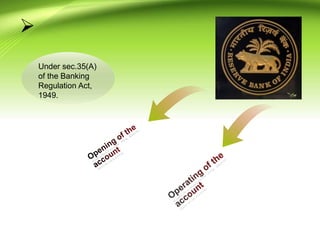
Under sec.35(A)
of the Banking
Regulation Act,
1949.

• To establish the identity of the customer.
• To ensure that sufficient information is
obtained on the nature of customer's
business and sources of fund for the
purpose of opening the account.
• To prevent banks from being used,
intentionally or unintentionally by criminal
elements for money laundering services.
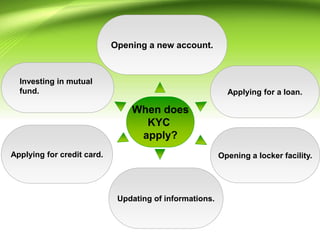
When does
KYC
apply?
Opening a new account.
Updating of informations.
Applying for a loan.
Applying for credit card. Opening a locker facility.
Investing in mutual
fund.
 Banks should treat the Informations collected from the
customers confidential.
 Banks should ensure that any remittance of funds above
Rs.50,000 is effected by debit to customers account.
 Banks should not make payment of cheques,drafts,etc if
the customers present it after the period of six months.
 Banks should ensure that the provision of foreign
regulation act,2010, wherever applicable, are strictly
adhered to.
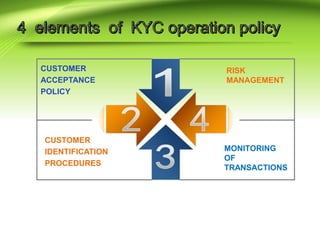
CUSTOMER
ACCEPTANCE
POLICY
CUSTOMER
IDENTIFICATION
PROCEDURES
MONITORING
OF
TRANSACTIONS
RISK
MANAGEMENT
RISK PROFILE OF DIFFERENT CATRGORIES OF CUSTOMERS:
 Salaried group - LOW RISK
 Businessman - MEDIUM RISK
 Customers operates through agents - HIGH RISK
customers are required to submit the following documents :
Identity
proof
Address
proof
Voter's identity card
PAN card
Passport
Driving license
Ration card
Adhar card
Phone bill
Electricity bill
Letter from employer
Bank statement
Ration card
 ATTENTION ON LARGE AMOUNT OF DEPOSITS
 EYE ON TRANSACTIONS OF CUSTOMERS
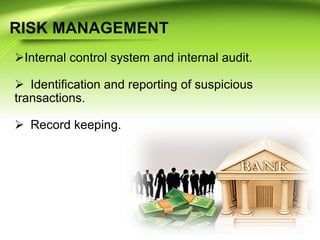
Internal control system and internal audit.
 Identification and reporting of suspicious
transactions.
 Record keeping.
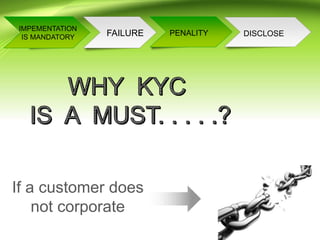
IMPEMENTATION
IS MANDATORY FAILURE PENALITY DISCLOSE
If a customer does
not corporate
Kyc norms2

Kyc norms2

  • 3.
    - KYC enablesbanks to know/ understand their customers and their financial dealings to be able to serve them better.
  • 5.
    Under sec.35(A) of theBanking Regulation Act, 1949. 
  • 6.
    • To establishthe identity of the customer. • To ensure that sufficient information is obtained on the nature of customer's business and sources of fund for the purpose of opening the account. • To prevent banks from being used, intentionally or unintentionally by criminal elements for money laundering services.
  • 7.
    When does KYC apply? Opening anew account. Updating of informations. Applying for a loan. Applying for credit card. Opening a locker facility. Investing in mutual fund.
  • 8.
     Banks shouldtreat the Informations collected from the customers confidential.  Banks should ensure that any remittance of funds above Rs.50,000 is effected by debit to customers account.  Banks should not make payment of cheques,drafts,etc if the customers present it after the period of six months.  Banks should ensure that the provision of foreign regulation act,2010, wherever applicable, are strictly adhered to.
  • 9.
  • 10.
    RISK PROFILE OFDIFFERENT CATRGORIES OF CUSTOMERS:  Salaried group - LOW RISK  Businessman - MEDIUM RISK  Customers operates through agents - HIGH RISK
  • 11.
    customers are requiredto submit the following documents : Identity proof Address proof Voter's identity card PAN card Passport Driving license Ration card Adhar card Phone bill Electricity bill Letter from employer Bank statement Ration card
  • 12.
     ATTENTION ONLARGE AMOUNT OF DEPOSITS  EYE ON TRANSACTIONS OF CUSTOMERS
  • 13.
    Internal control systemand internal audit.  Identification and reporting of suspicious transactions.  Record keeping.
  • 14.
    IMPEMENTATION IS MANDATORY FAILUREPENALITY DISCLOSE If a customer does not corporate