What is this Docker thing?
• A	company?
• A	format?
• An	API?
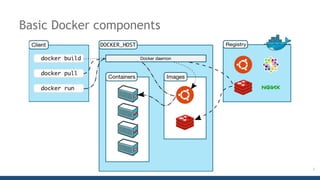
Basic Docker components
3
Kube what?
4
Kubernetes
Greek	for	“Helmsman”;	also	the	root	of	the	words	
“governor”	and “cybernetic”
• Runs	and	manages	containers
• Inspired	and	informed	by	Google’s	experiences	and	
internal	systems
• Supports	multiple	cloud	and	bare-metal	
environments
• Supports	multiple	container	runtimes
• 100%	Open	source,	written	in	Go
Manage	applications,	not	machines
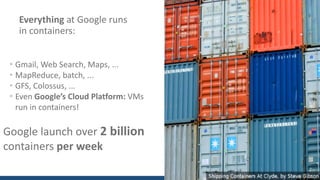
Everything at	Google	runs	
in	containers:
• Gmail,	Web	Search,	Maps,	...
• MapReduce,	batch,	...
• GFS,	Colossus,	...
• Even	Google’s	Cloud	Platform: VMs	
run	in	containers!
Google	launch	over	2	billion
containers	per	week
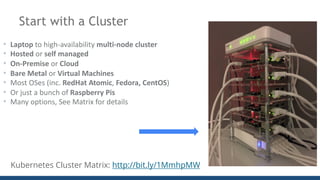
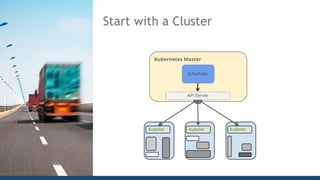
Start with a Cluster
• Laptop to	high-availability	multi-node	cluster
• Hosted or	self	managed
• On-Premise or	Cloud
• Bare	Metal or	Virtual	Machines
• Most	OSes	(inc. RedHat Atomic,	Fedora,	CentOS)
• Or	just	a	bunch	of	Raspberry	Pis
• Many	options,	See	Matrix	for	details
Kubernetes Cluster Matrix: http://bit.ly/1MmhpMW
etcd
scheduler
controller-manager
apiserver
kubelet docker kube-proxy iptables
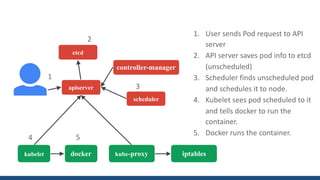
1. User	sends	Pod	request	to	API	
server
2. API	server	saves	pod	info	to	etcd
(unscheduled)
3. Scheduler	finds	unscheduled	pod	
and	schedules	it	to	node.
4. Kubelet sees	pod	scheduled	to	it	
and	tells	docker to	run	the	
container.
5. Docker	runs	the	container.
1
2
5
3
4
Kubelet Kubelet Kubelet
Kubernetes Master
Scheduler
API Server
Start with a Cluster
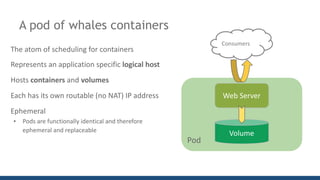
The	atom	of	scheduling	for	containers
Represents	an	application	specific	logical	host
Hosts	containers and	volumes
Each	has	its	own	routable	(no	NAT)	IP	address
Ephemeral
• Pods	are	functionally	identical	and	therefore	
ephemeral	and	replaceable
Pod
Web	Server
Volume
Consumers
A pod of whales containers
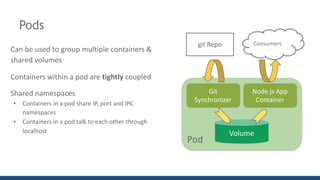
Pods
Pod
Git
Synchronizer
Node.js	App	
Container
Volume
Consumersgit	Repo
Can	be	used	to	group	multiple	containers	&	
shared	volumes	
Containers	within	a	pod	are tightly coupled
Shared	namespaces
• Containers	in	a	pod	share	IP,	port	and	IPC	
namespaces
• Containers	in	a	pod	talk	to	each	other	through	
localhost
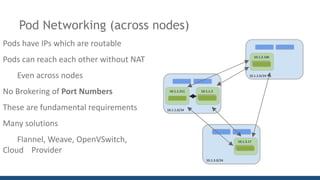
Pod Networking (across nodes)
Pods	have	IPs	which	are	routable
Pods	can	reach	each	other	without	NAT
Even	across	nodes
No	Brokering	of	Port	Numbers
These	are	fundamental	requirements
Many	solutions
Flannel,	Weave,	OpenVSwitch,	
Cloud	 Provider
10.1.2.0/24
10.1.1.0/24
10.1.1.211 10.1.1.2
10.1.2.106
10.1.3.0/24
10.1.3.4510.1.3.17
10.1.3.0/24
Client
Pod
Container
Pod
Container
Pod
ContainerContainer
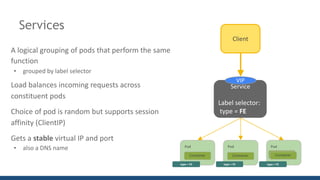
A	logical	grouping	of	pods	that	perform	the	same	
function
• grouped	by	label	selector
Load	balances	incoming	requests	across	
constituent	pods
Choice	of	pod	is	random	but	supports	session	
affinity	(ClientIP)
Gets	a	stable virtual	IP	and	port
• also	a	DNS	nametype =	FE
Services
Service
Label	selector:
type	=	FE
VIP
type	=	FE type	=	FE type	=	FE
Pod
Pod
frontend
Pod
frontend
Pod Pod
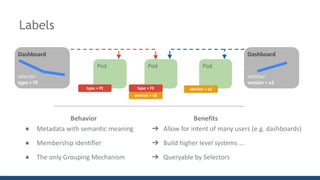
type	=	FE
version	=	v2
type	=	FE version	=	v2
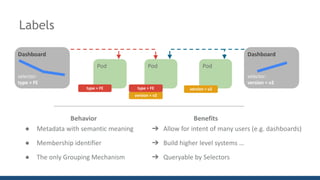
● Metadata	with	semantic	meaning
● Membership	identifier
● The	only	Grouping	Mechanism
Behavior Benefits
➔ Allow	for	intent	of	many	users	(e.g.	dashboards)
➔ Build	higher	level	systems	…	
➔ Queryable	by	Selectors
Labels
Dashboard
selector:	
type	=	FE
Dashboard
selector:	
version	=	v2
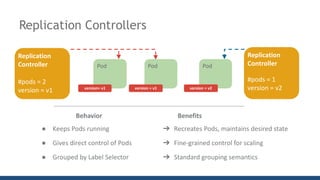
Replication	
Controller
Pod
Pod
frontend
Pod
frontend
Pod Pod
Replication	
Controller
#pods	=	1
version	=	v2
show:	version	=	v2
version=	v1 version	=	v1 version	=	v2
Replication	
Controller
#pods	=	2
version	=	v1
show:	version	=	v2
Behavior Benefits
● Keeps	Pods	running
● Gives	direct	control	of	Pods
● Grouped	by	Label	Selector
➔ Recreates	Pods,	maintains	desired	state
➔ Fine-grained	control	for	scaling	
➔ Standard	grouping	semantics
Replication Controllers
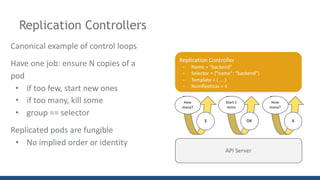
Replication	Controller
- Name	=	“backend”
- Selector	=	{“name”:	“backend”}
- Template	=	{	...	}
- NumReplicas	=	4
API	Server
3
Start	1	
more
OK 4
How	
many?
How	
many?
Canonical	example	of	control	loops
Have	one	job:	ensure	N	copies	of	a	
pod
• if	too	few,	start	new	ones
• if	too	many,	kill	some
• group	==	selector
Replicated	pods	are	fungible
• No	implied	order	or	identity
Pod
Pod
frontend
Pod
frontend
Pod Pod
type	=	FE
version	=	v2
type	=	FE version	=	v2
● Metadata	with	semantic	meaning
● Membership	identifier
● The	only	Grouping	Mechanism
Behavior Benefits
➔ Allow	for	intent	of	many	users	(e.g.	dashboards)
➔ Build	higher	level	systems	…	
➔ Queryable	by	Selectors
Labels
Dashboard
selector:	
type	=	FE
Dashboard
selector:	
version	=	v2
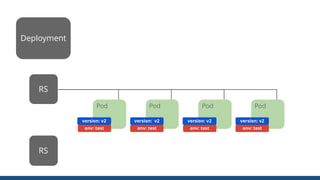
Deployment
RS
RS
Pod Pod Pod
env: test env: test env: test
Pod
env: test
version: v2 version: v2 version: v2 version: v2
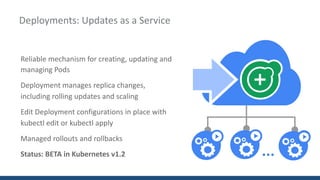
Reliable	mechanism	for	creating,	updating	and	
managing	Pods
Deployment	manages	replica	changes,	
including	rolling	updates	and	scaling	
Edit	Deployment	configurations	in	place	with	
kubectl	edit or	kubectl	apply
Managed	rollouts	and	rollbacks	
Status:	BETA	in	Kubernetes	v1.2
Deployments:	Updates	as	a	Service
...
Pod
Pod
frontend
Pod
frontend
Pod Pod
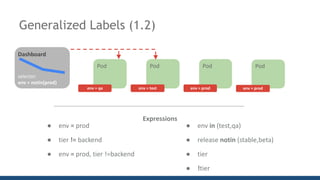
env	=	qa env	=	test
● env	= prod		
● tier	!= backend
● env	= prod,	tier	!=backend
Expressions
● env	in (test,qa)
● release	notin (stable,beta)
● tier
● !tier
Generalized Labels (1.2)
env	=	prod
Pod
env	=	prod
Dashboard
selector:	
env	=	notin(prod)
Replication	
Controller Pod
Pod
frontend
Pod
frontend
Pod Pod
app	=	demo app	=	demo app	=	demo
ReplicaSet
#pods	=	3
app	=	demo
color	in	(blue,grey)
show:	version	=	v2
Similar	to	ReplicationController	but	supports	generalized	Selectors	
ReplicaSets	(1.2)
selector:
matchLabels:
app:	demo
matchExpressions:
- {key:	color,	operator:	In,	values:	[blue,grey]}
color	=	blue color	=	blue color	=	grey
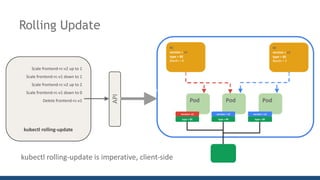
Rolling Update
kubectl	rolling-update
API
kubectl	rolling-update
Create	frontend-rc-v2
kubectl	rolling-update
Create	frontend-rc-v2
Scale	frontend-rc-v2	up	to	1
kubectl	rolling-update
Create	frontend-rc-v2
Scale	frontend-rc-v2	up	to	1
Scale	frontend-rc-v1	down	to	1
kubectl	rolling-update
Create	frontend-rc-v2
Scale	frontend-rc-v2	up	to	1
Scale	frontend-rc-v1	down	to	1
Scale	frontend-rc-v2	up	to	2
kubectl	rolling-update
Create	frontend-rc-v2
Scale	frontend-rc-v2	up	to	1
Scale	frontend-rc-v1	down	to	1
Scale	frontend-rc-v2	up	to	2
Scale	frontend-rc-v1	down	to	0
kubectl	rolling-update
Scale	frontend-rc-v2	up	to	1
Scale	frontend-rc-v1	down	to	1
Scale	frontend-rc-v2	up	to	2
Scale	frontend-rc-v1	down	to	0
Delete	frontend-rc-v1 Pod Pod
frontend
Pod
version	=	v1version	=	v2version=	v1
RC
version	= v1
type	= BE
#pods	=	2
show:	version	=	v2
type	=	BE type	=	BE
RC
version	= v2
type	= BE
#pods	=	0
show:	version	=	v2
Pod
version	=	v2
type	=	BE
kubectl rolling-update	is	imperative,	client-side
RC
version	= v1
type	= BE
#pods	=	2
show:	version	=	v2
RC
version	= v1
type	= BE
#pods	=	1
show:	version	=	v2
RC
version	= v1
type	= BE
#pods	=	0
show:	version	=	v2
RC
version	= v2
type	= BE
#pods	=	1
show:	version	=	v2
RC
version	= v2
type	= BE
#pods	=	2
show:	version	=	v2
be-svc
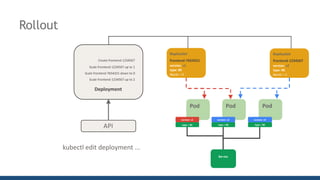
Rollout
API
DeploymentDeployment
Create	frontend-1234567
Deployment
Create	frontend-1234567
Scale	frontend-1234567	up	to	1
Deployment
Create	frontend-1234567
Scale	frontend-1234567	up	to	1
Scale	frontend-7654321	down	to	0
Pod Pod
frontend
Pod
version	=	v1
ReplicaSet
frontend-1234567
version	= v2
type	= BE
#pods	=	0
show:	version	=	v2
ReplicaSet
frontend-7654321
version	= v1
type	= BE
#pods	=	2
version:	v2
ReplicaSet
frontend-7654321
version:	v1
type:	BE
#pods	=	0
version:	v1
ReplicaSet
frontend-1234567
version	= v2
type	= BE
#pods	=	1
show:	version	=	v2
ReplicaSet
frontend-1234567
version:	v2
type:	BE
#pods	=	2
type	=	BE type	=	BE
Pod
version:	v2
type	=	BE
Servic
e
be-svc
Deployment
Create	frontend-1234567
Scale	frontend-1234567	up	to	1
Scale	frontend-7654321	down	to	0
Scale	frontend-1234567	up	to	2
kubectl	edit	deployment	...
Thank you
www.loodse.com
@Loodse
github.com/loodse/

Kubernetes Frankfurt