Chapter 6:
           Miracles


Pocket handbook of Christian apologetics (2003)
         Peter Kreeft & Ronald Tacelli
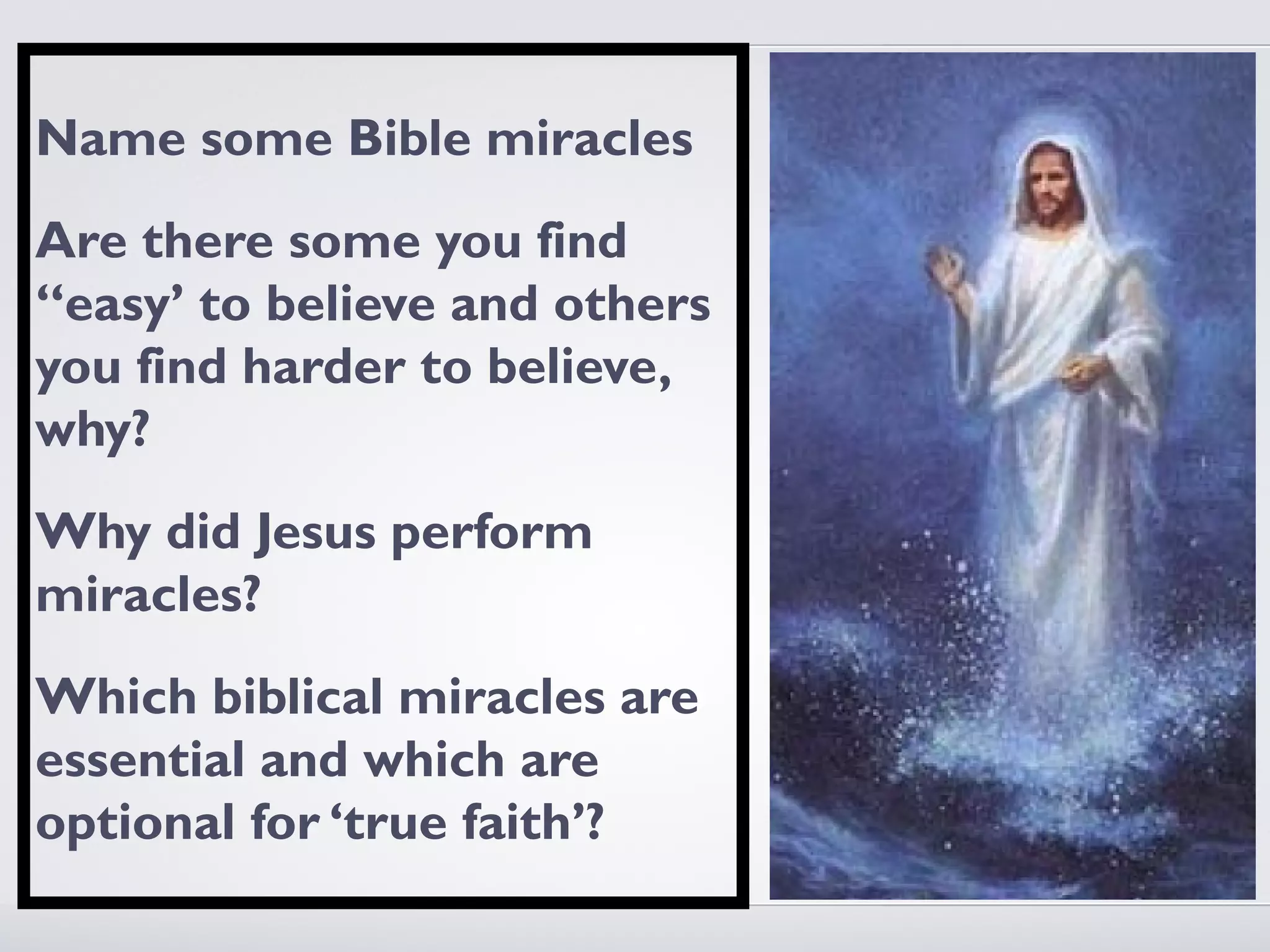
Name some Bible miracles
Are there some you find
“easy’ to believe and others
you find harder to believe,
why?
Why did Jesus perform
miracles?
Which biblical miracles are
essential and which are
optional for ‘true faith’?
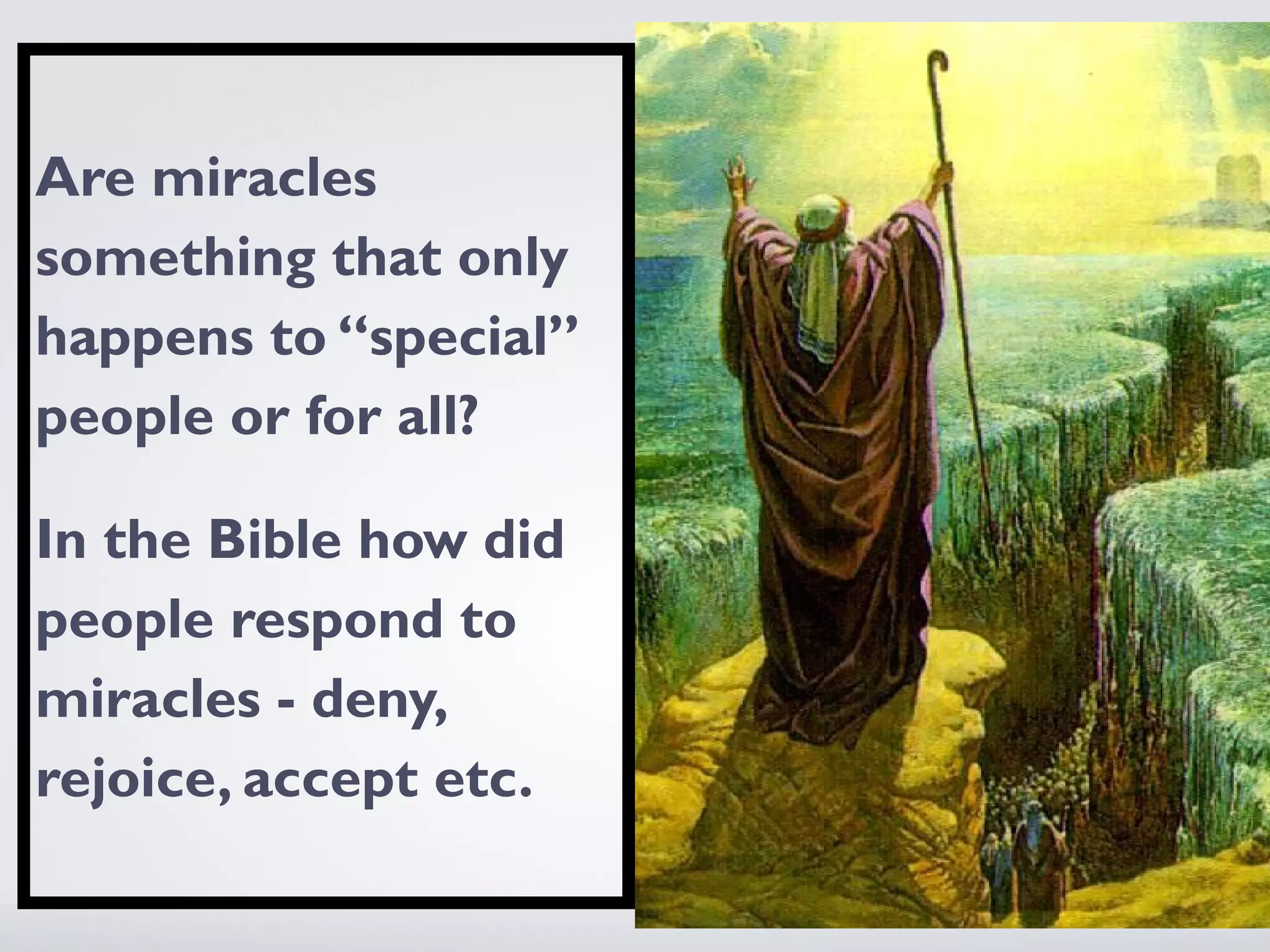
Are miracles
something that only
happens to “special”
people or for all?

In the Bible how did
people respond to
miracles - deny,
rejoice, accept etc.
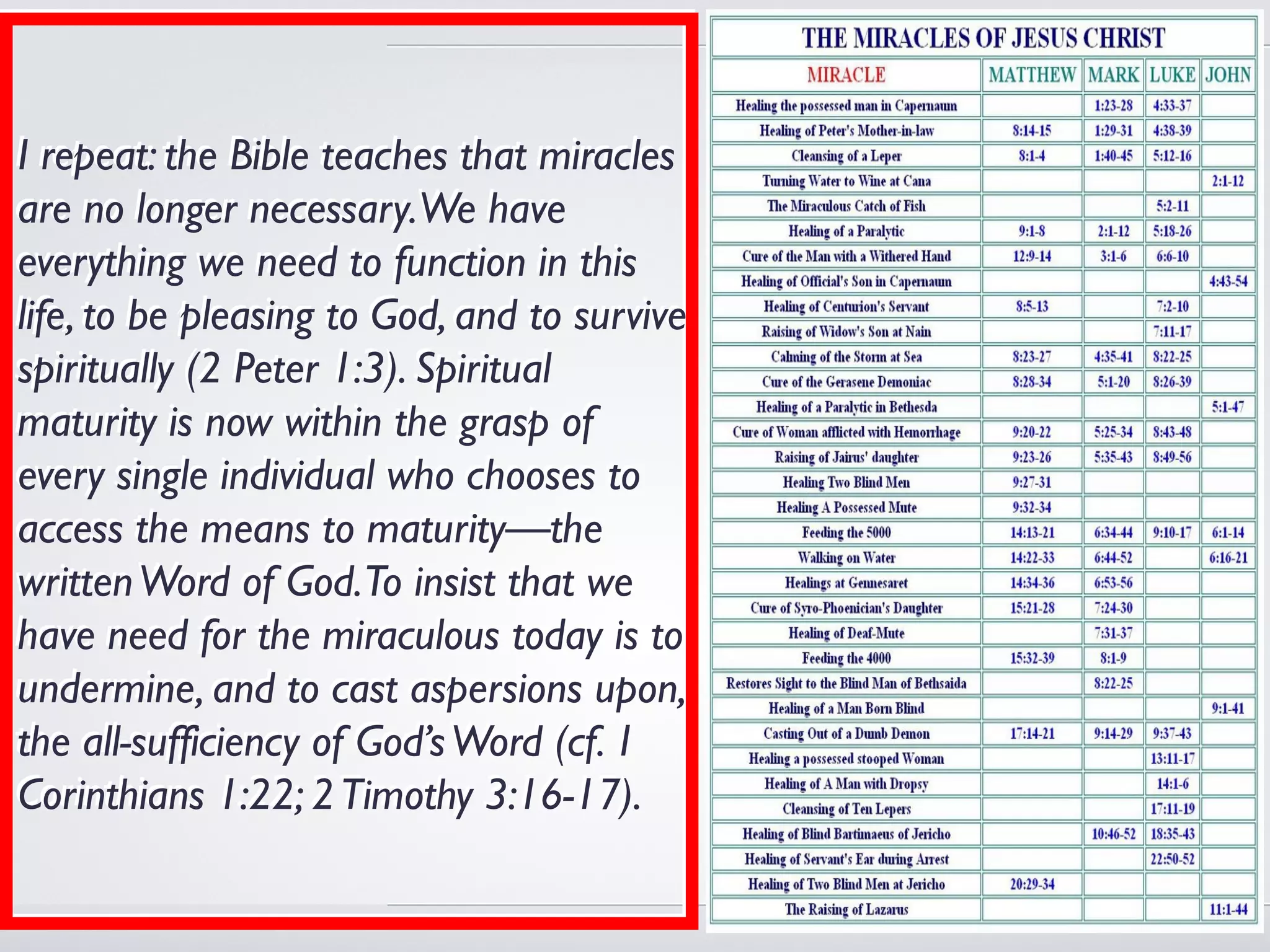
Jesus - Which miracles do you believe?
Born of a virgin           Fed the 5000
Water into wine            Cast out demons
Healed a paralytic         Rose from the dead
Healed blind, deaf, mute Calmed the storm
Appeared to the disciples after the resurrection

     CARM has a paper looking at miracles and
     CARM has a paper looking at miracles and
       rebutting arguments against miracles
       rebutting arguments against miracles
    http://carm.org/questions/about-jesus/cant-all-jesus-
     http://carm.org/questions/about-jesus/cant-all-jesus-
                miracles-be-explained-naturally
                 miracles-be-explained-naturally
The Objections most frequently leveled by
critics of Christ's resurrection
- Christ's resurrection is a myth, not history.
       How would you
- The resurrection stories are full of
contradictions.
        counter such
- Miracles are not possible.
- The body was stolen.
         arguments?
- Jesus only fainted and then recovered from his
wounds.
- The witnesses were just “seeing things.”
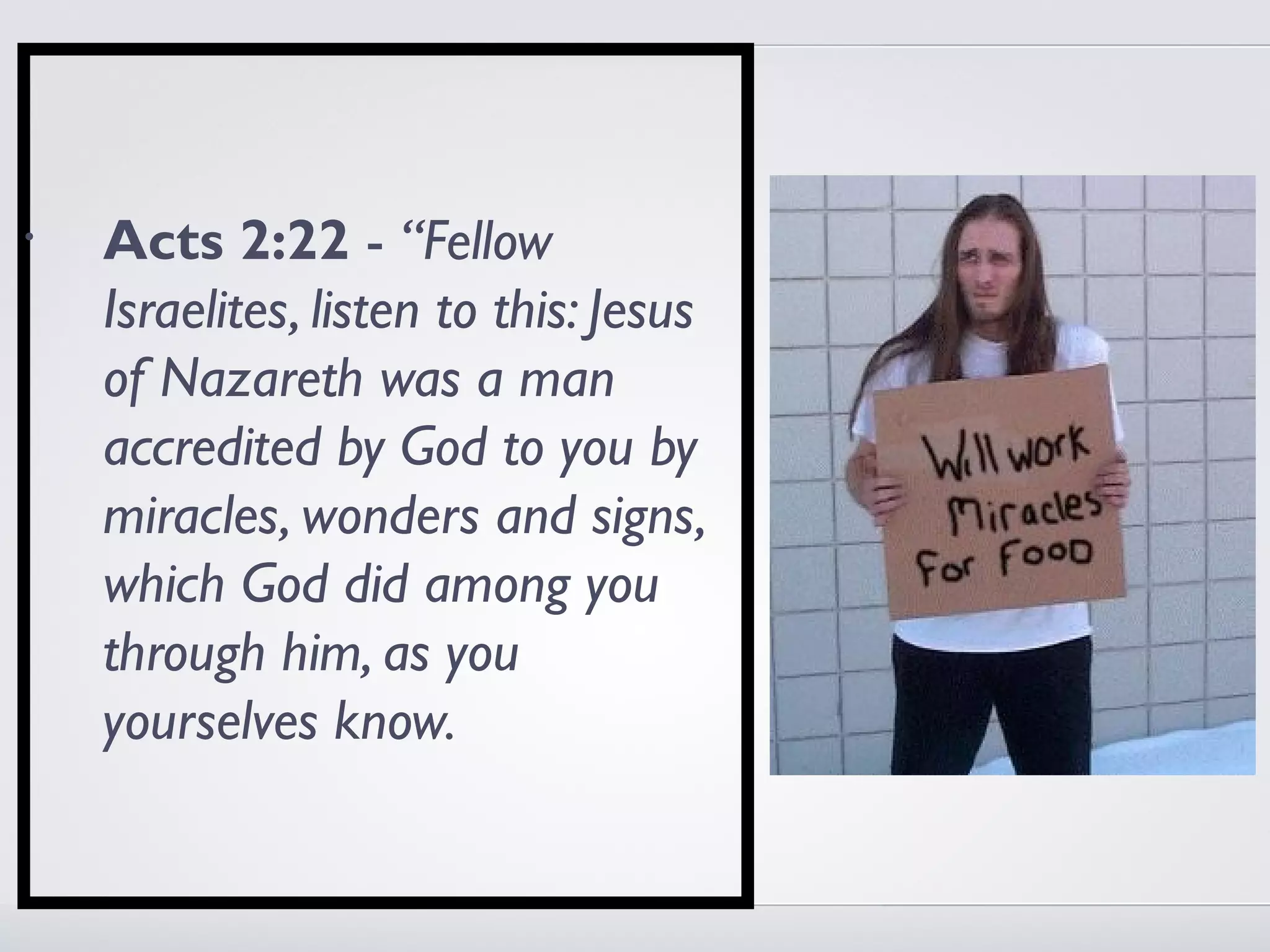
•   Acts 2:22 - “Fellow
    Israelites, listen to this: Jesus
    of Nazareth was a man
    accredited by God to you by
    miracles, wonders and signs,
    which God did among you
    through him, as you
    yourselves know.
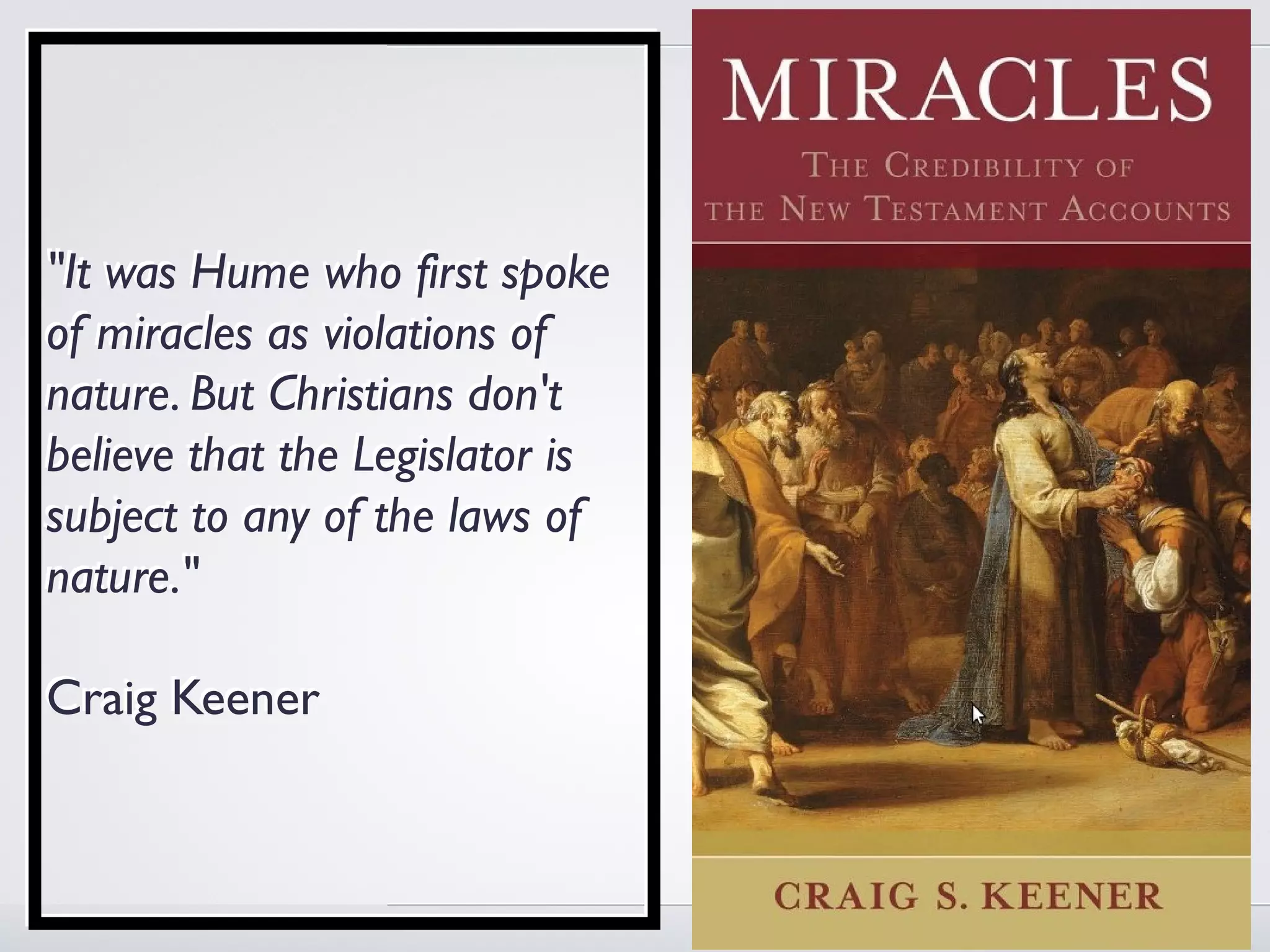
"It was Hume who first spoke
of miracles as violations of
nature. But Christians don't
believe that the Legislator is
subject to any of the laws of
nature."

Craig Keener
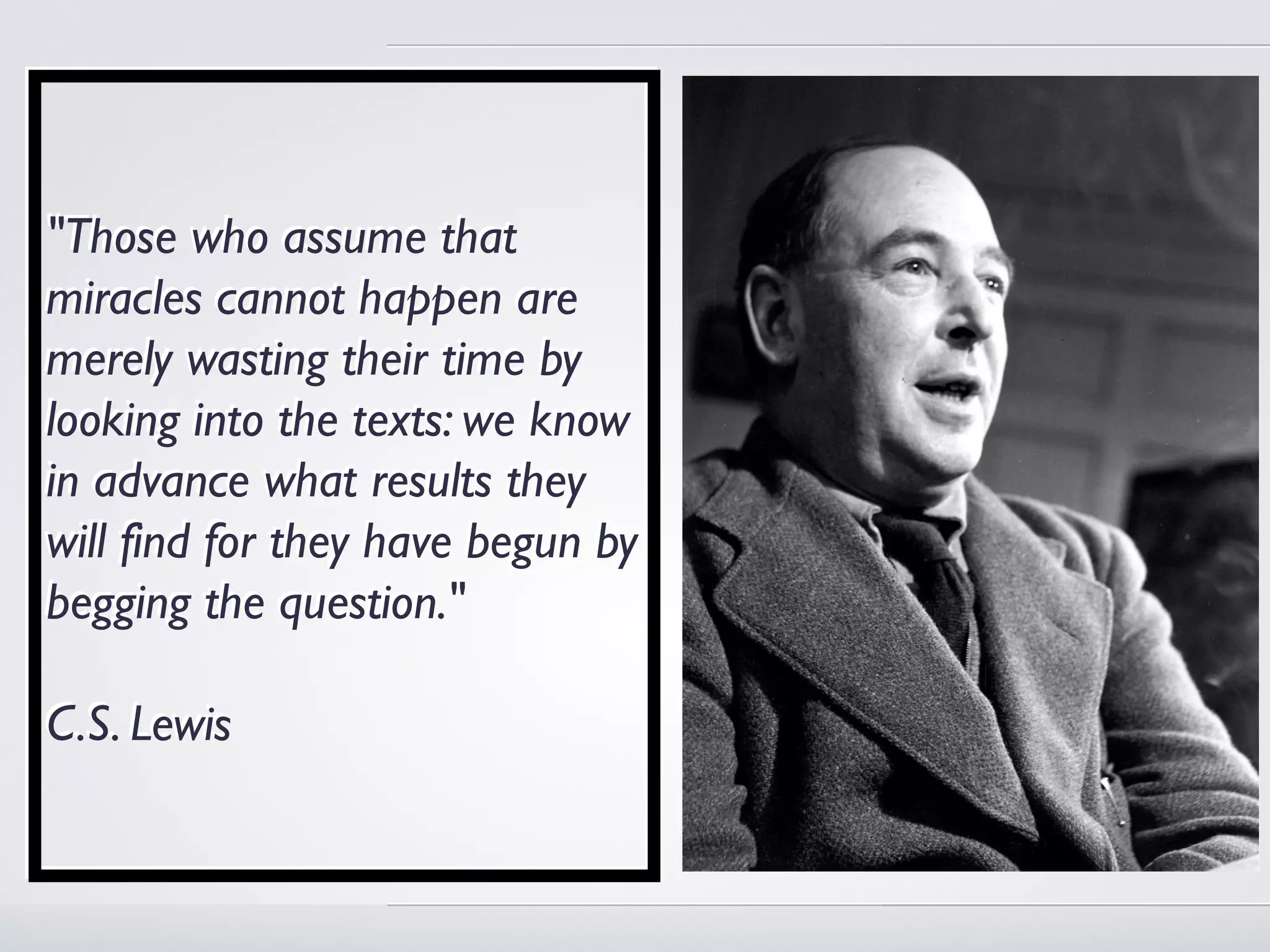
"Those who assume that
miracles cannot happen are
merely wasting their time by
looking into the texts: we know
in advance what results they
will find for they have begun by
begging the question."

C.S. Lewis
Why believe the biblical miracles?
1. God made the universe out of nothing
- a miracle is easy after that.
2.The factual nature of the miracle
stories is evident from the text of
Scripture - there were witnesses to the
healings etc. - nothing in the description
of the miracle events remotely suggests
that we should look for naturalistic
explanations for the miracles. They are
presented as truly supernatural.
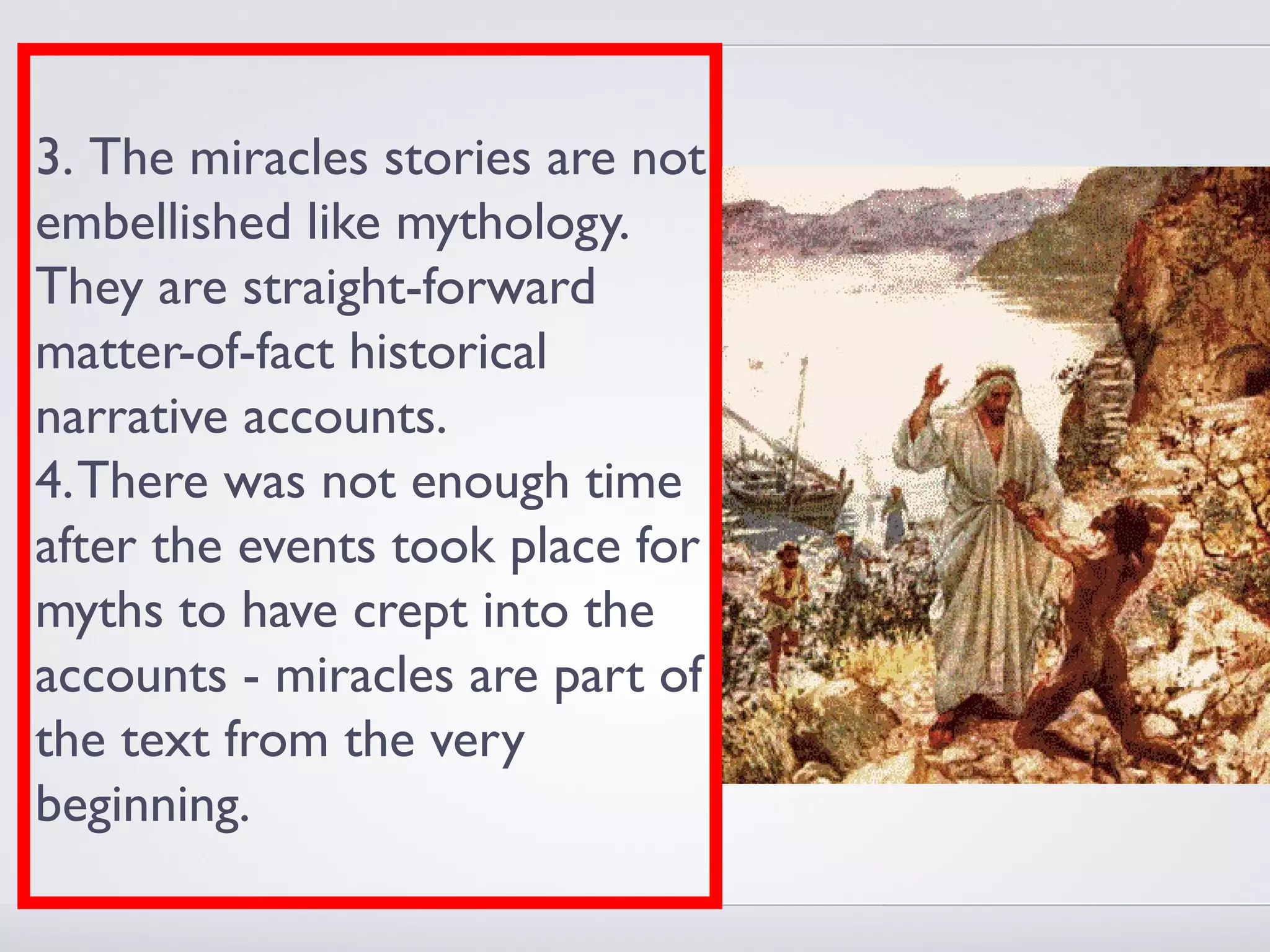
3. The miracles stories are not
embellished like mythology.
They are straight-forward
matter-of-fact historical
narrative accounts.
4. There was not enough time
after the events took place for
myths to have crept into the
accounts - miracles are part of
the text from the very
beginning.
5. The writers of the Bible attested
to Jesus’ miracles (John 2:11etc) but
Jesus himself based his claim of
divinity partly on his miracles (
Matthew 11:4-6, Luke 7:22-23,
John 10:25, 38, John 14:11,
John 15:24)
6.Jesus’ greatest miracle, the
resurrection, has overwhelming
evidence in its favor - if the
resurrection is a fact of history,
Jesus’ other miracles are believable.
7. To deny the miracles leaves
the Bible as a secular book,
which gives one the option of
ignoring it. If you start
throwing out the miracles, you
will [arguably] start picking
and choosing among other
things you like or don’t like in
the Bible.
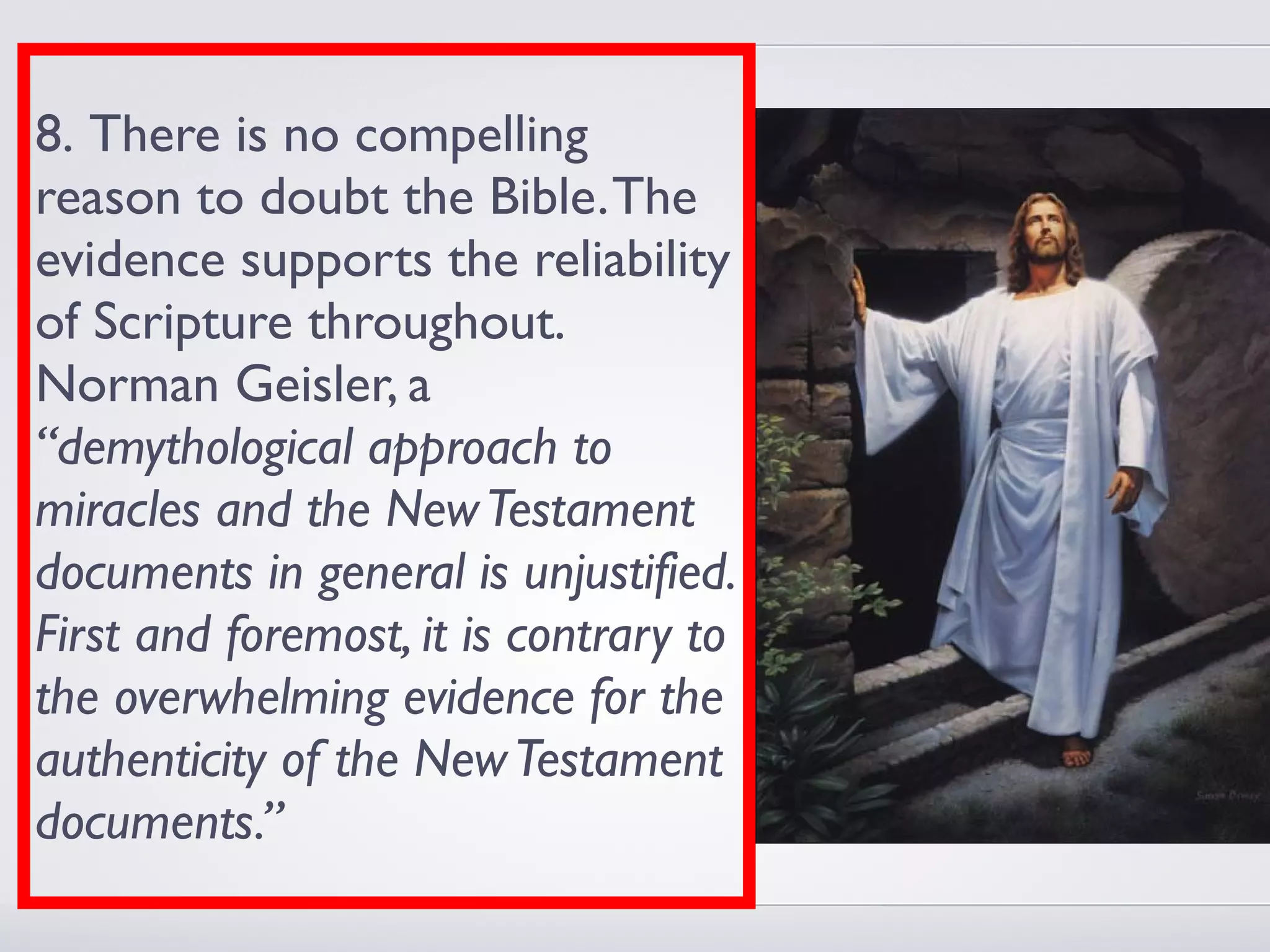
8. There is no compelling
reason to doubt the Bible. The
evidence supports the reliability
of Scripture throughout.
Norman Geisler, a
“demythological approach to
miracles and the New Testament
documents in general is unjustified.
First and foremost, it is contrary to
the overwhelming evidence for the
authenticity of the New Testament
documents.”
A miracle is
“a striking and religiously
 significant intervention
 of God in the system of
     natural causes”
William Lane Craig: A
        miracle is
 “an event which is not
producible by the natural
causes that are operative
 at the time and place
 that the event occurs”
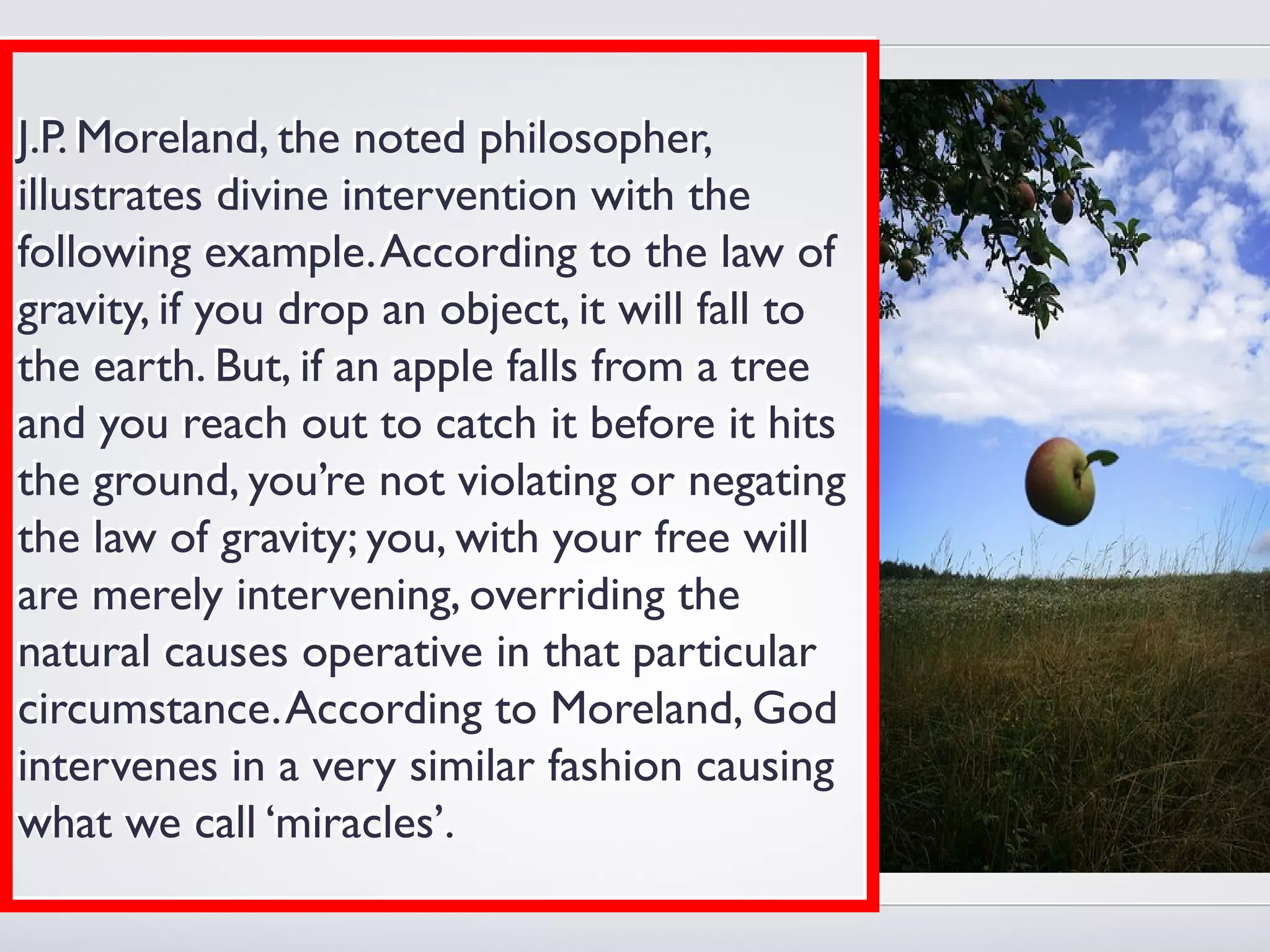
J.P. Moreland, the noted philosopher,
illustrates divine intervention with the
following example. According to the law of
gravity, if you drop an object, it will fall to
the earth. But, if an apple falls from a tree
and you reach out to catch it before it hits
the ground, you’re not violating or negating
the law of gravity; you, with your free will
are merely intervening, overriding the
natural causes operative in that particular
circumstance. According to Moreland, God
intervenes in a very similar fashion causing
what we call ‘miracles’.
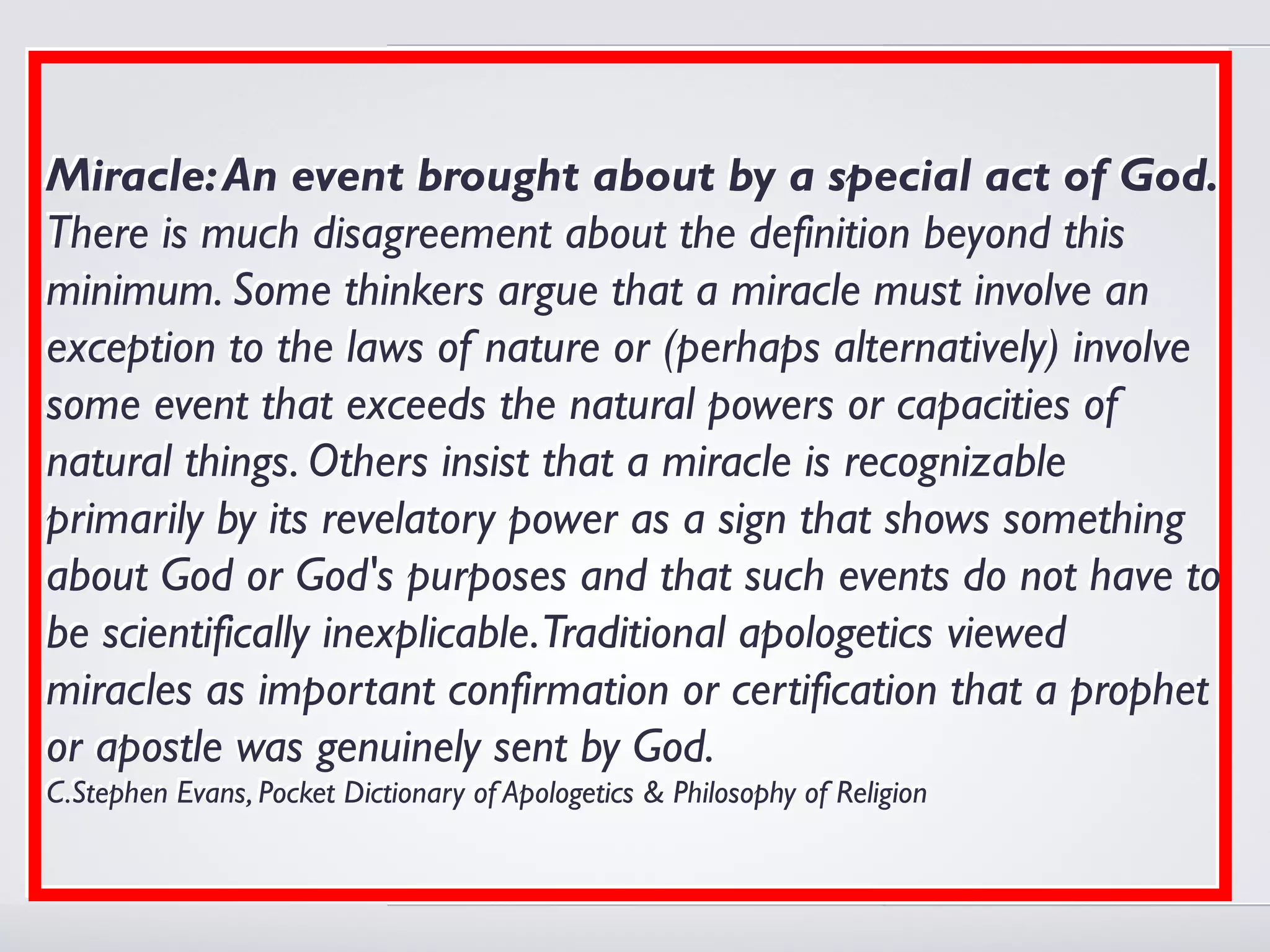
Miracle: An event brought about by a special act of God.
There is much disagreement about the definition beyond this
minimum. Some thinkers argue that a miracle must involve an
exception to the laws of nature or (perhaps alternatively) involve
some event that exceeds the natural powers or capacities of
natural things. Others insist that a miracle is recognizable
primarily by its revelatory power as a sign that shows something
about God or God's purposes and that such events do not have to
be scientifically inexplicable.Traditional apologetics viewed
miracles as important confirmation or certification that a prophet
or apostle was genuinely sent by God.
C.Stephen Evans, Pocket Dictionary of Apologetics & Philosophy of Religion
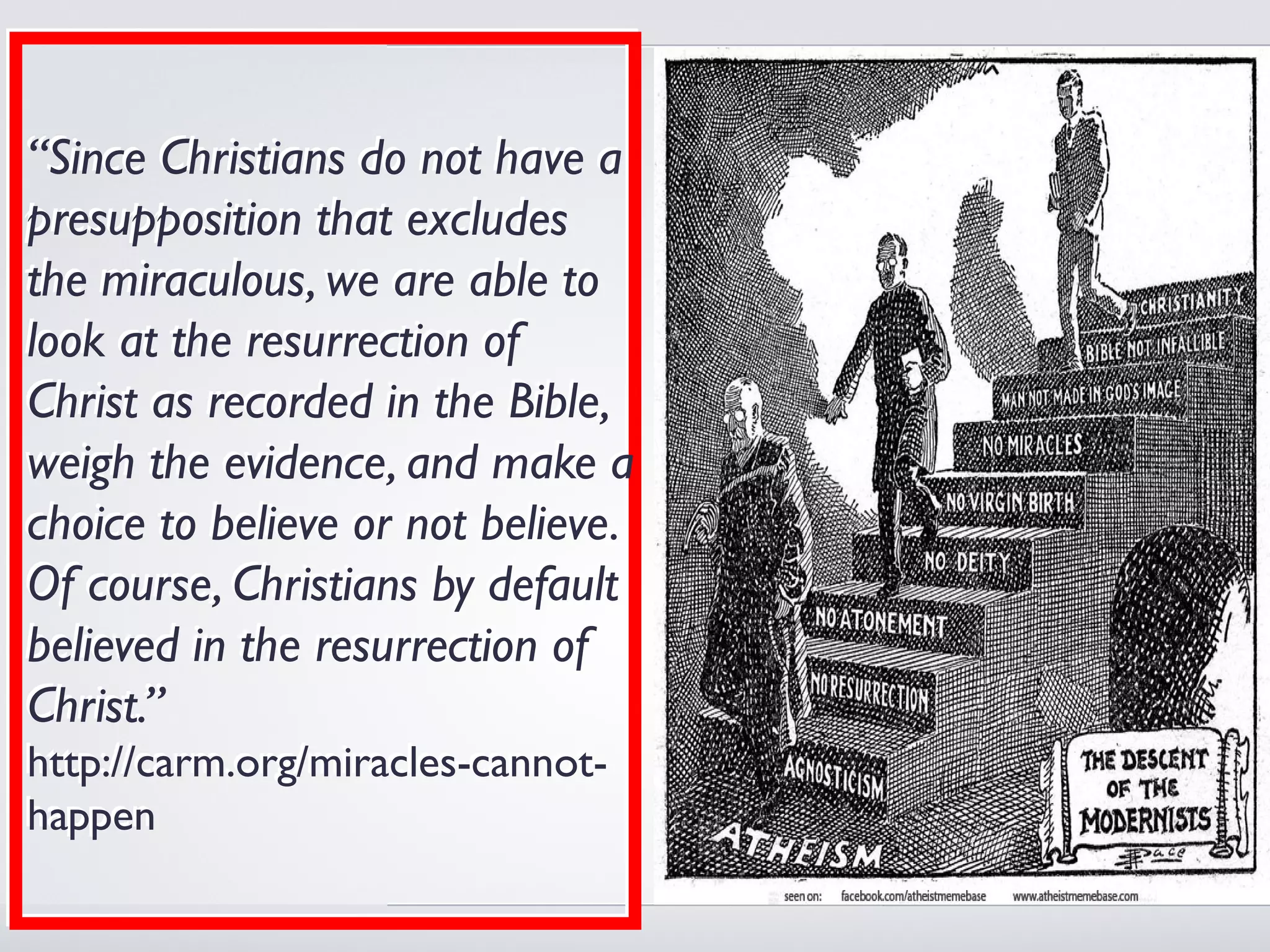
“Since Christians do not have a
presupposition that excludes
the miraculous, we are able to
look at the resurrection of
Christ as recorded in the Bible,
weigh the evidence, and make a
choice to believe or not believe.
Of course, Christians by default
believed in the resurrection of
Christ.”
http://carm.org/miracles-cannot-
happen
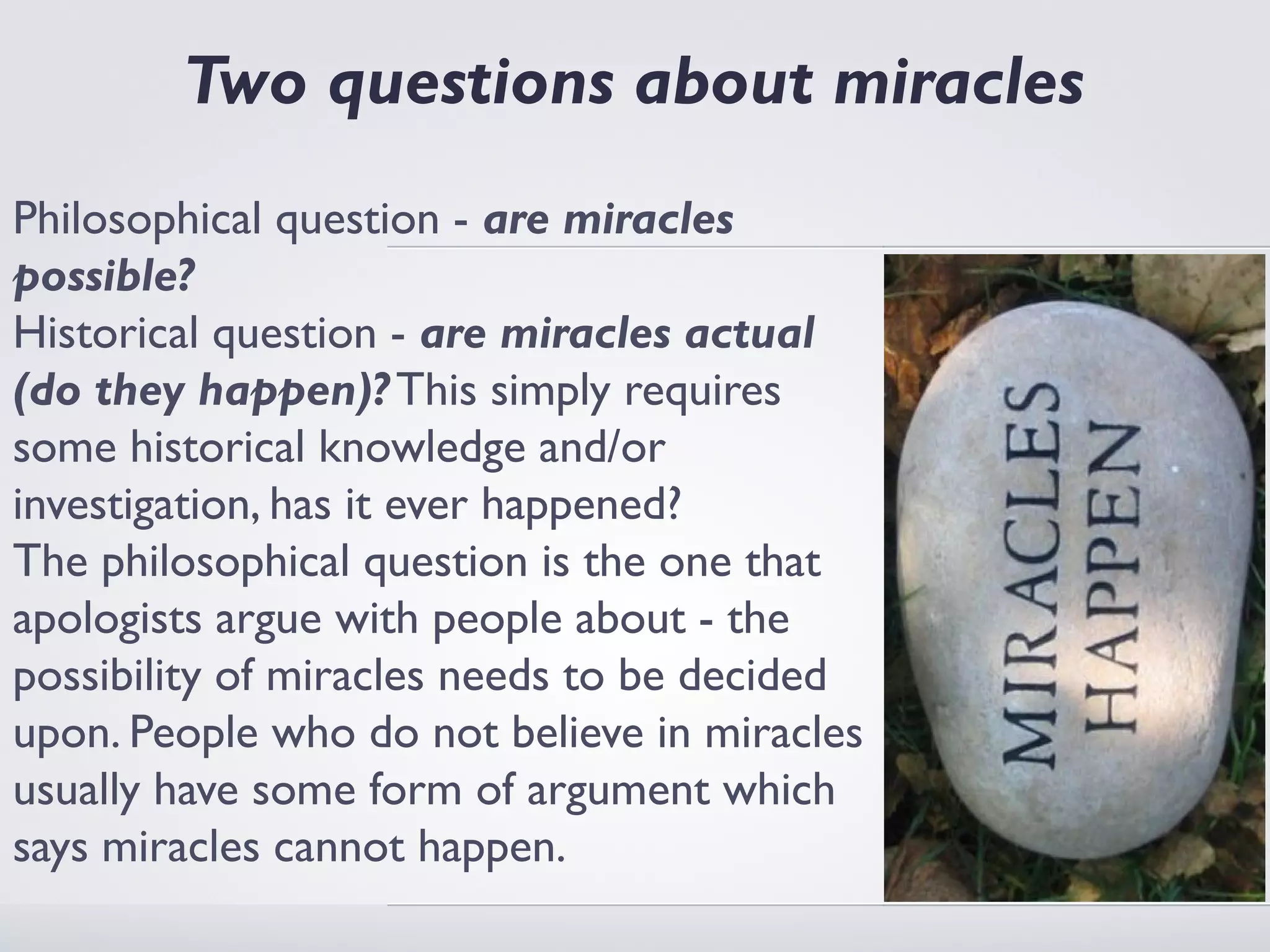
Two questions about miracles
Philosophical question - are miracles
possible?
Historical question - are miracles actual
(do they happen)? This simply requires
some historical knowledge and/or
investigation, has it ever happened?
The philosophical question is the one that
apologists argue with people about - the
possibility of miracles needs to be decided
upon. People who do not believe in miracles
usually have some form of argument which
says miracles cannot happen.
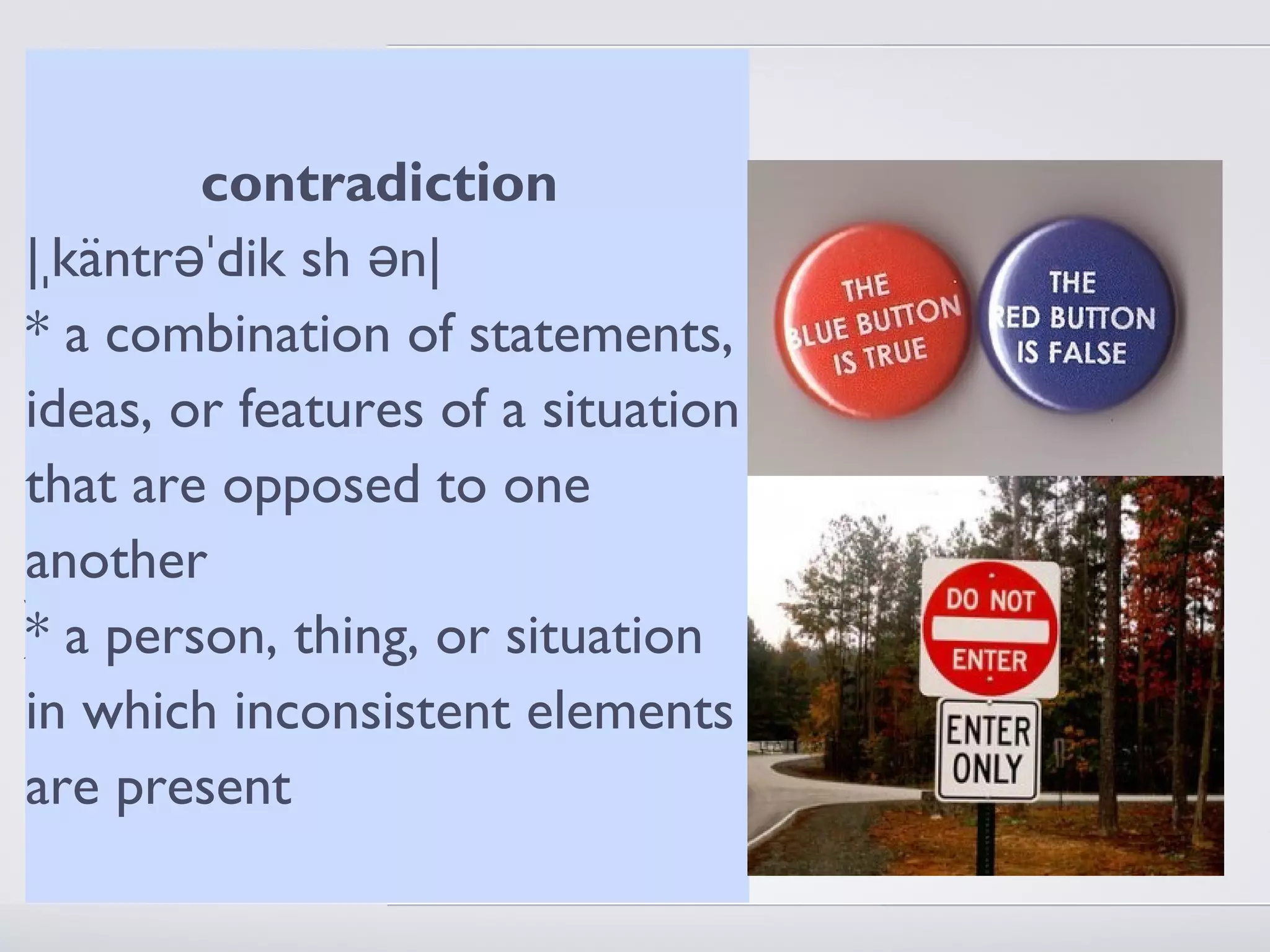
1. The idea of miracles
          contradiction
presupposes that nature is a self
|ˌkäntrəˈdik sh ə of
contained systemn| natural
causes - only in that there are
regularities can there bestatements,
* a combination of irregularities
ideas, or featuresaof a situation
2. A miracle is not contradiction
- a man walking through aone is a
that are opposed to wall
miracle, a man both walking through a
another
wall and not walking through a wall at
* a same time thing, or situation
the  person, is a contradiction - God
performs miracles but not elements
in which inconsistent
contradictions (which are
are present
meaningless)
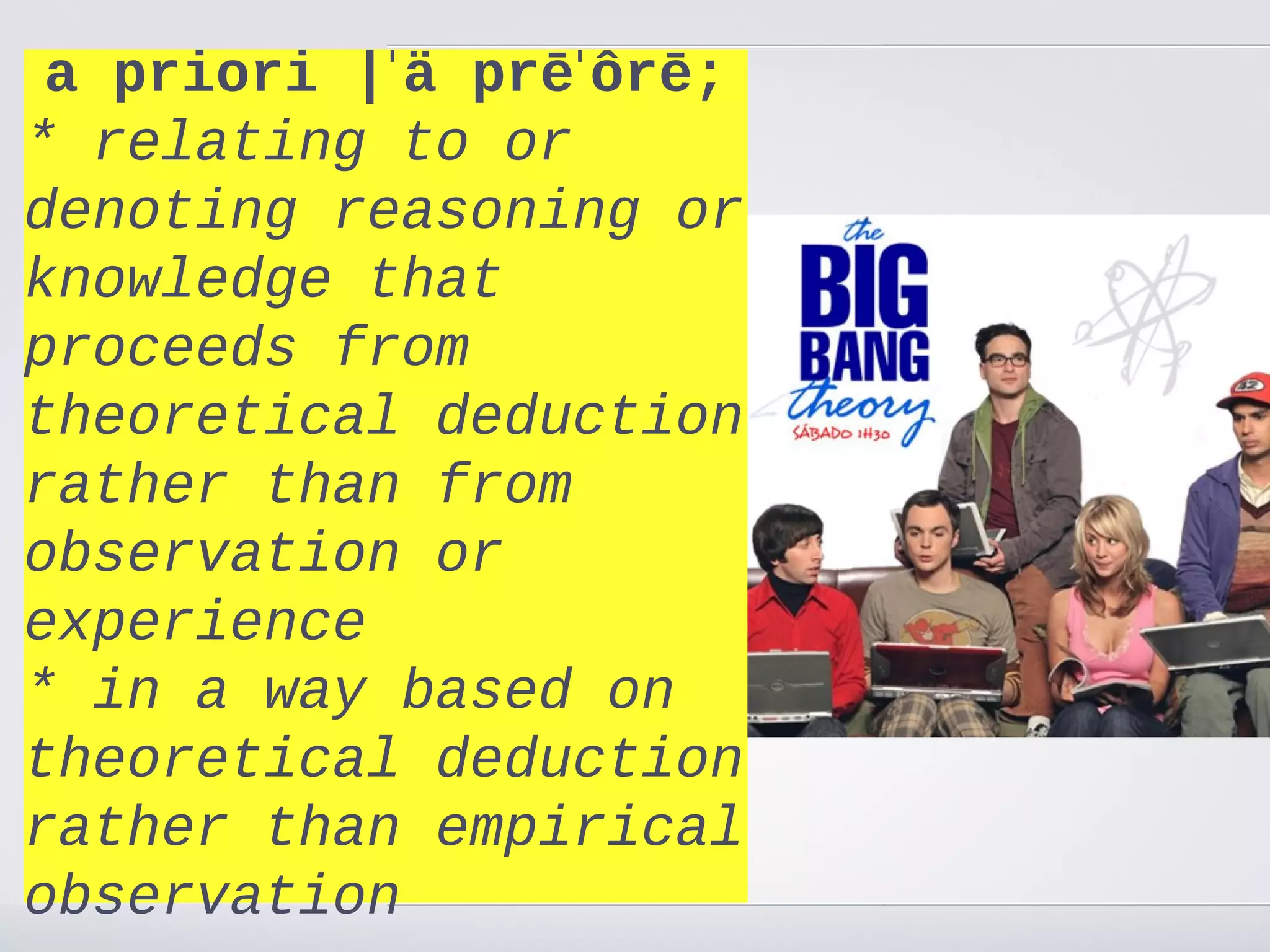
a priori |ˈ ä prēˈ ôrē;
To believe miracles happen you have
* believe in a miracle worker - you
to relating to or
denoting some form of Godor
have to believe reasoning
knowledge that
exists. Then we can say miracles are
possible - although God might
proceeds from
choose not to make this possibility a
theoretical deduction
reality.
rather than from open to
Are God and the world both
observation or
miracles happening?
experience
There is nothing in the nature of
God thata waywould not make a
* in says he based on
miracle happen - he is omnipotent
theoretical deduction
and can do it, we cannot know a
ratherwill though.
priori if he than empirical
observation
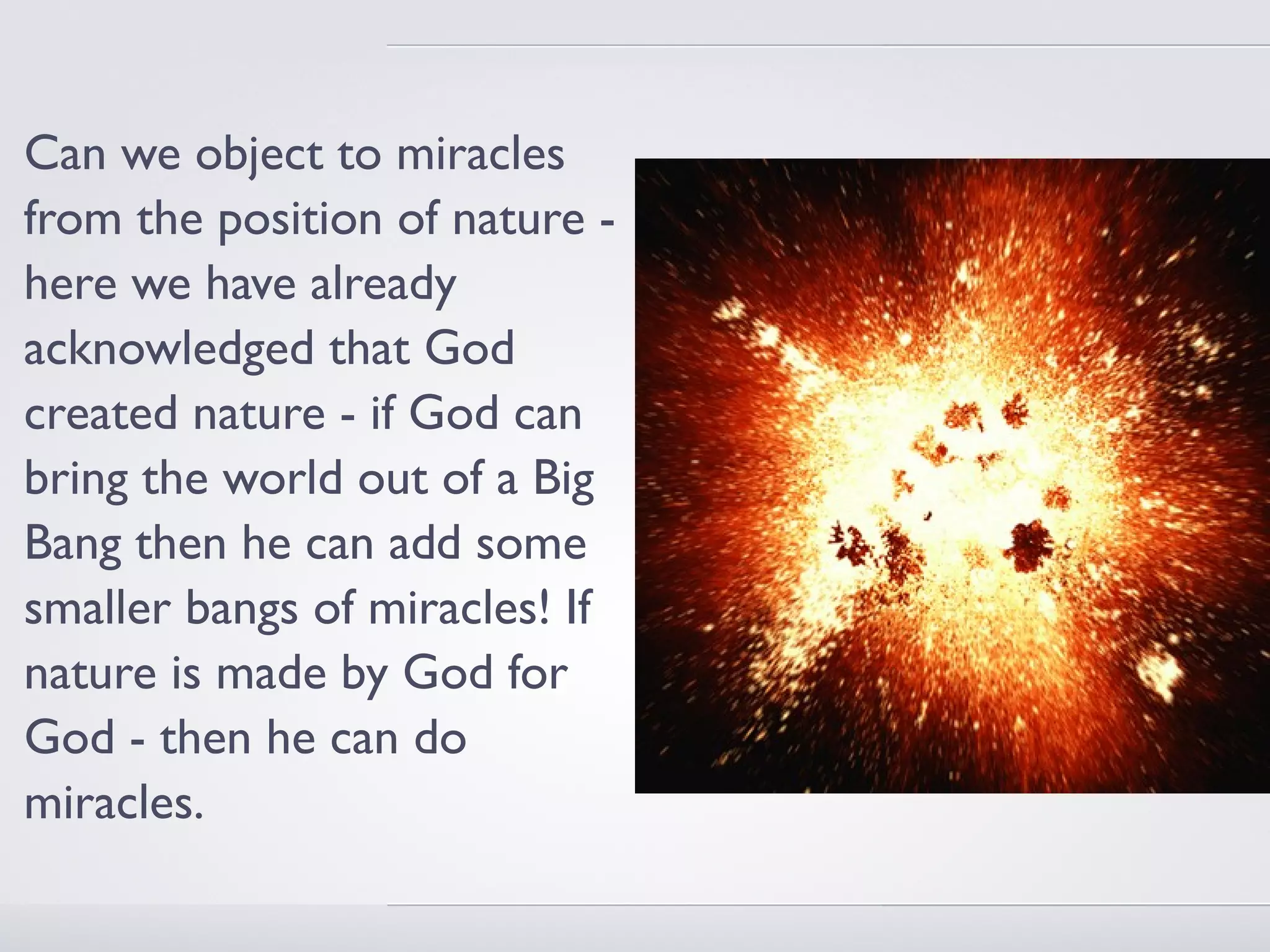
Can we object to miracles
from the position of nature -
here we have already
acknowledged that God
created nature - if God can
bring the world out of a Big
Bang then he can add some
smaller bangs of miracles! If
nature is made by God for
God - then he can do
miracles.
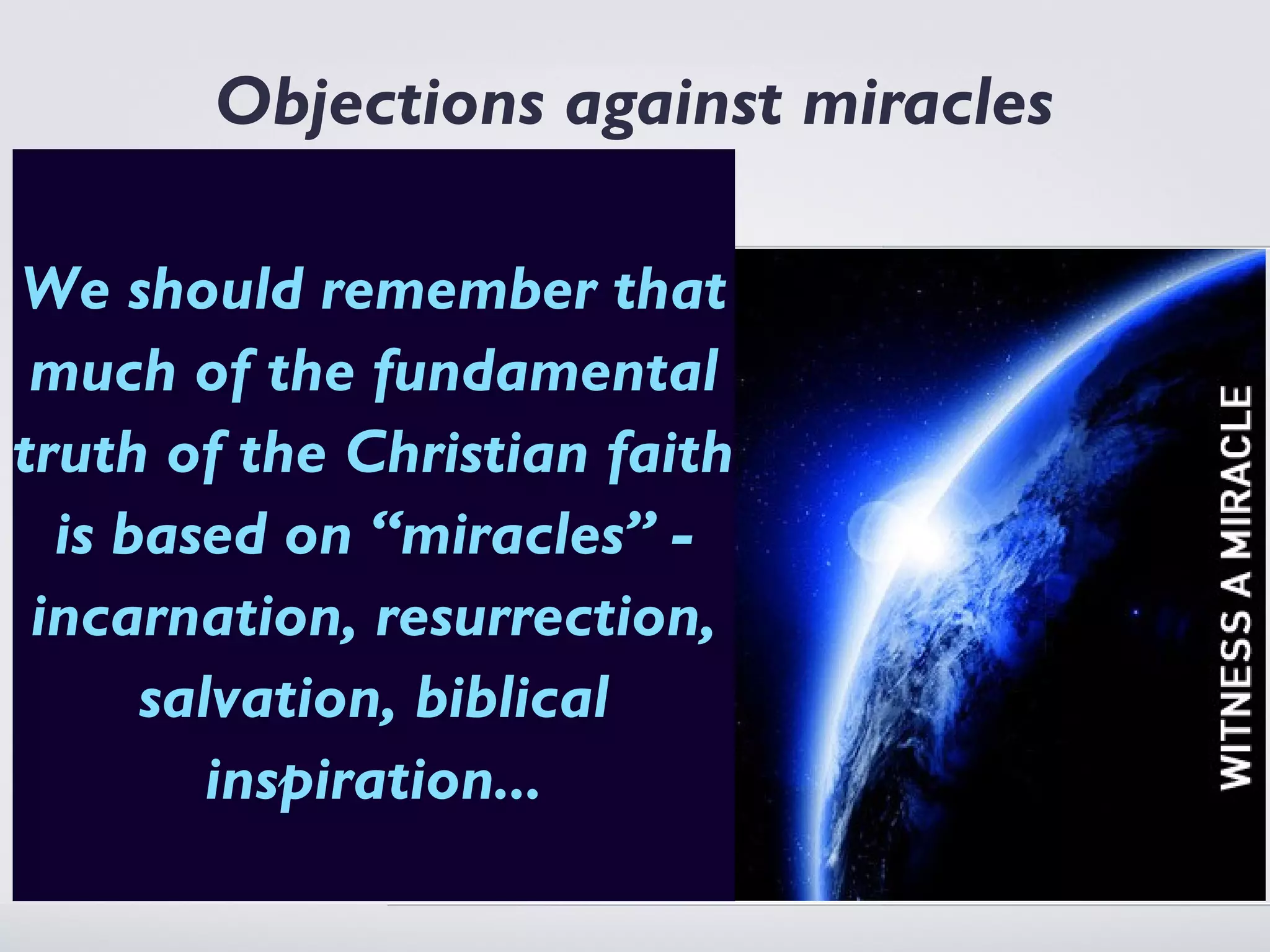
Objections against miracles
As apologists we have to consider
what objections rememberbring
We should people might that
against miracles. This is not to be
dealt withof the fundamental
 much on an historical level, the
people herethe probably objecting
truth of are Christian faith
on the basis of philosophical ideas
not historical validity - in other -
  is based on “miracles”
 incarnation, resurrection,
words we are arguing on the level of
possibility (or an argument that they
       salvation, biblical if they
are very improbable) - after all
           inspiration...
are impossible we do not need to
consider historical “occurrences”.
“Vital to the discussion of whether or not miracles can
occur is the issue of a person's presuppositions. If someone
believes that there is no God and also believes in what is
called naturalism - that all things in the universe are subject
to natural physical laws - then miracles are defined out of
existence - the universe is defined in such a way as to make
miracles impossible.Therefore, if someone says that
miracles cannot happen, then it is most probable they deny
the existence of God and/or believe in naturalism/evolution.”
http://carm.org/miracles-cannot-happen
Once God revealed the entirety of the
information that He wished to make
available to mankind…the need for
     This extract came from a
miraculous confirmation of the oral
 Christian apologetic website -
Word came to an end. Now, people can
                  http://
sit down with a New Testament, the
written Word of God, and, with honest
www.apologeticspress.org/apcontent.aspx?category=1
and diligent study, conclude that it is
God’s – it is Many preachers and an
       Word. shown here as
teachers today havethe reasoning
     example of failed to
acknowledgeby some believers for
 provided this crucial biblical factor.
They fail to face the fact that we have
    not believing in modern day
absolutely no need for the miraculous.
                 miracles
Since the purpose of miracles has been
achieved, the miracles, themselves, have
ceased
I repeat: the Bible teaches that miracles
are no longer necessary.We have
everything we need to function in this
life, to be pleasing to God, and to survive
spiritually (2 Peter 1:3). Spiritual
maturity is now within the grasp of
every single individual who chooses to
access the means to maturity—the
written Word of God. To insist that we
have need for the miraculous today is to
undermine, and to cast aspersions upon,
the all-sufficiency of God’s Word (cf. 1
Corinthians 1:22; 2 Timothy 3:16-17).
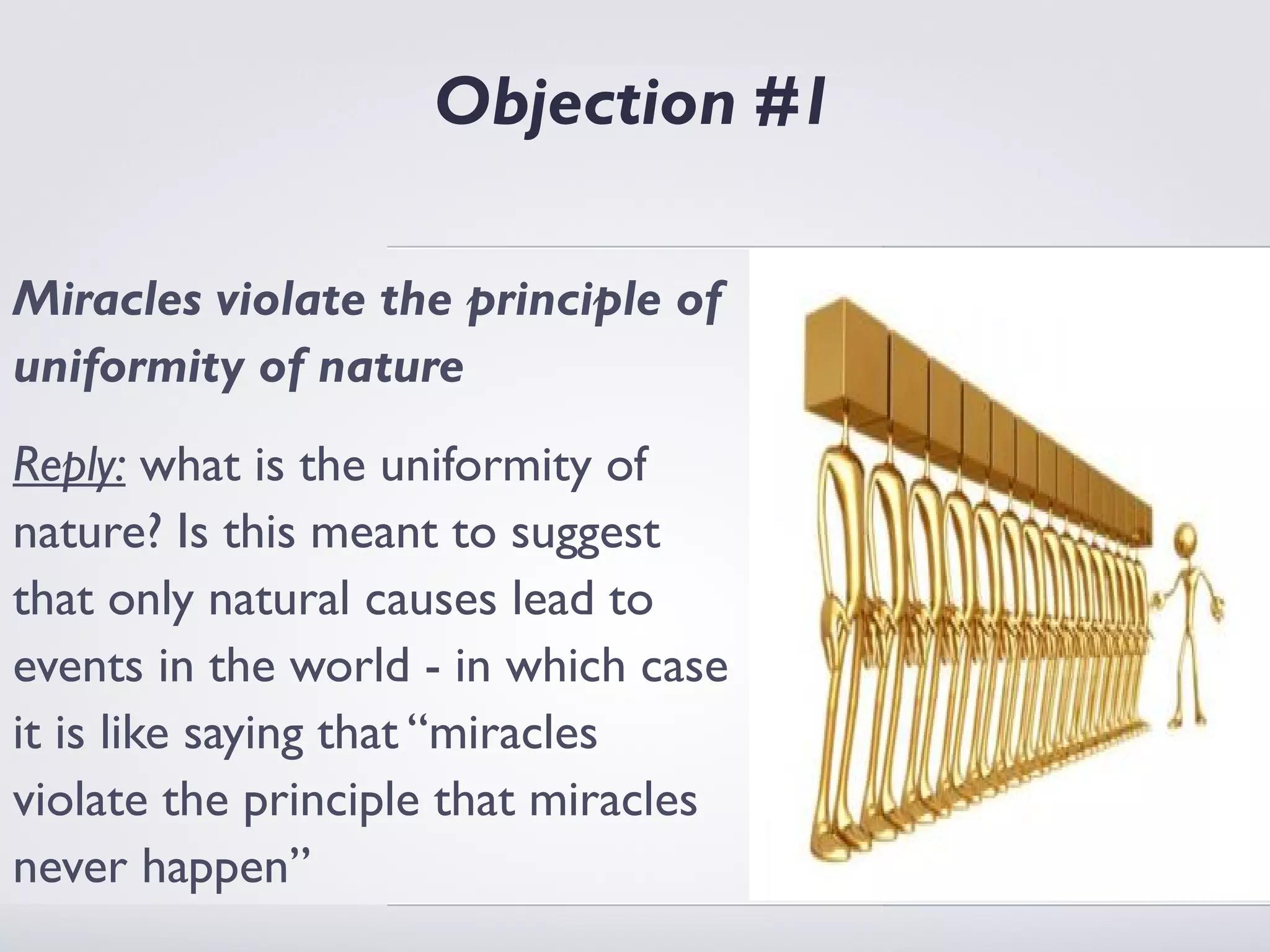
Objection #1

Miracles violate the principle of
uniformity of nature
Reply: what is the uniformity of
nature? Is this meant to suggest
that only natural causes lead to
events in the world - in which case
it is like saying that “miracles
violate the principle that miracles
never happen”
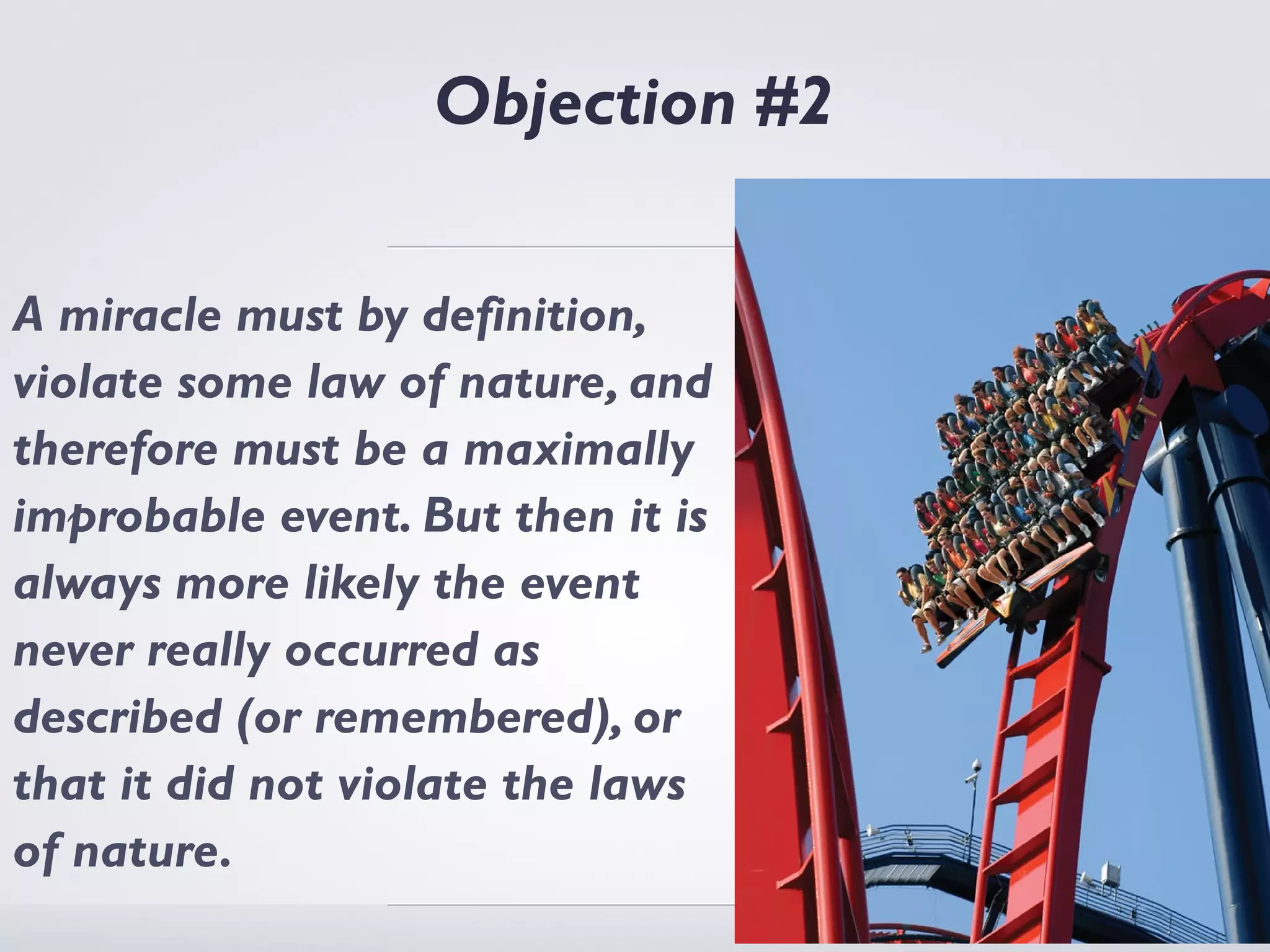
Objection #2

A miracle must by definition,
violate some law of nature, and
therefore must be a maximally
improbable event. But then it is
always more likely the event
never really occurred as
described (or remembered), or
that it did not violate the laws
of nature.
A miracle does not violate the laws
of nature in the same way the college
principal does not violate college law
by cancelling classes for a special
event. A violation can only take place
when an established order has to be
upheld and someone refuse to do so.
God has authority over the whole
universe and so he cannot violate it
(and would not feel guilt or
embarrassment about it). In a miracle
all God does is change the schedule
for the day.
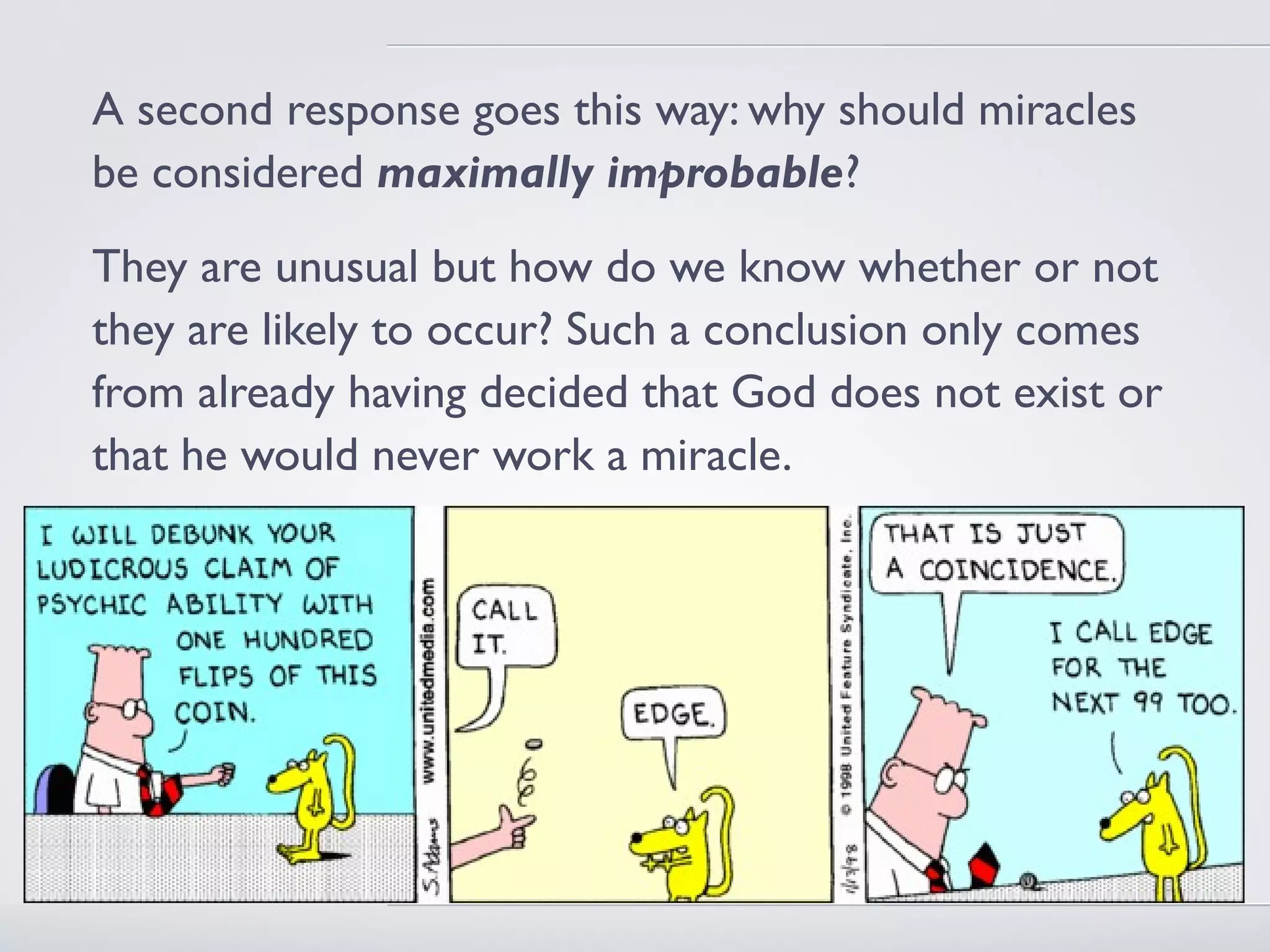
A second response goes this way: why should miracles
be considered maximally improbable?
They are unusual but how do we know whether or not
they are likely to occur? Such a conclusion only comes
from already having decided that God does not exist or
that he would never work a miracle.
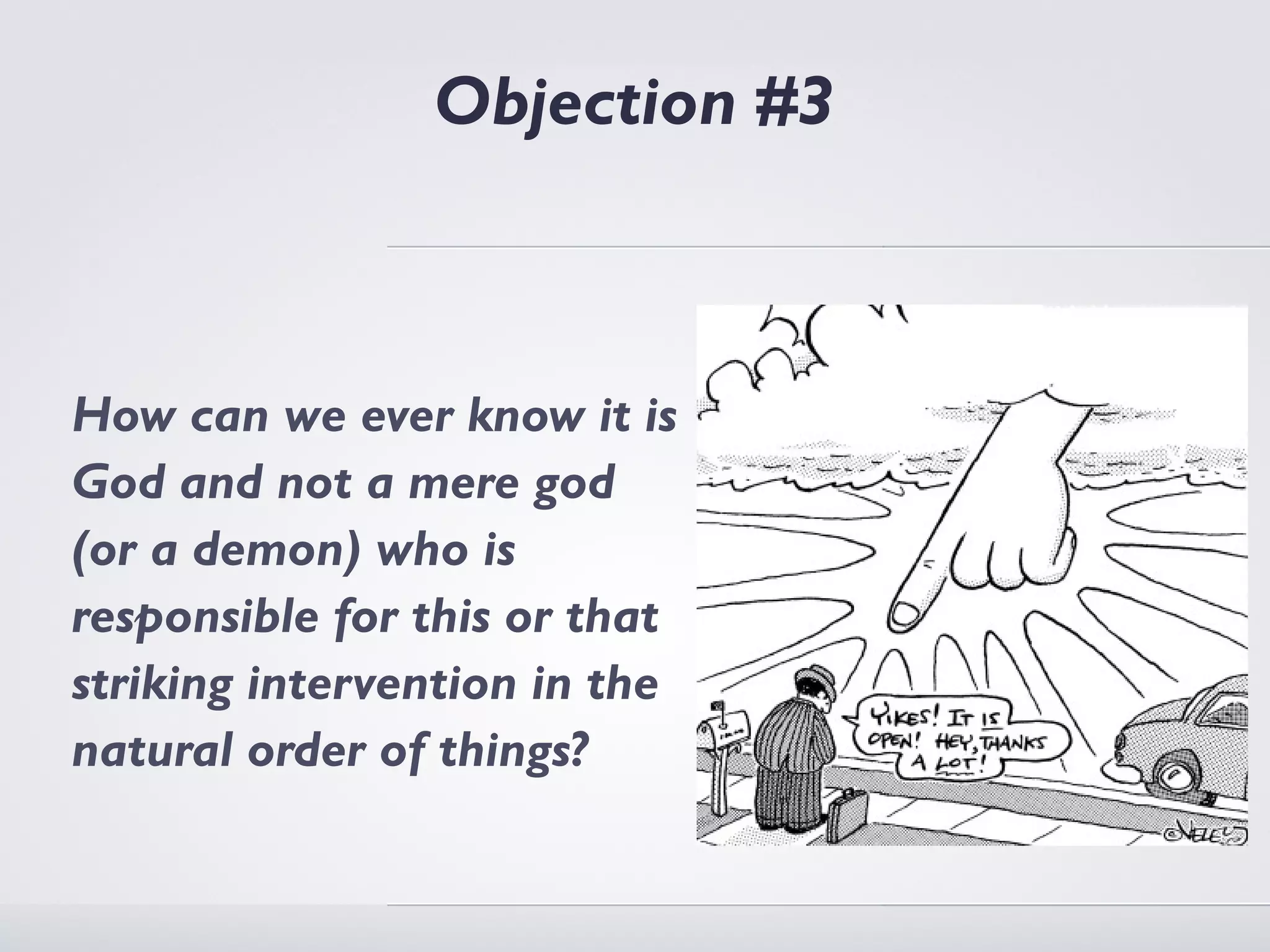
Objection #3


How can we ever know it is
God and not a mere god
(or a demon) who is
responsible for this or that
striking intervention in the
natural order of things?
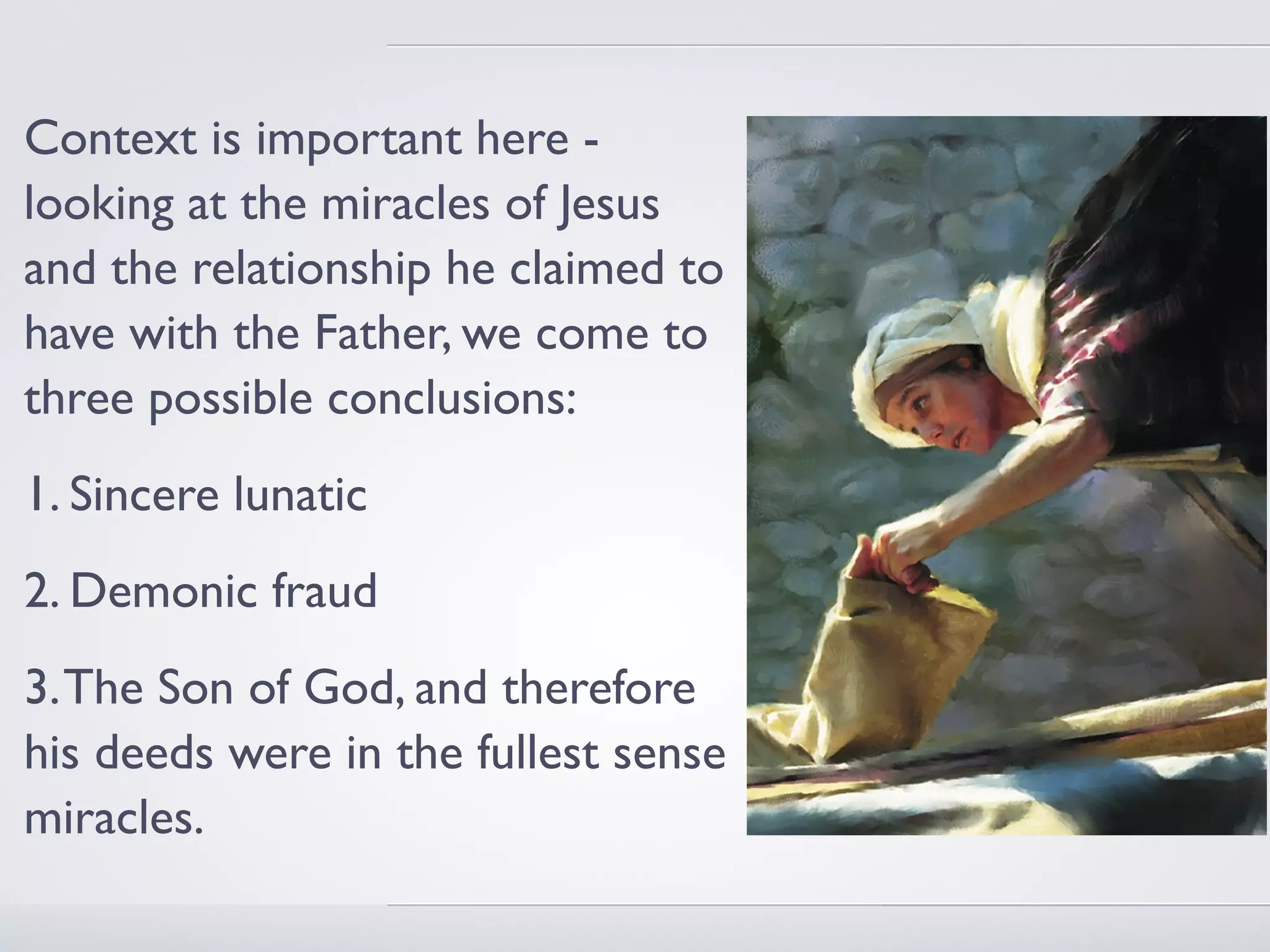
Context is important here -
looking at the miracles of Jesus
and the relationship he claimed to
have with the Father, we come to
three possible conclusions:
1. Sincere lunatic
2. Demonic fraud
3. The Son of God, and therefore
his deeds were in the fullest sense
miracles.
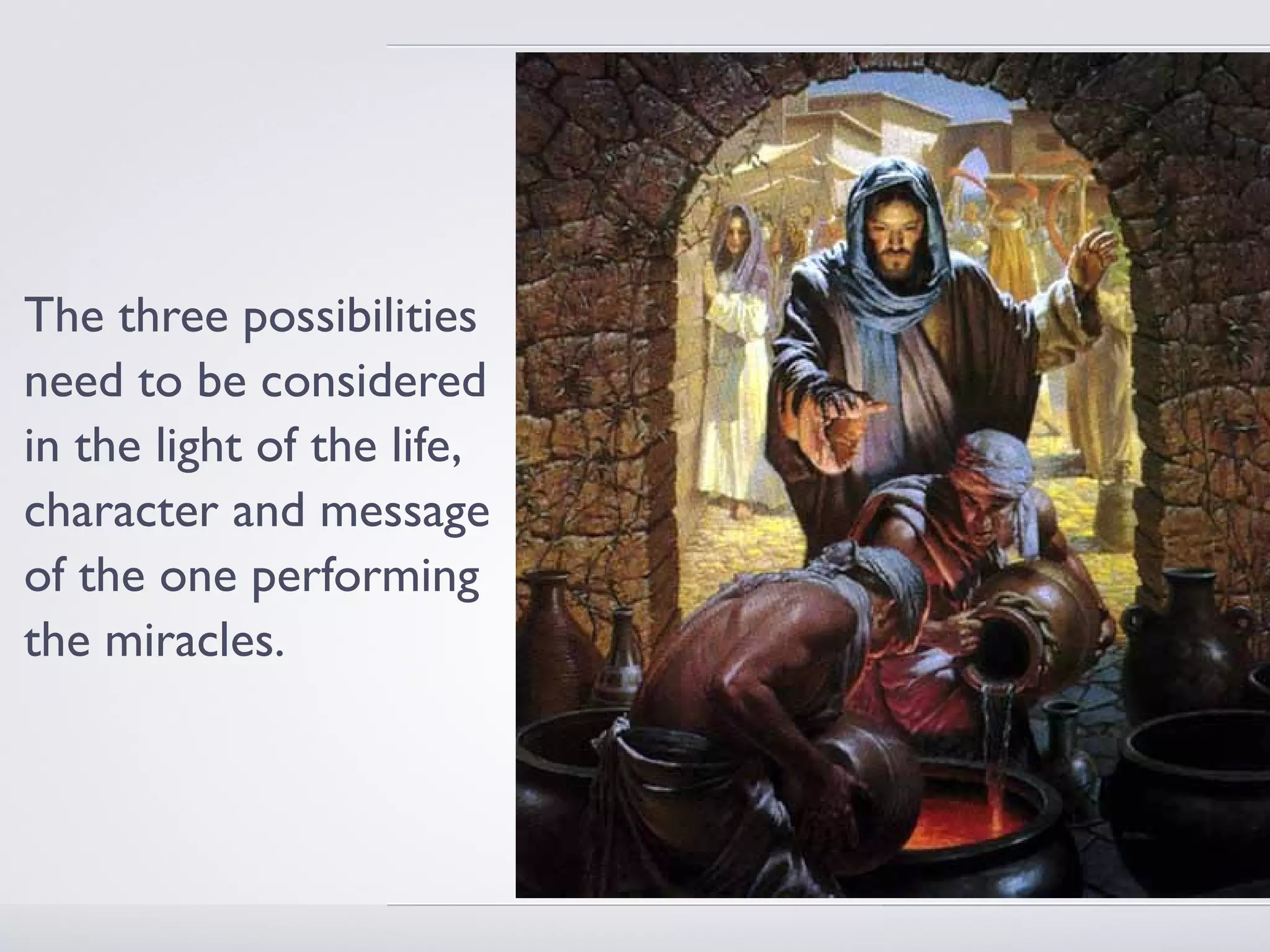
The three possibilities
need to be considered
in the light of the life,
character and message
of the one performing
the miracles.

Apologetics: Miracles 2013

  • 1.
    Chapter 6: Miracles Pocket handbook of Christian apologetics (2003) Peter Kreeft & Ronald Tacelli
  • 2.
    Name some Biblemiracles Are there some you find “easy’ to believe and others you find harder to believe, why? Why did Jesus perform miracles? Which biblical miracles are essential and which are optional for ‘true faith’?
  • 3.
    Are miracles something thatonly happens to “special” people or for all? In the Bible how did people respond to miracles - deny, rejoice, accept etc.
  • 4.
    Jesus - Whichmiracles do you believe? Born of a virgin Fed the 5000 Water into wine Cast out demons Healed a paralytic Rose from the dead Healed blind, deaf, mute Calmed the storm Appeared to the disciples after the resurrection CARM has a paper looking at miracles and CARM has a paper looking at miracles and rebutting arguments against miracles rebutting arguments against miracles http://carm.org/questions/about-jesus/cant-all-jesus- http://carm.org/questions/about-jesus/cant-all-jesus- miracles-be-explained-naturally miracles-be-explained-naturally
  • 5.
    The Objections mostfrequently leveled by critics of Christ's resurrection - Christ's resurrection is a myth, not history. How would you - The resurrection stories are full of contradictions. counter such - Miracles are not possible. - The body was stolen. arguments? - Jesus only fainted and then recovered from his wounds. - The witnesses were just “seeing things.”
  • 6.
    Acts 2:22 - “Fellow Israelites, listen to this: Jesus of Nazareth was a man accredited by God to you by miracles, wonders and signs, which God did among you through him, as you yourselves know.
  • 7.
    "It was Humewho first spoke of miracles as violations of nature. But Christians don't believe that the Legislator is subject to any of the laws of nature." Craig Keener
  • 8.
    "Those who assumethat miracles cannot happen are merely wasting their time by looking into the texts: we know in advance what results they will find for they have begun by begging the question." C.S. Lewis
  • 9.
    Why believe thebiblical miracles? 1. God made the universe out of nothing - a miracle is easy after that. 2.The factual nature of the miracle stories is evident from the text of Scripture - there were witnesses to the healings etc. - nothing in the description of the miracle events remotely suggests that we should look for naturalistic explanations for the miracles. They are presented as truly supernatural.
  • 10.
    3. The miracles storiesare not embellished like mythology. They are straight-forward matter-of-fact historical narrative accounts. 4. There was not enough time after the events took place for myths to have crept into the accounts - miracles are part of the text from the very beginning.
  • 11.
    5. The writersof the Bible attested to Jesus’ miracles (John 2:11etc) but Jesus himself based his claim of divinity partly on his miracles ( Matthew 11:4-6, Luke 7:22-23, John 10:25, 38, John 14:11, John 15:24) 6.Jesus’ greatest miracle, the resurrection, has overwhelming evidence in its favor - if the resurrection is a fact of history, Jesus’ other miracles are believable.
  • 12.
    7. To denythe miracles leaves the Bible as a secular book, which gives one the option of ignoring it. If you start throwing out the miracles, you will [arguably] start picking and choosing among other things you like or don’t like in the Bible.
  • 13.
    8. There is nocompelling reason to doubt the Bible. The evidence supports the reliability of Scripture throughout. Norman Geisler, a “demythological approach to miracles and the New Testament documents in general is unjustified. First and foremost, it is contrary to the overwhelming evidence for the authenticity of the New Testament documents.”
  • 14.
    A miracle is “astriking and religiously significant intervention of God in the system of natural causes”
  • 15.
    William Lane Craig:A miracle is “an event which is not producible by the natural causes that are operative at the time and place that the event occurs”
  • 16.
    J.P. Moreland, thenoted philosopher, illustrates divine intervention with the following example. According to the law of gravity, if you drop an object, it will fall to the earth. But, if an apple falls from a tree and you reach out to catch it before it hits the ground, you’re not violating or negating the law of gravity; you, with your free will are merely intervening, overriding the natural causes operative in that particular circumstance. According to Moreland, God intervenes in a very similar fashion causing what we call ‘miracles’.
  • 17.
    Miracle: An eventbrought about by a special act of God. There is much disagreement about the definition beyond this minimum. Some thinkers argue that a miracle must involve an exception to the laws of nature or (perhaps alternatively) involve some event that exceeds the natural powers or capacities of natural things. Others insist that a miracle is recognizable primarily by its revelatory power as a sign that shows something about God or God's purposes and that such events do not have to be scientifically inexplicable.Traditional apologetics viewed miracles as important confirmation or certification that a prophet or apostle was genuinely sent by God. C.Stephen Evans, Pocket Dictionary of Apologetics & Philosophy of Religion C.Stephen Evans, Pocket Dictionary of Apologetics & Philosophy of Religion
  • 18.
    “Since Christians donot have a presupposition that excludes the miraculous, we are able to look at the resurrection of Christ as recorded in the Bible, weigh the evidence, and make a choice to believe or not believe. Of course, Christians by default believed in the resurrection of Christ.” http://carm.org/miracles-cannot- happen
  • 20.
    Two questions aboutmiracles Philosophical question - are miracles possible? Historical question - are miracles actual (do they happen)? This simply requires some historical knowledge and/or investigation, has it ever happened? The philosophical question is the one that apologists argue with people about - the possibility of miracles needs to be decided upon. People who do not believe in miracles usually have some form of argument which says miracles cannot happen.
  • 21.
    1. The ideaof miracles contradiction presupposes that nature is a self |ˌkäntrəˈdik sh ə of contained systemn| natural causes - only in that there are regularities can there bestatements, * a combination of irregularities ideas, or featuresaof a situation 2. A miracle is not contradiction - a man walking through aone is a that are opposed to wall miracle, a man both walking through a another wall and not walking through a wall at * a same time thing, or situation the person, is a contradiction - God performs miracles but not elements in which inconsistent contradictions (which are are present meaningless)
  • 22.
    a priori |ˈä prēˈ ôrē; To believe miracles happen you have * believe in a miracle worker - you to relating to or denoting some form of Godor have to believe reasoning knowledge that exists. Then we can say miracles are possible - although God might proceeds from choose not to make this possibility a theoretical deduction reality. rather than from open to Are God and the world both observation or miracles happening? experience There is nothing in the nature of God thata waywould not make a * in says he based on miracle happen - he is omnipotent theoretical deduction and can do it, we cannot know a ratherwill though. priori if he than empirical observation
  • 23.
    Can we objectto miracles from the position of nature - here we have already acknowledged that God created nature - if God can bring the world out of a Big Bang then he can add some smaller bangs of miracles! If nature is made by God for God - then he can do miracles.
  • 24.
    Objections against miracles Asapologists we have to consider what objections rememberbring We should people might that against miracles. This is not to be dealt withof the fundamental much on an historical level, the people herethe probably objecting truth of are Christian faith on the basis of philosophical ideas not historical validity - in other - is based on “miracles” incarnation, resurrection, words we are arguing on the level of possibility (or an argument that they salvation, biblical if they are very improbable) - after all inspiration... are impossible we do not need to consider historical “occurrences”.
  • 25.
    “Vital to thediscussion of whether or not miracles can occur is the issue of a person's presuppositions. If someone believes that there is no God and also believes in what is called naturalism - that all things in the universe are subject to natural physical laws - then miracles are defined out of existence - the universe is defined in such a way as to make miracles impossible.Therefore, if someone says that miracles cannot happen, then it is most probable they deny the existence of God and/or believe in naturalism/evolution.” http://carm.org/miracles-cannot-happen
  • 26.
    Once God revealedthe entirety of the information that He wished to make available to mankind…the need for This extract came from a miraculous confirmation of the oral Christian apologetic website - Word came to an end. Now, people can http:// sit down with a New Testament, the written Word of God, and, with honest www.apologeticspress.org/apcontent.aspx?category=1 and diligent study, conclude that it is God’s – it is Many preachers and an Word. shown here as teachers today havethe reasoning example of failed to acknowledgeby some believers for provided this crucial biblical factor. They fail to face the fact that we have not believing in modern day absolutely no need for the miraculous. miracles Since the purpose of miracles has been achieved, the miracles, themselves, have ceased
  • 27.
    I repeat: theBible teaches that miracles are no longer necessary.We have everything we need to function in this life, to be pleasing to God, and to survive spiritually (2 Peter 1:3). Spiritual maturity is now within the grasp of every single individual who chooses to access the means to maturity—the written Word of God. To insist that we have need for the miraculous today is to undermine, and to cast aspersions upon, the all-sufficiency of God’s Word (cf. 1 Corinthians 1:22; 2 Timothy 3:16-17).
  • 28.
    Objection #1 Miracles violatethe principle of uniformity of nature Reply: what is the uniformity of nature? Is this meant to suggest that only natural causes lead to events in the world - in which case it is like saying that “miracles violate the principle that miracles never happen”
  • 29.
    Objection #2 A miraclemust by definition, violate some law of nature, and therefore must be a maximally improbable event. But then it is always more likely the event never really occurred as described (or remembered), or that it did not violate the laws of nature.
  • 30.
    A miracle doesnot violate the laws of nature in the same way the college principal does not violate college law by cancelling classes for a special event. A violation can only take place when an established order has to be upheld and someone refuse to do so. God has authority over the whole universe and so he cannot violate it (and would not feel guilt or embarrassment about it). In a miracle all God does is change the schedule for the day.
  • 31.
    A second responsegoes this way: why should miracles be considered maximally improbable? They are unusual but how do we know whether or not they are likely to occur? Such a conclusion only comes from already having decided that God does not exist or that he would never work a miracle.
  • 32.
    Objection #3 How canwe ever know it is God and not a mere god (or a demon) who is responsible for this or that striking intervention in the natural order of things?
  • 33.
    Context is importanthere - looking at the miracles of Jesus and the relationship he claimed to have with the Father, we come to three possible conclusions: 1. Sincere lunatic 2. Demonic fraud 3. The Son of God, and therefore his deeds were in the fullest sense miracles.
  • 34.
    The three possibilities needto be considered in the light of the life, character and message of the one performing the miracles.