DENNE KURSUSGANG:
1.Interessegrupper vol. 1
2. Lynrunde med præsentation af de studerendes cases
3. Oplæg ved Janus
1. Sociokulturel læring
2. Hvad karakteriserer ny mediebrug?
3. Hvilke læringspotentialer rummer den ny mediebrug?
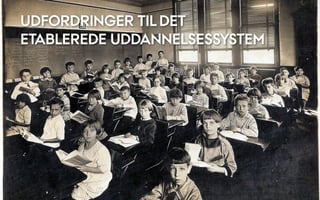
4. Hvordan udfordres det etablerede uddannelsessystem af disse potentialer
4. Pause, interessegrupper vol. 2
5. Gruppearbejde, analyse af case, forbedringsforslag, blogindlæg
6. Opsamling og næste gang
SOCIOKULTUREL
LÆRINGSFORSTÅELSE
For det første:
“According to Dewey (1916) knowledge is constructed in relation to
goal-directed actions, which have an aim or purpose. It means that
knowledge acquisition is a matter of knowledge construction, which
requires the individual to be engaged in actions with an aim or
purpose. Since knowledge is related to an understanding of the
goal of the action, actions must be directed and governed by the
individual.” - Dalsgaard 2009
5.
SOCIOKULTUREL
LÆRINGSFORSTÅELSE
For det andet:
“Socio-cultural theory places actions of the individual within a social
practice with other individuals and other goals (...). This does not
only mean that individuals are related to other individuals within a
practice, but also that the meaning of individual actions depends on
a collective practice.” - Dalsgaard 2009
6.
SOCIOKULTUREL
LÆRINGSFORSTÅELSE
Dvs. vi lærer gennem selvstyrede læringsaktiviteter, som eksisterer
i en social og kulturel kontekst
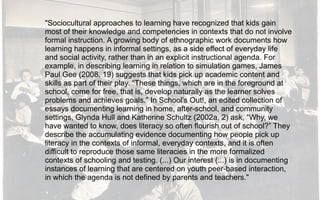
"Sociocultural approaches tolearning have recognized that kids gain
most of their knowledge and competencies in contexts that do not involve
formal instruction. A growing body of ethnographic work documents how
learning happens in informal settings, as a side effect of everyday life
and social activity, rather than in an explicit instructional agenda. For
example, in describing learning in relation to simulation games, James
Paul Gee (2008, 19) suggests that kids pick up academic content and
skills as part of their play. “These things, which are in the foreground at
school, come for free, that is, develop naturally as the learner solves
problems and achieves goals.” In School’s Out!, an edited collection of
essays documenting learning in home, after-school, and community
settings, Glynda Hull and Katherine Schultz (2002a, 2) ask, “Why, we
have wanted to know, does literacy so often flourish out of school?” They
describe the accumulating evidence documenting how people pick up
literacy in the contexts of informal, everyday contexts, and it is often
difficult to reproduce those same literacies in the more formalized
contexts of schooling and testing. (...) Our interest (...) is in documenting
instances of learning that are centered on youth peer-based interaction,
in which the agenda is not defined by parents and teachers."
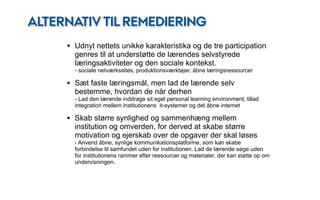
ALTERNATIV TIL REMEDIERING
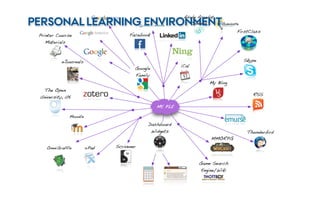
• Udnyt nettets unikke karakteristika og de tre participation
genres til at understøtte de lærendes selvstyrede
læringsaktiviteter og den sociale kontekst.
- sociale netværkssites, produktionsværktøjer, åbne læringsressourcer
• Sæt faste læringsmål, men lad de lærende selv
bestemme, hvordan de når derhen
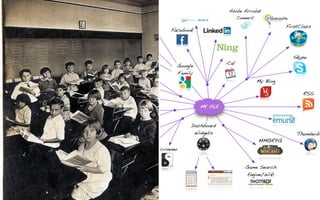
- Lad den lærende inddrage sit eget personal learning environment, tillad
integration mellem institutionens it-systemer og det åbne internet
• Skab større synlighed og sammenhæng mellem
institution og omverden, for derved at skabe større
motivation og ejerskab over de opgaver der skal løses
- Anvend åbne, synlige kommunikationsplatforme, som kan skabe
forbindelse til samfundet uden for institutionen. Lad de lærende søge uden
for institutionens rammer efter ressourcer og materialer, der kan støtte op om
undervisningen.
32.
GRUPPEOPGAVE
Analysér en af gruppemedlemmernes erfaringer fra
blogindlæggene til kursusgangen ved hjælp af dagens
litteratur og lav forbedringsforslag. Lav nyt blogindlæg i
gruppen. Kommentér de andres indlæg inden næste
kursusgang (det gør underviserne også).
33.
NÆSTE GANG:
Fællesskabskommunikation ognetværkskommunikation v.
Janus
- Hvordan karakteriserer man henholdsvis
fællesskabskommunkation og netværkskommunikation
- Hvad betyder internettet for denne kommunikation?
- Hvilke læringspotentialer indeholder de to
kommunikationsformer?
- Gdoc-opgave til næste gang om jeres epokegørende påhit!
34.
OPGAVEN TIL NÆSTEGANG:
Lav en brainstorm i et google-dokument over hvad jeres oplæg til næste gang
igen skal handle om. Oplægget skal:
- præsentere noget nyt! Dvs. noget, der ikke er på semesterplanen. Det kunne
fx være:
- en ny tjeneste
- en ny tendens
- en ny teori
- en ny videnskabelig undersøgelse
- et helt nyt emne
- ikke nødvendigvis være ultravidenskabeligt. Det vigtigste er, at vi bliver
inspirerede (man er dog selvfølgelig velkommen til at lave en videnskabelig
analyse
- Del dokumentet med Anders (andershjortskov@gmail.com) og Janus
(janusaaen@gmail.com) – vi kommenterer.







![Sociale Medier Er Fremtiden[1]](https://cdn.slidesharecdn.com/ss_thumbnails/sociale-medier-er-fremtiden1-1199203066189081-2-thumbnail.jpg?width=640&height=640&fit=bounds)


