Kotlin Backend
Rest & GraphQL
About Me
● Blog
○ https://animus.design
● GitLab
○ https://gitlab.com/AnimusDesign
● Job: Tech Lead @ Equinox
● Personal Projects
○ Music Recommendation System
○ Kotlin Examples
○ New Web Framework in Kotlin
○ Content Creation Service
Over ten years of experience. With a focus on
functional reactive full stack development. Utilizing
Kotlin to ease delivering of the domain to the client.
Early adopter of multi-platform to share code across
multiple targets.
What is GraphQL
● GraphQL is a newish API format developed by FaceBook for React. First released in 2015
○ Primarily used by Javascript Frameworks
● It is strongly typed, with a schema. Allowing for autocompletion, and is self documenting.
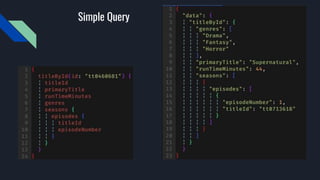
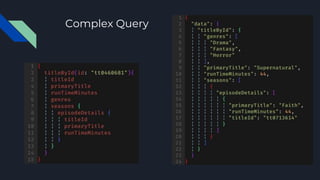
● You specify what data you wish to receive. In that vein you can chain multiple queries, without hitting
multiple endpoints.
○ Think of it as akin to sql, with functions instead of a language, but you still specify the returns.
● Advanced
○ Can whitelist queries run in production, limiting ad hoc queries.
○ Can build fragments that act as building blocks inside queries.
● Hacker News Discussion on Switching to GraphQL
Simple Query
Complex Query
GraphQL Additions
● GraphQL is a specification, additional libraries/frameworks expand its capabilities.
○ Much like an api gateway for REST, joining microservices.
● This is required because the structure of the data is put on the client instead of the server.
● Relay & Relay Modern from FaceBook, allow data binding to components, caching, etc.
● Apollo acts as a GraphQL API GateWay, with monitoring, alerting, and other features.
○ Client supports caching, binding, and managing local state of the application.
● Important
○ Support outside of JavaScript is weak. As an example JVM doesn’t support caching in Apollo, but
supports performance tracing.
● I will be focusing on Apollo
GraphQL Schema Stitching
● Schema stitching combines several GraphQL end points into one.
● Equivalent to an api gateway.
● When making a query, it will route the request to the proper service.
Why is the Framework Important?
● Isomorphic rendering, or server side rendering with GraphQL
● Caching, to limit hitting the primary data source repeatedly.
● How the javascript/Client interacts with the data layer.
● Whether the build process verifies the requested fields are in the schema.
● Performance monitoring, and trace monitoring.
● Schema stitching, or combining multiple graphql services together.
In short your framework choice will largely dictate your backend
language.
Why use GraphQL
● You’re using a javascript web/mobile framework.
● With Apollo client for web and mobile.
● Limits the data requested.
● Can whitelist queries, verifying what is queried in production.
● Less data requested, means less transfer.
○ Customize the data you retrieve from the data source.
● Reduce number of api calls.
● Strongly typed response.
● No need to maintain / generate swagger documentation.
Why Apollo?
● Polyglot support Swift (iOS), Kotlin (Android), JavaScript (vue, react, angular)
clients.
● Wide range of backend server support
○ With varying levels of support..
■ Tracing is supported in Java and other languages, see here for latest
supported languages.
○ Caching javascript only at this time.
● Integration with pager-duty and data dog, easing monitoring.
● Shiny dashboard with pretty lines.
● Better community integration, things like React router for isomorphic
rendering.
● Professional support
Backend MakeUp
● API
○ Jooby
■ HTTP Routing Library
○ Java-GraphQL
■ FrameWork for GraphQL
○ Graphql-spqr
■ Java 8+ Bindings easing definition, but not targeted towards
kotlin.
○ Jooq
■ Database layer that acts as a thin layer for operations.
○ Hikari CP
■ Connection pooling for the database.
● Apollo
○ GraphQL GateWay Server
○ Performance Monitoring
● Graphite + Grafana Monitoring
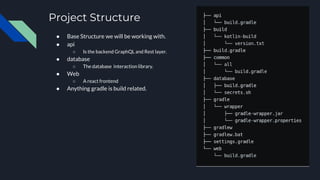
Project Structure
● Base Structure we will be working with.
● api
○ Is the backend GraphQL and Rest layer.
● database
○ The database interaction library.
● Web
○ A react frontend
● Anything gradle is build related.
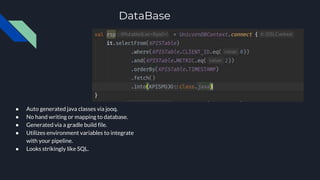
DataBase
● Auto generated java classes via jooq.
● No hand writing or mapping to database.
● Generated via a gradle build file.
● Utilizes environment variables to integrate
with your pipeline.
● Looks strikingly like SQL.
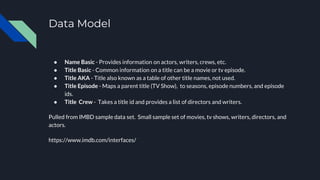
Data Model
● Name Basic - Provides information on actors, writers, crews, etc.
● Title Basic - Common information on a title can be a movie or tv episode.
● Title AKA - Title also known as a table of other title names, not used.
● Title Episode - Maps a parent title (TV Show), to seasons, episode numbers, and episode
ids.
● Title Crew - Takes a title id and provides a list of directors and writers.
Pulled from IMBD sample data set. Small sample set of movies, tv shows, writers, directors, and
actors.
https://www.imdb.com/interfaces/
Jooby: HTTP API GraphQl & Rest
● GraphQL requires a single POST or GET endpoint
● Supports multi versioned REST endpoints
● Swagger and RAML generation for Rest
● Metrics, supporting graphite, data dog and more.
● Docker support
● A number of other modules
● Running on Netty an asynchronous event server
○ Can run on other servers.
● Support for hot reloading, i.e. automatic recompilation.
There are a Plethora of HTTP Services
Choose what works for you!
● Vertx
● DropWizard
● Javalin
● Spark
● Ktor
● I’m sure I’m forgetting something.
Jooby Making End Points
● Closures, lambda functions included in a type safe DSL builder.
● Supports MVC class based method (My preference)
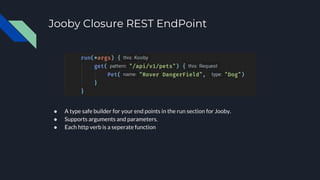
Jooby Closure REST EndPoint
● A type safe builder for your end points in the run section for Jooby.
● Supports arguments and parameters.
● Each http verb is a seperate function
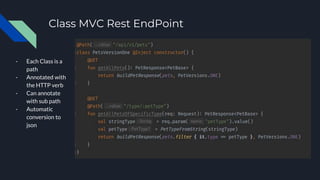
Class MVC Rest EndPoint
- Each Class is a
path
- Annotated with
the HTTP verb
- Can annotate
with sub path
- Automatic
conversion to
json
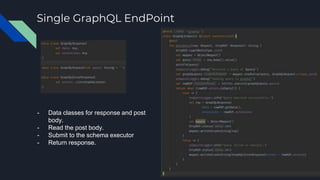
Single GraphQL EndPoint
- Data classes for response and post
body.
- Read the post body.
- Submit to the schema executor
- Return response.
GraphQL Java
● Strong Community, very active development.
● Support for Apollo (minus caching) and Relay, plus more.
● A number of additions to ease development.
○ https://github.com/graphql-java/awesome-graphql-java
● Can design schema first or classes first.
● Automatic integration with spring.
Limitations of GraphQL Java
● Kotlin is not a first class citizen.
● Builders, that feel a bit heavy in comparison to Kotlin Syntax.
● Documentation is a bit scarce.
● Wiring type definitions, to query resolvers is verbose.
● Doesn’t feel like idiomatic Kotlin
○ There is one Wrapper in Kotlin, but it is not overly active
● Enter GraphQL SPQR.
○ An annotation library that makes adding types and queries very simple.
○ The downside is it doesn’t support Kotlin Data Classes
■ Need to fall back to java in some instances.
■ May encounter esoteric bugs with annotations in Kotlin.
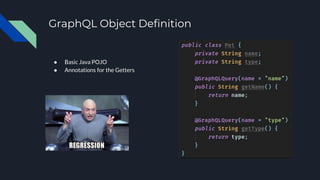
GraphQL Object Definition
● Basic Java POJO
● Annotations for the Getters
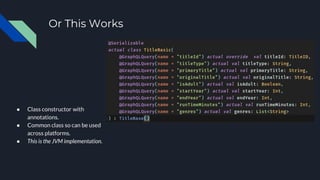
Or This Works
● Class constructor with
annotations.
● Common class so can be used
across platforms.
● This is the JVM implementation.
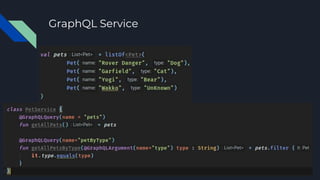
GraphQL Service
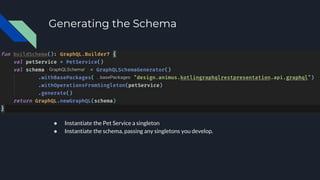
Generating the Schema
● Instantiate the Pet Service a singleton
● Instantiate the schema, passing any singletons you develop.
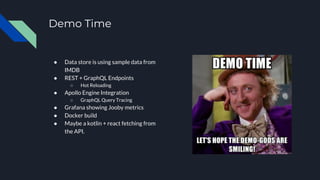
Demo Time
● Data store is using sample data from
IMDB
● REST + GraphQL Endpoints
○ Hot Reloading
● Apollo Engine Integration
○ GraphQL Query Tracing
● Grafana showing Jooby metrics
● Docker build
● Maybe a kotlin + react fetching from
the API.
Closing Thoughts
VertX
If you’re looking for a highly concurrent distributed backend layer. Look at VertX.
● Works with an event loop, and worker pools.
○ Passing information through a message bus.
■ Which can be centralized
■ And accessed from a number of languages.
● Can start with just http endpoints and add more later.
● Built in clustering and service discovery.
● First class Kotlin support.
● Polyglot (Java, Kotlin, Groovy, Scala, Javascript, Ruby)
● HTTP end points, as well as custom TCP/UDP services.
● Akin to an actor model.
● Great GraphQL support.
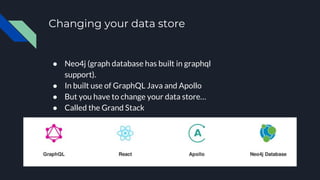
Changing your data store
● Neo4j (graph database has built in graphql
support).
● In built use of GraphQL Java and Apollo
● But you have to change your data store…
● Called the Grand Stack
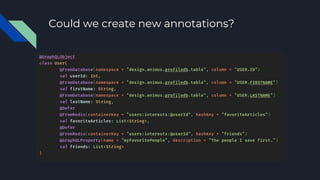
Could we create new annotations?
Questions ?

Kotlin REST & GraphQL API

  • 1.
  • 2.
    About Me ● Blog ○https://animus.design ● GitLab ○ https://gitlab.com/AnimusDesign ● Job: Tech Lead @ Equinox ● Personal Projects ○ Music Recommendation System ○ Kotlin Examples ○ New Web Framework in Kotlin ○ Content Creation Service Over ten years of experience. With a focus on functional reactive full stack development. Utilizing Kotlin to ease delivering of the domain to the client. Early adopter of multi-platform to share code across multiple targets.
  • 3.
    What is GraphQL ●GraphQL is a newish API format developed by FaceBook for React. First released in 2015 ○ Primarily used by Javascript Frameworks ● It is strongly typed, with a schema. Allowing for autocompletion, and is self documenting. ● You specify what data you wish to receive. In that vein you can chain multiple queries, without hitting multiple endpoints. ○ Think of it as akin to sql, with functions instead of a language, but you still specify the returns. ● Advanced ○ Can whitelist queries run in production, limiting ad hoc queries. ○ Can build fragments that act as building blocks inside queries. ● Hacker News Discussion on Switching to GraphQL
  • 4.
  • 5.
  • 6.
    GraphQL Additions ● GraphQLis a specification, additional libraries/frameworks expand its capabilities. ○ Much like an api gateway for REST, joining microservices. ● This is required because the structure of the data is put on the client instead of the server. ● Relay & Relay Modern from FaceBook, allow data binding to components, caching, etc. ● Apollo acts as a GraphQL API GateWay, with monitoring, alerting, and other features. ○ Client supports caching, binding, and managing local state of the application. ● Important ○ Support outside of JavaScript is weak. As an example JVM doesn’t support caching in Apollo, but supports performance tracing. ● I will be focusing on Apollo
  • 7.
    GraphQL Schema Stitching ●Schema stitching combines several GraphQL end points into one. ● Equivalent to an api gateway. ● When making a query, it will route the request to the proper service.
  • 8.
    Why is theFramework Important? ● Isomorphic rendering, or server side rendering with GraphQL ● Caching, to limit hitting the primary data source repeatedly. ● How the javascript/Client interacts with the data layer. ● Whether the build process verifies the requested fields are in the schema. ● Performance monitoring, and trace monitoring. ● Schema stitching, or combining multiple graphql services together. In short your framework choice will largely dictate your backend language.
  • 9.
    Why use GraphQL ●You’re using a javascript web/mobile framework. ● With Apollo client for web and mobile. ● Limits the data requested. ● Can whitelist queries, verifying what is queried in production. ● Less data requested, means less transfer. ○ Customize the data you retrieve from the data source. ● Reduce number of api calls. ● Strongly typed response. ● No need to maintain / generate swagger documentation.
  • 10.
    Why Apollo? ● Polyglotsupport Swift (iOS), Kotlin (Android), JavaScript (vue, react, angular) clients. ● Wide range of backend server support ○ With varying levels of support.. ■ Tracing is supported in Java and other languages, see here for latest supported languages. ○ Caching javascript only at this time. ● Integration with pager-duty and data dog, easing monitoring. ● Shiny dashboard with pretty lines. ● Better community integration, things like React router for isomorphic rendering. ● Professional support
  • 11.
    Backend MakeUp ● API ○Jooby ■ HTTP Routing Library ○ Java-GraphQL ■ FrameWork for GraphQL ○ Graphql-spqr ■ Java 8+ Bindings easing definition, but not targeted towards kotlin. ○ Jooq ■ Database layer that acts as a thin layer for operations. ○ Hikari CP ■ Connection pooling for the database. ● Apollo ○ GraphQL GateWay Server ○ Performance Monitoring ● Graphite + Grafana Monitoring
  • 12.
    Project Structure ● BaseStructure we will be working with. ● api ○ Is the backend GraphQL and Rest layer. ● database ○ The database interaction library. ● Web ○ A react frontend ● Anything gradle is build related.
  • 13.
    DataBase ● Auto generatedjava classes via jooq. ● No hand writing or mapping to database. ● Generated via a gradle build file. ● Utilizes environment variables to integrate with your pipeline. ● Looks strikingly like SQL.
  • 14.
    Data Model ● NameBasic - Provides information on actors, writers, crews, etc. ● Title Basic - Common information on a title can be a movie or tv episode. ● Title AKA - Title also known as a table of other title names, not used. ● Title Episode - Maps a parent title (TV Show), to seasons, episode numbers, and episode ids. ● Title Crew - Takes a title id and provides a list of directors and writers. Pulled from IMBD sample data set. Small sample set of movies, tv shows, writers, directors, and actors. https://www.imdb.com/interfaces/
  • 15.
    Jooby: HTTP APIGraphQl & Rest ● GraphQL requires a single POST or GET endpoint ● Supports multi versioned REST endpoints ● Swagger and RAML generation for Rest ● Metrics, supporting graphite, data dog and more. ● Docker support ● A number of other modules ● Running on Netty an asynchronous event server ○ Can run on other servers. ● Support for hot reloading, i.e. automatic recompilation.
  • 16.
    There are aPlethora of HTTP Services Choose what works for you! ● Vertx ● DropWizard ● Javalin ● Spark ● Ktor ● I’m sure I’m forgetting something.
  • 17.
    Jooby Making EndPoints ● Closures, lambda functions included in a type safe DSL builder. ● Supports MVC class based method (My preference)
  • 18.
    Jooby Closure RESTEndPoint ● A type safe builder for your end points in the run section for Jooby. ● Supports arguments and parameters. ● Each http verb is a seperate function
  • 19.
    Class MVC RestEndPoint - Each Class is a path - Annotated with the HTTP verb - Can annotate with sub path - Automatic conversion to json
  • 20.
    Single GraphQL EndPoint -Data classes for response and post body. - Read the post body. - Submit to the schema executor - Return response.
  • 21.
    GraphQL Java ● StrongCommunity, very active development. ● Support for Apollo (minus caching) and Relay, plus more. ● A number of additions to ease development. ○ https://github.com/graphql-java/awesome-graphql-java ● Can design schema first or classes first. ● Automatic integration with spring.
  • 22.
    Limitations of GraphQLJava ● Kotlin is not a first class citizen. ● Builders, that feel a bit heavy in comparison to Kotlin Syntax. ● Documentation is a bit scarce. ● Wiring type definitions, to query resolvers is verbose. ● Doesn’t feel like idiomatic Kotlin ○ There is one Wrapper in Kotlin, but it is not overly active ● Enter GraphQL SPQR. ○ An annotation library that makes adding types and queries very simple. ○ The downside is it doesn’t support Kotlin Data Classes ■ Need to fall back to java in some instances. ■ May encounter esoteric bugs with annotations in Kotlin.
  • 23.
    GraphQL Object Definition ●Basic Java POJO ● Annotations for the Getters
  • 24.
    Or This Works ●Class constructor with annotations. ● Common class so can be used across platforms. ● This is the JVM implementation.
  • 25.
  • 26.
    Generating the Schema ●Instantiate the Pet Service a singleton ● Instantiate the schema, passing any singletons you develop.
  • 27.
    Demo Time ● Datastore is using sample data from IMDB ● REST + GraphQL Endpoints ○ Hot Reloading ● Apollo Engine Integration ○ GraphQL Query Tracing ● Grafana showing Jooby metrics ● Docker build ● Maybe a kotlin + react fetching from the API.
  • 28.
  • 29.
    VertX If you’re lookingfor a highly concurrent distributed backend layer. Look at VertX. ● Works with an event loop, and worker pools. ○ Passing information through a message bus. ■ Which can be centralized ■ And accessed from a number of languages. ● Can start with just http endpoints and add more later. ● Built in clustering and service discovery. ● First class Kotlin support. ● Polyglot (Java, Kotlin, Groovy, Scala, Javascript, Ruby) ● HTTP end points, as well as custom TCP/UDP services. ● Akin to an actor model. ● Great GraphQL support.
  • 30.
    Changing your datastore ● Neo4j (graph database has built in graphql support). ● In built use of GraphQL Java and Apollo ● But you have to change your data store… ● Called the Grand Stack
  • 31.
    Could we createnew annotations?
  • 32.

Editor's Notes

  • #14 Show Jooq Build gradle in idea
  • #16 Walk through