
GraphQL + Relay
@telligcirdec + @catelandaxel
Cédric GILLET
Développeur JAVA /
Architect
Axel CATELAND
Développeur Frontend /
Leadtech Front
Bientôt =>
GraphQL
Specification
The boring part
What is GraphQL ?
● An open sourced specification edited by Facebook still in draft
● Define a query language to query, fetch and mutate data from
any datasources in a declarative way
What is NOT GraphQL ?
● NOT a framework
● NOT specific to a language
● NOT as easy as you think
Keys concepts
● Hierarchical : a GraphQL query is a hierarchical set of fields
● Product-centric : the consumer decide what and how
● Strong-typing : queries are syntactically checked and provided
data are type safe
● Introspective : clients and tools can query the type system
using the GraphQL syntax
● Application-layer protocol : use it via FTP, you fools !!
(hidden) Keys concepts
● You gonna need some cache
● You gonna need some papers and a good knowledge of your
data
● You gonna need some red bull
GraphQL
Implementation
Exploitation
May the force be with you !
Meet SWAPI
A P I
SWAPI
Meet SWAPI
● The Star Wars API, or "swapi" (Swah-pee) is the
world's first quantified and programmatically-
accessible data source for all the data from the Star
Wars canon universe!
● All the data is accessible through a HTTP web API.
SWAPI
SWAPI Examples
GO ! GO ! GO !
SWAPI
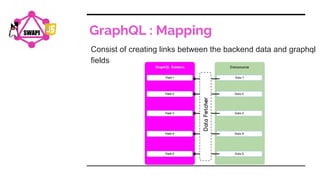
GraphQL : Mapping
Consist of creating links between the backend data and graphql
fields
SWAPI
GraphQL : TypingSWAPI
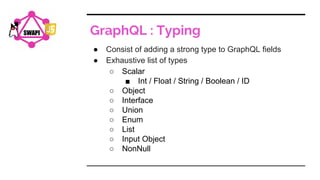
GraphQL : Typing
● Consist of adding a strong type to GraphQL fields
● Exhaustive list of types
○ Scalar
■ Int / Float / String / Boolean / ID
○ Object
○ Interface
○ Union
○ Enum
○ List
○ Input Object
○ NonNull
SWAPI
GraphQL : Introspection
A GraphQL server supports introspection over its schema by
using GraphQL itself
SWAPI
GraphQL : Introspection
{
__type(name: “User”) {
name,
fields {
name,
type {
name
}
}
}
}
{
“data” : {
“__type”: {
“name” : “User”,
“fields” : [
{
“name” : “id”,
“type” : { “name” : “String” }
},
{
“name” : “name”,
“type” : { “name” : “String” }
},
{
“name” : “gender”,
“type” : { “name” : “Boolean” }
},
]
}
}
SWAPI
GraphQL : Arguments
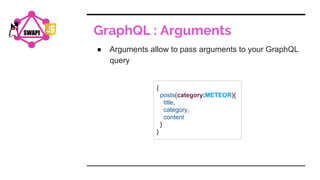
● Arguments allow to pass arguments to your GraphQL
query
{
posts(category:METEOR){
title,
category,
content
}
}
SWAPI
GraphQL : Adding cache
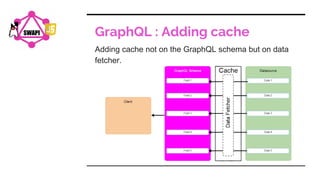
Adding cache not on the GraphQL schema but on data
fetcher.
SWAPI
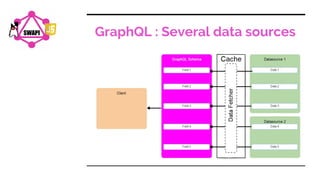
GraphQL : Several data sourcesSWAPI
GraphQL : Mutations
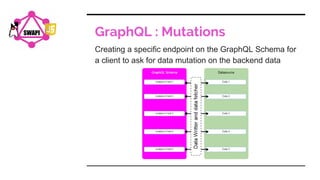
Creating a specific endpoint on the GraphQL Schema for
a client to ask for data mutation on the backend data
SWAPI
GraphQL : Directives and
Variables
SWAPI
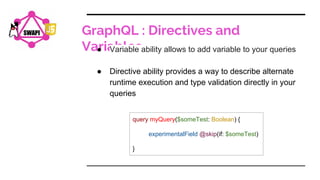
● Variable ability allows to add variable to your queries
● Directive ability provides a way to describe alternate
runtime execution and type validation directly in your
queries
query myQuery($someTest: Boolean) {
experimentalField @skip(if: $someTest)
}
GraphQL usefull links
● http://graphql.org/
● http://facebook.github.io/graphql/
● https://sandbox.learngraphql.com/
● https://learngraphql.com/
● https://code.facebook.com
Relay
Best use of GraphQL for moderns webapps ? Why ? How ?
How relay help us ?
● To create true independents/reusables components.
● To further optimize data fetching.
● Static query check at build time (babel plugin)
● Effortless data mutation (Nope)
https://facebook.github.io/relay/
https://github.com/facebook/relay/
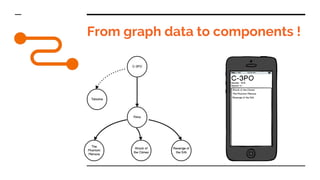
From graph data to components !
Expliquer le mapping de données sur
un composant
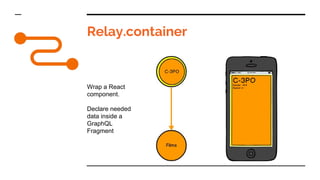
Relay container
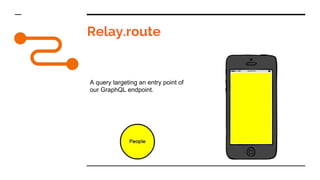
Relay route
Relay.route
A query targeting an entry point of
our GraphQL endpoint.
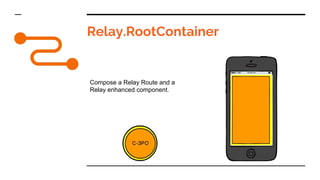
Relay.RootContainer
Compose a Relay Route and a
Relay enhanced component.
Relay.container
Wrap a React
component.
Declare needed
data inside a
GraphQL
Fragment
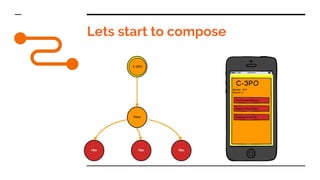
Lets start to compose
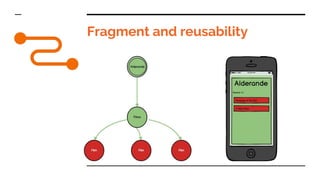
Fragment and reusability
Relay compose and solve !
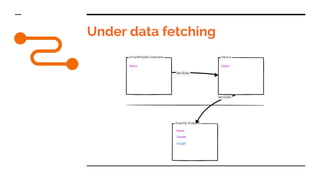
Under data fetching
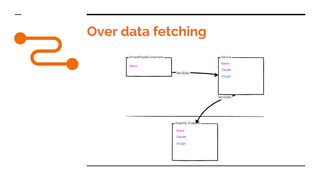
Over data fetching
Use the best of GraphQL
tl/dr kill the need of ad’hoc endpoints
Under data fetching
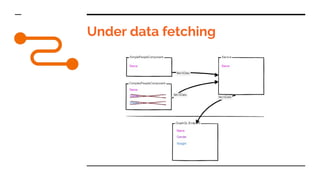
Under data fetching
Over data fetching
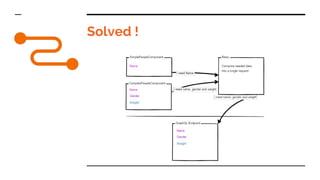
Solved !
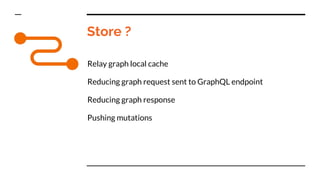
Store ?
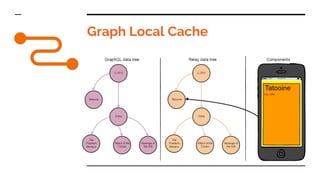
Relay graph local cache
Reducing graph request sent to GraphQL endpoint
Reducing graph response
Pushing mutations
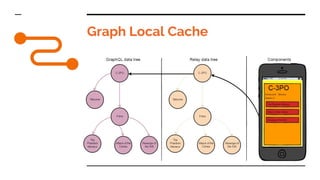
Graph Local Cache
Graph Local Cache
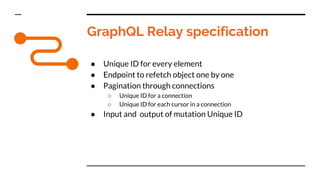
GraphQL Relay specification
● Unique ID for every element
● Endpoint to refetch object one by one
● Pagination through connections
○ Unique ID for a connection
○ Unique ID for each cursor in a connection
● Input and output of mutation Unique ID
GraphQL Relay to save the day
GraphQL Relay provide api to help fulfilling these request.
GraphQL Relay live in your GraphQL Endpoint
https://github.com/graphql/graphql-relay-js
Mutation - Welcome to hell
(seriously hardest part of relay)
Mutation
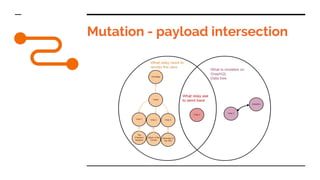
Relay push mutation to server
And ask back as a payload an intersection between what it
need and what changed on the server.
Can mutate local cache optimistically.
Mutation - payload intersection
App State
Binding with app routing
No app state stored only app data
Resources
https://github.com/relayjs/relay-starter-kit
https://code-cartoons.com/a-cartoon-intro-to-facebook-s-
relay-part-1-3ec1a127bca5#.y0x0eivc3
QUESTION(S) ?

GraphQL + relay