Site-seeing in Korea
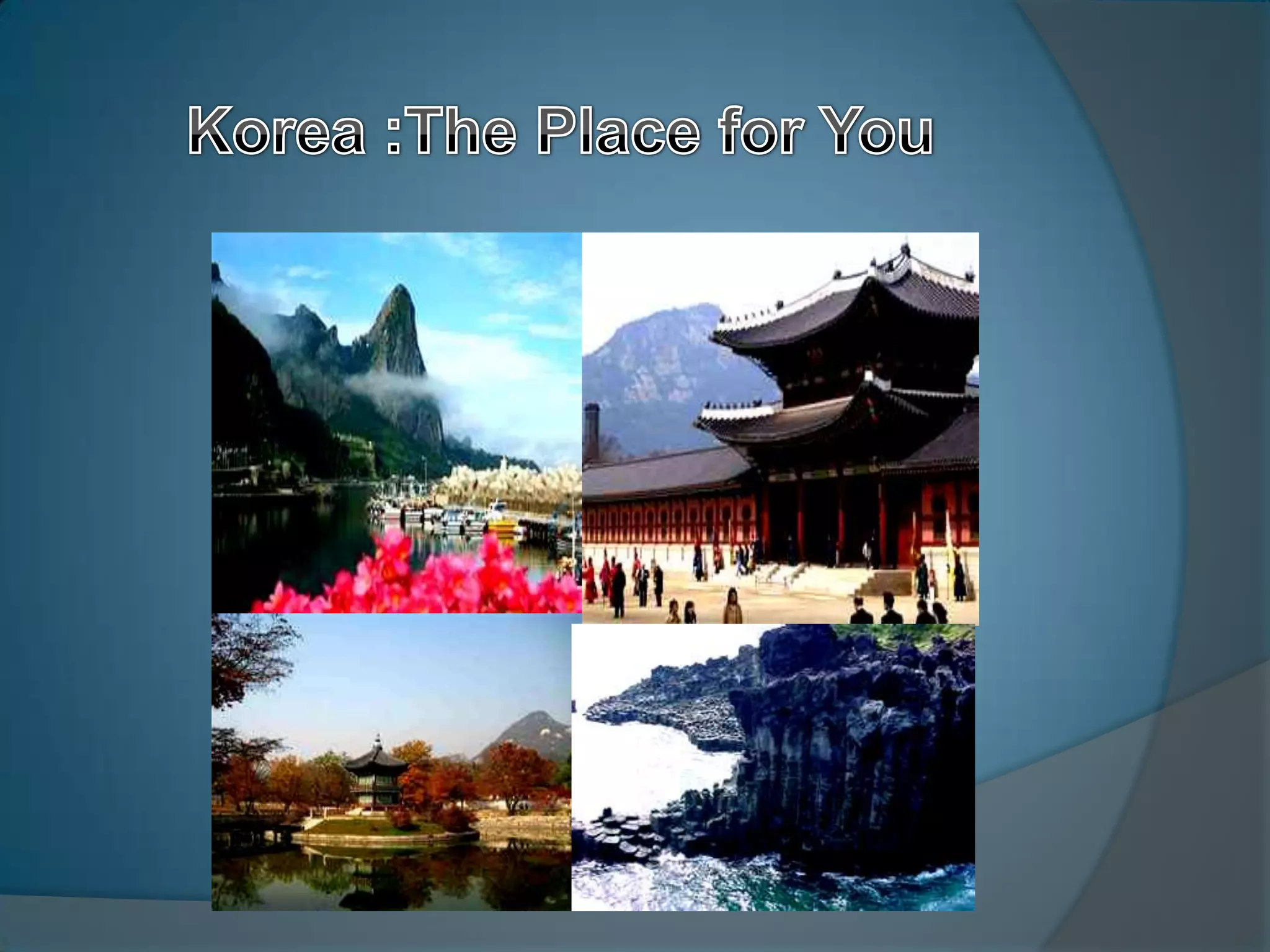
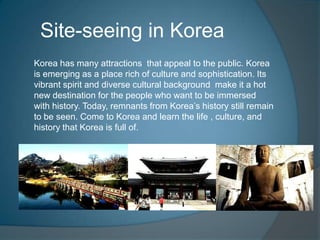
Korea has many attractions that appeal to the public. Korea
is emerging as a place rich of culture and sophistication. Its
vibrant spirit and diverse cultural background make it a hot
new destination for the people who want to be immersed
with history. Today, remnants from Korea’s history still remain
to be seen. Come to Korea and learn the life , culture, and
history that Korea is full of.
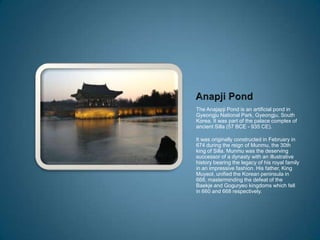
The Anajapji Pond is an artificial pond in
Gyeongju National Park, Gyeongju, South
Korea. It was part of the palace complex of
ancient Silla (57 BCE - 935 CE).

It was originally constructed in February in
674 during the reign of Munmu, the 30th
king of Silla. Munmu was the deserving
successor of a dynasty with an illustrative
history bearing the legacy of his royal family
in an impressive fashion. His father, King
Muyeol, unified the Korean peninsula in
668, masterminding the defeat of the
Baekje and Goguryeo kingdoms which fell
in 660 and 668 respectively.
Pohyon Temple
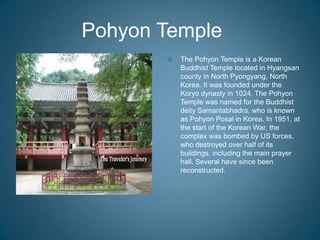
          The Pohyon Temple is a Korean
           Buddhist Temple located in Hyangsan
           county in North Pyongyang, North
           Korea. It was founded under the
           Koryo dynasty in 1024. The Pohyon
           Temple was named for the Buddhist
           deity Samantabhadra, who is known
           as Pohyon Posal in Korea. In 1951, at
           the start of the Korean War, the
           complex was bombed by US forces,
           who destroyed over half of its
           buildings, including the main prayer
           hall. Several have since been
           reconstructed.
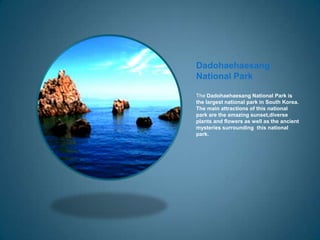
Dadohaehaesang
National Park

The Dadohaehaesang National Park is
the largest national park in South Korea.
The main attractions of this national
park are the amazing sunset,diverse
plants and flowers as well as the ancient
mysteries surrounding this national
park.

Korea1a

  • 2.
    Site-seeing in Korea Koreahas many attractions that appeal to the public. Korea is emerging as a place rich of culture and sophistication. Its vibrant spirit and diverse cultural background make it a hot new destination for the people who want to be immersed with history. Today, remnants from Korea’s history still remain to be seen. Come to Korea and learn the life , culture, and history that Korea is full of.
  • 3.
    The Anajapji Pondis an artificial pond in Gyeongju National Park, Gyeongju, South Korea. It was part of the palace complex of ancient Silla (57 BCE - 935 CE). It was originally constructed in February in 674 during the reign of Munmu, the 30th king of Silla. Munmu was the deserving successor of a dynasty with an illustrative history bearing the legacy of his royal family in an impressive fashion. His father, King Muyeol, unified the Korean peninsula in 668, masterminding the defeat of the Baekje and Goguryeo kingdoms which fell in 660 and 668 respectively.
  • 4.
    Pohyon Temple  The Pohyon Temple is a Korean Buddhist Temple located in Hyangsan county in North Pyongyang, North Korea. It was founded under the Koryo dynasty in 1024. The Pohyon Temple was named for the Buddhist deity Samantabhadra, who is known as Pohyon Posal in Korea. In 1951, at the start of the Korean War, the complex was bombed by US forces, who destroyed over half of its buildings, including the main prayer hall. Several have since been reconstructed.
  • 5.
    Dadohaehaesang National Park The DadohaehaesangNational Park is the largest national park in South Korea. The main attractions of this national park are the amazing sunset,diverse plants and flowers as well as the ancient mysteries surrounding this national park.