A Specific Value Chain
Framework for Mountain
Products in a Globalised
Market

Michael Kollmair and Brigitte Hoermann

International Centre for Integrated Mountain Development
Kathmandu, Nepal
Introduction

 • Socioeconomic and environmental change as
   challenge and opportunity for mountain people
 • Mountain products an important highland-lowland
   and rural-urban linkage
 • VC approach as an international development tool
   (wall-to-wall solution)
 • Adaptation of a global concept to the mountain
   specifities
 • Generating economic opportunities for rural
   livelihoods by using the comparative advantages of
   mountains
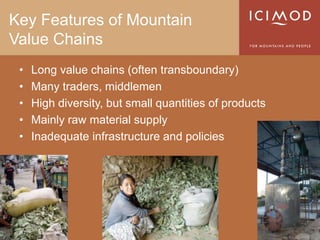
Key Features of Mountain
Value Chains
 •   Long value chains (often transboundary)
 •   Many traders, middlemen
 •   High diversity, but small quantities of products
 •   Mainly raw material supply
 •   Inadequate infrastructure and policies
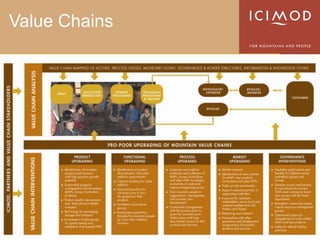
Value Chains
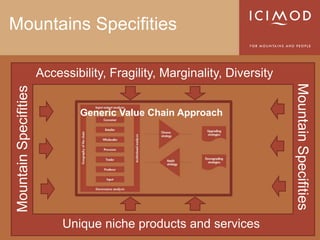
Mountains Specifities

                       Accessibility, Fragility, Marginality, Diversity


                                                                          Mountain Specifities
Mountain Specifities


                               Generic Value Chain Approach


                            Unique niche products and services
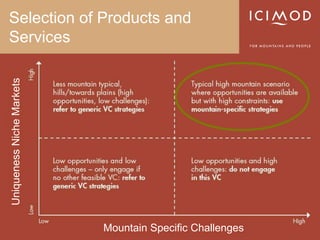
Selection of Products and
Services
Uniqueness Niche Markets


                           Mountain Specific Challenges
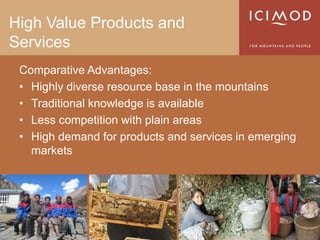
High Value Products and
Services
 Comparative Advantages:
 • Highly diverse resource base in the mountains
 • Traditional knowledge is available
 • Less competition with plain areas
 • High demand for products and services in emerging
   markets
Strategies to Address
Mountain Specifities
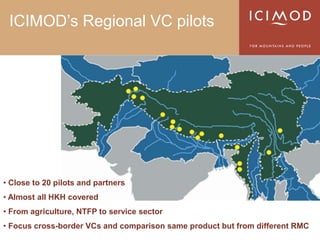
ICIMOD’s Regional VC pilots


• Close to 20 pilots and partners
• Almost all HKH covered
• From agriculture, NTFP to service sector
• Focus cross-border VCs and comparison same product but from different RMC
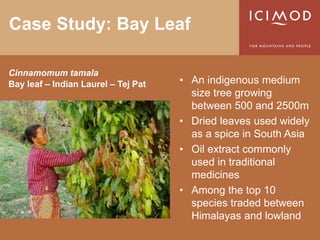
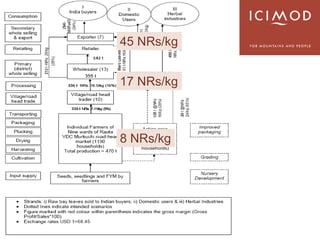
Case Study: Bay Leaf

Cinnamomum tamala
Bay leaf – Indian Laurel – Tej Pat   • An indigenous medium
                                       size tree growing
                                       between 500 and 2500m
                                     • Dried leaves used widely
                                       as a spice in South Asia
                                     • Oil extract commonly
                                       used in traditional
                                       medicines
                                     • Among the top 10
                                       species traded between
                                       Himalayas and lowland
45 NRs/kg


17 NRs/kg


8 NRs/kg
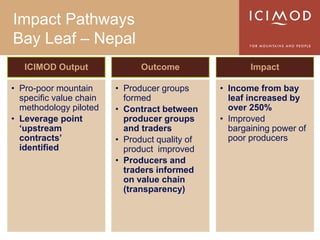
Impact Pathways
Bay Leaf – Nepal
   ICIMOD Output               Outcome                 Impact

• Pro-poor mountain      • Producer groups      • Income from bay
  specific value chain     formed                 leaf increased by
  methodology piloted    • Contract between       over 250%
• Leverage point           producer groups      • Improved
  ‘upstream                and traders            bargaining power of
  contracts’             • Product quality of     poor producers
  identified               product improved
                         • Producers and
                           traders informed
                           on value chain
                           (transparency)
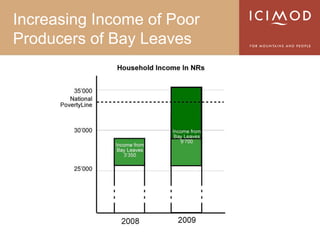
Increasing Income of Poor
Producers of Bay Leaves
Impact Pathways
Bay Leaf – India
   ICIMOD Output               Outcome                 Impact

• Pro-poor mountain      • Pilot model for      • Improved
  specific value chain     NTFP policy            marketing and
  methodology piloted      readjustment           payment system
• Leverage point         • Co-management          benefit the poor
  ‘policy’ identified      favoured by NFTP       producers
                           policy makers        • Increased and
                         • Collection permits     secured income for
                           for Bay Leaves         collectors
                           issued               • Sustainable
                         • Rotational mandis      harvesting from wild
                           (markets)            • Government
                           established            investment in up-
                                                  scaling to other
                                                  NTFPs
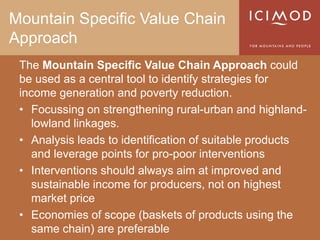
Mountain Specific Value Chain
Approach
 The Mountain Specific Value Chain Approach could
 be used as a central tool to identify strategies for
 income generation and poverty reduction.
 • Focussing on strengthening rural-urban and highland-
    lowland linkages.
 • Analysis leads to identification of suitable products
    and leverage points for pro-poor interventions
 • Interventions should always aim at improved and
    sustainable income for producers, not on highest
    market price
 • Economies of scope (baskets of products using the
    same chain) are preferable
Publication


              ICIMOD, 2010

              Books online
Thank you

A Specific Value Chain Framework for Mountain Products in a Globalised Market [Michael Kollmair]

  • 1.
    A Specific ValueChain Framework for Mountain Products in a Globalised Market Michael Kollmair and Brigitte Hoermann International Centre for Integrated Mountain Development Kathmandu, Nepal
  • 2.
    Introduction • Socioeconomicand environmental change as challenge and opportunity for mountain people • Mountain products an important highland-lowland and rural-urban linkage • VC approach as an international development tool (wall-to-wall solution) • Adaptation of a global concept to the mountain specifities • Generating economic opportunities for rural livelihoods by using the comparative advantages of mountains
  • 3.
    Key Features ofMountain Value Chains • Long value chains (often transboundary) • Many traders, middlemen • High diversity, but small quantities of products • Mainly raw material supply • Inadequate infrastructure and policies
  • 4.
  • 5.
    Mountains Specifities Accessibility, Fragility, Marginality, Diversity Mountain Specifities Mountain Specifities Generic Value Chain Approach Unique niche products and services
  • 6.
    Selection of Productsand Services Uniqueness Niche Markets Mountain Specific Challenges
  • 7.
    High Value Productsand Services Comparative Advantages: • Highly diverse resource base in the mountains • Traditional knowledge is available • Less competition with plain areas • High demand for products and services in emerging markets
  • 8.
  • 9.
    ICIMOD’s Regional VCpilots • Close to 20 pilots and partners • Almost all HKH covered • From agriculture, NTFP to service sector • Focus cross-border VCs and comparison same product but from different RMC
  • 10.
    Case Study: BayLeaf Cinnamomum tamala Bay leaf – Indian Laurel – Tej Pat • An indigenous medium size tree growing between 500 and 2500m • Dried leaves used widely as a spice in South Asia • Oil extract commonly used in traditional medicines • Among the top 10 species traded between Himalayas and lowland
  • 11.
  • 12.
    Impact Pathways Bay Leaf– Nepal ICIMOD Output Outcome Impact • Pro-poor mountain • Producer groups • Income from bay specific value chain formed leaf increased by methodology piloted • Contract between over 250% • Leverage point producer groups • Improved ‘upstream and traders bargaining power of contracts’ • Product quality of poor producers identified product improved • Producers and traders informed on value chain (transparency)
  • 13.
    Increasing Income ofPoor Producers of Bay Leaves
  • 14.
    Impact Pathways Bay Leaf– India ICIMOD Output Outcome Impact • Pro-poor mountain • Pilot model for • Improved specific value chain NTFP policy marketing and methodology piloted readjustment payment system • Leverage point • Co-management benefit the poor ‘policy’ identified favoured by NFTP producers policy makers • Increased and • Collection permits secured income for for Bay Leaves collectors issued • Sustainable • Rotational mandis harvesting from wild (markets) • Government established investment in up- scaling to other NTFPs
  • 15.
    Mountain Specific ValueChain Approach The Mountain Specific Value Chain Approach could be used as a central tool to identify strategies for income generation and poverty reduction. • Focussing on strengthening rural-urban and highland- lowland linkages. • Analysis leads to identification of suitable products and leverage points for pro-poor interventions • Interventions should always aim at improved and sustainable income for producers, not on highest market price • Economies of scope (baskets of products using the same chain) are preferable
  • 16.
    Publication ICIMOD, 2010 Books online
  • 17.