MODULE 4
MORAL CHARACTER
DEVELOPMENT AND
DISPOSITION
OBJECTIVES
Define the moments of the moral formation.
Interpret the relationship between individual acts and character.
Recognize the stages of moral development.
Analyze feelings and personal and moral experiences.
Determine the reasonable and emotional responses.
Develop a process of moral decision-making.
Develop a sense of accountability on each moral decision.
2
What Is Moral Development?
deals with the way we identify right and wrong as we
grow up and go through adulthood. It encompasses
our religious and ethical values, and it influences our
behavior and sense of social responsibility.
3
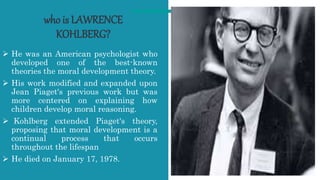
who is LAWRENCE
KOHLBERG?
 He was an American psychologist who
developed one of the best-known
theories the moral development theory.
 His work modified and expanded upon
Jean Piaget's previous work but was
more centered on explaining how
children develop moral reasoning.
 Kohlberg extended Piaget's theory,
proposing that moral development is a
continual process that occurs
throughout the lifespan
 He died on January 17, 1978.
4
KOHlBERG’S THEORY
First systematic theory based on
empirical research was
introduced by Lawrence
Kohlberg (1969). Kohlberg’s
theory is regarded as a
rationalist theory since it
assumes that the main
determinant of moral judgment
is rational thinking processes,
even though it is thought that
emotional or intuitive processes
are also involved – at least in
part – in moral judgment.
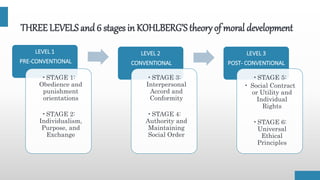
THREE LEVELS and6 stages in KOHLBERG’S theory of moral development
LEVEL 1
PRE-CONVENTIONAL
•STAGE 1:
Obedience and
punishment
orientations
•STAGE 2:
Individualism,
Purpose, and
Exchange
LEVEL 2
CONVENTIONAL
•STAGE 3:
Interpersonal
Accord and
Conformity
•STAGE 4:
Authority and
Maintaining
Social Order
LEVEL 3
POST- CONVENTIONAL
•STAGE 5:
• Social Contract
or Utility and
Individual
Rights
•STAGE 6:
Universal
Ethical
Principles
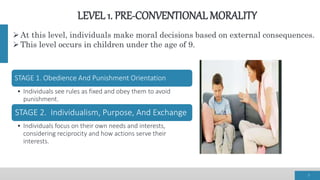
LEVEL 1. PRE-CONVENTIONAL MORALITY
STAGE 1. Obedience And Punishment Orientation
• Individuals see rules as fixed and obey them to avoid
punishment.
STAGE 2. Individualism, Purpose, And Exchange
• Individuals focus on their own needs and interests,
considering reciprocity and how actions serve their
interests.
7
At this level, individuals make moral decisions based on external consequences.
This level occurs in children under the age of 9.
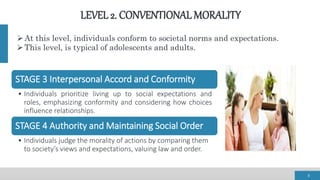
LEVEL 2. CONVENTIONAL MORALITY
STAGE 3 Interpersonal Accord and Conformity
• Individuals prioritize living up to social expectations and
roles, emphasizing conformity and considering how choices
influence relationships.
STAGE 4 Authority and Maintaining Social Order
• Individuals judge the morality of actions by comparing them
to society’s views and expectations, valuing law and order.
8
At this level, individuals conform to societal norms and expectations.
This level, is typical of adolescents and adults.
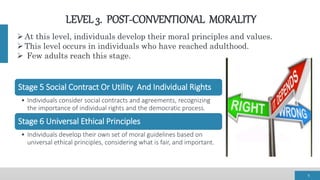
LEVEL 3. POST-CONVENTIONAL MORALITY
Stage 5 Social Contract Or Utility And Individual Rights
• Individuals consider social contracts and agreements, recognizing
the importance of individual rights and the democratic process.
Stage 6 Universal Ethical Principles
• Individuals develop their own set of moral guidelines based on
universal ethical principles, considering what is fair, and important.
9
At this level, individuals develop their moral principles and values.
This level occurs in individuals who have reached adulthood.
 Few adults reach this stage.
How Did Kohlberg Develop His Theory of Moral Development?
• Kohlberg developed a theory of moral development by
asking boys between the ages of 10 and 16 to resolve a set
of moral dilemmas. One of his most famous experiments
involved presenting moral dilemmas to people, specifically
the Heinz Dilemma.
• Kohlberg was not interested so much in the answer to
whether Heinz was wrong or right but in the reasoning for
each participant's decision. He then classified their
reasoning into the stages of his theory of moral
development.
10
HEINZ DILEMMA
11
A woman was near death from a unique kind of
cancer. There is a drug that might save her. The drug
costs $4,000 per dosage. The sick woman’s husband,
Heinz, went to everyone he knew to borrow the
money and tried every legal means, but he could only
get together about $2,000. He asked the doctor
scientist who discovered the drug for a discount or to
let him pay later. But the doctor and scientist refused.
12
1.Should Heinz break into the
laboratory to steal the drug for his
wife? Why or why not?
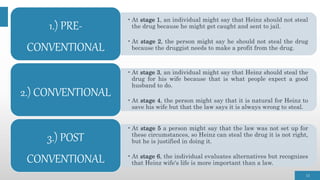
•At stage 1, an individual might say that Heinz should not steal
the drug because he might get caught and sent to jail.
•At stage 2, the person might say he should not steal the drug
because the druggist needs to make a profit from the drug.
1.) PRE-
CONVENTIONAL
•At stage 3, an individual might say that Heinz should steal the
drug for his wife because that is what people expect a good
husband to do.
•At stage 4, the person might say that it is natural for Heinz to
save his wife but that the law says it is always wrong to steal.
2.) CONVENTIONAL
•At stage 5 a person might say that the law was not set up for
these circumstances, so Heinz can steal the drug it is not right,
but he is justified in doing it.
•At stage 6, the individual evaluates alternatives but recognizes
that Heinz wife's life is more important than a law.
3.) POST
CONVENTIONAL
13
EXPLORING MORAL DILEMMAS
IN “NOWHERE”
14
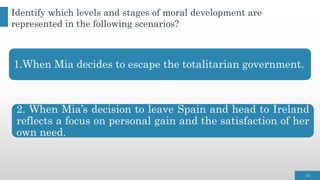
1.When Mia decides to escape the totalitarian government.
2. When Mia’s decision to leave Spain and head to Ireland
reflects a focus on personal gain and the satisfaction of her
own need.
15
Identify which levels and stages of moral development are
represented in the following scenarios?
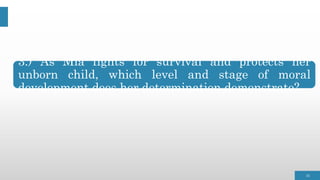
3.) As Mia fights for survival and protects her
unborn child, which level and stage of moral
development does her determination demonstrate?
16
17
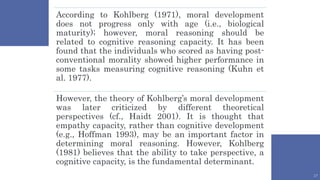
According to Kohlberg (1971), moral development
does not progress only with age (i.e., biological
maturity); however, moral reasoning should be
related to cognitive reasoning capacity. It has been
found that the individuals who scored as having post-
conventional morality showed higher performance in
some tasks measuring cognitive reasoning (Kuhn et
al. 1977).
However, the theory of Kohlberg’s moral development
was later criticized by different theoretical
perspectives (cf., Haidt 2001). It is thought that
empathy capacity, rather than cognitive development
(e.g., Hoffman 1993), may be an important factor in
determining moral reasoning. However, Kohlberg
(1981) believes that the ability to take perspective, a
cognitive capacity, is the fundamental determinant.
CRITICISM OF KOHLBERG’S THEORY
18
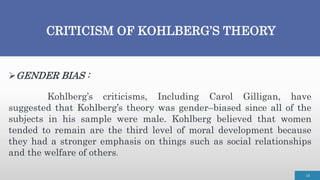
GENDER BIAS :
Kohlberg’s criticisms, Including Carol Gilligan, have
suggested that Kohlberg’s theory was gender–biased since all of the
subjects in his sample were male. Kohlberg believed that women
tended to remain are the third level of moral development because
they had a stronger emphasis on things such as social relationships
and the welfare of others.
CRITICISM OF KOHLBERG’S THEORY
19
CULTURAL BIAS :
Individualist cultures emphasize personal
rights, while collectivist cultures stress the importance
of society and community. Eastern, collectivist
cultures may have different moral outlooks that
Kohlberg’s theory does not take into account.
CRITICISM OF KOHLBERG’S THEORY
20
 MORAL REASONING DOES NOT EQUAL MORAL
BEHAVIOR:
Kohlberg’s theory is concerned with moral
thinking, but there is a big difference between knowing
what we ought to do versus actual actions. Moral
reasoning, therefore, may not lead to moral behavior.
Tracy Latimer, a 12-year-old victim of cerebral palsy, was killed by her father in
1993. Tracy lived with her family on a prairie farm in Saskatchewan, Canada. One
Sunday morning while his wife and other children were at church, Robert Latimer
put Tracy in the cab of his pickup truck and piped in exhaust fumes until she died.
At the time of her death, Tracy weighed less than 40 pounds, and she was described
as “functioning at the mental level of a three-month-old baby.” Mrs. Latimer said
that she was relieved to find Tracy dead when she arrived home. She said that she
“didn’t have the courage” to do it herself.
Robert Latimer was tried for murder, but the judge and jury did not want to treat
him harshly. The jury found him guilty of only second-degree murder and
recommended that the judge ignore the mandatory 10-year sentence. The judge
agreed and sentenced him to one year in prison, followed by a year of confinement to
his farm. However, the Supreme Court of Canada stepped in and ruled that the
mandatory sentence must be imposed. Robert Latimer entered prison in 2001 and
was paroled in 2008. Legal questions aside, did Mr. Latimer do anything wrong?
This case involves many of the issues that we saw in the other cases. One argument
is that Tracy’s life was morally precious, and so her father had no right to kill her. In
his defense, it may be said that Tracy’s condition was so catastrophic that she had
no prospects of a “life” in any but a biological sense. Her existence consisted of
pointless suffering, and so killing her was an act of mercy. Considering those
arguments, it appears that Robert Latimer acted defensibly. His critics, however,
made other points.
21
Case Study
Questions:
1. Was Robert Latimer given a lenient
sentence by the trial court? Support your
answer.
Yes, initially the trial court gave Robert
Latimer a lenient sentence of one year in
prison followed by a year of confinement to
his farm. However, the Supreme Court of
Canada intervened and ruled that the
mandatory 10-year sentence must be
imposed.
2. What reasons or arguments can be given
for the following:
a.) The wrongness of killing
Killing is generally considered wrong
because it violates the fundamental value of
human life. Society believes in the sanctity
of life and that it should be protected.
Taking someone's life is seen as a violation
of this principle
b. ) The wrongness of discriminating
against the handicapped.
Discriminating against the handicapped is
considered wrong because it goes against
the principles of equality and fairness.
Every individual, regardless of their
abilities or disabilities, deserves to be
treated with dignity and respect.
Discrimination based on disability
undermines these principles and can lead to
marginalization and inequality.
QUIZ
4.) Deals with the way we identify right and wrong as we grow up
and go through adulthood.
23
5.) Kohlberg extended _________theory, proposing that moral
development is a continual process that occurs throughout
the lifespan.
1-3 )Give the 3 criticisms of Kohlberg’s theory
6.) At this level, individuals develop their moral principles
and values.
QUIZ
8.) At this level, individuals make moral decisions based on external
consequences.
24
9-14.). What are the 6 stages of Kohlberg’s theories? Write it down in
chronological order.
15.)The first systematic theory based on empirical research was
introduced by?
7.)At this level, individuals conform to societal norms and
expectations.
ANSWERS
25
1-3.)Gender Bias, Cultural Bias, And Moral Reasoning Does Not Equal Moral
Behavior
4.) Moral Development
5.) Piaget’s
6.) Post-Conventional Morality
7.) Conventional Morality
8.) Pre – Conventional Morality
9-14.)STAGE 1: Obedience and punishment orientations
STAGE 2: Individualism, Purpose, and Exchange
STAGE 3:Interpersonal Accord and Conformity
STAGE 4:Authority and Maintaining Social Order
STAGE 5:Social Contract or Utility and Individual Rights
STAGE 6: Universal Ethical Principles
15.) Kohlberg’s
THANK YOU!!!

KOHLBERG THEORY-ETHICS-MODULE-4-PPT-.pptx

  • 1.
  • 2.
    OBJECTIVES Define the momentsof the moral formation. Interpret the relationship between individual acts and character. Recognize the stages of moral development. Analyze feelings and personal and moral experiences. Determine the reasonable and emotional responses. Develop a process of moral decision-making. Develop a sense of accountability on each moral decision. 2
  • 3.
    What Is MoralDevelopment? deals with the way we identify right and wrong as we grow up and go through adulthood. It encompasses our religious and ethical values, and it influences our behavior and sense of social responsibility. 3
  • 4.
    who is LAWRENCE KOHLBERG? He was an American psychologist who developed one of the best-known theories the moral development theory.  His work modified and expanded upon Jean Piaget's previous work but was more centered on explaining how children develop moral reasoning.  Kohlberg extended Piaget's theory, proposing that moral development is a continual process that occurs throughout the lifespan  He died on January 17, 1978. 4
  • 5.
    KOHlBERG’S THEORY First systematictheory based on empirical research was introduced by Lawrence Kohlberg (1969). Kohlberg’s theory is regarded as a rationalist theory since it assumes that the main determinant of moral judgment is rational thinking processes, even though it is thought that emotional or intuitive processes are also involved – at least in part – in moral judgment.
  • 6.
    THREE LEVELS and6stages in KOHLBERG’S theory of moral development LEVEL 1 PRE-CONVENTIONAL •STAGE 1: Obedience and punishment orientations •STAGE 2: Individualism, Purpose, and Exchange LEVEL 2 CONVENTIONAL •STAGE 3: Interpersonal Accord and Conformity •STAGE 4: Authority and Maintaining Social Order LEVEL 3 POST- CONVENTIONAL •STAGE 5: • Social Contract or Utility and Individual Rights •STAGE 6: Universal Ethical Principles
  • 7.
    LEVEL 1. PRE-CONVENTIONALMORALITY STAGE 1. Obedience And Punishment Orientation • Individuals see rules as fixed and obey them to avoid punishment. STAGE 2. Individualism, Purpose, And Exchange • Individuals focus on their own needs and interests, considering reciprocity and how actions serve their interests. 7 At this level, individuals make moral decisions based on external consequences. This level occurs in children under the age of 9.
  • 8.
    LEVEL 2. CONVENTIONALMORALITY STAGE 3 Interpersonal Accord and Conformity • Individuals prioritize living up to social expectations and roles, emphasizing conformity and considering how choices influence relationships. STAGE 4 Authority and Maintaining Social Order • Individuals judge the morality of actions by comparing them to society’s views and expectations, valuing law and order. 8 At this level, individuals conform to societal norms and expectations. This level, is typical of adolescents and adults.
  • 9.
    LEVEL 3. POST-CONVENTIONALMORALITY Stage 5 Social Contract Or Utility And Individual Rights • Individuals consider social contracts and agreements, recognizing the importance of individual rights and the democratic process. Stage 6 Universal Ethical Principles • Individuals develop their own set of moral guidelines based on universal ethical principles, considering what is fair, and important. 9 At this level, individuals develop their moral principles and values. This level occurs in individuals who have reached adulthood.  Few adults reach this stage.
  • 10.
    How Did KohlbergDevelop His Theory of Moral Development? • Kohlberg developed a theory of moral development by asking boys between the ages of 10 and 16 to resolve a set of moral dilemmas. One of his most famous experiments involved presenting moral dilemmas to people, specifically the Heinz Dilemma. • Kohlberg was not interested so much in the answer to whether Heinz was wrong or right but in the reasoning for each participant's decision. He then classified their reasoning into the stages of his theory of moral development. 10
  • 11.
    HEINZ DILEMMA 11 A womanwas near death from a unique kind of cancer. There is a drug that might save her. The drug costs $4,000 per dosage. The sick woman’s husband, Heinz, went to everyone he knew to borrow the money and tried every legal means, but he could only get together about $2,000. He asked the doctor scientist who discovered the drug for a discount or to let him pay later. But the doctor and scientist refused.
  • 12.
    12 1.Should Heinz breakinto the laboratory to steal the drug for his wife? Why or why not?
  • 13.
    •At stage 1,an individual might say that Heinz should not steal the drug because he might get caught and sent to jail. •At stage 2, the person might say he should not steal the drug because the druggist needs to make a profit from the drug. 1.) PRE- CONVENTIONAL •At stage 3, an individual might say that Heinz should steal the drug for his wife because that is what people expect a good husband to do. •At stage 4, the person might say that it is natural for Heinz to save his wife but that the law says it is always wrong to steal. 2.) CONVENTIONAL •At stage 5 a person might say that the law was not set up for these circumstances, so Heinz can steal the drug it is not right, but he is justified in doing it. •At stage 6, the individual evaluates alternatives but recognizes that Heinz wife's life is more important than a law. 3.) POST CONVENTIONAL 13
  • 14.
  • 15.
    1.When Mia decidesto escape the totalitarian government. 2. When Mia’s decision to leave Spain and head to Ireland reflects a focus on personal gain and the satisfaction of her own need. 15 Identify which levels and stages of moral development are represented in the following scenarios?
  • 16.
    3.) As Miafights for survival and protects her unborn child, which level and stage of moral development does her determination demonstrate? 16
  • 17.
    17 According to Kohlberg(1971), moral development does not progress only with age (i.e., biological maturity); however, moral reasoning should be related to cognitive reasoning capacity. It has been found that the individuals who scored as having post- conventional morality showed higher performance in some tasks measuring cognitive reasoning (Kuhn et al. 1977). However, the theory of Kohlberg’s moral development was later criticized by different theoretical perspectives (cf., Haidt 2001). It is thought that empathy capacity, rather than cognitive development (e.g., Hoffman 1993), may be an important factor in determining moral reasoning. However, Kohlberg (1981) believes that the ability to take perspective, a cognitive capacity, is the fundamental determinant.
  • 18.
    CRITICISM OF KOHLBERG’STHEORY 18 GENDER BIAS : Kohlberg’s criticisms, Including Carol Gilligan, have suggested that Kohlberg’s theory was gender–biased since all of the subjects in his sample were male. Kohlberg believed that women tended to remain are the third level of moral development because they had a stronger emphasis on things such as social relationships and the welfare of others.
  • 19.
    CRITICISM OF KOHLBERG’STHEORY 19 CULTURAL BIAS : Individualist cultures emphasize personal rights, while collectivist cultures stress the importance of society and community. Eastern, collectivist cultures may have different moral outlooks that Kohlberg’s theory does not take into account.
  • 20.
    CRITICISM OF KOHLBERG’STHEORY 20  MORAL REASONING DOES NOT EQUAL MORAL BEHAVIOR: Kohlberg’s theory is concerned with moral thinking, but there is a big difference between knowing what we ought to do versus actual actions. Moral reasoning, therefore, may not lead to moral behavior.
  • 21.
    Tracy Latimer, a12-year-old victim of cerebral palsy, was killed by her father in 1993. Tracy lived with her family on a prairie farm in Saskatchewan, Canada. One Sunday morning while his wife and other children were at church, Robert Latimer put Tracy in the cab of his pickup truck and piped in exhaust fumes until she died. At the time of her death, Tracy weighed less than 40 pounds, and she was described as “functioning at the mental level of a three-month-old baby.” Mrs. Latimer said that she was relieved to find Tracy dead when she arrived home. She said that she “didn’t have the courage” to do it herself. Robert Latimer was tried for murder, but the judge and jury did not want to treat him harshly. The jury found him guilty of only second-degree murder and recommended that the judge ignore the mandatory 10-year sentence. The judge agreed and sentenced him to one year in prison, followed by a year of confinement to his farm. However, the Supreme Court of Canada stepped in and ruled that the mandatory sentence must be imposed. Robert Latimer entered prison in 2001 and was paroled in 2008. Legal questions aside, did Mr. Latimer do anything wrong? This case involves many of the issues that we saw in the other cases. One argument is that Tracy’s life was morally precious, and so her father had no right to kill her. In his defense, it may be said that Tracy’s condition was so catastrophic that she had no prospects of a “life” in any but a biological sense. Her existence consisted of pointless suffering, and so killing her was an act of mercy. Considering those arguments, it appears that Robert Latimer acted defensibly. His critics, however, made other points. 21 Case Study
  • 22.
    Questions: 1. Was RobertLatimer given a lenient sentence by the trial court? Support your answer. Yes, initially the trial court gave Robert Latimer a lenient sentence of one year in prison followed by a year of confinement to his farm. However, the Supreme Court of Canada intervened and ruled that the mandatory 10-year sentence must be imposed. 2. What reasons or arguments can be given for the following: a.) The wrongness of killing Killing is generally considered wrong because it violates the fundamental value of human life. Society believes in the sanctity of life and that it should be protected. Taking someone's life is seen as a violation of this principle b. ) The wrongness of discriminating against the handicapped. Discriminating against the handicapped is considered wrong because it goes against the principles of equality and fairness. Every individual, regardless of their abilities or disabilities, deserves to be treated with dignity and respect. Discrimination based on disability undermines these principles and can lead to marginalization and inequality.
  • 23.
    QUIZ 4.) Deals withthe way we identify right and wrong as we grow up and go through adulthood. 23 5.) Kohlberg extended _________theory, proposing that moral development is a continual process that occurs throughout the lifespan. 1-3 )Give the 3 criticisms of Kohlberg’s theory 6.) At this level, individuals develop their moral principles and values.
  • 24.
    QUIZ 8.) At thislevel, individuals make moral decisions based on external consequences. 24 9-14.). What are the 6 stages of Kohlberg’s theories? Write it down in chronological order. 15.)The first systematic theory based on empirical research was introduced by? 7.)At this level, individuals conform to societal norms and expectations.
  • 25.
    ANSWERS 25 1-3.)Gender Bias, CulturalBias, And Moral Reasoning Does Not Equal Moral Behavior 4.) Moral Development 5.) Piaget’s 6.) Post-Conventional Morality 7.) Conventional Morality 8.) Pre – Conventional Morality 9-14.)STAGE 1: Obedience and punishment orientations STAGE 2: Individualism, Purpose, and Exchange STAGE 3:Interpersonal Accord and Conformity STAGE 4:Authority and Maintaining Social Order STAGE 5:Social Contract or Utility and Individual Rights STAGE 6: Universal Ethical Principles 15.) Kohlberg’s
  • 26.