Knowing Letter Names
Letter Naming Research Letter naming is a strong predictor of phonics acquisition and reading fluency. Letter naming shows common ground among languages. Knowing letter names accurately and fluently explain variance in letter reading ability. Knowing letter  names  is a better predictor of later reading than knowing letter  sounds  because learning letter names helps children acquire letter sounds since many letter names contain the letter sounds (Share, 2004; Treiman, Tincoff, Rodriguez, Mousaki, & Francis, 1998).
Letter Naming – Teaching and Learning Research has shown that learning letter names can be facilitated in a variety of ways (Justice,Pence, Bowles & Wiggins, 2006) Letters that occur in children’s names Alphabetical order Letter frequency effect Explicit handwriting instruction
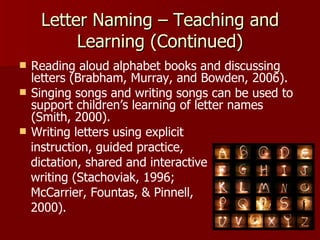
Letter Naming – Teaching and Learning (Continued) Reading aloud alphabet books and discussing letters (Brabham, Murray, and Bowden, 2006). Singing songs and writing songs can be used to support children’s learning of letter names (Smith, 2000). Writing letters using explicit  instruction, guided practice,  dictation, shared and interactive  writing (Stachoviak, 1996;  McCarrier, Fountas, & Pinnell,  2000).
Learning Letter Names Using children’s names.
Learning Letter Names Class names BINGO Using children’s names Jump Rope Rhymes My name is ____________________ My friend’s name is ______________ We come from ________________ And we sell ___________________
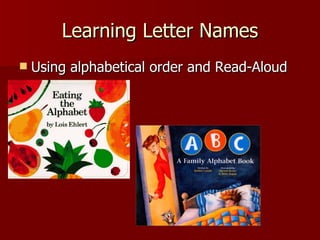
Learning Letter Names Using alphabetical order and Read-Aloud
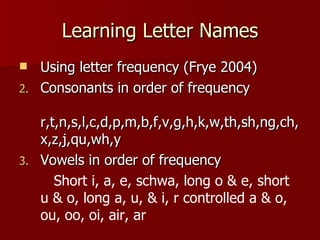
Learning Letter Names Using letter frequency (Frye 2004) Consonants in order of frequency r,t,n,s,l,c,d,p,m,b,f,v,g,h,k,w,th,sh,ng,ch,x,z,j,qu,wh,y Vowels in order of frequency   Short i, a, e, schwa, long o & e, short u & o, long a, u, & i, r controlled a & o, ou, oo, oi, air, ar
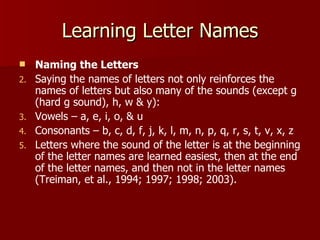
Learning Letter Names Naming the Letters Saying the names of letters not only reinforces the names of letters but also many of the sounds (except g (hard g sound), h, w & y): Vowels – a, e, i, o, & u Consonants – b, c, d, f, j, k, l, m, n, p, q, r, s, t, v, x, z Letters where the sound of the letter is at the beginning of the letter names are learned easiest, then at the end of the letter names, and then not in the letter names (Treiman, et al., 1994; 1997; 1998; 2003).
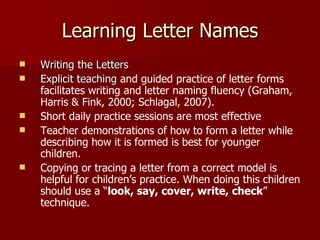
Learning Letter Names Writing the Letters Explicit teaching  and guided practice of letter forms facilitates writing and letter naming fluency (Graham, Harris & Fink, 2000; Schlagal, 2007). Short daily practice sessions are most effective Teacher demonstrations of how to form a letter while describing how it is formed is best for younger children. Copying or tracing a letter from a correct model is helpful for children’s practice. When doing this children should use a “ look, say, cover, write, check ” technique.
Learning Letter Names Writing the letters Explicit teaching and guided practice of letter forms facilitates writing and letter naming fluency (Graham, Harris & Fink, 2000; Schlagal, 2007). Using pictographs in story or song based instruction for introducing letters such as is found in the British  Letterland  approach is helpful.
Learning Letter Names Play “I Spy with My Little Eye” Teacher lays out multiple children’s books on the floor or table. Teacher says: “I spy with my little eye the letter ‘e’.” The student must find a letter “e” on any of the book covers provided.
Learning Letter Names Practicing letter dictation Teacher should dictate random letters (both upper and lower case) Student has 10 seconds to write that letter on his/her markerboard Decrease time as the students progress.
Learning Letter Names An action research project on the “Letter a Day” approach… 4 schools in a Reading First School District matched on Demographics and Achievement levels 95 100 % poverty 75% second language learners Inner city setting  95% diversity Low achieving
Learning Letter Names An action research project on the “Letter a Day Approach” continued… 3 schools changed to a letter a day format including lowest school of the 4 1 school remained unchanged  with a letter a week Results after a year?
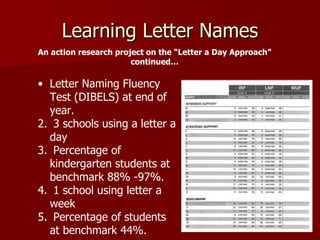
Learning Letter Names An action research project on the “Letter a Day Approach” continued… Letter Naming Fluency Test (DIBELS) at end of year. 3 schools using a letter a day Percentage of kindergarten students at benchmark 88% -97%. 1 school using letter a week Percentage of students at benchmark 44%.
D. Ray Reutzel, Ph.D. Emma Eccles Jones Endowed Chair Professor Utah State University
DIBELS for Letter Naming Dynamic Indicators of Basic Early Literacy Skills
Why is DIBELS important? Studies show that the later a reading deficiency is identified, the harder it is to catch the student up. DIBELS tests students as early as Kindergarten for these deficiencies.
DIBLES Background Information DIBELS was developed by Dr. Roland Good III and Dr. Ruth Kaminski.  It measures the five critical areas of literacy indicated by the National Reading Panel (2000) and the National Research Council (1998). Word Usage Vocabulary Retell Comprehension Letter Naming Oral Reading Fluency Nonsense Word Phonics Initial Sound Phoneme Segmentation Phonemic Awareness DIBELS Assessment/Fluencies National Reading Panel and Reading First Five Critical Areas of Early Reading Skills

Knowing letter names

  • 1.
  • 2.
    Letter Naming ResearchLetter naming is a strong predictor of phonics acquisition and reading fluency. Letter naming shows common ground among languages. Knowing letter names accurately and fluently explain variance in letter reading ability. Knowing letter names is a better predictor of later reading than knowing letter sounds because learning letter names helps children acquire letter sounds since many letter names contain the letter sounds (Share, 2004; Treiman, Tincoff, Rodriguez, Mousaki, & Francis, 1998).
  • 3.
    Letter Naming –Teaching and Learning Research has shown that learning letter names can be facilitated in a variety of ways (Justice,Pence, Bowles & Wiggins, 2006) Letters that occur in children’s names Alphabetical order Letter frequency effect Explicit handwriting instruction
  • 4.
    Letter Naming –Teaching and Learning (Continued) Reading aloud alphabet books and discussing letters (Brabham, Murray, and Bowden, 2006). Singing songs and writing songs can be used to support children’s learning of letter names (Smith, 2000). Writing letters using explicit instruction, guided practice, dictation, shared and interactive writing (Stachoviak, 1996; McCarrier, Fountas, & Pinnell, 2000).
  • 5.
    Learning Letter NamesUsing children’s names.
  • 6.
    Learning Letter NamesClass names BINGO Using children’s names Jump Rope Rhymes My name is ____________________ My friend’s name is ______________ We come from ________________ And we sell ___________________
  • 7.
    Learning Letter NamesUsing alphabetical order and Read-Aloud
  • 8.
    Learning Letter NamesUsing letter frequency (Frye 2004) Consonants in order of frequency r,t,n,s,l,c,d,p,m,b,f,v,g,h,k,w,th,sh,ng,ch,x,z,j,qu,wh,y Vowels in order of frequency Short i, a, e, schwa, long o & e, short u & o, long a, u, & i, r controlled a & o, ou, oo, oi, air, ar
  • 9.
    Learning Letter NamesNaming the Letters Saying the names of letters not only reinforces the names of letters but also many of the sounds (except g (hard g sound), h, w & y): Vowels – a, e, i, o, & u Consonants – b, c, d, f, j, k, l, m, n, p, q, r, s, t, v, x, z Letters where the sound of the letter is at the beginning of the letter names are learned easiest, then at the end of the letter names, and then not in the letter names (Treiman, et al., 1994; 1997; 1998; 2003).
  • 10.
    Learning Letter NamesWriting the Letters Explicit teaching and guided practice of letter forms facilitates writing and letter naming fluency (Graham, Harris & Fink, 2000; Schlagal, 2007). Short daily practice sessions are most effective Teacher demonstrations of how to form a letter while describing how it is formed is best for younger children. Copying or tracing a letter from a correct model is helpful for children’s practice. When doing this children should use a “ look, say, cover, write, check ” technique.
  • 11.
    Learning Letter NamesWriting the letters Explicit teaching and guided practice of letter forms facilitates writing and letter naming fluency (Graham, Harris & Fink, 2000; Schlagal, 2007). Using pictographs in story or song based instruction for introducing letters such as is found in the British Letterland approach is helpful.
  • 12.
    Learning Letter NamesPlay “I Spy with My Little Eye” Teacher lays out multiple children’s books on the floor or table. Teacher says: “I spy with my little eye the letter ‘e’.” The student must find a letter “e” on any of the book covers provided.
  • 13.
    Learning Letter NamesPracticing letter dictation Teacher should dictate random letters (both upper and lower case) Student has 10 seconds to write that letter on his/her markerboard Decrease time as the students progress.
  • 14.
    Learning Letter NamesAn action research project on the “Letter a Day” approach… 4 schools in a Reading First School District matched on Demographics and Achievement levels 95 100 % poverty 75% second language learners Inner city setting 95% diversity Low achieving
  • 15.
    Learning Letter NamesAn action research project on the “Letter a Day Approach” continued… 3 schools changed to a letter a day format including lowest school of the 4 1 school remained unchanged with a letter a week Results after a year?
  • 16.
    Learning Letter NamesAn action research project on the “Letter a Day Approach” continued… Letter Naming Fluency Test (DIBELS) at end of year. 3 schools using a letter a day Percentage of kindergarten students at benchmark 88% -97%. 1 school using letter a week Percentage of students at benchmark 44%.
  • 17.
    D. Ray Reutzel,Ph.D. Emma Eccles Jones Endowed Chair Professor Utah State University
  • 18.
    DIBELS for LetterNaming Dynamic Indicators of Basic Early Literacy Skills
  • 19.
    Why is DIBELSimportant? Studies show that the later a reading deficiency is identified, the harder it is to catch the student up. DIBELS tests students as early as Kindergarten for these deficiencies.
  • 20.
    DIBLES Background InformationDIBELS was developed by Dr. Roland Good III and Dr. Ruth Kaminski. It measures the five critical areas of literacy indicated by the National Reading Panel (2000) and the National Research Council (1998). Word Usage Vocabulary Retell Comprehension Letter Naming Oral Reading Fluency Nonsense Word Phonics Initial Sound Phoneme Segmentation Phonemic Awareness DIBELS Assessment/Fluencies National Reading Panel and Reading First Five Critical Areas of Early Reading Skills